Job Opening: Capacity Building Liaison Officer |
|
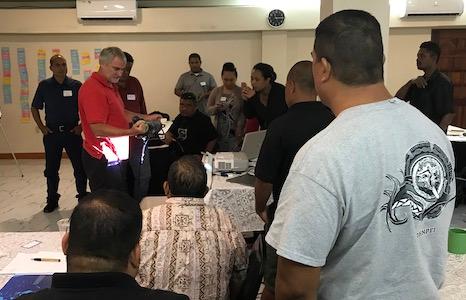
The Micronesia Conservation Trust and PacIOOS are seeking applications to fill a new position, for a Capacity Building Liaison Officer. Based on the island of Pohnpei, Federated States of Micronesia, the candidate will be responsible to help build ocean observing capacity across Micronesia by training communities and interested agencies in the collection and analysis of oceanographic data. This position is addressing the need to have a dedicated water quality and physical oceanography outreach and capacity building specialist within the Micronesia Conservation Trust to support science-based management of natural resources, especially as it relates to climate change and conservation. Find out more details and how to apply. The application period ends August 13, 2021. [Photo: Capacity building workshop participants learn about nearshore sensors during a hands-on demonstration. Credit. PacIOOS] |
|
Funding to Assess Ocean Acidification Vulnerability in Hawai‘i |
|
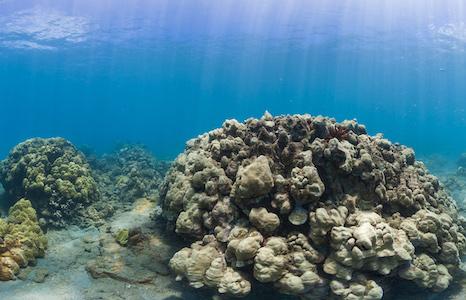
NOAA's Ocean Acidification Program awarded a multi-disciplinary team of researchers with $1 million in grant funding to Assess Current and Future Ocean Acidification and Climate Vulnerabilities Along the Hawaiian Archipelago. Dr. Christopher Sabine, School of Ocean and Earth Science and Technology ( SOEST) Associate Dean for Research and Professor in the Department of Oceanography, serves as the lead Principal Investigator. PacIOOS co-investigator Dr. Brian Powell and PacIOOS Researcher Dr. Tobias Friedrich will support the assessment by combining state-of-the-art climate, regional, and coral reef ecosystem models to produce projections of the frequency, duration, spatial variability and severity of ocean acidification related stress in the Hawaiian Islands for the period 2020-2070. Data and synthesis results from this 3-year project will be made available through PacIOOS’ data services. [Photo: Coral head at Hanauma Bay, O‘ahu. Credit: Catlin Seaview] |
|
Heads Up: Server Downtime in August |
|
PacIOOS’ data management team is currently in the process of preparing a major hardware move, which will lead to a temporary disruption in service. This will affect all of PacIOOS online data access, including the website, Voyager, and data servers. We are currently anticipating some downtime around August 8-10, 2021. The exact timing still needs to be determined. Notices will be posted online with the most recent information. If you have questions or concerns, please contact us at info@pacioos.org. |
|
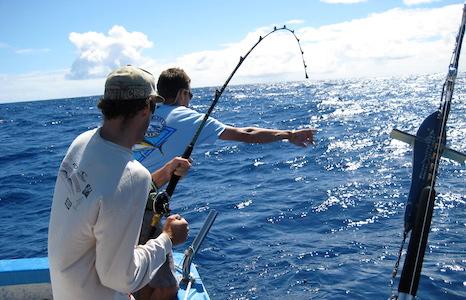
Last year, PacIOOS along with other IOOS Regional Associations and the IOOS Association launched a survey to get a better understanding of the economic value that our coastal and ocean observing data and products have to our users. The Center for the Blue Economy of the Middlebury Institute of International Studies at Monterey is now in the final stages of completing the analysis, and we are seeking additional respondents for more robust results. If you can spare 5 minutes, we would appreciate it if you could fill out this quick survey. Many thanks to those of you who have already participated -- no need to resubmit! [Photo: Recreational fishing in the Hawaiian Islands. Credit: Dave Itano] |
|
Adopt & Respond to Rising Seas |
|
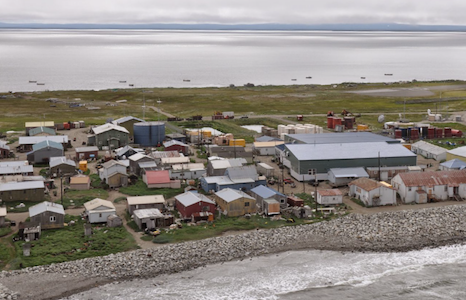
In a special issue of the Environment Coastal & Offshore (ECO) Magazine, Rising Seas, three regional associations of the U.S. Integrated Ocean Observing System ( IOOS) contributed to the article Helping Coastal Communities Adapt & Respond to Rising Seas. The Alaska Ocean Observing System ( AOOS), Southeast Coastal Ocean Observing Regional Association ( SECOORA), and PacIOOS share how ocean observing enhances community resilience. While AOOS' and SECOORA' efforts focus on increasing the number of water level stations, PacIOOS has helped to increase preparedness by developing wave run-up forecasts for the Marshall Islands and other parts of the region. [Photo: The Native Village of Shishmaref is located on Sarichef Island, in the Chukchi Sea, just north of the Bering Strait. Increased coastal erosion from sea level rise and reduced shorefast ice has been threatening village structures for several years. Credit: AOOS] |
|
Hawai‘i Wai Ola Water Quality Monitoring |
|
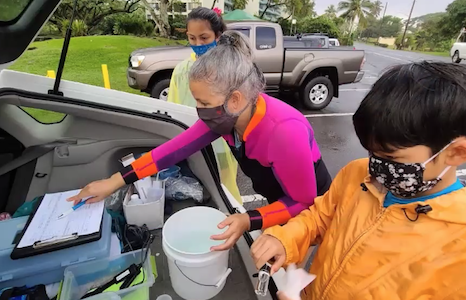
Comprised of community member volunteers, scientists, government, and non-government organizations, Hawai‘i Wai Ola strives to improve Hawai‘i Island's coastal water quality through science, communication and collaboration to accelerate positive change. Hawai‘i Wai Ola has formed a network of community scientists to regularly measure coastal water quality. The water samples are tested for water temperature, salinity, dissolved oxygen, pH, turbidity, total dissolved nutrients, and enterococcus (a common bacteria indicator used to identify the presence of sewage). Modeled after the Hui O Ka Wai Ola on Maui, Hawai‘i Wai Ola is closely working with the Department of Health Clean Water Branch to establish quality assured monitoring procedures to ensure that data can be utilized by the State. Monitoring efforts are currently focusing on South Kohala, Kona, and Hilo/Hamakua Coast. This summer, volunteer training sessions will be held within these regions to bring new volunteers into the network, with the ultimate goal to sample up to 150 sites to accelerate positive change. [Photo: Following a rigorous sampling protocol, Hui Wai Ola community scientists collect water samples on Hawai‘i Island. Credit: Hawai‘i Wai Ola] |
|
NOAA Student Programs for Minority Serving Institutions |
|
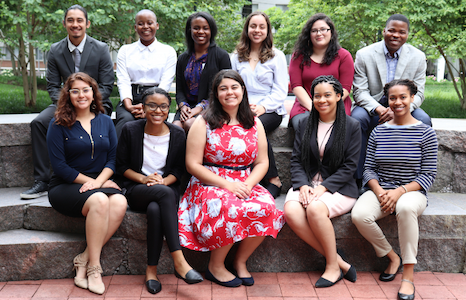
Over 10 years ago, NOAA's Office of Education established the Educational Partnership Program with Minority Serving Institutes ( EPP/MSI) to support the training and graduation of students and to increase participation of students from traditionally underrepresented minority communities. The program aims to develop eligible STEM students in support of a diverse future workforce for NOAA and NOAA mission-related enterprises. The Undergraduate Scholarship Program provides funds up to $45,000 in total support (including travel and conference participation) during the students' junior and senior years. Participants also conduct research at a NOAA facility during two paid summer internships. U.S. citizens and U.S. nationals are eligible to apply. A Department of Education list of Minority Serving Institutions can be found here. The 2022 application period for the Undergraduate Scholarship Program will open on September 1, 2021. Post secondary graduate programs within the EPP/MSI include Cooperative Science Centers and Experiential Research and Training Opportunities. [Photo: The Undergraduate Scholarship Program Class of 2019 gathers at the NOAA headquarters in Silver Spring, Maryland, during scholarship orientation. Credit: NOAA] |
|
Apply for Margaret A. Davidson Fellowship |
|
NOAA's Office for Coastal Management is requesting proposals for the FY2022-2023 Margaret A. Davidson Graduate Fellowship. This program offers graduate students admitted to/or enrolled in a Master’s or Ph.D. program the opportunity to conduct collaborative estuarine research within a National Estuarine Research Reserve (NERR). There will be one fellowship at each of the 29 reserves in the national system. Within the two-year project, fellows will engage with end-users, incorporate multi-disciplinary perspectives, and ensure that outcomes are applicable to local coastal resource management needs and decision-making. NOAA is committed to reaching applicants from minority serving institutions, and to partnering with these universities for collaborative science initiatives and fellowship opportunities within the research reserves. Applications are due December 10th, 2021. [Photo: Fellows closely collaborate with researchers at one of the NERRs. Credit: NOAA] |
|
Developing Skills, Knowledge, and Relationships |
|
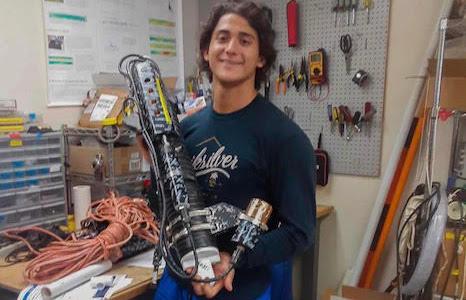
Peter Felicijan is currently a sophomore in the Global Environmental Science ( GES) program at the University of Hawai‘i at Mānoa. Under the mentorship of Professor Dr. Margaret McManus and Gordon Walker, Peter supports the PacIOOS Nearshore Sensor Group as an Oceanographic Technician Lab and Field Assistant. His main responsibilities include snorkeling to recover Sea-Bird nearshore sensors, downloading data, and performing any necessary in lab services or repairs to ensure the data are accurate.
In addition to gaining invaluable field experience, Peter truly appreciates the opportunity to build professional relationships, the camaraderie within the team, and the value of collaboration in environmental studies. Learning about the environmental significance and necessity of ocean observing, Peter's involvement with the Nearshore Sensor Group has sparked ideas for his undergraduate thesis, and has also inspired him to aim for a graduate degree in Physical Oceanography. Outside of work, Peter loves participating in outdoor activities, such as hiking and surfing, while learning how to respect and honor nature through the lens of Hawaiian culture. [Photo: Peter is holding a Sea-Bird sensor in the lab on Mānoa campus. Credit: PacIOOS]
|
|
|
|
|
|
|