|
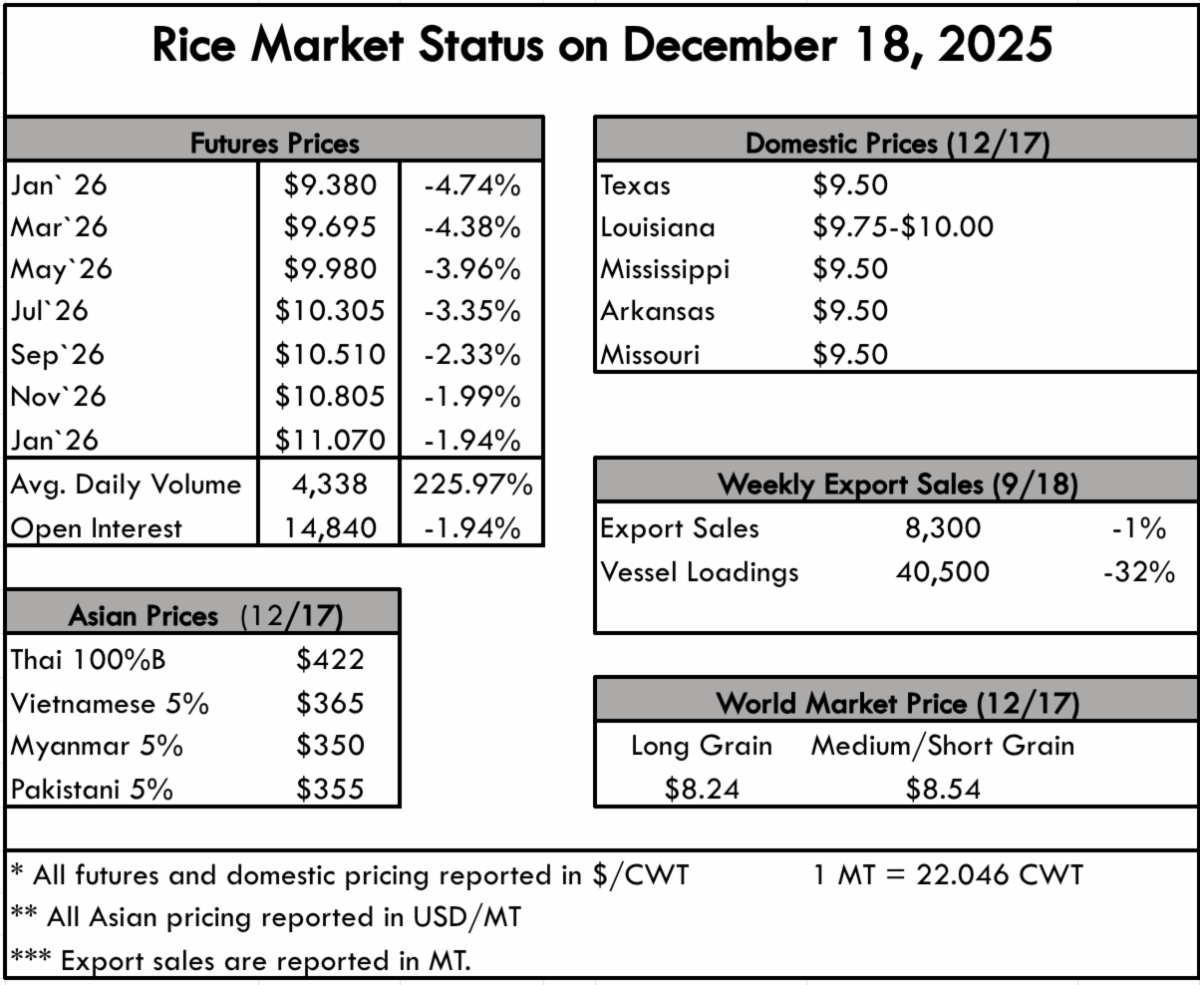
There is finally an Export Sales report that offers updated numbers. Year over year, the real loser is paddy exports, where we are behind nearly 370,000 metric tons. Milled shipments are similar, thanks to strong demand from Iraq and steady Haiti shipments. The paddy export reduction will be addressed later.
The most recent Food and Agriculture Organization Rice Price Update shows their rice price index averaging 98.4 points in October, another 2.5% down from September, and 21.7% below its value last year. Indica declined 3% and is now at its lowest levels since June 2019. Prices in Pakistan are particularly low, where they are fighting against neighboring India, and are in the midst of a decade-low pricing. With Indonesia and the Philippines still largely absent from the market, there is little to provide upward pressure amidst the new crop harvest becoming available.
The story is the same here at home. Prices are bouncing along decade-long bottoms, and the new-crop harvest in South America is reported to hit the first week of January. The crop down there looks “excellent” according to several sources. The problem is that these core markets that have been the lifeblood of U.S. long grain paddy exports are looking at alternate origins because the U.S. quality coming off the river doesn’t meet their minimum quality standards.
Reports of problems are similar in Colombia. The largest tender of the year for the TRQ is scheduled for January 26. While the likelihood of success is good because Colombian acres are down and the Colombian currency makes U.S. rice attractive, there is talk of needing to blend 100% of the U.S. rice with domestic production just to meet basic quality expectations.
The commingling on the river, the lack of consistent varieties, the inability to have good milling yields, the excess chalk, and a myriad of other problems are putting a strangle-hold on the industry’s ability to succeed in an increasingly competitive market. There must be fundamental, structural changes to dig out of this hole and become a reliable supplier of quality rice in the future. Just some of these changes would require identity preservation, reduction of commingling varieties as well as hybrids/conventional varieties, and to reduce the number of varieties available. A smaller number of varieties reduces the standard deviation of differences and will help create a more homogeneous product for the customer. These and related topics are under debate throughout the U.S. rice industry on an informal basis. The situation begs for a strategic planning process involving every aspect of our industry.
The expectation is nearly a 30% reduction of acres; we can only hope the planted acres coordinate by variety, and the industry takes ownership of implementing structural change before it’s too late.
|