The American Society of Le Souvenir Français Inc.
Bulletin Mensuel - Vol. II. No 5 - May 2022
|
|
The crucial role of the
French Navy
during the American Revolutionary War
|
|
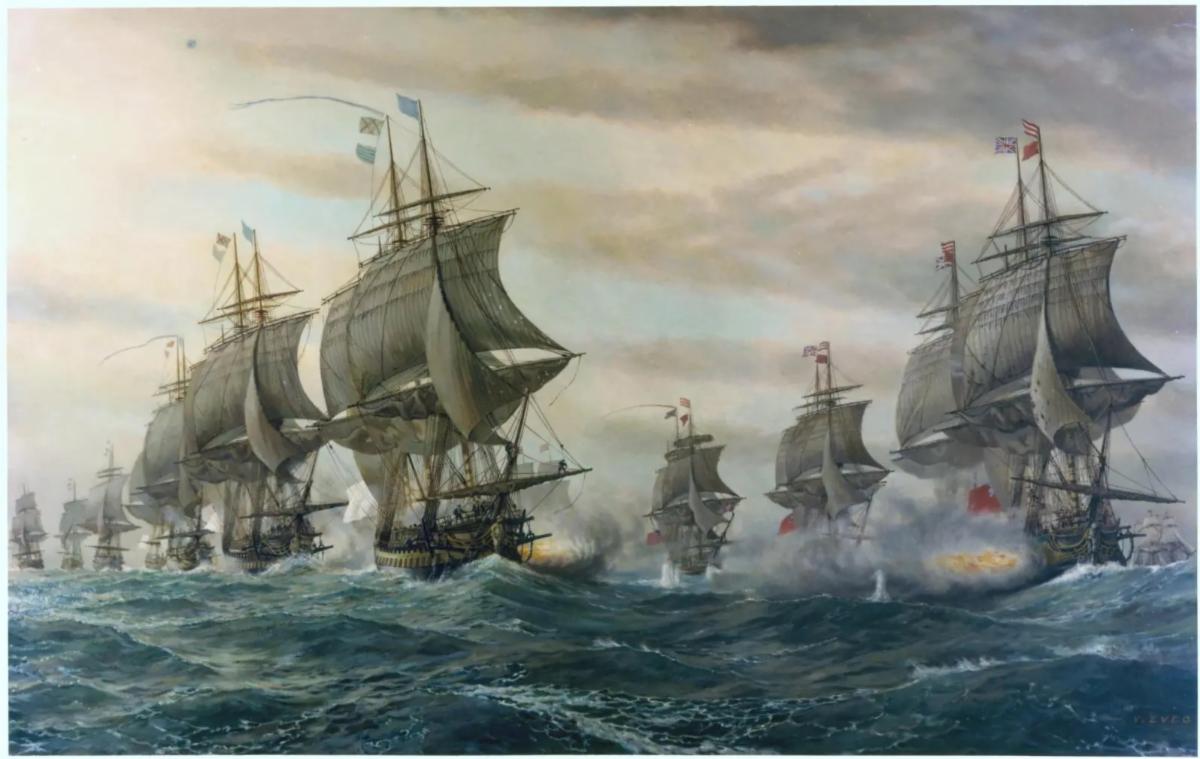
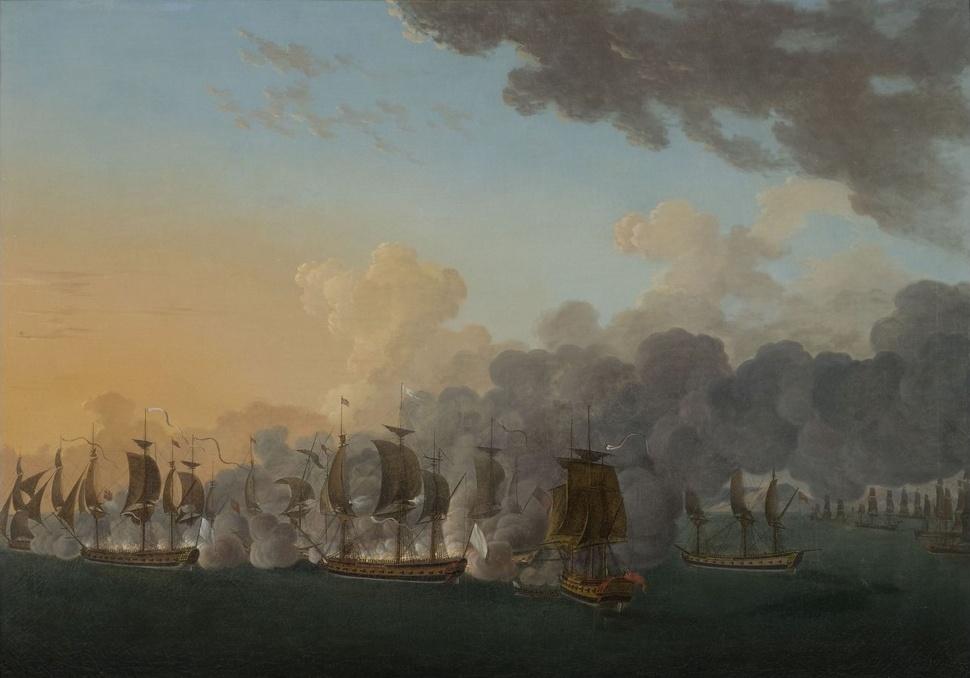
Battle of The Capes, September 5, 1781.
Hampton Roads Naval Museum, Public domain, via Wikimedia Commons
Oil on canvas by v. Zveg, 1962, depicting the French fleet (at left), commanded by Vice Admiral the Comte de Grasse, engaging the British fleet (at right) under Rear Admiral Sir Thomas Graves off the mouth of Chesapeake Bay. The French successfully prevented the British fleet from entering Chesapeake Bay and relieving Major General Lord Cornwallis' army at Yorktown, Virginia. Courtesy of the U.S. Navy Art Collection, Washington, D.C. U.S. Naval History and Heritage Command Photograph.
|
|
EDITORIAL
This month of June, as many of us are heading to the beaches, we cannot help but reflect on the crucial role of navies in the history of warfare. Whichever World Power controls the seas has a decisive strategic advantage in the outcome of a war spreading to several continents.
In this Bulletin, we would like to give an overview of the crucial role played by the French Navy during the American Revolutionary War. Although the British Royal Navy enjoyed overall superiority at sea, the French Marine Royale not only carried French troops across the Atlantic Ocean, they fought the British Navy on all oceans from the Caribbean to India, and by winning the "Battle of the Capes" on September 5, 1781, successfully sealed the fate of the British in Yorktown, the resounding victory which led to the Independence of the United States.
These last few weeks have been quite active for our association!
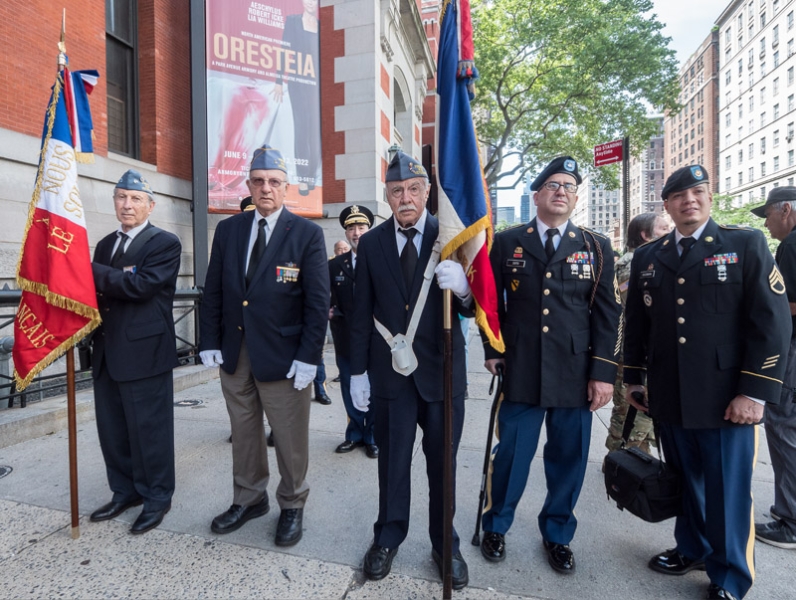
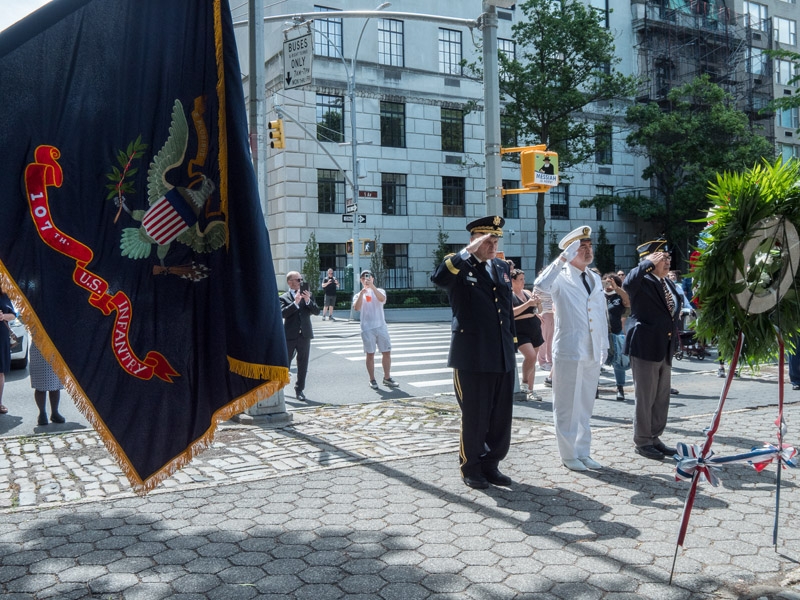
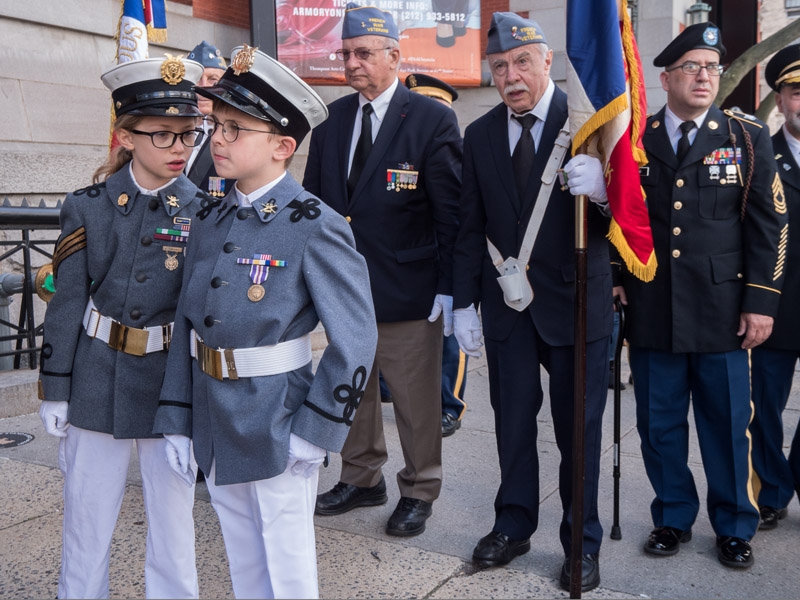
We celebrated Memorial Day side-by-side with the New York 7th Regiment Veterans at the Armory in Park Avenue, New York at a wreath-laying ceremony at the monument of this fabled regiment on 5th Avenue & 69th Street, on the border of Central Park.
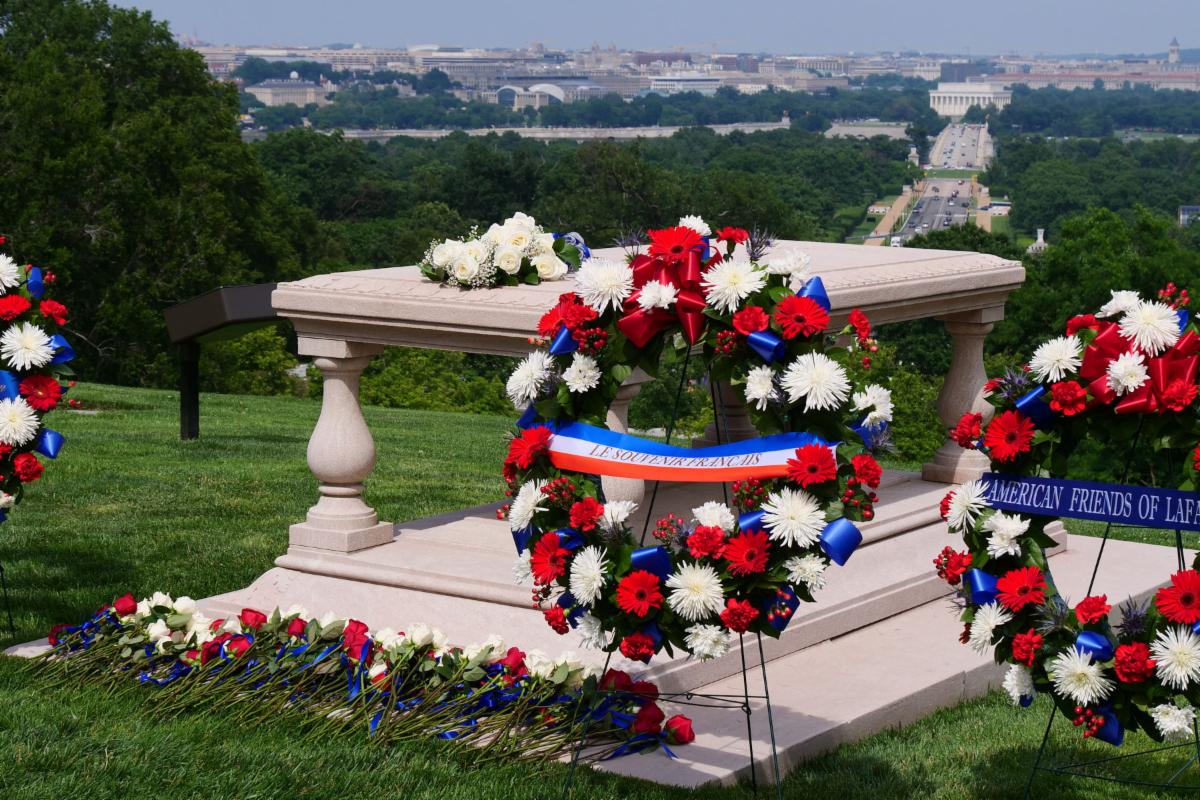
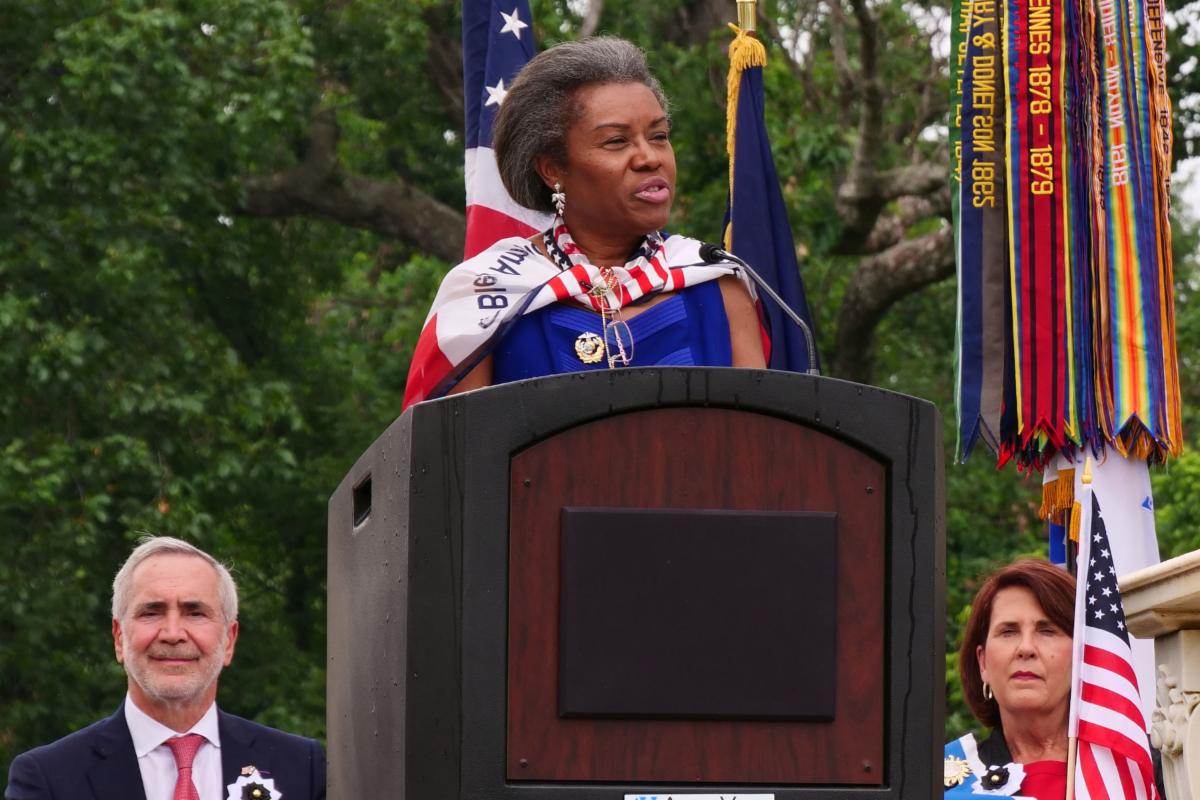
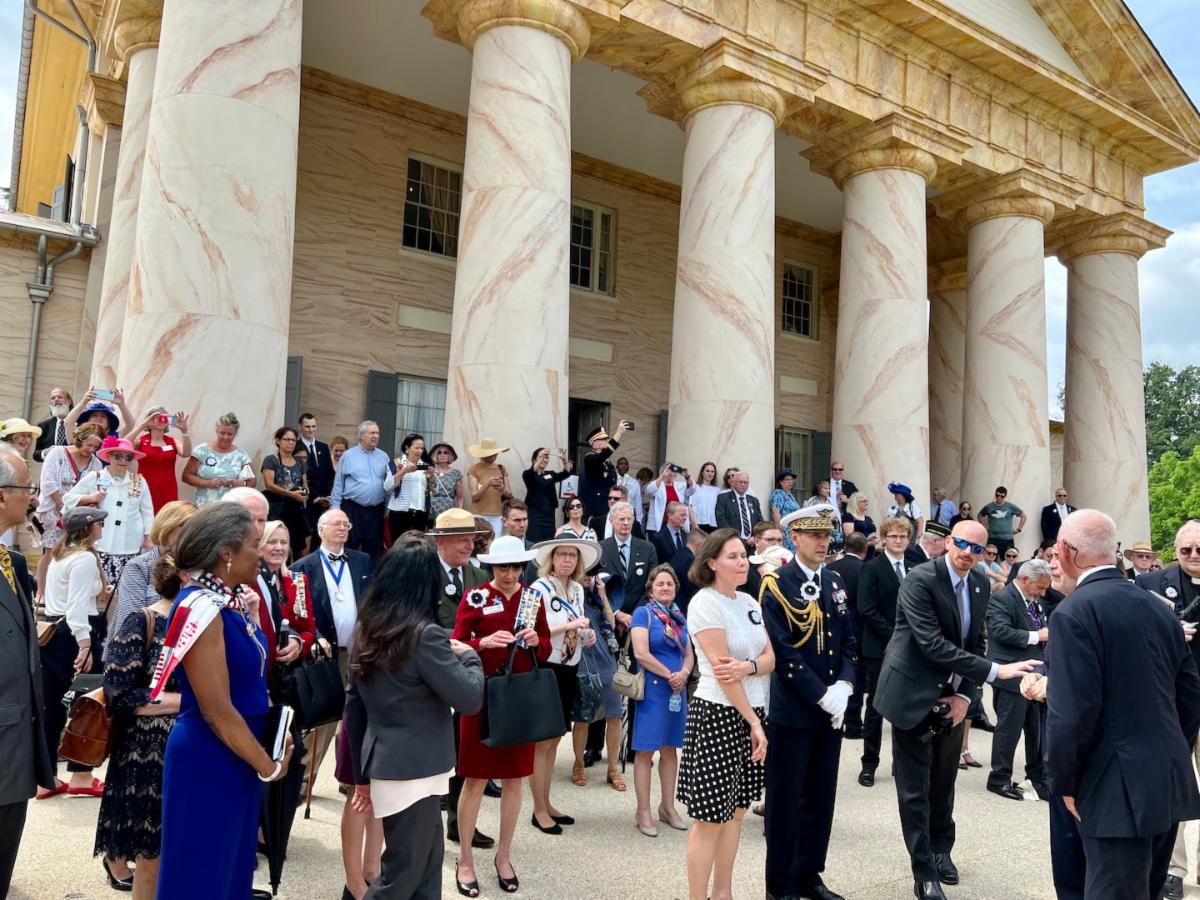
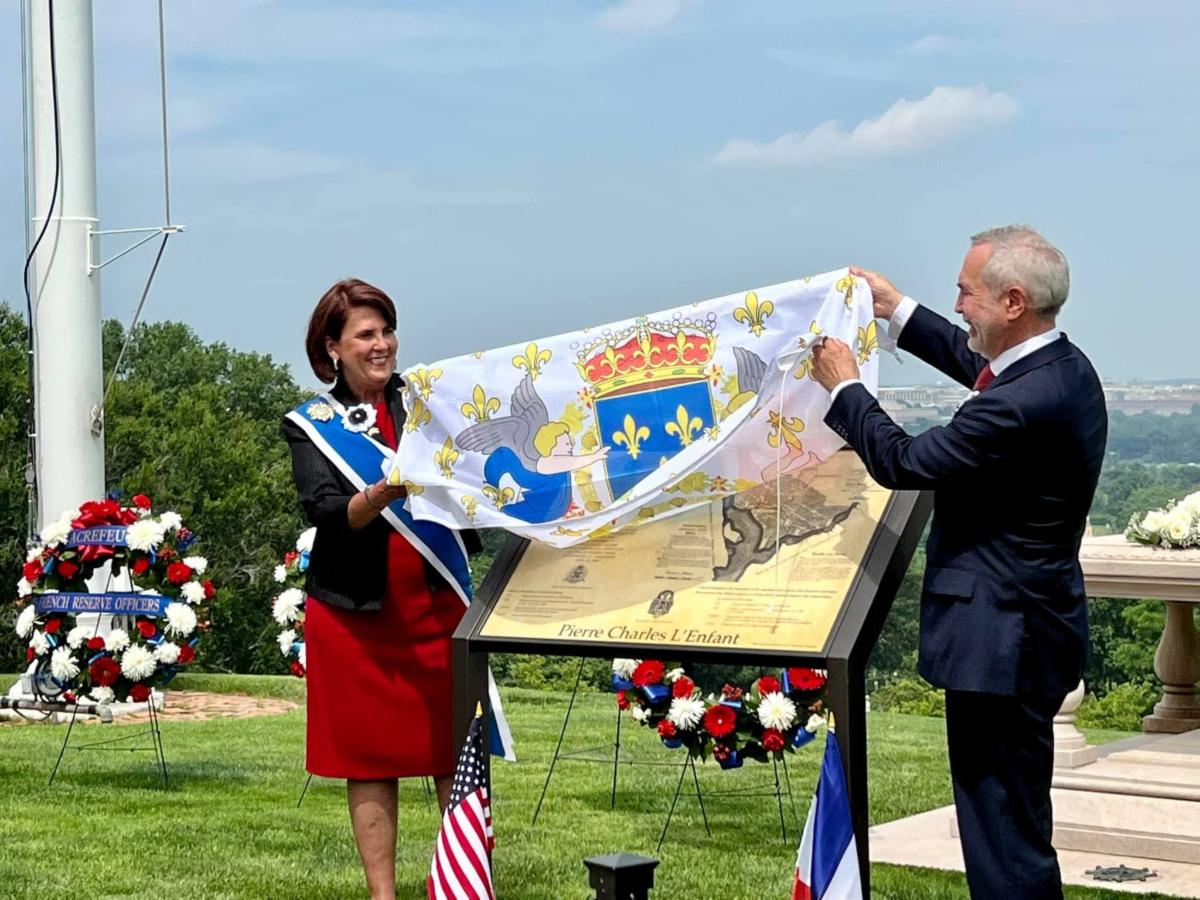
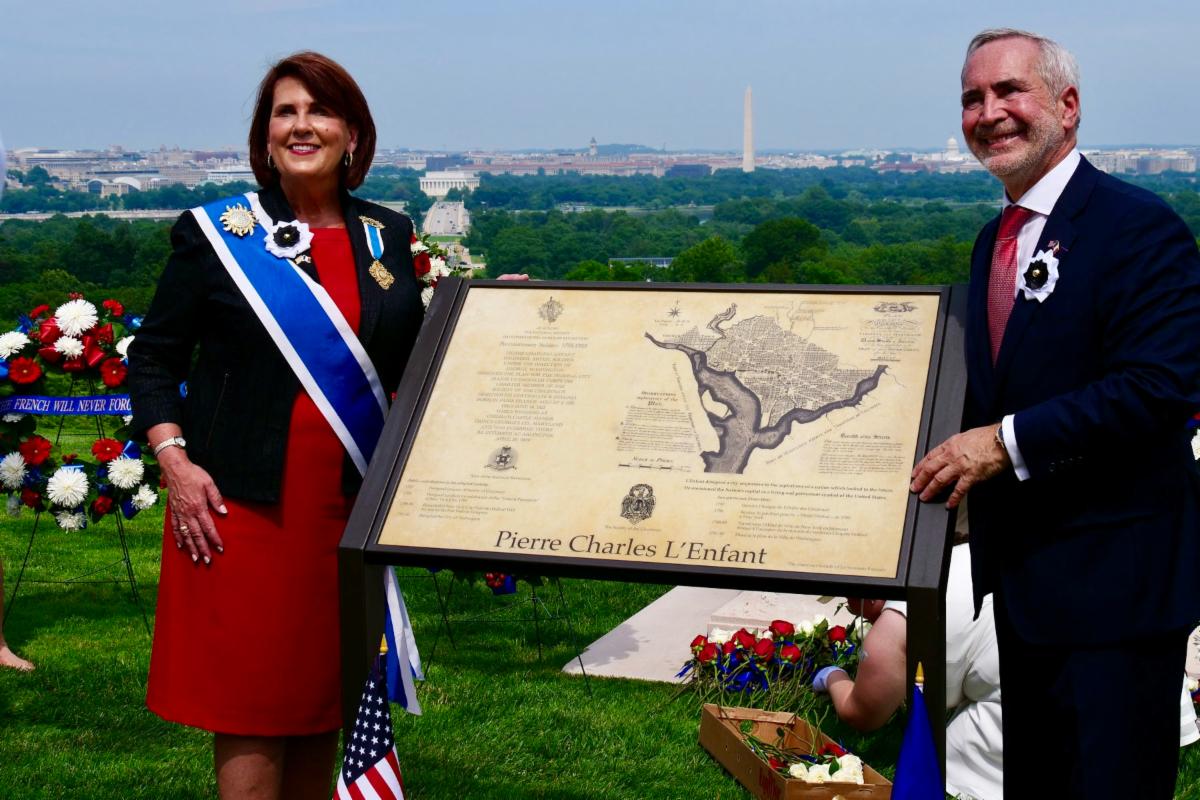
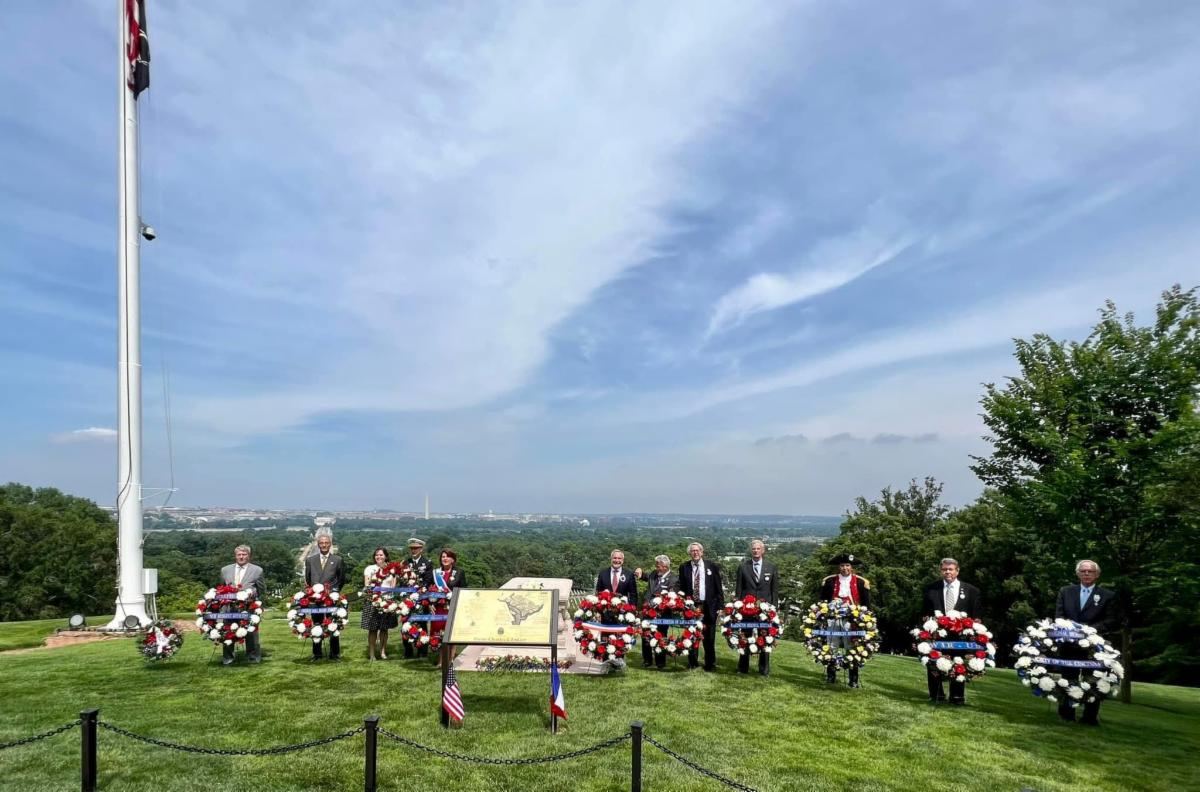
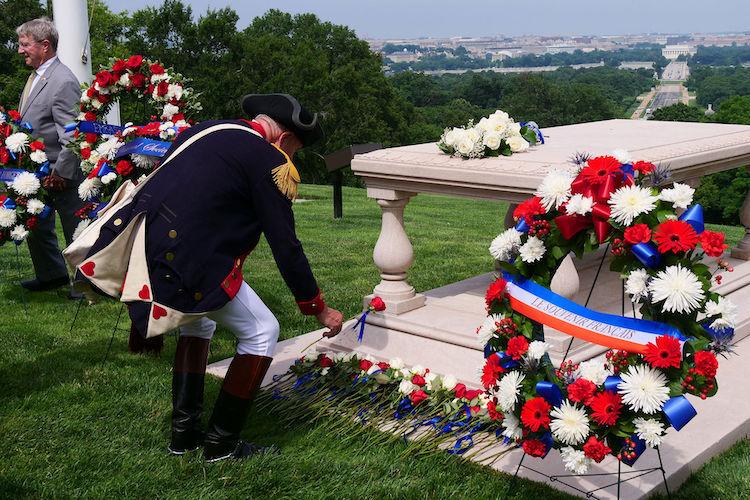
On June 14, we inaugurated a new interpretive marker at the monument of Major Pierre Charles L'Enfant in Arlington National Cemetery, co-signed by your association and the Daughters of the American Revolution, with dozens of wreaths laid by presidents of major patriotic and fraternal organizations, in the presence of Virginia Lt. Governor Winsome Sears and Deputy Ambassador of France Mme Aurélie Bonal. Dozens of distinguished guests laid a rose at the monument. The new marker will educate some of the 10,000 tourists who visit these hallowed grounds every calendar day, 365 days a year!
You will find more photos of these memorable occasions further below.
Among the many projects that are on the horizon, we are planning the restoration of a stele to the memory of explorer La Pérouse in Maui, the inauguration of a plaque to the memory of the same explorer at Glacier National Park in Alaska, our participation to the several patriotic exercises in Yorktown in October, the installation of a memorial at the future Odell House Museum (location of Rochambeau's headquarters from July 6 until August 19, 1781) in Greenburgh, Westchester County, New York, the installation of the statue of The Little Prince and a bust of Antoine de Saint-Exupéry in Manhattan, the participation to the restoration of the frigate Hermione....
We mailed a reminder letter to all supporters and past members to renew their 2022 membership. Please help us promote the long-standing historical bonds of alliance and friendship between France and the United States of America with concrete, tangible markers and plaque to be erected coast to coast. We thank you for supporting our growing activities with your annual membership, your generous donations, and are always grateful for your suggestions and encouragements!
Our monthly Bulletins will continue throughout the summer. In July, we look forward to sharing General George Washington's thoughts and writings on the "First Alliance" with the French, and starting in August we will resume last year's narration of the 690-mile march of the French Army, this time on the way back from Williamsburg, VA, all the way to Boston, MA.
As we are blending historical reflexions and anecdotes on this continuous love story almost 250 years old, we wish you a Happy July 4th, with hopefully some entertaining beach reading!
On behalf of the Board of Directors.
Thierry Chaunu, President,
American Society of Le Souvenir Français, Inc.
Poor is the nation that has no heroes, but poorer still is the nation that having heroes, fails to remember and honor them. Marcus Tullius Cicero 106-43 BC
|
|
HISTORICAL CONTEXT:
When everything was seemingly lost...
|
|
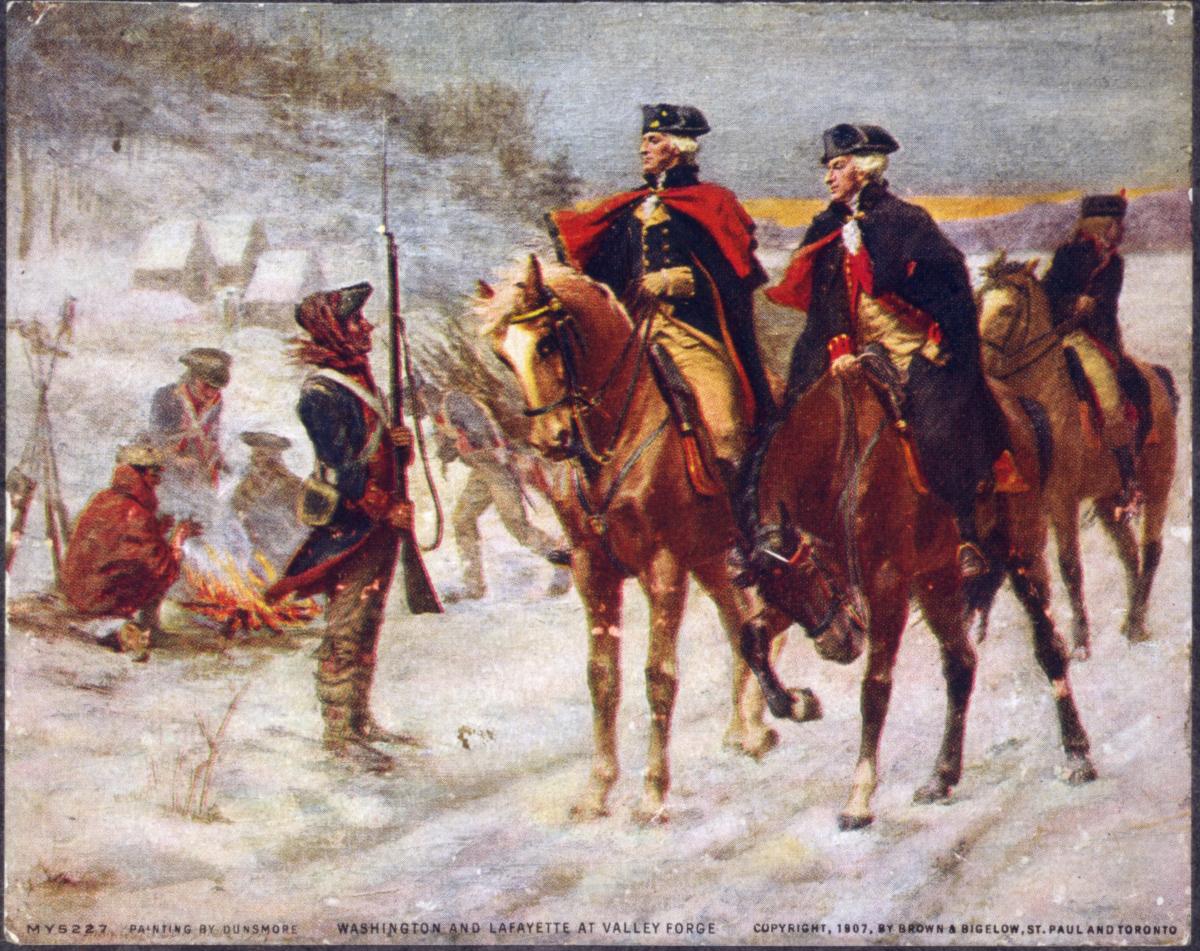
Washington and Lafayette at Valley Forge, By John Ward Dunsmore - https://www.loc.gov/pictures/item/91792202/, Public Domain, https://commons.wikimedia.org/w/index.php?curid=16944858
|
|
Just like the first American troops came to the aid of embattled France during some of the darkest hours of World War One in 1917, a hundred and fifty years before, the first French volunteers came to help the Insurgents and served in the Continental Army.
Many were young French aristocrats, impassioned with the ideals of Freedom and "Rights of Man" propagated by the philosophers of the "Age of Enlightenment", Voltaire, Rousseau, Diderot, Montesquieu, d'Alembert, to name a few. The effervescence is Parisian salons was palpable. News of the struggles of the American Insurgents were the talk of the salons and dinners, and the arrival of the American envoys to the court of Versailles was met with halting expectations from the French. The popularity of Benjamin Franklin, nicknamed the "Bonhomme Franklin" was universal throughout France. Everyone was rooting for the success of the Insurgents, and the desire for revenge after the humiliating defeat of the Seven Years War (named the French & Indian War this side of the pond) was certainly a factor.
King Louis XVI and his ministers were hesitant to start a new war. Initially, they agreed to secretly help the Insurgents with the shipment of arms, ammunitions, clothing, and volunteers, a scheme masterfully organized by Beaumarchais, the immortal author of "Le mariage de Figaro", who created a fictitious Spanish trading company Hortalez & Co. to this end.
Among the young aristocrats looking to serve the cause of Liberty, and enamored with America, the likes of Lafayette, L'Enfant and many others presented themselves to the Continental Congress, asking for commissions and a rank within the Continental Army, under the command of General George Washington, and at their own expenses.
Everything seemed lost during the terrible winter of 1777-1778, when the Continental Army quartered in Valley Forge, with scant food and clothing. George Washington and his commanders, as well as the entire army, was at its depths. Short of a miracle, the implacable strength of the British troops was about to crush, once and for all, the brave insurgents.
However, Louis XVI resolved to sign the famous Treaty of Alliance, Friendship and Commerce of February 6, 1778, and agreed to openly side with the American Insurgents. When news reached Congress and George Washington on May 4, the joy was indescribable. So were their expectations. It would take another 5 long years of armed conflict to secure a final victory.
For this to happen, French troops had to cross the ocean, transported and protected by French Navy warships, numerous naval battles were to be fought. While naval supremacy couldn't be achieved universally by any of the two main protagonists, France and Britain, local dominance, even temporary, enabled one side to prevail.
This was made possible by a combination of the most advanced shipbuilding techniques of the times, daring naval officers and well-trained crews, excellent tactical operating procedures, and last but not least, the right amount of luck at precisely the right time.
This is not in the scope of this bulletin to narrate each and every turn of this long war fought on the oceans. Rather, we will illustrate the role of the French Navy by presenting a few of the most illustrious ships and their captains: the frigate Hermione, commanded by Captain Latouche, the 80-gun Duc de Bourgogne commanded by Admiral de Ternay, the three decker ship of the line "Ville de Paris", and its admiral de Grasse, the role played by Barras in transporting the heavy artillery to Yorktown, as well as the less successful, but historically noteworthy, role of Admiral d'Estaing in the siege Savanah, GA., a site that can still be visited today.
|
|
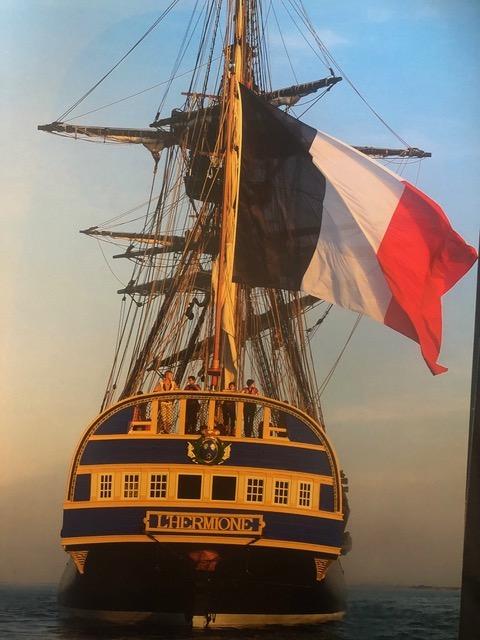
THE VALIANT FRIGATE HERMIONE |
|
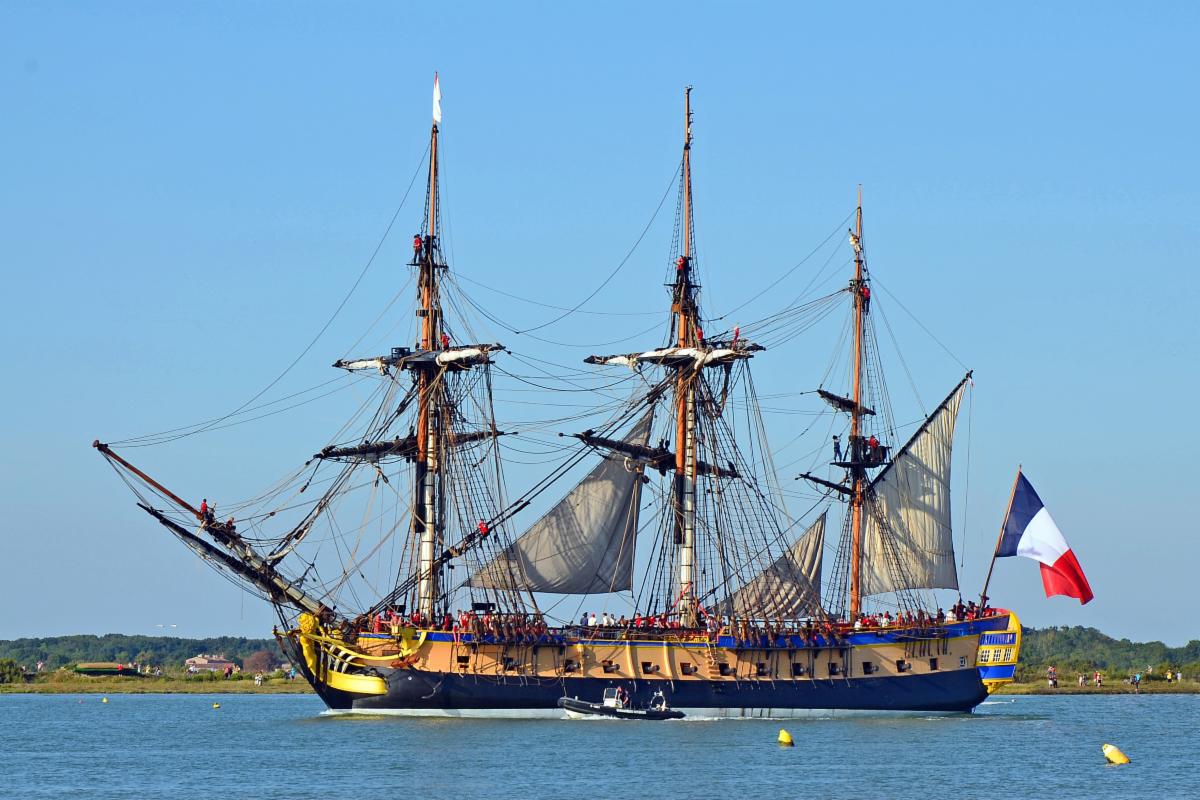
2014 September 17th, Hermione replica, built in Rochefort, comes off the Charente river, and reach open sea for the first time. Thousands of spectators attend this first departure.
By Jp.sembely - Own work, CC BY-SA 4.0, https://commons.wikimedia.org/w/index.php?curid=60749233
|
|
• Hermione was a 32-gun Concorde-class frigate of the French Navy. Designed for speed, she was one of the first ships of the French Navy to receive a copper sheathing, a new technique pioneered in England that made ships run faster, and delayed the corrosive effect of salt water and biofouling. She became famous when she ferried General La Fayette to the United States in his return trip in 1780 in support of the rebels.
• On May 4, 1780, the Captain of Hermione, Louis-René Latouche-Tréville, received on board the principal members of the Massachusetts State Council as well as personalities such as Samuel Adams and John Hancock (future first governor of Massachusetts).
• Latouche-Tréville proposed to the Council to make the frigate available to fight the privateers or English frigates likely to harass the local maritime trade.
The Hermione sailed from Boston on May 14 for Penobscot Bay in search of two enemy ships, and approached the English positions at Castine. On her return, she stopped at Portsmouth (then the capital of the state of New Hampshire) on May 19 before returning to Boston two days later.
• The Hermione set sail again on May 29, 1780, this time south. In the days that followed, she captured two English merchant ships: the English brig Thomas with a cargo of butter, candles and soap on June 2 south of Nantucket, then the salt laden Rewrery on June 6 south of Long Island.
• On June 7, 1780, the French frigate fought the British frigate Iris off Long Island and suffered significant damage. During the one-and-a-half-hour fight, the Hermione fired 260 cannon shots, 140 scree shots and 1,280 rifle and blunderbuss shots.
Ten men were killed, and 37 wounded including the commander and his second. Two of the injured died of their wounds in the days that followed.
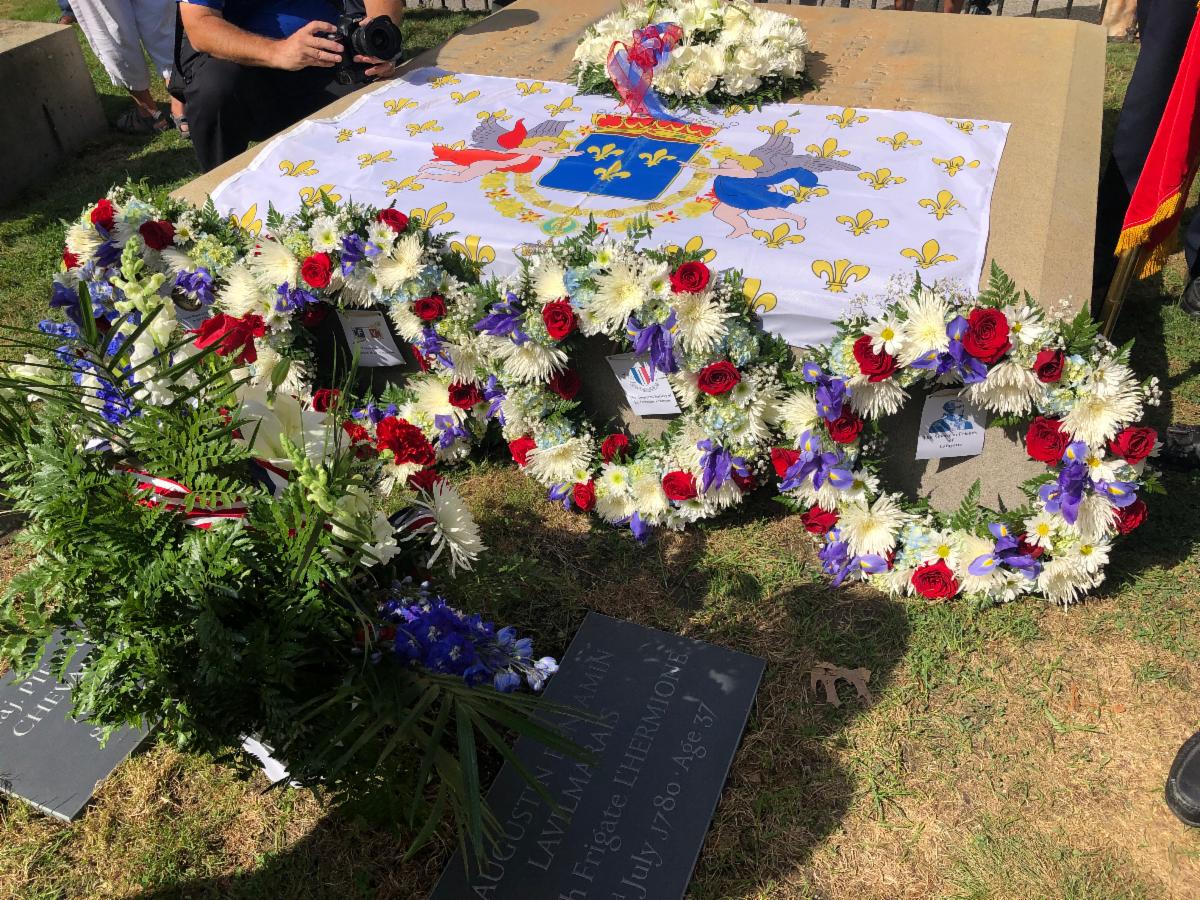
• One of the officers wounded in this fight who died a few days later at the Newport hospital was Lt. Benjamin de la Villemarais (also spelled Lavilmarais), whom we honored this past September 10, 2021, with a grave marker alongside the one of Major Pierre du Rousseau, chevalier de Fayolle, aide-de-camp of Lafayette, also an officer of the Hermione.
• On July 4, 1780, the Hermione was decked out and Captain Latouche-Tréville ordered 13 cannons to fire a round of 3 shots each to celebrate the 4 years of the Declaration of Independence of the 13 United States of America.
• She went on to participate in the Battle of Cape Henry on 16 March 1781, and a major one in the action of 21 July 1781, when along with the frigate Astrée captained by La Pérouse, she engaged a convoy of 18 British ships and their Royal Navy escorts. The French captured two of the British escorts while the remainder of the British convoy managed to escape.
• Wrecked in 1793 during the French Revolution, the Hermione came back to life 10 years ago, when an association of French naval devotees decided to build a replica using exactly the same blueprints, the same shipbuilding techniques, in the shipyard in Rochefort in the West Coast of France. Her maiden voyage to America in 2015 made headlines. Unfortunately, crossing the Atlantic is very costly and her sailings were confined to the European coasts. A year ago, she was diagnosed with a very serious infection of fungi that is eating the wood at the bottom of the hull, and has been immobilized in a repair shipyard near Bayonne in the Basque region of SouthWestern France. Repairs are estimated to be upwards of $3 million, and a fund raising campaign is going to be necessary.
• The Board of the American Society of Le Souvenir Français has voted to participate in this worthy cause and to facilitate the collection of tax-deductible donations by working with a resurrected Hermione Foundation in the United States. Once repaired, we hope to see the Hermione visit us more often on our shores.
|
|
ADMIRAL DE TERNAY
TRINITY CHURCHYARD, NEWPORT, R.I.
|
|
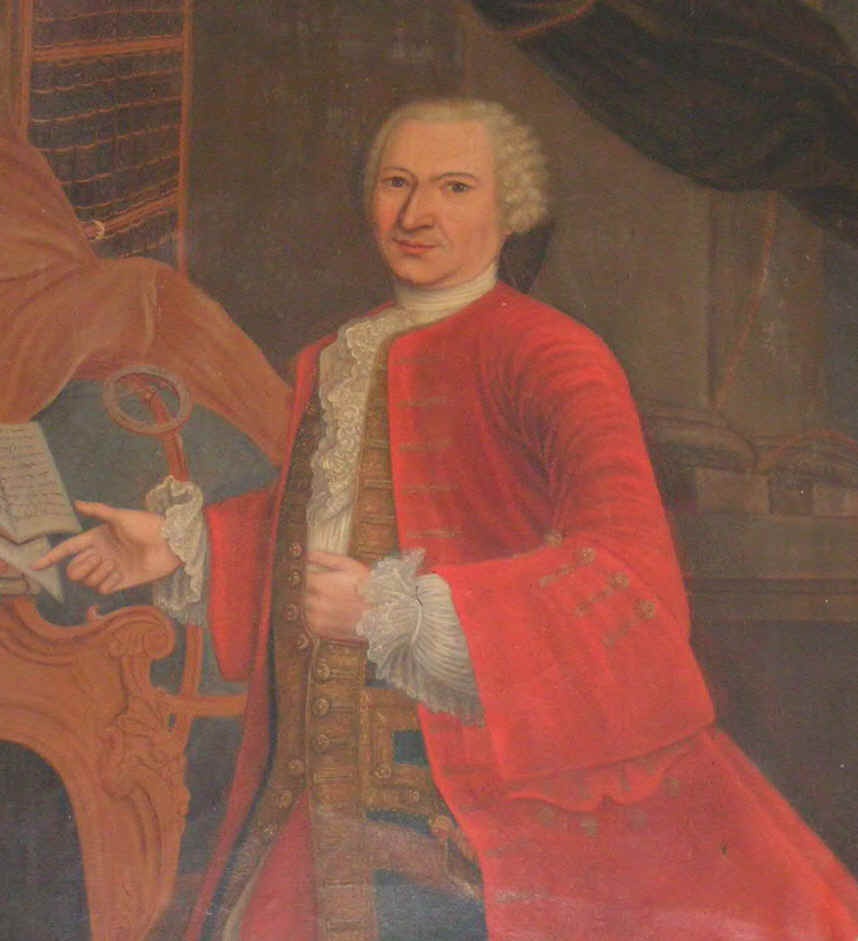
Oil portrait, painter unknown — Public Domain
https://commons.wikimedia.org/w/index.php?curid=15975136
|
|
• Charles-Henri-Louis d'Arsac, chevalier de Ternay (27 January 1723 - 15 December 1780) was born in Angers (Maine & Loire) of an old noble family with origins in Brittany. He enrolled in the French Navy at the age of 15. He rose through the ranks and had a well deserved reputation for his wisdom and cautious decision-making. Ternay was the naval commander of a 1762 expedition that successfully captured St. John's Newfoundland.
• He was appointed commander of the French naval forces whose mission was to successfully transport Rochambeau's army across the ocean. On 2 May 1780, he departed Brest with a 7-ship and 3-frigate squadron, escorting 36 transports carrying troops and heavy artillery. Although fast-running frigates under his command could have captured slower British merchant ships during the crossing, he wisely restrained them and focused on his mission to land the troops to America as fast as possible. He landed in Boston on June 11, 1780.
• Admiral de Ternay died on December 15, 1780 of typhus shortly after meeting George Washington with Rochambeau in October. On December 16, 1780, a procession starting from the Hunter House on Water Street (now Washington Street) led by military men and nine Catholic chaplains, wound its way through the streets of Newport. A fifteen-gun salute was fired as soon as the casket came into sight of his flagship, the 80 gun ship of the line Duc de Bourgogne, which was anchored in Newport Harbor. A cannon was fired every half-hour for the rest of the day and flags were at half-mast. Newport residents lined the streets to watch as the French military commemorated Admiral de Ternay and lowered him into the ground.
• He was posthumously enrolled in the Society of Cincinnati for his role in the war. Port Glaud, district of Mahé, Seychelles, Baie Ternay and Cap Ternay are named after him. There is a bay Ternay in Primorsky Krai, Russia, which was discovered by La Pérouse on June 23, 1787 and named after Ternay.
|
|
Admiral de Ternay’s Tomb & Plaque
Trinity Church, Newport R.I.
141 Spring St. Newport, RI 2840
"In the name of God CHARLES LOUIS d'ARSAC De TERNAY
Knight of the Order of St. John of Jerusalem
Though the Vows of the Order he had never acknowledged
descended from an ancient and noble family of Bretagne
One of the Admirals of the King's Fleets a Citizen, a Soldier, a Chief, serviceably faithful to his King and country, for 42 years, now rests beneath this marble."
Next to Admiral de Ternay's tomb, one can see the two grave markers we inaugurated this past September 10, 2021, thanks to a cooperative effort with the National Park Service, The American Friends of Lafayette, The Washington-Rochambeau Revolutionary Route (W3R), the American Battlefield Trust, the Newport Historical Society, the Trinity Churchyard, the Alliance Française de Newport, in memory of the two officers of the Hermione buried in the same cemetery, Major Pierre du Rousseau, chevalier de Fayolle, and Lt Benjamin de la Villemarais.
Photo: Daniel Falguerho, Federation of French War Veterans
|
|
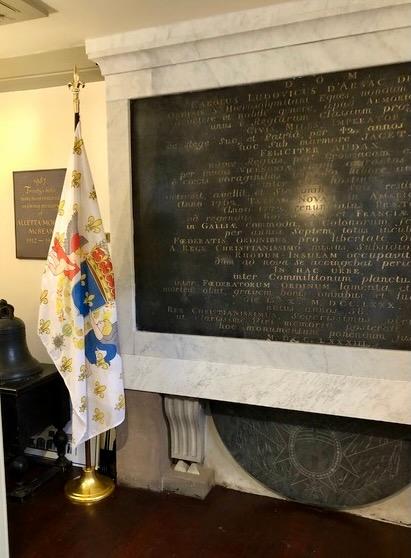
The original marble plaque ordered by King Louis XVI was transferred from the top of Admiral de Ternay's tomb to the vestibule entrance of Trinity Church, in order to be protected from the elements. Trinity Church is one of the oldest continuous place of worship in America, where George Washington came to pray, and Queen Elizabeth visited in 1976. The French Royal Navy's standard, which was used at the time (the central coat-of-arms with cherubs in the middle is the personal flag of the King) and offered by The American Society of Le Souvenir Français to Trinity Church in 2021, is on display next to the plaque.
Photo: courtesy of Ms. Charlotte Johnson, Trinity Churchyard historian.
|
|
The translation from Latin reads:
“D.O.M.
Lies under this marble
Charles Louis d'Arsac de Ternay
Knight of the Order of St John of Jerusalem, From a noble and ancient House of Brittany. Chief of the Naval Armies of His Most Christian Majesty. Citizen Soldier. As a General Officer, he deserved well from his King and his country for forty two years.
After the fatal day of Croisic, the King's ships having been dispersed in the dangerous and impassable straits of the Vilaine, animated by a happy audacity and by tireless work during the years 1760, 1761, in the very presence of the enemy who opposed his efforts, he tore them from the deep chasms of the river and returned them to the ports which were destined for them.
In 1762 he seized the Isle of Terra Nova in America.
In 1772, appointed Governor of the Isles of France and Bourbon, he devoted himself entirely to the advantages of France and the happiness of the Colonists who were entrusted to his care for seven years.
Sent in 1780 by the Most Christian King to the aid of the United States which was fighting for their freedom, he took up post in Rhode Island; while preparing for further attempts, he succumbed at Newport to a death which cost many tears and regrets to his officers, his crews, the United States, virtuous men and his loved ones on December 197 of the same year aged 58.
The very Christian King Judge and very equitable remunerative of Virtue, to consecrate to posterity the memory of such a respectable General, ordered that this Monument be erected.
M.DCCLXXXIII »
|
|
MONUMENT TO THE FRENCH NAVY IN NEWPORT, R.I. |
|
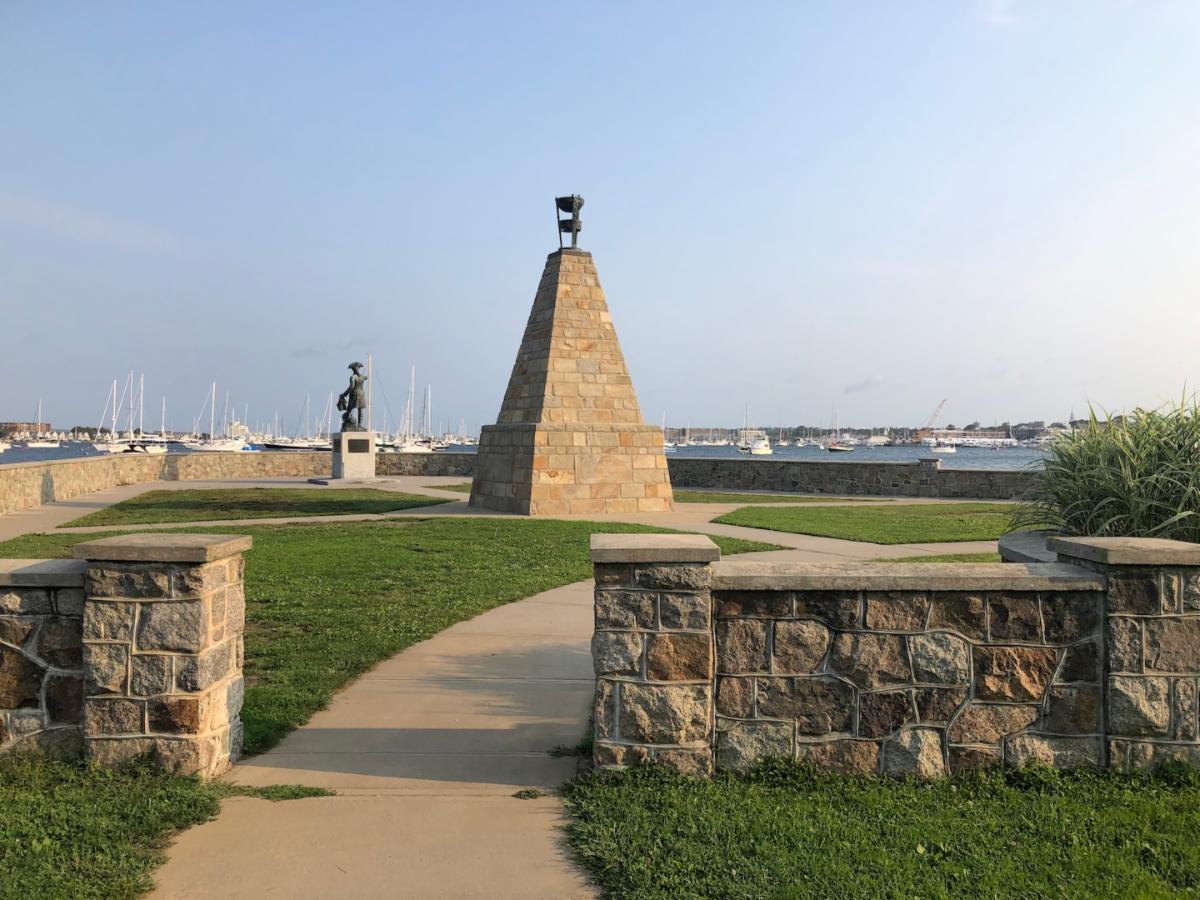
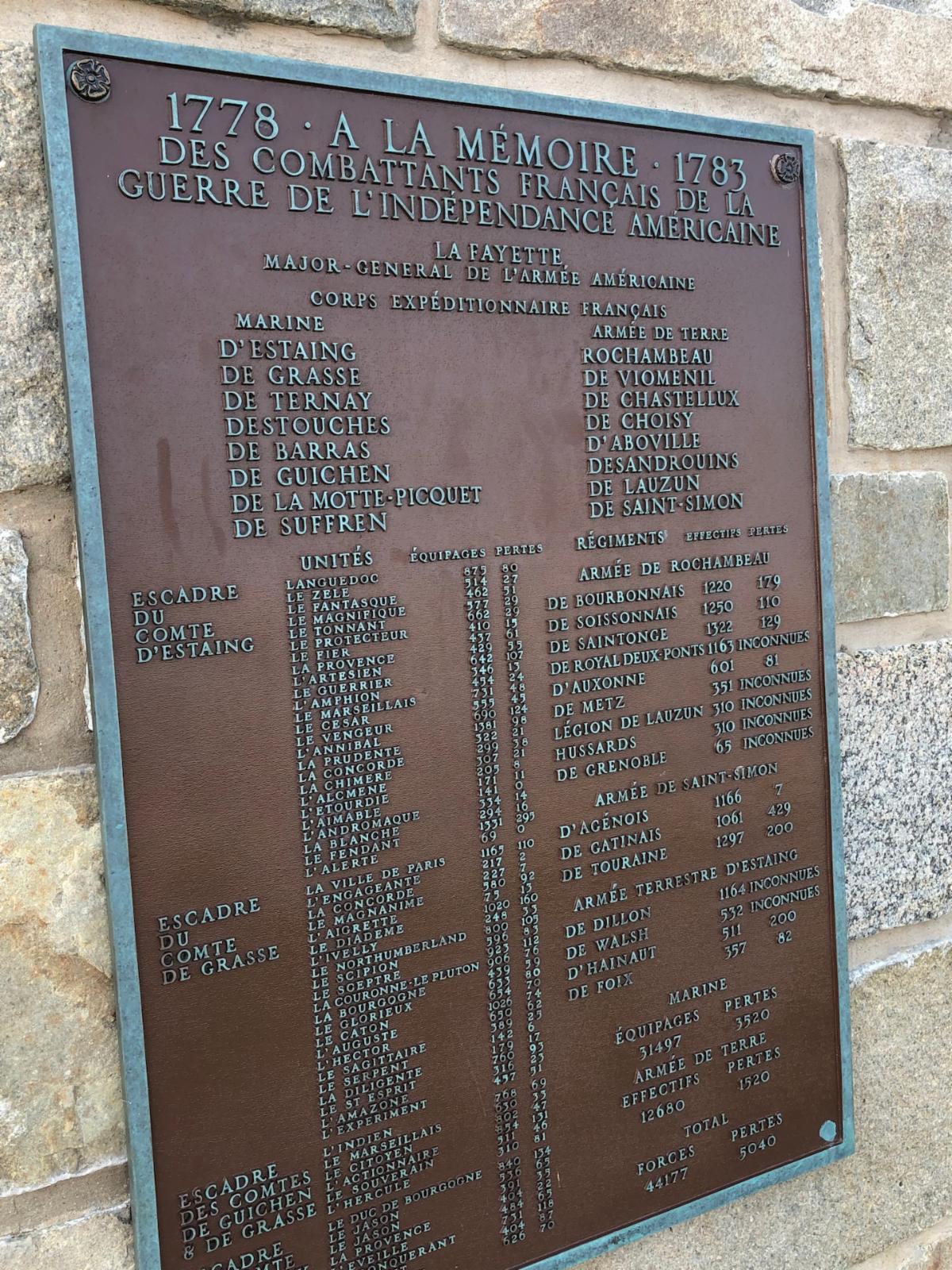
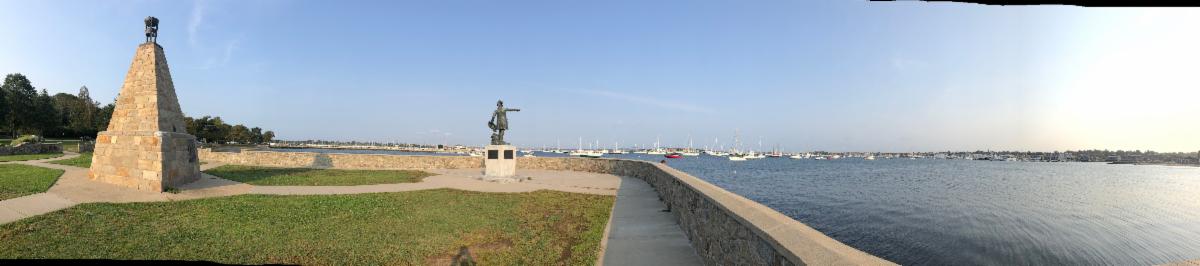
Memorial to the French Navy, located nearby the Statue of Rochambeau, King's Park, Newport, Rhode Island.
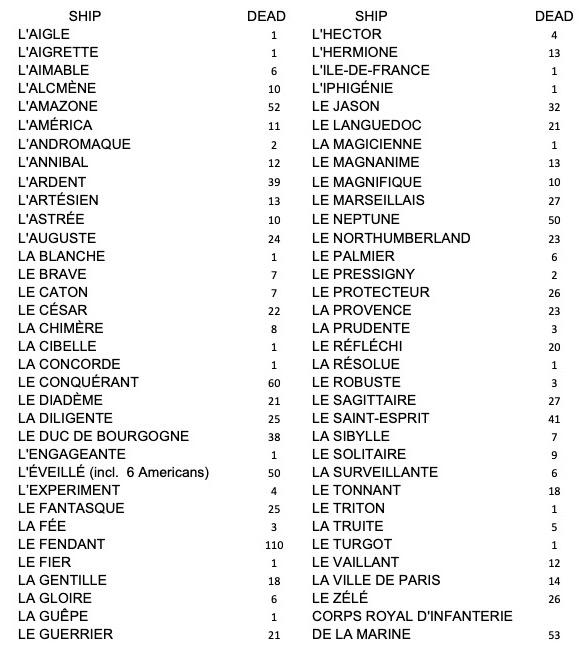
Contrary to what is heard at times in patriotic ceremonies, more than "5 French frigates" were sent to America! A similar plaque exists near the French Memorial in Yorktown, VA (see further below)
Located at the waterfront in Kings Park, Newport R.I. 02840
Photos: Thierry Chaunu (2021)
|
|
[ South side : ]
NEAR THIS SPOT
THE FRENCH ARMY OF 6000 MEN
LED BY GENERAL ROCHAMBEAU
OUR ALLIES
IN THE WAR FOR INDEPENDENCE
FIRST SET FOOT IN AMERICA
[ East side : ]
"I WELCOME THE NEWS
OF YOUR ARRIVAL
A NEW MARK OF FRIENDSHIP
fFROM HIS MOST CHRISTIAN MAJESTY"
GEORGE WASHINGTON
JULY XIII 1780
[ West side : ]
ERECTED BY
NEWPORT HISTORICAL SOCIETY
GIFT OF RODERICK TERRY 1928
[ North side : ]
STONE 19.5 " x 17.5"
JULY 11, 1780
1902 unsigned
|
|
ADMIRAL DE GRASSE, AN UNSUNG HERO
THE TRUE ENABLER OF THE JOINT FRENCH-AMERICAN VICTORY IN YORKTOWN
|
|
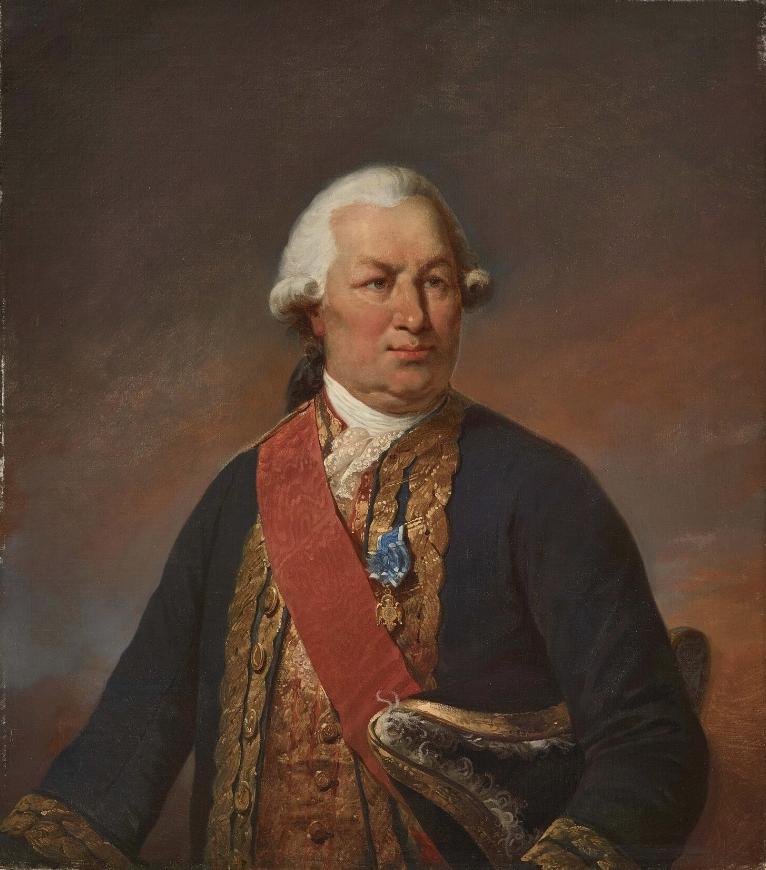
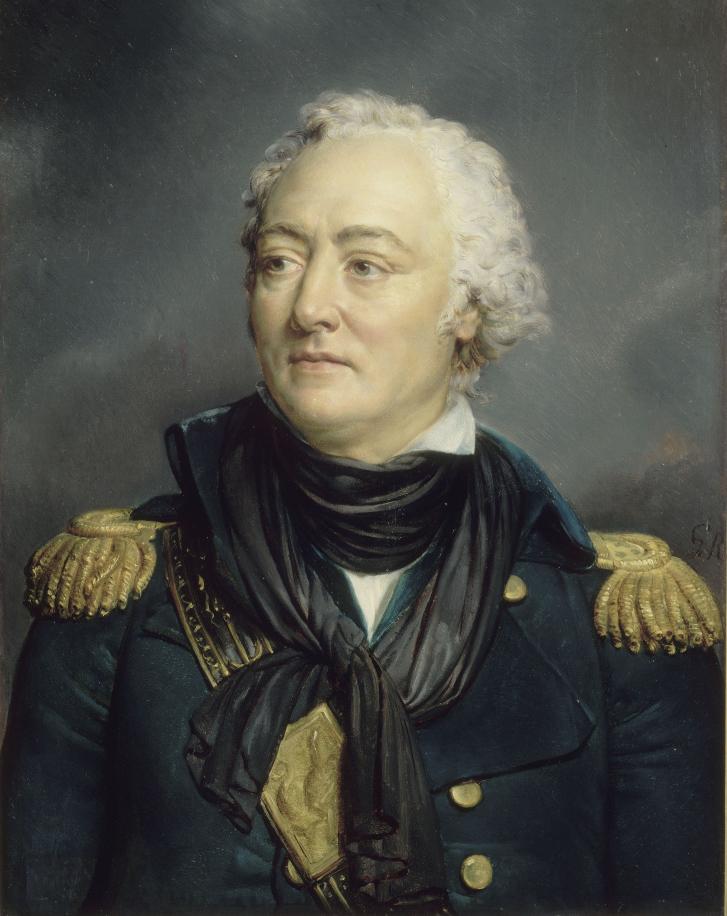
Portrait of Admiral de Grasse by Jean-Baptiste Mauzaisse - Joconde, Public Domain, https://commons.wikimedia.org/w/index.php?curid=10628855/ |
|
• Admiral François Joseph Paul, Comte de Grasse, Marquis of Grasse-Tilly (13 September 1722 – 11 January 1788) is best known for his command of the French fleet at the Battle of the Chesapeake in 1781. It led directly to the British surrender at Yorktown ensuring the Independence of the United States.
• In 1779, he joined the fleet of Count d'Estaing in the Caribbean as commander of a squadron. He contributed to the capture of Grenada and took part in the Battle of Martinique (1780) against Admiral Rodney. De Grasse was promoted to lieutenant-general of the Navy (vice-admiral) in March 1781, and was successful in defeating Admiral Samuel Hood and taking Tobago.
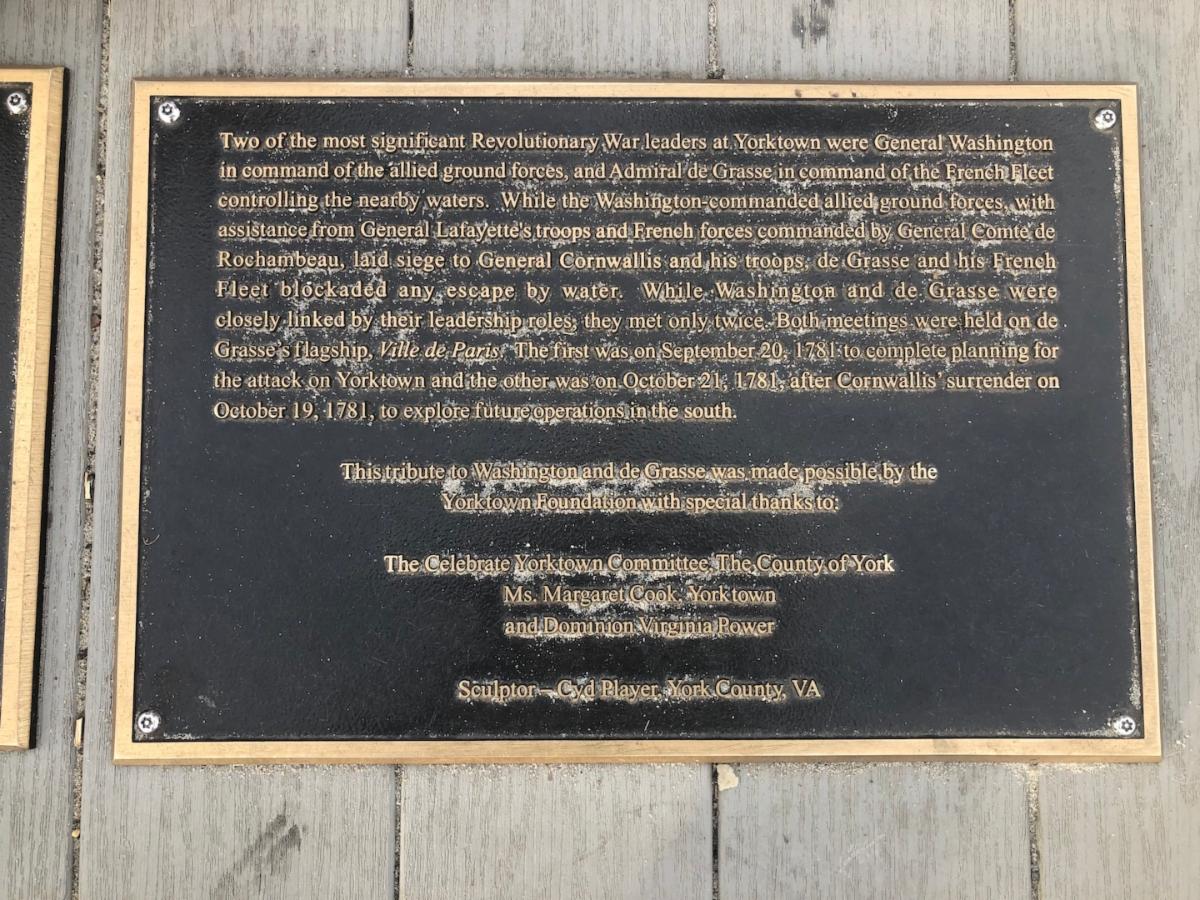
• De Grasse responded to Washington and Rochambeau when they appealed for his aid in 1781, setting sail with 3,000 troops from Saint-Domingue. He decisively defeated the British fleet in the Battle of the Chesapeake on September 5, 1781. He drew away the British forces and blockaded the coast until Lord Cornwallis surrendered at Yorktown.
• He acted decisively, had a jovial temper, hosted George Washington for dinner on board his flagship 104-cannon “Ville de Paris”, however didn’t set foot on American soil, which maybe explain while his role, although crucial, is usually overlooked and unjustly forgotten.
• This is when the famous anecdote took place: when greeting on board General George Washington, for a festive dinner, the Admiral, himself 6 feet and almost as tall as the general, embraced the general with the words of welcome: "Bienvenue, mon petit Général"!
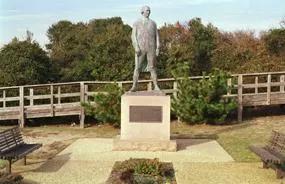
His statue at Cape Henry, VA, is inside a US Navy installation and difficult to visit, unfortunately.
|
|
STATUE and MARKERS AMIRAL DE GRASSE
CAPE HENRY, VIRGINIA
|
|
600 Atlantic Ave, Virginia Beach VA 23459
(Located inside Fort Story Military Reservation in Virginia Beach, VA. Parking lot- corner of Atlantic Avenue and New Guinea Road
• His statue at Cape Henry, VA, is inside a US Navy installation and difficult to visit.
The base no longer issues passes at the gate to visit the park and you cannot drive a personal vehicle onto the base unless you have official base access, i.e., military ID, retiree ID, dependent ID, etc. Visitors must now park in a designated parking spot near the gate and board a free shuttle that will take them to the park
Contact: Joint Expeditionary Base Little Creek-Fort Story Public Affairs Office
757-462-8423/25
Photo: courtesy National Park Service
|
|
• Inscription:
“THIS STATUE, A GIFT FROM FRANCE, IS PLACED HERE OVERLOOKING THE WATERS WHERE ADMIRAL COMTE DE GRASSE SUCCESSFULLY ENGAGED THE BRITISH FLEET ON SEPTEMBER 5, 1781.
THE “BATTLE OF THE CAPES” PREVENTED CRUCIAL REINFORCEMENTS FROM REACHING CORNWALLIS THUS HASTENING HIS SURRENDER.
DEDICATED IN GRATEFUL REMEMBRANCE OF THE DECISIVE CONTRIBUTION OF ADMIRAL DE GRASSE
TO THE WINNING OF AMERICAN INDEPENDENCE.”
MARKERS PLACED NEARBY THE STATUE:
• Marker, “Battle of the Capes”, Cape Henry, VA
• Excerpts:
“On the morning of September 5, 1781, a line of 19 British warships appeared off this cape, headed for Chesapeake Bay. Surprised at anchor in the mouth of the bay, the crews of 24 French warships scrambled out to challenge them. Both fleets sailed southward together in parallel “lines of battle,” passing out of view of the cape. Then the cannonade began. For two hours, their broadsides could be heard on shore. By nightfall, the shore was quiet again; the two fleets had dueled to a stand-off.
The French blockade of the Chesapeake had held, and the British troops of General Charles Cornwallis were denied supplies and reinforcements at Yorktown. On October 19, 1781, General Cornwallis surrendered to General George Washington, assuring America victory in the Revolutionary War.
Erected by U.S. Department of the Army, Fort Story, Virginia.
• Marker, “Battle of the Capes 1781”, Cape Henry, VA
• Inscription:
…"I wish it was in my power to express to Congress how much I feel myself indebted to the Count of deGrasse and his fleet…"
G. Washington Oct 19, 1781
"…I consider myself infinitely happy to have been of some service to the United States …reserve me a place in your memory …"
Admiral de Grasse Nov. 3, 1781”.
The complete sentence from General Washington in his report to Congress reads:
"I wish it were within my power to express to Congress how much I feel myself indebted to the Count de Grasse and the Officers of the Fleet under his Command for the distinguished Aid and Support which have been afforded by them, between whom and the Army, the most happy concurrence of Sentiments and Views have subsisted and from whom every possible Cooperation has been experienced."
• Marker, “Battle of the Capes 1781”, Cape Henry, VA
• Inscription:
On August 30, the French Fleet, consisting of 24 ships of the line, sailed past Cape Henry into the Bay, bringing reinforcements and supplies to the American forces near Yorktown. The British fleet of 19 ships, under Admiral Graves sailed form New York on September 1, setting the stage for a dramatic confrontation. By September 5, at 9:30 a.m., the French were sighted within the Bay. The approaching British fleet had the advantage of the wind and the tide, while the French had not yet formed its line of battle. Graves, however, chose to follow the Royal Navy's fighting instructions and did not disrupt the French Fleet's emerging battle line. For six and one-half hours the fleets maneuvered for position. The French fleet gradually move out past Cape Henry into the Atlantic. Finally, at 4:15 p.m., the leading ships opened fire. An indecisive but vigorous cannonade continued until 6:30 p.m. The forward British ships were heavily engaged and suffered losses in masts and rigging. The British and French fleets continued to sail on parallel course for four days. On the evening of September 9, the French fleet slipped away and headed back to the Chesapeake Bay where it was joined by an additional French squadron which had arrived from Rhode Island. Graves decided his ships were too badly damaged to continue fighting. On September 13, he made the fateful decision to return to New York for repairs.
|
|
PLAQUE TO THE MEMORY OF THE FRENCH NAVY
YORKTOWN, NEAR THE VICTORY COLUMN
|
|
Photo: Thierry Chaunu (2020)
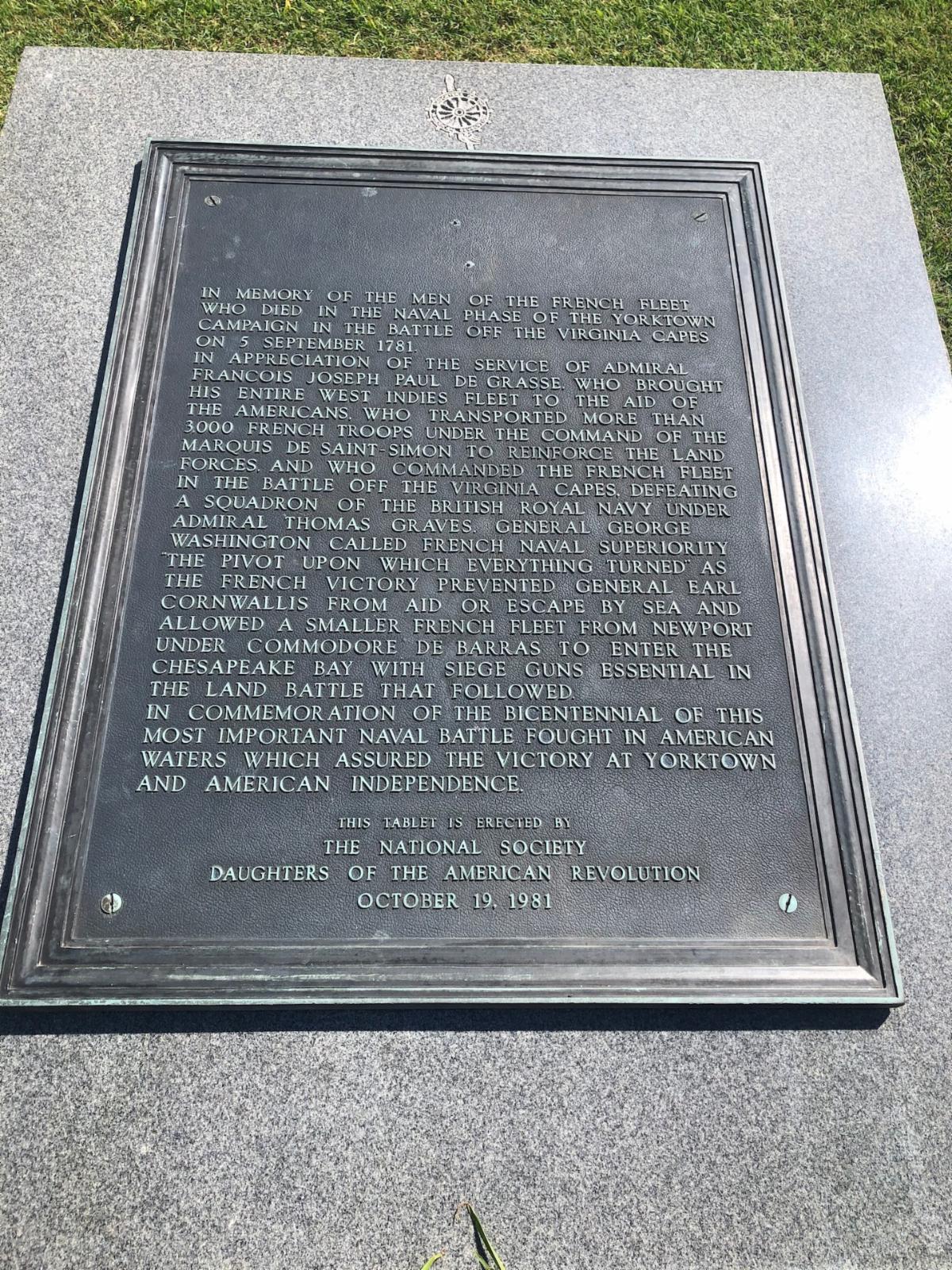
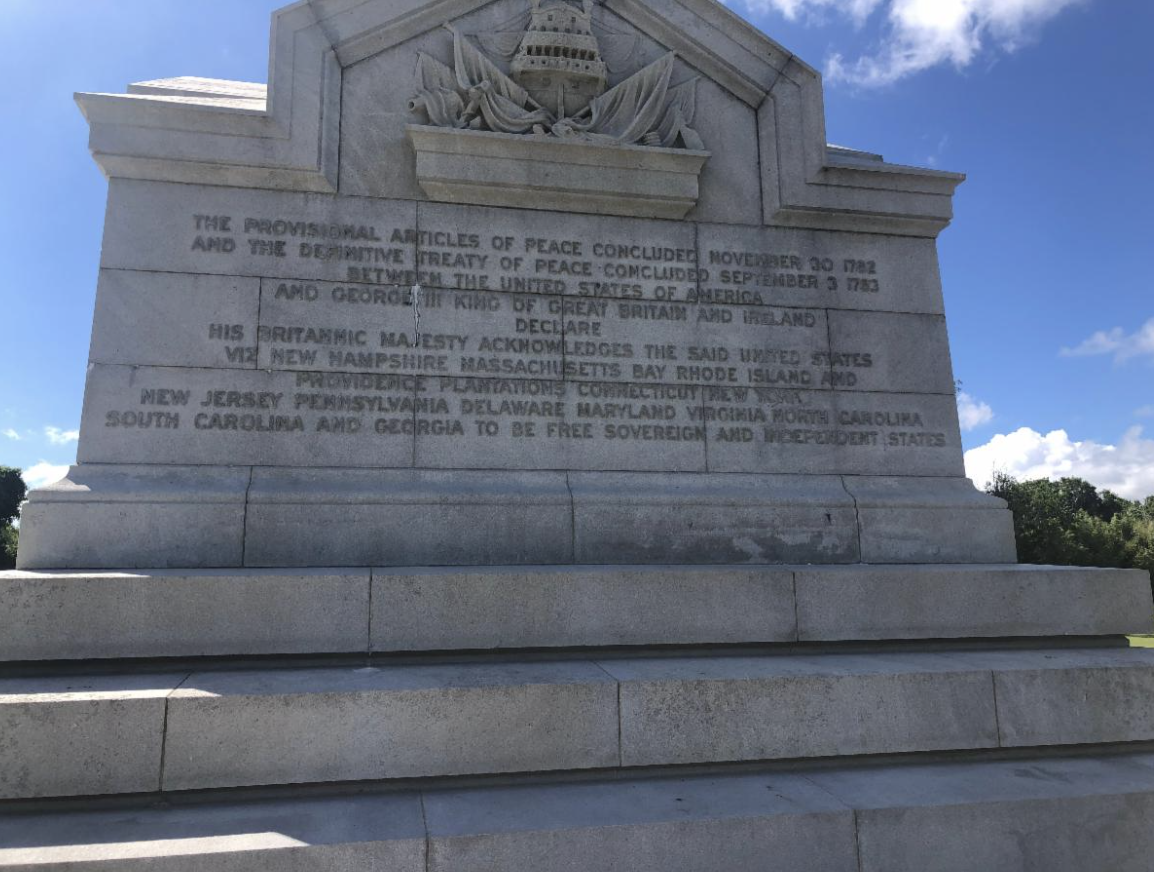
Bronze plaque, « In memory of the men of the French Fleet »
A few feet near the Monument to the Alliance & Victory,
Yorktown, VA
37.233462,-76.504745
|
|
• Inscription:
“In memory of the men of the French Fleet who died in the naval phase of the
Yorktown campaign in the Battle off the Virginia Capes on 5 September 1781.
In appreciation of the service of Admiral François Joseph Paul de Grasse who brought his entire West Indies Fleet to the aid of the Americans, who transported more than 3000 French troops under the command of the Marquis de Saint-Simon to reinforce the land Forces, and who commanded the French Fleet in the battle off the Virginia Capes, defeating a squadron of the British Royal Navy under Admiral Thomas Graves. General George Washington called French naval superiority “the pivot upon which everything turned” as the French victory prevented General Earl Cornwallis from aid or escape by sea and allowed a smaller French Fleet from Newport under Commodore de Barras to enter the Cheasapeake Bay with siege guns essential in the land battle that followed. In commemoration of the bicentennial of this most important naval battle fought in American waters which assured the victory at Yorktown and American Independence.
This tablet is erected by The National Society Daughters of the American Revolution October 19, 1981”
|
|
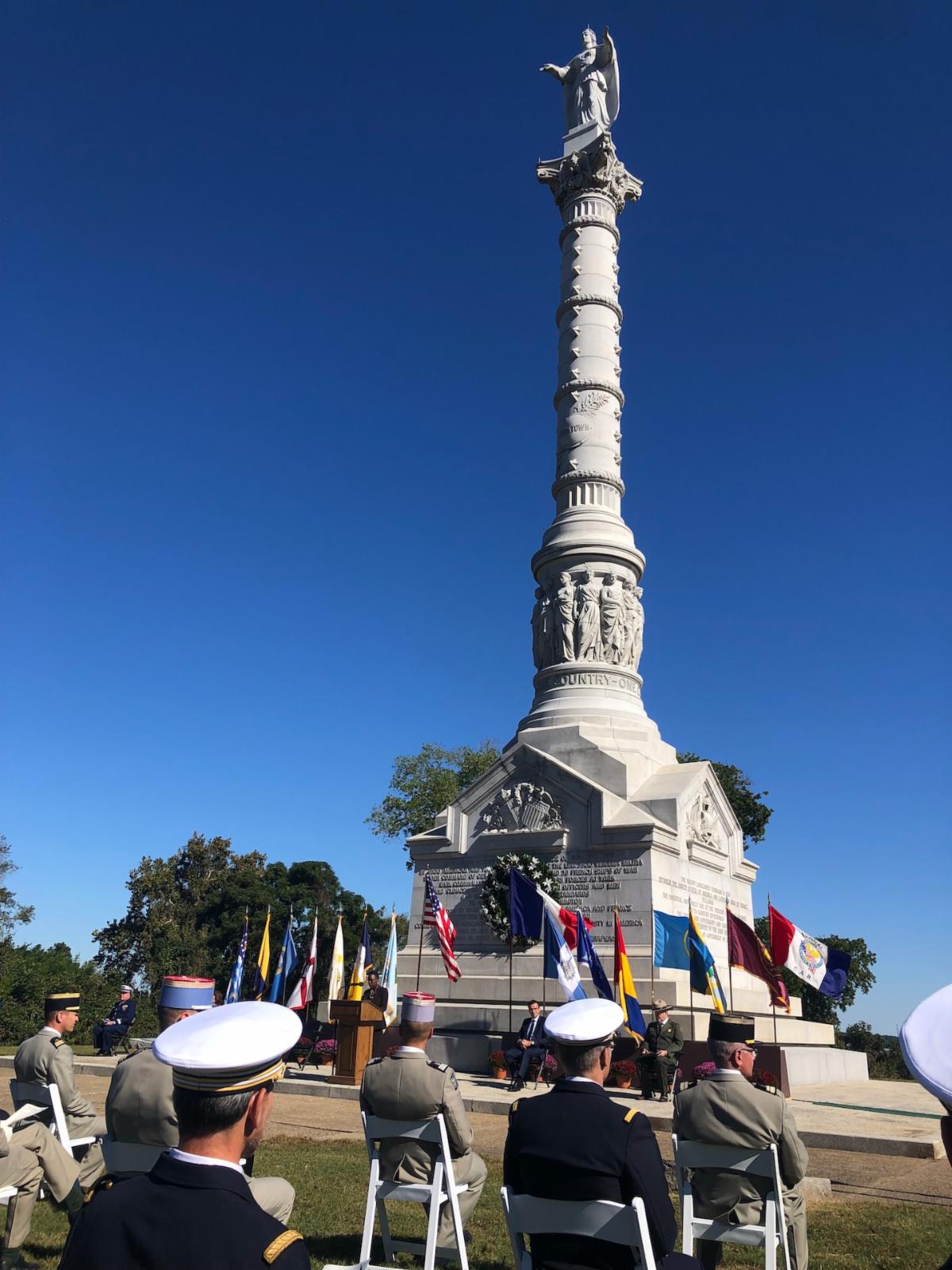
The Victory Monument stands as a fitting symbol to the French and American victory at Yorktown on October 19, 1781 - a victory that resulted in American Independence.
The Yorktown Monument to "The Alliance and Victory" was the first monument ever authorized by the Federal Government.
|
|
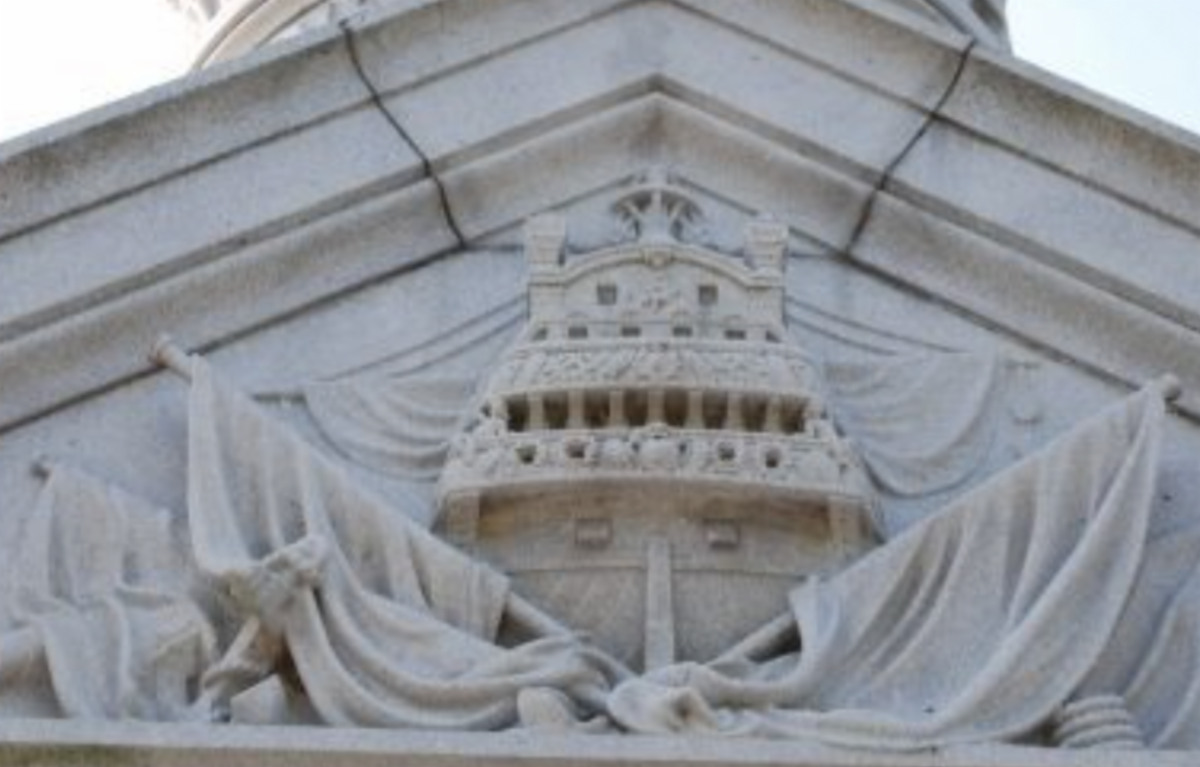
The detail above depicts (most likely) Admiral de Grasse’s flagship 104-gun ship “Ville de Paris". The 104-cannon flagship of Admiral de Grasse, the "Ville de Paris" was originally laid down in 1757 as the 90-gun Impétueux; she was funded by the City of Paris and renamed Ville de Paris in 1762 as a result of the "don des vaisseaux", Duc de Choiseul’s campaign to raise funds for the Marine Royale from the cities and provinces of France.
|
|
PLAQUE IN HONOR OF ADMIRAL DE GRASSE,
CUSTOMS HOUSE, YORKTOWN
|
|
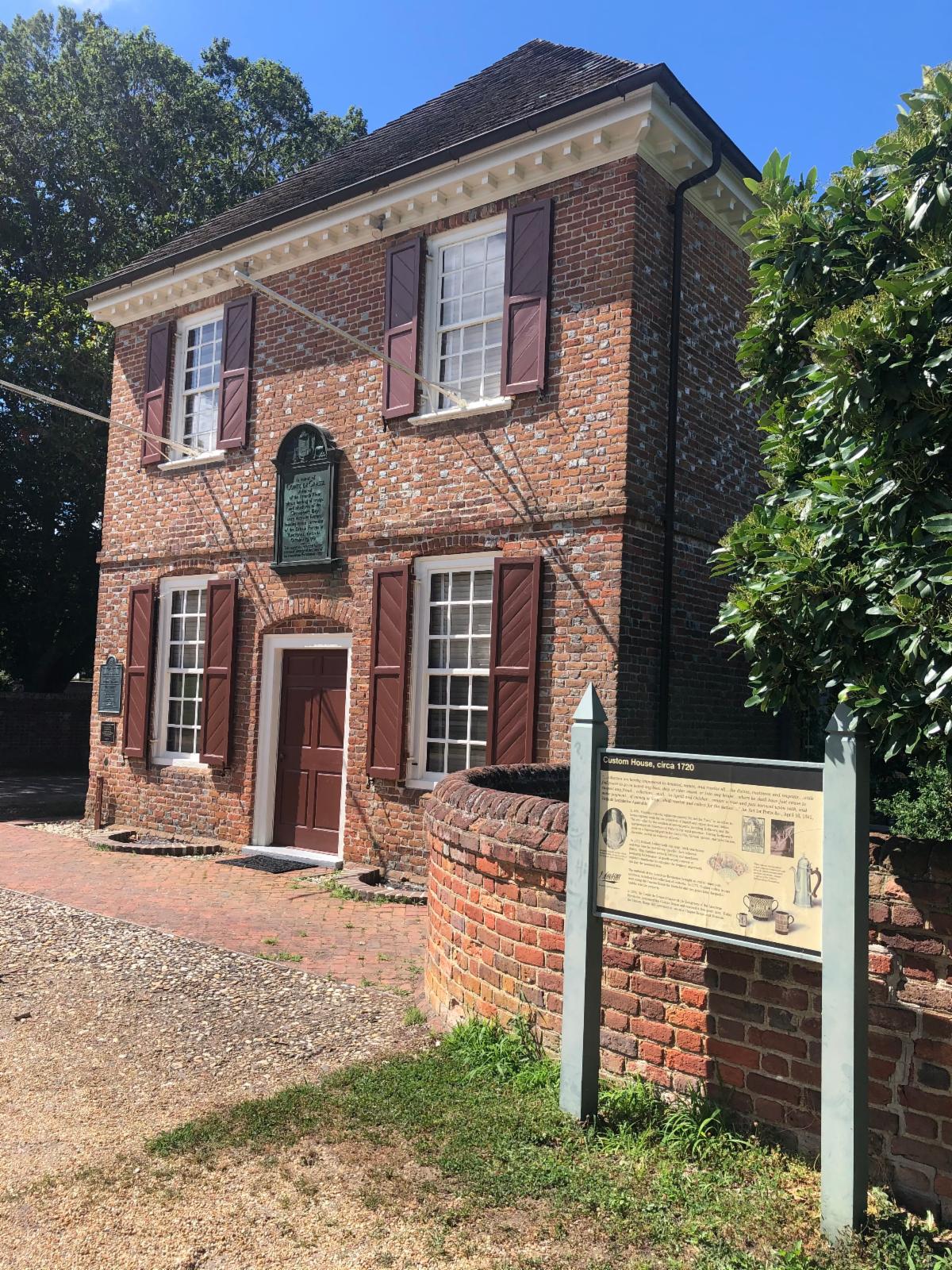
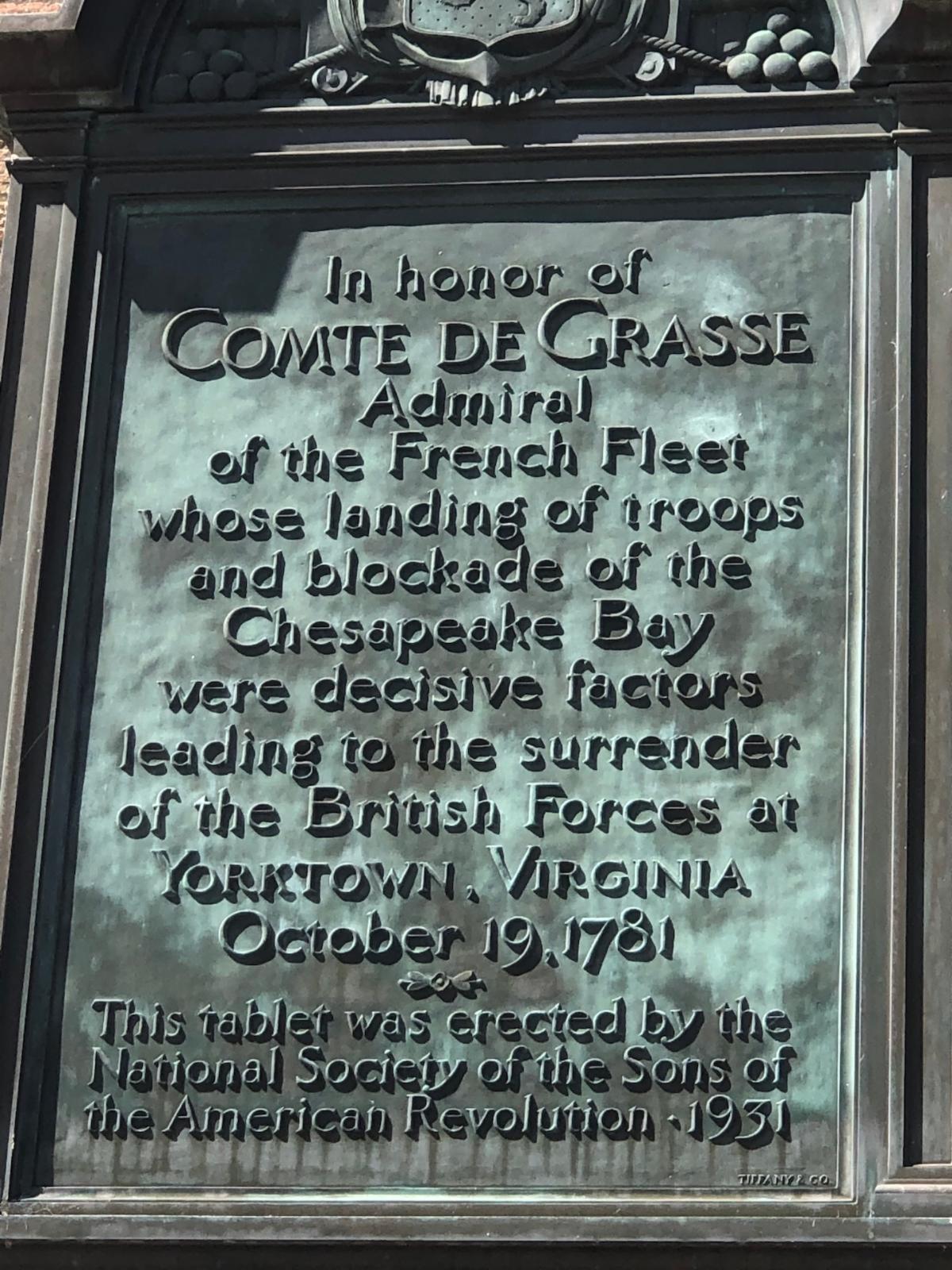
Tablet, Comte de Grasse, at Old Custom House
410 Main Street, Yorktown, VA 23690 In the heart of historic Newport
http://www.comtedegrasse-dar.org/customhouse.html 37.234885,-76.507711
Photos: Thierry Chaunu (2020)
|
|
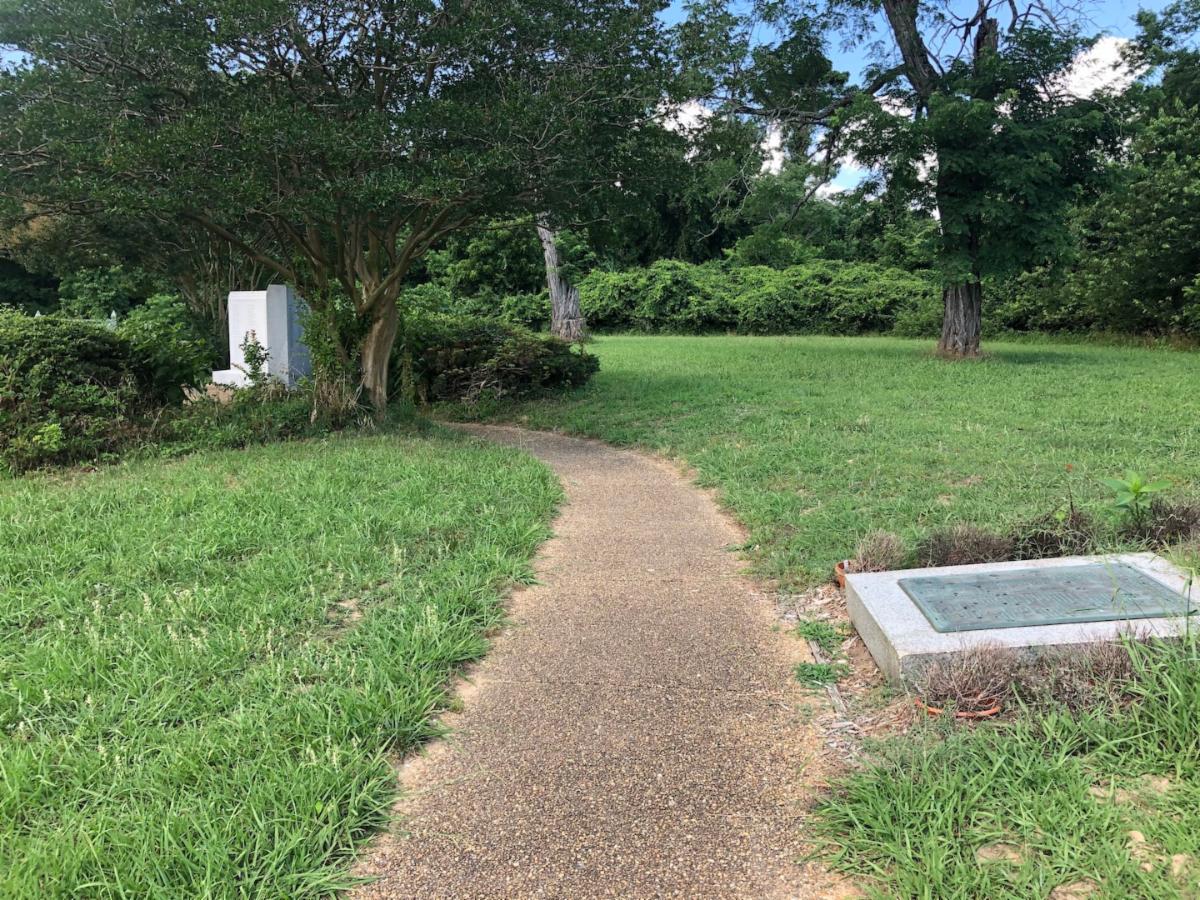
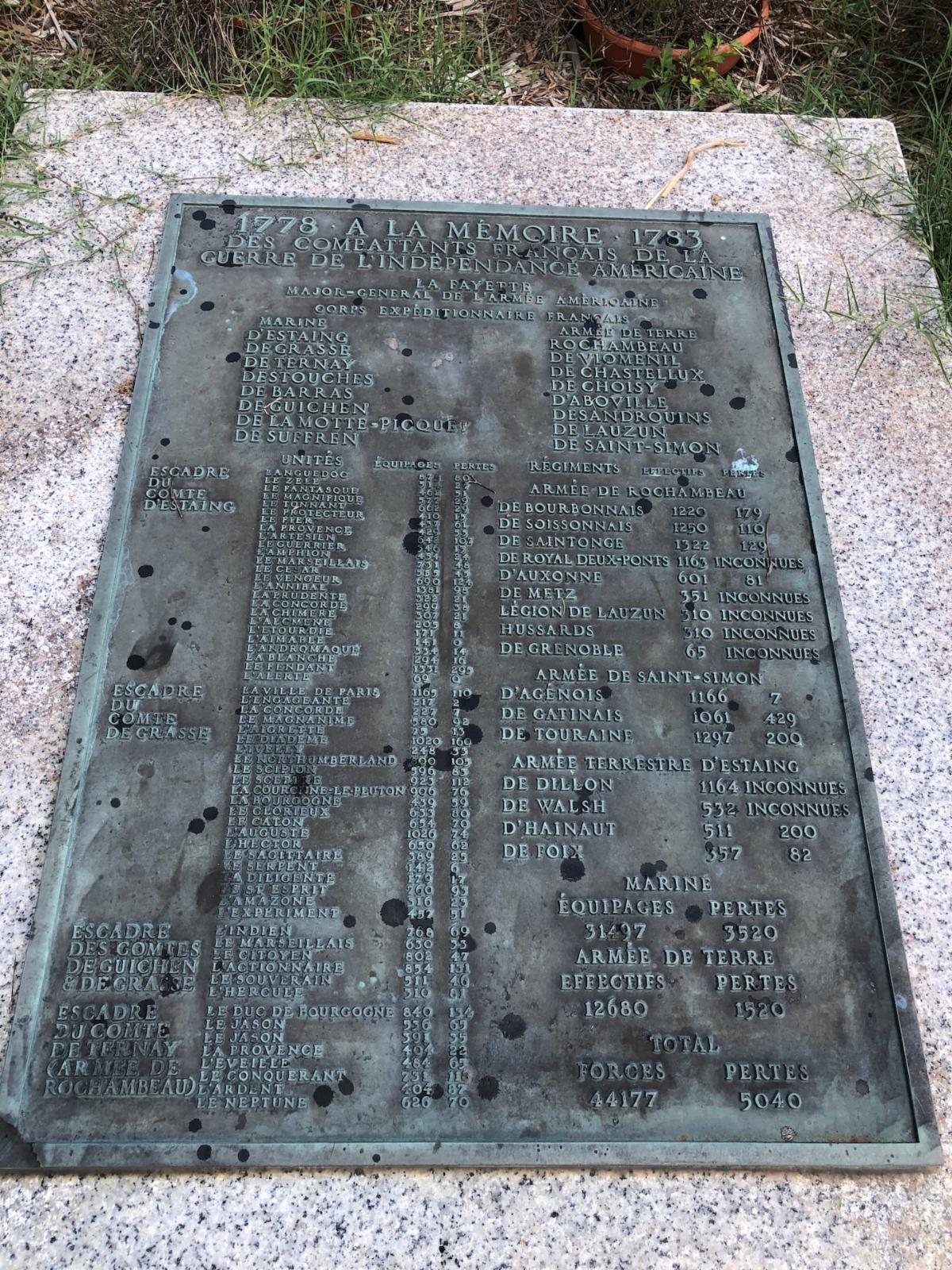
PLAQUE TO THE FRENCH ARMY AND NAVY CASUALTIES
NEAR THE FRENCH MEMORIAL, YORKTOWN
|
|
French Memorial Plaque, Yorktown
Located near the French Memorial
Fusiliers Redoubt Ram (by the river, across the American Revolution Museum),
Yorktown, VA
Photos: Alain Abad, Colonel, French Army
The American Society of Le Souvenir Français Inc. has applied for a permit to install a bronze plaque next to this one, dedicated to the "Memory of the thousands of French Sailors and Soldiers who died at sea" during the American Revolutionary War and who rest at the bottom of the ocean with no sepulture. We hope to receive approval and inaugurate it in 2023.
|
|
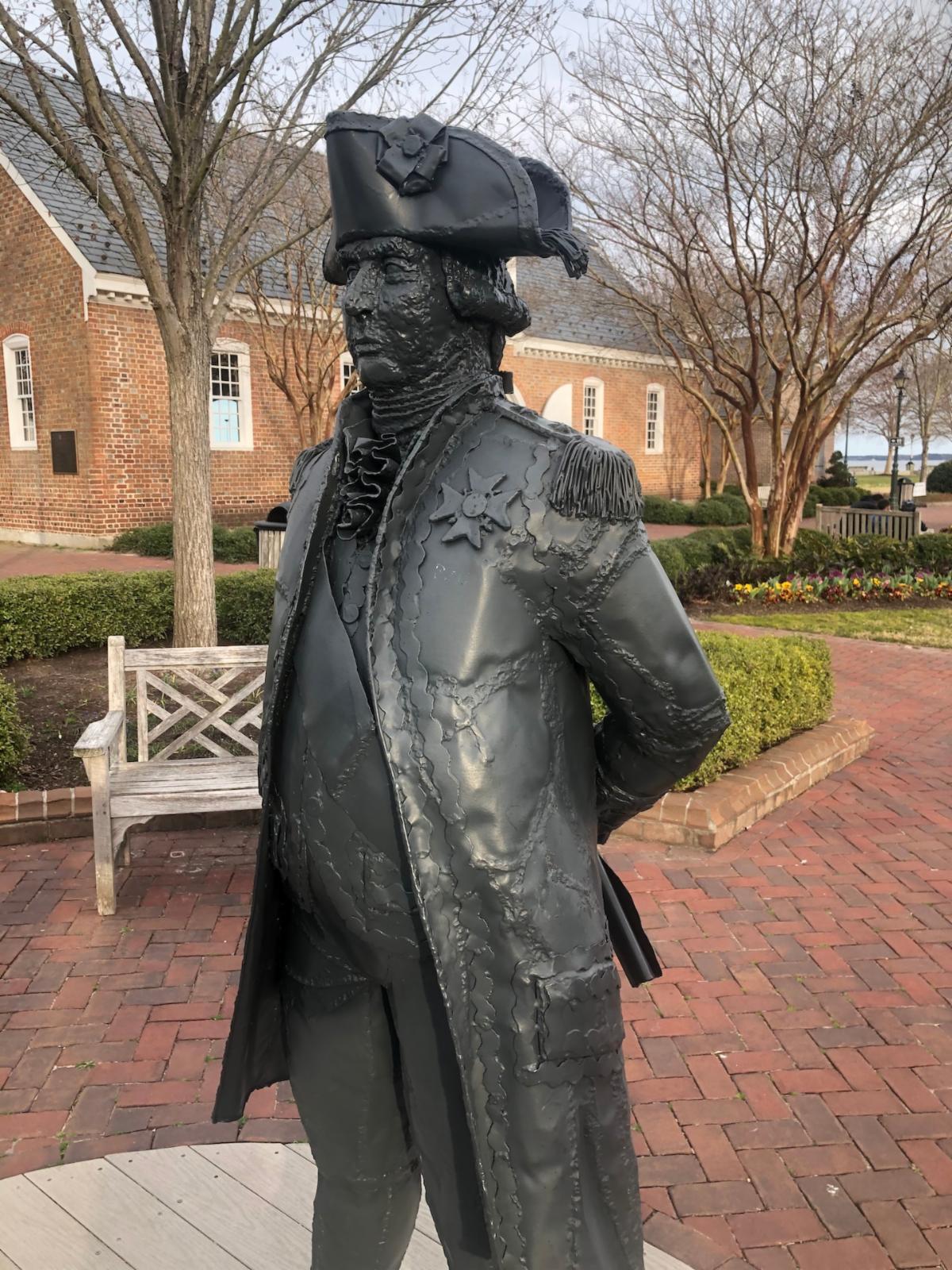
STATUE OF ADMIRAL DE GRASSE
YORKTOWN, VA
|
|
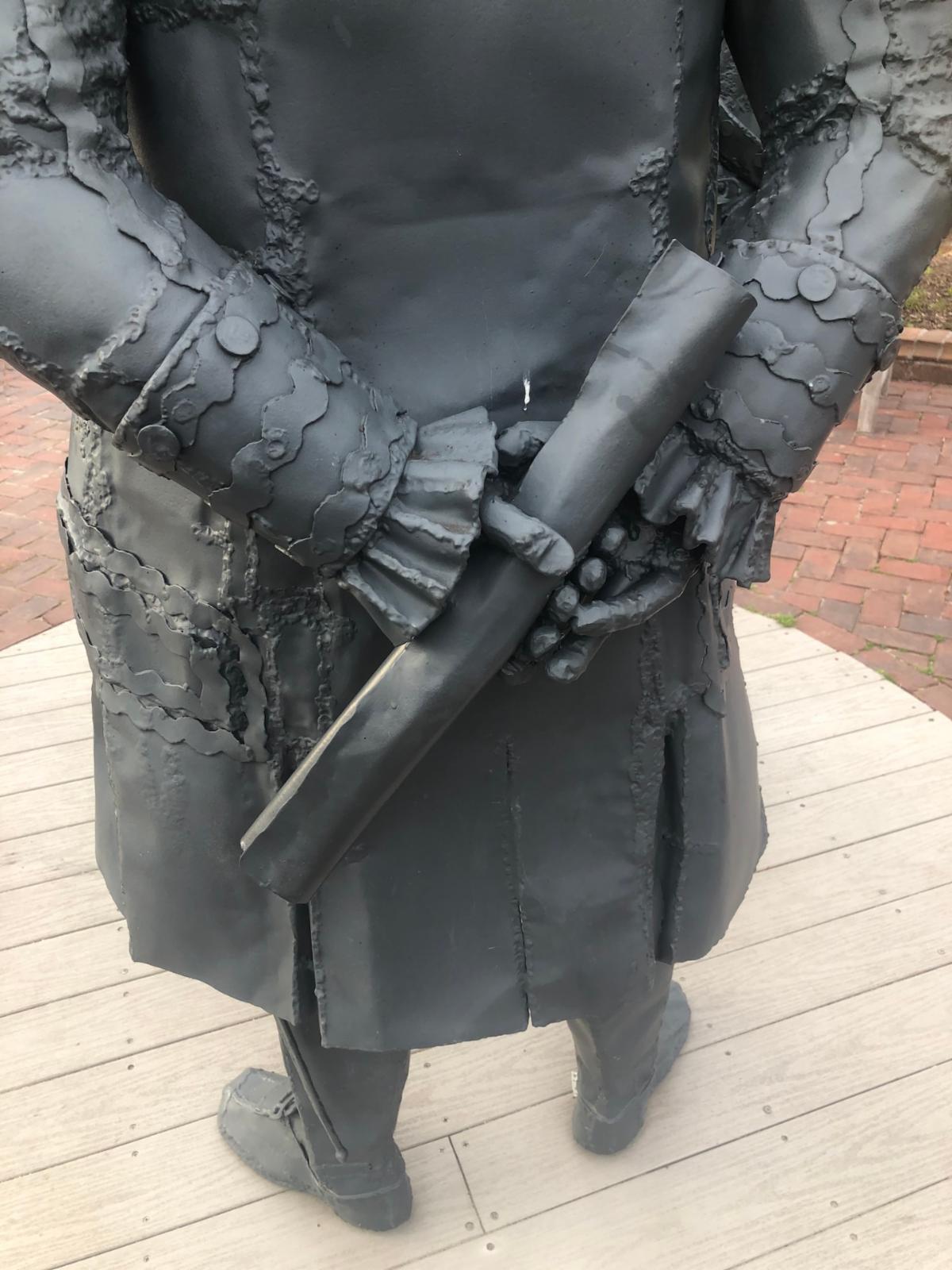
Riverwalk Landing, sidewalk along Water Street, Yorktown, VA
General George Washington and Admiral Francois DeGrasse, were the original two statues inaugurated in 2005. General Lafayette joined them in 2017, and Comte de Rochambeau in 2021.
|
|
Cyd Player, is a Williamsburg-based artist who sculpted the four statues. She spent about 10 months on Lafayette alone.
The American Friends of Lafayette led the fundraising for the statue and credited the Celebrate Yorktown Committee for being the top donor. The Massachusetts Society of the Cincinnati and members of the Ordre Lafayette contributed as well.
|
|
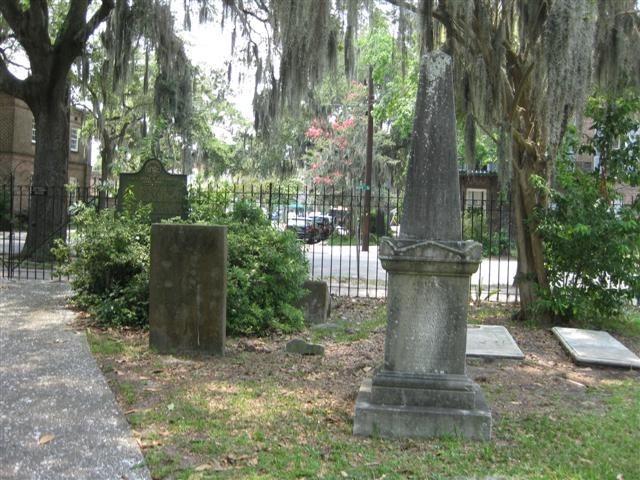
CAPT. DENIS N. COTTINEAU
A French Captain in the nascent US Navy
|
|
Tomb, “Capt. Denis N. Cottineau (1745-1808)”
218 Abercorn St, Savannah, GA 31401
|
|
• Inscription:
“This grave links Savannah with one of history's greatest naval dramas - the epic fight in 1779 between the "Bon Homme Richard" and "Serapis" in which John Paul Jones immortalized himself. Denis Nicolas Cottineau de Kerloguen received a commission in the Continental Navy during the American Revolution. Commanding the slow sailing “Pallas” during the famous naval engagement of September 23, 1779, Capt. Cottineau, by skillful seamanship, forced H.M.S. “Countess of Scarborough” to strike her colors. He was subsequently wounded in a duel with another officer, Pierre Landais, against whom Commodore Jones made serious charges after the battle.
Cottineau later settled in the French West Indies. During the slave insurrection in San Domingo he fled to Pennsylvania where he joined several fellow French refugees in establishing a colony. Suffering from a “lingering illness,” he came to Savannah early in 1808. Capt. Cottineau died here, Nov. 29 of that year, at the residence of Abbé Carles. Cottineau’s widow was the sister of the Marquis de Montalet who once owned the Hermitage plantation near Savannah.
In 1928 Ambassador Paul Claudel of France knelt in homage here at the grave of the gallant Frenchman who helped establish the prestige of the infant American Navy.
Erected 1957 by Georgia Historical Commission”
|
|
ADMIRAL CHARLES HECTOR, COMTE D'ESTAING: |
|
Public Domain, https://commons.wikimedia.org/w/index.php?curid=140493 |
|
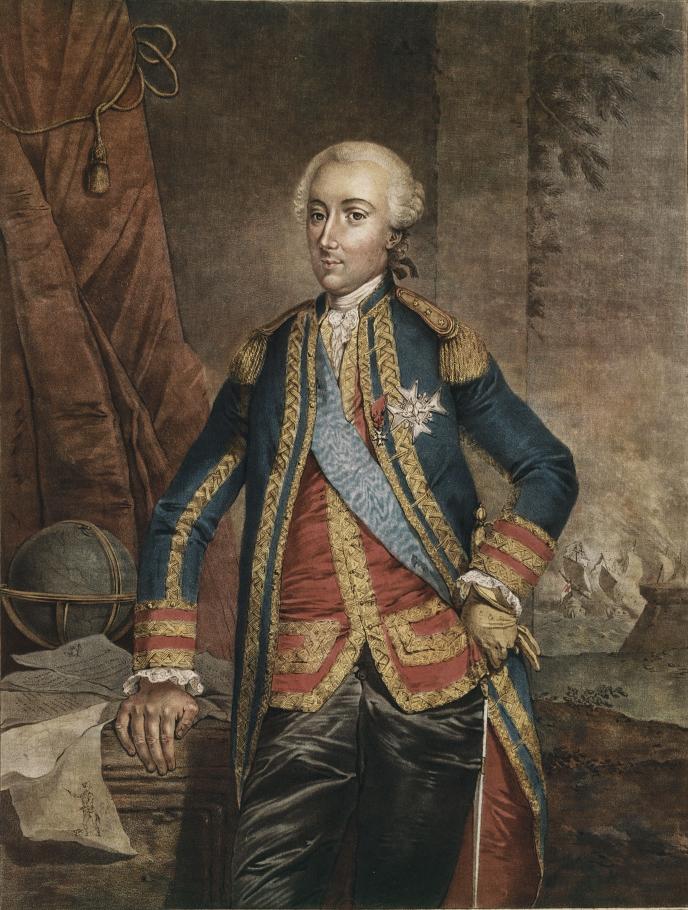
• Jean Baptiste Charles Henri Hector, comte d'Estaing (24 November 1729 – 28 April 1794) was a French general and admiral.
• He started his career in the French Army, and reached the rank of Brigadier General in the infantry, fought the British in India during the Seven Years War (known in America as the French & Indian War), was wounded and made prisoner, was released, transferred there to the French Navy and fought gallantly in the Indian Ocean. Back at the Court of Versailles, he managed to be promoted Lieutenant General of the Naval Forces. This promotion rattled many career Navy officers, and made him somewhat unpopular.
• Named Vice-Admiral for the Atlantic, he initially commanded the French naval forces in the first phase of the American War of Independence.
His record was inconclusive. Although he was very brave and never hesitated to lead his men in an assault, his subordinates resented his lack of strategic seamanship.
• Between the 11th and the 22nd of July 1778, he blockaded the smaller British fleet of Lord Howe at Sandy Hook, New Jersey, but didn't enter New York harbour, fearing the treacherous sand bar and unwilling to risk his ships.
He was similarly unsuccessful when planning to take Newport, R.I. when a violent storm damaged his ships and those of British Admiral Lowe, and forced him to repair in Boston, before sailing back to the West Indies.
• In June 1779 , after successfully taking Saint Vincent, he took Grenada from the British, and in August he sailed back to Savanah Georgia, to join forces with the Americans who wanted to recapture the British-held city.
• The siege consisted of a joint Franco-American attempt to retake Savannah from 16 September 1779 to 18 October 1779, with d'Estaing in overall command of the combined forces. After weeks of fruitless bombardment, on 9 October 1779, a major assault against the British siege works failed. During the attack, d'Estaing was twice wounded. When the assault failed, d'Estaing lifted the siege. British forces remained in control of coastal Georgia until they withdrew near the end of the war.
• It is during this siege that Major Pierre Charles L'Enfant tried to dismantle and set fire to the abatis (a barrier of sharpened tree limbs designed to slow down the attackers), was wounded and taken prisonner. He would be released later when General Rochambeau agreed to an exchange of prisoners, rejoined General Washington's staff and later designed Washington D.C.
• The admiral sailed back to France and although he was initially feted as a hero for the capture of Grenada, he eventually fell out of favor at the Court. He was guillotined during the French Revolution. The day of his sentence, he famously declared to the judges:
"After my head falls off, send it to the British, they will pay a good deal for it!..."
|
|
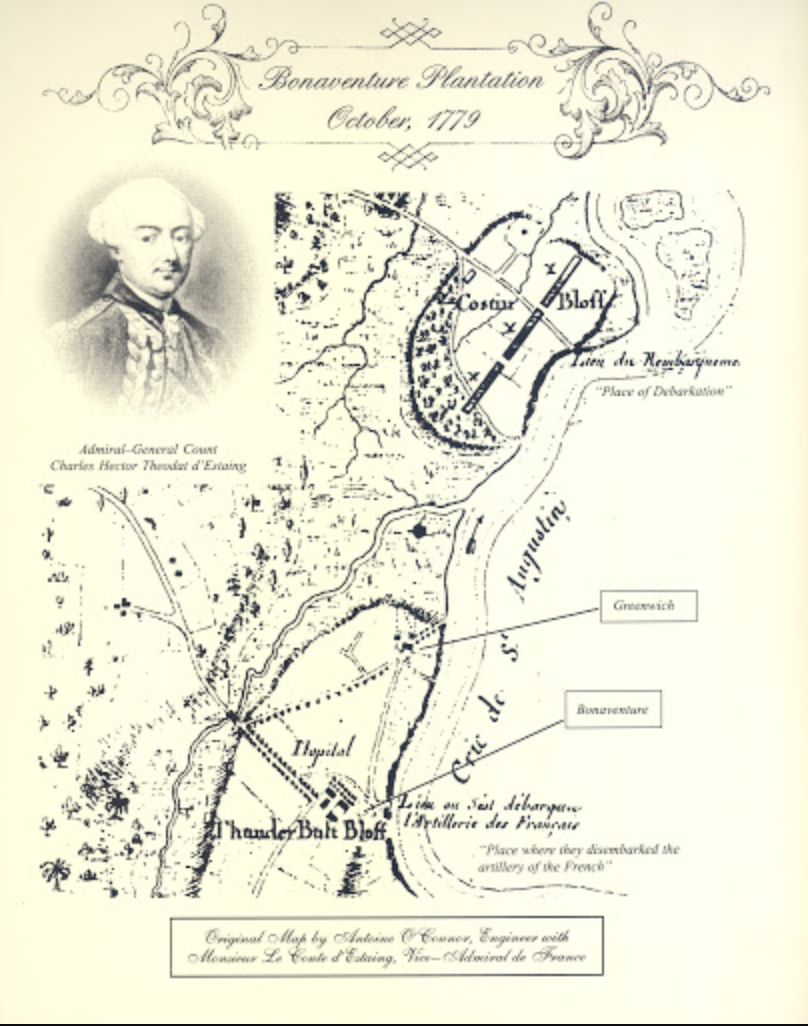
Map By Antoine O' Connor, engineer of Admiral d'Estaing
Public Domain, https://commons.wikimedia.org/w/index.php?curid=107371043
|
|
Marker “Beaulieu Plantation”
478 Beaulieu Avenue, Savannah, GA 31406
• Vice-Admiral Charles-Henri d'Estaing had sailed from San Domingo in the West Indies in August; his French troops had been disembarked in September at Beaulieu Plantation on the Vernon River.
• The French troops and American militia, numbering 5,500, half-encircled the British in Savannah on September 15. Within the city, the British forces were approximately 2630. When the battle ended at Spring Hill that October 9th morning 333 British, French and American soldiers and 32 officers were dead; 377 lay wounded.
• The dead were buried in a mass grave probably on the site of the present Savannah visitor's Center.
• Excerpts of marker
:
“Here in 1779 under
Count d'Estaing the
French landed to join
the Americans under
General Lincoln in
the Siege Of Savannah
W.P.A. 1936. D.A.R. S.R.”
|
|
Jacques-Melchior Saint-Laurent, Comte de Barras |
|
Jacques Louis Melchior de BARRAS-SAINT-LAURENT |
|
Jacques-Melchior Saint-Laurent, Comte de Barras (1719–1793 notably served in Yorktown. He was a scion of one of the most ancient (since the Crusades) and most famous noble families of Provence. He enlisted in the French Navy at the age of 15, rose through the ranks and by 1778 commanded a squadron under Admiral de Ternay. In 1781, he was named in charge of the squadron stationed in Newport, RI and commanded the three-decker ship of the line Duc de Bourgogne.
Based in Newport, and technically outranking admiral de Grasse, he nevertheless agreed to play a hidden and unheralded role in carrying to the siege all the heavy artillery brought by the French, which so effectively pounded the British positions day and night.
Afterwards Barras served under De Grasse in the West Indies. He led the French expedition that captured Montserrat in February 1782 then participated in the ill-fated Battle of the Saintes in the Caribbean Sea where the British prevailed and thwarted the invasion plan against Jamaica.
|
|
CAPTAIN LATOUCHE-TREVILLE |
|
Portrait of Latouche-Tréville as a rear-admiral, in 1792. Louis-Philippe commissioned the painting for the History Museum of Versailles in 1835; By Georges Rouget - Public Domain, https://commons.wikimedia.org/w/index.php?curid=17859662
|
|
Latouche enlisted at the age of 13. At the time of the American War of Independence, he was a frigate captain, and became noticed for his ardor in combat and naval competence. His two-frigate squadron with fellow captain La Pérouse, who went on to become the world-renowned navigator explorer, once manoeuvred a 74-gun ship of the line to the point of sinking.
In May 1777, he was promoted to lieutenant and was given command of the 20-gun corvette Rossignol, then captain of the Hermione.
|
|
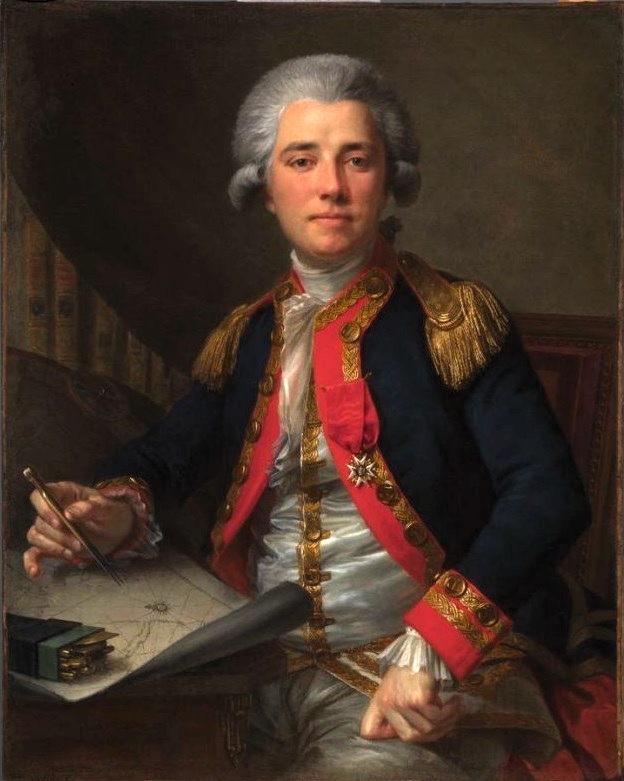
By Geneviève Brossard de Beaulieu - tumblr.com, Public Domain, https://commons.wikimedia.org/w/index.php?curid=62779249
1778 portrait of Count Jean-François de Galaup de La Pérouse (1741-1788), French sailor and explorer. Worn made on return from India: lieutenant's uniform with wearing of the Order of Saint-Louis issued the previous year. Location: Fine Arts Museums of San Francisco.
|
|
Jean François de Galaup, comte de La Pérouse 23 August 1741 – 1788 became noticed during the American War of Independence and two years after the Peace Treaty of Paris in 1983, was chosen by King Louis XVI to lead a scientific expedition around the world, equaling that of Captain Cook. His ships stopped in Chile, Hawaii, Alaska, California, Macau, Japan, Russia, and Australia, before wrecking on the reefs of Vanikoro in the Solomon Islands and his death at the hands of the island natives.
At the outbreak of the war in 1778, Lapérouse was given command of the 32-gun frigate Amazone. On 7 October 1779, he captured the 20-gun HMS Ariel. La Pérouse was promoted to Captain in 1780, and served under Admiral Ternay, departing Brest on 2 May 1780. Lapérouse then transferred to Astrée, and was appointed to lead a frigate division, along with Hermione, commanded by Latouche-Tréville.
|
|
Action of 21 July 1781 - By Auguste-Louis de Rossel de Cercy - Musée national de la marine, Public Domain, https://commons.wikimedia.org/w/index.php?curid=7319990
Naval battle off Louisbourg, July 21, 1781. On July 21, 1781, the French 32-gun frigates Astrée and Hermione, commanded respectively by La Pérouse and Latouche-Tréville, engaged a convoy of 18 British ships and their Royal Navy escorts. After a few hours of fighting, HMS Jack lowered her flag and HMS Charlestown was dismasted from her mainmast. Taking advantage of the darkness at nightfall, the latter slipped away.
|
|
This Bulletin only outlines the maritime dimension of the American Revolutionary War in American waters.
Many naval battles have been fought in other theaters of operation, such as the Caribbean, the Indian Ocean... Many exploits, many officers deserve a complete Bulletin. We will no doubt have the opportunity to do so in the future.
• Thus, the eminent role of the illustrious family of La Croix de Castries, starting with the Marquis Charles-Eugène-Gabriel de La Croix de Castries, (whom the Court called Castries) who had succeeded Minister Sartine on October 16, 1780. He is the one who convinced Prime Minister Maurepas and Foreign Minister Vergennes that the war could be won.
Two other members of this family participated in the War of Independence in Admiral de Ternay's squadron:
• Armand-Charles-Augustin de La Croix de Castries, Comte de Charlus, (known as Charlus in America) son of Charles-Eugène de La Croix de Castries, and enlisted at the age of 24, second colonel of the Saintonge regiment, who was aboard the Jason, and who wrote the "Journal of my trip to America"
• Anne-Jean-Jacques-Scipion de La Croix de Vagnas, (Scipion) Vicomte de Castries, cousin of Charles-Eugène, engaged at 23, who served on board the Neptune and the Hermione, who wrote his riveting "Maritime Memories".
We recommend that you visit the Château de Castries, in the town of Castries:
Postal address: Friends of the Château de Castries, 7 rue du château 34160 Castries
|
|
While there are many historical markers recounting all the different episodes of the French Army under Rochambeau, from Rhode Island to Virginia, there are very few of them paying tribute to the crucial role of the French Navy.
When there are dozens of plaques paying tribute to the memory of French soldiers who died for the cause of Liberty and who are buried in the United States, there are none paying tribute to the sailors (and soldiers) who died at sea and were unceremoniously dumped overboard, to rest at the bottom of the ocean and be eaten by fish.
The American Society of Le Souvenir Français is working on installing a bronze plaque in Yorktown, near the French Memorial, to address this sad omission. While the application is under review, we also plan to install at the River front in Yorktown an interpretive marker illustrating the crucial contribution of the French Navy to the American Independence.
We also will endeavor to join the fund raising campaign to help restore the replica of the frigate Hermione, and facilitate its return on a regular basis to the American shores.
|
|
PAST MONTHLY BULLETINS
OUR GOAL: turn the spotlight on a famous, or less famous, episode or historical figure during the long shared history between France and the United States, with illustrations and anecdotes.
You can have access to all our past Monthly Bulletin
since February 2021 by visiting our website:
You can click on the photos and on the links indicated in blue for more information and direct access to the references.
|
|
Our next Bulletin in June will look into the evolving perception of General George Washington towards the French, ranging from initial hostility during the "French & Indian War" to cautious cooperation before the landing of Rochambeau's troops, ending in laudatory admiration and genuine comradeship as the tides of war led to American Independence. |
|
TRIBUTE TO THE MEMORY OF PIERRE WHELAN
CALVARY CEMETERY, QUEENS, NY
SATURDAY MAY 28, 2022
WITH THE FEDERATION OF FRENCH WAR VETERANS
|
|
Photo: Daniel Falgerho, FFWV
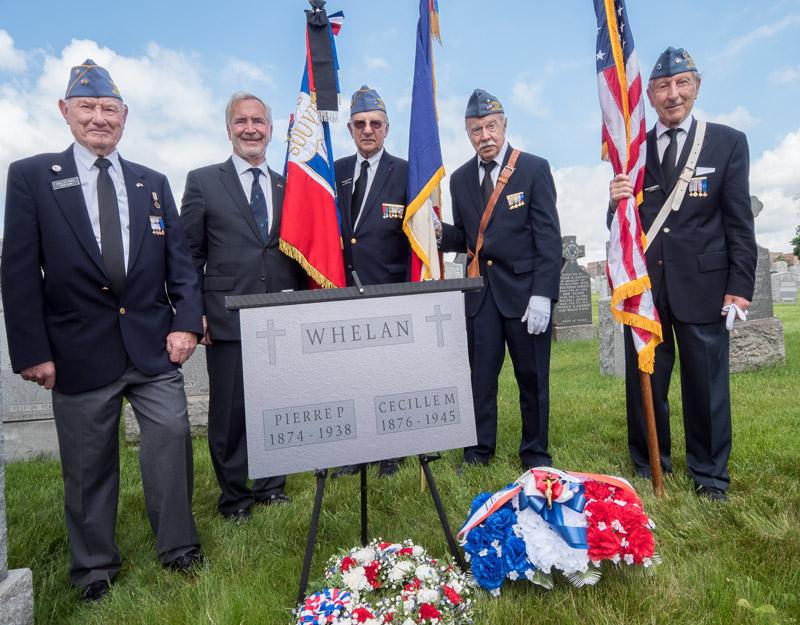
Pictured L to R: Jean Legall, Thierry Chaunu, Alain Dupuis, president, Henry Dubarry, and Paul Garabedian
In the presence of his grandson, Mr. Pierre Whelan, his wife Ann, their daughter and son-in-law, and Members of the FFWV led by Alain Dupuis, we conducted a ceremony to pay tribute to Mr. Pierre Whelan, WWI Veteran and member of the French Diplomatic Corps stationed in Washington DC, from 1908 to 1923. He died on November 21, 1938, and is buried in Section 19, Range 1A, Plot T, Grave 12.
Thierry Chaunu read the biography of Pierre Whelan, collaborator of Jean-Jules Jusserand, one of the greatest Ambassadors of France in the United States, (in office from 1906 to 1923), and gave the family a file on their ancestor.
|
|
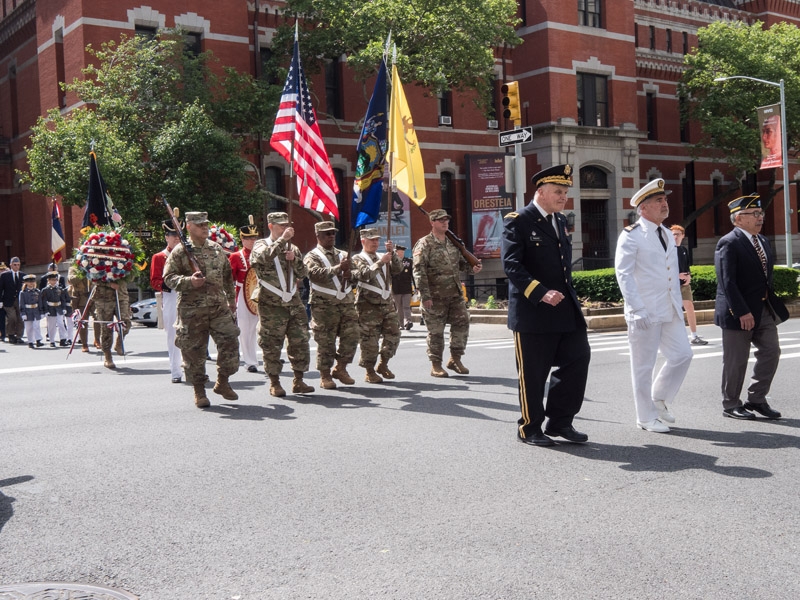
Brig. General Thomas J. Principe, New York National Guard, 7th Regiment Veterans association, leads the march from the Armory on Park Avenue to the 7th Regiment on Central Park.
Photo: Daniel Falgerho, Federation of French War Veterans
|
|
MEMORIAL DAY 2022 COMMEMORATION
WITH THE 7th REGIMENT
At the invitation of Brigadier General Thomas J. Principe, President, 7th Regiment Veterans, the Federation of French War Veterans participated in the Memorial Day traditional march. The procession went from the 7th Regiment Armory on Park Avenue to the 7th Regiment Memorial monument on Fifth Avenue, where BG Thomas J. Principe and LT CDR Thierry J. Chaunu President, American Society of Le Souvenir Français presented a wreath. MAJ Louis L. Nock, Chaplain, gave the invocation. Back at the armory, LT CDR Chaunu spoke about the unique historical bonds between France and the United States since the Treaty of Alliance of 1778, “By which France, first of all nations, recognized the independence of the United States” and received the commemorative medal of the 7th Regiment. This regiment hosted General Lafayette during his triumphal tour of the United States in 1824, and was the first one to adopt the name “National Guard” in his honor, followed in due time by all other 49 States. A painting of General Lafayette adorns the wall of the Armory, facing General George Washington’s.
For more photos:
|
|
INAUGURATION OF A LAFAYETTE MARKER AT
WEST POINT MILITARY ACADEMY
JUNE 6, 2022
|
|
Marker Dedication
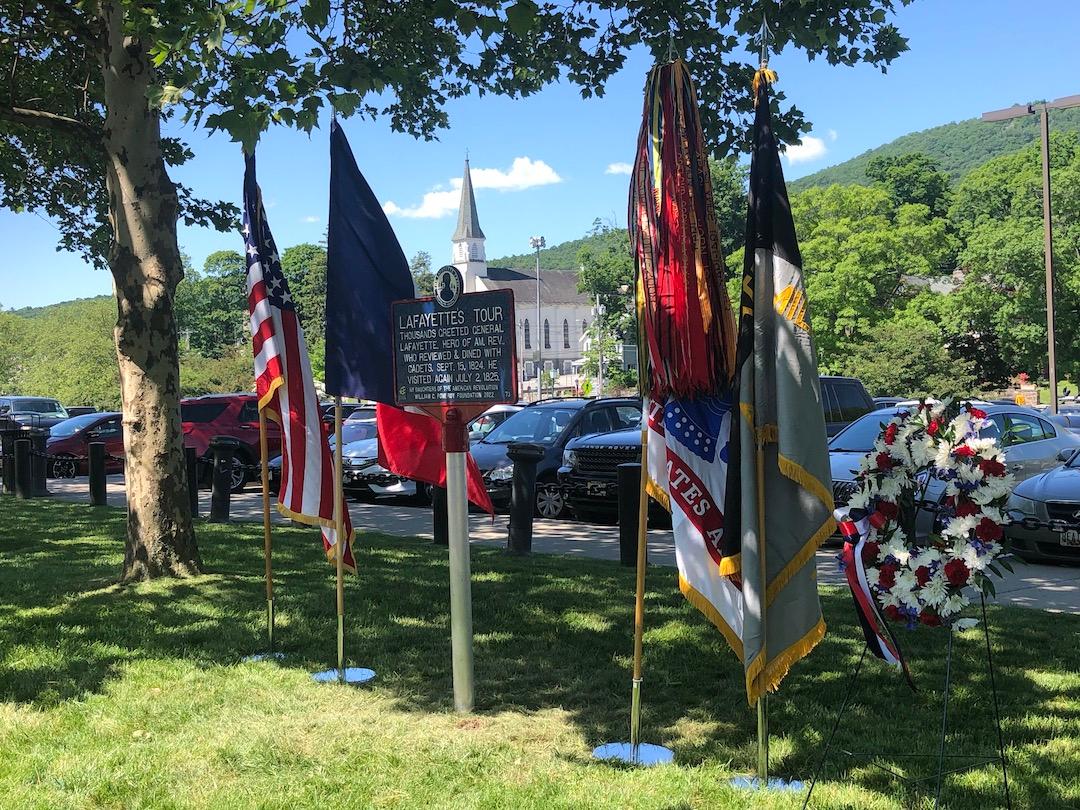
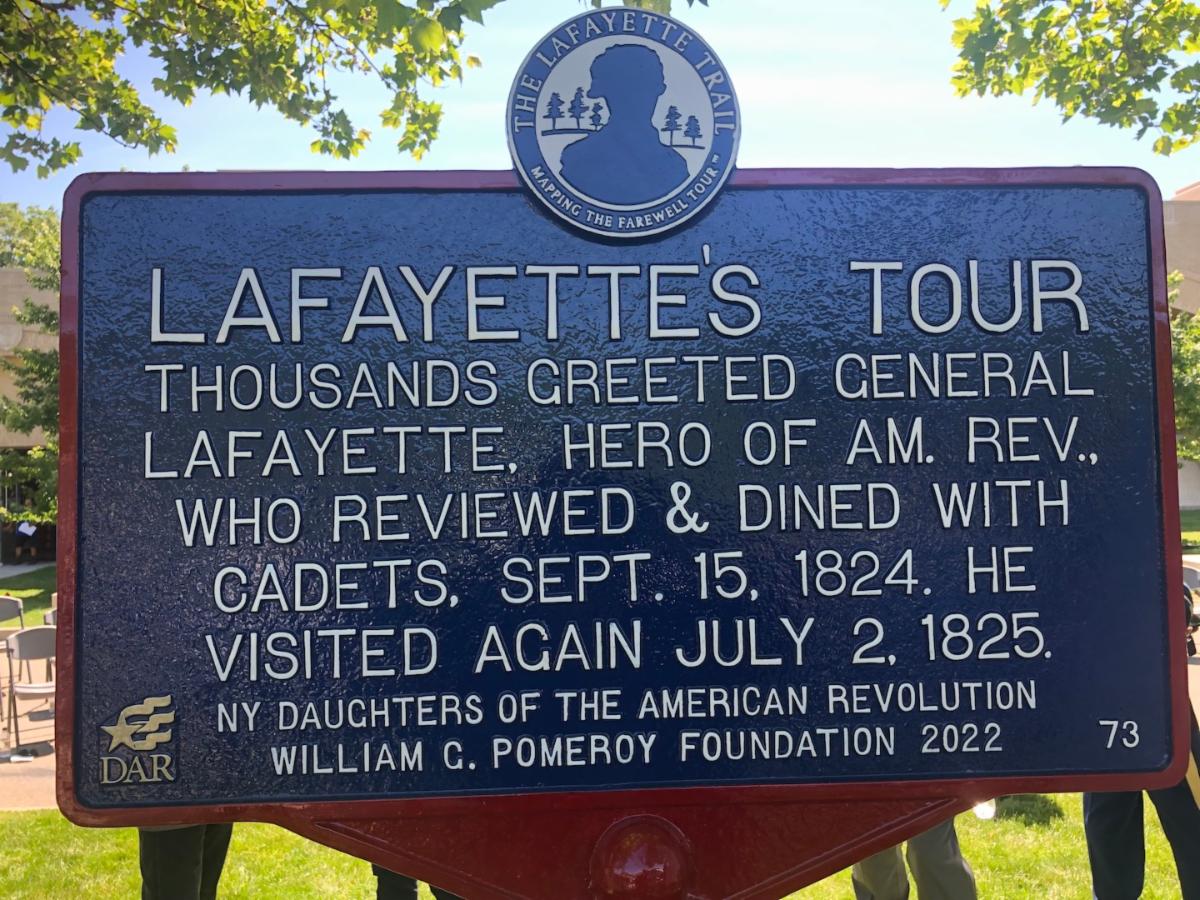
• We were honored to be invited to the dedication of a new historic marker at the United States Military Academy at West Point, NY by The Lafayette Trail, Inc.
The marker dedication ceremony took place in front of the Visitors Center located at 2107 New South Post Road, West Point, NY 10928
The leadership of the United States Military Academy at West Point for including the Lafayette Trail marker dedication ceremony as part of its D-Day commemorations.
The program included the playing of both the French and American national anthems, a presentation of The Lafayette Trail framework, and greetings from Robert McDonald, Professor of History, United States Military Academy,
followed by remarks about the significance of Lafayette's two visits to West Point during his Farewell Tour of the U.S. on September 15, 1824, and July 2, 1825 by Julien Icher, president, Denise VanBuren, President General, Daughters of the American Revolution, and Mr. Jérémie Robert, Consul General of France in New York.
The event included a wreath-laying ceremony, a moment of silence, and the playing of "Over There" by the West Point Band to honor the memory of the numerous U.S. soldiers who died on June 6, 1944, on the beaches of Normandy in France, far from home, to defend and preserve European freedom.
A guided tour of the Military Academy ensued, as well as a luncheon. The ties with France are numerous, and we will dedicate a monthly Bulletin to the history of the famed institution.
|
|
CEREMONY TO INAUGURATE A NEW MARKER AT
MAJOR PIERRE CHARLES L'ENFANT MONUMENT
ARLINGTON NATIONAL CEMETERY
|
|
Monument of Major Pierre Charles L'Enfant at the highest point in Arlington National Cemetery, overlooking the city he created,
Photos: Sherryl Belinsky, Honorary Regent, Stone Bridge Chapter, State Chair, VIS Committee
|
|
• On Tuesday, June 14, 2022, at Arlington National Cemetery, we proudly inaugurated with co-signer Denise VanBuren, President General, Daughters of the American Revolution, a new interpretive marker in front of the monument of Pierre Charles L’Enfant, the French military engineer and American Revolutionary War Patriot who designed the plans for Washington D.C.
It was a particularly moving ceremony, celebrating the unique historical bonds of alliance and friendship between France and the United States.
Among others who participated in our shared ceremony were:
Commonwealth of Virginia Lieutenant Governor Winsome Sears;
Deputy Ambassador of France Aurélie Bonal;
Arlington National Cemetery Superintendent Ray Alexander;
Executive Director of Army Cemeteries Karen Durham-Aguilera;
Military Women’s Memorial President Phyllis Wilson;
Society of the Honor Guard Tomb of the Unknown Soldier Co-Founder Richard Azzaro;
And representatives of a dozen patriotic and fraternal organizations, including, in alphabetical order, :
Lawrence Abbell, President, Washington-Rochambeau Revolutionary Route,
Joe Buche, Colonel, US Army (Retired), former Commander, 3rd Infantry Regiment, Tomb of the Unknown Soldier Foundation,
Cyril Carcy, Divisional General, French Air Force Defense Attache,
Colonel Maxime Do Tran, French Army, Deputy Defense Attache,
Alain Dupuis, president, Federation of French War Veterans,
Patrick du Tertre, president, Association of French Reserve Officers in the USA, Didier Choix, TheFrenchWillNeverForget.org,
Kym Hall, Superintendent, National Park Service,
Alan R. Hoffman, President, American Friends of Lafayette,
Donna Houle, Senior Director of Memorial Engagement & Impact, Military Women's Memorial,
P.J. Jeff Lambert, Society of Cincinnati,
David Lauhoff, president, and Gardiner Pearson, past president, Washington Memorial Heritage,
Bruce Meyer, president, Sons of the American Revolution,
Sharla P. Rausch, Director, District V, Virginia Daughters of the American Revolution,
Russell Rich, General President, General Society of the Sons of the Revolution, Charles J. Shacoshis, Jr., Chaplain, Society of the Honor Guard Tomb of the Unknown,
Chuck Schwam, COO, American Friends of Lafayette,
Colonel Benjamin “Soubi” Souberbielle, French Air Force, Deputy Defense Attache, Frank Keech Turner, General President, The Society of the Cincinnati,
Davis Wright, National President General, Sons of the American Revolution.
And many Distinguished Guests, to whom we address our heartfelt gratitude for their devotion and service to the ideals pursued by the Founding Fathers.
|
|
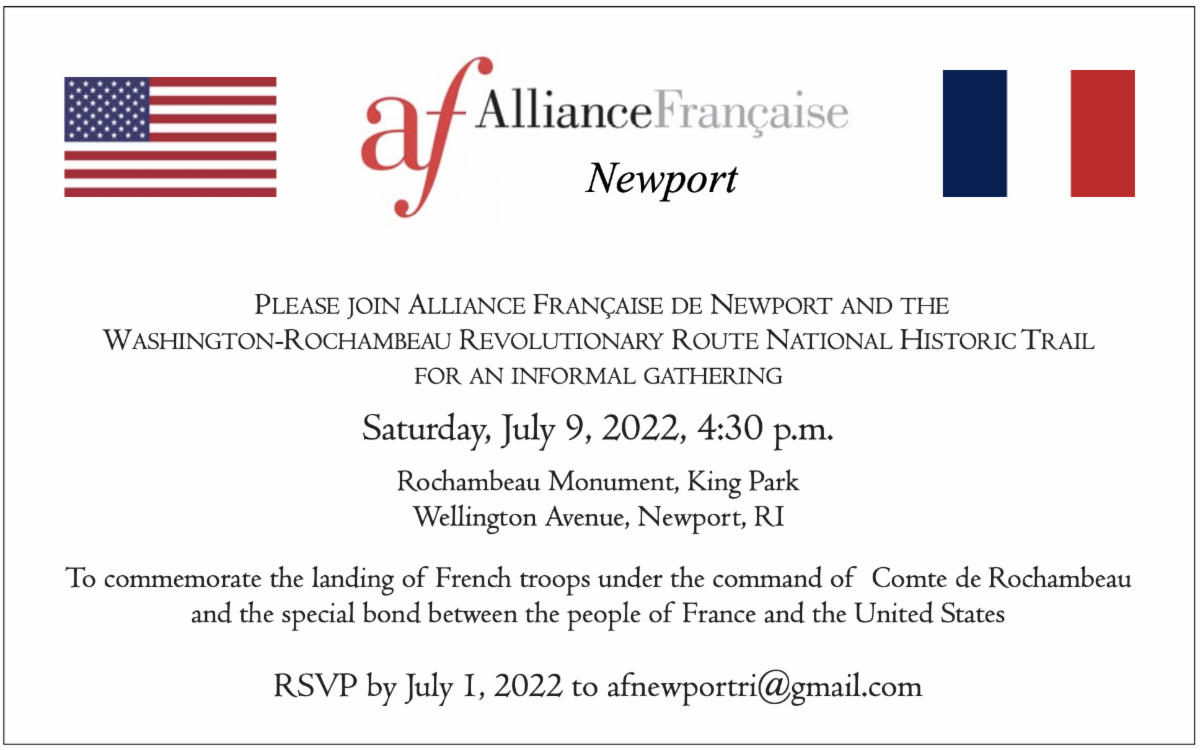
INVITATION
ANNUAL WREATH-LAYING CEREMONY
SATURDAY, JULY 9 AT 4:30PM
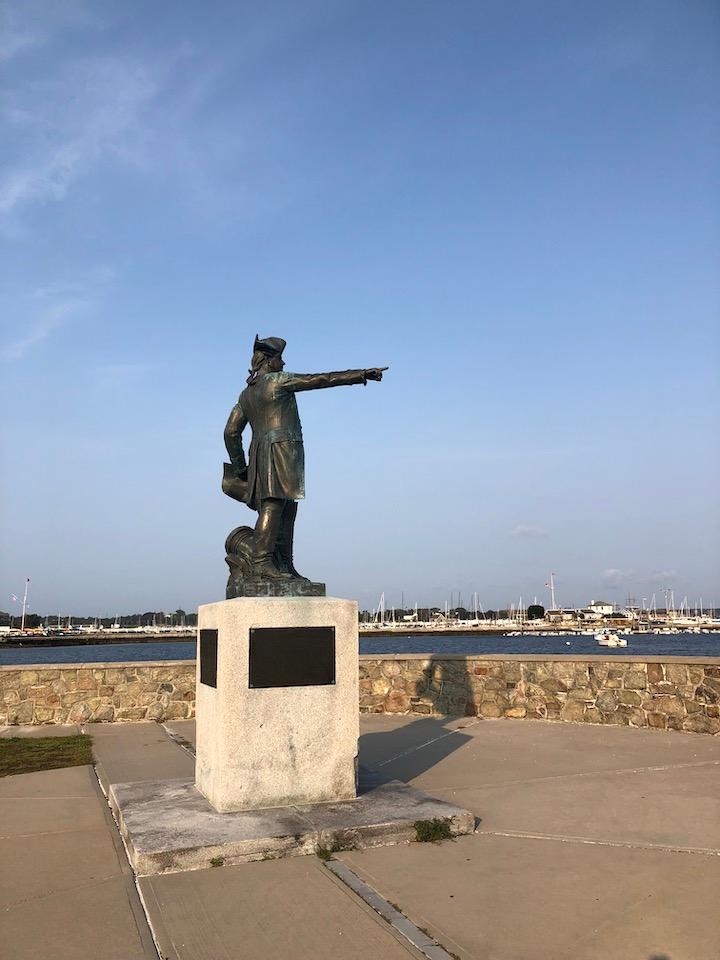
STATUE OF ROCHAMBEAU, NEWPORT, R.I.
AND TRIBUTE TO FRANCE WEEKEND
|
|
The American Society of Le Souvenir Français Inc. will lay a wreath in honor of the great General and the French Navy, alongside many other American patriotic and fraternal organizations.
Program:
Welcome by Alliance Française of Newport and City of Newport officials
French reenactors, including Comte de Rochambeau, will row ashore from the schooner and land on the beach west of the Rochambeau statue. They will be greeted by American soldiers (Newport Artillery) and will march to the Rochambeau statue area. (10‐15 minutes)
Wreaths will be laid at the statue and cannon will be fired from the schooner. (10 minutes)
Final remarks, thank‐yous and announcements about Sunday’s activities presented by the Newport Historical Society at the Great Friends Meeting House
|
|
CHÂTEAU DE ROCHAMBEAU
SATURDAY, JULY 2ND
A SPECIAL EVENING WITH THE GENERAL
|
|
JULY is around the corner ...
On July 2, a very special evening will take place at the Château de Rochambeau, to celebrate the upcoming 240th anniversary of the Victory of Yorktown, and the long-standing Franco-American friendship.
This exceptional festival will open its doors to the public at 6:00PM and will end at nightfall with a pyro-musical show on the banks of the Loir river.
You are welcome to tell your friends who reside in or who are visiting Western France.
Château of Rochambeau
1 Hameau de Rochambeau
41100, THORE-LA-ROCHETTE
France
|
|
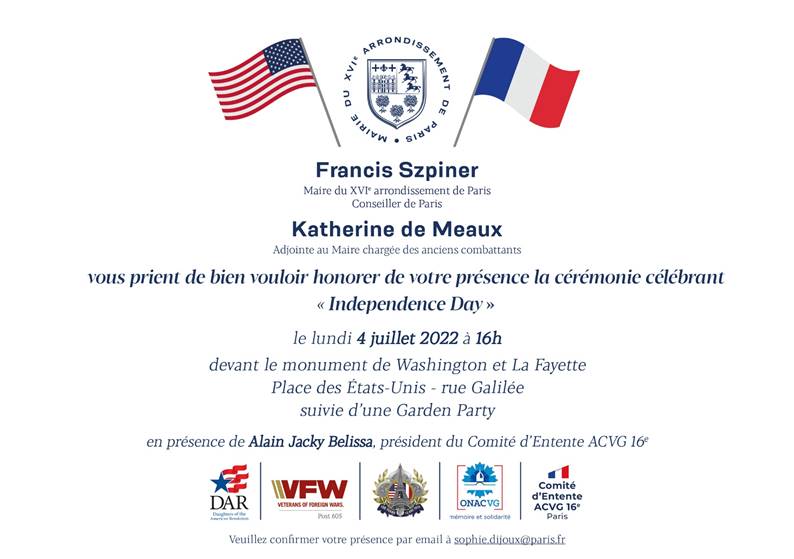
JULY 4TH CELEBRATION IN PARIS
AMERICAN LEGION POST 1
|
|
4TH OF JULY AGENDA:
Washington and La Fayette Monument
Place des Etats Unis - rue Galilée
Tree of Liberty - September 11th Memorial
Place des Etats-Unis
Monument to the American Volunteers of World War I
rue de Lubeck
Plaque in honor of Admiral de Grasse
Place Admiral de Grasse
Memorial Statue to Rochambeau
Place de Rochambeau
Garden Party to follow ceremonies hosted by the 16th arrondissement.
Ravivage ceremony at the Arc de Triomphe:
6:00 p.m. Placing of the flag bearers
6:20 p.m. Ceremony begins
A contingent of American Friends of Lafayette members will be visiting the Marquis' grave at Picpus on both July 4th and July 5th (the flag changing ceremony).
|
|
FÊTE NATIONALE DU 14-JUILLET À CENTRAL PARK, NYC |
|
The Consul General of France in New York, Jérémie Robert & the President of the Committee of French Speaking Societies, Gérard Epelbaum, officially invite you to Bastille Day: July 14!
July 14, 2022
6 p.m. to 10 p.m. (doors open at 5 p.m.)
at Rumsey Playfield, Central Park (69th Street & 5th Avenue)
Free admission
Program
6:00 p.m. - Opening of the Bastille Day festival
Cadets Lafayette brass band under the musical direction of Jacques LeTalon
Speech by the Consul General of France in New York Jérémie Robert
Speech by the President of the Committee of French Speaking Societies(CAFUSA) Gérard Epelbaum
French and American national anthems by Marie Viapiano:
The Marseillaise
The Star Spangled Banner
6:30 p.m. - French classical music with Virgil Boutellis, Adam Leites and Daniel Rafimayeri
As a trio, violinists Virgil Boutellis and Daniel Rafimayeri and oboist Adam Leites will introduce or rediscover pieces from the French classical repertoire to the public!
Classic meets contemporary here with a performance by New York FlexN dancer Cal Hunt and hip hop dancer Jai'Quin Coleman.
7:00 p.m. - Theater: Sganarelle, or The Imaginary Cuckold by the troupe of Molière in the Park
On the occasion of the 400th anniversary of the birth of the most famous of French playwrights, the professional actors of Molière in the Park will offer an original interpretation of Sganarelle or The Imaginary Cuckold. 45 minutes of dynamic and fun show! The performance will be in English.
7:45 p.m. - Jazz with China Moses and her musicians
Then back to music with the sparkling China Moses and her musicians, who will revisit in jazz version some of the greatest classics of French song: La Vie En Rose, La Javanaise, J'ai Deux Amours,... well more !
8:30 p.m. - Electro-pop with DeLaurentis
DeLaurentis, an accomplished electro-pop artist, will also be there for a concert combining tracks from his new album Unica and adaptations of essentials by Piaf, Gainsbourg and Christophe!
We will also find the dancer Cal Hunt who will choreograph the famous Bolero by Ravel revisited by DeLaurentis for the occasion.
9:10 p.m. - DJ Set with Joachim Garraud
The evening will end with dancing to a DJ set by Joachim Garraud, a key DJ and producer on the French electronic scene!
10:00 p.m. - End of the Bastille Day festival
|
|
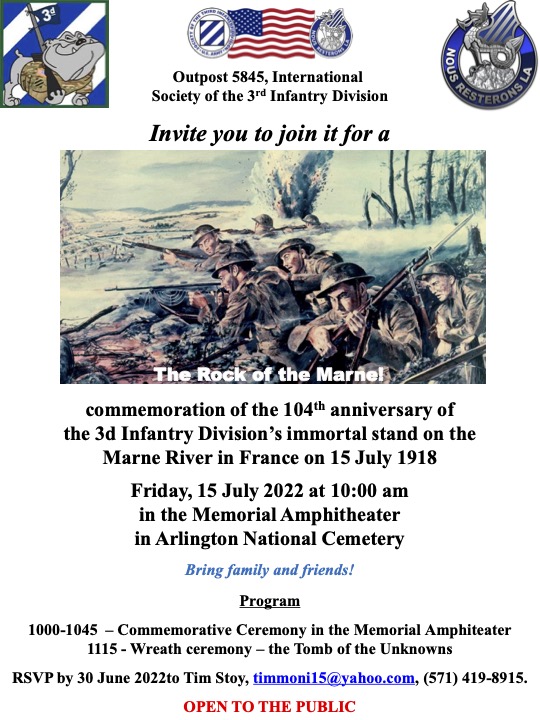
COMMEMORATION OF THE 3RD INFANTRY DIVISION
FRIDAY, JULY 15, 2022 AT 10:00AM
ARLINGTON NATIONAL CEMETERY
|
|
WEDNESDAY OCTOBER 19, 2022
YORKTOWN ANNUAL COMMEMORATION
Laying of wreaths at the French cemetery
Wreath laying at the French Memorial
Ceremony, Victory Monument
SATURDAY NOVEMBER 5, 2022 IN THE MORNING
Ceremony to commemorate the
25 soldiers from Rochambeau
buried in Providence Cemetery, Rhode Island
SATURDAY NOVEMBER 5, 2022 IN THE AFTERNOON
Ceremony in tribute to Mr. Joseph Scheinman
French resistance fighter, 1942
buried in New Bedford, Massachusetts
FRIDAY NOVEMBER 11, 2022 - VETERANS DAY
5th Avenue Parade
|
|
OUR MISSIONS:
• To preserve the memory of the French soldiers, sailors and airmen who gave their lives for freedom, and who are buried in the United States.
• To honor French Citizens who did great deeds in the United States, or with a strong connection with the United States,
• To promote the appreciation for French culture and heritage in the United States, and the ideals that unite our two nations, in order to pass the torch of memory to younger generations.
• To strengthen the long-standing traditional bonds of friendship between the American and French peoples, and to this end: erect or maintain memorials and monuments and encourage historical research, public presentations and publications in the media.
We are looking to expand our geographic coverage with Regional Delegates in cities such as Austin, or Houston (SouthWest), New Orleans (Louisiana), Savannah, Jacksonville or Miami (SouthEast), Boston or Newport (New England).
The American Society of Le Souvenir Français, Inc. is an independent American corporation, apolitical, established in 1993 in NY, with 501 (c) 3 non-profit status.
|
|
Did you know that a portion of every purchase you make on Amazon can benefit American Society of Le Souvenir Francais Inc, at no cost to you?
Simply go to: smile.amazon.com, designate American Society of Le Souvenir Francais Inc. as your beneficiary, and shop away
|
|
Help us implement several historic commemorative projects celebrating the 244-year-old Franco-American friendship and alliance! |
|
The American Society of Le Souvenir Français, Inc. is a registered NY State non-profit corporation and has full IRS tax exempt 501(c)3 status. All donations are tax deductible.
Contact: Thierry Chaunu, President
697 Third Avenue #341 New York, NY 10017
|
|
|
|
|
|
|