Rail Workers Weekly News Digest
Number 26 - September 17th, 2019
|
|
Below is a series of articles compiled over the previous week.
They are of interest to railroad workers.
_____________________________________________
|
|
2019-26 Article 1
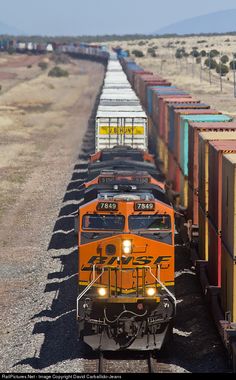
Most train traffic dropped the week of Sept. 7
The Association of American Railroads today reported U.S. rail traffic for the week ending Sept. 7, 2019.
For this week, total U.S. weekly rail traffic was 469,285 carloads and intermodal units, down 6.6% compared with the same week last year.
Total carloads for the week ending Sept. 7 were 238,988 carloads, down 5.6% compared with the same week in 2018, while U.S. weekly intermodal volume was 230,297 containers and trailers, down 7.5% compared to 2018.
Three of the 10 carload commodity groups posted an increase compared with the same week in 2018. They were chemicals, up 1,425 carloads, to 30,888; miscellaneous carloads, up 42 carloads, to 8,674; and petroleum and petroleum products, up 1 carload, to 11,653. Commodity groups that posted decreases compared with the same week in 2018 included coal, down 5,965 carloads, to 79,446; grain, down 2,589 carloads, to 17,431; and non-metallic minerals, down 2,524 carloads, to 32,734.
Read more ...
|
|
2019-26 Article 2
Illinois At the Crossroads of Railroad Staffing Dispute
Illinois has become involved in a national debate over minimum staffing ratios on freight trains.
In May, the Federal Railroad Administration
withdrew a proposed rule
to require minimum crew sizes. "After closely examining the train crew staffing issue and conducting significant outreach to industry and public stakeholders, FRA determined that issuing any regulation requiring a minimum number of train crew members would not be justified because such a regulation is unnecessary for a railroad operation to be conducted safely at this time," wrote Ronald Batory, administrator of the FRA.
The rule was initially proposed by the FRA in 2016, following a fatal 2013 accident in Lac-Mégantic, Quebec, Canada, when an unattended freight train rolled down a hill, killing 42 people. Another 2013 accident involving a BNSF train in Casselton, North Dakota caused no fatalities but drew widespread media attention.
The FRA received nearly 1,600 comments on their decision to withdraw the minimum staffing rule proposal. All but 39 backed the requirements. Most of the supporters of a rule identified themselves as current, former or retired train crew members. The opponents were largely associated with industry groups.
As part of the decision, the agency also prevented states from passing their own mandates. But in August, Gov. J.B. Pritzker signed a law requiring two-person crews on trains passing through Illinois in direct contradiction of the federal directive.
Read More ...
|
|
2019-26 Article 3
The decline of American coal is taking a toll on the railroad industry
No matter what President Trump says, coal in America isn’t coming back — and it’s bringing other industries down with it.
Driving the news: Coal demand for electricity is likely to drop by more than 50% in 11 years,
according to a report
by the rating agency Moody's. In turn, revenue from transporting that coal around the country via trains is expected to drop $5 billion by 2030, or 5.5% of the railroad industry’s 2018 revenue.
The big picture: Coal’s dramatic decline is fueled by several factors: cheaper natural gas and renewable electricity, tougher environmental regulations in the Obama administration and the global shift to cleaner sources of energy in the face of climate change.
One level deeper: Because of the industry's outsized dependence on coal, the fossil fuel’s decline is hitting railroads especially hard. Coal makes up 13% of total freight volume, which is the largest single freight commodity moved by rail.
- 4 railway companies, led by CSX and Burlington Northern Sante Fe (BNSF), get more than 10% of their revenue from coal and are thus most at risk for revenue hits.
- CSX gets nearly 20% of its revenue from coal, while BNSF gets nearly 17%.
- Moody’s says credit effects for U.S. railroad companies "are likely manageable if the [coal] decline remains gradual."
|
|
2019-26 Article 4
Solutionary Rail is Good for Workers and Unions
The Solutionary Rail concept would prove highly beneficial for working and retired railroad workers. In contrast to the current operating plan the major rail carriers have embraced, Solutionary Rail holds out the promise of:
- more jobs in both passenger rail and freight rail, not fewer
- more rail infrastructure, not less
- good, family-wage, secure union jobs
The railroad industry is the most unionized sector of the economy. Most all Class One railroad jobs are organized into a union. Since the Solutionary Rail concept applies primarily to the major trunk lines – practically all of which are unionized Class One railroads – the increase in rail employment would necessarily mean an increase in union jobs.
Close to 100% of the jobs created by implementing Solutionary Rail would be union, with good pay and benefits.
Read more ...
|
|
2019-26 Article 5
FRA: Railroads posted PTC implementation progress in Q2
Based on the railroads'
Q2 progress reports
, PTC systems were in operation on about 50,300 of the nearly 58,000 route miles required to be equipped with the technology, a 4 percent increase in route miles since Q1, FRA officials said in a press release. Class Is reported that PTC systems were in operation on about 91 percent of required mainlines as of June 30, also a 4 percent increase since Q1.
For Amtrak, 899 of 901 required route miles were governed by a PTC system at Q2's end. The national intercity passenger railroad also reported that its operations are currently governed by a PTC system on at least 16,032 of the 19,119 route miles where
Amtrak
operates as a tenant railroad on other railroads' PTC-equipped mainlines
Meanwhile, commuter railroads reported they were operating their PTC systems in revenue service demonstrations on 698 route miles and in regular revenue service on 443 route miles as of June 30. In total, the involved route miles rose 12 percent since Q1, FRA officials said.
|
|
2019-26 Article 6
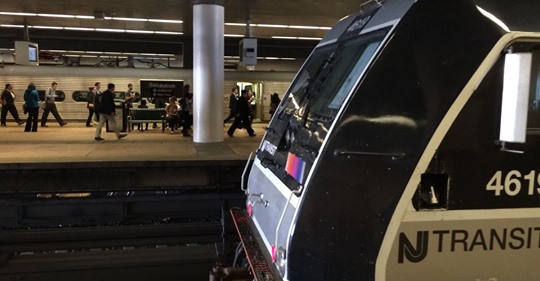
NJ Transit canceled 29 trains Sunday because it had no one to run them
NJ Transit officials canceled almost 30 trains on Sunday, due to a lack of engineers to operate them. But commuters Monday morning were spared from a spike in missing trains.
The Sunday shortage was blamed on a switch to new rail schedules that took effect on Sept. 8, which requires engineers to select new work assignments, officials said. Only one of the 29 canceled trains was axed to a mechanical issue, on the Pascack Valley Line, according to official agency alerts.
Read More...
|
|
2019-26 Article 7
New York Air Brake unveils new, autopilot train software
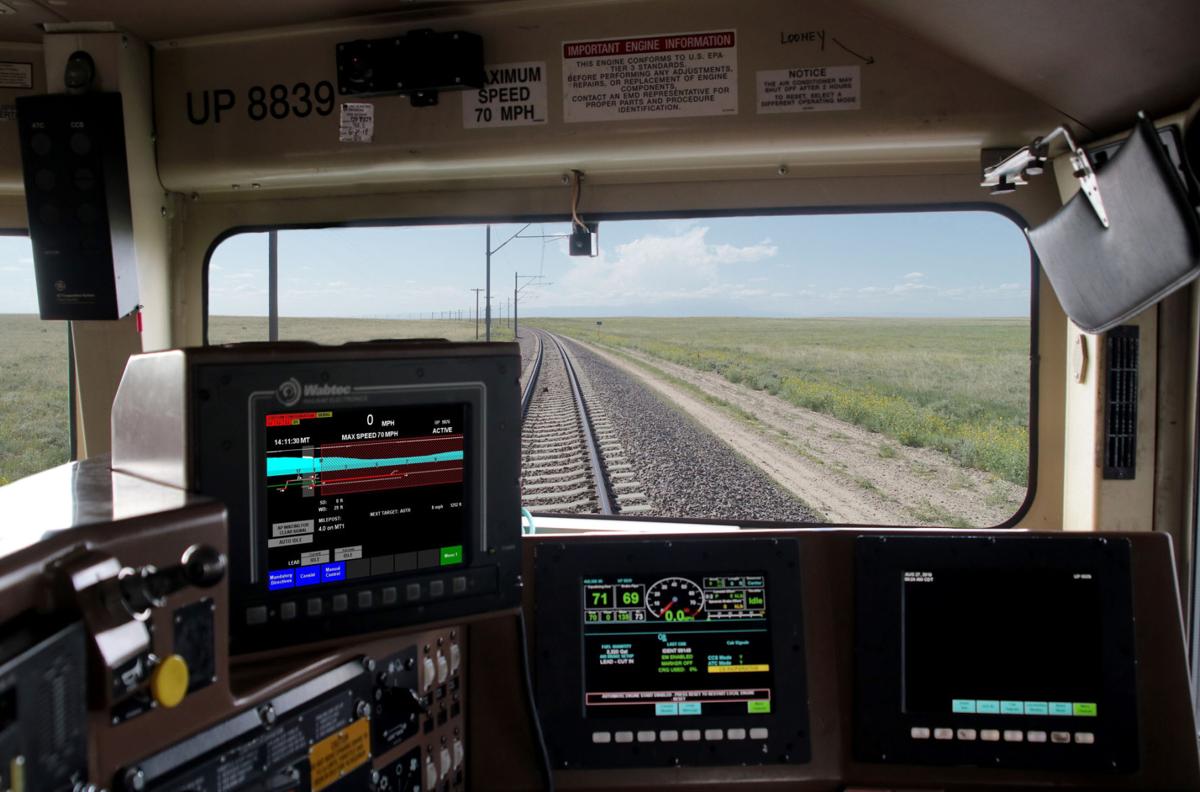
WATERTOWN — New York Air Brake has unveiled its newest autopilot train control software, which could allow for complete automation of trains when released for purchase.
Railroad executives and other industry leaders witnessed the latest iteration of the manufacturer’s LEADER on-board train control and energy management system and its innovative ability to start and stop a heavy-haul train during a demonstration on Aug. 27 at the Transportation Technology Center, Inc., in Pueblo, Colo.
According to a news release from the company, the new system controlled the throttle, dynamic brake, independent brake and air brakes on a positive train control-compliant train with three locomotives and 30 loaded wagons as it traveled along 48 miles of test track.
Mr. Connell said he believes
deploying the product in U.S. trains may take longer than in other countries because the railroads across it have many obstructions, particularly road crossings, that other countries lack. He also said he does not expect the new system to displace engineers on the trains.
Union reacts to computer-run train test: ‘That’s not the real world’
On Friday morning, the company announced that it had operated a 30-car freight train with its LEADER on-board train control and energy management system in full control. The test took place on Aug. 27 at the Transportation Technology Center Inc. test track in Pueblo, Colo.
In an interview with Trains News Wire, John Risch, National Legislative Director of SMART Transportation, North America’s largest rail trade union, notes that running a train on a secure test track is a lot easier than running one out on an actual railroad.
“That’s not real world train operations,” he says. “There were no other trains to meet, no crossings to deal with, no pedestrians around.”
Union officials have been raising the alarm in recent years that technology like LEADER and positive train control could lead to single-person train crews or even driverless trains. Union officials say either scenario would lead to a decrease in safety.
“We still need to have two people aboard every freight train in the United States,” Risch says. “Just like we still have two pilots on every plane, even though a plane can basically fly itself.”
|
|
2019-26 Article 8
Make America's Trains Great Again
Western Interstate Trains Coalition:
The current status of interstate trains and the National Train Network
|
|
|
|
|
|
|