April 2025 - Catch up on the latest news from CAARI! | | |
Dear William,
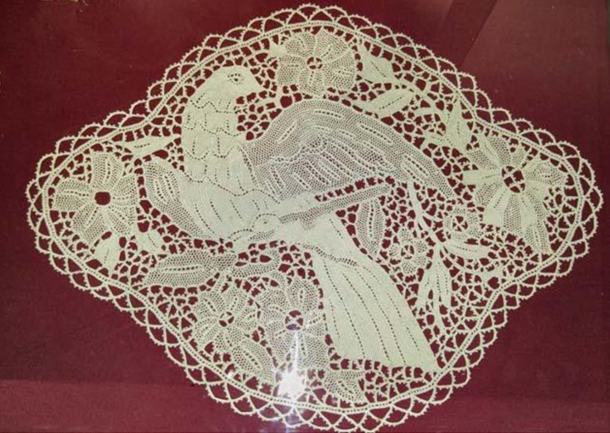
This lace panel belongs to CAARI’s collection of Cypriot traditional arts. It figures here to herald the advent of spring. The frigid weather that gripped early March is gone, birds are jubilant, and the Lenten count-down to Easter is underway. The season’s bounty will soon unfold: those who have known Cyprus only in summer would gaze in wonder at the island’s lush greenness in spring. CAARI, too, has its own, dynamic springtime program ahead, with a full roster of both indoor and outdoor activities. You will read about the Institute’s energetic program of archaeological and cultural work in the Message from the Director just below. The wider cultural scene around CAARI in Nicosia is flourishing. As the Cyprus Museum thinks ahead to creative new exhibits and programs, both physical and virtual, in its rapidly emerging new home, the Byzantine Museum of the Archbishop Makarios III Cultural Foundation reopened as a fully renovated new museum on March 9. Surely significantly, the day was also the Feast of Orthodoxy, first celebrated on March 11, 843, to herald the Church’s embrace of visual imagery, especially painting. The new museum offers the first diachronic display of painting on Cyprus from the era of Iconoclasm to the nineteenth century.
This Newsflash brings two research reports by CAARI Fellows and announces two newly published books by scholars related to CAARI. First, in her Message from the Director, Dr. Lindy Crewe presents the imposing volume that she herself co-edited, bringing to completion the symposium on Cyprus and archaeology in the British period that CAARI sponsored in 2020-2021. Then within the body of the Newsflash, CAARI Trustee Prof. Bill Caraher invites us through the ten, thoughtfully counterbalanced chapters of the major new book on archaeological method that he has co-edited in the wake of a series of conferences on the current condition of Byzantine archaeology held at Dumbarton Oaks. The two research reports, one from a predoctoral and one from a postdoctoral Fellow, treat very different eras and media, but both apply new, technological methods to existing archaeological evidence. Elisabeth Ilgner works with data programs to reassemble a vast trove of once-recorded but now lost ceramic evidence excavated from Polis-Chrysochous in the 1880s; Dr. Leilani Lucas uses new methods to turn food evidence collected at Kissonerga-Skalia into evidence about prehistoric cooking. We also invite readers to revisit the event at the Penn Museum co-organized by CAARI and the Cyprus Society of Greater Philadelphia by reading a summary in the Hellenic News of America.
| | |
Message from CAARI’s Director
Dear friends and supporters of CAARI,
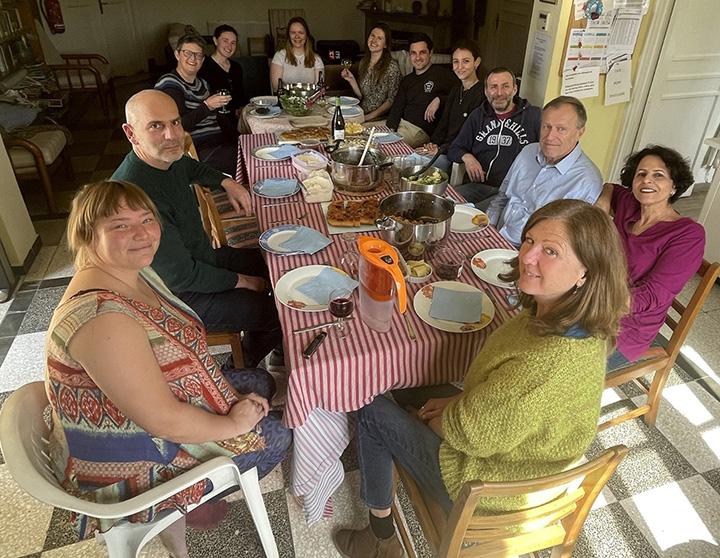
2025 is well and truly upon us, and with it, a new range of challenges and opportunities. Cyprus is emerging from a very chilly winter into our brief but beautiful spring. The Easter season is here, and we began with a Clean Monday lunch. We held it upstairs in the CAARI residence, rather than out in the fields as tradition dictates, since the weather was not looking promising, and indeed it bucketed down in the afternoon. Clean Monday marks the start of Lent in the Orthodox calendar so it should have been a meal without dairy or meat and just seafood, but we cheated a little, adding haloumi into the mix! Our friends and residents all added a delicious contribution and we had a lovely afternoon.
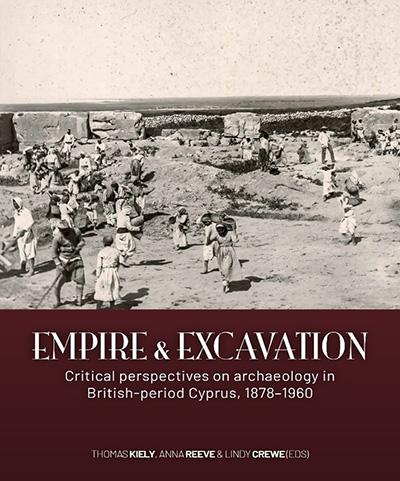
| | CAARI residents and researchers on Clean Monday enjoying a delicious feast. | I am VERY happy to announce that the publication resulting from CAARI’s most recent conference is now out! My co-editors, Thomas Kiely and Anna Reeve, and I have been working hard together to bring Empire and Excavation. Critical Perspectives on Archaeology in British-Period Cyprus, 1878–1960 to fruition. | | |
The volume is a whopping 458 pages and includes 23 chapters dealing with topics ranging from the establishment of the Department of Antiquities (along with stories of some of the early personalities involved) to the beginnings of underwater archaeology and systematic survey in the late British period.
The conference was originally scheduled to be held at CAARI in late 2020 but of course the pandemic intervened and we ended up holding two online sessions in November 2020 and January 2021, in addition to further informal workshop meetings as restrictions permitted during 2021.
| | |
I, and my amazing co-editors, would like to take this opportunity, to thank all the contributors to the volume, as well as all those who assisted us with peer review or gave permissions for the use of archives and images. We are now waiting eagerly for the author copies to be delivered. The book is available to purchase in paperback or hardback or you can read it for free online on the Sidestone Press website: https://www.sidestone.com/books/empire-and-excavation.
In other news, CAARI has held two hybrid lectures this year. The first was a lecture given by CAARI Senior Research Fellow Prof. Bernard Knapp launching his new volume, Cyprus and Ugarit: Connecting Material and Mercantile Worlds. The second was by our current Peltenburg Postdoctoral Fellow Ellon Souter, who presented a lecture on Changes in ground stone technology related to early copper use in Cyprus (3500–1900 BC). Both lectures attracted a great audience and lively discussion. If you missed the live sessions you can catch up on CAARI’s YouTube channel. Ellon also gave a workshop in February for the Association of Cypriot Archaeologists on analyzing ground stone tools and researchers were very eager to participate and learn about this material class that many of us feel we do not sufficiently understand. Our final lecture for the spring series will be on the 3rd April when Fulbright Student Research Fellow and University of British Columbia graduate student, Caroline Barnes, will present a lecture entitled Building Bronze Age Cyprus: an integrative approach to monumental architecture and ashlar masonry. Do join us in the library or online.
Best wishes,
Lindy Crewe, Ph.D.
Director, CAARI
| |
|
Grave Goods in Context at Polis-Chrysochous: Extracting Meaning from 19th-Century Assemblages
Elisabeth Ilgner
University College Dublin
Anita Cecil O’Donovan Fellowship
| |
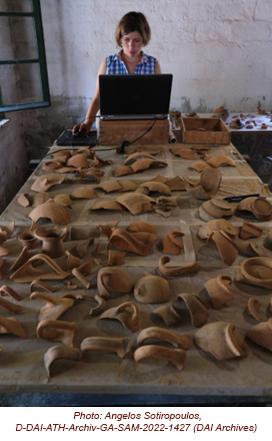
| |  | Finds from historical excavations at Polis- Chrysochous number in the thousands and are scattered across museums outside of Cyprus today. My project identified which grave goods had been found by excavations at the site in 1886. Even though the objects are gone, excavation diaries and lists of finds with drawings, surviving as a remnant of the British colonial administration in Cyprus, allow detailed insights into how many and which types of objects the nineteenth-century excavators found in 441 tombs. Reconstructing these funerary assemblages I hoped would allow me to give the data back to where they belong and contribute knowledge to archaeology today. Conducting my research in Cyprus was important for achieving this aim and I am very grateful for the support I received through the Anita Cecil O’Donovan fellowship at CAARI. In order to analyze my dataset, I compared the data from the archives with published data from twentieth-century excavations, and then combined the information from both sources. This resulted in a large database with over 9,000 objects that described grave goods by different material and typological parameters, encoded the area where they were found, and gave them a date where possible. Although spanning a timeframe of over 1,000 years, most finds in the database date to the Cypro-Archaic and Cypro-Classical periods (c. 750–300 BCE); they were distributed over 540 tombs in seven different excavation areas.
One of the project questions was: are the excavation areas representative of the same burial behavior or are they different? Figure 1 below shows two correspondence analysis plots with the pottery assemblages of tombs from six different excavation areas, distinguished by color.
| | |
The variables used in the analysis are: imported, locally produced decorated, and locally produced undecorated. Imported pottery clusters at Site II in the Cypro-Archaic period (Figure 1a), which could indicate that this excavation area was located near the Cypro-Archaic harbor. None of the other excavations areas shows this anomaly in the composition of its pottery assemblages; moreover, Site II does not stand out in the plot of the Cypro-Classical period (Figure 1b). Of course this statistical pattern needs further archaeological backing. But it does seem that we have an indicator of a shift in the location of settlement and burial areas at Polis Chrysochous between the Cypro-Archaic and Cypro-Classical periods, independently of the actual spatial distribution of excavation areas. Regardless where the site’s harbor was located, the imported pottery provided the same groups that presumably controlled the site’s trading connections with goods that signified their role also in the funerary context.
Locating Site II, which was excavated in the nineteenth century, and other excavation areas is far from straightforward. This is mainly due to the lack of adequate documentation from historical excavations. Sometimes this was intentional, to prevent further looting. The results of the Department of Antiquities’ rescue excavations and the Princeton Cyprus Expedition could offer more insights in the future.
The final step to achieve the aims of my project is to publish my data and results. I want to co-operate with the Department of Antiquities, Cyprus, to do this in a responsible and sustainable way. I am enormously grateful for the support I received at CAARI, the Archaeological Research Unit, the Cyprus Museum, Cyprus State Archives, and Cyprus Institute, during my time in Cyprus.
| |
|
The Archaeology of Food at Kissonerga-Skalia: Tracing the Prehistoric Origins of Tremithopita
Dr. Leilani Lucas
College of Southern Nevada, Las Vegas, Nevada
CAARI/CAORC Postdoctoral Fellow
| | |
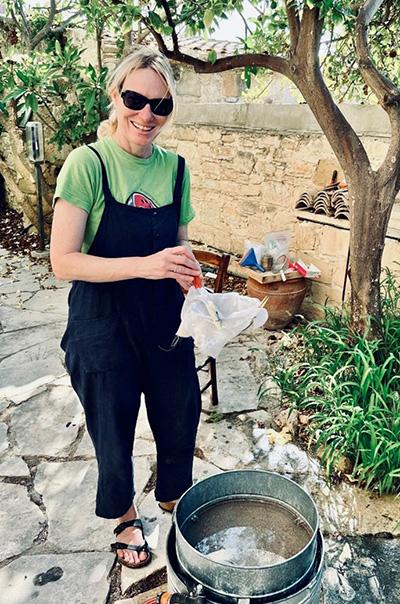
Building on CAARI’s August 2024 Newsflash which explored the archaeology of food, my research as a CAARI/CAORC Postdoctoral Fellow shifts the focus to an earlier chapter of Cyprus’s culinary past. My research is all about the archaeology of food in prehistoric Cyprus! In particular, I am interested in how foods were processed, cooked, and consumed in prehistory.
While later periods often leave behind quite detailed evidence of cuisine and cooking practices, prehistoric food traditions are much more elusive. They are occasionally preserved in charred plant and animal remains, frequently in the tools used to prepare and consume them, and rarely in the remains of the food products themselves. Recent advances in analyzing archaeological food remains have provided new ways of exploring the island’s early culinary traditions, revealing connections to modern day practices. My time at CAARI was invaluable, allowing me to deepen my research into the island’s culinary past by exploring the intersection of material culture, archaeobotany, and present-day food traditions. While my time in the library and basement laboratory, along with my endless discussions about food with colleagues in Nicosia, have laid the foundation for exciting research, here I share one intriguing possibility—the prehistoric origins of a traditional Cypriot flatbread, tremithopita.
To explore the connection between modern-day traditional flatbread made with the fruit of Pistacia terebinthus (terebinth) and prehistoric culinary traditions, we must first turn to the archaeobotanical record and then to the evidence from material culture. The simplest form of tremithopita today requires bread wheat and the fruit of the terebinth tree. While bread wheat’s higher gluten content yields a much nicer flatbread, prehistoric Cypriots seem to have preferred denser versions made from glume wheats (emmer and einkorn) and barley. Pistacia terebinthus, glume wheat, and barley are ubiquitous at sites dated to the Cypro-PPNA onwards and appear in samples recovered from Bronze Age Kissonerga-Skalia. Until recently, interpretations of Pistacia in archaeological samples have ranged from its use as an edible fruit to oil extraction and even fuel. The prehistoric culinary uses of einkorn, emmer and barley presumably mirror those that align with the southwest Asian bread and oven culture with the addition of porridge following the introduction of cooking vessels. However,
| | |
charred archaeobotanical remains alone do not constitute a culturally produced food or meal; they only provide a list of potential ingredients.
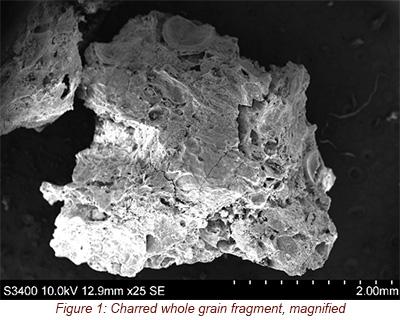
Recent finds of charred food fragments like that shown in Figure 1 allow for a deeper understanding of the culinary use of both wheat and terebinth in prehistory, linking culinary traditions of the past to the present. With the use of high-resolution microstructural analysis of the charred food fragments, the ingredients have gone from a list of possibilities to a culturally produced food. The charred remains from Kissonerga-Skalia provide compelling evidence for the preparation of ‘cooked’ food combining cereals and Pistacia terebinthus—a connection that may bridge thousands of years of Cypriot culinary history! But culinary traditions are not just about the cultural artifact, they are also about cooking technologies and practices. The archaeology supports the preparation of tremithopita at Kissonerga-Skalia with evidence of all stages of food preparation from cereal processing to cooking. The charred prehistoric remains of possible ‘tremithopita’ were recovered from inside a large malting kiln. Slowly heating the bread-like product would have resulted in harder, crunchier, and more dense food with a longer shelf life, all characteristics of traditional, modern tremithopita!
The analysis of charred food remains recovered from Kissonerga-Skalia has revealed a tangible connection between the island’s prehistoric culinary practices and a uniquely Cypriot modern tradition. Tremithopita is just one example! Going forward, my research aims to continue to explore how early Cypriots prepared and consumed their food, shedding new light on the origins and evolution of Cypriot prehistoric culinary traditions.
| | |
Invitation to a New Book:
Looking Beyond Icons in the Study of the Byzantine Past
Professor William Caraher
University of North Dakota, Grand Forks, N.D.
CAARI Trustee
| | |
When many people think about the history and archaeology of Byzantium, the spectacular painted churches of Cyprus or cliff hugging monasteries of Meteora come to mind. The flicker of candlelight off gold mosaics and icons evokes the enduring mystery of the Byzantine era and sometimes provides an uncanny metaphor for the obscurity in which Byzantium lingers among many scholars. Archaeologists and Art Historians who study Cyprus are an exception, of course. Not only has the island's Byzantine legacy enjoyed significant acclaim, but the island has both hosted generations of brilliant and influential scholars of Byzantium and provided a fruitful place for the next generation of scholars to develop.
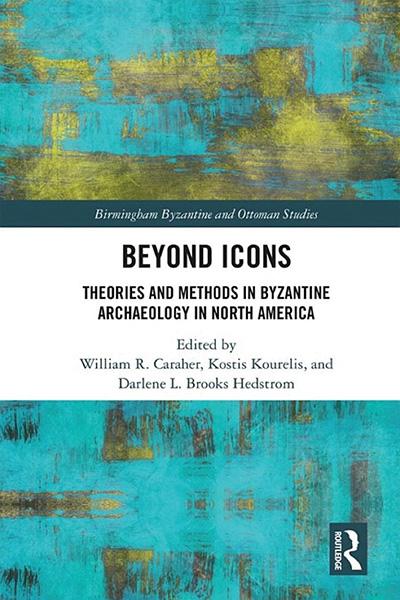
Beyond Icons: Theories and Methods in Byzantine Archaeology in North America (London: Routledge, 2024) offers some perspectives on the field of Byzantine archaeology from a dozen scholars deeply invested in the field. Some names will be familiar to archaeologists on Cyprus: Amy Papalexandrou has worked for years at Polis and William Caraher and David Pettegrew surveyed and excavated at
| | |
Pyla-Koutsopetria in Larnaka District. Nick Kardulias has worked for a generation at Atheinou and the Malloura Valley. Caraher continues to work at Polis where he and Amy have published one of two Early Christian basilicas. The volume itself emerged from a series of conversations nearly fifteen years ago at Dumbarton Oaks in Washington, DC. Dumbarton Oaks, as many readers of this newsletter will know, worked to preserve and to publish Byzantine monuments on Cyprus throughout the 1960s and 1970s and as recently as the early twenty-first century published Peter Megaw's volume on the Episcopal basilica at Kourion.
Amy Papalexandrou's, Ann Marie Yasin's, and Dar Brooks Hedstrom's works remind us that there is still much to learn from religious architecture and landscapes. Anyone who has spent time with the over one hundred Early Christian churches excavated on Cyprus or the dozens of painted churches of the Byzantine and Medieval periods there recognizes the value of these buildings not just for the history of religion on the island, but for the history of communities, social life, and economics. Scholarship centered on the experience of life and worship within these spaces, soundscapes, and landscapes shifts our attention from architecture as architecture (or art as art) to religious spaces as places for human activity. Marica Cassis's work situates women within both Byzantine communities and domestic spaces often outside elite, urban contexts. If Cassis's article recognizes the potential of this approach in Byzantine archaeology, Nick Kardulias's study of Early Byzantine millstones from Isthmia in Greece continues his efforts to situate the archaeology of Byzantium in the context of global archaeology. Adam Rabinowitz and William Caraher's work with Kostis Kourelis, considers the past and future of Byzantine archaeology. Dreams, stratigraphy, and digital tools connect the legacy of innovation in Byzantine archaeology to the future of the discipline.
As Margaret Mullet explains in the book’s afterward, during her term as director of Dumbarton Oaks she sought to encourage wide ranging conversations about Byzantine archaeology, which had by the early twenty-first century fallen into a secondary role at the institute. The papers in this volume found inspiration from these conversations and reflect a view of the field of Byzantine archaeology from a group of North America based archaeologists situated between the "Golden Age" of Byzantine Archaeology in the 1960s and 1970s and the generation to come.
The appearance of so many archaeologists with ties to Cyprus in this volume and the presence of so many Cypriot projects in the footnotes reveals the strong connection between Cyprus and the archaeology of the Byzantine era. Indeed, the editor of this newsletter – Annemarie Weyl Carr – set new standards for how archaeology and art history on Cyprus could inform how we understood Byzantine society. The scholars who contributed to this new volume followed her pathbreaking legacy and continue to work to move the study of Byzantium beyond icons and into the varied landscapes not only on Cyprus but elsewhere in the Medieval Mediterranean.
| |
|
A Brief Return to Philadelphia
Annemarie Weyl Carr
Professor Emerita, SMU in Dallas, TX
CAARI Vice President
| | |
Our last Newsflash contained a description of the event at The Penn Museum in Philadelphia, in which CAARI participated with the Cyprus Society of Greater Philadelphia and the Embassy of the Republic of Cyprus in Washington to “celebrate Cyprus’ cultural legacy in American life and learning.” Readers of this Newsflash are invited to click into the most recent issue of Hellenic News of America, where the event appears as front-page news. Here is the link: https://hellenicnews.com/four-institutions-celebrate-cyprus-cultural-heritage-and-its-role-in-america/.
| | |
To All our Friends and Supporters
First, we send our sincerest thanks to all who have helped support our aims and efforts in both small and large ways over the last four decades. A special thanks goes out to all those who helped us over the first hurdle in addressing the needed repairs to the exterior stonework of our building in Nicosia. We hope that you will continue to join us in our efforts as we take future steps in this process.
Second, we would like to assure all of our friends that we are tracking and navigating the many changes in a new American administration. The Institute has faced various challenges in its nearly fifty years of operation. While the way that these challenges may affect CAARI remains an evolving situation, we remain steadfast in our ability to adapt, innovate, and also maintain what is at the core of our mission.
Our greatest strength is not the sandstone walls that surround us, nor the extent of our library’s holdings, but rather the community of friends, scholars, and colleagues – near and far – that make CAARI the welcoming, productive, and inventive center that it is known to be. We remain committed to the study and understanding of the history and cultural legacy of Cyprus and the Eastern Mediterranean and to the maintenance of our fellowships for both pre-doctoral and post-doctoral research. CAARI has achieved much in half a century because of the many gifts of our community of supporters. Your continued generosity will ensure that we are able to continue to do so.
All gifts, large and small, get us to our goals. Where does your generosity go? A general donation allows us to allocate your funds to where they are needed most. Targeted contributions to our fellowship funds ensure that CAARI will continue to host scholars in a productive and collaborative environment, while a gift to the library helps maintain the unparalleled research collections available to fellows and outside researchers alike. Donations to the operating fund keeps the lights on, while a gift to the endowment helps CAARI to grow its financial longevity. We welcome support for these perennial needs. Our newest area of need is, however, the maintenance of the Nicosia building.
We invite you to consider which of these areas most speaks to you. With your help, we can together build a resilient CAARI uncompromised. Do help if you can: caari.org/donate.
| | |
Annemarie Weyl Carr
Vice President, CAARI Board
| | | | | |