October 10, 2019
The Out-of-Pocket Health News Digest
|
|
Below you will find briefs about recent health policy news stories. Our hope is for students to have an information outlet at their fingertips to keep up-to-date with the most pressing news stories in health policy.
This compilation is produced by the HPSA Education Committee: Sharoni Bandyopadhyay, Matthew Dunn, Payton Watt and Courtney Zott.
|
|
Enbridge Pipeline spurns public health concerns across Michigan
|
|
The fate of Enbridge line 5 will impact Michigan’s public health. Line 5 is a 66-year-old pipeline owned by Enbridge Energy,
transporting crude oil
from Superior, WI to Sarnia, Ontario. Critically, this includes a 4.5 mile stretch of pipeline along the lake floor in the
Straits of Mackinac
. Environmental advocates have called for removing Line 5, citing the harmful consequences of a potential spill in the Great Lakes. Enbridge has argued the risk is minimal, and that the pipeline has too much economic value to remove.
Scientists warn that a line 5 spill would be catastrophic for public health. According to computer models developed by the University of Michigan Water Center, over
700 miles of Great Lakes shoreline
could be at risk of oil accumulation. In fact, the lead investigator of this study identified the Straits of Mackinac as
the worst possible location
for a spill in the Great Lakes. This is concerning because crude oil contains chemicals that can be toxic to humans. The main short-term danger is to clean-up workers who will be exposed to the chemicals, while there is a long-term
danger to the general population
if they enter our water systems. Several at-risk counties, including Emmet, Cheboygan, and Mackinac County, have limited hospital access, which could make it difficult to respond to a health emergency.
This issue also involves environmental health inequities, because Tribal Nations in northern Michigan may be especially at risk. A worst-case scenario oil spill in the Straits of Mackinac threatens to
shut down intakes
that provide Lake Michigan water to tribal communities. Also, Tribal Nations depend on Great Lakes fisheries as a source of food and commercial activity, which could be compromised for a long time if the pipeline breaks. Native American tribes, such as the
Sault Ste. Marie Tribe of Chippewa Indians
, have called for immediate decommission of Line 5.
|
|
Trump expands Medicare Advantage programs with new executive order
|
|
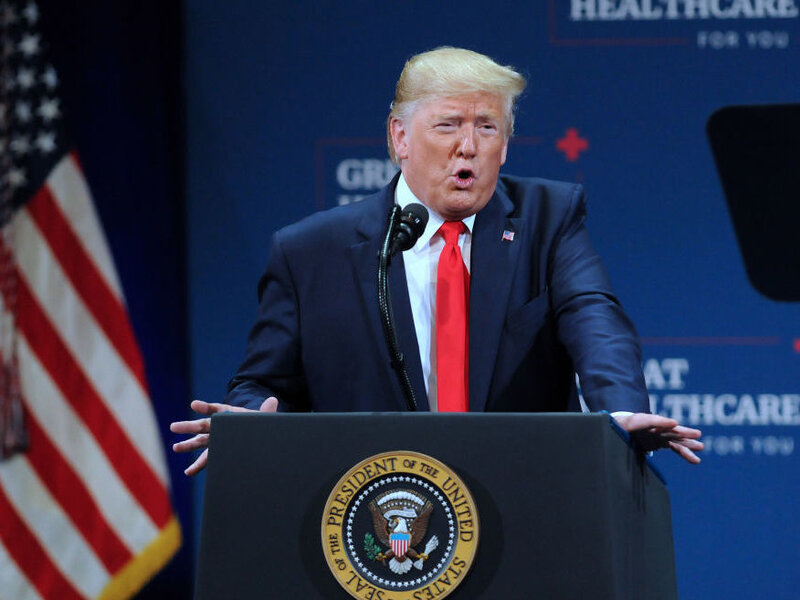
On October 2nd, President Trump issued an executive order on Medicare called
“Protecting Medicare from Socialist Destruction”
and presented it to the Floridian retirement community, The Villages. This comes at a time when Democrats are debating several health care reform plans, and health care is
one of the most important issues
for voters. Some candidates support Medicare-for-all, while others support expanding the Affordable Care Act; the Trump administration rejects both. One aspect of the Trump administration’s health care reform plan is the strengthening of Medicare Advantage (Medicare Part C), a private Medicare plan for seniors and individuals with disabilities, taking a
“market-based approach”
to Medicare.
The Trump administration is trying to cater to the elderly population by offering new benefits and incentives in the Medicare Advantage program, but in reality could have
consequences opposite of what was intended
. Up to this point, Medicare Advantage has been appealing to seniors because it has been less expensive to pay the premium with certain services included-- such as dental and vision-- than to have traditional Medicare and seek additional coverage for these services. Now, the administration is advertising that Medicare Advantage will have
even lower rates, implement more telehealth initiatives, and promote wellness benefits
. From this perspective, Medicare Advantage does not seem to have many setbacks. However, to cover these additional services that will be added, Medicare payment
rates would likely increase
, and this could result in drawing from the Medicare trust fund. In turn, this would hurt future generations. On top of this, the Trump’s administration’s 2020 budget proposal for Medicare suggests a
$575 billion cut.
Lastly, it is important to note the ways in which Medicare Advantage has hidden information from its patients, and could continue to do so. Last year, Medicare Advantage engaged in
fraudulent activities
that sought profit and benefitted insurance companies (e.g. reporting that their patients are sicker than they truly are). Now, this executive order will make it
easier for doctors to opt out
of Medicare billing, which could leave the patient to pay the bill (without the cap that is present in the current Medicare Advantage plan and in traditional Medicare plans) if they sign a contract with a doctor and do not fully understand what they are signing. This is otherwise known as “surprise billing.” In conclusion, there are unknowns with this executive order and many reasons to be cautious, but information will continue to unfold in the coming months.
|
|
HHS’s proposed changes reduces limitations to the Stark Law and the Anti-Kickback Statute
|
|
The US Department of Health and Human Services (HHS) has released their proposed reforms to the Stark Law, or the Physician Self-Referral Law, and Anti-kickback Statute that intends to improve care coordination and value-based reimbursement. The Stark Law and the Anti-Kickback Statute prohibits physicians from referring patients to entities that they can financially benefit from and from accepting financial incentives to provide referrals, medications, etc, respectively. While these decades-old laws exist to prevent fraud and abuse in the healthcare system, regulatory reforms have been under discussion since 2018 in order to update these rules and reduce barriers to value-based care. As such, the proposed rules create safe harbors, designated exceptions, for some value-based care models and exchanges of cybersecurity technology between hospitals.
Specifically, the proposed rules allow for specialty physician practices to exchange information with primary care physicians to improve care coordination. It also allows these practices to leverage data analytics to discharge hospital patients. The intent is to improve care coordination efforts for patients in a way that increases value and reduces over-utilization of the system. The American Medical Association and American Hospital Association support these provisions, claiming they will support patients who are trying to navigate through a fragmented health system and improve teamwork between physicians and hospitals. Still, the reforms must be made with caution to ensure that the laws are still effective in reducing fraud and abuse.
|
|
- Immigration: President Trump issued an executive proclamation on Oct. 4 that will require immigrants to prove they can afford private health insurance before they receive a visa. (Politico)
- Abortion rights: The U.S. Supreme Court has agreed to hear a case involving Louisiana’s abortion law; meanwhile, a federal judge blocked Georgia’s “heartbeat” law. (NPR, NBC News)
- ACOs: CMS saved $739 million from its Medicare ACO program in 2018, more than double the amount it saved in 2017. (Modern Healthcare)
- Michigan Medicaid: In a rare use of authority in modifying the state budget, Gov. Gretchen Whitmer transferred $15 million from other departments to support Michigan’s Medicaid work requirement program after the state legislature had refused to include funding. (MLive)
- Drug prices: The most recent federal budget package includes a provision intended to lower state and federal drug spending by increasing rebates pharmaceutical companies are required to pay Medicaid programs for covering their drugs. (Becker’s Hospital Review)
|
|
|
|
|
|
|