|
April Newsletter Highlights:
Get a peek into how families are being housed in Sacramento, read SSF's statement on the need for greater regional partnership, join the upcoming Case Conferencing cycle, see the progress made within our community's plan to address homelessness, & more!
| | |
|
How the Family Rehousing Accelerator is Moving Families into Housing
A Message from Marjorie Delgadillo, Family Collaborative Director, Sacramento Steps Forward
Across Sacramento, providers, public agencies, and partners are working together to help families move from homelessness into stable housing. The Housing Families First Collaborative (HFFC) has created a structure for that work, bringing programs into closer coordination and aligning them around how to improve the system. Within that structure (and under the stewardship of Sacramento Steps Forward), the Family Rehousing Accelerator focuses on a specific part of the process: What happens from referral to move-in, and how that experience can be faster, clearer, and more consistent for families.
This program has already led to more than two dozen households moving into housing.
The accelerator was launched as part of a $5 million investment from the Bezos Day One Families Fund, a philanthropic initiative launched by Jeff Bezos to address homelessness and education. The Sacramento Family Rehousing Accelerator is designed to strengthen how the system functions through clearer eligibility pathways, more coordinated referrals, faster financial assistance, and fewer missed connections between steps.
Two programs were selected to carry out this work in close coordination with us here at Sacramento Steps Forward, chosen through a public community request for proposals process: Insight Housing and Sacramento Children’s Home. Both bring significant expertise and unique approaches to supporting and housing families, while working within the shared framework of this program.
This accelerator focuses on rapid rehousing, a proven strategy that helps families quickly move from homelessness into stable housing by providing short-term rental assistance, housing navigation, and supportive services. In Sacramento, this approach is strengthened by using real-time data and targeted prioritization to accelerate placements, maximize resources, and reduce the time families experience homelessness.
Launched just last fall, the program is making a real difference for families in Sacramento. Beyond the dozens already housed, 116 households have been referred and 79 households have enrolled.
Jennifer, a mother of two who moved into her home in January, shared, “I am incredibly grateful to the rapid rehousing team for their outstanding support which made a stressful time much easier.”
For Dibora and her daughter, now settled in a two-bedroom apartment,: “Insight has been a Godsend. My daughter and I appreciate all they have done to support us.”
And for Joann, moving into stable housing brought a sense of progress that had been difficult to reach before, “Piece by piece, it all comes together.”
These are the outcomes of referrals that move forward without unnecessary delay, processes that are easier to navigate, and providers who are aligned in how they work together. Now, these families are able to focus on stabilizing and rebuilding rather than surviving.
This work will continue throughout 2026 as the program continues to refine eligibility and referral processes and provide smoother, human-centered experiences for families. If the grant is renewed for 2027—a decision which will come from the Bezos Grant team later this spring—the goal will be to carry this momentum forward and build a model that can support more families over time.
With deep gratitude,
Marjorie Delgadillo
Data accurate as of April 2, 2026.
|
| | | |
Continuum of Care Meetings
Get involved in our local Continuum of Care (CoC), which leads our regional planning, coordination, and funding to resolve homelessness. This month's meetings include:
-
CoC Board: In-person on Wednesday, April 8 at 9:00 a.m.
-
HMIS & Data Committee: via Zoom, Thursday, April 9 at 10:00 a.m.
-
Community Accountability Committee: via Zoom, Wednesday, April 15 at 9:00 a.m.
-
System Performance Committee: via Zoom, Thursday, April 23 at 9:00 a.m.
| | |
March Board Meeting Recap
Sacramento's March CoC Board meeting included a presentation and conversation on understanding the Homeless Management Information System (HMIS) led by SSF's Chief Program Officer Dr. Trent Simmons and a discussion led by CoC Governance Committee Chair Deisy Madrigal on proposed CoC Governance Charter amendments.
What to Expect at the April Board Meeting
Be sure to adjust your calendar! The April 8, 2026 meeting will start at 9:00 a.m. (1 hour later than the regular meeting schedule). This in-person meeting at 2425 Sierra Blvd, Sacramento, CA 95825 has free, on-site parking available.
This meeting will include continued discussions on CoC Governance changes, a presentation on how state Homeless Housing, Assistance, and Prevention (HHAP) funding is invested locally and the impact it’s making, and more.
Find the most up-to-date information or how to listen online ➜
| | | | | |
Join the Next Case Conferencing Cycle
Are you a homelessness or housing service provider looking for problem solving and practical support? Case Conference groups meet weekly during 10-week cycles. They offer structured and collaborative spaces for providers to pool expertise, share real-time updates, and coordinate care plans.
The next cycle starts Monday, April 13. To submit a client case, complete this form by Wednesday, April 8. The following groups are currently open for submissions: Shelters, Families, Single Adults, and Transition Aged Youth (18-24).
| | | | |
Provider Training Updates & Opportunities
CalAIM: Session Recording and New Learning Series
Thank you to everyone who joined our "CalAIM Explained" training last month! If you missed it or want to share it with colleagues, you can now access the recording.
Want to learn more about using CalAIM? Join the first of our 3-part learning series on Tuesday, April 14. This initial session will be held virtually and is designed for agencies new to or not yet working with the HMIS, and providers serving children, youth, or older adults.
Sessions 2 and 3 of this training series will be held in-person with limited space and reserved for active CalAIM service providers. Sign up here to receive invitations.
CAS Assessor Training: More to Love in 2026
We've updated the Sacramento CAS Assessor training series based on your feedback! This year, the 6-part training series will include Trauma-Informed Conversational Case Management and the addition of the Survivor (S)-CAS 101 training which is essential for providers. The series supports those who have regular client interactions by providing standardized, trauma-informed tools and techniques to engage clients and complete timely and accurate HMIS data entry. This series begins in May, is scheduled for in every Tuesday at 10:00 a.m., and is open to HMIS-certified Sacramento providers. Register now!
| | Updates & Progress Points | | |
From SSF: It's Time to Partner on Resolving Homelessness
On Monday, April 6, Sacramento Steps Forward released a statement to community leaders, partners, and decision-makers, calling for greater partnership and urgency in determining how our region addresses homelessness. It was prefaced by the following from Lisa Bates, CEO:
| |
As new governance structures are being actively debated, the decisions made in the coming months will fundamentally determine our ability to make homelessness rare, brief, and nonrecurring for years to come. While multiple models are currently under consideration, Sacramento Steps Forward believes we cannot afford a fragmented approach. Any successful structure must be rooted in partnership and shared responsibility. We have identified five core elements, led by a unified strategy and strict performance accountability, that are essential for any governance model.
| To read the full statement, click below. | | | | | |
Regional Plan Update: Strengthening Access and System Capacity
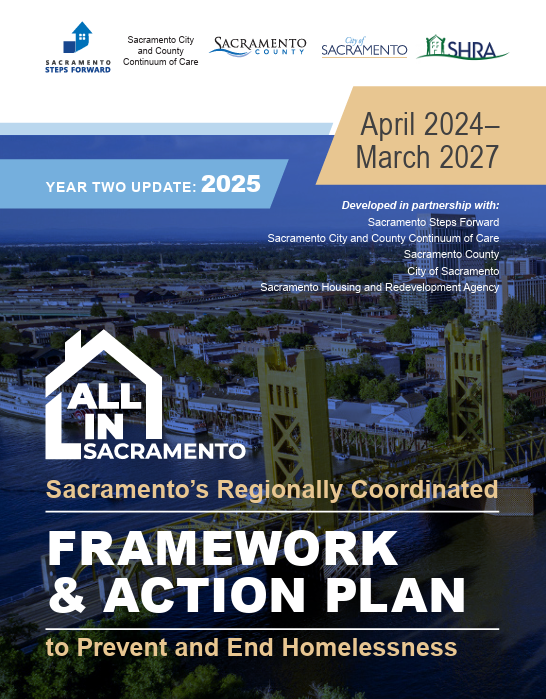
Working alongside our partners, we are putting Sacramento’s regional plan into action through state HHAP investments that improve access and system capacity. This includes strengthening the 2-1-1 “front door,” expanding prevention and problem-solving supports, enhancing navigation through access points, growing provider capacity through training, and centering leadership from people with lived expertise. Together, this work is helping more households secure housing and support while improving how the system functions.
| | | |
The Coordinated Access System: February Experiences and Data
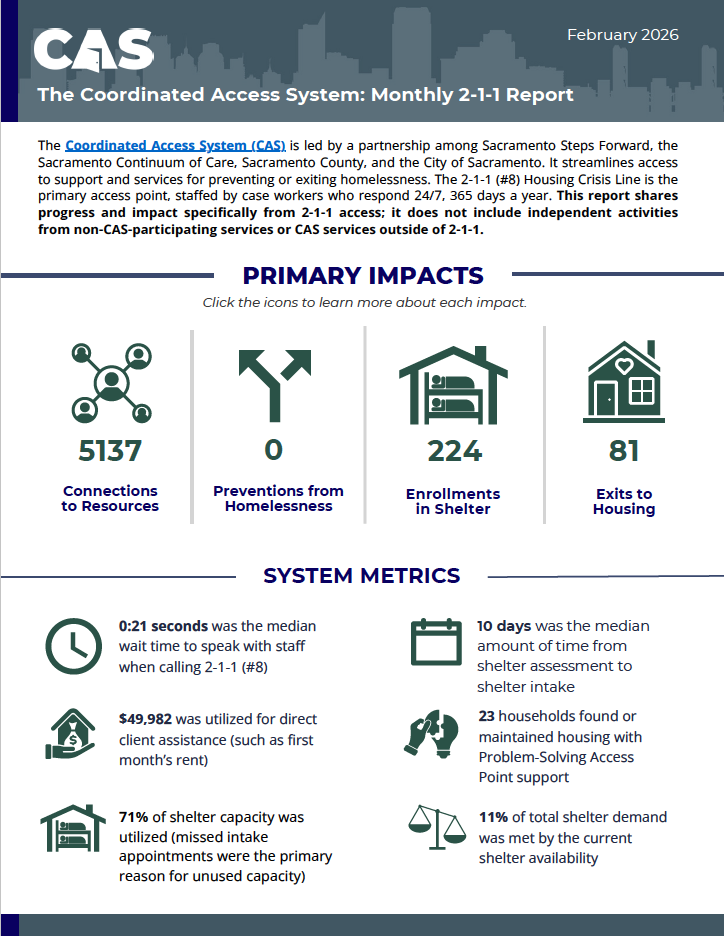
Calling 2-1-1 is the primary way people enter Sacramento's Coordinated Access System (CAS) for homelessness and housing services that participate in the system. In February, it connected 5,137 people to support, helped 81 to become housed, and enrolled 224 in shelter.
At the same time, the report highlights some of the ongoing challenges the system is working to address. Shelter capacity was only able to serve 11% of the total demand, and it took a median of 10 days for individuals to move from assessment to placement. While most shelter capacity was utilized, missed intake appointments meant that some beds still went unused, pointing to opportunities to improve coordination.
Want to learn more about the CAS? Sign up for our new monthly CAS newsletter!
| | | | |
CoC NOFO Update: Renewals and What It Means for Our Community
The U.S. Department of Housing and Urban Development (HUD) has announced new Continuum of Care (CoC) renewal funding, including $2.46 million for Sacramento programs that support housing, youth services, and homelessness data systems, helping ensure these efforts continue without disruption. This news comes alongside a recent federal appeals court decision that requires HUD to move forward with renewing all CoC funding this year rather than changing program rules or timelines. This decision protects stability for providers and the people they serve. Together, these updates indicate continued federal investment in proven approaches and greater certainty for local programs.
| | | | |
Lutheran Supportive Services Selected to Steward Permanent Supportive Housing Program
After a public, competitive request for proposals process, we have selected Lutheran Supportive Services (LSS) to steward three existing Permanent Supportive Housing (PSH) programs, ensuring continued operations as we bridge to upcoming U.S. Department of Housing and Urban Development (HUD) Continuum of Care funding. This $2.56 million investment will support 186 households beginning in May 2026, maintaining stability across Step Up Sacramento, Omega PSH, and Home at Last. Through this funding, LSS will continue providing tenancy-focused services, coordinating housing placements and transitions, and working closely with property partners to help residents remain stably housed without interruption.
| |
2026 at Sacramento Steps Forward
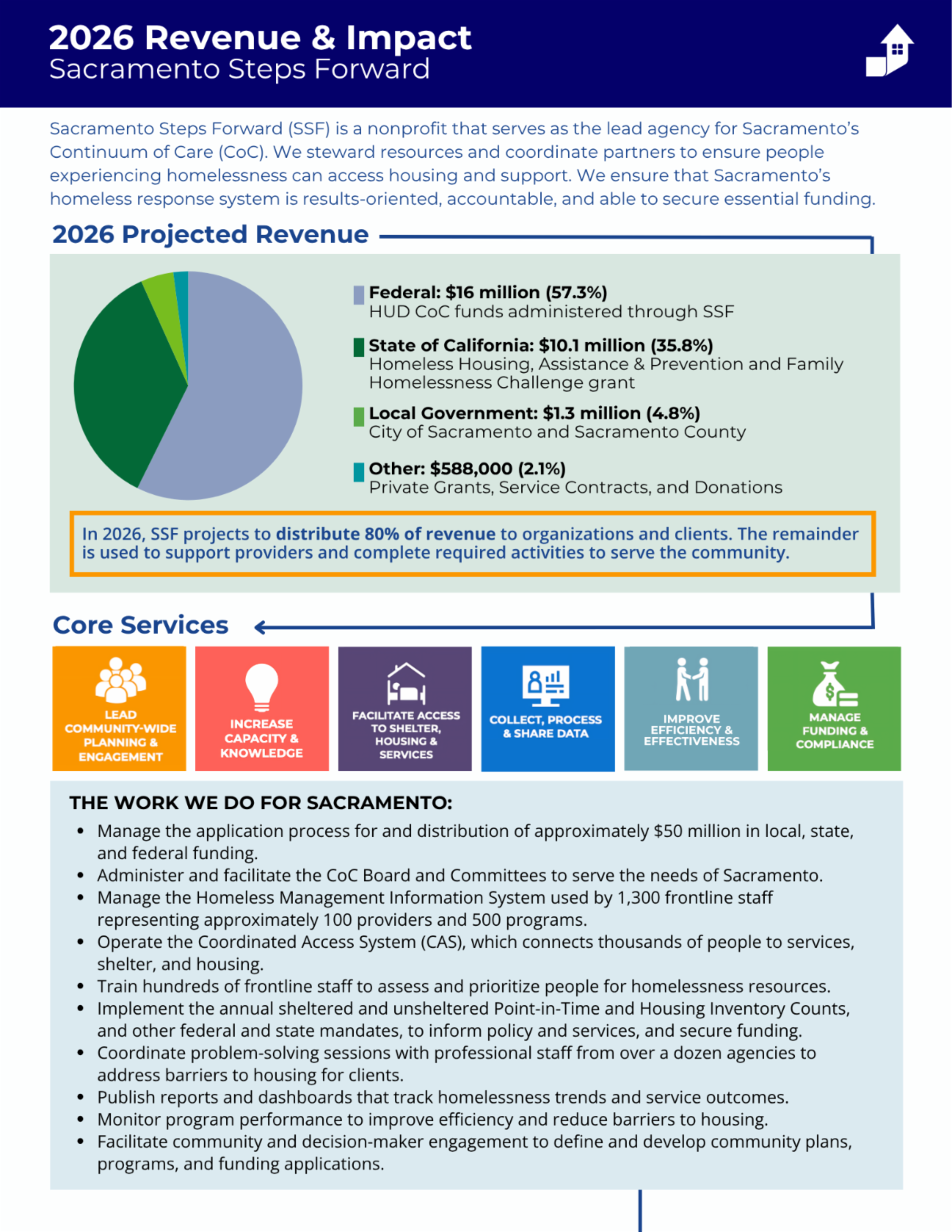
Sacramento Steps Forward is a nonprofit that serves as the lead agency for Sacramento’s Continuum of Care. We are responsible for stewarding resources, ensuring compliance, coordinating partners, and advancing a unified regional system to prevent and resolve homelessness. Use our 2-page 2026 Revenue & Impact Summary to learn how we will help manage and distribute funding, support our community's service providers, and make it possible for more people to have safe, stable housing this year.
| | | Opportunities & Resources | | |
Sacramento County Launches $80K Grants for Nonprofits
Sacramento County is inviting mid-sized nonprofits serving people experiencing homelessness or food insecurity to apply for a new capacity-building initiative designed to strengthen organizational sustainability and expand community impact. Ten selected organizations will participate in a 20-month cohort that combines $80,000 in grant funding with training, mentorship, technical assistance, and peer learning. Applications are open through Wednesday, April 8 at 5:00 p.m.
| | | |
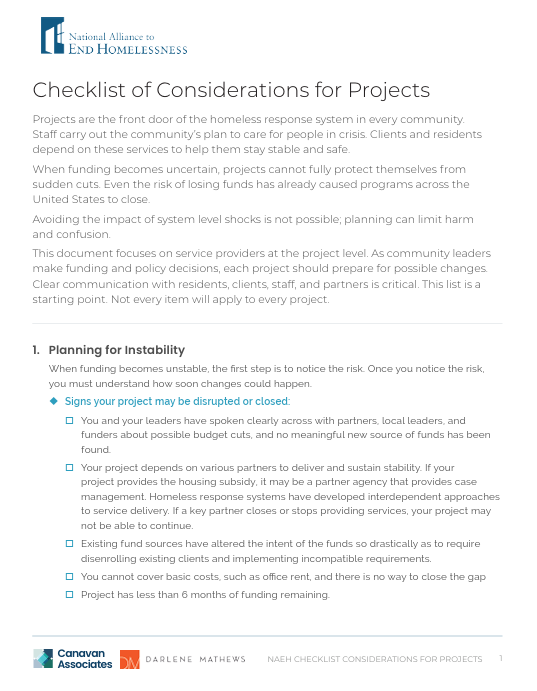
From the National Alliance to End Homelessness: Project Consideration Checklist ️
The all-new Project Consideration Checklist will help providers navigate sudden changes to funding and other shocks, providing structured next steps to create an accurate understanding of how funding changes will affect housing and other safety-net programs.
| | | |
5 Years of Research Culminated: Permanent Supportive Housing Compendium
The Non-Profit Housing Association of Northern California (NPH), in partnership with the Terner Center for Housing Innovation, has released a new Permanent Supportive Housing (PSH) Working Group Compendium, bringing together five years of research, tools, and recommendations to support the long-term sustainability of PSH. The resource includes practical operational tools, policy recommendations, and strategies for housing stability, resident well-being, and program effectiveness within the Housing First approach.
| | | |
2025 Community Solutions Impact and Learning Report
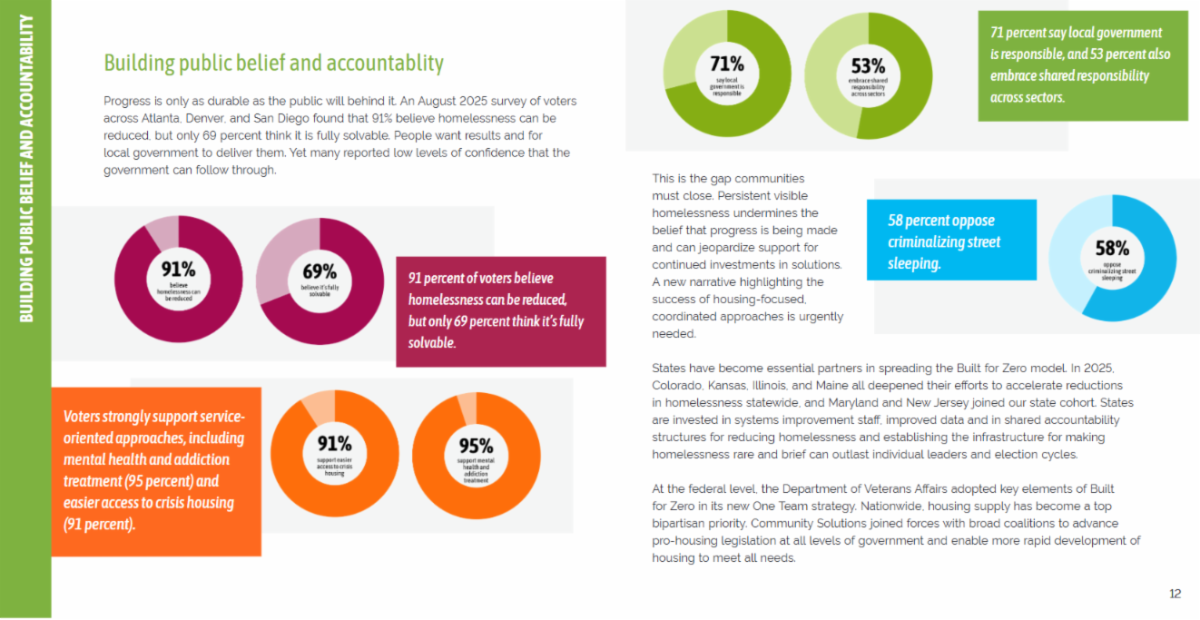
Community Solutions has released its 2025 Impact and Learning Report, a practical resource for understanding what is driving measurable reductions in homelessness across communities. Drawing on real-world examples and data from the Built for Zero network, the report highlights how coordinated efforts, real-time data, and aligned partners are improving outcomes, while offering clear strategies to strengthen systems and expand impact. For homelessness response leaders and partners, it provides useful insights into what is working and how to apply those approaches here in Sacramento.
| | | |
Recording Now Available from the Older Adults’ Homelessness Virtual Summit
If you missed the Solutions for Older Adults’ Homelessness Virtual Summit, hosted in partnership with USAging and utilizing research informed by Sacramento Steps Foward, don’t worry! You can watch CEO Ann Oliva share the importance of Continuums of Care partnering with local agencies to address older adult homelessness.
| | | |
April Wellness Tip: Setting a "Completion Cue" Reminder for the End of Each Day
Homelessness response work rarely has clean endings. The people you support may stay on your mind long after you leave work. A completion cue is a small, intentional action that signals to your body and mind that your day is done. It might be washing your hands with warm water, listening to a specific song on your drive home, touching leaves to release the day’s energy, or listening to an inspiring podcast.
This simple practice helps set a boundary your brain can’t always create on its own. Over time, it trains your system to shift out of work mode and back toward rest.
Do you have a completion practice when you end your day? We’d love to hear about it! Use the button below to share what works for you.
| | | |
Share Your Work: Be Featured as a Provider
Help us highlight the great work happening across Sacramento! We’re inviting providers to share their progress, challenges, and opportunities for collaboration to be featured in our upcoming newsletters and other communications. This is a chance to showcase your impact, inspire new partnerships, and help shape the conversation around homelessness response. Fill out the form below to share your story and connect with the broader community.
| | | | | |