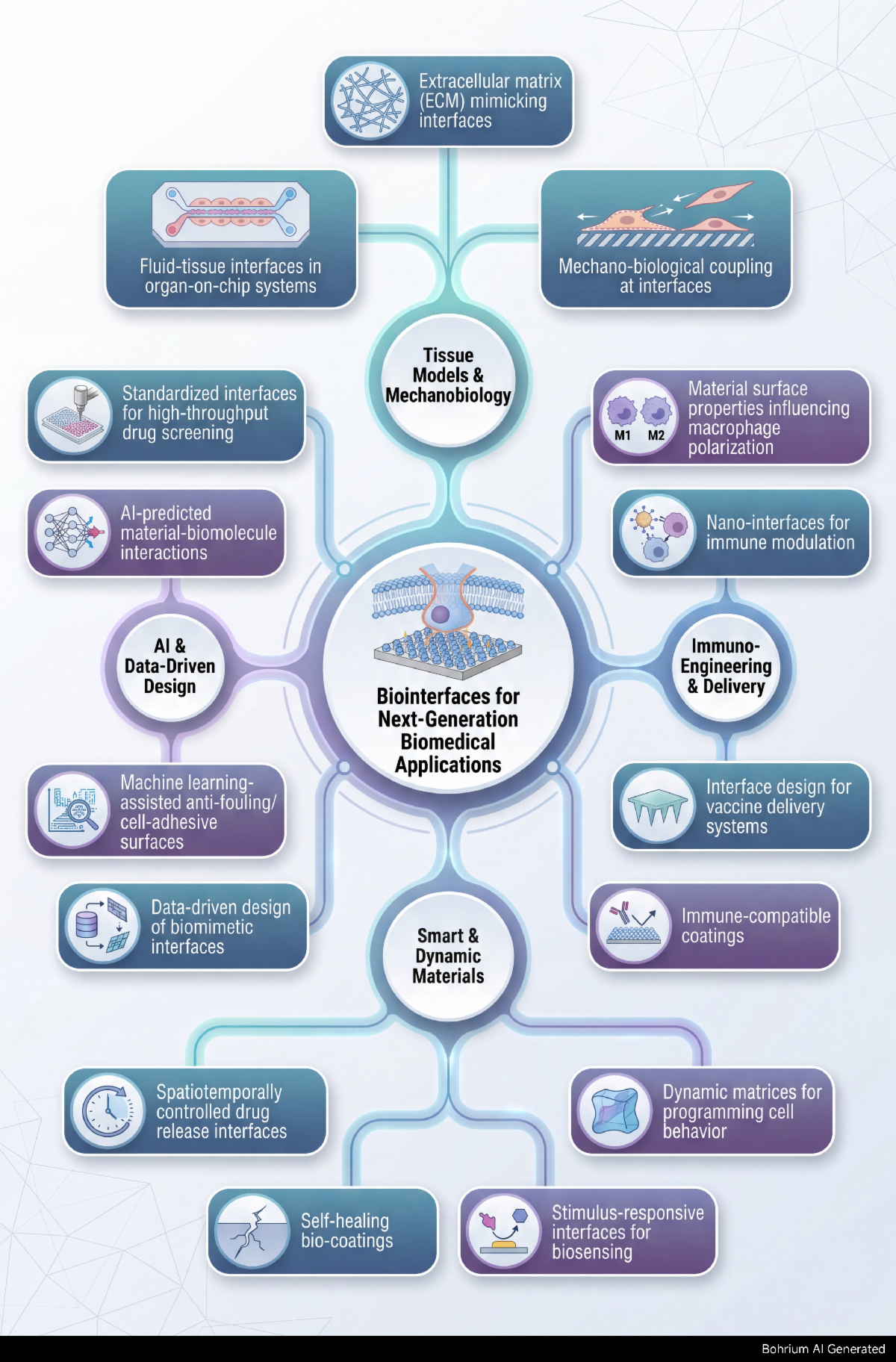
| | Biointerfaces represent the definitive frontier at the intersection of advanced materials, biomedical engineering, and living systems, where molecular recognition, cellular signaling, immune regulation, and therapeutic function are dynamically governed. Far beyond passive biocompatibility, next-generation biointerfaces are engineered as adaptive, responsive, and biologically instructive platforms that direct cell fate, modulate immune phenotypes, enable spatiotemporally controlled delivery, and mediate mechanochemical coupling at material–biology junctions. These interfaces underpin the performance of medical devices, biomedical implants, diagnostic systems, drug delivery platforms, microphysiological systems, and 3D bioprinting constructs, with function dictated by precise control over interfacial chemistry, topography, and dynamic signaling. Bioink-based programmable biointerfaces further expand this landscape by enabling user-defined, spatially patterned control over cellular microenvironments for tissue engineering and regenerative medicine.
This Collection in Biointerphases highlights transformative interdisciplinary advances driving the rational design of next-generation biointerfaces. We invite high-quality original research, reviews, and perspectives covering biomimetic matrix interfaces, mechanobiological coupling, immune-modulating materials, stimulus-responsive and self-healing coatings, controlled delivery systems, organ-on-chip fluid–tissue interfaces, and AI/ML-driven prediction and optimization of interfacial interactions. By integrating materials science, chemistry, biology, and computation, this Collection aims to define state-of-the-art progress and accelerate the translation of biointerface science into clinical impact.
|