NEWSLETTER

We Fix Broken RFPS

11 November 2026

Rethink bonding, insurance, and contract negotiations—and join us November 19 for Ask the RFP Doctor®.

Click on image for better resolution


A signed contract doesn't guarantee a successful project. So why do we spend so much time negotiating legal protections and so little time negotiating how the work will actually get done?


For many procurement professionals, contract negotiations are the final hurdle in a lengthy RFP process. The supplier has been selected, legal counsel is reviewing terms and conditions, and everyone is eager to get the agreement signed.


But there's a problem. A contract can be legally sound and still be operationally flawed.


Liability provisions, indemnification clauses, and compliance requirements are important. But they won't necessarily prevent disagreements over schedules, deliverables, responsibilities, or unexpected costs.


That's why effective contract negotiations should involve two parallel conversations: one focused on legal protections and another focused on project execution.


The goal isn't simply to protect the agency if something goes wrong. It's to reduce the likelihood of things going wrong in the first place.


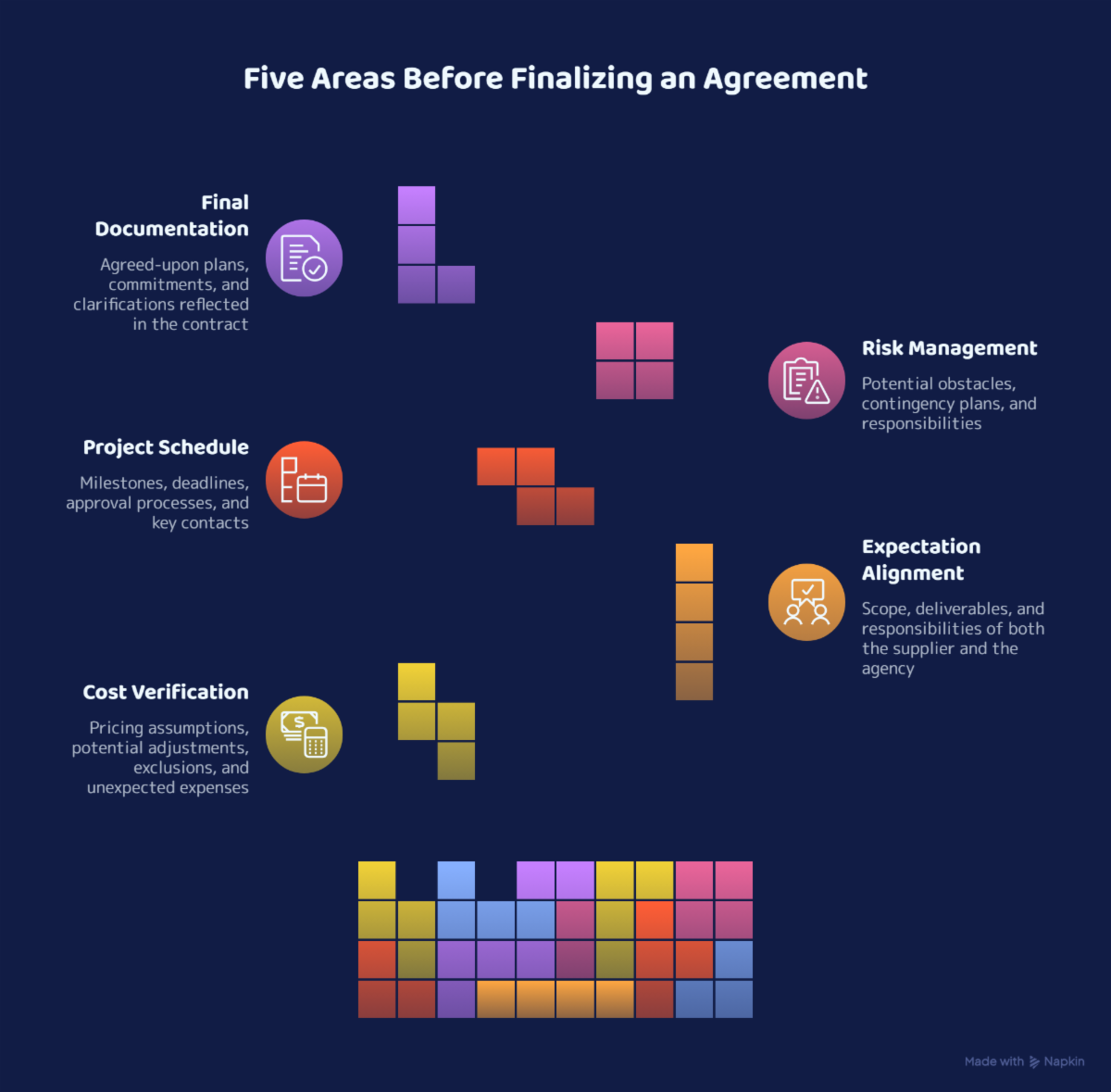
Before finalizing an agreement, procurement professionals should ensure that five critical areas have been addressed:

  • Cost Verification: Are pricing assumptions clear? Have potential adjustments, exclusions, and unexpected expenses been identified?
  • Expectation Alignment: Does everyone understand the scope, deliverables, and responsibilities of both the supplier and the agency?
  • Project Schedule: Are milestones, deadlines, approval processes, and key contacts clearly established?
  • Risk Management: Have potential obstacles been identified, contingency plans discussed, and responsibilities assigned?
  • Final Documentation: Are all agreed-upon plans, commitments, and clarifications reflected in the contract?


Addressing these questions doesn't require reinventing the procurement process. It requires involving the right people before the contract is signed.


Bring procurement, project managers, technical staff, and supplier representatives together to discuss how the project will actually work. Identify assumptions, resolve uncertainties, and document the decisions. Incorporate those agreements into the final contract so everyone starts with the same understanding.


Consider the alternative. A supplier assumes the agency will provide certain resources. The agency assumes those resources are included in the supplier's price. Neither assumption is clarified during negotiations.


The result? Delays, disputes, change orders, and costs that could have been avoided with one conversation.


Procurement professionals have an opportunity to prevent these problems before they begin. By treating negotiations as both a legal and operational exercise, agencies can strengthen supplier relationships, improve accountability, and create a clearer path to successful project delivery.


The best negotiations don't just produce a signed contract. They produce a shared plan for success.


Before your next contract is finalized, ask yourself: Are we negotiating the terms of the agreement—or the success of the project?


A Signed Contract Isn't the Finish Line—It's the Starting Line.

Is Your Agency Overinsured and Undercompetitive?

Ask the RFP Doctor® | November 19, 2026 | Noon CT


Your agency requires insurance and bonding to manage risk. But how do you know whether those requirements are reasonable—or whether they're costing you qualified bidders and driving up contract prices?


It's a question every procurement professional should be asking, and one we're putting front and center in this month's Ask the RFP Doctor® webinar.


Insurance and bonding requirements are familiar territory in public procurement. They're included in solicitations, reviewed by legal and risk management departments, and often carried forward from one RFP to the next with little discussion.


After all, if the requirements worked for the last procurement, why change them?


Because the cost of getting them wrong may be greater than you realize.


Every requirement has consequences. Insurance limits that exceed a project's actual exposure can increase vendor costs. Bonding requirements that are unnecessarily restrictive can discourage smaller firms, emerging businesses, and otherwise qualified contractors from competing.


And when fewer vendors compete, agencies may lose opportunities for better pricing, innovative solutions, and stronger project outcomes.

So where do you draw the line between responsible risk management and unnecessary barriers to competition?


On Thursday, November 19, at Noon CT, Ask the RFP Doctor® takes a closer look at the assumptions, practices, and real-world consequences behind bonding and insurance requirements.

During this free, one-hour webinar, we'll explore:

  • The true cost of insurance requirements. How coverage limits affect vendor pricing and what agencies ultimately pay.
  • Bonding requirements and vendor participation. When financial safeguards become obstacles for capable, qualified competitors.
  • What other agencies are actually requiring. Survey findings that offer an opportunity to compare your organization's requirements with those of your peers.
  • Matching requirements to real risk. Why higher limits don't automatically translate into better protection—and how to approach requirements more thoughtfully.


We'll also consider how procurement, legal, and risk management professionals can work together to develop requirements that are appropriate, defensible, and consistent with the goal of maintaining open competition.


The objective isn't less protection. It's smarter protection.


Public agencies have a responsibility to manage risk. They also have a responsibility to spend public funds wisely and provide qualified vendors with a fair opportunity to compete. Those goals shouldn't be at odds.


If you've ever wondered whether your agency's standard bonding and insurance provisions are truly necessary—or simply standard because nobody has questioned them—this discussion is for you.


Join us Thursday, November 19, at Noon CT for "Bonds and Insurance: Are You Asking for Too Much?"


Bring your questions for our live Q&A, and leave with a fresh perspective on whether your agency's requirements are protecting its interests—or unnecessarily limiting its options.

Protecting Your Agency—or Pricing Out Competition?


The Center for Procurement Excellence (CPE) is a non-profit, membership based organization that promotes the use and training of advanced Request For Proposals (RFPs). We provide tools, templates, educational and networking opportunities to assist in better project outcomes. Our mission is to improve the effectiveness of public and private procurement worldwide by advocating to drive change in the solicitation process. We advocate for Fair, Open, Transparent, Efficient, and Accountable purchasing practices. Visit our website to find out more.


LinkedIn  Facebook