The American Society of Le Souvenir Français Inc.
Monthly Bulletin - Vol. III. No 6 - June 2023
|
|
French Forts of the Mississippi and Lower Louisiana |
|
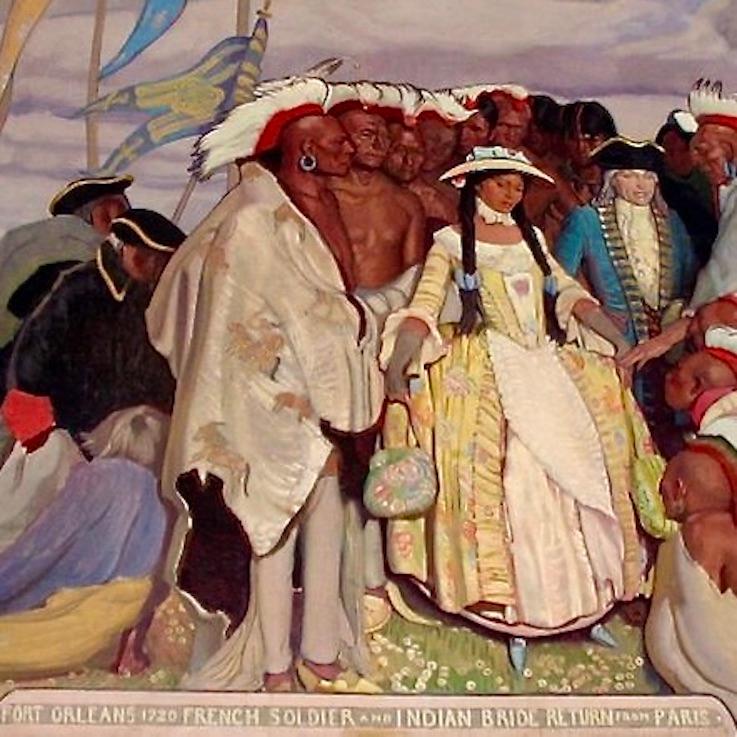
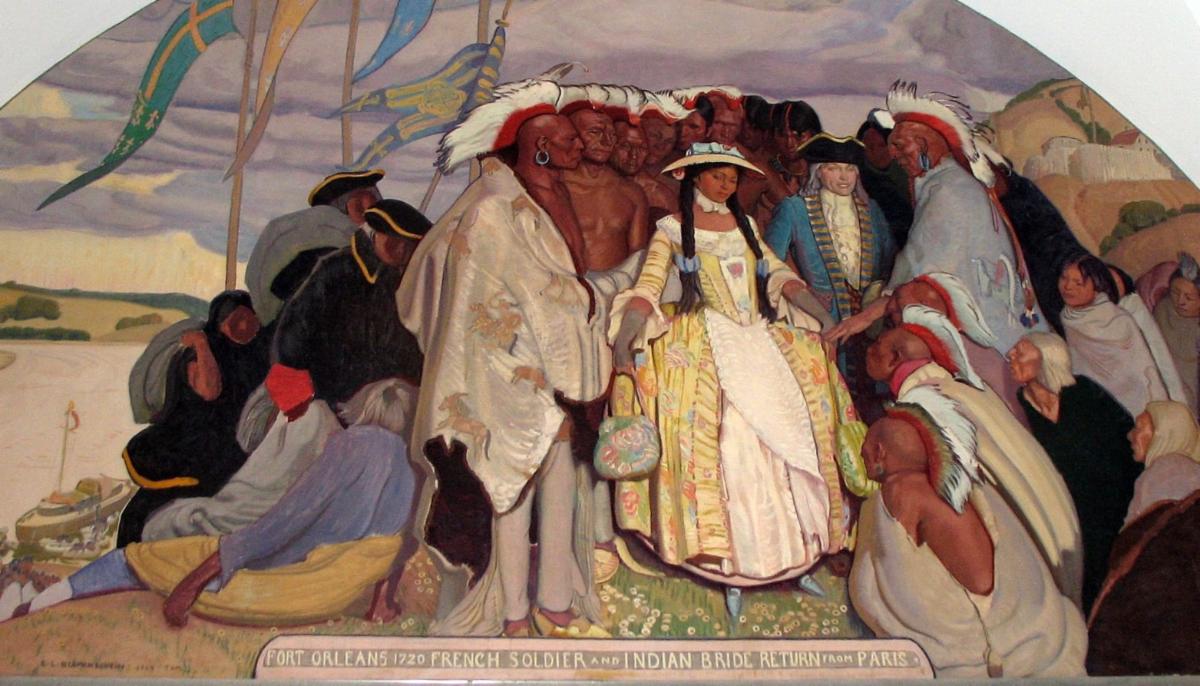
Cover illustration: Detail of Mural at the Missouri State Capitol, “Fort Orléans - 1720 - French soldier and Indian Bride return from Paris”, by Ernest Blumenschein; Ernest Leonard Blumenschein (1874-1960) – Public Domain
Missouri State Capitol, 201 W Capitol Ave, Jefferson City, MO 65101 .
More about the interesting story behind this mural in the "Epilogue" section of this Bulletin!
|
|
EDITORIAL
This past winter we visited several French forts stretching from New York to the MidWest. Refresher course: after New York this past January, we toured the great States of Michigan, Illinois, Minnesota, Wisconsin and Indiana in March. This month in June we are concluding our survey of the long chain of forts and fortifications built by intrepid solders and explorers in what was called Lower Louisiana and which encompassed several States, from Arkansas, Missouri, Alabama, Louisiana and Florida - - yes, the Sunshine State too! Later this year we will conclude our tour of "French Forts in the United States" with several sites in Pennsylvania and Ohio.
We became familiar with the great men that were Father Marquette and Louis Joliet, Robert Cavelier de La Salle, and Henri de Tonty...
In this Bulletin we will present the extraordinary lives and accomplishments of Jean-Baptiste Le Moyne Sieur de Bienville and his brother Pierre Le Moyne d'Iberville, Étienne de Veniard, Sieur de Bourgmont ...
Along the way, we will include a few noteworthy sites and markers honoring lesser known intrepid figures such as Jean de Sauvole de la Villantry, Jean Charles de Pradel de Lamaze, the D'Artaguiette brothers...
Two centuries later, we will continue to follow general Lafayette on some of his footsteps during the month of June 1825. "Our dear Marquis", who was originally supposed to stay 3 months as "Guest of the Nation" following the invitation of President James Monroe, stayed a total of 13 months, feted in each and every 24 States. One can only imagine how he must have felt in June 2025, as the end of his triumphal tour was in sight, and the idea that he would have to leave his beloved adopted Nation.
As always, towards the end of this Bulletin we will share some photos of the recent patriotic and commemorative events in which your Society participated. We will also announce several upcoming events from like-minded organizations that should be of interest to our members and sympathizers.
Thank you for your remarks, suggestions and support. Thank you also for your donations. By the end of this month we will send an illustrated recap of our exciting projects as part of our mid-year membership call.
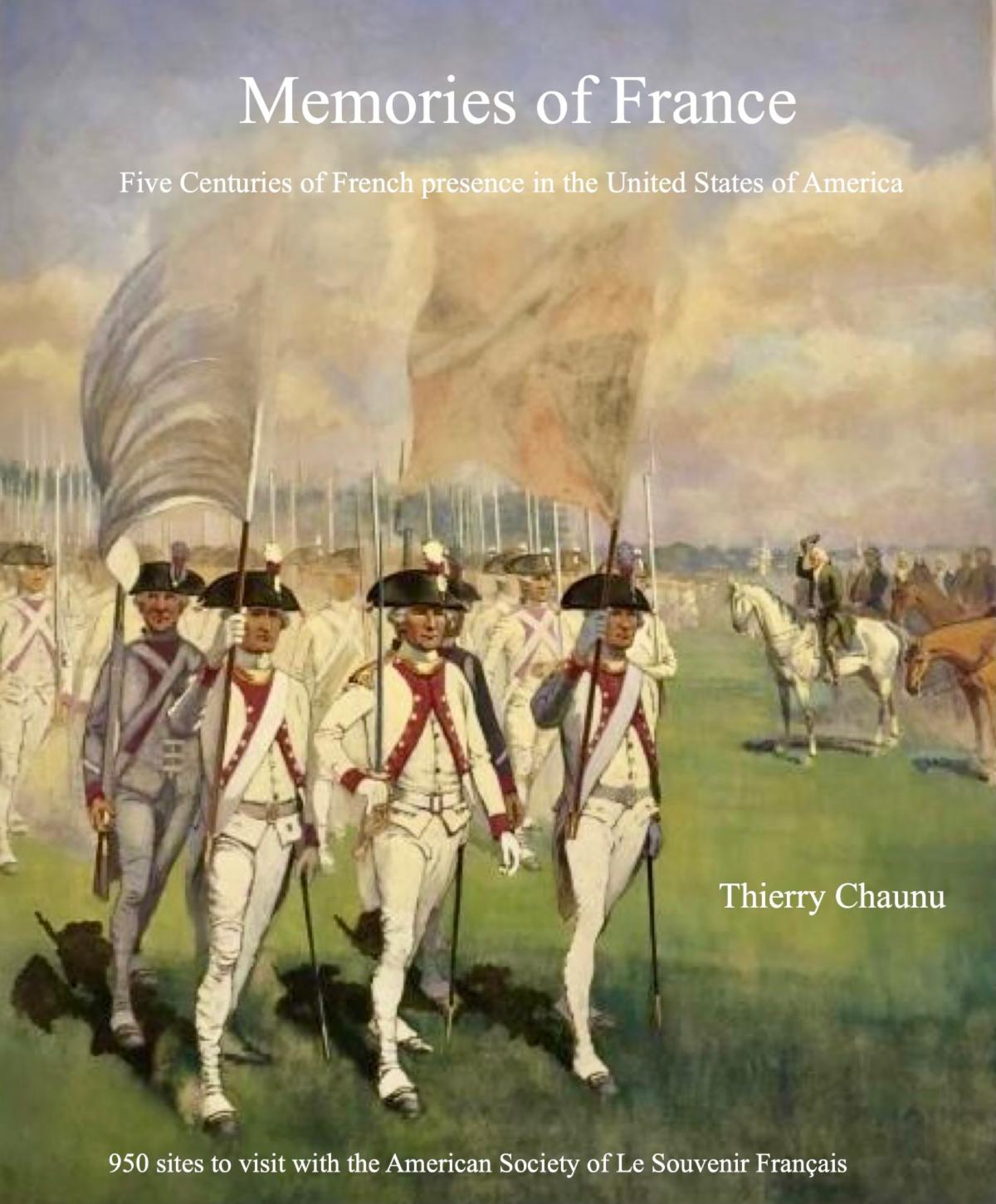
Summer is in the air...If you are planning vacations and driving excursions throughout America the Beautiful, make sure you include in your itineraries several of the sites that are catalogued with photos and GPS coordinates in the e-book Memories of France at: Amazon.com. All royalties go to your Society!
Thank you for your comments, suggestions, and continued support.
On behalf of the Board of Directors,
Thierry Chaunu, President,
American Society of Le Souvenir Français, Inc.
|
|
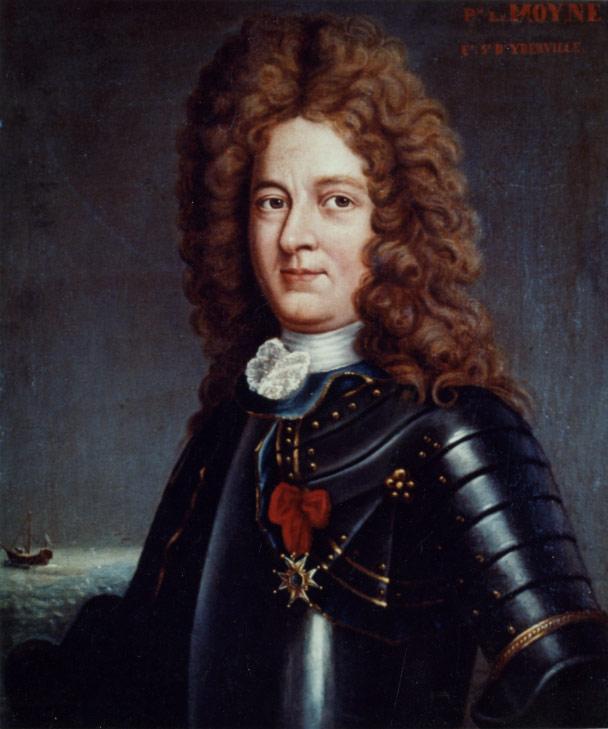
Pierre Le Moyne d'Iberville |
|
Portrait of Pierre Le Moyne d'Iberville, French explorer and naval commander, founder of the Colony of Louisiana, Unknown author - Centre d'archives de Montréal. Bibliothèque et Archives nationales du Québec, Fonds Armour Landry, P97.
Marker, "The French in North America"
Natchez Visitor Reception Center, 640 S Canal St, Natchez, MS 39120
|
|
• Pierre Le Moyne d'Iberville (16 July 1661 – 9 July 1706) or Sieur d'Iberville was a soldier, ship captain, explorer, colonial administrator, Knight of the Order of Saint-Louis, founder of the French colony of Louisiana in New France.
• He became a French Navy officer and in the years 1690, he fought against the British in the Hudson Bay area and captured several forts.
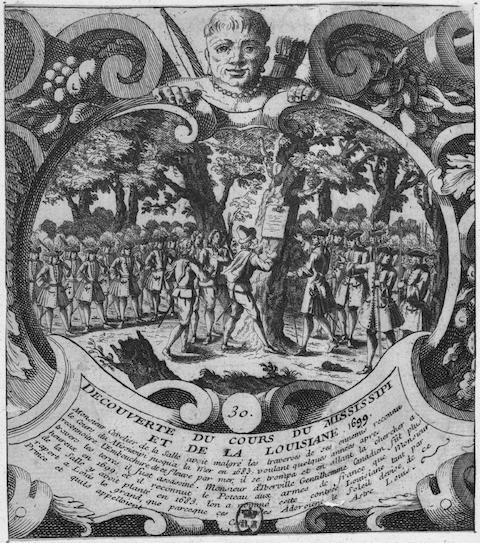
• In 1699, he led an expedition to ascertain the exact location of the mouth of the Mississippi, following La Salle claim of the region for France, and established Fort Maurepas in Old Biloxi as the temporary capital of Louisiane. • On his second voyage in 1700 he built a second Fort Maurepas in Biloxi, and on his third voyage in 1701 he built a fort in Mobile.
• His brother Jean-Baptiste Le Moyne de Bienville founded La Nouvelle Orléans (New Orleans) in 1718.
Dozens of sites are named after him, such as:
• The city of D'Iberville, Mississippi
• Iberville Parish, Louisiana
• Rue Iberville in New Orleans, Louisiana
• Excerpts from Marker:
...“France was the first of the three great European powers to recognize and appreciate the strategic importance of Natchez. Operating out of bases in Quebec, French explorers crossed the Great Lakes and followed smaller streams into the broader Mississippi River. In 1673, Father Jacques Marquette and Louis Joliet descended as far south as the Arkansas River. In 1682, René-Robert Cavalier, Sieur de La Salle (above), discovered the point where the Mississippi River emptied into the Gulf of Mexico and laid claim to the entire Mississippi Valley in the name of France.
[...]
La Salle became the first Frenchman to encounter the Natchez Indians and declare them an ally. Between 1699 and 1702, the Natchez welcomed the explorer, Pierre Le Moyne d'Iberville, and allowed a French missionary to settle among them.”
|
|
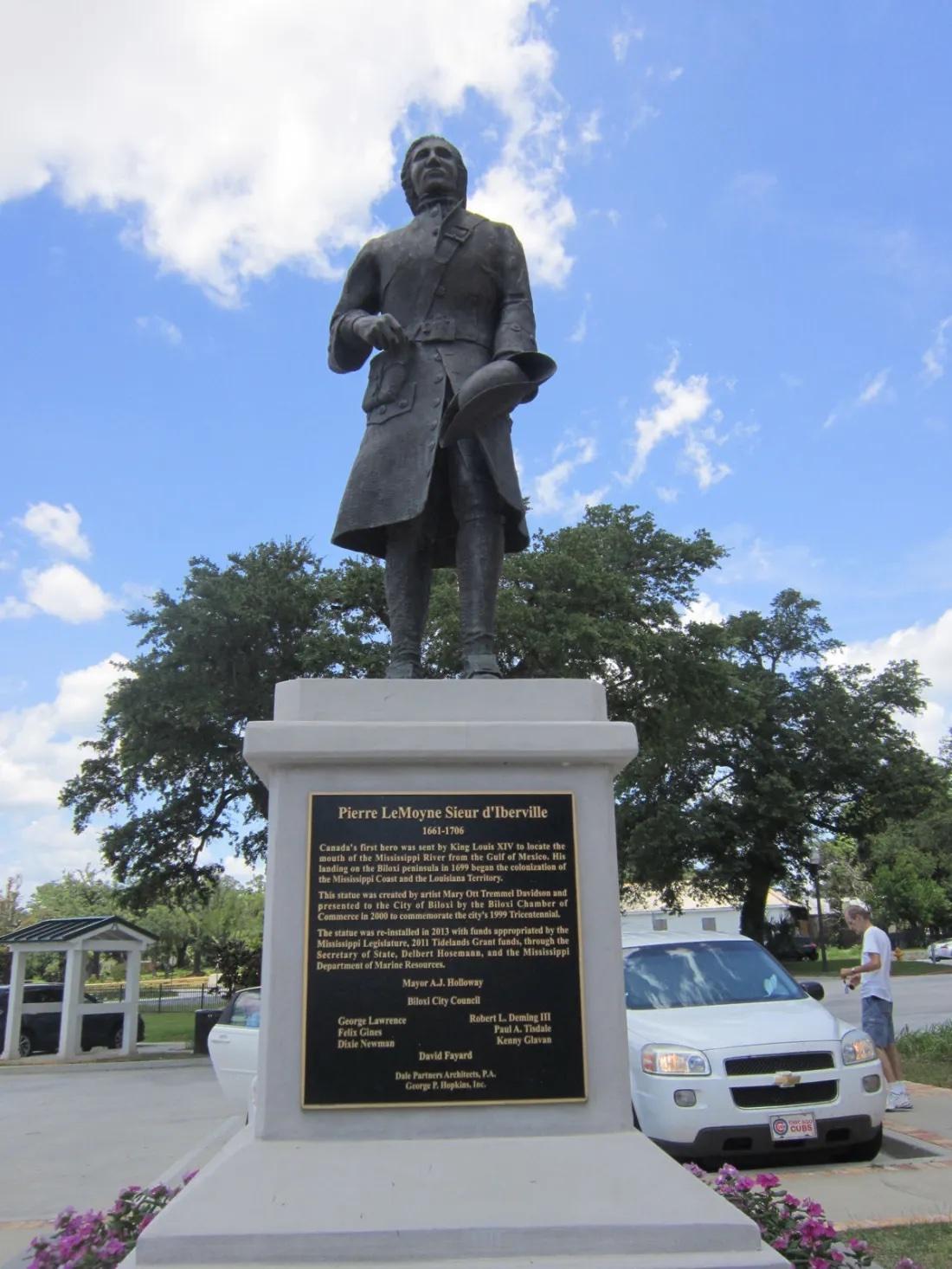
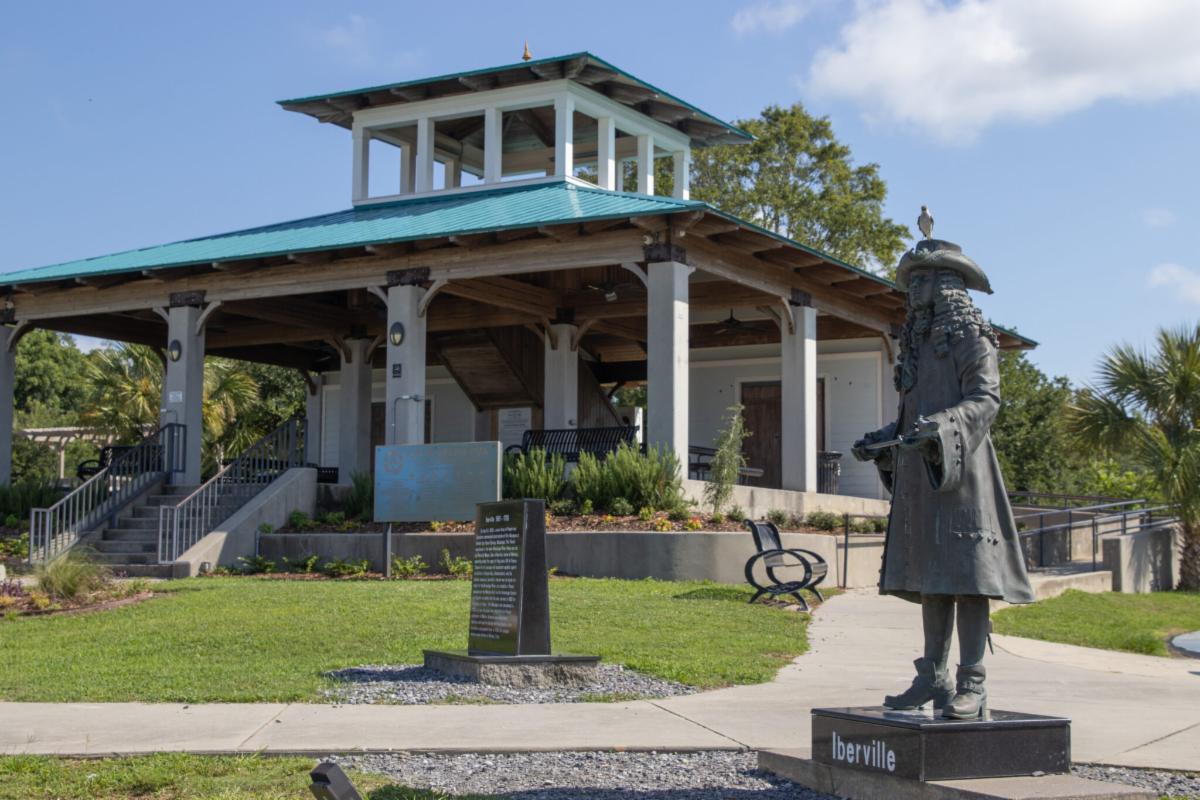
Statues of Pierre Le Moyne D'Iberville |
|
Top: Statue of Pierre Le Moyne D'Iberville, Biloxi, MS
Outside Visitors Center, 1050 Beach Boulevard, Biloxi MS 39530
Photo: © 2012-2022 Randall and Anne Golden. All rights reserved, Creative Commons Attribution-ShareAlike 3.0 Unported License https://midlifecrisiscrossover.com/2016/01/24/2015-road-trip-photos-37-biloxi-views/
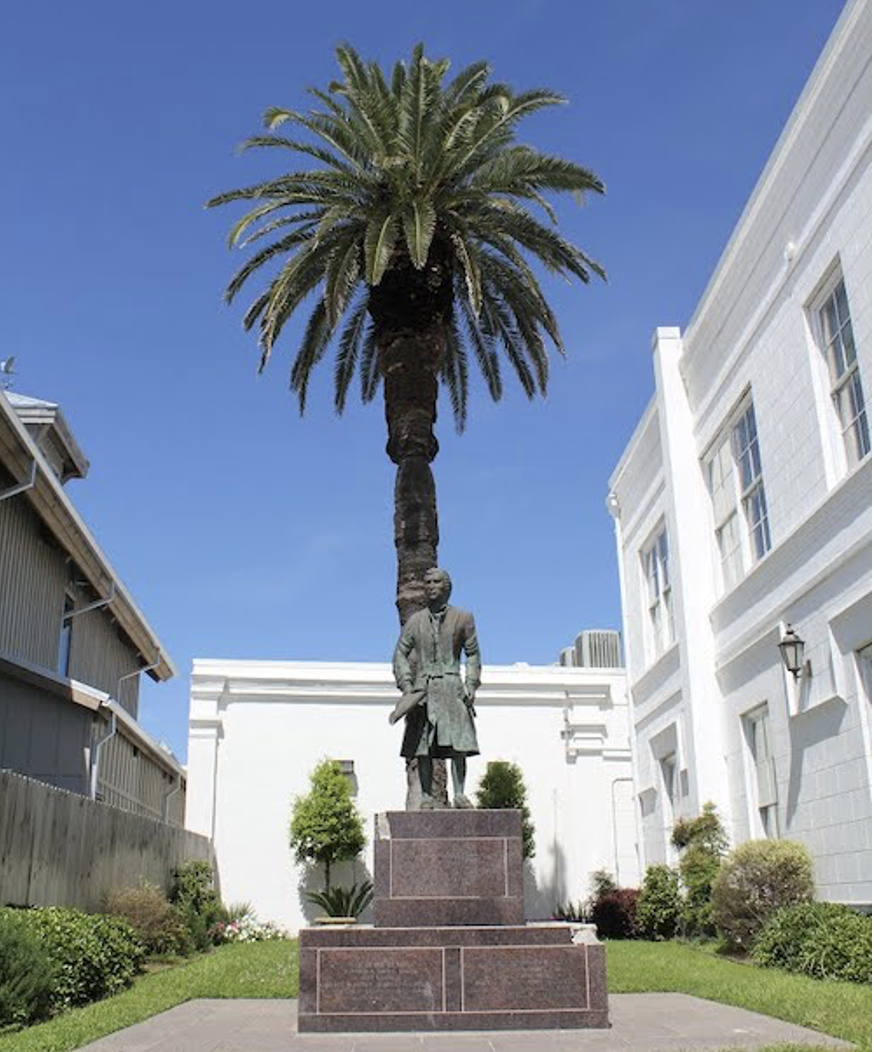
Middle: Statue of Pierre Le Moyne D'Iberville, Ocean Springs, MS
Fort Maurepas Park, 499 Front Beach Dr, Ocean Springs, MS 39564
Photo: https://www.expedia.com/Fort-Maurepas-Park-Ocean-Springs.d553248621558035002.Vacation-Attraction
Bottom: Statue, « Jean Baptiste Le Moyne Sieur de Bienville 1680-1768”
108 S Beach Blvd, Bay St Louis, MS 39520
Photo: https://mapio.net/pic/p-130712526/
Marker, "To the Glory of Pierre Le Moyne d'Iberville:
182 St Francis Street, Mobile AL 36602
|
|
• This "Statue of Pierre Le Moyne Sieur d'Iberville" honors the French naval hero who spent his life (1661-1706) in exploration and fighting battles in the Hudson Bay area and along the Gulf Coast.
• He was the founder of the territory of Louisiana as well as establishing other forts along the Gulf Coast.
• The French explorer is equally revered in Cuba, where he died and is interred, and a similar statue is located at the entrance of Havana harbor.
• Inscription:
“Canada's first hero was sent by King Louis XIV to locate the mouth of the Mississippi River from the Gulf of Mexico. His landing on the Biloxi peninsula in 1699 began the colonization of the Mississippi Coast and the Louisiana Territory. This statue was created by artist Mary Ott Tremmel Davidson and presented to the City of Biloxi by the Biloxi Chamber of Commerce in 2000 to commemorate the city's 1999 Tricentennial.
The statue was re-installed in 2013 with funds appropriated by the Mississippi Legislature, 2011 Tidelands Grant funds, through the Secretary of State, Delbert Horsemann, and the Mississippi Department of Marine Resources.
Mayor A.J. Holloway, Biloxi City Council”
• Inscription of statue at Fort Maurepas Park:
"Iberville"
• Inscription of statue in St Louis, MS:
“Explored the Bay of Saint Louis on August 25, 1699
and named it for Louis IX of France.”
• Marker, "To the Glory of Pierre Le Moyne d'Iberville"
"To the glory of Pierre Le Moyne D'Iberville, the hero of Hudson Bay,
who founded in 1702 Mobile first city of French Louisiana.
Born in Montréal in 1661 - Died in Havana in 1706.
Erected 1937 by the Committee of French-Americans “
|
|
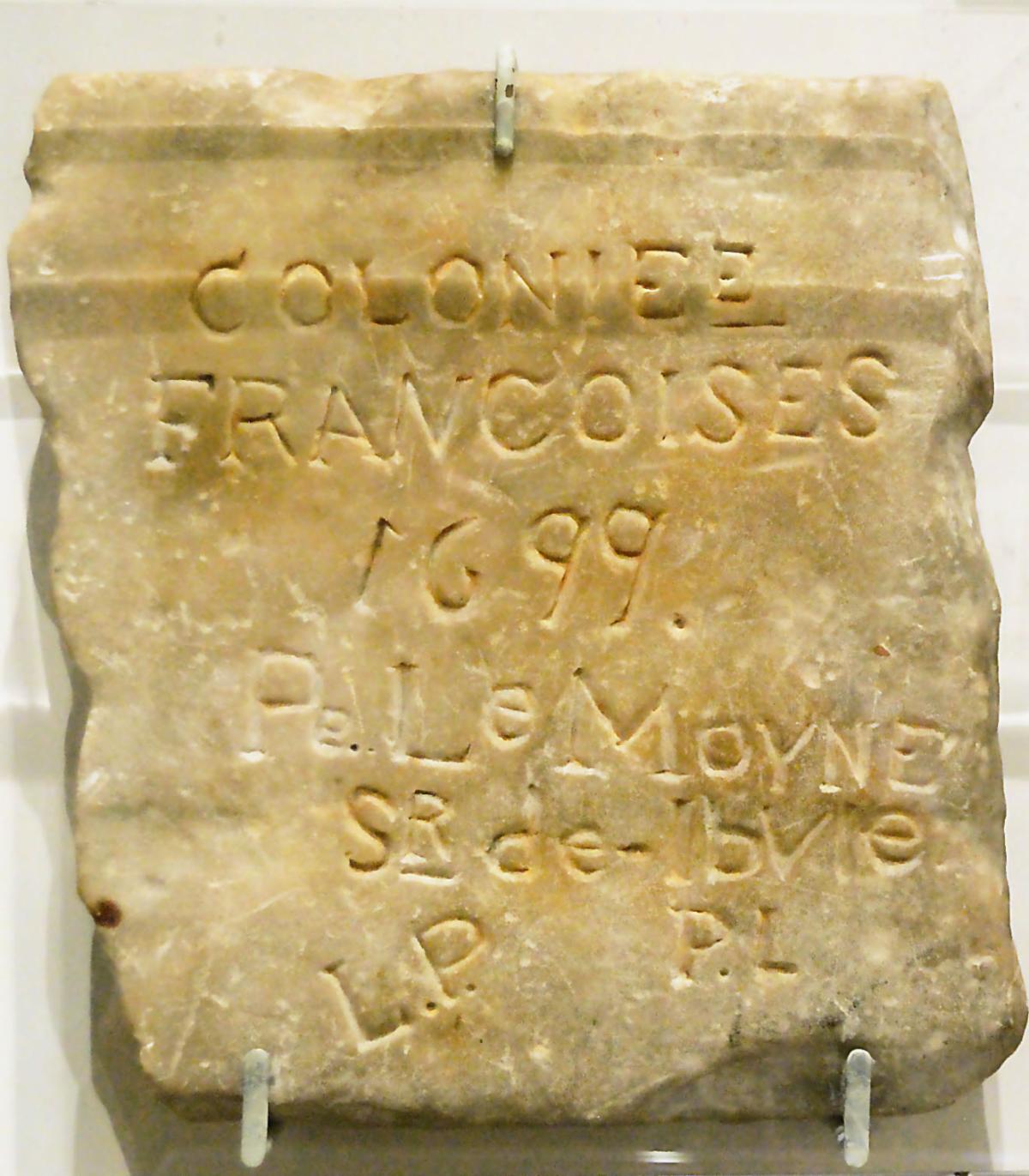
Iberville Stone: Stone purported to be the original plaque that Pierre Le Moyne, sieur d'Iberbille, used to mark the Louisiana colony's first permanent French settlement in 1699. (New Orleans Museum)
Louisiana State Museum at The Cabildo in New Orleans
701 Chartres St, New Orleans, LA 70130
Photo: By Pierre5018 - Own work, CC BY-SA 4.0,
|
|
• It is a chunk of marble that is basically signed by d’Iberville himself. It is displayed at the Louisiana State Museum at The Cabildo in New Orleans.
• It was unearthed in 1910 by a ground keeper at the W.B. Schmidt summer home on Front Beach in Ocean Springs.
• A notice at the Museum reads: "Iberville foundation or colonization plaque of the French Empire in the southern part of the North American continent. The first relic of Louisiana. This marble plaque was found by F.A. Schrieber in 1910 on the estate of W.B. Schmidt at Old Biloxi, now Ocean Springs, Miss., where Pierre Le Moyne Sieur d'Iberville and his brother Jean Baptiste Le Moyne, Sieur de Bienville established the French colony in the southern part of the North American continent on February 13, 1699. The inscription in French reads as follows...."
• Inscription:
“COLONIE FRANCOISES
1699
Pe LeMOYNE
Sr de-LbVIeR
L.P. P.L.”
|
|
FRENCH FORTS IN MISSISSIPPI |
|
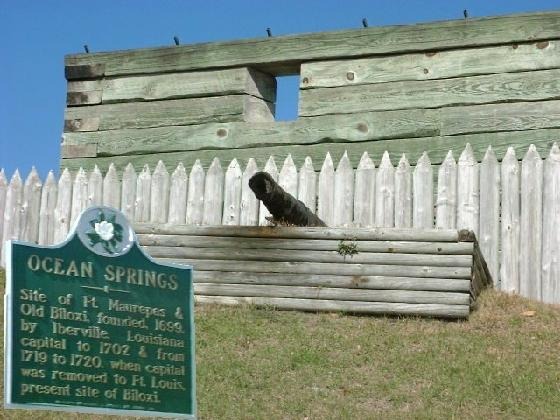
The replica of Fort Maurepas built as a tourist attraction was destroyed by Hurricane Kathrina and replaced by a park with the contour of the fort marked with bricks.
499 Front Beach Dr, Ocean Springs, MS 39564
Photo: by Iberville - Own work, CC BY-SA 3.0
|
|
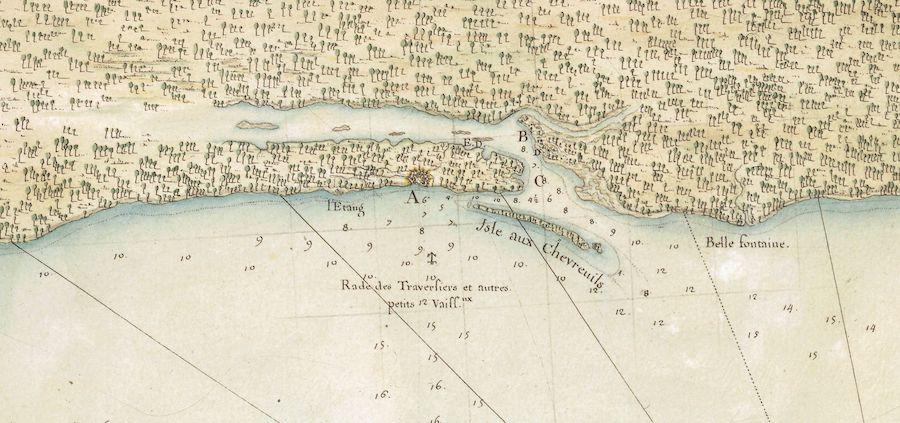
• Fort Maurepas, later known as Old Biloxi, was founded in 1699 and is in present-day Ocean Springs, Mississipi.
• It was built by Pierre Lemoyne d’Iberville.
• Jean de Sauvole de la Villantry (c.1671–1701), naval ensign of the frigate Le Marin, was left in command as governor, while Iberville’s teenage brother Jean-Baptiste Le Moyne de Bienville was appointed second in command.
• De La Villentry died of fever and was buried just outside the fort.
• Inscription:
OCEAN SPRINGS
"Site of Fort Maurepas and Old Biloxi, founded 1699 by Iberville.
Louisiana capital to 1702 & from 1719 to 1720
when capital was removed to Ft. Louis, present site of Biloxi”
|
|
Marker, The Landing of Pierre Le Moyne D'Iberville"
|
|
Marker «The Landing of Pierre Le Moyne D'Iberville»
1050 Beach Boulevard, Biloxi MS 39530
Illustration: Depiction of d'Iberville and Cavelier de La Salle exploring Louisiana
By Unknown author - Gallica.fr, Public Domain
|
|
• Excerpts from Marker:
“The 17th Century struggle among the French Spanish, and English for supremacy on the North American continent led the Bourbon King of France, Louis XIV to sanction an expedition from France to the Gulf of Mexico in 1698. The command was given to Canadian-born Pierre LeMoyne d'Iberville (1661-1706). After his military exploits against the British during the European War of the League of Augsburg, which spread to America as the first of the French and Indian wars (1689-1697), Iberville was recognized as Canada's first hero. Iberville's new commission was to locate the mouth of the Mississippi River from the Gulf and to build fortifications against Spanish and English advancement. The mission also served to reinforce the claim to the Louisiana Territory made by French explorer René LaSalle when, in 1682, he descended the Mississippi from Canada to the Gulf of Mexico”...
[...]
...”On February 10, 1699, Iberville's two frigates, Marin and Badine, anchored in the natural deep water harbor in the northwestern lee of Ship Island "The 13th, I crossed over to the land 4 leagues (about 12 miles) north in my Biscayne (flat bottomed boat, with eleven men, and my brother (Jean Baptiste de Bienville) in a bark canoe with two men...”
Erected 2015 by City of Biloxi”
|
|
Marker «Fort Maurepas and Old Biloxi 1699 -1920» |
|
10004 Central Ave, D'Iberville, MS 39540
|
|
• Inscription:
“This stone marks the site of
Fort Maurepas and Old Biloxi,
the first French settlement in the
lower south, established in the
name of Louis XIV King of France,
by Pierre Le Moyne D'Iberville
April 8, 1699.
Erected by the Gulf Coast Chapter,
Daughters of the American Revolution,
April 8, 1920, in commemoration of the
Two-Hundred and Twenty-First Anniversary
of the founding of the colony.
Erected 1920 by the Gulf Coast Chapter, Daughters of the American Revolution.”
|
|
This marker is one of the few on the south side of Beach Blvd. (Highway 90). It is to the left if entering Biloxi from Ocean Springs.
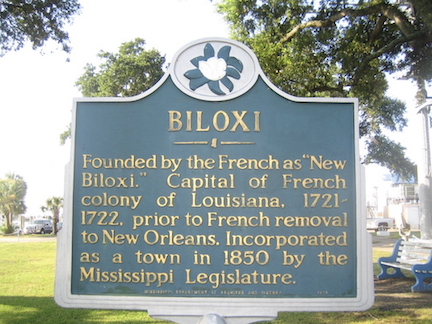
Marker «Biloxi»
687 Beach Boulevard, Biloxi MS 39530
Photo: http://www.mississippimarkers.com/biloxi.html
|
|
• In 1699 French colonists formed the first, permanent, European settlement in French Louisiana, at Fort Maurepas, now in Ocean Springs, Mississippi, and referred to as "Old Biloxi". They were under the direction of Pierre Le Moyne d'Iberville.
• The name of Biloxi in French was Bilocci, the name of the local Indian tribe. In 1720, the area of today's city of Biloxi was settled for the first time around Fort Louis. In this year, the administrative capital of French Louisiana was moved to Biloxi (or Bilocci) from Mobile (or La Mobile).
• In 1722, due to fears of tides and hurricanes, colonial governor Bienville moved the capital of French Louisiana from Biloxi to a new inland harbor town named La Nouvelle Orléans for that purpose in 1718-1720
• Inscription:
“Founded by the French as "New Biloxi."
Capital of French colony of Louisiana, 1721-1722,
prior to French removal to New Orleans.
Incorporated as a town in 1850 by the Mississippi Legislature.
Erected 1973 by Mississippi Department of Archives and History.”
|
|
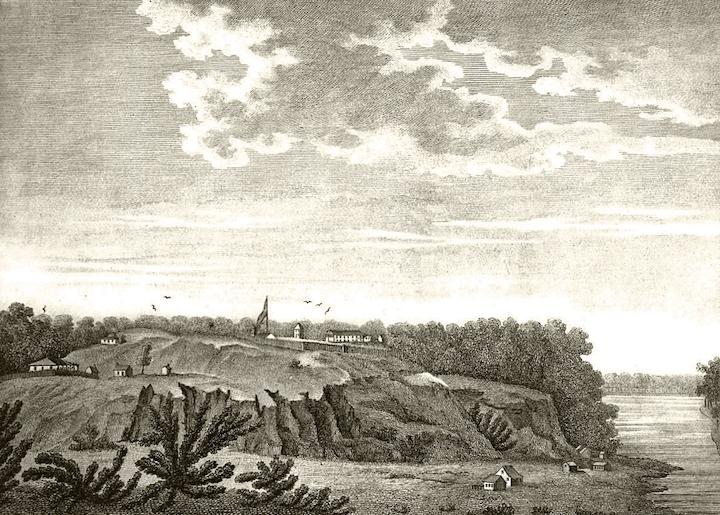
"View of the Fort of the Natchez", from Georges Henri Victor Collot's Voyage dans l'Amérique Septentrionale, ou Description des pays arrosés par le Mississipi, l'Ohio, le Missouri. Originally published in 1796.
|
|
• Fort Rosalie was built by the French in 1716 within the territory of the Natchez Native Americans and it was part of the French colonial empire in the present-day city of Natchez, Mississippi.
• As part of the peace terms that ended the First Natchez War in 1716, Jean-Baptiste Le Moyne, Sieur de Bienville established Fort Rosalie to serve as the seat of local government. After a massive surprise massacre by the Natchez in 1731, retaliation by the French and allied Choctaw forces in early 1730 forced the Natchez to evacuate, leaving the fort in ruins.
• Through 1731, the French, with their more numerous Indian allies, continued to war with the Natchez until 1731, killing, capturing or dispersing most of the Natchez until they ceased to exist as a tribe.
• Inscription:
“On bluff to south stood Ft. Rosalie, established by the French in 1716. Became nucleus of settlements from which the Miss. Territory was founded. Near this marker stood the French warehouse that was a center of bloodshed during the Natchez Massacre of 1729.
Dedicated December 11, 1988 by the Mississippi State Society
Daughters of the American Revolution, Mrs. D. Kelly Love, State Regent
Erected 1988 by Mississippi State Society, Daughters of the American Revolution.”
Marker « The French Build a Fort and a Colony»
528 S Canal St, Natchez, MS 39120
• Excerpts from Marker: “The French needed a strong defensive fortification in the lower Mississippi River valley to prevent European intrusions from the south, and the bluffs overlooking the Mississippi River at the settlement of the Natchez proved ideal. Following the peace terms that ended the 1716 conflict between the French and the Natchez tribe, Jean-Baptiste Le Moyne, Sieur de Bienville, required the Natchez to provide materials and labor for the construction of Fort Rosalie, named for the Countess of Pontchartrain.The fort served as the local seat of colonial government and was quickly surrounded by French settlements and plantations. In an effort to establish a stable economy, the French encouraged colonists to grow crops such as tobacco and indigo. Growing tensions between the French and the Natchez erupted in violence throughout the 1720s. When the French demanded additional lands that included the White Apple village, an important settlement for the native people, the Natchez determined to take a stand."
Marker « French Retaliation & the Second Fort Rosalie»
528 S Canal St, Natchez, MS 39120
• Excerpts from Marker: “ French retaliation for the uprising was swift. In 1730, the French engaged with Choctaw warriors to pin down the Natchez in two fortifications that they had constructed near the Grand Village ceremonial mound site while Louisiana Governor Etienne Perier led a combined French and Indian force upriver from New Orleans to conduct a siege battle that lasted until February 25, 1730. Following a negotiated peace wherein the French retreated to the burned remains of Fort Rosalie, the Natchez dispersed from the vicinity after releasing the French and African hostages. The Natchez continued their hostilities against the French colony in the Lower Mississippi Valley, even though a second siege battle some twenty-five miles northwest of Fort Rosalie resulted in the capture of the Great Sun and many Natchez elites who were sold into slavery to work the plantations of Santa Domingo. Natchez people who evaded the French sought refuge among other native nations in the Southeast.The French first erected a provisional fort a short distance to the southwest. Then, over the next few years, the French reconstructed a new Fort Rosalie within large earthen embankments in the shape of a pentagon, surrounded by a dry moat. This construction project utilized enslaved African labor from New Orleans under an Irish overseer. Unfortunately, due to the silty loose soil in the Natchez area, the embankments of the new fort were constantly eroding, and only one wall remains today. France would maintain a garrison of only about fifty men in the second Fort Rosalie for the next 30 years.”
|
|
Jean Charles de Pradel de Lamaze |
|
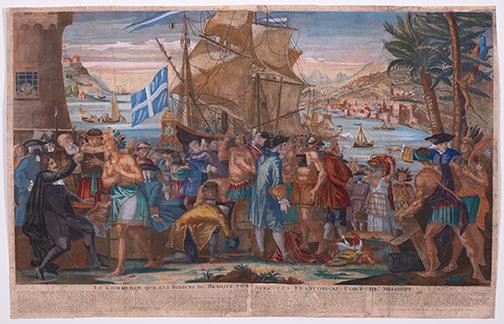
Illustration above: "Le commerce que les Indiens du Mexique font avec les François au port de Mississippi"; between 1719 and 1721; copperplate engraving with watercolor by François-Gérard Jillian; The Historic New Orleans Collection, 1952.3 (The trade that the Indians of Mexico make with the French at the port of Mississippi) - Photo: https://www.hnoc.org/exhibitions/new-orleans-founding-era
Marker, “Le Chevalier de Pradel - Jean Charles de Pradel de Lamaze
(1692 - 1764)” (one of the Founders of New Orleans)
430 Chartres St, New Orleans, LA 70130
|
|
• Jean Charles de Pradel de Lamaze (1692 - 1764) was born in 1692 in Uzerche (Corrèze) and died in 1764 in New Orleans.
• He was an infantry captain in the French Army and came to Louisiana in 1714. He was also commandant of Fort Chartres in Illinois in 1724 and at Fort Rosalie in Natchez (1731-1732).
• He became one of the founders of New Orleans where he settled until the end of his days in his plantation of Monplaisir, opposite of Jackson Square (now defunct).
• Inscription Plaque (excerpts):
“French Captain of Infantry
was assigned to Louisiana in 1714.
One of the founders of New Orleans,
he resided on this site.
De Pradel was commandant of
Fort Chartres in the Illinois country in 1724
and of Fort Rosalie in Natchez 1731-1732.
In 1736 De Pradel and his wife
Alexandrine de la Chaise
purchased Monplaisir Plantation
on the west bank of the Mississippi river
and made it one of the colony's grandest houses..."
|
|
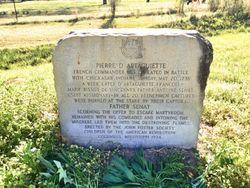
Grave site, “Pierre D'Artaguiette, Father Senat, Francois -Marie Bissot De Vincennes”
At the intersection of Mississippi Route 41 and Campground Road (County Road 134), 3753 MS-41, Pontotoc, MS 38863
Plaque “The D'Artaguiette Concession”
200 S River Rd, Port Allen, Baton Rouge LA 70802
|
|
• Pierre d'Artaguiette or d'Artaguette was the younger brother of Diron d'Artaguette, Inspector General of the Compagnie des Indes, to which Louisiana was granted by the Duke of Orleans in 1717.
• As an officer in the French Army in 1730, Pierre was mentioned in dispatches for "brilliant valor" during the Natchez revolt. He was appointed to rebuild Fort Rosalie.
• In 1734 Bienville sent him to Fort de Chartres with the rank of Major to command the Illinois District of the Province of Louisiana.
• In 1736 d'Artaguiette led a force of French and Illini against the formidable Chickasaw during the Chickasaw Wars. His impetuous attack at Ogoula Tchetoka on 25 March 1736 was crushed. Some accounts say d'Artaguiette died on the battlefield; others state he was captured with 18 other Frenchmen and burned alive.
• Inscription:
“The D'Artaguiette Brothers, Jean-Baptiste Martin, Navy Commissaire and later director of the Company of the Indies, Bernard Diron, Inspector General and later Commandant at Mobile and Captain Pierre D'Itouralde, Commandant of Illinois, killed in 1736 in the Chickasaw War, all served in French Colonial Louisiana between 1708 and 1742. Bernard and Pierre with the help of Martin in 1720, established a land grant settlement called Baton Rouge, Red Stick, which lasted several years. It was resettled after 1730 and the site retained the name Baton Rouge. The D'Artaguiette Brothers are considered the founders of Baton Rouge.”
• Inscription gravesite:
“Pierre D' Artaguiette
French Commander was defeated in battle
with Chickasaw Indians Sunday May 20, 1736
A week later D' Artaguiette, Francois -
Marie Bissot De Vincennes, Father Antoine Senat,
Jesuit Missionary-in all 20 Frenchmen captured-
were burned at the stake by their captors.
Father Senat
Scorning the offer to escape martyrdom,
remained with his comrades and intoning the
Miserere, led them into the destroying flames."
"Erected 1934 by the John Foster Society Children of the American Revolution Columbus, Mississippi.”
|
|
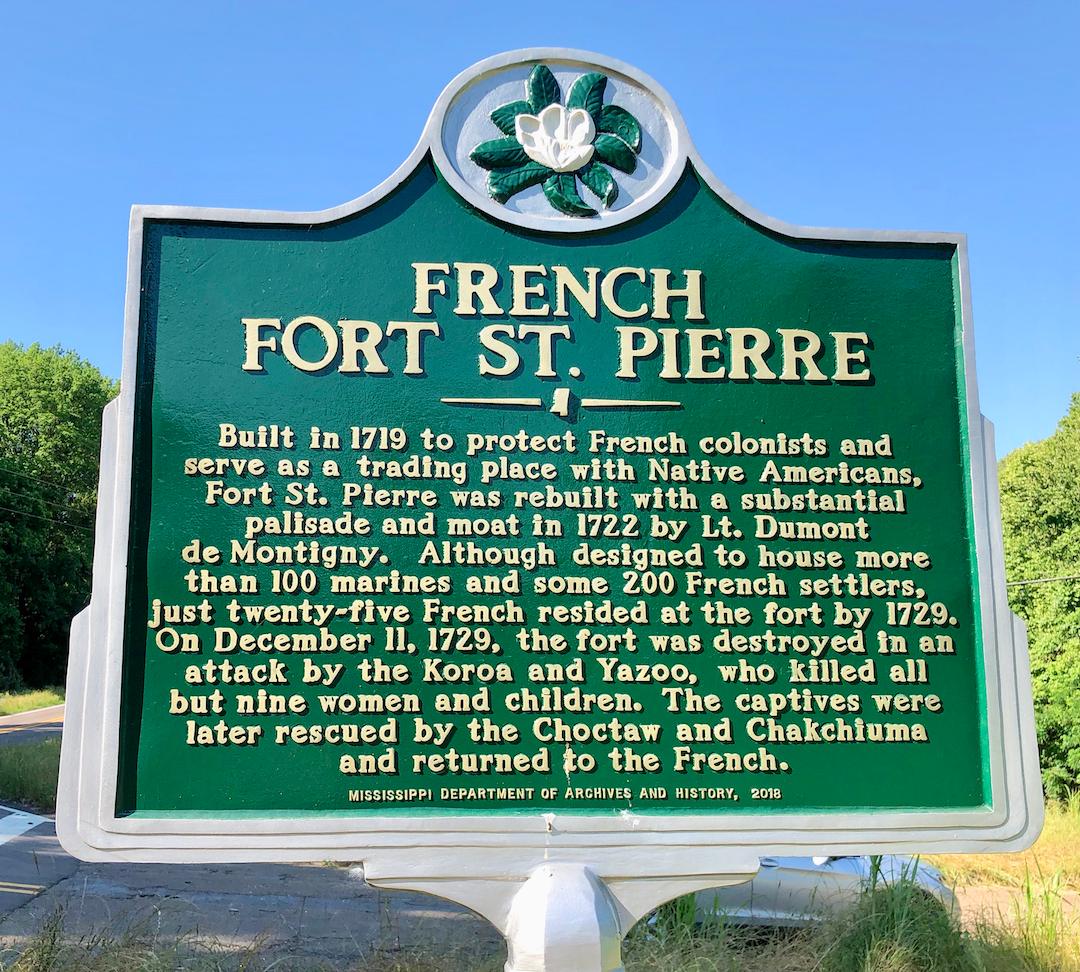
Marker « French Fort Saint Pierre»
Mississippi Route 3, 0.6 miles south of Mary Hearn Road, Redwood MS 39156
Photo by Mark Hilton - Own work, CC BY-SA 4.0,
|
|
• Also known as Fort St. Claude, it was established in 1719 and served as the northernmost outpost of French Louisiana. It was destroyed in a surprise attack by a band of Natchez, whose leadership had become hostile to French incursions on their territory upon the death of a French-friendly chief, and was not rebuilt.
• Its location was discovered by archaeologists in the 1970s. It was declared a National Historic Landmark in 2000.
• Inscription of marker:
...“Built in 1719 to protect French colonists and serve as a trading place with Native Americans, Fort St. Pierre was rebuilt with a substantial palisade and moat in 1722 by Lt. Dumont de Montigny. Although designed to house more than 100 marines and some 200 French settlers, just twenty-five French resided at the fort by 1729. On December 11, 1729, the fort was destroyed in an attack by the Koroa and Yazoo, who killed all but nine women and children. The captives were later rescued by the Choctaw and Chakchiuma and returned to the French.
Erected 2018 by the Mississippi Department of Archives and History.”
• Inscription of marker#2 (excerpts):
...“The first white men to visit the Yazoo River were four missionary priests from the Seminary of Quebec. Rev. Francis De Montigny, a native of Paris, was the leader of the party and bore the appointment of Vicar General of the Bishop of Quebec. The other priests were: Rev. Anthony Davion, Rev. Thaumer De La Source and Rev. John Francis Buisson De St. Cosme. Their purposes were to civilize and make known to the Indians that there was an Almighty God who loved all mankind and would reward with everlasting happiness all who would learn to love and serve Him and keep His commandments.The arrived at this site January 11, 1698 and were conducted inland from the Mississippi River by Indians of the Tunica tribe to the village of the chief. They estimated the population at 2,000, which included the Yazoo and Ofo tribes. The visit lasted eight days and sickness being among them they baptized several dying children and a distinguished chief. They visited other tribes and returned to Canada for necessaries to make permanent the places selected for missions. The Missionaries were back in Jan. 1699. Their study of the Indian languages was so extensive and thorough as to have John R. Swanton of the U.S. Bureau of Ethnology, in 1911, state, in bulletin 43: "It is evident that of all men De Montigny and St. Cosme, especially the latter, were best fitted to to pass upon the relationship of Natchez to the language of its neighbors," and in referring to the languages of the ten other tribes he states "That in the light of all our present knowledge not a single mistake was made by them." Large grants of land were made to M. Le Blanc, French minister of State and his associates”
In 1719 Fort St. Peter was constructed and "Additions were made annually to all the settlements until there were two farms on Walnut Hills, and fourteen on the Yazoo around Fort St. Peter that became the envy of the British and pride of the French in 1721. On December 31, 1729, the Yazoo Indians massacred Rev. John Souel S.J. Chevalier Des Roches, commandant, and all the population except 4 women and 5 children. “ M.J. Mulvihill, Sr. Historian.
Erected 1929 by Board of Supervisors of Warren County, Mississippi.”
|
|
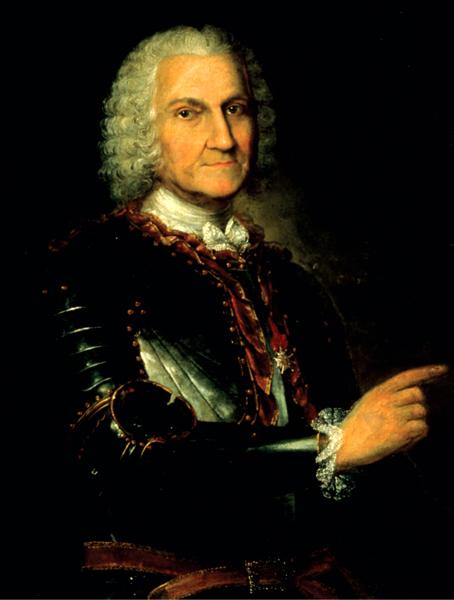
Jean-Baptiste Le Moyne de Bienville |
|
Jean-Baptiste Le Moyne de Bienville (1680-1767), Unknown Painter, Public Domain
|
|
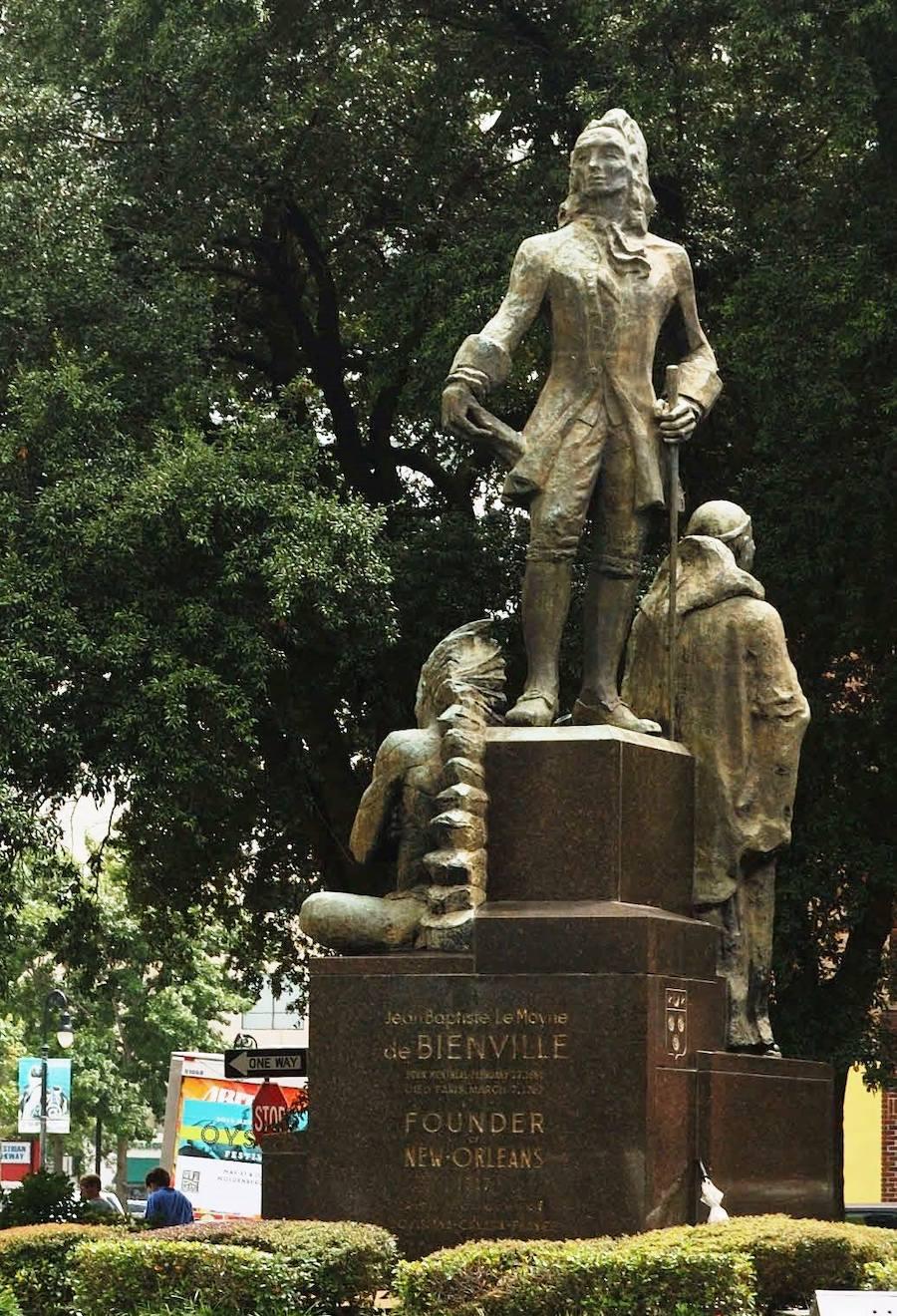
• Jean-Baptiste Le Moyne de Bienville (February 23, 1680 – March 7, 1767), also known as Sieur de Bienville, was a French colonial administrator in New France. Born in Montreal, he was an early governor of French Louisiana, appointed four separate times during 1701–1743. He was the younger brother of explorer Pierre Le Moyne d'Iberville.
• At the age of 17, Bienville joined his brother Iberville on an expedition to establish the colony of Louisiana. After his brother left, Bienville established a settlement along the Mississippi River at the first solid ground he could find. Fifty miles upriver, Bienville established Fort de la Boulaye, also known as Fort Mississippi.
• Bienville founded New Orleans in the spring of 1718 (May 7 has become the traditional date to mark the anniversary, but the actual day is unknown). In 1721 he ordered military engineer Adrien de Pauger drew up the eleven-by-seven block rectangle now known as the French Quarter or the Vieux Carré, eventually becoming the capital of Louisiana in 1723 in replacement of Biloxi.
|
|
Statue “Jean-Baptiste Le Moyne de Bienville”
Founder of New Orleans, Louisiana
|
|
French Quarter at the south end of Bienville Place & Decatur St., New Orleans, LA 70116
Photo: By Pierre5018 - Own work, CC BY-SA 4.0,
|
|
• In addition to being the co-founder of Mobile in Alabama, is he known as the Father of New Orleans, and is also considered the Father of Louisiana
• The statue was first erected at the Bienville Plaza near the New Orleans Union (railroad) station in April 1955. It was relocated to Bienville Place in November 1996.
• Inscription on base of statue:
“Jean Baptiste LeMoyne de Bienville
born Montreal, February 23, 1680
died Paris, March 7, 1767
Founder of New Orleans
1717
with homage of Louisiana * Canada * France
Erected 1955 by Louisiana Purchase Sesquicentennial Commission.”
• Marker on the south side of the statue:
“In commemoration of the 250th anniversary of the founding of New Orleans, a wreath was placed here by his excellency, Charles Lucet ambassador of France to the United States and the honorable Victor H. Schiro, Mayor of New Orleans, on May 9, 1968."
|
|
FRENCH FORTS OF LOUISIANA |
|
Fort de la Boulaye (1700) |
|
Marker, “Fort de la Boulaye”
Highway LA-39, Braithwaite, LA 70040
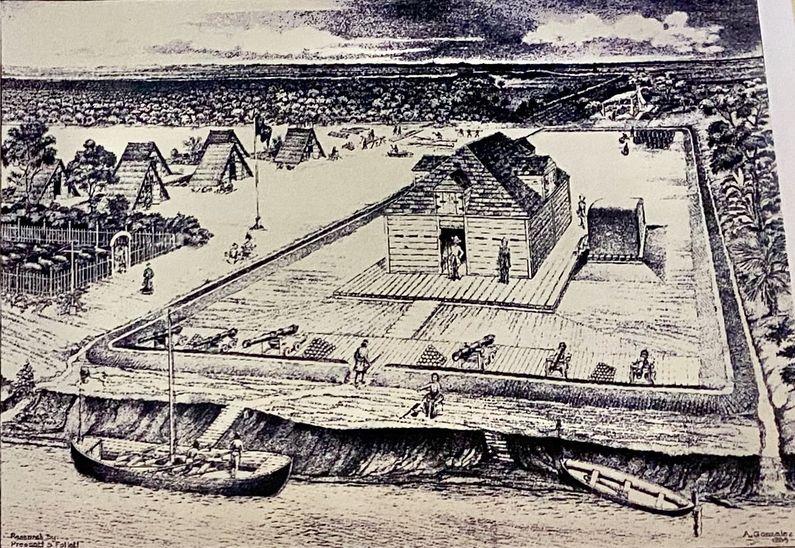
Illustration: Fort de La Boulaye, aka Fort Mississippi, from a display at the Fort Jackson Museum, photo by John Stanton 2 Nov 2021 Fortwiki
|
|
• Fort de La Boulaye (1700-1707) was a French Colonial Fort established in 1700 by Pierre Le Moyne d'Iberville with his brother Jean-Baptiste Le Moyne de Bienville near present-day Phoenix, Plaquemines Parish, Louisiana.
• It was also known as Fort Iberville, Fort on the Mississippi, Fort Louisiana and Fort Vieux.
• It was the first French outpost in present-day Louisiana. It was intended to secure a French claim to the region and to counteract intrusions by the Spanish from the west and English from the east.
• The post had a two-story 28-foot square log blockhouse armed with six cannons and was garrisoned by 18 men. Iberville initially left the garrison under the command of his younger brother, Bienville.
• The fort was abandoned in 1707. It operated as a trading post until 1711. It is now on the National Register of Historic Places as “Fort De La Boulaye Site”.
• Inscription:
FORT de la BOULAYE
“First white settlement in present-day Louisiana, erected by Bienville in 1699 on this spot (then the bank of the Mississippi), prevented Britain's seizure of the Mississippi Valley.”
|
|
Fort Saint Jean Baptiste (1714) |
|
Marker, “Fort Saint Jean Baptiste”
2nd St #200, Natchitoches LA 71457
|
|
• Natchitoches was founded by a French Canadian, Louis Antoine Juchereau de St. Denis, in 1714 while he was en route to Mexico from Mobile, Alabama, on a trade mission.
• When he reached the village of the Natchitoches Indians on the Red River, he had two huts constructed within the village and left a small detachment there to guard the stores and trade with the inhabitants. This became the first permanent European settlement in the territory later known as the Louisiana Purchase.
• Inscription:
“On this hill stood Fort Saint Jean Baptiste, westernmost outpost of the French Colonial Empire in the west, erected by Saint Denis under Iberville's orders in 1720, seat of the garrison of the Post of Natchitoches, the oldest town in the Louisiana Purchase, and of the French and Spanish governors until the cession of 1803, after which it was continuously occupied for many years by American troops.”
Erected 1934 by Daughters of the American Revolution of Louisiana.”
|
|
Fort Louis de la Mobile (1702) |
|
Marker “Site of Old Mobile“, Fort Louis
12950 US Hwy 43, Axis AL 36505
Photo: By Harfang - Own work, CC BY-SA 3.0,
|
|
• Inscription:
(English side)
"Site of Old Mobile
Fort Louis de la Louisiane
Founded 1702 by Pierre Le Moyne d’Iberville
Under orders of Louis XIV
First Capital of French Louisiana 1702-1711
Erected 2001 by Christopher Branch Chapter, Mobile, Alabama, National Society Colonial Dames XVII Century"
|
|
Marker, “Fort Toulouse”
2521 West Fort Toulouse Road, Wetumpka, AL 36093
Photo: By Altairisfar - Own work, Public Domain,
Fort Toulouse is a reconstruction near Wetumpka, Alabama.
|
|
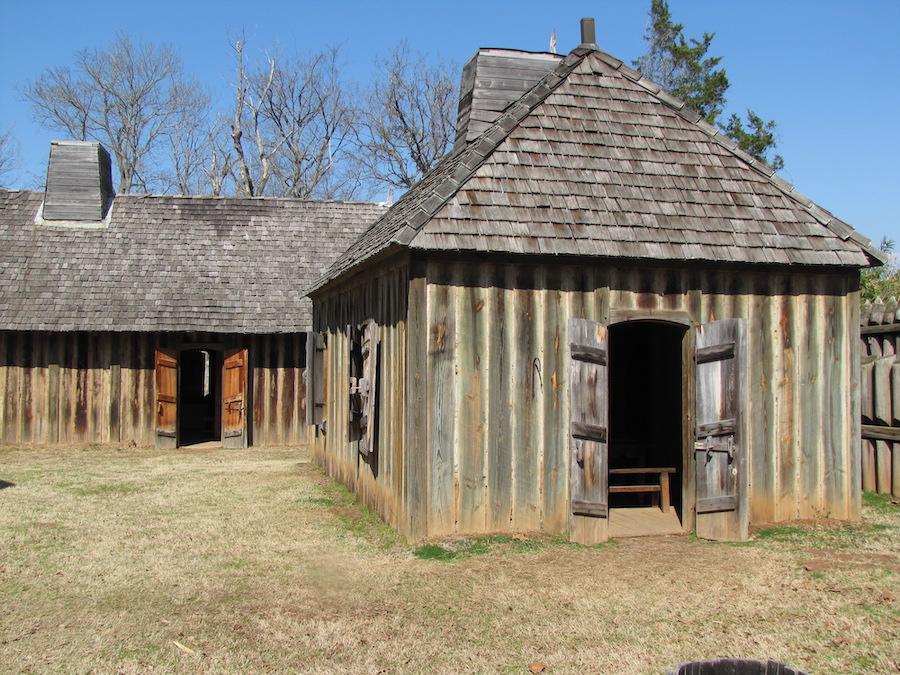
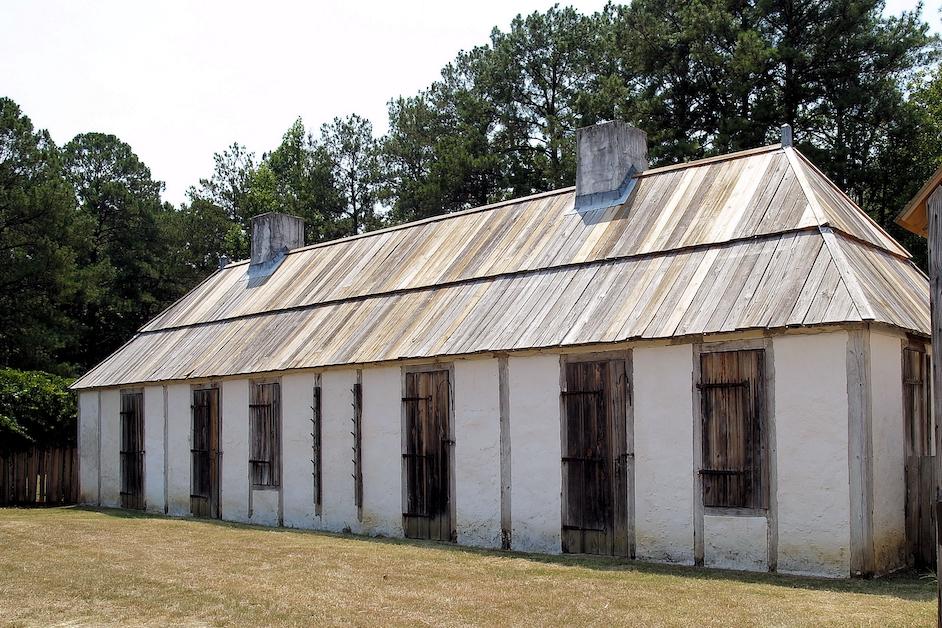
• Fort Toulouse (Muscogee: Franca choka chula), also called Fort des Alibamons and Fort Toulouse des Alibamons was founded in 1717, and was named for Louis-Alexandre de Bourbon, comte de Toulouse.
• It was the easternmost fort (in what is now the United States) established by colonial French Louisiana.
•In order to counter the growing influence of the British colonies of Georgia and Carolina, the government of French Louisiana erected a fort on the eastern border of the Louisiana Colony in what is now the state of Alabama. The number of troops in garrison varied between 20 and 50 French Colonial Marines. Living and working at the fort, the Marines traded extensively with the local Creek Native Americans and cultivated friendly relations with them.
• According to tradition, the French commander Captain Jean Baptiste Louis De Courtel Marchand married the high-status Creek woman Sehoy in about 1720.
• Due to the poor living conditions at the fort, the troops mutinied in 1722. They killed Captain Marchand and captured the other officers, tying them up before leaving the fort. The imprisoned officers managed to escape, and with the help of nearby Creek, they captured the mutineers and sent them to Fort Conde in Mobile for punishment.
• The fort was abandoned after France ceded it to the British. The site was declared a National Historic Landmark by the Department of Interior in 1960 and a replica was built.
• Inscription:
"Here stood
Fort Toulouse
A defense against the Indians
Built by
Bienville
1714
The Alabama Society of Colonial Dames preserves the memory of faithful service
Erected 1912 by Alabama Society of Colonial Dames."
|
|
Fort Condé (Fort Charlotte) (1723) |
|
Marker, “The Site of Historic Fort Condé”
150 South Royal Street, Mobile AL 36602
Photos:
Top: Wikid77, CC BY 3.0 <https://creativecommons.org/licenses/by/3.0>, via Wikimedia Commons
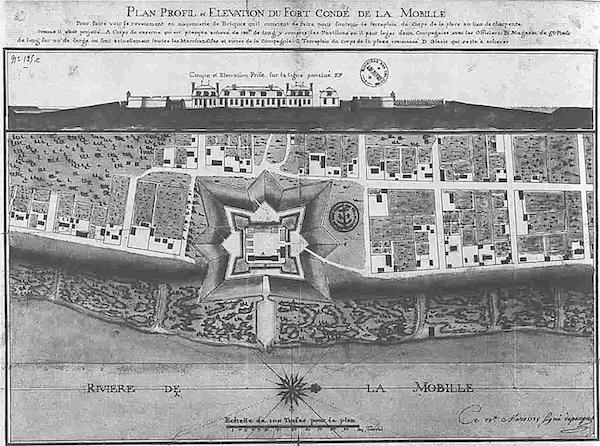
Bottom: Map by Adrien de Pauger (He also designed the Vieux Carré in New Orleans, Louisiana ), Public domain, via Wikimedia Commons
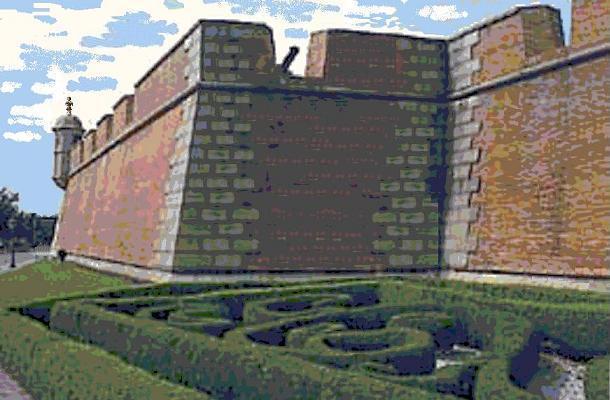
This fort is a reconstruction.
|
|
• Inscription (excerpts):
• Patterned after forts designed by French military engineer Sebastian Le Pestre de Vauban, Fort Condé protected Mobile and its citizens for nearly 100 years from 1723-1820. Built by the French as a defense against British and Spanish attack, the strategic location of Mobile Bay guarded the eastern-most part of the Louisiana colony. Founded in 1702 at the 27-Mile Bluff site on Mobile River, the settlement was relocated in 1711 to the site on which you stand.
[...] Renamed Fort Condé in honor of King Louis’s brother, the fort covered about 11 acres of land. From 1763 to 1780, England occupied Mobile, and the fort received the name Fort Charlotte in honor of King George III’s wife. From 1780 to 1813, Spain controlled Mobile and the fort was renamed Fort Carlota. The United States seized Mobile in 1813 and again named the structure Fort Charlotte. By 1820, the fort was no longer needed for defense and Congress authorized its demolition to make way for new streets and buildings toward the river and southward.
[...] The current Fort Condé is about 1/3 of the original fort structure recreated in 4/5-scale. It opened July 4, 1976 as part of Mobile’s United States bicentennial celebration.
Erected by History Museum of Mobile."
|
|
Plaque, “Fort Tombecbee”
Fort Tombecbee Road, Epes, AL 35460
|
|
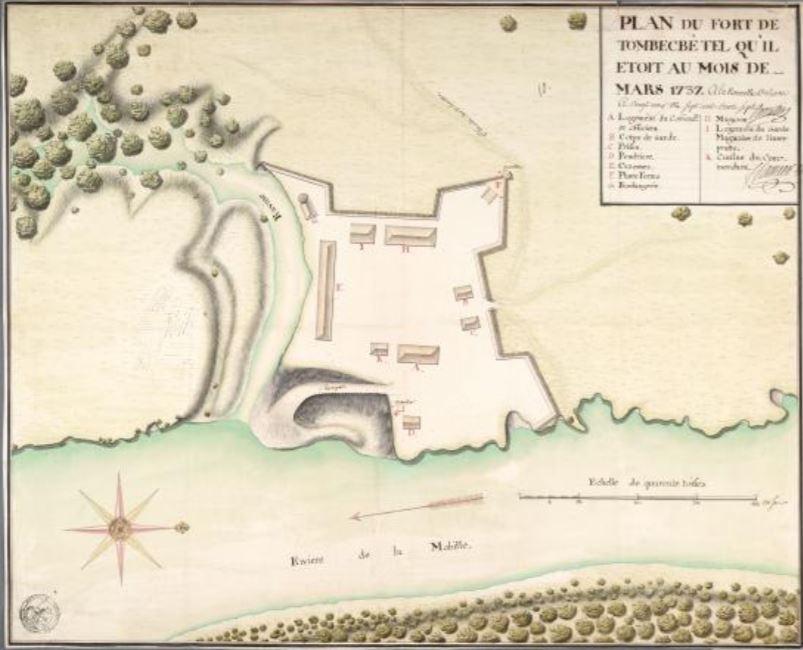
• Fort Tombecbe, or Fort Tombecbee (Fort de Tombecbé) was constructed under the leadership of Jean-Baptiste Le Moyne, Sieur de Bienville in 1736-37 as a major trading post in the Choctaw nation, until it was ceded to the British in 1765, renamed Fort York, and eventually renamed Fort Confederation by the US government until its abandonment in the 19th Century.
• The archeological site is now under the supervision of the University of West Alabama.
• Inscription:
"On This Site Stood Fort Tombecbee built by
Jean Baptiste Le Moyne Sieur de Bienville,
Governor of Louisiana
Here civilization and savagery met,
and the wilderness beheld the glory of France.”
Erected in 1915 by The National Society of The Colonial Dames of America
|
|
FRENCH FORTS OF TENNESSEE |
|
Fort de l'Assomption (1739) |
|
Fort de l’Assomption, Memphis, TN
983-1019 Riverside Blvd, Memphis, TN 38106
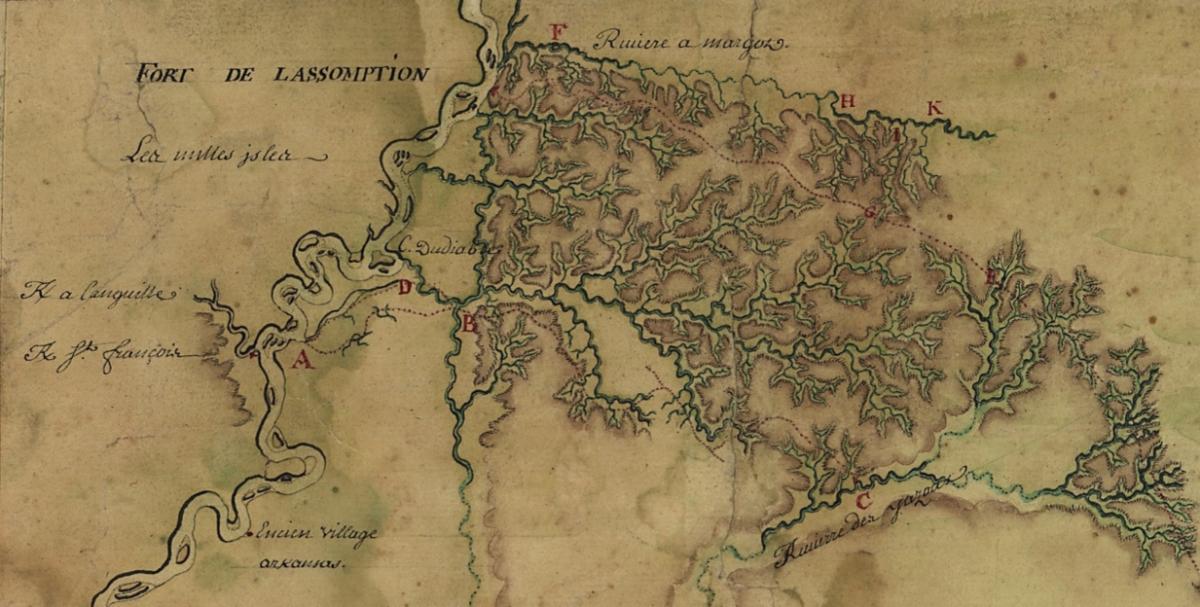
Illustration: Louisiana and Mississippi routes of Broutin, de Verges, and Saucier, author unknown., Public domain, via Wikimedia Commons
|
|
• Fort De L'Assomption was located on the banks of the Mississippi River in what is now downtown Memphis. The French fortification was constructed in 1739 on the fourth Chickasaw Bluff on the Mississippi River in Shelby County, present day Memphis, Tennessee. The fort was used as a base against the Chickasaw in the unsuccessful Indian-removal Campaign of 1739.
• In 1739, Jean-Baptiste Le Moyne, Sieur de Bienville led an army of 1,200 Frenchmen into the area of what is modern day Shelby County, Tennessee to eradicate the native Chickasaw Indians in order to secure and prepare the land for settlement by the French
• On August 15, 1739, the day of the Feast of the Assumption, the fort was finished and named Fort de l’Assomption in commemoration of the holy day
• During the winter of 1739/40, the garrison was plagued by "weather, disease, desertion and drunkenness". The Chickasaw had taken French hostages during the eradication campaign, the hostages were released on March 20, 1740 after negotiations. On March 31, 1740 the discouraged and exhausted French troops were withdrawn and the fortification was abandoned by the French army.
• Although the French presence on the fourth Chickasaw Bluff only lasted for a few months, the area was claimed by France for eighty years.
|
|
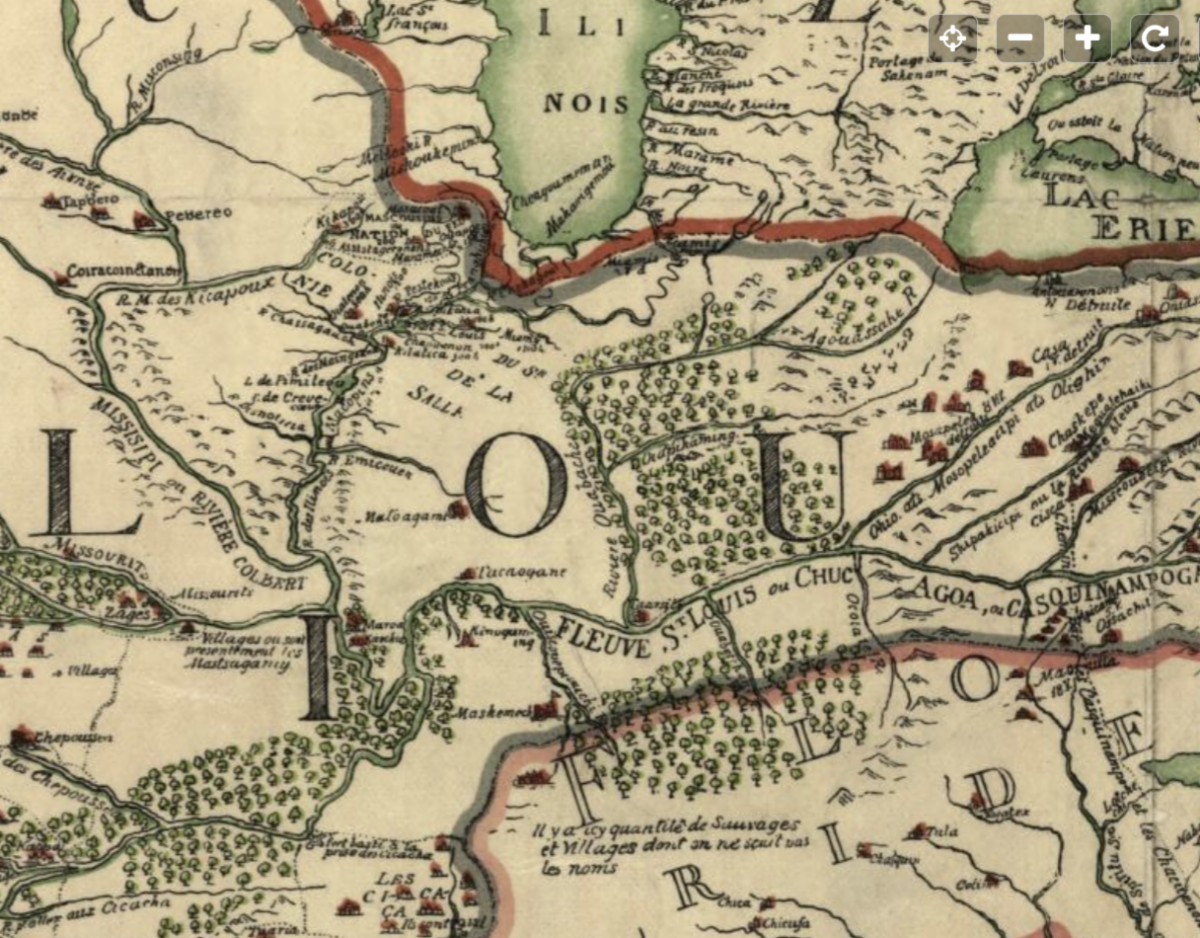
Detail, Carte de la Louisiane ou des voyages du Sr. De La Salle, by Franquelin, Jean Baptiste Louis, 1684, Library of Congress, Public Domain
Reduced facsimile of MS. copy (made in Paris for Francis Parkman), now in the Library of Harvard University. The original, formerly in the Archives de la Marine, Paris, has been lost. From the Jesuit Relations, vol. 63, frontispiece.
"Il y a ici quantités de Sauvages et Villages dont on ne sait pas les noms" (There are here a lot of Savages and Villages whose names we do not know)
|
|
• In 1682, René-Robert Cavelier, Sieur de La Salle, claimed what is now West Tennessee for France during his exploration of the Mississippi River. While on his mission, he constructed the earliest known European military fortification in West Tennessee, Fort Prudhomme.
• When La Salle and his men stopped to hunt on the east bank of the Mississippi River, they lost one of their members, an armorer named Pierre Prudhomme, in the old growth forests and wetlands along the river. La Salle feared his man might have been captured by the Chickasaws, so they built a stockade to protect the group, on the second Chickasaw Bluff south of the Hatchie River. La Salle called it Fort Prudhomme.
• The exact location of Fort Prudhomme remains unclear, although some researchers place it near the later town of Randolph in Tipton County. Meanders of the Mississippi River since the 1680s may have destroyed the site.
• Additional recommended reading on this fort:
|
|
Étienne de Veniard, Sieur de Bourgmont,
First explorer of Kansas and Missouri (1679-1734)
|
|
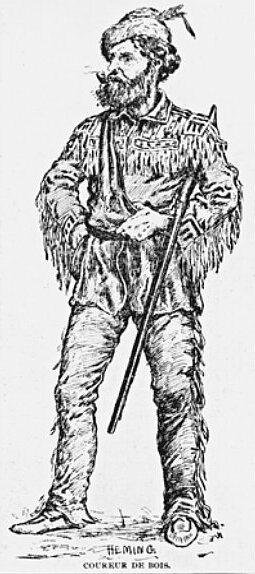
Illustration: Coureur de Bois in typical dress. These Frenchmen became involved in the 1650s in the fur trade. Woodcut by Arthur Heming (1870 - 1940). Heming, National Archives of Canada, C5746, Public Domain
Bourgmont, a fugitive from justice, became a coureur des bois for several years during his early career.
|
|
• Étienne de Veniard, Sieur de Bourgmont was the first documented French visitor to the Kansas City area and the first European to explore the lower Missouri River.
• He ran into trouble with his superiors when commanding Fort Detroit for deserting his post after an attack from American Natives.
• He married an American Indian and traded furs.
• He redeemed himself by writing the "Exact Description of Louisiana, of Its Harbors, Lands and Rivers, and Names of the Indian Tribes That Occupy It, and the Commerce and Advantages to Be Derived Therefrom for the Establishment of a Colony" in 1713 followed in 1714 by "The Route to Be Taken to Ascend the Missouri River"
• He was the first to use the names Kansas and Missouri.
• He was consequently named commander of the Missouri. He built the first fort (and first extended settlement in Missouri) in 1723 at Fort Orleans.
• In 1724, Bourgmont led a group of Native Americans probably up the Kansas River en route to the southwest to set up an alliance with the Comanche to fight the Spanish, thereby creating a New France empire extending from Montreal through Kansas City to New Mexico.
|
|
Marker, “Fort Orléans”
711 Jefferson Street, De Witt MO 64639
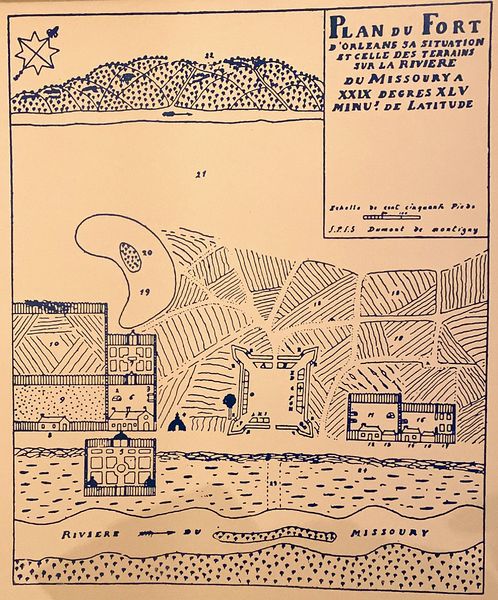
Illustration: Fort Orleans, 1727, Plan, Photograph of a copy in the Arrow Rock National Historic Landmark, photo by John Stanton 21 Aug 2020, Creative Commons FortWiki
|
|
• Fort Orléans (sometimes referred to Fort d'Orléans) was a French fort in colonial North America, the first fort built by any European forces on the Missouri River.
• Intended to be the linchpin in the vast New France empire stretching from Montreal to New Mexico, the fort was occupied from 1723–1726.
• It was the first multi-year European settlement in what is today the U.S. state of Missouri.
• The fort was established in 1723 on the Missouri River by Étienne de Veniard, Sieur de Bourgmont, in honor of the Duke of Orléans
• Inscription:
“First settlement in Missouri
made by the French”
“Marked by the Carrollton Chapter
Daughters American Revolution 1924”
|
|
Marker «Fort Cavagnal”
16721 Daniel Rd, Leavenworth, KS 66048
Photo: By Captain Thor - Own work, CC BY-SA 3.0,
|
|
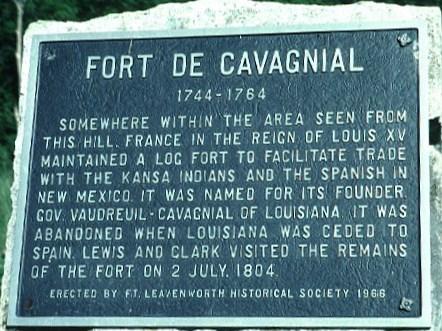
• Fort de Cavagnial (also known as Fort Cavagnolle, Fort Cavagnal, Post of the Missouri, or Fort de la Trinité) was a French colonial Fort established in 1744.
• Named after Louisiana Governor Marquis de Vaudreuil-Cavagnial.
• It was abandoned in 1764.
• The fort site is located on private property not open to the public adjacent to the Kickapoo Memorial Cemetery. A marker is located at the entrance to the Kickapoo Memorial Cemetery
• Inscription:
“Somewhere within the area seen from this hill, France in the reign of Louis XV maintained a log fort to facilitate trade with the Kansa Indians and the Spanish in New Mexico. It was named for its founder Gov. Vaudreuil-Cavagnial of Louisiana. It was abandoned when Louisiana was ceded to Spain. Lewis and Clark visited the remains of the fort on 2 July 1804.
Erected by Leavenworth Historical Society 1966”
|
|
EPILOGUE: About the Indian Bride who visited Paris... |
|
• The mural, by American Painter Blumenschein, Ernest Leonard 1874-1960 was painted circa 1917-1928 and adorns the Missouri State Capitol.
We chose this painting to illustrate our monthly Bulletin as it captures the peculiar blend of colonial benevolence, elegance, refinement, but also the danger of two worlds colliding, and the role that these forts played in a fragile territorial domination.
• This lunette, one of twenty-two along the second floor corridor, depicts French officer Du Bois standing beside his Missouri Indian princess bride dressed in an elegant Parisian gown surrounded by her fellow Missouri Indians...
But why, will you ask, would an Indian princess be dressed as a French marquise?
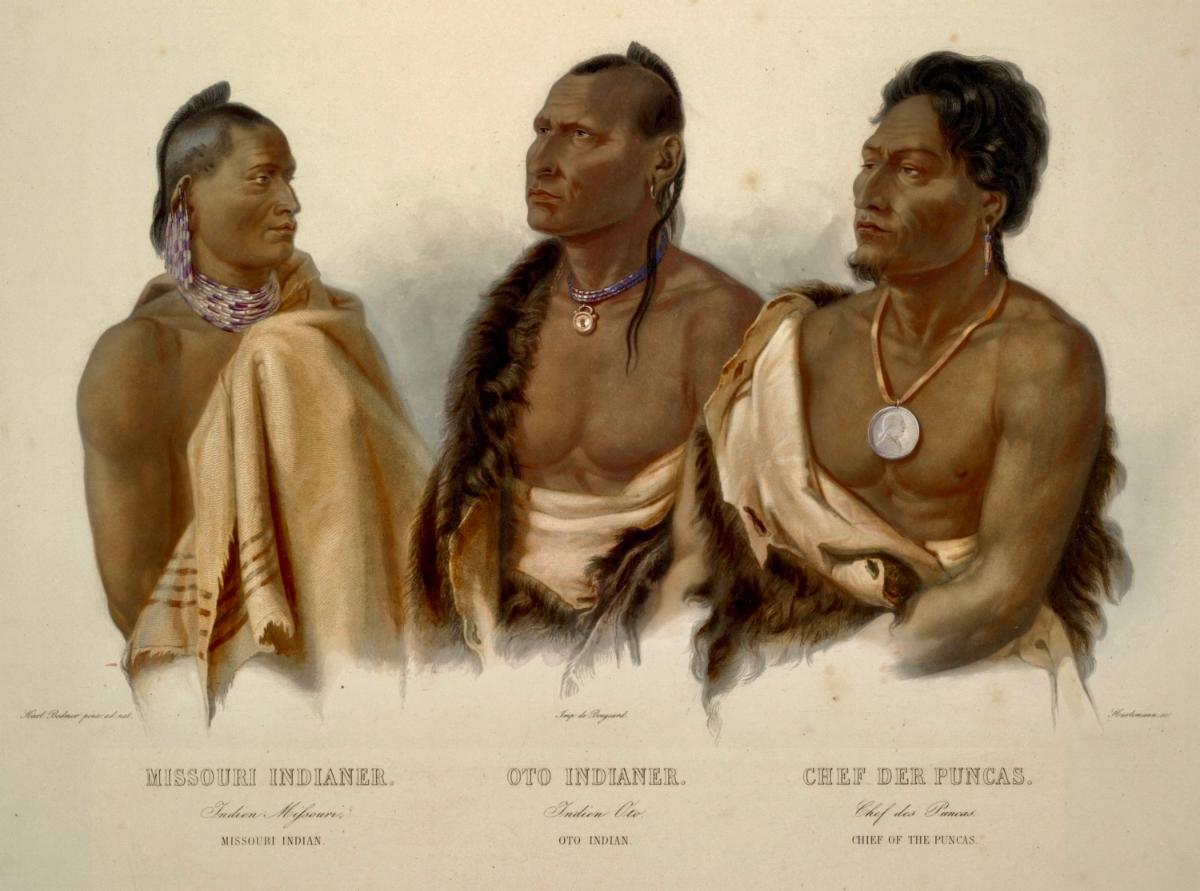
• As you recall, Étienne de Veniard, Sieur de Bourgmont, the first explorer of Kansas and Missouri, built the first fort (and first extended settlement in Missouri) in 1723 at Fort Orléans. In 1724, Bourgmont led a group of Native Americans probably up the Kansas River en route to the southwest to set up an alliance with the Comanche to fight the Spanish, thereby creating a New France empire extending from Montreal through Kansas City to New Mexico. • • To celebrate the success of the venture, he took the Native American chiefs on the equivalent of a modern-day junket to Paris to see the glory of France at Versailles and Fontainebleau...The Indians were lavishly treated by King Louis XV himself, went hunting with him, were presented at the Court and attended the opera. It is thought that the Indian princess was actually married to Bourgmont (whose legitimate French wife Jacqueline had stayed in France all along) and with whom she had a son.
• It is during the trip that the young French officer (Sergeant? Captain? We do not know for sure) Du Bois, who served with Bourmont, fell in love with the Indian princess... and married her.
• In the mural painting, the Indian princess and a small group of the Missouri Indians have just returned Fort Orleans from this memorable trip to the French Court. The scene takes place along the Missouri River at Fort Orleans.
• The date on the lunette (1720) is erroneous, the trip from France took place in 1725.
• As for Bourgmont? He didn’t accompany the Indians back to the New World, stayed in France with his legitimate wife, and died there in 1734.
• According to legend, the Native Americans who had been so lavishly entertained in France slaughtered everybody in the Fort Orleans garrison...
After the Treaty of Paris in 1763, the French continued their fur trade on the Mississippi river, but under Spanish license...
|
|
PART ELEVEN OF THE SERIES
"LAFAYETTE, GUEST OF THE NATION"
If you missed the episodes from our past Bulletins...
• President James Monroe invited Lafayette, the last surviving major general of the American Revolutionary War, to tour the United States, officially to celebrate the nation's 50th anniversary but also to instill the "spirit of 1776" in the next generation of Americans at a time of great political divide. His tour drew large crowds and sparked a renewal of patriotism.
• From July 1824 to September 1825, Lafayette made a tour of all 24 States in the United States. He was received with a hero's welcome everywhere he stopped. Immense crowds, children, old veterans would come from miles away and wait hours to have a chance to see him, approach him, touch him. Many honors and monuments were presented to commemorate and memorialize the visit.
• The 24 states visited were: Alabama, Connecticut, Delaware, Georgia, Illinois, Indiana, Kentucky, Louisiana, Maine (ex-Massachusetts / North part), Maryland, Massachusetts, Mississippi, Missouri, New Hampshire, New Jersey, New York, North Carolina, Ohio, Pennsylvania, Rhode Island, South Carolina, Tennessee, Vermont, Virginia, Washington D.C.
• The main means of transportation were stagecoach, horseback, canal barge, and steamboat.
• Throughout the years 2024 and 2025 each city will celebrate this most illustrious Frenchman, ranked alongside the Founding Fathers, practically on a par with George Washington. If anyone harbors any doubt about it, one only needs to read some of the hundreds of local newspaper articles and the accounts or memoirs of contemporary witnesses accounts.
|
|
• Several of his stops are memorialized with markers and plaques, some decades-old, and an increasing number of brand new ones, thanks to the energy and enthusiasm deployed by Julien Icher, president of the LafayetteTrail.org, whose goal is to dedicate all 175 markers by 2024.
• These new markers from the LafayetteTrail.org are all made in the same distinctive blue and red cast metal and signed by the William C. Pomeroy Foundation which is generously funding this gigantic project.
• The American Society of Le Souvenir Français Inc. is honored to partner with these two like-minded organizations, as well as all other American patriotic associations and volunteers who are participating in these celebrations, under the umbrella of America250.
|
|
As we started with the August 2022 Bulletin, we continue our narration every month with some of the most salient episodes of this remarkable journey of the corresponding month 199 years ago, while keeping you abreast of the many celebrations planned by the local committees of the American Friends of Lafayette in 2024 and in 2025.
For this series we borrow primarily from the testimonies of a privileged close witness, Auguste Levasseur, Lafayette’s personal secretary, who traveled along with the Marquis and his son, George Washington Lafayette, and who published his extensive daily journal: “Lafayette en Amérique 1824-1825, ou Journal d'un voyage aux Etats-Unis" (Published by the Librairie Baudoin, Paris, in 1829). We also rely on other well-documented sources, such as Samuel Lorenzo Knapp. “Memoirs of General Lafayette : with an Account of His Visit to America and His Reception By the People of the United States; From His Arrival, August 15th, to the Celebration at Yorktown, October 19th, 1824”(Published in November, 1824)
|
|
- June 1 – Arrived in Butler, Pennsylvania
- June 2 - Stayed overnight in Waterford at Reed's Hotel. After
- breakfast shown Eagle Hotel (under construction) Escorted to
- Erie by Colonel Colt and distinguished party.
-
June 3 - Visited the home of Judah Colt (Burgess of Erie) Erie, Pennsylvania
- June 4 – Gave speech at Eagle Tavern, Lafayette Square, Buffalo, and follows part of the uncompleted Erie Canal from Buffalo across New York
- June 7 – Met Revolutionary War veterans at Silvius Hoard's Tavern, Rochester, New York
- June 11- Traveling via packet boat on the Erie Canal he stopped in Schenectady to meet with Mayor Isaac Schermerhorn and dined at the Givens Hotel
- June 12- Stopped in Albany and visited with Governor Joseph Yates
- June 13 – Arrived in Pittsfield, Massachusetts, and was received and gave speech to an audience at the Congregational Church located in the Park Square Historic District (Pittsfield, Massachusetts) later dining at Joseph Merrick Coffee House before leaving.
- June 17 – Laid the cornerstone of the Bunker Hill Monument during celebration of the 50th anniversary of the Battle of Bunker Hill in Charlestown, Boston, Massachusetts, accompanied by Daniel Webster, who gives a rousing speech
- June 22 – Dover, New Hampshire
-
June 23 – Arrived in South Berwick, Maine, and spent the day in Saco, Maine[62] and Biddeford, Maine.
-
June 24 – Scarborough, Maine at 7AM and then at 9AM was welcomed at Portland, Maine, by Maine governor Albion Parris, Bowdoin College President William Henry Allen, Henry Wadsworth Longfellow's father Stephen Longfellow.
- Sunday, June 27 — Arrived in Concord, New Hampshire, Hopkinton, New Hampshire, and Claremont, New Hampshire
- June 28 — Crossed into Vermont at the Cornish Bridge, passing through Woodstock and taking a stagecoach through the mountains to Barnard and Royalton, Vermont. He passes through Randolph; here he is said to have met a young Justin S. Morrill and eventual Senator Dudley Chase. He is escorted with Governor Cornelius P. Van Ness and others through Barre to large festivities in Montpelier that include speeches by Supreme Court Judge Elijah Paine and others. He spends the night in Montpelier at The Pavilion.
- June 29—Lafayette meets with women's groups and then departs Montpelier for Burlington, Vermont, arriving there about 11:00am. He lays the cornerstone for the "South College" building at the University of Vermont and gives a talk to about 50–60 students. He is entertained at the Grasse Mount estate. He departs 12 hours after he arrives for Whitehall, New York.
We will only select below a few noteworthy stops. For a more complete list, refer to TheLafayetteTrail.org or our e-book Memories of France
|
|
Visit of Lafayette, Fredonia, NY
June 4, 1825
|
|
June 4, 1825
Marker, “Lafayette Tour" , Fredonia, NY
85 US-20, Fredonia, NY 14063
Marker, “The Site of the First Gas Well” , Fredonia, NY
Seven Day St, Fredonia, NY 14063
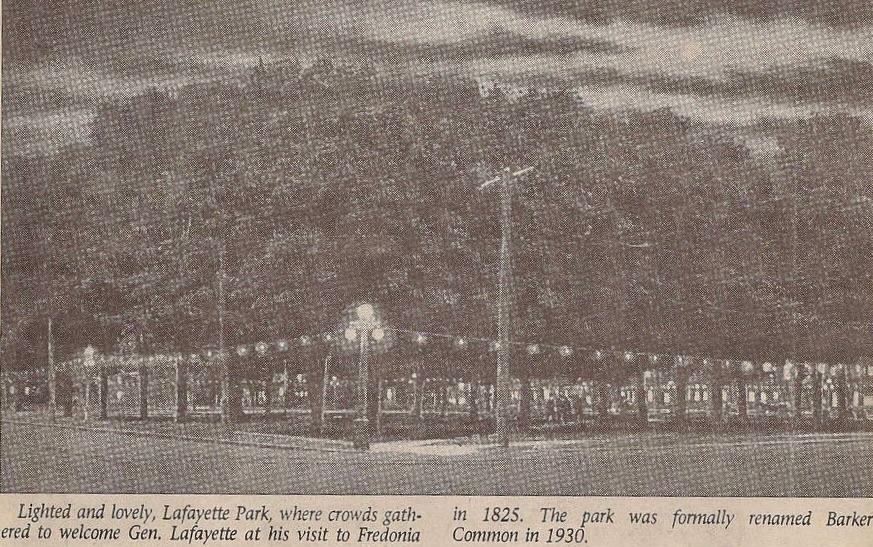
“Lighted and lovely, Lafayette Park, where crowds gathered to welcome Gen. Lafayette at his visit to Fredonia in 1825. The park was formally renamed Barker Common in 1930”.
|
|
• Due to delays during his travels, General Lafayette arrived in Fredonia, New York on June 4, 1825 at two o’clock in the morning. Despite the time, he was welcomed by a 13-gun salute, crowds of veterans and citizens, an elaborately decorated platform outside of Abell’s Hotel, and an early breakfast. At dawn, Lafayette was escorted to Dunkirk, where he boarded the steamboat Superior and continued his tour to Buffalo, New York.
• Inscription :
"Lafayette's tour
On June 4, 1825, general
Lafayette was welcomed at
Abell's hotel, where he
reviewed troops and enjoyed
breakfast before departing.
NY Daughters of the American Revolution
William G. Pomeroy Foundation 2022"
“...On a sudden the startling explosion of a piece of artillery awoke us, and our eyes were immediately dazzled by the glare of a thousand lights, suspended to the houses and trees that surrounded us. We were solicited to alight, and we found ourselves in the middle of an avenue, formed on one side by men and boys, and on the other by young girls and women holding their infants in their arms. At the sight of Lafayette, the air resounded with joyful cries, all arms were stretched out towards him, the mothers presented their infants to him and begged his benediction on them, and warlike music uniting its sound to the din of artillery and bells gladdened all hearts. Struck by so touching a reception, the general was unable for some time to subdue his emotions; at last, he advanced slowly through the crowd, at every step shaking affectionately the hands that were stretched out to him and replying with tenderness to the sweet salutation of the children who accompanied his progress with cries of “Welcome, Lafayette.” Auguste Levasseur. “Lafayette in America in 1824 and 1825, Vol. II, p.475”
• Inscription :
"The Site of the First Gas Well
in the United States.
Lighted
in honor of General Lafayette's visit
June 4, 1825
Erected 1925 by Benjamin Prescott Chapter, D.A.R."
|
|
Visit of Lafayette, Buffalo, NY
June 4, 1825
|
|
June 4, 1825
Marker, Lafayette’s Tour, Buffalo, NY
Lafayette Square, Buffalo, NY 14203
By Unknown author - Views of Old-Time Buffalo, January 1, 1916, The Express, 1916
|
|
• On June 4, 1825 General Lafayette visited this square during his historic tour of the United States and gave a speech in the square. He spoke on a platform in front of the Eagle Tavern as part of ceremonies to celebrate the fiftieth anniversary of the outbreak of the war.
• Seneca Chief Red Jacket had met Lafayette during the Revolutionary War. Lafayette spoke a few Indian words to him, which profoundly moved the old Chief.
• Inscription of marker (inaugurated December 13, 2021):
“On June 4, 1825, General
Lafayette was received at
the Eagle tavern by local
leaders. He met Seneca chiefs
Red Jacket & Capt. Pollard.”
NY Daughters of the American Revolution & William G. Pomeroy Foundation 2021"
|
|
Visit of Lafayette, “Niagara Falls”, NY
June 5, 1825
|
|
June 5, 1825
Marker, Lafayette’s tour, Niagara Falls, NY
Niagara Falls State Park on Goat Island, Niagara Falls, NY 14303
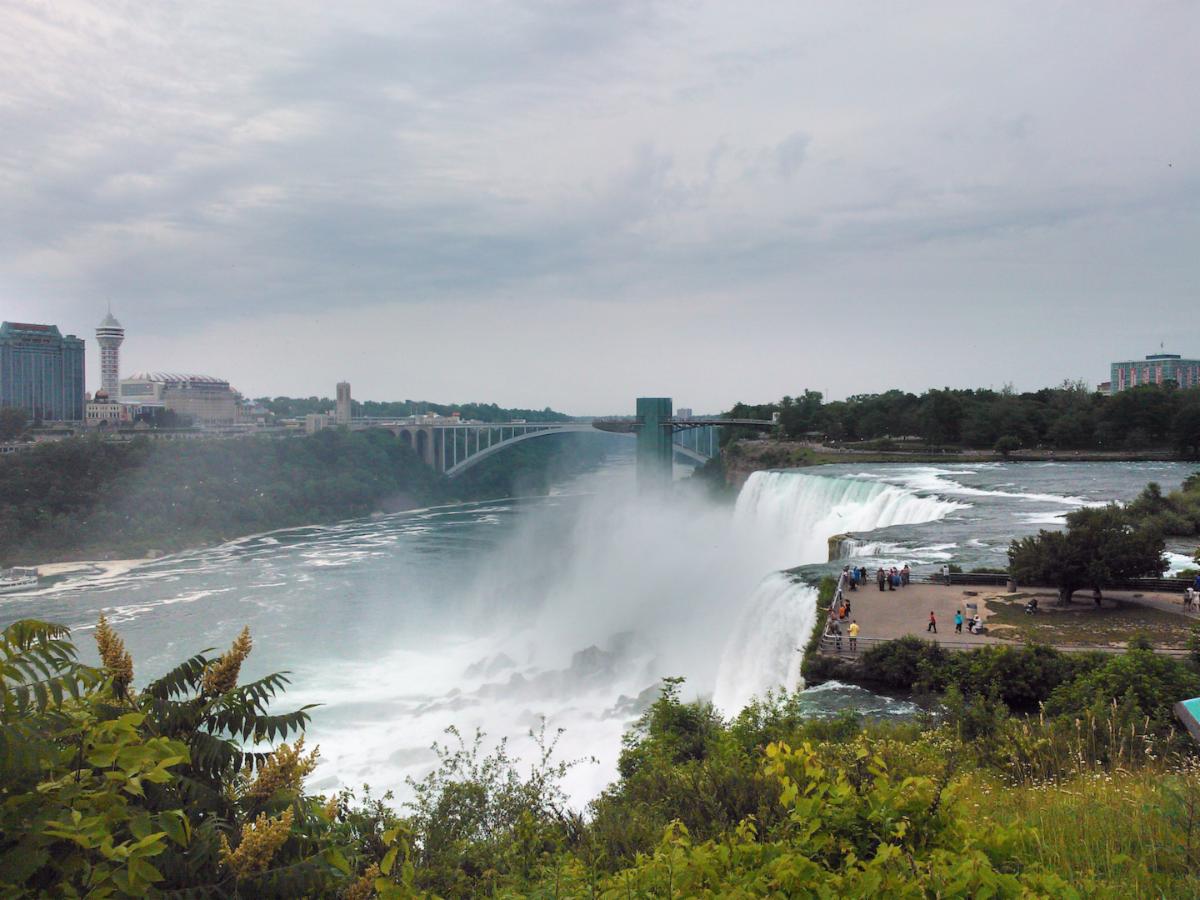
Photo: American Falls from Goat Island
|
|
• “We remained near half an hour on the edge of the gulf, silently contemplating the rapid fall of the water, and almost stunned by the noise of its terrible roaring [...] “Mr. A. Porter, the brother of General Porter, with whom we had breakfasted at Black Rock, is the owner of Goat Island; he had the kindness to conduct the general to all the most picturesque points of this singular property, which is, as it were, suspended above the abyss”
Excerpt From: Auguste Levasseur. “Lafayette in America in 1824 and 1825, Vol. II.”
• Inscription of marker (inaugurated May 20, 2021)
“On June 5, 1825, General
Lafayette, abolitionist and
human rights advocate, was
escorted to Goat Island by
Mr. Porter to see the falls.”
NY Daughters of the American Revolution & William G. Pomeroy Foundation
|
|
Inauguration of Bunker Hill Monument by Lafayette, Boston, MA
June 17 1825
|
|
June 17, 1825
Bunker Hill Obelisk Monument, Boston
Monument Sq, Charlestown, MA 02129
Photos:
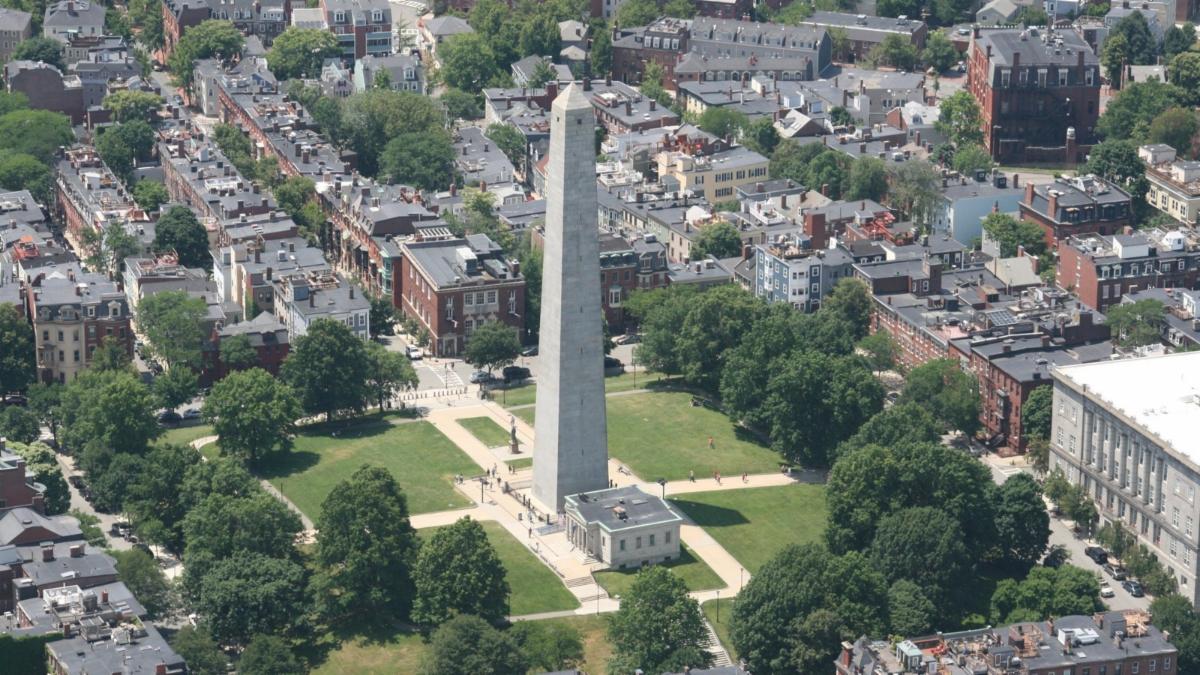
Top: Aerial view of Bunker Hill Monument by Tom Zion, National Park Service
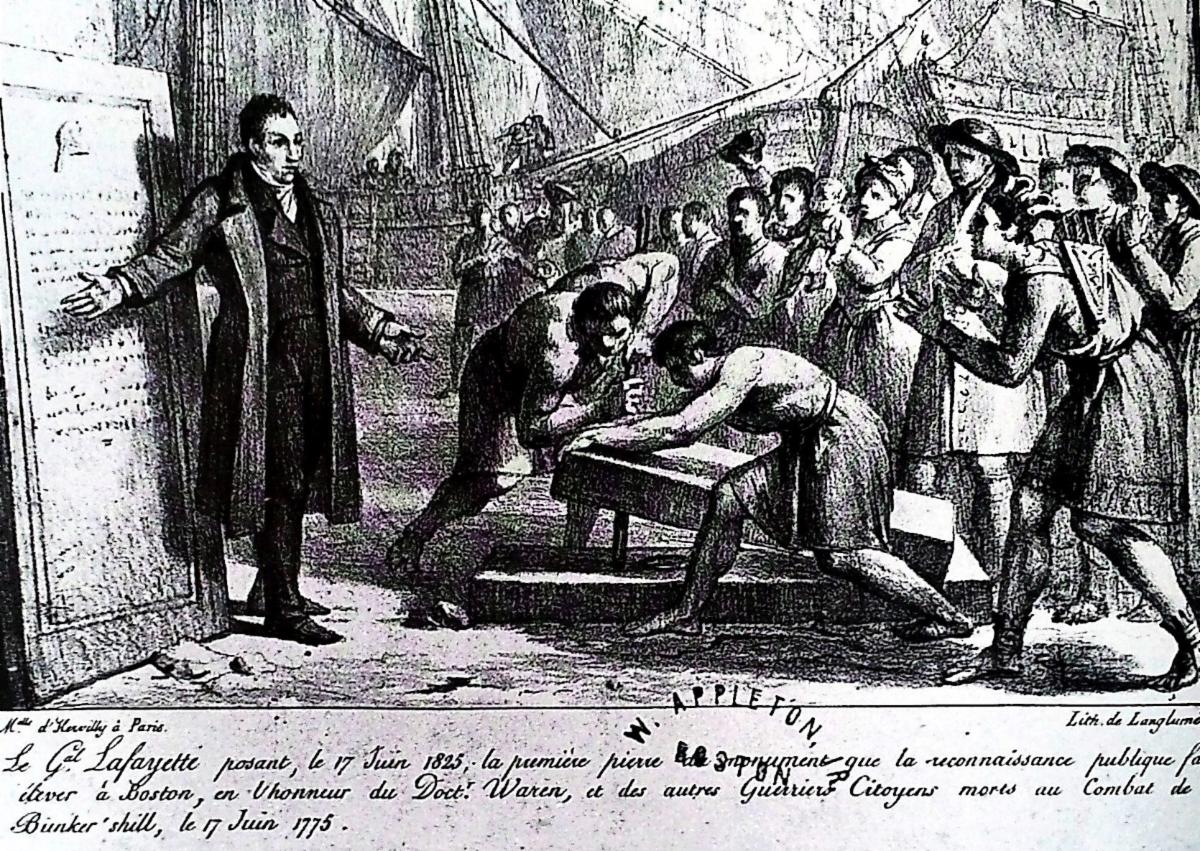
Bottom: Le Gal Lafayette posant, le 17 juin 1825, la première pierre [...] de Bunker's Hill - Langlumé, d'après un dessin de Mlle d'Hervilly - 1825
|
|
• On June 17, 1825, Fifty years after the battle, an immense crowd gathered for a cornerstone-laying ceremony for the monument. It included about 40 veterans from the 1775 battle, and another 190 from the Revolutionary War. The General Marquis de Lafayette and the statesman-orator Daniel Webster led the ceremony. The Marquis De Lafayette set the cornerstone of what would become a lasting monument and tribute to the memory of the Battle of Bunker Hill.
• Alas there is no official marker on the Bunker hill monument grounds to memorialize this seminal day. However, the museum nearby exhibits the trowel used by general Lafayette (who is buried under soil gathered from Bunker Hill).
• “... “At the head of these, in a chair, was the only surviving general of the revolution, General Lafayette; and immediately behind, two thousand ladies, in brilliant dresses, appeared to form a guard of honour to the venerable men, and to defend them against the tumultuous approaches of the crowd; behind the ladies, were more than ten thousand persons seated on the numerous benches placed in a semi-circular form on the side of the hill, the summit of which was crowded by more than thirty-thousand spectators, who, although beyond the reach of the orator’s voice, maintained the most perfect silence.” (Auguste Levasseur, “Lafayette in America in 1824 and 1825”, Vol. II, p. 453)
|
|
Visit of Lafayette, Concord, New Hampshire
June 22, 1825
|
|
June 22, 1825
Plaque, “Lafayette’s Posts”, Concord, NH
71 S Fruit St, Concord, NH 03301
Photos The Lafayette Trail, Inc.
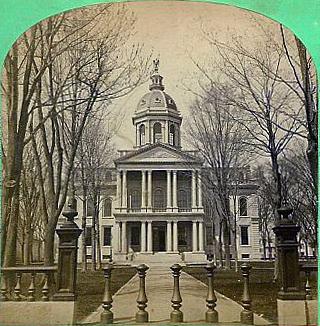
Top: Stereograph view of the New Hampshire State House, ca. 1875
Public Domain,
|
|
• “General La Fayette arrived at Concord, N.H. on Wednesday morning last, and at 12 o’clock he was received by both branches of the Legislature in the Representatives Chamber, addressed by the Governor and introduced to the heads of departments, members of Senate, House of Representatives, &c. Several members of the Legislature who had served in the army of the revolution were more particularly presented to the General, who received them with affectionate and marked attention. After leaving the hall of the House of Representatives, Gen. La Fayette was received on the floor of the State House by the surviving soldiers of the revolution belonging to the State, in whose name he was addressed by one of their number, the venerable General Pierce, of Hillsborough.” July 1, 1825 edition of the Statesman
• Note: General Benjamin Pierce is the father of Franklin Pierce, the 14th President of the United States 1853-1857
• Inscription:
Lafayette's tour
“On June 22, 1825, General
Lafayette was received by
the State legislature in the
State house. He returned on
June 27, 1825 heading west.
William G. Pomeroy Foundation 2022"
• “...a great number of his old fellow soldiers, who, notwithstanding age and fatigue, had not hesitated to leave their distant fire-sides to shake hands and recall with him for a moment, scenes long passed. They, as well as the senators and members of the house of representatives, were individually introduced to him; the people joyfully prepared a dinner in the public square for six hundred guests, to which we were invited on leaving the capitol. The general had the pleasure of finding himself seated in the midst of two hundred officers and soldiers of the revolution, who could scarcely restrain their joy at the presence of their old friend.” Excerpt From: Auguste Levasseur, “Lafayette in America in 1824 and 1825, Vol. II.”
• Inscription:
“Lafayette Posts
Between these posts
originally in front
of the State House
General Lafayette
entered the capitol
grounds on his visit
to Concord
June 22, 1825”
|
|
Visit of Lafayette, Durham, New Hampshire
June 23, 1825
|
|
June 23, 1825
Marker, Lafayette’s tour, Durham, NH
1 Main St #16, Durham, NH 03824
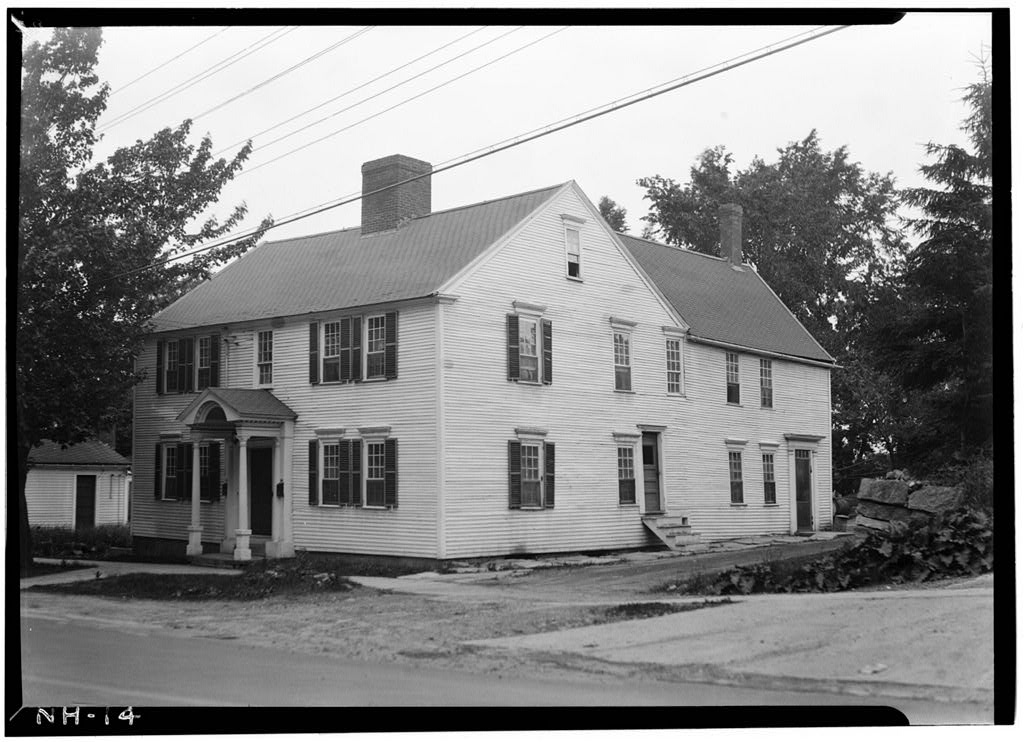
Photo: Ebenezer Smith House, 20 Main Street, Durham, Strafford County, NH
Library of Congress, Public Domain, https://www.loc.gov/item/nh0170/
|
|
• “When near the village, a salute of 24 guns was fired by the company of artillery, under the command of Capt. Langley, stationed on Chesley’s hill. On the General’s arrival at Kelley’s hotel, he was introduced to the Selectmen, Committee, &c. and was addressed, at their request, by S. Mitchell, Esq. Many of the citizens and strangers were then introduced to, and kindly received by the General, after which, he and the company partook of an elegant collation prepared by Mrs. Kelly [sic]. The General was then conducted to the ball, which was decorated with elegance and taste, and introduced to a large assemblage of ladies from this and the neighboring towns. After leaving the hall, he was presented to about seventy female scholars, dressed in white, with blue sashes, and ornamented with wreaths of flowers; and who were arranged in the street near the hall door, exhibiting a delicate and interesting spectacle; especially when contrasted with the martial appearance of the artillery, drawn up in a nine opposite; to each of whom, the General presented his hand. He soon after took his departure, attended by the same escort to the limits of the town, where he was received by the escort from Dover.” The Portsmouth Journal of Literature, July 2, 1825
• Inscription:
“On June 23, 1825, General
Lafayette was welcomed by
a 24-gun salute and escorted
to Kelley's hotel where he was
greeted by local citizens.
William G. Pomeroy Foundation 2022"
|
|
Visit of Lafayette, Dover, NH
June 26, 1825
|
|
Dover City Hall, 3 Hale St, Dover, NH 03820
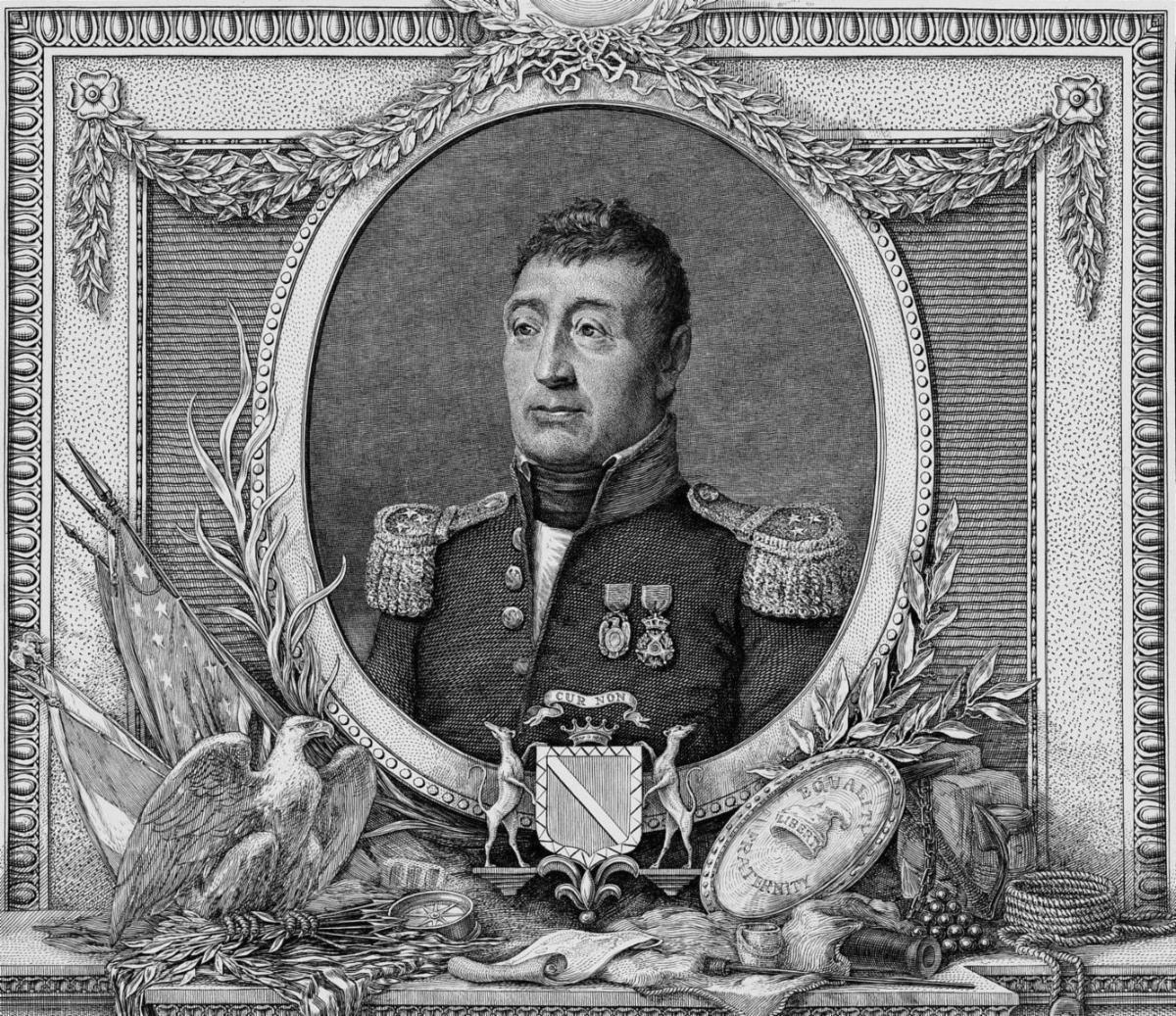
A portrait print of the Marquis de Lafayette commemorating his farewell tour of the United States in 1824-1825 published in 1899.
Library of Congress; Public Domain
|
|
• “At the line of Dover he was also received by a committee, and was escorted in the village by a military escort, and a large number of citizens. Here he was addressed by Hon. W. Hale, in behalf of the citizens, to whom he replied; and afterwards was introduced to many old soldiers of the revolution, some of whom had travelled 80 miles to see the friend of their youth... A public dinner was also provided at Dover, at with Hon. Mr. Hale presided. The General and suite passed the night at Mr. Hale’s, at whose hospitable mansion the ladies of the town were introduced in the evening.” The New Hampshire Observer, July 4, 1825
• Inscription:
“On June 26, 1825, general
Lafayette was a guest of
honor in this city on his
way to Portland. He spent
the night at William Hale’s.”
William G. Pomeroy foundation 2022"
|
|
Visit of Lafayette, Burlington VT
June 29, 1825
|
|
June 29, 1825
Lafayette’s cornerstone, South College, Burlington, VT
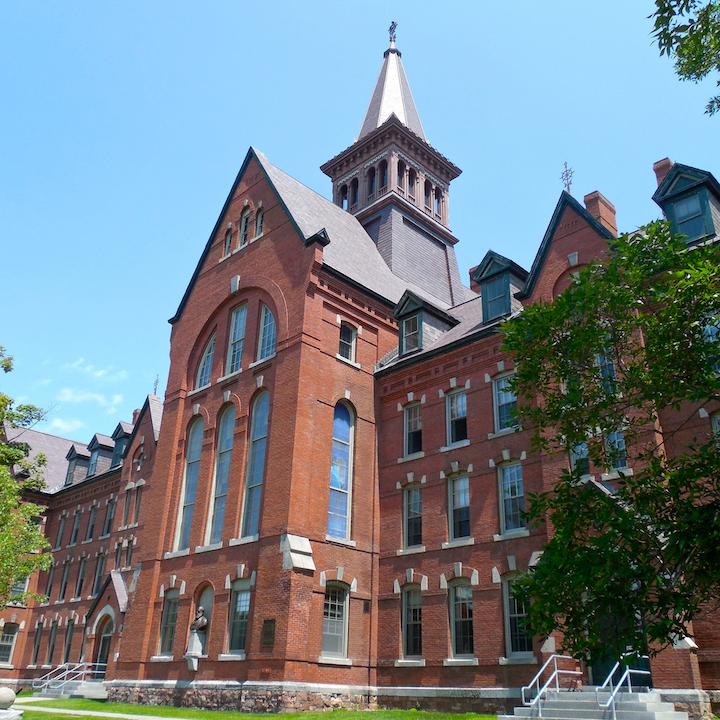
University of Vermont, Lafayette Hall, Old Mill, Burlington, VT 05405
Photos: by Niranjan Arminius - Own work, CC BY-SA 4.0,
|
|
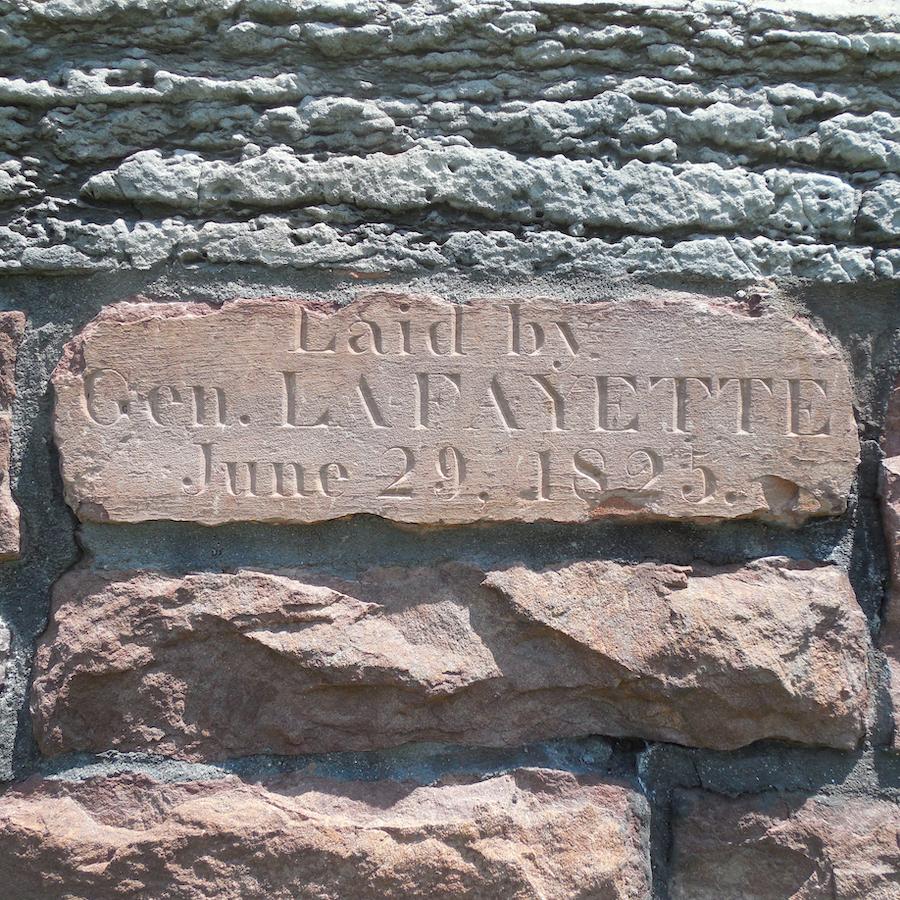
• “After the public dinner, which was concluded before night, the general visited the university, where he was invited to lay the corner stone”[...] “The ceremony of laying the corner stone took place in presence of the pupils of the university, their professors, the magistrates of the city, and a great concourse of citizens, who saw with joy the restoration and enlargement of an institution destined to render more permanent the support of their wise institutions, by instructing and enlightening the rising generations.” (Auguste Levasseur, “Lafayette in America in 1824 and 1825, Vol. II, p. 149)
• Originally constructed as two separate buildings (e.g. the "North College" & "South College") in 1825. On 29 June 1825, General Lafayette laid the original cornerstone to what is today known as of the University of Vermont "Old Mill" building, on the "South College" portion of the building, overshadowing the laying of the cornerstone to "North College" by Gov. Van Ness on 26 April of that year. The "Middle College" was built between the two buildings (separated by 8' fire breaks) in 1829. In 1846, the three buildings were joined together to form the singular "Old Mill" building
• Inscription of corner stone:
“Laid by
Gen. Lafayette
June 29, 1825”
|
|
Visit of Lafayette, Schuylerville, NY
June 30, 1825
|
|
June 30, 1825
Marker, Lafayette tour, Schuylerville, NY
Philip Schuyler Country Estate, 4 Broad St, Schuylerville, NY 12871
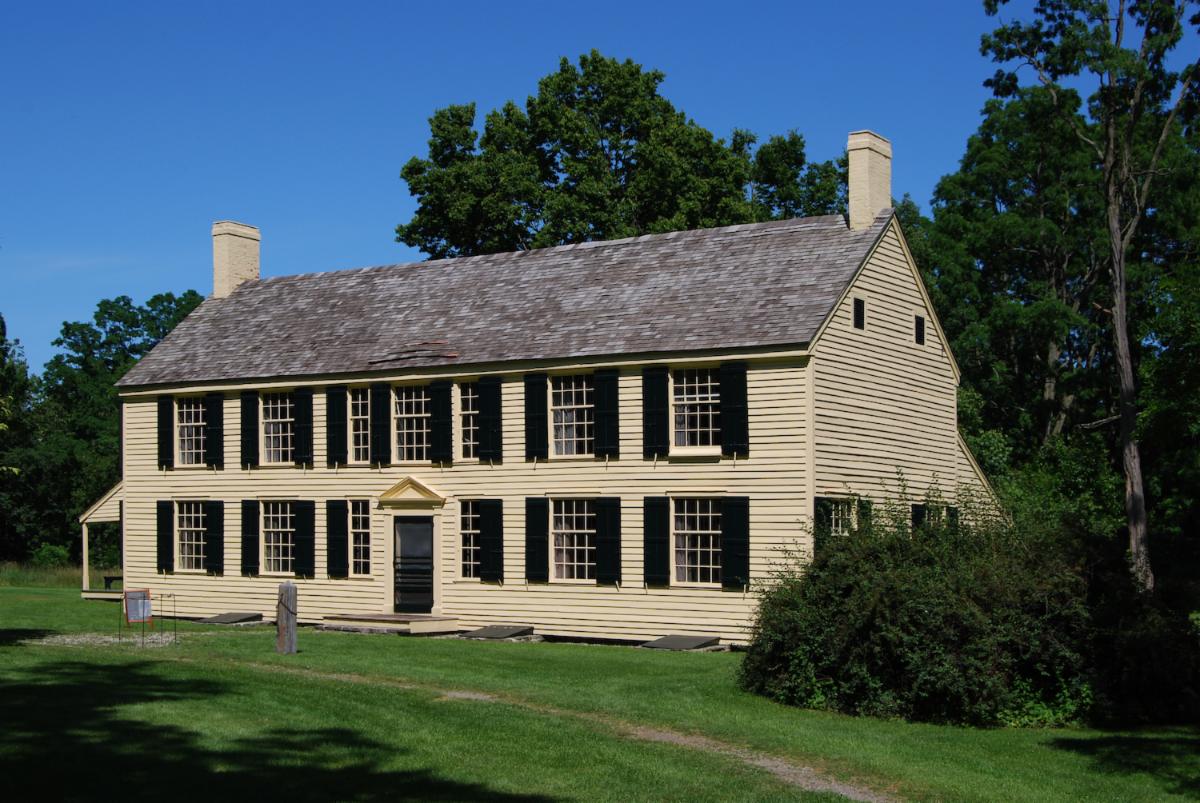
Photo: House of Major General of the Continental Army Philip Schuyler, part of the Saratoga National Historic Park
Photo: By UpstateNYer - Own work, CC BY-SA 3.0,
|
|
• “After sunset we crossed Fish Creek, and stopped some minutes at the house of Mr. Schuyler, which is built on the precise spot where General Burgoyne delivered his sword to General Gates.” (Auguste Levasseur, “Lafayette in America in 1824 and 1825, Vol. II. p. 479”
• General Philip Schuyler became Senator, and father-in-law of Alexander Hamilton. The house was visited by George Washington, Thomas Jefferson, James Madison, the Marquis de Lafayette and President Franklin D. Roosevelt. It has no electricity or running water and remains largely as it was in 1777. It can be visited from late May to Labor Day.
• Inscription:
“On June 30, 1825 while
en route to New York City,
general Lafayette visited
general Philip Schuyler's
family here at their home”
William G. Pomeroy foundation 2020
|
|
WE WILL CONTINUE TO TRAVEL WITH LAFAYETTE
OVER THE NEXT 3 MONTHS!...
|
|
PAST MONTHLY BULLETINS
OUR GOAL: turn the spotlight on a famous, or less famous, episode or historical figure during the long shared history between France and the United States, with illustrations and anecdotes.
You can have access to all our past Monthly Bulletin
since February 2021 by visiting our website:
You can click on the photos throughout our bulletins and also on the links indicated in blue for more information and direct access to sources.
|
|
Next month in July we will narrate the incredible adventure of La Salle's ill-fated expedition in Texas, his recently recovered ship La Belle, exhibited at the Bullock Texas State History Museum and one of his sailor buried at Texas State Cemetery in Austin, TX.
|
|
THE SCULPTURE OF LE PETIT PRINCE®
SOON AT HOME IN NEW YORK
FINAL VERSION OF THE SCULPTURE!
|
|
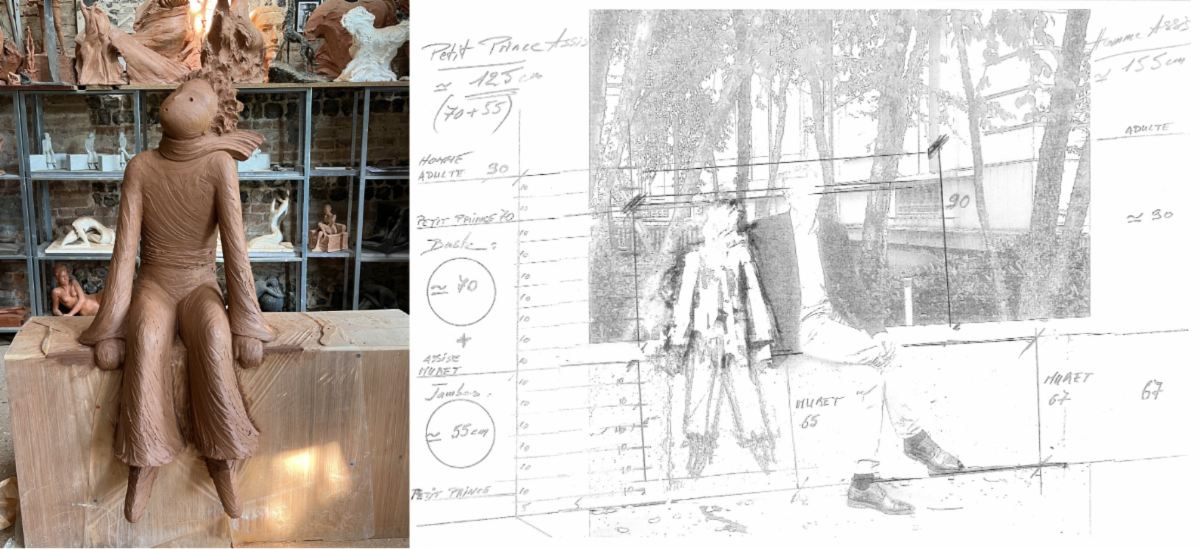
Photos and illustration courtesy of sculptor Jean-Marc de Pas. LE PETIT PRINCE® in the artist's studio at the Château de Boisguilbert, Normandie, looking at the stars and soon to be cast in bronze before flying courtesy of Air France to its new home at the French Cultural Services - Villa Albertine, NY.
|
|
Our association The American Society of Le Souvenir Français is at the origin of the Little Prince sculpture project in Manhattan.
A short history: our association had already honored Antoine de Saint Exupéry in the year 2000, by placing a plaque at 3 East 52nd Street, but wanted to pay homage to him with a sculpture, as is the case in several countries. The idea of a sculpture was first proposed by the late Colonel Roger Cestac, president of our association in the 1990's.
Antoine de Saint Exupéry wrote The Little Prince® entirely in New York, and his name is among the 463 volunteers and conscripts from New York who “Died For France”. Originally intended for Central Park, it couldn't be materialized for a host of reasons and the project lingered for several years. Immediately upon his election at the head of our organization in 2021, Thierry Chaunu, along with fellow Board Members Jean-Hugues Monier & Francis Dubois decided to make it a top priority.
With the unfailing and constant support of The Antoine de Saint Exupéry Youth Foundation headed by its Vice-president Mr. Olivier d'Agay (great-nephew of the author), Nicolas Delsalle-Mun, General Delegate of the Foundation, and members of the Saint-Exupéry family, a “Steering Committee” composed of MM. Nicolas Delsalle, Jean-Hugues Monier, Francis Dubois and Thierry Chaunu pursued the project from start to finish.
Thanks to Brigitte Van den Hove-Smith, Regional Delegate for the Southeast region of the USA who did the introduction, the Board of our association selected the renowned French sculptor Jean-Marc de Pas in March 2022 after a bidding process.
This project received in May 2022 the high patronage of the French Ambassador in the United States Mr. Philippe Etienne and the General Consul of France in New York, Mr. Jérémie Robert. An Honorary Committee, co-chaired by American author Stacy Schiff (Pulitzer Prize) and Mr. Olivier d'Agay was formed in June 2022 and co-signed a fundraising campaign, to which many French and American donors, individuals and companies, responded enthusiastically.
Finally, among several possible locations, the choice of Cultural Services-Villa Albertine on Fifth Avenue was chosen in September with the active support of the Cultural Attaché Mr. Gaëtan Bruel. We officially presented the project on October 13, 2022, at the French Cultural Services - Villa Albertine in New York.
The commission is studying our request 27 minutes from the start.
Comments from commissioners start at 46:43.
The final version of the sculpture is now at the foundry, then will be transported to New York by Air France, for an installation in August and an inauguration scheduled for around September 18-19, 2023.
The list of our "Grands Donateurs" will be publicized and be permanently featured on our website as well as the website of the Antoine de Saint Exupéry Youth Foundation:
Olivier d'Agay • Pierre-Olivier & Alexandra Bouée • Henri & Elisabeth Gazay • Jean-Hugues & Véronique Monier • Gildo Pallanca Pastor, Consul General of Monaco in New York • Rémy Raisner • Lionel & Jinus de Saint Exupéry •
And the following companies: Dassault • Air France • Venturi
We will keep you further informed in the coming July and August Bulletins!
|
|
ANNUAL CELEBRATION OF V-DAY
Eglise Notre-Dame, Federation of French War Veterans
May 7, 2023
|
|
Eglise de Notre-Dame
405 West 114th Street, New York, NY 10025
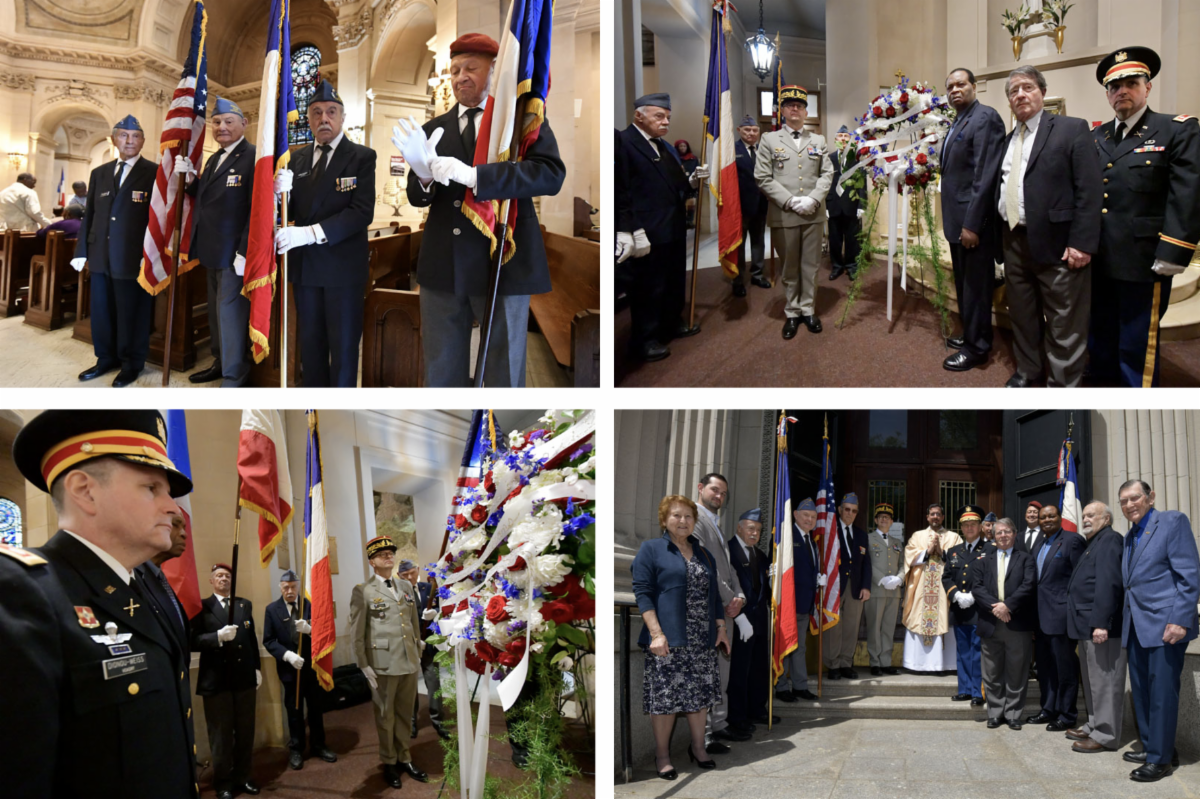
Photos Top, clockwise: French War Veterans Paul Garabédian, Jean Legall, Henry Dubarry, Michel Dumerchat • Général de brigade Vincent de Kytspotter / PhD, Head of Military and Defense Mission, French Permanent Mission to the United Nations, Prof. Clément Mbom, Board Member, American Society of Le Souvenir Français Inc., Patrick du Tertre, president of the Association of French Reserve Officers in the United States (ACREFEU) and 1st Vice President of our Society, Lt. Col. Dionysios Dionou-Weiss, US Army • Group photo on the steps around Alain Dupuis, president of the Federation of French War Veterans, 2nd Vice President of our Society and Deputy General Delegate of Le Souvenir Français in the United States.
All photos by Daniel Falgerho, Federation of French War Veterans
|
|
• The Federation of French War Veterans gathered at the Church of Notre Dame to attend the annual mass celebrated by Rev. Peter A. Heasley, Pastor in honor of all those who fought and died for France. General Vincent de Kytspotter, Head of Military and Defense Mission at the French Permanent Mission to the United Nations and Lieutenant-Colonel, US Army Dionysios Dionou-Weiss laid a wreath honoring the 463 French and American conscripts and volunteers from New York who "Died for France" in two world wars, whose names are inscribed in marble plates on the wall.
|
|
Visit in New York of MM. Olivier d'Agay & Nicolas Delsalle
Antoine de Saint Exupéry Youth Foundation
May 15, 2022
|
|
May 15, 2023 - Meeting of the executive committee for the installation of a sculpture of the Little Prince by the artist Jean-Marc de Pas in New York (5th Avenue) at the headquarters of the cultural services of the French Embassy in the USA - Villa Albertine. This project initiated by the American Society of Le Souvenir Français USA has been done in partnership and with the support of the Antoine de Saint Exupéry Foundation for Youth and the French Embassy (in the photo from left to right: Francis Dubois, Thierry Chaunu, Gaëtan Bruel, Nicolas Delsalle and Jean-Hugues Monier).
Also, if you visit France this summer, you are cordially invited to come and discover a unique exhibition dedicated to Antoine de Saint Exupéry to mark the 80th anniversary of his Little Prince at Château L'Hospitalet in Narbonne throughout the summer!
|
|
Reception at the Résidence de France, Washington D.C.
80th Anniversary of The Little Prince
May 17, 2023
|
|
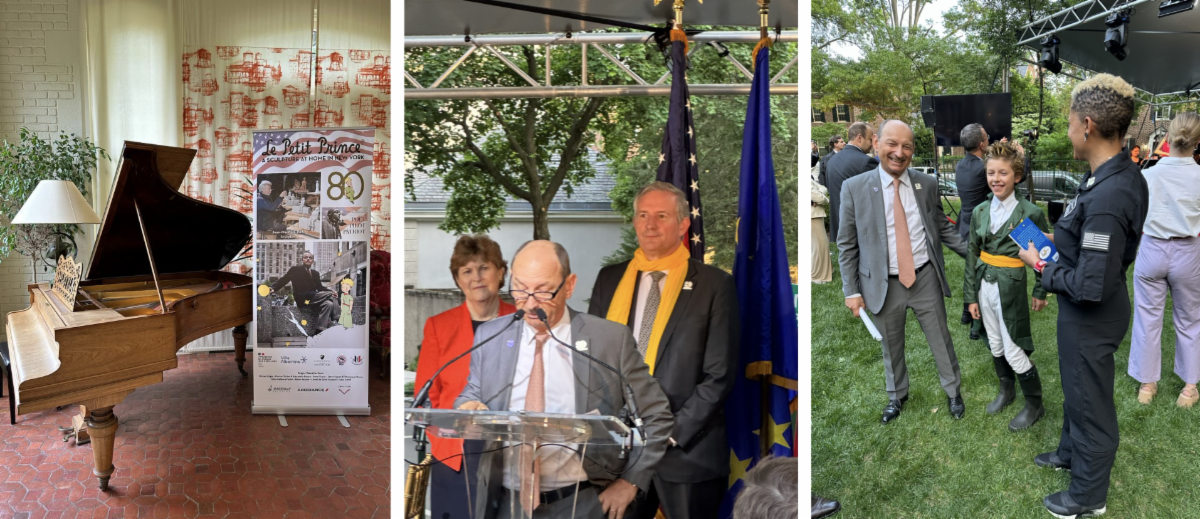
On May 17 H.E. Mr. Laurent Bili, Ambassador of France, hosted a reception at his Washington DC Residence to celebrate the 80th Anniversary of The Little Prince. Mr. Olivier d'Agay, president of the Antoine de Saint Exupéry Youth Foundation and grand-nephew of the author, provided emotional remarks about the life of the celebrated author and the universal message of Le Petit Prince.
Photos (Left to right): The ambassador's official residence was turned into a Le Petit Prince residence, Mr. Olivier d'Agay addressing guests with Ambassador Bili wearing a Little Prince scarf, and Le Petit Prince himself paying a special visit. along with Space X astronaut Dr. Sian "Leo" Proctor reading passages of the book on stage.
|
|
"Follow the French: Rochambeau Festival"
May 20, 2023
|
|
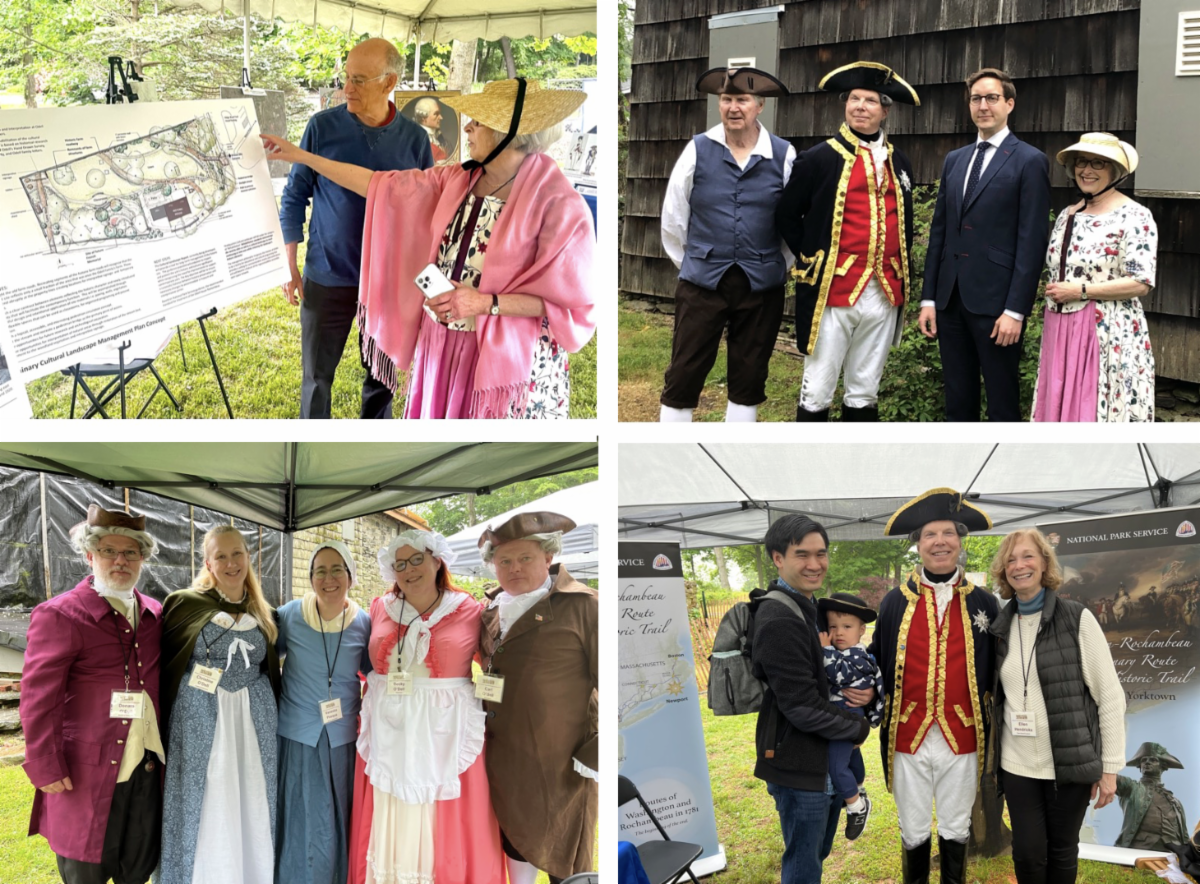
Odell House - Rochambeau Headquarters
425 Ridge Rd, Hartsdale, NY 10530
Top to Bottom, Left to Right:
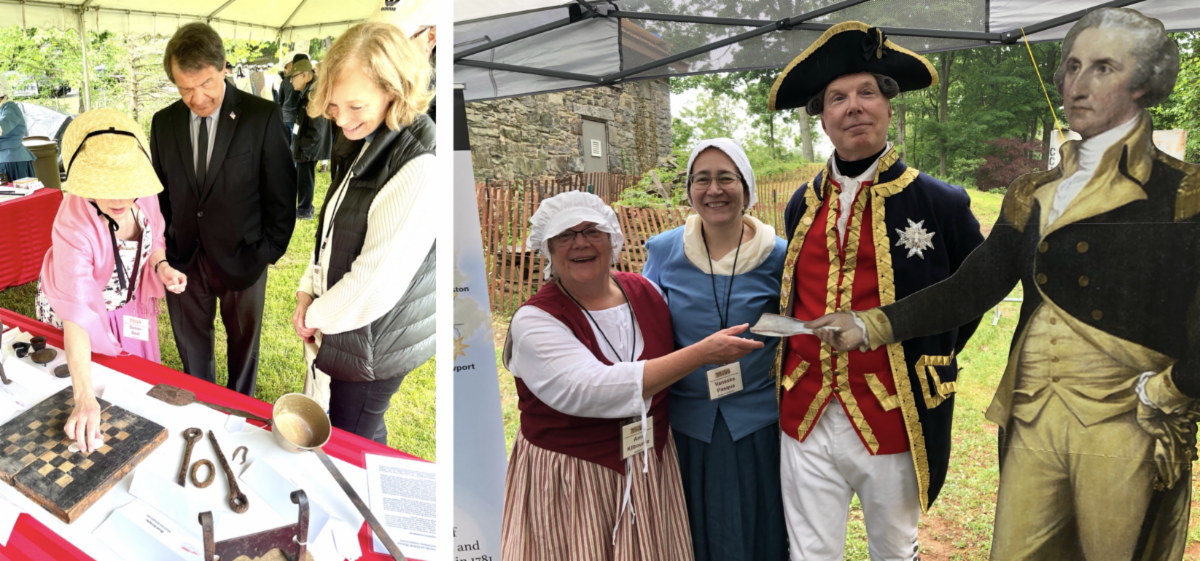
- Susan Seal, President Friends of OHRH, Goerge Latimer, Westchester County Executive, Ellen Hendrickx, Greenburgh Town Board
- Ann Kilbourne, volunteer, Vaneska Pasqua, OHRH Board, Tom Hay as General Rochambeau,
- Paul Feiner, Town of Greenburgh Supervisor and Susan Seal looking at proposed cultural landscape plan
- David Seal as John Odell, Tom Hay, Raphael de Gouberville (General Rochambeau's direct descendant), Susan Seal
- Don and Christie O'Dell, Vaneska Pasqua, Becky and Carl O'Dell. The O'Dells are direct descendants of John Odell.
- David Imamura, Westchester County Legislator, Tom and Ellen discussing the Washington Rochambeau Trail
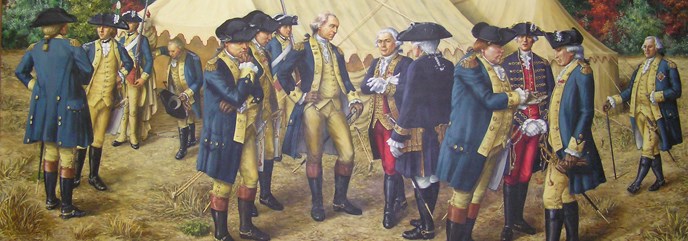
On Saturday, May 20th, Odell House held a special open house to the general public who came in drove in spite of unrelenting rain. Special exhibits and artefacts were on display, showing plans for the future Museum, thanks to the vision and leadership of Susan and David Seal with board members of the Friends of Odell House. General Rochambeau's headquarters were located at the farm from July 6 to August 19, 1781. Both French and the American Continental Army camped in surrounding grounds. It is in this house that the strategic decision to bypass New York and go to Yorktown was decided between Rochambeau and Washington. A memorial to 4 soldiers from the Royal Deux-Ponts Regiment will be located in the grounds of the future Museum, thanks to a donation of your Society.
|
|
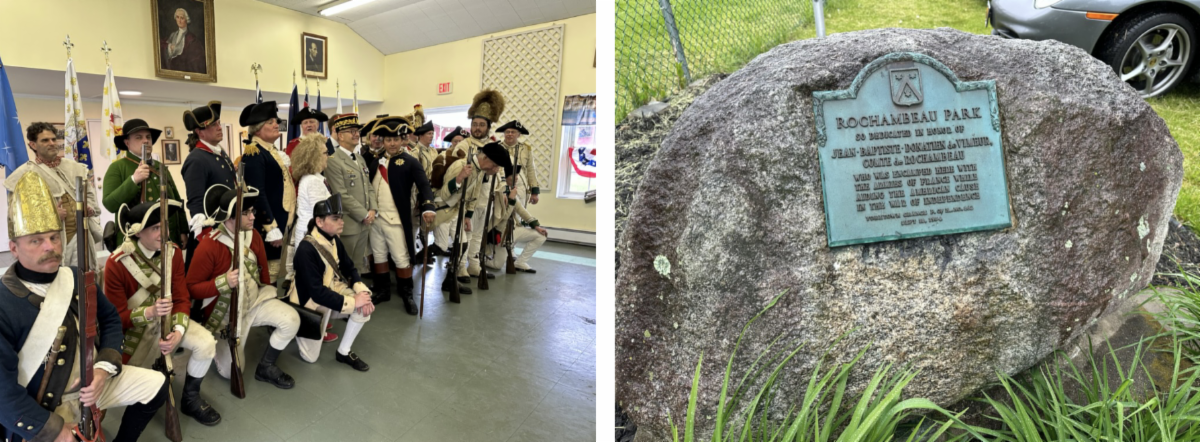
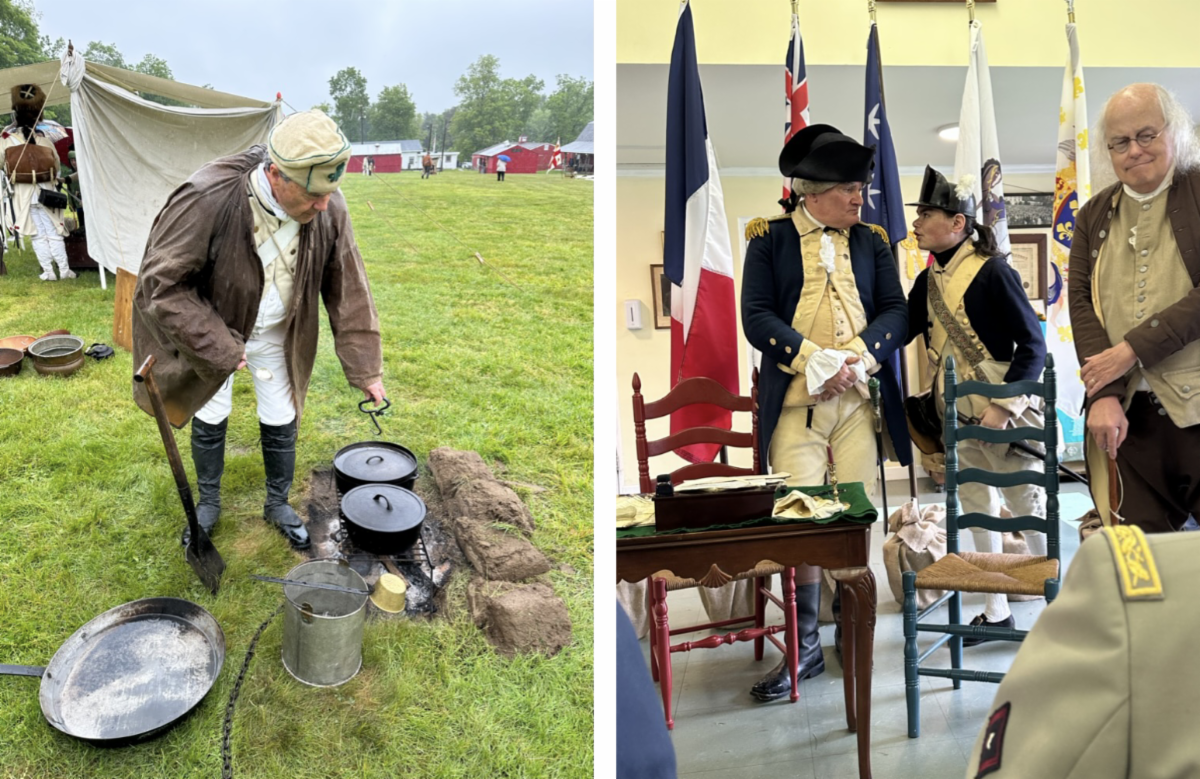
Yorktown Site, Yorktown Grange Fairgrounds
99 Moseman Road, Yorktown, NY 10598
That same day, at noon, still under pouring rain, Lynn Briggs, Chair, New York State Washington Rochambeau Revolutionary Route Organization, hosted an important event at the Grange at Yorktown, NY, the site of the encampment of the French Army. Many re-enactors were present, from Benjamin Franklin, George Washington, and of course Rochambeau. The Grange was packed when General Vincent de Kytspotter delivered a riveting exposé on Rochambeau and the several "miracles" that allowed the United States to obtain their independence. We are grateful to Susan and David Seal, and Lynn Briggs for their warm welcome and look forward to participating every year going forward.
"Follow the French", sponsored by Friends of Odell House...
...directly on your smartphone!
A detailed narration of the encampments of the French Army led by General Rochambeau has just been released on a the free app downloadable on your smartphone TravelStorysGPS.
The episodes Follow the French, sponsored by Friends of Odell House,
can be downloaded at:
The app works on. iPhone and Android, and can be downloaded for free at
You can now visit the different sites and listen to the narrations while driving, as the episodes play automatically based on your GPS location - no need for access to Wifi or cell coverage!
|
|
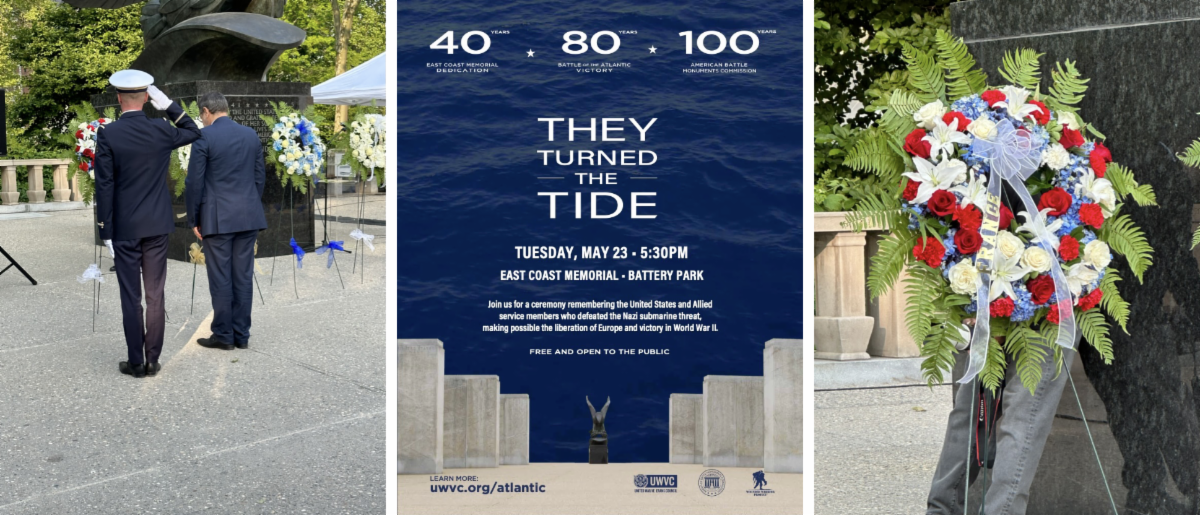
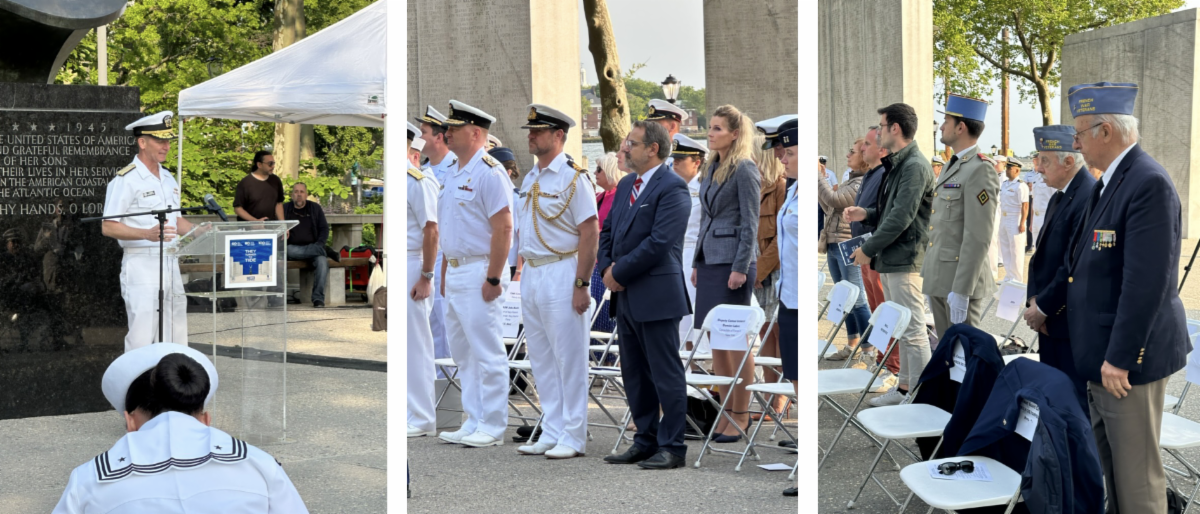
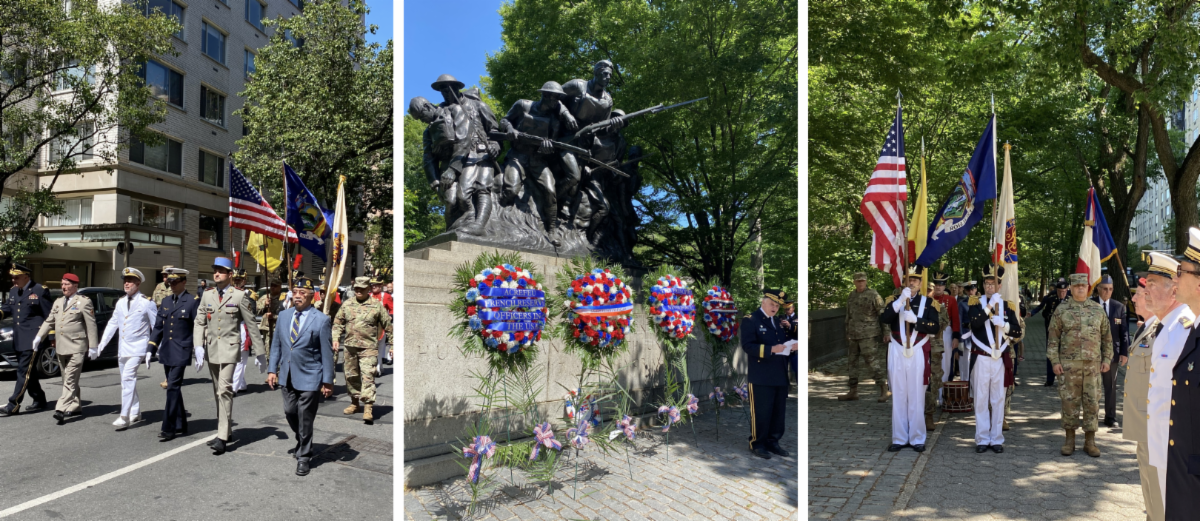
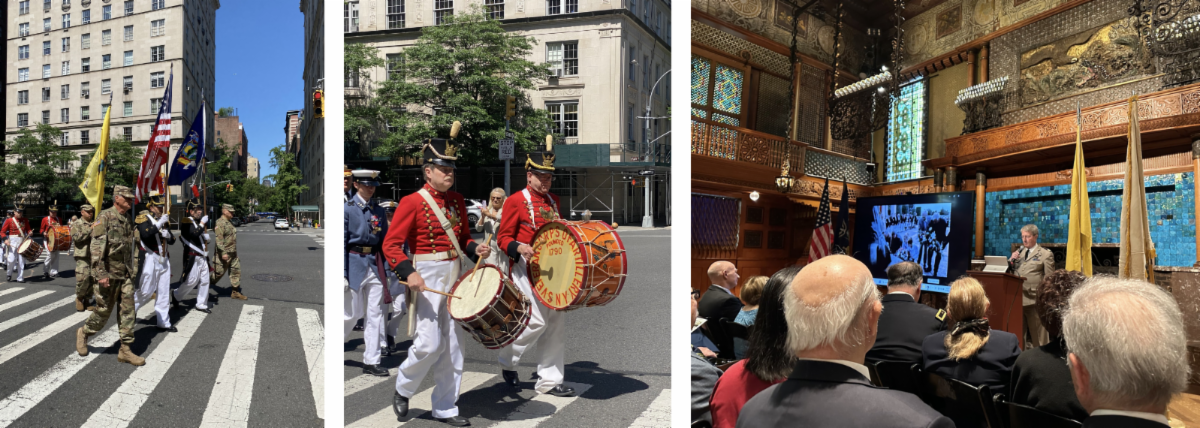
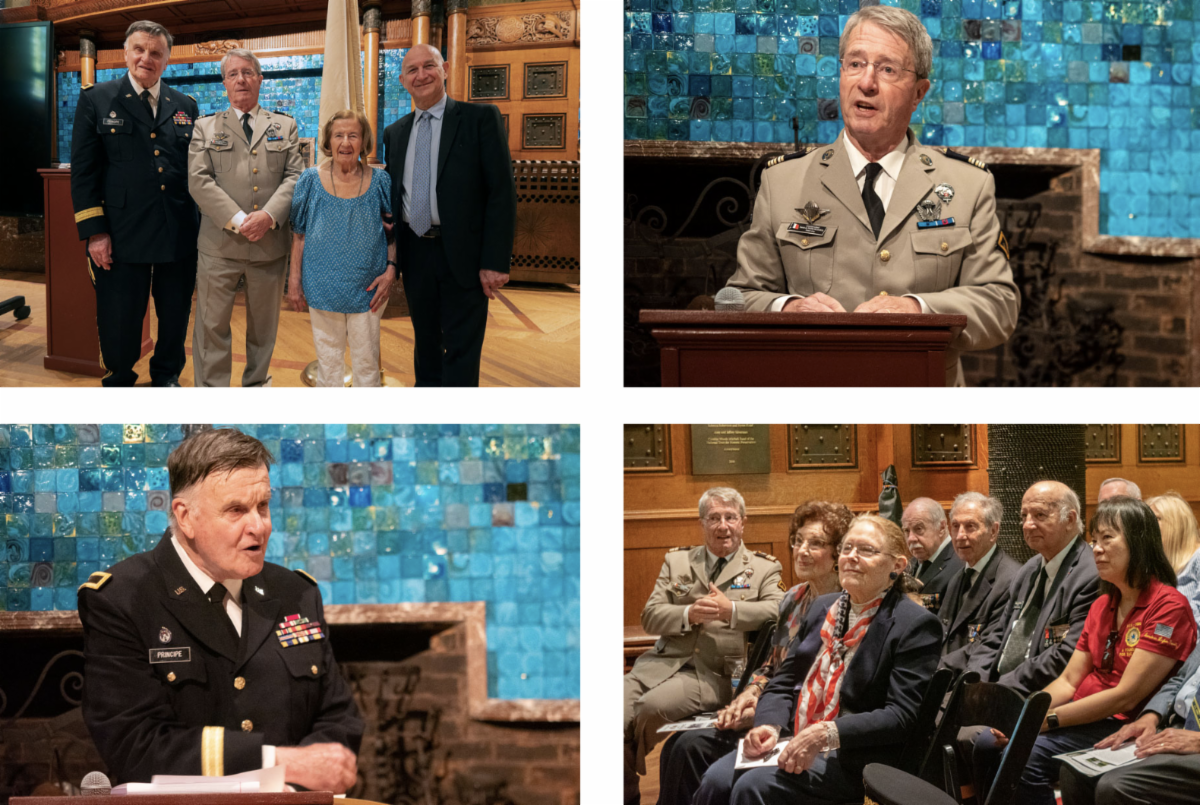
Annual They Turned the Tide event
May 23, 2023
|
|
The United War Veterans Council invited us to join on Tuesday, May 23, for the annual They Turned the Tide event, commemorating the Allied service members who won the Battle of the Atlantic and made possible the liberation of Europe during World War II.
This year's commemoration marked the 40th Anniversary of the Memorial, the 80th Anniversary of the battle, and the 100th Anniversary of the American Battle Monuments Commission, stewards of the East Coast Memorial and of U.S. military cemeteries around the world.
The ceremony took place at East Coast Memorial, Battery Park, Lower Manhattan and the Keynote speaker was Vice Admiral John Mustin, Chief of Navy Reserves, U.S. Navy.
Mr. Damien Laban, Deputy Consul General of France in New York, and First Master, French Navy Franck Le Bris, from the French Permanent Mission to the United Nations, laid a wreath, along several dignitaries and Military representatives of U.S. and Allied nations (Great Britain, Australia, Belgium, Brazil, Canada, Norway, New Zealand, the Netherlands and Poland), representatives of the American Battle Monuments Commission, U.S. and international veterans, military, families and supporters, JROTC (High School) student cadets, and the French War Veterans represented by their President Alain Dupuis and Henri Dubarry.
We are grateful to Ryan Hegg, Legacy & Education at the United War Veterans Council for his invitation.
The United War Veterans Council, Inc. is a 501(c)19 non-profit organization dedicated to mobilizing our communities to honor, support and serve America's veterans. We are dedicated to ensuring that the public always embraces its commitment to provide all veterans and their families with the care, recognition and opportunities they have rightfully earned.
|
|
Memorial Day tribute at the 107th Infantry Memorial
Park Avenue Armory & Central Park
May 28, 2023
|
|
We were honored to be invited by Brig. General Thomas J. Principe, president of the Veterans of the Seventh Regiment to lay a wreath at the Seventh Regiment/107th Infantry Regiment Memorial Fifth Avenue & 67th Street.
Thank you BG(R) Principe for your Welcome and Commentary on the long historical ties between the United States and France.
Guest Speaker at the Park Avenue Armory was LCL(R) Patrick du Tertre President of the French Reserve Officers Association in the United States & co-president of TheFrenchWillNeverForget.org, who gave a stirring and emotional testimony of the deep gratitude of the French people for the Americans who fought for their freedom twice in two world wars.
Dr. Gérard Epelbaum, president of the French Speaking Associations and consular representative to the Assembly of French Citizens Abroad, was present with his mother. Members of the Federation of the French War Veterans led by Alain Dupuis, president, were also present to express their comradeship with members of the Seventh Regiment. The Regiment fought in France, notably breaking the Hindenburg Line in September 1918 and with units in the Ardennes-Alsace during the Battle of the Bulge in 1944. The Seventh Regiment Armory on Park Avenue displays portraits of the Marquis de Lafayette and General George Washington. Under the portrait of Lafayette is inscribed: "The marquis de Lafayette, Commandant de la Garde Nationale. Presented to the Seventh Regiment by the Republic of France April 12 ,1934 In recognition of the adoption by this Regiment, in the year 1824, of the name "National Guard" in honor of the First Citizen Soldier of France. "
|
|
A moving gesture at Arlington National Cemetery
on Memorial Day
|
|
On Sunday May 28, 2023 Memorial Day, Richard Azzaro, co-Founder and past president of the Society of the Honor Guard, Tomb of the Unknown Soldier (SHGTUS) and Donna Houle, Senior Director at the Military Women's Memorial, laid a bouquet of white Niphetos roses on top of Major Pierre L'Enfant monument, as a tribute to the long-standing historical ties of alliance and friendship between France and the United States.
|
|
HONORING SOLDIERS AND SAILORS AT CYPRESS HILL NATIONAL CEMETERY, NEW YORK, MAY 28, 2023 |
|
27,000 American flags were placed next to the graves of the American, French and British soldiers and sailors at the cemetery! The Federation of French War Veterans paid tribute to the "Carré des Marins Français" where 25 French sailors from WWI rest for eternity among their brothers-in-arms (Photo: Daniel Falgerho). |
|
The French Are Coming to Newport!
Friday, July 14 - Saturday, July 15, 2023
|
|
Click on the picture above to view "The French are coming!"
This July 14-July 15, 2023, step back in time to Newport in 1780 during the “French in Newport Living History Weekend”. Centered at Washington Square in downtown Newport, RI, meet costumed historical interpreters portraying French soldiers, Newport citizens and many recognizable names from history like Rochambeau, George and Martha Washington, Lafayette and Chastellux, and many others. Experience the Museum of the American Revolution’s First Oval Office, taste historic bread from Half Crown Bakehouse, and enjoy a concert presented by the Middlesex County Volunteers Fifes & Drums Corps. For more details, click the link below. The “French in Newport Living History Event” is generously sponsored by The Washington-Rochambeau National Historic Trail along with Discover Newport.
On Saturday July 15 at 10:00AM, a wreath-laying ceremony will take place in front of the Statue of Rochambeau and the monument to the French Fleet at Kings Park, in the presence of Mr. Mustafa Soykurt, Consul General of France in Boston. sponsored by the Newport Historical Society, the Alliance Française of Newport, the National Park Service, with the participation of the Washington Rochambeau Revolutionary Route, the American Friends of Lafayette, the American Society of Le Souvenir Français, Inc.
The French in Newport Event will feature living historians portraying recognizable figures such as George and Martha Washington, the Marquis de Lafayette and the Marquis de Chastellux along with the head of the French army, comte de Rochambeau. Dozens of costumed living historians representing both civilians and French soldiers will discuss the challenges of establishing this new alliance. Programming will be rooted at Washington Square and surrounding sites such as the Colony House, the Wanton-Lyman-Hazard House and the Brick Market.
Justin Cherry from Half Crown Bakehouse, who is the resident baker at George Washington’s Mount Vernon, will offer 18th century baking demonstrations while discussing the bread and food rations that would have been available in 1780 Newport. Additional programming will include:
- Ladies fashion presentations highlighting the differences of French and American women’s clothing, makeup and hairstyles.
- An interview with Iris de Rode, Ph.D. and a living historian representing the Marquis de Chastellux.
- A family-friendly tea
- And a dressing talk showing the many layers of French military clothing.
The event concludes with a free concert presented by the Middlesex County Volunteers Fifes & Drums. A full schedule of activities will be available in late June 2023.
This French in Newport event is generously sponsored by the National Parks Service/Washington-Rochambeau National Historic Trail and Discover Newport.
For more last minute information.click on:
and
|
|
BASTILLE DAY IN NEW YORK
Friday, July 13, 2023
|
|
Friday July 13:
On Thursday July 13, 2023 at 5 p.m., in the heart of Central Park, come and celebrate the French National Day in an urban, pop, and electro atmosphere! Discover our program below, and visit Facebook, Twitter, LinkedIn, Instagram, and YouTube so you don't miss a thing.
On the occasion of the French National Day, the Consulate General of France in New York presents Bastille Day, a French festival in the heart of Central Park, in partnership with the Committee of French and French-speaking Associations of New York (CAFUSA).
Meet on Thursday, July 13, 2023 from 5:00 p.m. to 10:00 p.m., at the Rumsey Playfield in Central Park (entrance is located at 72nd Street and 5th Avenue).
Here is the program for the evening:
Adèle Castillon, artist of the new French pop scene, will make you (re)discover her first hits, such as the famous Amour Plastique, as well as songs from her new album;
Passi, a famous rapper, will perform his great hits, such as Je zappe et je mate, Facing the sea; and of course the hits of the group Bisso Na Bisso.
Bénabar, icon of French variety, will resume his classics, including Le Diner, and will perform the essentials of French song.
C’WEST 44, a benchmark organization for street art, will bring together the greatest breakdancers in France as well as French and American hopefuls for the 2024 Olympics. Get ready for a show of great magnitude with DJ!
Joachim Garraud, world-renowned DJ, will be accompanied by Marie Berson, DJ, singer, and flautist, for a unique electro duo that will make Central Park vibrate.
The Cadets Lafayette brass band and singer Marie Viapiano, under the musical direction of Jacques Letalon, will offer a French repertoire followed by French and American national anthems.
|
|
OTHER SAVE THE DATES:
Friday July 7: Concert by the Les Petits Chanteurs de Monaco (Monaco Boys Choir) at St. Bartholomew’s Church 325 Park Avenue (at 51st Street) Presented by Great Music at St. Bart's - MMPAF.org
September 18 or 19 (TBC): Inauguration of the sculpture of Le Petit Prince, Villa Albertine Services Culturels, 972 Fifth Avenue, New York, NY 10075.
Tuesday, October 3: dedication of our new historical marker "Duc de Lauzun and his Legion of hussars" at the Battle of the Hook at Gloucester, VA.
Thursday, October 19: Celebration of the combined French-American Victory at Yorktown, VA.
|
|
SUPPORT US AND BUY (OR OFFER) OUR E-BOOK ON AMAZON! |
|
Book Cover : "Scenes from the American Revolution: The French "Soissonnais" Regiment Being Reviewed at Philadelphia by President Washington and Congress, 1781". By Charles MacKubin Lefferts (American, 1873 – 1923). Reproduced with permission of the New York Historical Society Museum. |
|
Support our organization! Purchase or offer this e-book which makes great reading for all ages. All royalties go to the American Society of Le Souvenir Français, Inc. Simply click on this link: Amazon.com
We are pleased to have given to the Consulate General of France several dozens of sites for the application mapstr. The complete and extensive descriptions are only available in our book, copyrighted by our organization.
MEMORIES OF FRANCE
950 sites of French presence in the United States over the past 5 centuries
Everyone knows that Lafayette, the Statue of Liberty, or New Orleans, were all French imports…
But did you know what the first protestant prayer in America, the first recorded birth of a European in North America, the first commercial artist, the first free school west of the Mississippi, the first discovery of Niagara Falls, the first grapefruit planter in Florida, the first discoverer of oil in America, the first Pulitzer Prize in history, the first archbishop of New Mexico, to name just a few, have in common? (Hint: they were all French)
CONTENTS:
Guide - historical directory of more than 950 sites where a French footprint has been left across the 50 states of the present United States, from 1524 to the turn of the 20th century.
It is written in two versions: in English and in French.
It is a tribute to explorers, missionaries, soldiers, adventurers, French, illustrious or unknown, who left their mark in the United States and are recognized, whose memory is honored by a monument, a statue, a stele, a panel, a billboard, a plaque...
Each page corresponds to one site and includes:
• Photo (with url link)
• Address with postal code
• Exact GPS coordinates
• A brief historical explanation
• The exact transcription of the inscription appearing on the pedestal or plaque
• One or more internet links directing the reader to more detailed information
• Some divider pages are dedicated to a brief biography of a related historical figure
This Guide can thus be compared to:
• An “Enthusiast’s dictionary” compiling the traces left by Frenchmen in the United States
• A collection of French postcards from the 50 States
• A tourist guide for all lovers of US history
Available in e-book
• E-book price: $19.50
• The book is copyrighted © American Society of Le Souvenir Français, Inc.
|
|
OUR MISSIONS:
• To preserve the memory of the French soldiers, sailors and airmen who gave their lives for freedom, and who are buried in the United States.
• To honor French Citizens who did great deeds in the United States, or with a strong connection with the United States,
• To promote the appreciation for French culture and heritage in the United States, and the ideals that unite our two nations, in order to pass the torch of memory to younger generations.
• To strengthen the long-standing traditional bonds of friendship between the American and French peoples, and to this end: erect or maintain memorials and monuments and encourage historical research, public presentations and publications in the media.
We are looking to complete our geographic coverage with Regional Delegates for the SouthWest in cities such as Austin, or Houston, and Louisiana, in cities such as New Orleans or Baton Rouge.
The American Society of Le Souvenir Français, Inc. is an independent American corporation, apolitical, established in 1993 in NY, with 501 (c) 3 non-profit status.
|
|
Board of Directors
American Society of Le Souvenir Français, Inc.
Members (2023):
Françoise Cestac, Honorary President • Thierry Chaunu, President, and General Delegate, Le Souvenir Français in the United States • Yves de Ternay, Treasurer • Patrick du Tertre, 1st Vice President • Henri Dubarry • Francis Dubois • Alain Dupuis, 2nd Vice President & Deputy General Delegate, Le Souvenir Français in the United States • Daniel Falgerho, General Secretary • Pierre Gervois • Caroline Lareuse • Clément Mbom, Education Advisor • Jean-Hugues Monier, Auditor • Harriet Saxon • Nicole Yancey
Regional Delegates:
Jacques Baisnenou, Great Lakes and Midwest • Bruno Cateni, South
Prof. Norman Desmarais, New England • Alain Leca, Washington D.C. •
Marc Onetto, West Coast • Brigitte Van den Hove – Smith, Southeast • Nicole Yancey, Yorktown & Virginia, former Honorary Consul of France in Virginia
|
|
Help us implement several historic commemorative projects celebrating the 245-year-old Franco-American friendship and alliance! |
|
The American Society of Le Souvenir Français, Inc. is a registered NY State non-profit corporation and has full IRS tax exempt 501(c)3 status. All donations are tax deductible.
Copyright © 2023 The American Society of Le Souvenir Français, Inc.
All Rights Reserved
Merci de nous contacter si vous souhaitez recevoir ce bulletin dans sa version traduite en français.
Contact: Thierry Chaunu, President
697 Third Avenue #341 New York, NY 10017
|
|
|
|
|
|
|