Weekly Digest Number 37 - September 14th, 2021 |
|
(Editor's Note: This may well be the biggest rail news story of the year, if not the decade. Finally, the Class One carriers are being shown up for what they are: a gang of profiteers with no interest in workers, shippers, passengers, communities, the environment or the nation. Hopefully STB Chair Oberman's revelations can trigger a movement to put a stop to this farce. Readers are urged to read the entire article. It is time to raise hell!) |
|
STB’S Oberman Says US Railroads Reduced Service, Raised Rates, and Derived $191 Billion in Dividends and Buybacks Since 2010 |
|
Martin Oberman, chair of the Surface Transportation Board (STB), charged U.S. railroads with reducing service, raising freight rates, shifting more truckloads onto highways, contributing to global warming while deriving $191 billion in dividends and stock buybacks since 2010.
According to STB data, Oberman explained “Since 2010, the seven Class 1 railroads have spent $138 billion on capital. Most of this is spent on the regular upkeep of the railroads which is essential. Relatively little has been spent on infrastructure needed to expand service and improve service.
Since 2010, the five U.S.-based Class 1 railroads have paid out $114 billion in stock buybacks. On top of that, the U.S. railroads have paid out $77 billion in dividends during the same period. Thus, the railroad owners have taken back an astonishing $191 billion in stock buybacks and dividends … far more than the $138 billion spent on the railroads’ infrastructure.
Where would rail customers, rail workers and the public be if a meaningful portion of that $191 billion had been re-invested in expanding service and making service more predictable and reliable. Clearly, we would have more freight moved and at a lower rate. We would have more employment with better working conditions and the public would benefit with lower consumer prices, less highway congestion and less polluted air. And all of this could be achieved with the railroad owners continuing to receive a healthy return on their investments.”
Railroads’ Responsibilities
Oberman was addressing the North American Rail Shippers Association (NARS) convention at Chicago. He argued that forty years of rail deregulation following enactment of the Staggers Act did not absolve U.S. railroads of legal responsibilities. He said that the current state of the railroads may result in an investigation by STB as to whether the railroads have violated the ‘common carrier mandate.’ The Staggers Rail Act of 1980 is a federal law that deregulated the American railroad industry:
“The strategies pursued by the railroad industries as a whole, and it is not the same among all the Class 1s, have serious implications as to whether the ‘common carrier ...
More Freight By Truck
Oberman said the railroads actions have resulted in more freight going by truck which increases traffic, congestion and has also increased the generation of carbon emissions when freight is moved from more fuel-efficient trains pulled by a few locomotives to trucks which are less fuel efficient and more polluting...
|
|
(Editor's Note: This appears to be some good news of workers winning justice on the job. But as we have been reporting for the past 6 years or so, the Carrier simply appeals each of these OSHA rulings to the courts, where the cases may drag on for years. The law is fatally flawed. See our report from the Summer issue of our newsletter, The Highball HERE.
|
|
CSX Must Pay More Than $667,000 to Two Workers in Whistleblower Incident |
|
OSHA finding is third against railroad in 10 months.
CSX Transportation has been ordered to reinstate two workers at a yard in Waycross, Ga., and pay them more than $667,000 after the U.S. Department of Labor’s Occupational Safety and Health Administration found they had been fired in retaliation for whistleblowing actions.
The two workers reported encountering a blue flag that signaled their train could not move safely, and were pulled from their job and fired, according to an OSHA press release. In addition to the payment of $667,740 — for compensatory and punitive damages, back pay, and costs incurred by the workers — CSX must pay the workers’ attorney fees, restore their seniority and benefits they would have earned, and credit toward retirement, vacation days, and personal leave days the employees would have earned.
“All workers have the right to be safe on the job, and by speaking up, these workers prevented potential harm to themselves and others,” OSHA Acting Assistant Secretary Jim Frederick said in a press release. “Employers that punish workers for speaking out against unsafe or unfair working conditions are breaking the law, and OSHA will hold them accountable.”
It is the third such OSHA finding against CSX in 10 months. In July, CSX had to pay back wages and damages to a worker in New Orleans [see “CSX must pay more than $220,000 …,” Trains News Wire, July 6, 2021]. In October 2020, a worker in Rebecca, Ga., received more than $170,000 in back page and punitive damages.
|
|
Call Your Senators - Pass the PRO Act! |
|
Call your U.S. senators and tell them to pass the PRO Act now!The U.S. House of Representatives passed the Protecting the Right to Organize (PRO) Act last year, but anti-worker legislators in the Senate blocked it. Undeterred, working people fought to elect pro-worker lawmakers to the Senate, House and White House. And we won. Lawmakers gave us their word they would make the PRO Act a top priority. It’s time for them to keep that promise. The House passed the PRO Act for a second time on March 9, 2021, sending the bill to the U.S. Senate.
-- Empower workers to organize and bargain.
-- Hold corporations accountable for union-busting.
-- Repeal “right to work” laws, which were created during the Jim Crow era to keep White and Black workers from organizing together.
Stronger unions mean higher wages, safer working conditions and dignity for all people who work. The PRO Act is our first step to get there.
|
|
(Editor's Note: Having worked for Conrail through the split-up in the late 1990s, it is easy to see the similarity between that battle between CSX and NS and this one a quarter century later between CP and CN. Like their Conrail counterparts, the corporate officers and stockholders of KCS are laughing all the way to the bank.) |
|
Back to Their Future: CP and KCS |
|
The story is a familiar one to readers of Railway Age, as we have followed it closely, in detail, publishing numerous news items and feature stories, editorials and podcasts involving all the key players, as KCS, exercising its fiduciary duty to its shareholders, pivoted away from CP toward CN’s larger pie, then back to CP almost immediately after the STB turned a fire extinguisher on the CN deal as it was baking in the oven, snuffing out a crucial ingredient, CN’s voting trust application.
CP, patiently—though not quietly—waiting on a siding with a somewhat larger pie than it originally offered, an approved voting trust and the STB’s decision to consider a CP-KCS combination under simpler, pre-2001 merger rules—has now moved out of that siding under a limited clear, as a few more pieces must fall into place before STB traffic control gives a high green. While there are no guarantees, the track forward looks relatively straight. Clear track ahead? Almost.
Most of what follows here is drawn from the press releases issued by CP and KCS on Sept. 12. The language, undoubtedly vetted by attorneys and financial advisors, is, in my opinion, just a formality—statements that have to be made. I’ve edited it to simplify some of the “twisties”:
On Sept. 12, right at deadline, the KCS Board of Directors announced it “determined that CP’s revised proposal constitutes a ‘Company Superior Proposal’ as defined in KCS’s merger agreement with CN … after consultation with its outside legal and financial advisors. KCS has notified CN that it intends to terminate KCS’s merger agreement with CN and enter into the definitive agreement with CP ...
|
|
(Editor's Note: Presumably, CP will follow suit. One can only speculate what the Canadian based Class One's will mandate on their U.S. properties in the coming months, with Amtrak already announcing mandatory vaccines for its workers by November 1st.) |
|
CN: Mandatory COVID-19 Vaccinations for Canadian Employees |
|
“Safety being a core value at CN, this measure will contribute to protecting the health of its employees, customers, and the communities in which it operates,” the railroad said.
Vaccinations apply to employees and new-hires of CN and its subsidiaries in Canada, as well as CN’s contractors, consultants, agents, suppliers and anyone who accesses CN’s Canadian properties. According to the railroad, requests for medical or religious exemptions will be considered on a case-by-case basis.
The move, CN said, is “in line with the measures announced by the government of Canada in order to ensure the safety of its employees and keep the North American economy moving.” The government in August announced its intent to require vaccination as early as the end of September across the federal public service. In addition, as soon as possible in the fall and no later than the end of October, it will require employees in the federally regulated air, rail and marine transportation sectors to be vaccinated.
“The government of Canada is leading by example in requiring vaccinations for public service employees, and we are asking all federally regulated employers to develop vaccine plans to ensure their employees and workplaces are safe,” Minister of Transport Omar Alghabra said on Aug. 13. “This is the right thing to do and will ensure Canada continues to build back better from the global COVID-19 pandemic.”
|
|
FRA Releases PTC Safety Advisory |
|
The Federal Railroad Administration (FRA) has published a Safety Advisory on a Positive Train Control (PTC) issue recently identified during testing of ACSES II (Advanced Civil Speed Enforcement System II) and I-ETMS (Interoperable Electronic Train Management System) technology.
FRA reported in the Federal Register on Sept. 2 that an interface design issue “allows a train crewmember to circumvent a PTC enforcement by manually cutting out the pilot valve/brake stand. …” This permits the PTC system to be “disabled and unable to initiate the brakes to prevent a train-to-train collision, over-speed derailment, incursion into an established work zones, or the movement of a train through a switch left in the wrong position.”
While all PTC systems are potentially impacted, “FRA believes that the interface designs of most concern are limited to a number of older locomotives equipped with mechanical braking systems, and the interface design is likely not an issue on most newer locomotives equipped with electronic braking systems.”
FRA is recommending that all freight and passenger railroads operating with PTC:
“Immediately remind crewmembers that circumventing a PTC enforcement is subject to civil penalty or disqualification for the locomotive engineer or conductor responsible...
|
|
How to Protect Workers While Protecting the Climate |
|
To protect against catastrophic global warming, the United States is preparing to rapidly reduce the burning of fossil fuels — coal, oil, and natural gas. As we transition to a climate safe economy, many people ask, “What about the workers who will lose their jobs in fossil fuels and other polluting industries?” Here’s how those workers can be protected.
Much of the resistance to climate protection lies in a deep fear that, whatever promises may be made, workers who lose their jobs will just be thrown on the economic scrapheap. Making sure that workers and communities are not left behind in the process is a crucial part of securing a climate safe future, yet the United States has rarely done a good job of managing major shifts in regional and national economies. Protecting workers and communities from the unintended side effects of such changes is often referred to as a “just transition.”
Just transition efforts are already under way at the local, state, and national level. For example, the Colorado Just Transition law created a Just Transition Office in the Department of Labor and Employment. Once the program is funded it will administer benefits to coal transition workers to enable them to support themselves and their families and to access and complete education and training, resulting in being hired for high-quality jobs. And it will make grants to eligible entities in coal transition communities that seek to create a more diversified, equitable, and vibrant economic ...
|
|
Two CN Locomotives Collide in Ontario, Tearing Up Tracks |
|
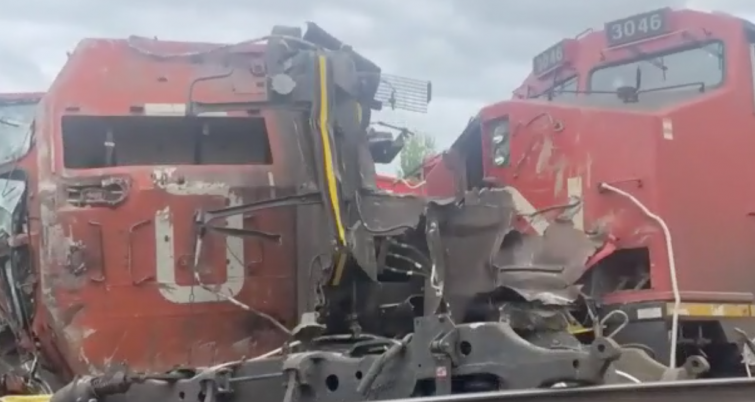
Investigators are trying to figure out what happened when two trains collided in Prescott, Ontario, on Sept. 2. The accident happened near Edward Street, and one person was treated at the scene for minor injuries. Prescott is about 95 km from Ottawa. Four locomotives derailed along with 16 railcars, according to Canadian National. One of the locomotives had a small diesel fuel leak. Prescott Mayor Brett Todd said the tracks are pretty torn up, and “you can see the seriousness of the impact.” The Canadian National rail line through Prescott was shut down on Sept. 2, and VIA Rail service along the Toronto-Montreal route also was affected.
The Transportation Safety Board had a team of investigators at the scene.
|
|
(Editor's Note: Railroaders know that the public would be on our side if they knew the truth about what goes on out here. All of us have an important story to tell. Please consider telling yours! There are ample opportunities to do just that. This is one of them. You can remain anonymous.) |
|
Podcast Host Seeks Rail Workers for Interviews About Working Conditions |
|
Danelle Morton is the host of an upcoming podcast for IHeart Media about railroading, and is looking for workers’ voices to help her tell the true story of the rails. She lacks the authentic voices of the working life, and is searching for on-the-ground railroaders willing to share their experiences. In particular, if you happen to work in Colton, California, please consider responding. Morton is a life-long writer, author, and journalist, who has written about the rails. To hear a sample of her work, listen to this radio show from few years ago. If you’re interested, shoot her an email at danellemorton@sbcglobal.net. She will get back to you and set up a time to talk.
|
|
WEBINAR: What's Next? Passenger Rail in Virginia |
|
RSVP for the upcoming Virtual Town Hall with VA Dept. of Rail and Public Transportation Director Jennifer Mitchell and VA Passenger Rail Authority Executive Director DJ Stadtler on September 16th at 1pm. This is a free event but you must register in advance.
|
|
Alstom Demonstrates Battery-Powered Train in Germany |
|
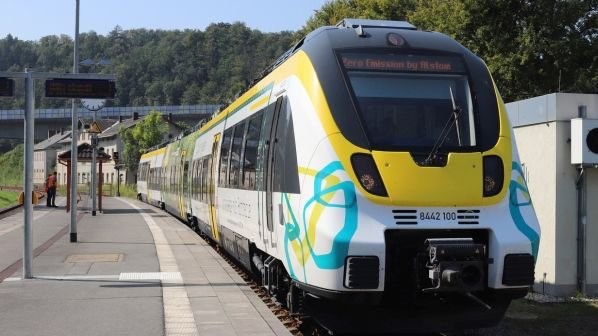
An Alstom battery-powered Coradia train undertook demonstrations in Saxony, Germany, running from Flöha and Zschopau and then back to Chemnitz on September 7 and will also be used on September 9 to carry passengers as part of the Digital Rail Convention in Annaberg-Buchholz.
The train is due to start operating in Baden-Württemberg and Bavaria from the start of the new timetable this December. Alstom says it will be the first battery-powered train approved for regular passenger operation in Germany since the 1960s.
The train was developed at the manufacturer’s Hennigsdorf site and can ran both on overhead ac electrification and battery power.
“Alongside our hydrogen train, this battery-powered drive concept represents another milestone for the market launch of emission-free regional trains in Germany and worldwide,” says Mr Müslüm Yakisan, Alstom president for Germany, Austria and Switzerland.
The project began in 2016 as a research partnership with the Technical University of Berlin and covers development, approval and operation of battery-powered trains. The overall economic viability of battery operation on main line railways also formed part of the research.
|
|
(Editor's Note: Numerous countries are forging ahead with rail electrification and specifically, solar power trains. Check out the plan for such development here in the U.S. know as Solutionary Rail.) |
|
One-in-Four Indian Railways Trains Could Use Solar Energy, Report Claims |
|
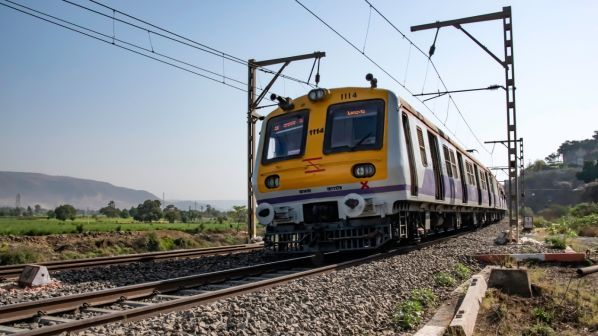
ONE-in-four trains in India could be powered by solar energy in the future according to a study published on September 1.
The study, commissioned by Indian NGO Climate Trends and British-based green technology start-up Riding Sunbeams, found that a direct supply of solar energy to Indian Railways (IR), without the need to connect via the grid, would save almost 7 million tonnes of carbon per year, whilst powering at least one in four trains on the national network.
Indian rail minister, Mr Piyush Goyal, has recently issued a directive to IR to earmark large areas of land for solar development as part of the country’s Net Zero plans.
Already there are plans to deliver 20GW of solar-generated power to match growing demand for energy to power trains.
The study, conducted by Ricardo Energy and Environment, suggests that around a quarter of this new capacity, up to 5.272GW, could be fed directly into the overhead catenary instead of being procured via electricity networks. This would reduce energy losses and save money, says the study.
Research found that by substituting energy supplied from the coal-dominated grid for private-wire supply from solar, emissions could be cut by as much as 6.8 million tonnes of CO2 each year. This is the equivalent of just over the entire annual emissions of the city of Kanpur.
“Right now India is leading the world on two vital climate frontiers – rail electrification and solar power deployment,” says report co-author and Riding Sunbeams found and director of innovation, Mr Leo Murray. “Our analysis shows that connecting these two keystone low-carbon technologies together in IR can drive both India’s economic recovery from the Covid-19 pandemic and its efforts to transition off fossil fuels to tackle the climate crisis.”
|
|
|
|
|
|
|