The American Society of Le Souvenir Français Inc.
Monthly Bulletin - Vol. III. No 4 - April 2023
|
|
Jean de Verrazane:
Discoverer of New York, originally called Angoulême
|
|
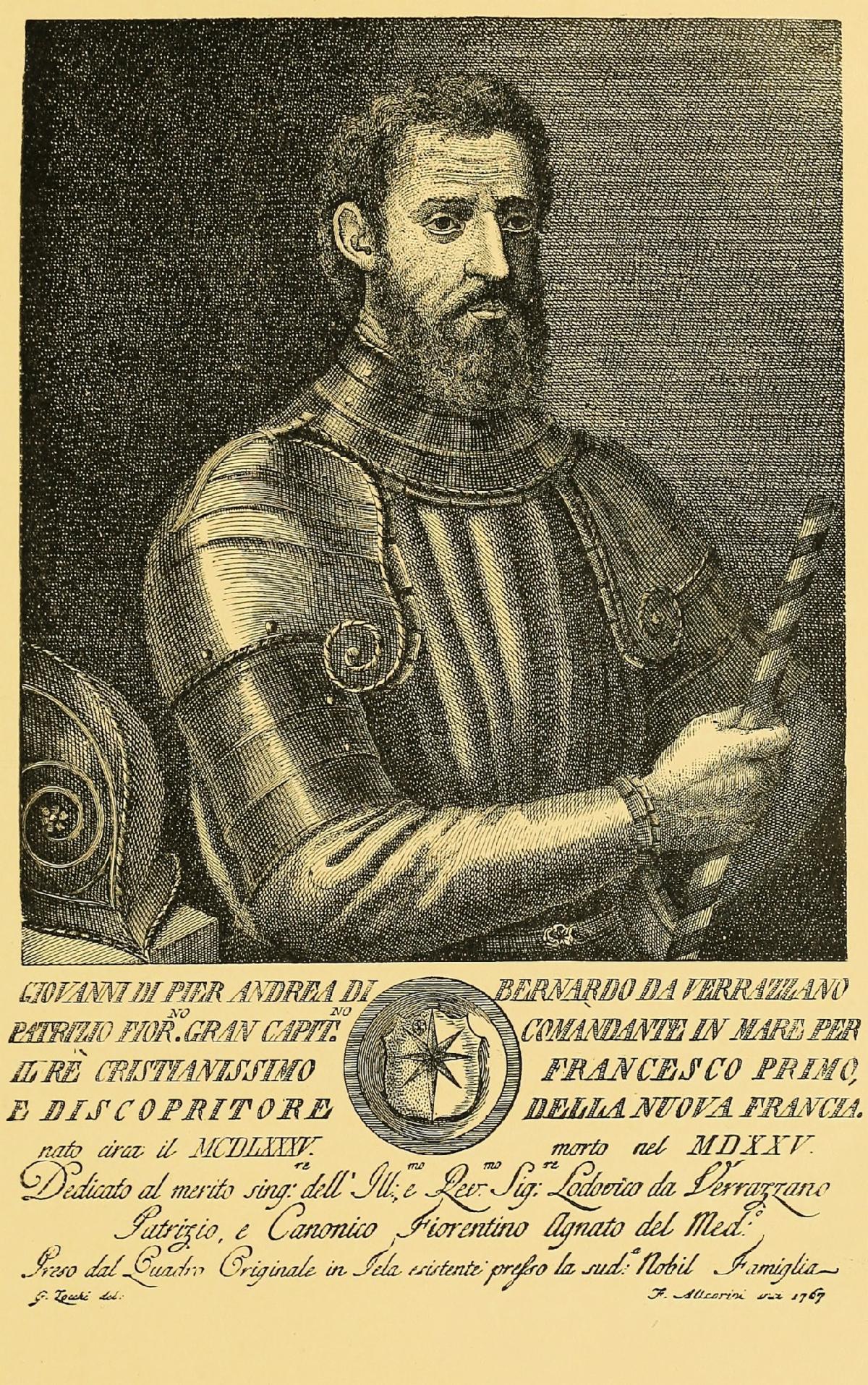
Cover photo: Giovanni di Pier Andrea di Bernardo da Verrazzano, "Captain Commandant at Sea for the Most Christian King François Ier, and Discoverer of New France"
By Allegrini, Francesco (1729-17..). Graveur ; Zocchi, Giuseppe (1711-1767). Peintre, Public domain, via Wikimedia Commons
|
|
EDITORIAL
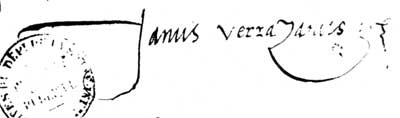
Giovanni da Verrazzano? Or Giovanni da Verrazano with one z, as is often the case in English? Or Janus Verrazanus? Or Jehan de Verrazane, as in his will, preserved in the Archives Départementales de Seine-Maritime, dated 11 May 1526 and signed in Rouen, France ? Or Jean de Verrazane, as he is remembered in France?
Whatever the case may be, one thing is certain: every New-Yorker knows the Verrazzano Bridge (the additional "z" was added by Governor Andrew Cuomo on October 1, 2018) linking Brooklyn to Staten Island.
What few people know, however, is that this talented navigator was serving France, and on April 17, 1524 was the very first to discover New York, which he named La Nouvelle-Angoulême in honor of its then French king: François 1er - - 85 years before Henry Hudson...
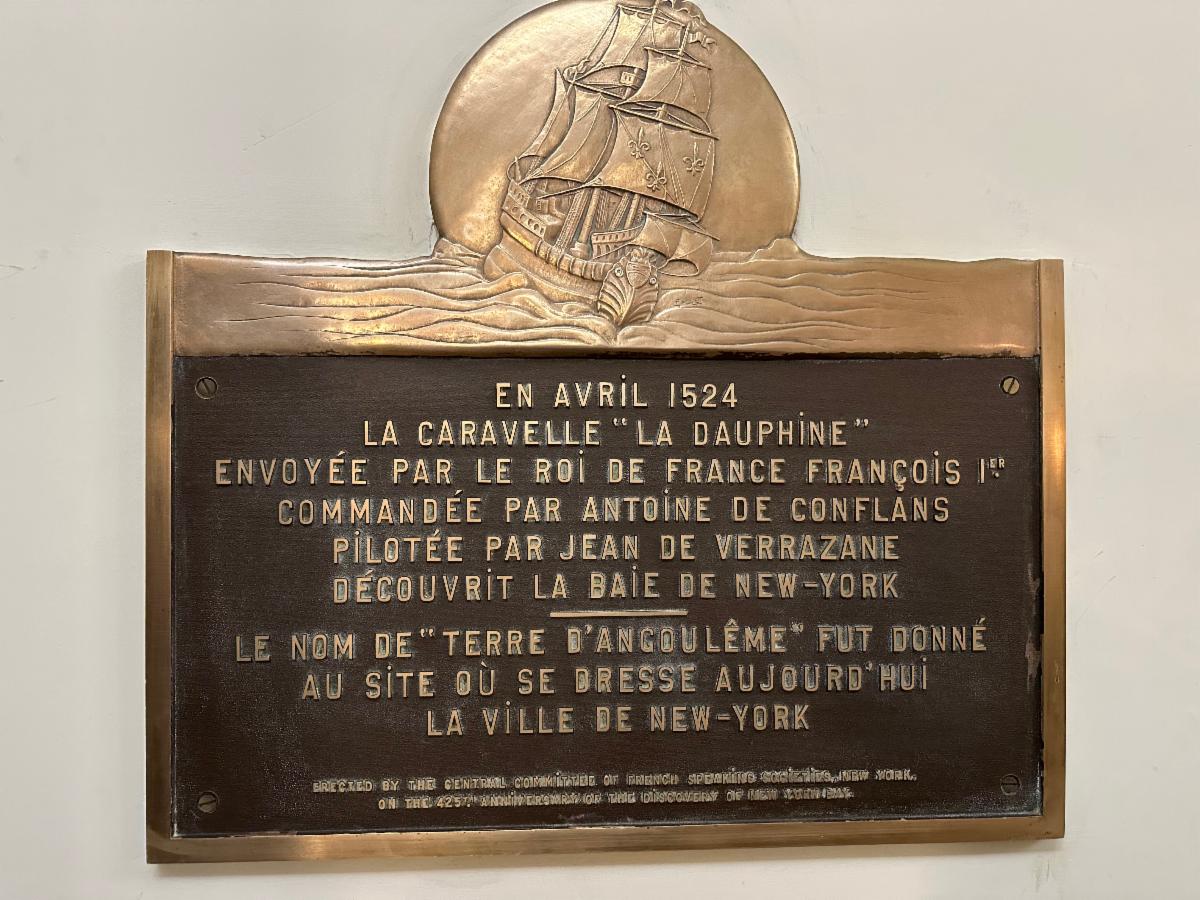
Visitors to the French General Consulate at 934 Fifth Avenue can see a bronze plaque in the vestibule entrance of the mansion. Of course, the few words on the plaque do not tell his life story. This being April 17, 2023, 499 years day for day after he dropped the anchor of his ship La Dauphine in the Narrows, it is appropriate that we narrate his remarkable achievements, including his many other discoveries, from North Carolina to Canada, including his discovery of Le Refuge, present-day Newport, Rhode Island.
We thus take this opportunity to pay homage to the late Jacques Habert, Senator of the French living abroad, and longtime supporter of the Souvenir Français, whose doctoral thesis at Columbia University in 1954 helped shed considerable light on this great explorer.
Next time you drive on the Belt Parkway, nearing the Verrazzano-Narrows bridge, please look up towards Fort Hamilton. You will spot a marker installed in 2021 by our friends of the Lafayette Trail to honor Lafayette's visit of September 8, 1824 near that site, formerly Fort Lafayette, demolished in 1964 to make way for the eastern pillars of the bridge.
We are proud to be active participants in the Bicentennial Committee of the triumphal farewell tour of General Lafayette, led by the American Friends of Lafayette, as part of America250 celebrations ordained by the US Congress.
In this Bulletin, we will continue to follow this most illustrious Frenchman on some of his footsteps during the month of April 1825. Make sure you mark your calendar for the official kick-off welcome parade in Lower Manhattan on August 16, 2024!
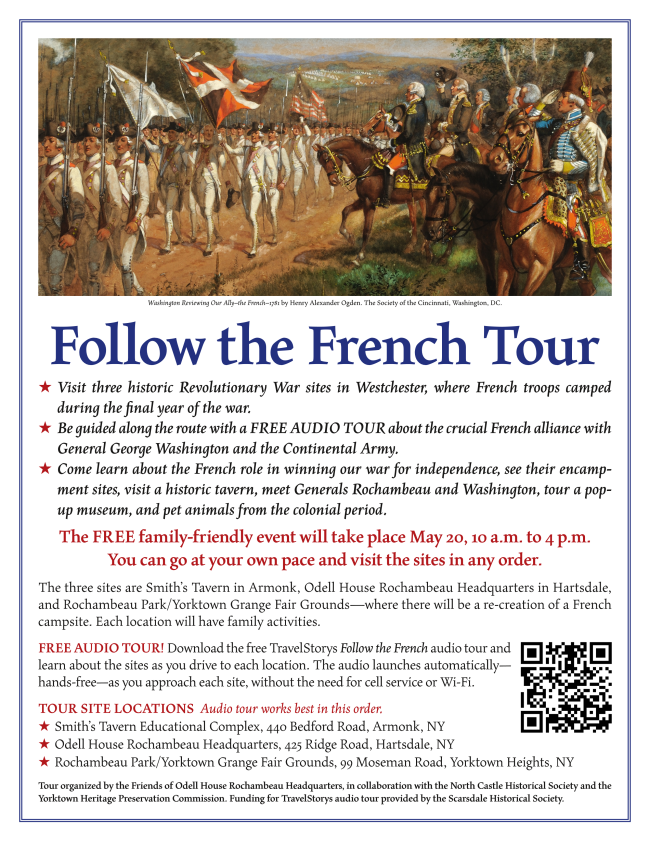
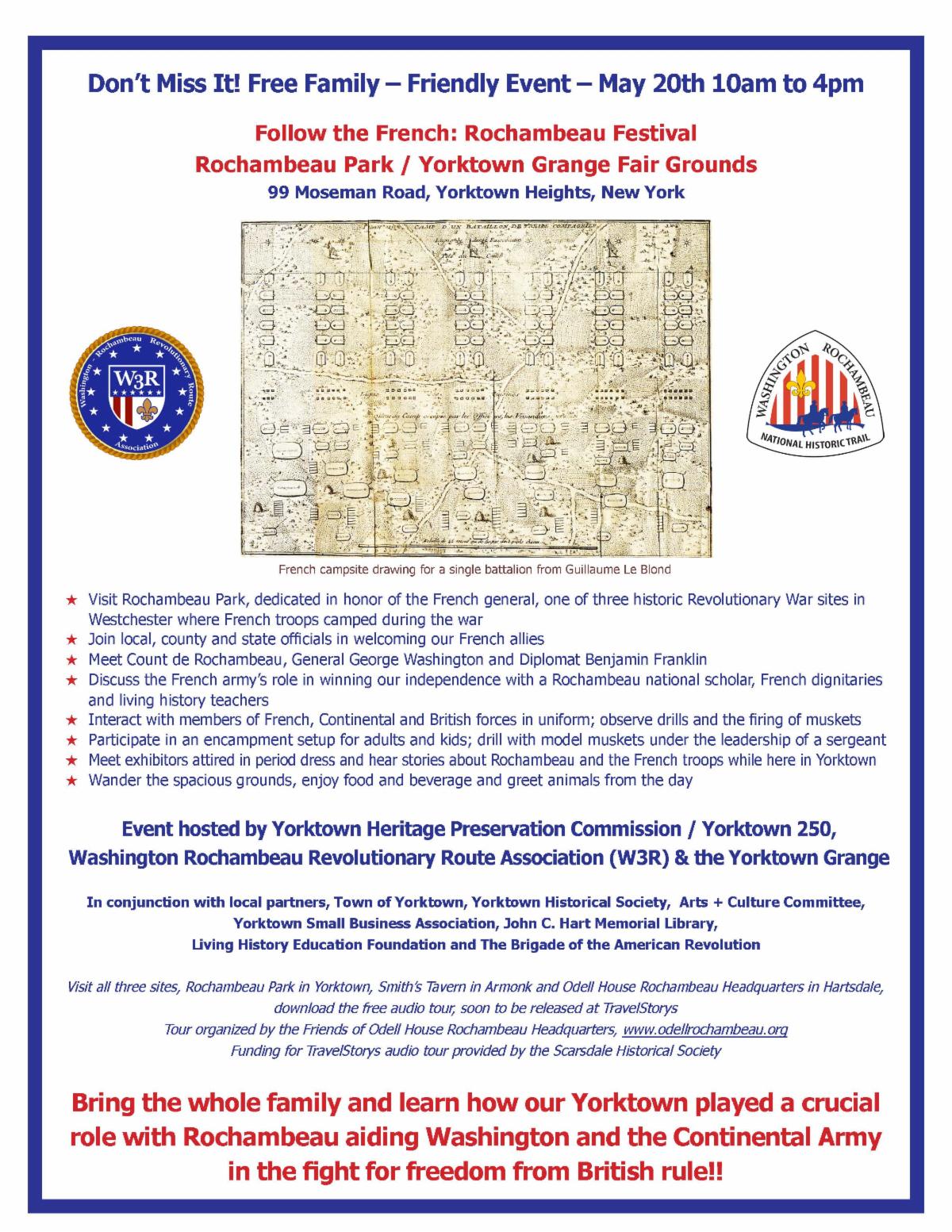
There are other anniversaries looming on the horizon. In 2025, we will celebrate the Tricentennial of the birth of another illustrious Frenchman, whose decisive contribution to American Independence is often overshadowed by Lafayette: we are talking, of course, of the count of Rochambeau. Already, next month on May 20th, our friends of the Washington-Rochambeau Revolutionary Route (W3R) in Westchester County, along with the Friends of Odell House-Rochambeau Headquarters, are preparing a day-long celebration open to the general public. Make sure to bring your children to see re-enactors and tents of the encampments of the French and Continental armies, less than 45 minutes drive from Manhattan. Details are provided below.
Further down in this Bulletin, we will announce some upcoming events from like-minded organizations that are of great interest to our members and sympathizers.
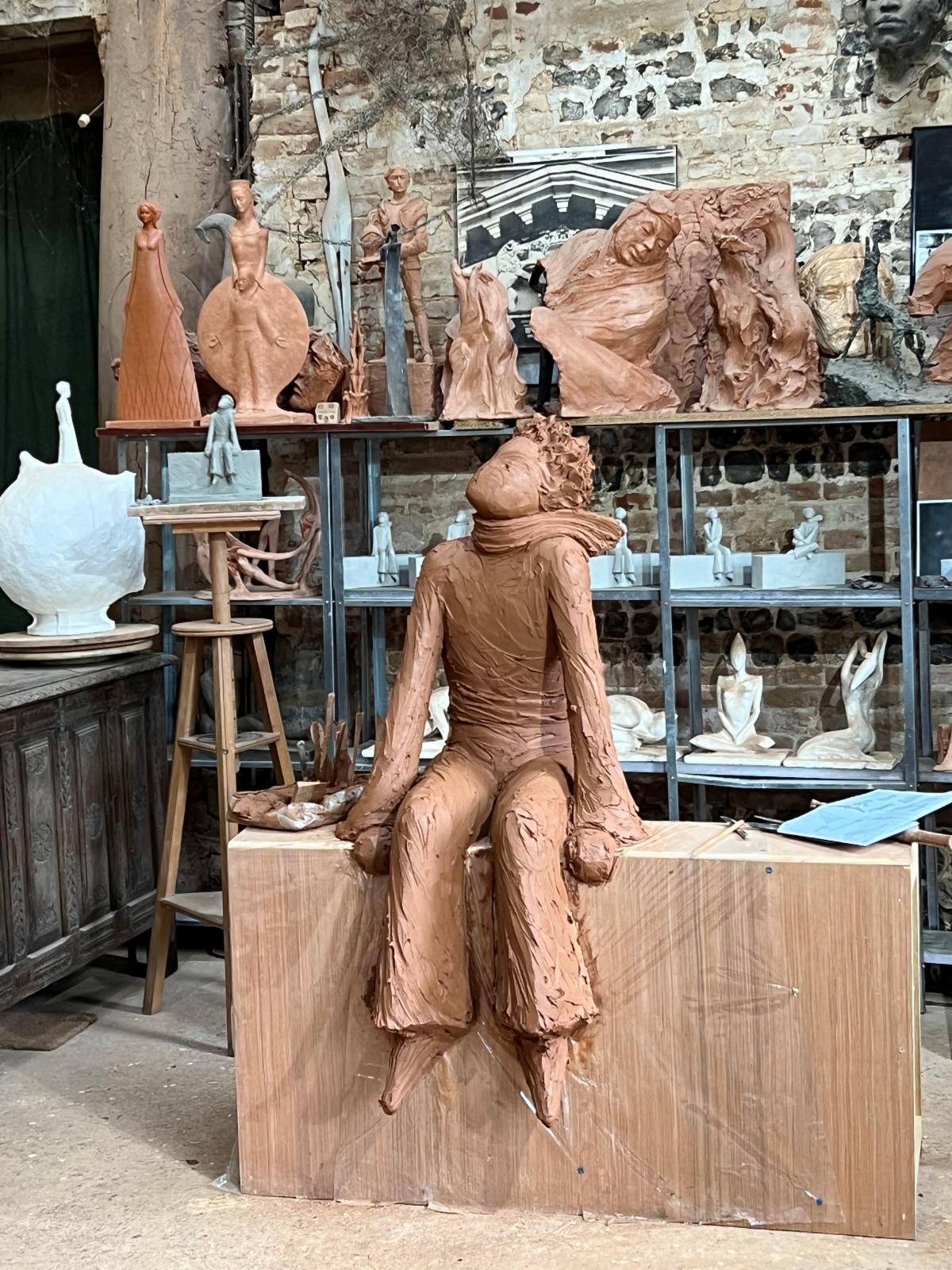
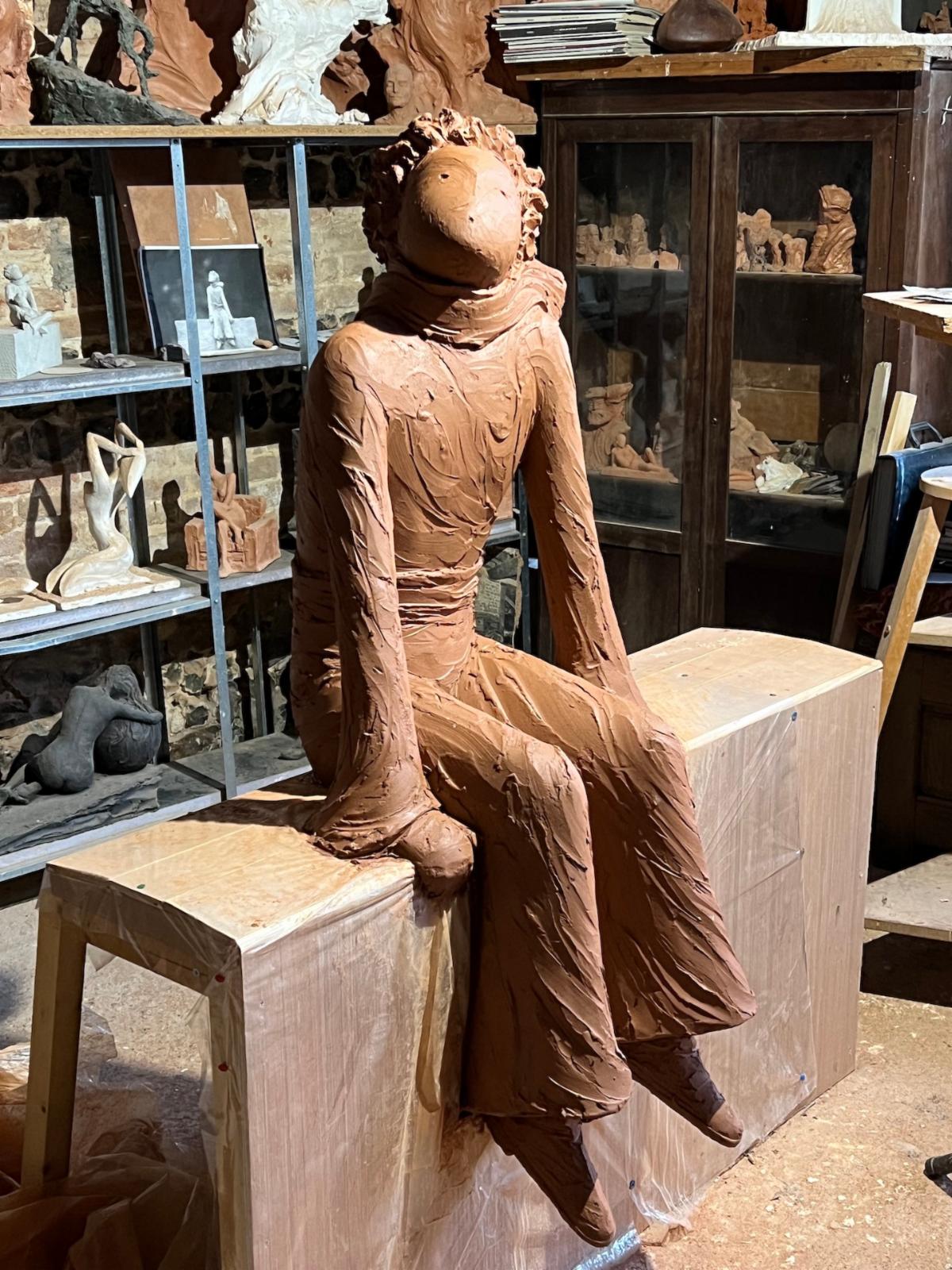
Anyone thinking that our activities are only centered on a distant past would be mistaken. We are pleased to inform that our sculpture of Le Petit Prince by Jean-Marc de Pas is now at the foundry, and will be transported from France to New York courtesy of Air France.
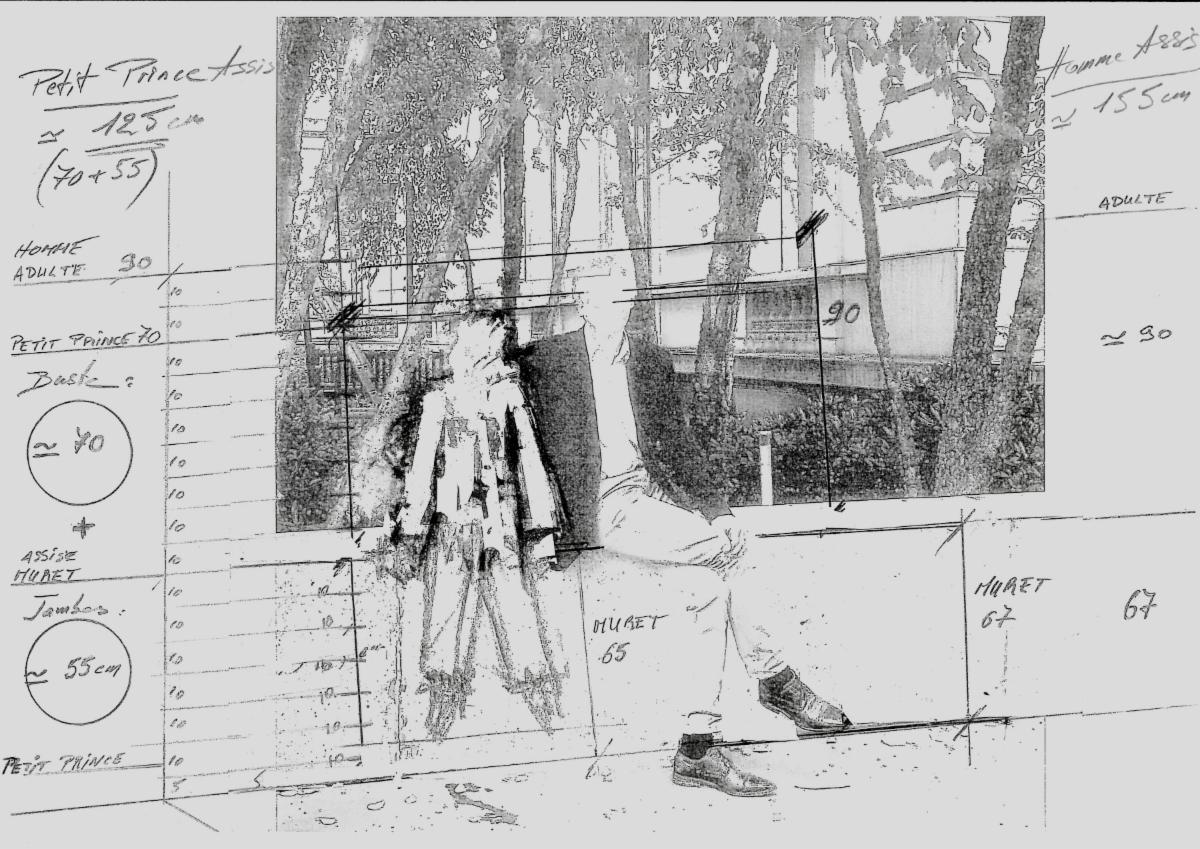
The official inauguration's exact date (most likely in September) will be announced soon. In the meantime we are proud to share with you a couple of photographs and illustrations, courtesy of sculptor Jean-Marc de Pas. We will also duly recognize all our individual and corporate donors who made this memorable project possible, and first and foremost the Saint-Exupéry Youth Foundation.
Please mark your calendar for May 15 at the National Arts Club in Manhattan: we will have the honor to celebrate the 80th anniversary of Le Petit Prince with MM. Olivier d'Agay, President of the Saint-Exupéry Youth Foundation and nephew of the author Antoine de Saint-Exupéry, Nicolas Delsalle-Mun, General Delegate of the Saint-Exupéry Youth Foundation, and Ms. Stacy Schiff, co-President of the Honor Committee for the sculpture of The Little Prince over drinks.
Thank you as always for your remarks, suggestions and support.
Become a member of the American Society of Le Souvenir Français.
The basic annual dues are only $40 and will make you an active participant to our mission and will help us achieve it. It feels good to belong!
Another way to support us is to buy the e-book Memories of France at: Amazon.com. All royalties go to our association. You can effectively support us by downloading it from Amazon.
Also, you can help us by spreading the word and sharing our monthly Bulletin with others - - it is entirely free! Enjoy.
On behalf of the Board of Directors,
Thierry Chaunu, President,
American Society of Le Souvenir Français, Inc.
|
|
FRANCE AND NORTH AMERICA: THE BEGINNINGS |
|
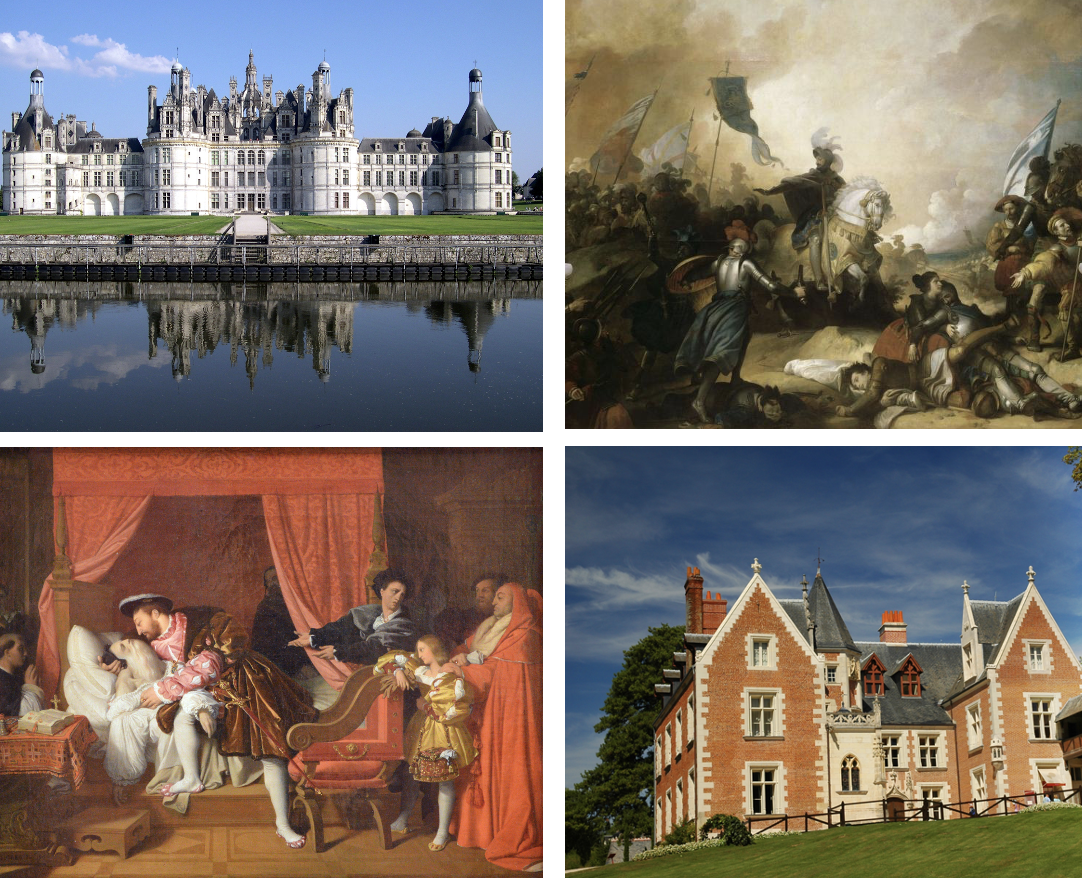
Bottom clockwise: Château de Chambord, Loir et Cher, France, Photo by Patrick Giraud https://commons.wikimedia.org/w/index.php?curid=601617 • François Ier at the Battle of Marignano (1515) By Alexandre-Évariste Fragonard Public Domain, https://commons.wikimedia.org/w/index.php?curid=7842833 • François Ier receiving the last breath of Leonardo da Vinci in 1519, by Jean Auguste Dominique Ingres, painted in 1818, Public Domain, https://commons.wikimedia.org/w/index.php?curid=29835895 • Château de Clos-Lucé (Leonardo da Vinci's residence) , By Nadègevillain, https://commons.wikimedia.org/w/index.php?curid=16980784
|
|
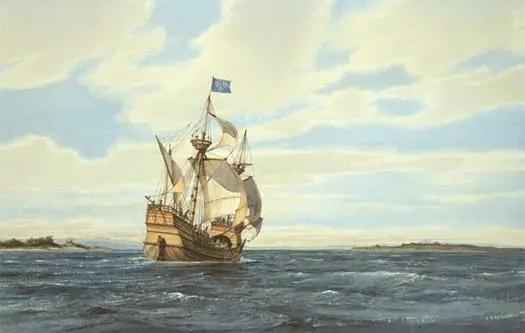
1524 is the year of the first exploration of North America by a French vessel, La Dauphine, under the command of Giovanni da Verrazzano, a Florentine captain at the service of King François Ier.
• Why was King François Ier interested in America?
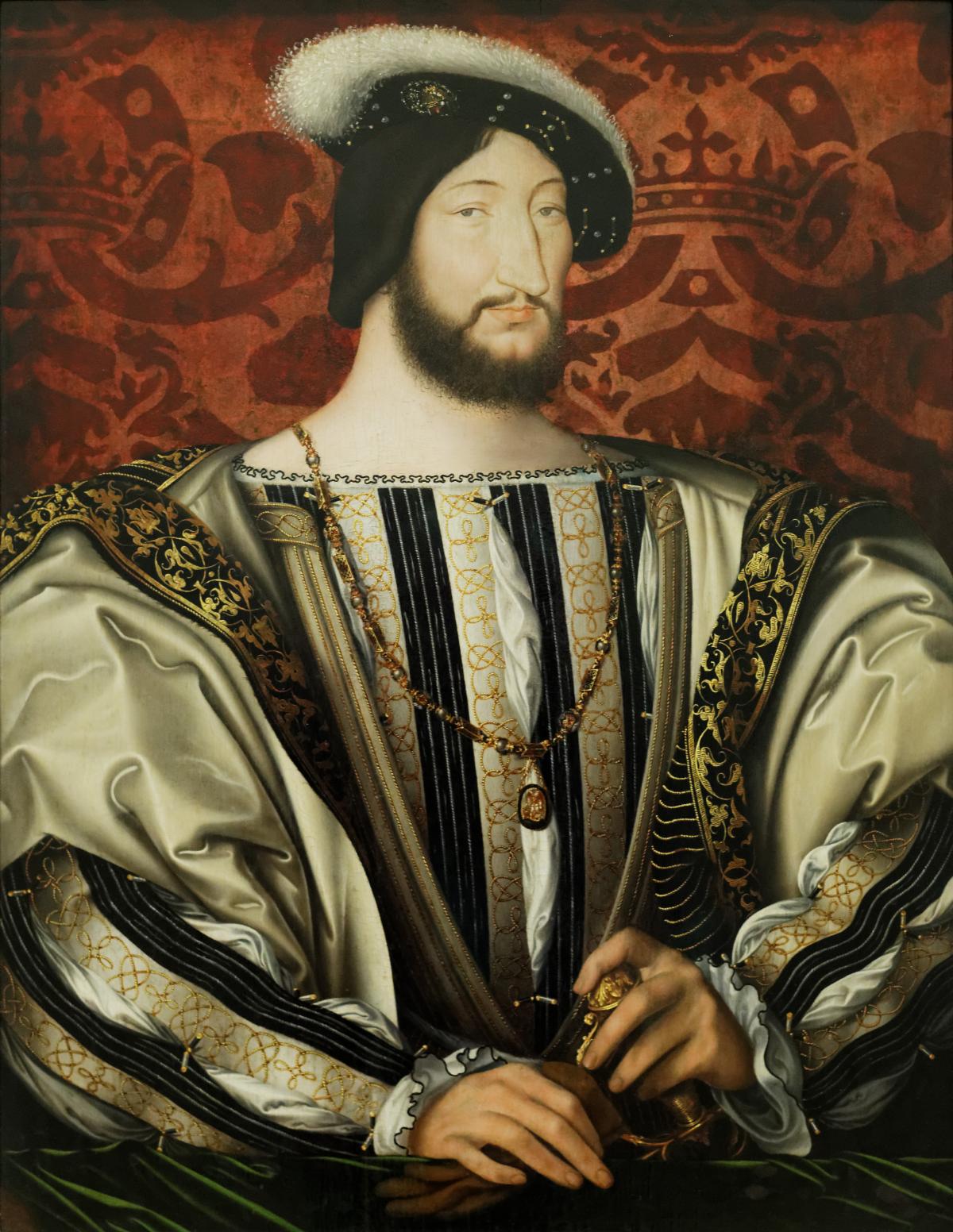
When the Pope decided to divide the new world between Spain and Portugal, (Treaty of Tordesillas, 1494), the French King was outraged. He declared: "The sun shines for me as it does for others. I would very much like to see the clause of Adam’s will by which I should be denied my share of the world".
• What was the goal of the exploration?
The main eluding goal at the time was to find a direct westward passage to China. Every navigator since Christopher Columbus tried to find such a passage. The city of Lyon, France, being a major silk producer (which it is still today), several merchants formed a syndicate to find a lucrative route. On the other hand, several Italian families had settled in Lyon, and Giovanni da Verrazano was chosen to lead such an expedition. The King provided a ship and issued instructions to have the expedition leave from a newly built harbor on the Atlantic facade at Le Havre.
• Why did King François Ier choose Giovanni da Verrazzano?
It was not unusual to have Italian navigators propose their services to foreign kings. Christopher Columbus served the Court of Spain, Amerigo Vespucci served the Court of Portugal, Giovanni Cabot for the Court of England. As for Verrazano, although no birth record has been found to prove that he was born in Florence or in Lyon, it is established that he spent the major part of his life in France and could thus be considered a dual national, as we would say today.
As a side note, Italians of the Renaissance era were particularly appreciated by François Ier. Certainly the most famous of all is Leonardo da Vinci (known as Léonard de Vinci in France), who died in his estate of Clos Lucé, near the château of Amboise, another royal residence of King François Ier (pictured above). Another, strong link, among countless other, between France and Italy: Catherine de Médicis, born in Florence, married François Ier's second son, Henry d'Orléans in 1533, became Queen of France, and mother of three French kings...
Back to our subject: King François Ier was also intent on establishing a permanent presence in the New World. Ten years later, in 1534, he sent navigator Jacques Cartier to the Saint Lawrence river in Québec to find "certain islands and lands where it is said there must be great quantities of gold and other riches" and Jean-François de Roberval to Canada in 1541 to settle the land and "spread the Holy Catholic faith". Unfortunately, François Ier was embroiled in constant continental wars with the Habsburg dynasty and never focused on the vast land between Florida and Canada named "Francesca" in his honor - - thus leaving to the English and the Dutch the settlement of colonies instead.
|
|
Giovanni da Verrazzano or Jean de Verazane? |
|
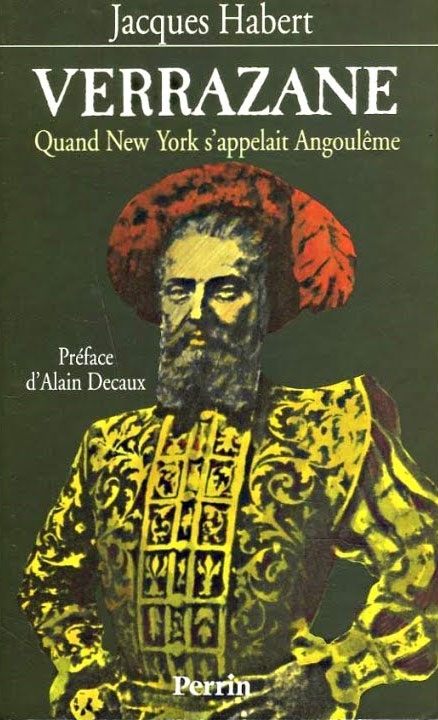
Cover, Jacques Habert, "Quand New York s'appelait Angoulême" ("When New York was called Angoulême")
Up until the turn of the 20th century some scholars doubted that the expedition even took place. Thanks to the discovery of long lost manuscripts, and after decades of research in the United States, Italy and France, Jacques Habert succeeded in reestablishing the facts. Following his thesis at Columbia University in 1954, and thanks to the constant lobbying of the Italian-American community, the suspension bridge located at the entrance of New York inaugurated in 1964 was officially named the Verrazano-Narrows bridge. Renamed the Verrazzano (with two "z"'s) -Narrows bridge in 2018, it underlines the fact that the Englishman Hudson had a predecessor in the service of the King of France.
|
|
"In the past we wrote the names as we heard them and that produced mistakes... Names, even the most illustrious, underwent incredible transformations. Thus, that of Amerigo Vespucci is written Améric Vespuce, Albericus, Albericus Vesputius, Amerigo Vespuche, Amerrigo, Amerigo de Espuche, Vispuche, Déspuchy, Vespuchi, Morigo, Morigo Vespuche'. Christophe Colomb was named Colombo, Colombus, Colon, Colom, Colomo and, which is a Germanic pearl, Chrislojfel Dawber, that is to say 'Christopher Pigeon Male''. How can we be surprised, after that, that Verrazano was made Verrazzano, Verrazanus, Verrasane, Varassanne, Verazano, Verazze, Varesam? It is no further from Verrazano to Varesamque from Amerigo Vespucci to Morigo Vespuche or from Colombo to Male Pigeon. “
- Excerpt from "Giovanni Verrazano's voyages to the American coasts with Norman sailors, on behalf of the King of France, in 1524-1528" / by M. Gabriel Gravier. 1898, National Library of France - Gallica
This excerpt above shows the difficulty in assigning a specific spelling!
What is interesting to note is that he himself signed either in Latin: "Janus Verrazanus" or in his will of 1526: "Jehan de Verrazane".
In all official documents concerning the armaments of ships, he is designated in the "Frenchified" form of his name.
A family named Verrasan, originally from Florence, had been established in Lyon for more than a century prior to his birth, circa 1485. While there are no birth certificates to ascertain whether he was born in Florence or in France, what is for sure is that throughout his public life (which took place entirely in France), he was always referred to in a "Frenchified" form of his name, and he himself never used any other.
We will therefore call him: Jean de Verrazane!
|
|
Whether or not he was born in Lyon or near Florence around 1481, he spent his school years in Italy. His father's name is Piero Andrea da Verrazzano and his mother's name is Fiametta Capelli. Son of a rich Florentine family, he undoubtedly benefited from a solid education. No document has been found to ascertain how and where he studied navigation.
As a young man, he spent several years in Cairo as a commercial agent (his brother was a banker). It is likely that in the early years 1501-1507 he worked in the Middle East for rich Italian traders. And it was undoubtedly in the eastern Mediterranean that he learned navigation as he visited Syria, the Greek isles.. which he later evoked in his writings places such as Rhodes, Crete.
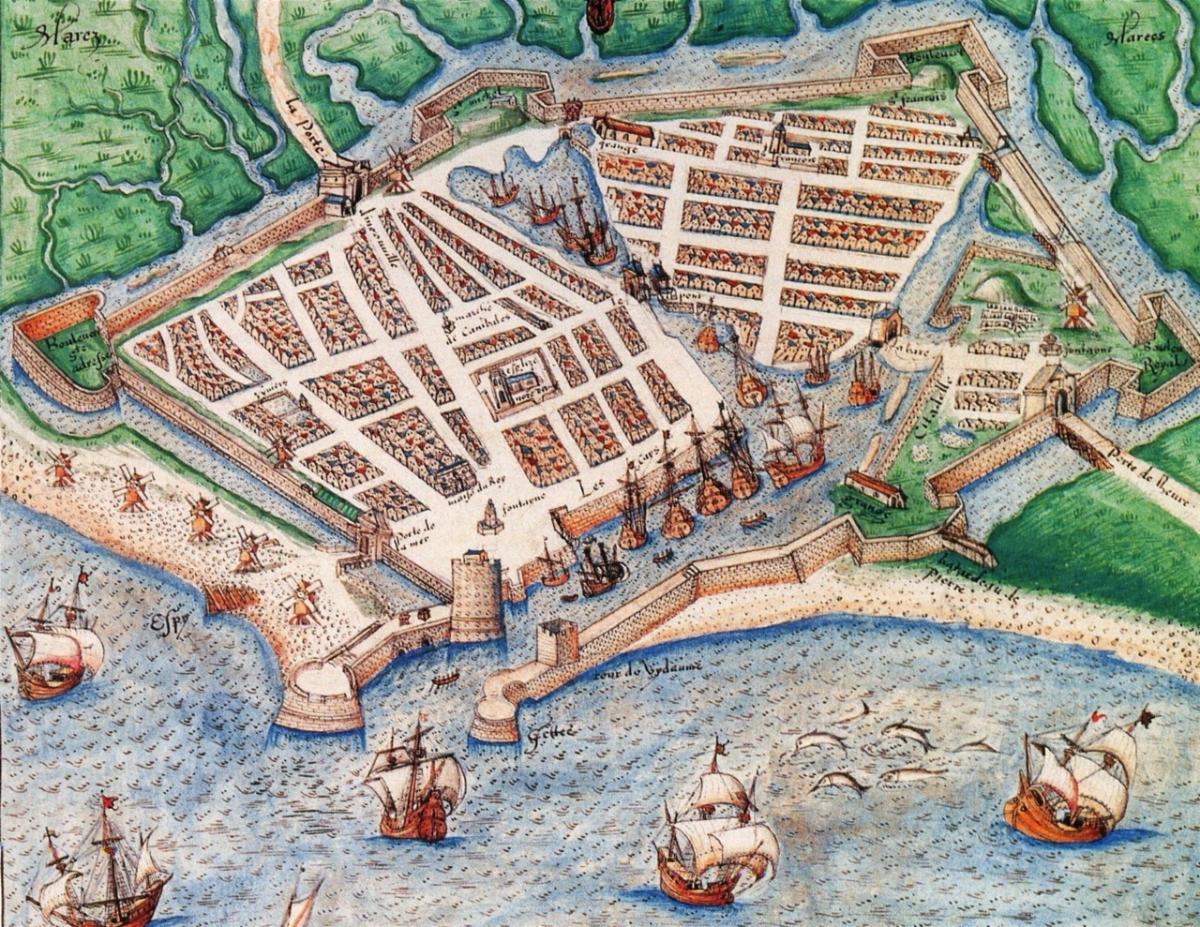
He eventually join rich Florentines established in Normandy and pursue trade with Asia. While in Rouen, Verrazane did several trips to the Mediterranean for silk merchants, and possibly even took part in an expedition to Newfoundland in 1507. What is established is that he was based in Normandy, in Rouen from 1508 then in Dieppe, Fécamp, Le Havre and Honfleur from 1522 to his first voyage to America.
|
|
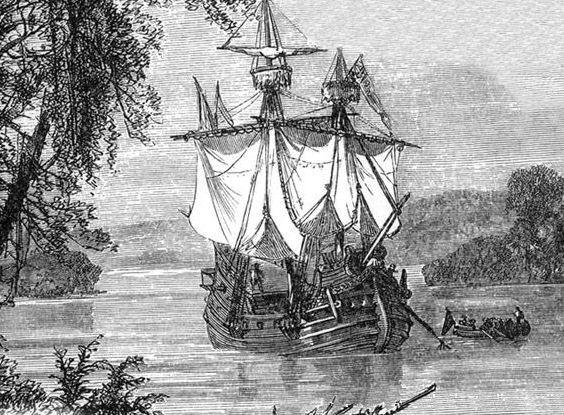
Top: Le Havre de Grâce in the 16th century. Drawing by Jacques de Vaux published in Le Havre d'Autrefois by Lemale and Roessler.1883 (Public domain)
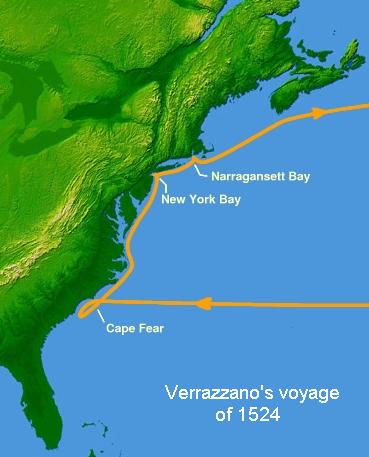
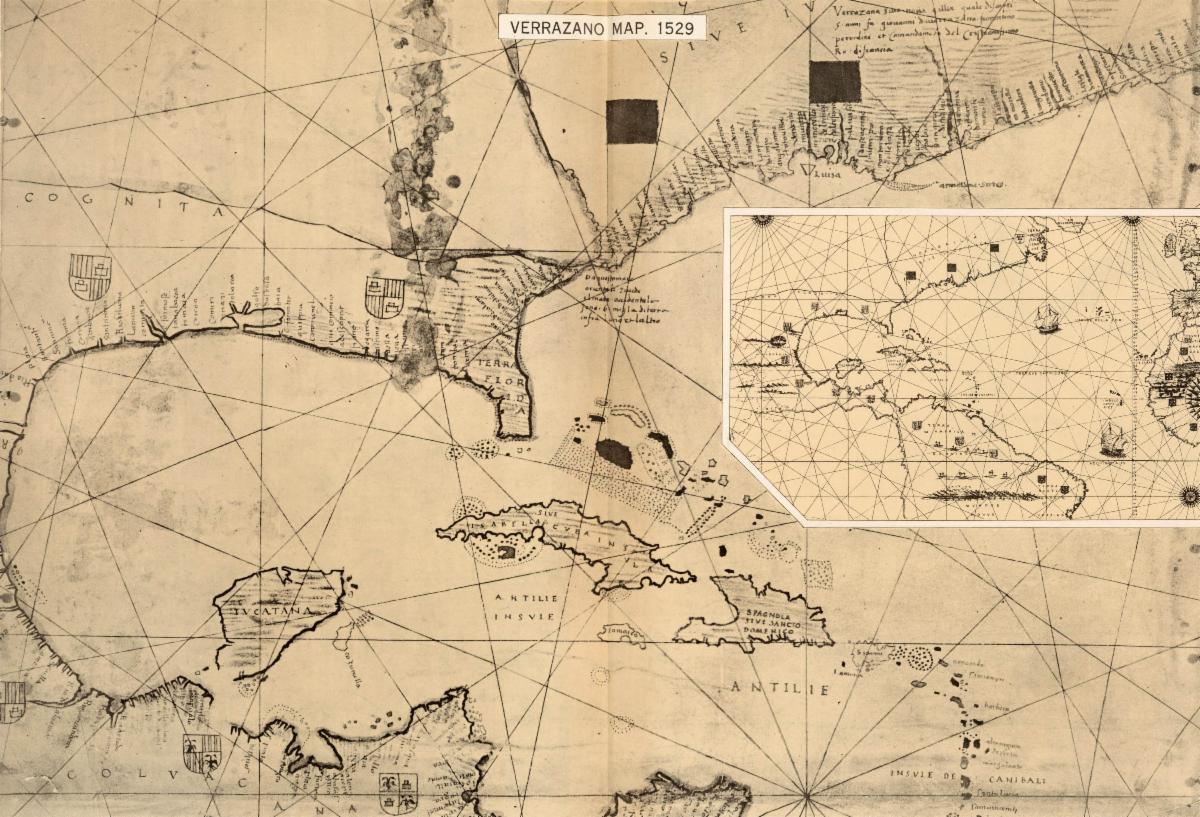
Middle top: Voyage map
see http://it.wikipedia.org/wiki/Immagine:Viaggioverrazzano.jpg, via Wikimedia Commons
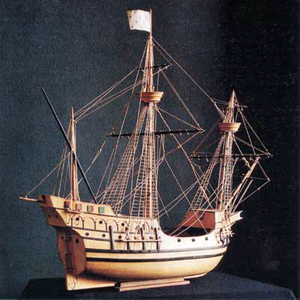
Middle bottom: "La Dauphine", replica 1/5 model of the Musée Maritime de Rouen "Nearly five centuries later, a group of enthusiasts wants to give back all its historic place to this extraordinary adventure. The model was done by the volunteers of the association, supervised by the Master Carpenter Patrice Mabire, and by the participation of the students of the Colleges of Haute-Normandie. The 1/5th replica of “la Dauphine” is 7 meters long." 13, Quai Emile Duchemin, 76000 Rouen, France
|
|
What follows is the narration of the first official contact of a European with the territory of the future United States (with the exception of Florida, approached by the Spaniards earlier in 1513). The territories of America that he
discovers are named by him “Nova Gallia”. Nova Gallia, which extends from Florida to Newfoundland, will become Nueva Francia, Neuve France at the time of Jacques Cartier, and finally Nouvelle France, New France.
• While partly funded by rich silk merchants from Lyon and Rouen, the voyage was undertaken at the express instructions of King François Ier. Documents have been found that show all the lengthy preparation for such an expedition. His brother Girolamo, a cartographer, accompanied him in his voyages. François Ier gave clear instructions signed on March 16, 1523 at Bray-sur-Seine and addressed to Vice-Admiral du Chillou at Le Havre, to facilitate the departure of 4 ships: La Dauphine, La Normande (the names of the two others are not specified). Antoine de Conflans was the captain with authority on the crew, but Jean de Verazane was the leader of the expedition. Due to the weather and other accidents, only La Dauphine made the crossing of the Atlantic.
• "Cèllere Codex:"
Jean de Verazane wrote a letter to François Ier on July 8, 1524 to report on his voyage. This letter known under the name "Cèllere Codex" and was reproduced in 3 original versions. One of them is at the Pierpont Morgan Library in New York.
Discovery of the Atlantic Coast:
• First sighting:
Jean de Verrazane writes:
"...In another XXV days we sailed more than four hundred leagues, where there appeared a new land which had never been seen before by any man, either ancient or modern. At first it appeared to be rather low-lying; having approached to within a quarter of a league, we realized that it was inhabited, for huge fires had been built on the seashore...."
It is believed that the Dauphine touched land near Cape Fear in present-day North Carolina around March 7th, 1524, then proceeded south towards Florida, sailed near the Savannah River between present-day South Carolina and Georgia, but didn't pursue that route to avoid intrusion in Spanish territory.
Verrazano decided to turn around and continue the exploration of the coast to the north. He observed fires and reported that the land was inhabited:
"Seeing that the land continued to the south [so as not to meet with the Spaniards], we decided to turn and skirt it toward the north, where we found the land we had sighted earlier. So we anchored off the coast and sent the small boat in to land. We had seen many people coming to the seashore, but they fled when they saw us approaching; several times they stopped and turned around to look at us in great wonderment. We reassured them with various signs, and some of them came up, showing great delight at seeing us and marveling at our clothes, appearance, and our whiteness; they showed us by various signs where we could most easily secure the boat, and offered us some of their food. We were on land, and I shall now tell Your Majesty briefly what we were able to learn of their life and customs"....
What follows is the first description of the Native Americans of the Atlantic coast of the current United States:
"They go completely naked except that around their loins they wear skins of small animals like martens, with a narrow belt of grass around the body, to which they tie various tails of other animals which hang down to the knees; the rest of the body is bare, and so is the head. Some of them wear garlands of birds’ feathers. They are dark in color, not unlike the Ethiopians, with thick black hair, not very long, tied back behind the head like a small tail. As for the physique of these men, they are well proportioned, of medium height, a little taller than we are. They have broad chests, strong arms, and the legs and other parts of the body are well composed. There is nothing else, except that they tend to be rather broad in the face: but not all, for we saw many with angular faces. They have big black eyes, and an attentive and open look. They are not very strong, but they have a sharp cunning, and are agile and swift runners..."
• A second landing took place on March 25, 1524 near Cape Fear which he called Land of the Annunciation (in present-day North Carolina).
When sailing past Cape Hatteras, he believed to have found the famous inland sea linking the two oceans, Atlantic and Pacific, which is in fact the current Pamlico Sound. This error lasted several decades and inflicted a stain on his reputation, which partly explains his long disgrace from history books. (The other reason, as we have seen earlier, being that subsequent English and Dutch colonizers erased and replaced the geographical names he had given to his discoveries.
• In Virginia, at the end of March 1524, Verrazano stepped on land again and baptized these new lands in homage to François 1er, Francesca, a name which would become Francescane (and recognized as such by the Spanish and Portuguese).
• A third landing took place on April 2. He and a good half of his crew did an incursion inland. He named the region Arcadia because of the beauty of the landscapes, "...[We] continued to follow the coast to the northeast which we baptized “Arcadia” on account of the beauty of the trees.."
He probably was inspired by the mythical Arcadia of ancient Greece celebrated by poets. Samuel de Champlain eventually changed the spelling by dropping the "r" from the name Arcadia to designate Nova Scotia some 80 years later.
• Capture of a young Indian:
"...after fifty leagues we reached another land which seemed much more beautiful and full of great forests. We anchored there, and with XX men we penetrated about two leagues inland, to find that the people had fled in terror into the forests. Searching everywhere, we met with a very old woman and a young girl of 18 to 20 years, who had hidden in the grass in fear. The old woman had two little girls whom she carried on her shoulders, and clinging to her neck a boy -- they were all about eight years old. The young woman also had three children, but all girls. When we met them, they began to shout. The old woman made signs to us that the men had fled to the woods. We gave her some of our food to eat, which she accepted with great pleasure; the young woman refused everything and threw it angrily to the ground. We took the boy from the old woman to carry back to France, and we wanted to take the young woman, who was very beautiful and tall, but it was impossible to take her to the sea because of the loud cries she uttered. And as we were a long way from the ship and had to pass through several woods, we decided to leave her behind, and took only the boy."
As was customary at the time, in order to bring back tangible proof of his voyage to his financial backers, Verrazane captured an Indian boy and brought him back to France. It was also a way to give the young boy an education and teach him French, in order to send him back to his tribe and thus have an able interpreter. He was also destined to be presented to King François Ier, however we do not know what became of him...
• From April 8 to 13, 1524, Verrazano recognizes the coast of present-day Delaware and New Jersey where promontories are named Cap Alençon, Cap Bonnivet and a large Vendôme river (today the Delaware River)... before approaching...
|
|
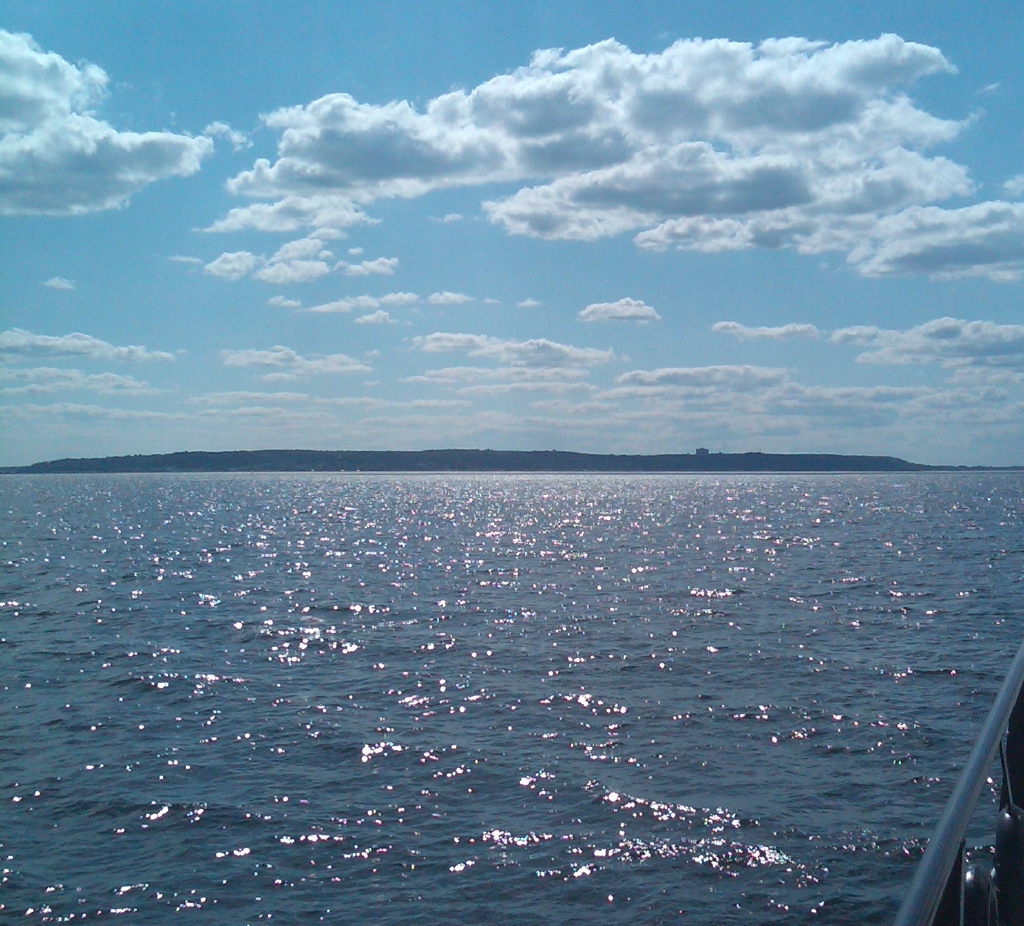
Navesink Highlands seen from the Atlantic Ocean while on approach to New York Harbor
....a high land by the sea, which was sighted for the first time by our navigators. It is called the Navesink Highlands nowadays. Verrazano named it Hill of Saint Pol in homage to the King's confident and general François Bourbon-Vendôme, comte de Saint-Pol, who had pushed back the English in front of Paris the previous December.
And then...
|
|
The discovery of New York: April 17, 1524 |
|
• On April 17 (the exact date is not specified in the Codex, however this date is determined based on navigation), the Dauphine enters a narrow pass (the Narrows) and proceeds to the mouth of the current Hudson River. Using a probe, Verrazane realizes the good depth of the harbor which is the first true natural seaport encountered on the east coast of North America.
• In his letter to François Ier, he described New York Bay:
"After a hundred leagues we found a very agreeable place between two small but prominent hills; between them a very wide river, deep at its mouth, flowed out into the sea; and with the help of the tide, which rises eight feet, any laden ship could have passed from the sea into the river estuary. Since we were anchored off the coast and well sheltered, we did not want to run any risks without knowing anything about the river mouth."
“...So we took the small boat up this river to land which we found densely populated. We went up this river for about half a league, where we saw that it formed a beautiful lake, about three leagues in circumference [the mouth of the Hudson]. Suddenly as often happens in sailing, a violent unfavorable wind blew in from the sea, and we were forced to return to the ship, leaving the land with much regret on account of its favorable conditions and beauty; we think it was not without some properties of value, since all the hills showed signs of minerals.”
A rowboat is launched. Jean Verrazano is on board with twenty crew. He writes in his report:
"We entered the country. We found it densely populated. The people were dressed in feathers of birds of various colors. They came to us cheerfully, uttering loud cries of admiration and showing us the safest place to land. We ascended the river (the channel) half a league inland. There we saw that it formed a very beautiful lake about three leagues in circumference. stops on all sides about thirty small boats manned by a crowd of people passing from both banks to see us".
Bad weather prevented the Normans from staying longer, which he wished he could have done: "We left this land reluctantly, because of its advantages and its beauty."
• Verrazano had just discovered the port that would become New York and baptized the area Terre d'Angoulême in homage to François 1er. (He was known as François, count of Angoulême before becoming king).
"this land was called Angoulême, because of the appanage that Your Majesty received when it was less fortunate, and the bay formed by this land, Sainte-Marguerite, named after your sister, which prevails over the others ladies by her discretion and her spirit. »
• He proceed to name Long Island “Flora,” Block Island “Louisa.” (in honor of King François Ier's mother, Louise de Savoy).
His brother Girolamo’s outline of North America was, along with a contemporary chart by the Napalese cartographer Adrien Maggiolo, the first to include New York Bay under the French name Angouleme. This denomination persisted on French and Italian maps until Hudson’s explorations in the early 17th century.
|
|
The discovery of Le Refuge,
present-day Newport, and Narragansett Bay
Rhode Island
|
|
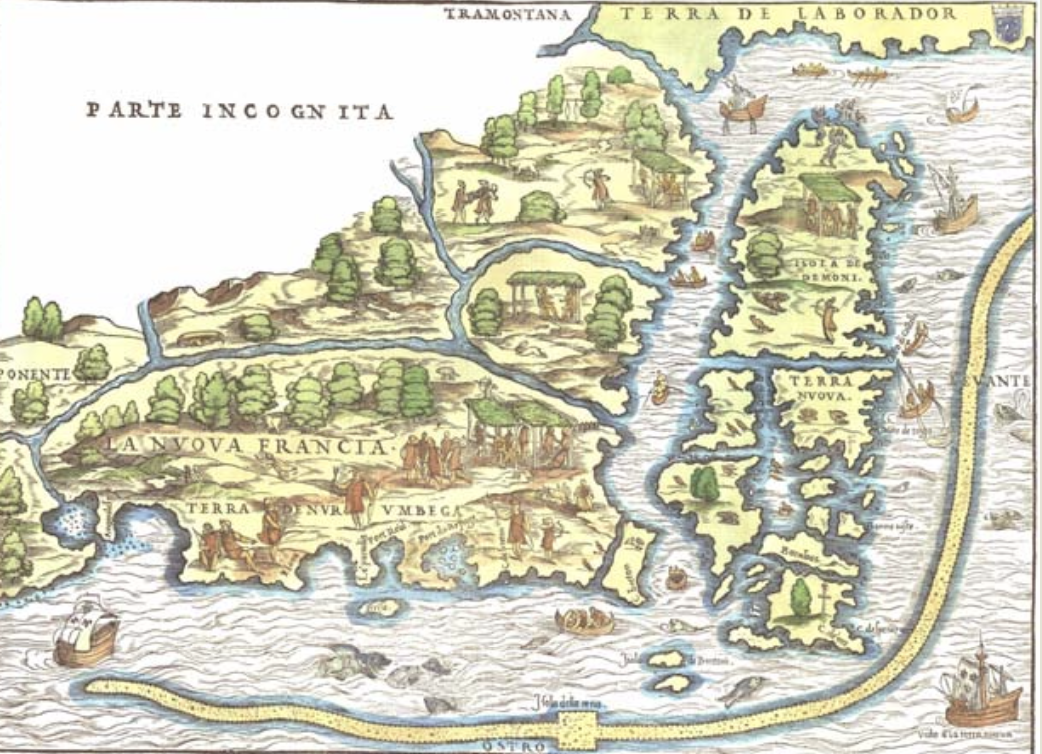
Top: La Nuova Francia, (New France) by Gastaldi, Giacomo, circa, 1556 , Ramusio, Giovanni Battista, 1485-1557 published [In Venetia :Giunta],1556, Domaine Public, Bibliothèque et Archives Nationales du Québec
Largely based on the voyages of Verrazzano in 1524 and Cartier in 1535-36, this is the first printed map of present-day New England and eastern Canada. The yellow band may represent the Grand Banks, fished each summer by several European nations from the late 1400s (and perhaps much earlier by Basque fishermen).
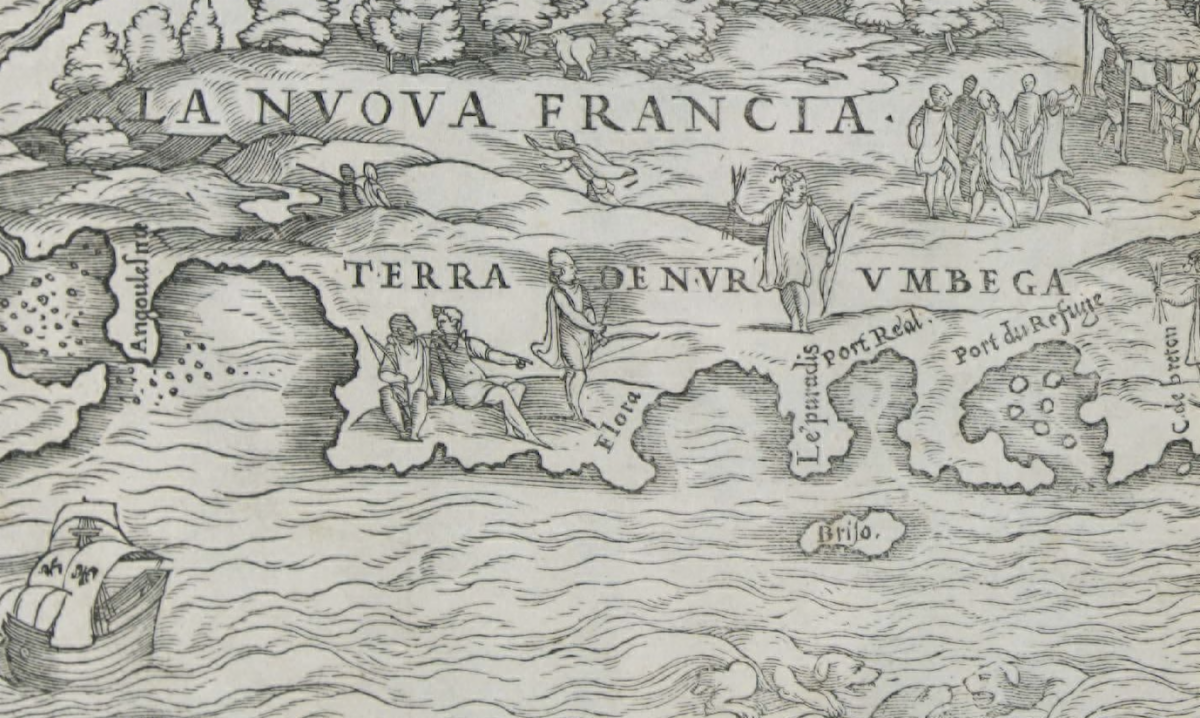
Bottom: close-up, showing Angoulême (New York), Port du Refuge (Newport, R.I.)
New York harbor, “a very agreeable place,” is to the left of “Angoulesme.” Long Island is labeled as the peninsula “Flora.”
|
|
Jean de Verrazane writes:
..."We discovered a triangular-shaped island, ten leagues from the mainland, similar in size to the island of Rhodes; it was full of hills, covered in trees, and highly populated to judge by the fires we saw burning continually along the shore. We baptized it in the name of your illustrious mother [Louise of Savoy], but did not anchor there because the weather was unfavorable..."
Taking up the initial comparison of Verrazano, the English will make it Rhode Island. This is the only surviving name of his discovery in 1524 of the current United States, Acadia being in Canada.
• On April 22, ... "We entered another very beautiful port that could also house a large fleet that we baptized Le Refuge" (and which would become Newport).
“In this bay are five very fertile and very pleasant islets, covered with tall and wide trees. Any large fleet could stay there in safety without having to fear storms or gusts. Towards the south, on each side of the entrance to the port, there are graceful hills and many streams whose clear waters fall from the heights in the sea. In the middle of the bottleneck is a living stone rock, of natural origin . It would be easy to install batteries or a fort there to protect the port. »
• The crew spent two weeks there with members of the Narragansett and Wampanoag Tribes in perfect harmony. He writes:
"These people are the most beautiful and have the most civil customs that we have found on this voyage. They are taller than we are; they are a bronze color, some tending more toward whiteness, others to a tawny color; the face is clear-cut; the hair is long and black, and they take great pains to decorate it; the eyes are black and alert, and their manner is sweet and gentle, very like the manner of the ancients. I shall not speak to Your Majesty of the other parts of the body, since they have all the proportions belonging to any well-built man " [...]
"Their women are just as shapely and beautiful; very gracious, of attractive manner and pleasant appearance; their customs and behavior follow womanly custom as
far as befits human nature; they go nude except for a stag skin embroidered like the men’s, and some wear rich lynx skins on their arms; their bare heads are decorated with various ornaments made of braids of their own hair which hang down over their breasts on either side. Some have other hair arrangements such as the women of Egypt and Syria wear ..."
• He also adds:
"They did not appreciate cloth of silk and gold, nor even of any other kind, nor did they care to have them; the same was true for metals like steel and iron, for many times when we showed them some of our arms, they did not admire them, nor ask for them, but merely examined the workmanship. They did the same with mirrors; they would look at them quickly, and then refuse them, laughing. They are very generous and give away all they have"...
• The crew explored at length the surroundings area.
Jean de Verrazane writes:
"...we found it as pleasant as I can possibly describe, and suitable for every kind of cultivation grain, wine, or oil. For there the fields extend for twenty-five to thirty leagues (75-90 miles); they are open and free of any obstacles or trees, and so fertile that any kind of seed would produce excellent crops.”
• On May 6, La Dauphine left Le Refuge, continuing her progress towards the northeast (present-day Cape Cod, New Hampshire, Maine) without ever losing sight of the coast, but the tribes are not as friendly.
• Several islets in what is now Penobscot Bay was called the Three Daughters of Navarre. On May 28, 1524, after more than 2,000 miles of American coastline, and five months of navigation, and almost out of food and beverages, Verrazano decided to head back to Dieppe in France after a final stop at Terre aux Bretons (Newfoundland) to get some fresh water and wood for cooking.
• On July 8, after 41 days of navigation during which Jean Verrazano finished his report, the Dauphine arrived in Dieppe, from where the Codex was sent to François Ier.
|
|
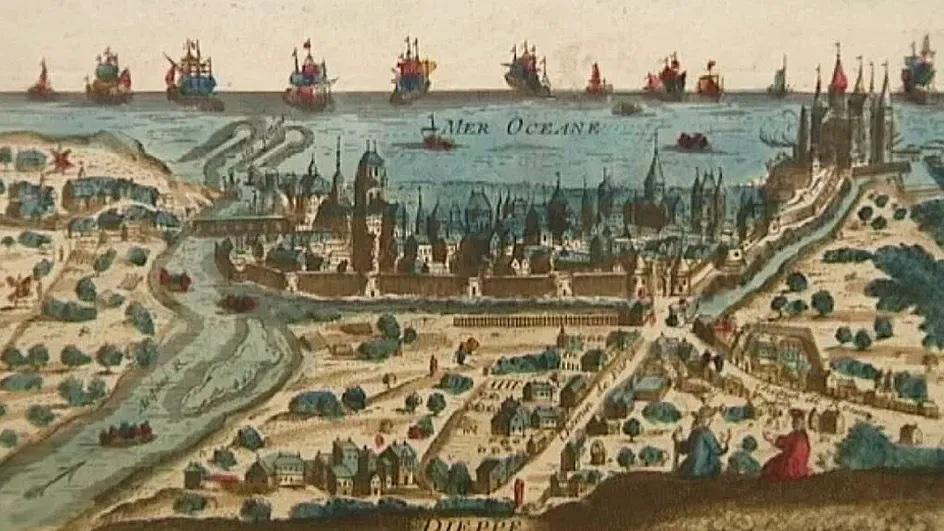
Illustration above: a map from the "Ecole de Dieppe" which flourished a few years after Jean de Verrazane's voyages. A common denominator to all the maps of the Dieppe school, also called world maps: they ignored longitude, and indicated latitude in degrees, after observation by astrolabe or quadrant. Many shipowners or monarchs such as Henry II of France or Henry VIII of England placed orders with the school of Dieppe, its reputation having largely exceeded the borders. |
|
Second voyage in 1526-1527:
In the company of his brother Girolamo, he left Dieppe with three ships with the aim of crossing the Cape of Good Hope to go to Asia. this expedition was also under the patronage of the king, as evidenced by a contract concluded that year by Chabot, the admiral of France, with Verrazzano and other investors for the loan of three vessels. In addition to trade, the purpose of the trip was also to find the untraceable passage to Asia. He first aimed for South America, passing through Brazil, then he crossed towards the Cape of Good Hope where a storm prevented him from continuing. He brought back brazil wood (called Pernambuco wood) which was sold back in Dieppe.
...and a third and final trip to the New World...
On the third trip that left in the spring of 1528, on its way to Brazil or Panama trying to find yet another passage to the Pacific ocean, Jean de Verrazane was captured on land (probably in the West Indies, maybe in Guadeloupe or in Jamaica) in August.
Jean de Verrazane was killed, roasted and eaten by cannibals under the horrified eyes of his brother Girolamo and the crew who had stayed on board, anchored at a distance and unfortunately out of gunshot range.
No one on board could prevent his atrocious death...
|
|
LEGACY
The Verrazzano-Narrows Bridge (1964), New York, NY
|
|
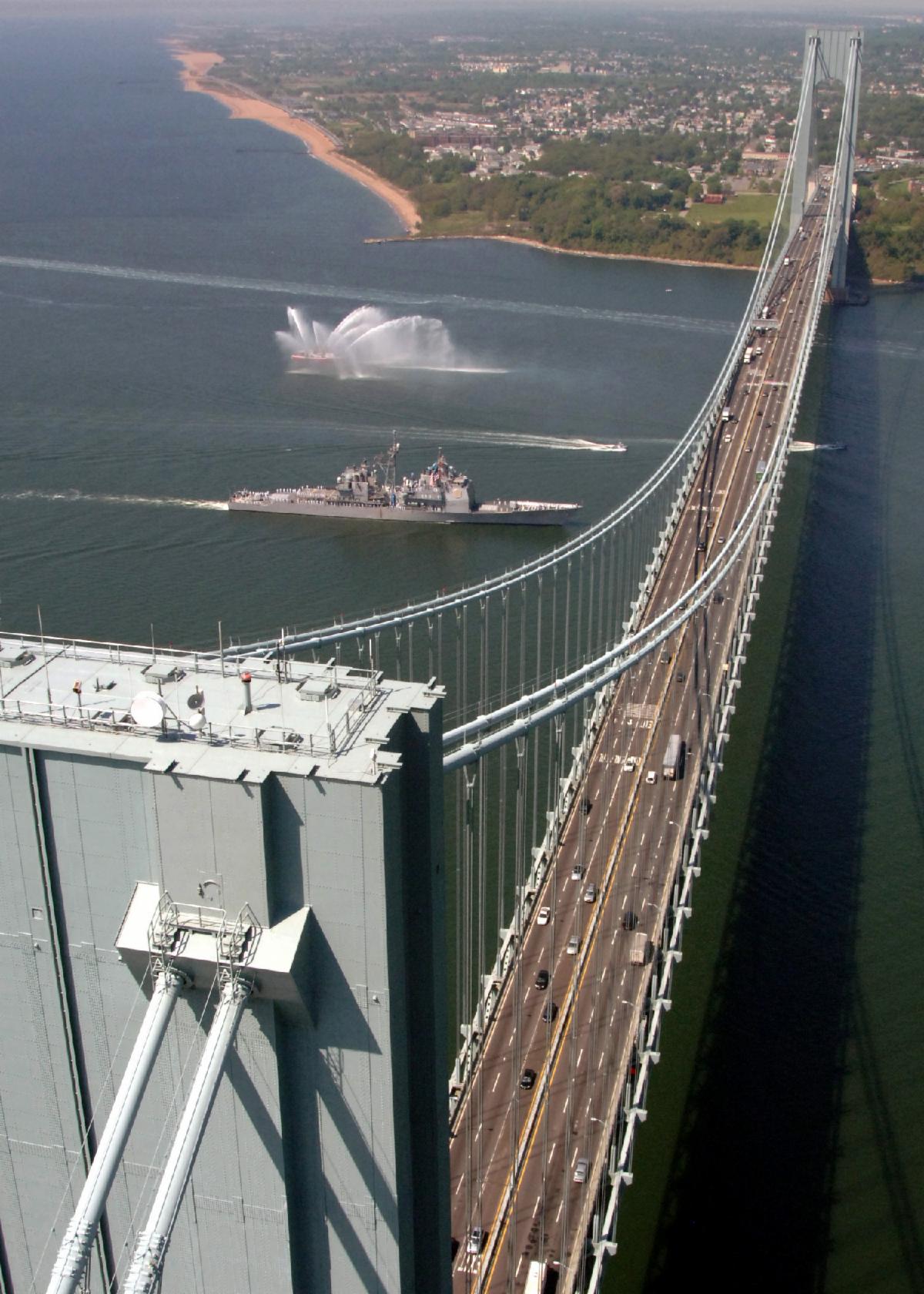
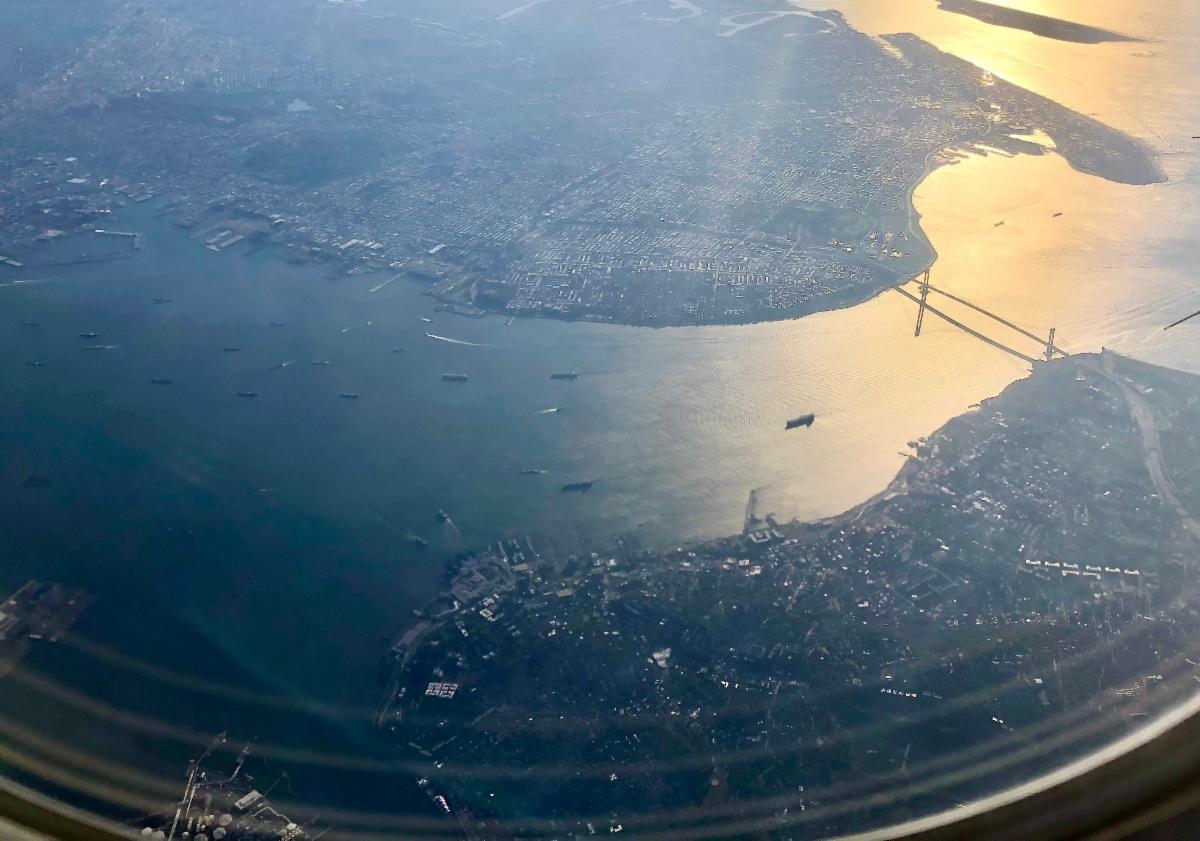
Top: The Verrazzano-Narrows Bridge looking toward Staten Island
Bottom: The Verrazano-Narrows Bridge and New York harbor from 5,000 feet at dawn, by Thierry Chaunu © 2019 American Society of Le Souvenir Français Inc.
|
|
• While plans for a bridge linking the boroughs of Brooklyn and Staten Island existed had existed since the 1920's, it was finally decided to build a one in the 1950's, inaugurated in 1964 and for many years the longest suspension bridge in the world.
• Interestingly, there was initial resistance to naming it Verrazzano. It took a lot of lobbying from the Italian Historical Society and the Italian-American Chamber of Commerce to overcome prejudices. Initially it was named Verrazano with one "z" as it was argued that it was the American way to spell the name. When president John F. Kennedy was assassinated, there were motions to rename the bridge after him. In the end, the Idelwild airport became JFK instead. It was only in 2018 that Governor Andrew Cuomo signed a law adding two "z"'s (existing signs, however many have been left intact due to budget constraints).
|
|
Statue of Giovanni da Verrazzano, New York City |
|
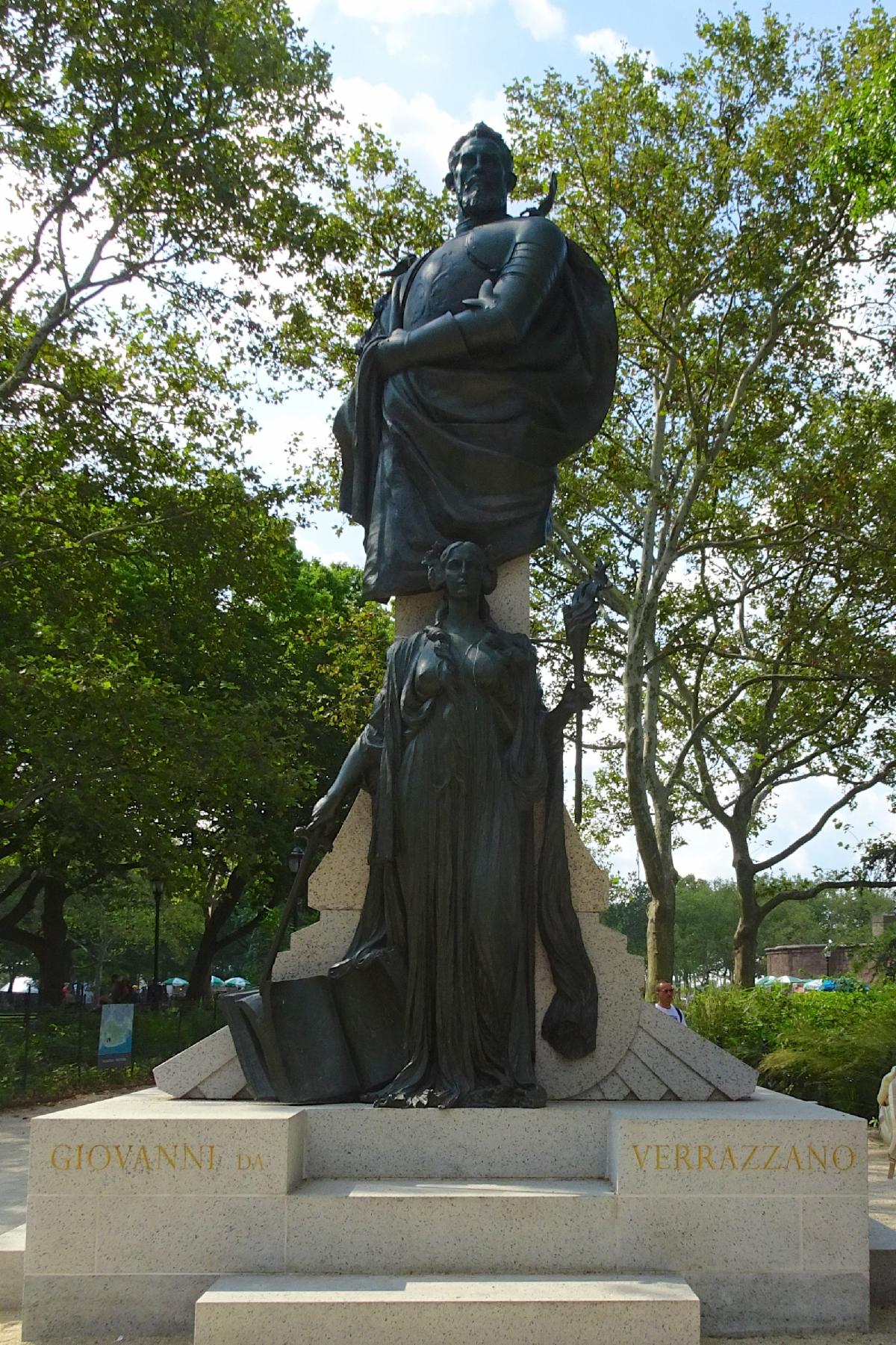
Statue of Verrazzano
State Street and, Battery Pl, New York, NY 10004
|
|
• In 1909, the City of New York celebrated the 300th anniversary of the discovery of New York by Henry Hudson. Except that the Italian-American community was outraged at this re-writing of history.
• Carlo Barsotti, the publisher of the most influential Italian-American newspaper at the time, the Italian language newspaper Il Progresso, decided to pay out of his own funds a statue to the glory of the lesser known Florentine navigator.
• Ettore Ximenes (1855–1926), a famous Italian sculptor was selected, and designed the monument which was inaugurated on October 9, 1909 while the celebrations to Henry Hudson were taking place. In this statue, Verrazzano is flanked below by a beautifully rendered female figure bearing a torch, represent Discovery.
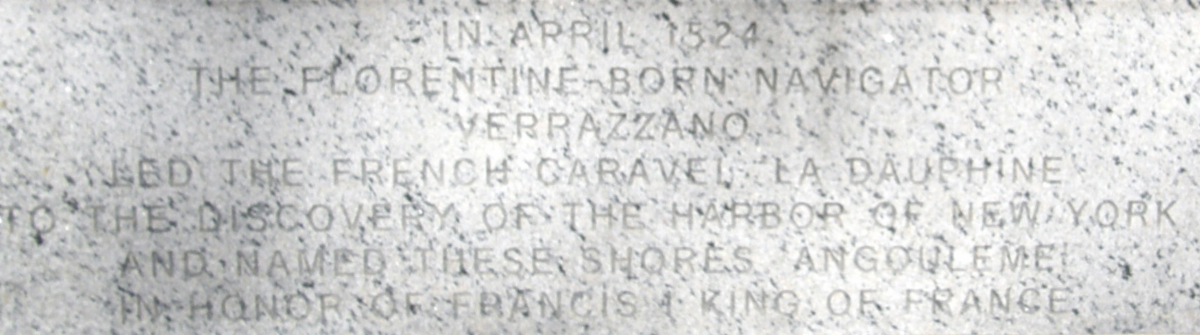
• The engraved inscription is located at the rear of the granite pedestal of the statue states the historical truth:
• Inscription:
“IN APRIL 1524
THE FLORENTINE-BORN NAVIGATOR
VERRAZZANO
LED THE FRENCH CARAVEL LA DAUPHINE
TO THE DISCOVERY OF THE HARBOR OF NEW YORK
AND NAMED THESE SHORES ANGOULEME
IN HONOR OF FRANCIS I KING OF FRANCE”
|
|
Verrazano Bridge, Sandy Point, Maryland |
|
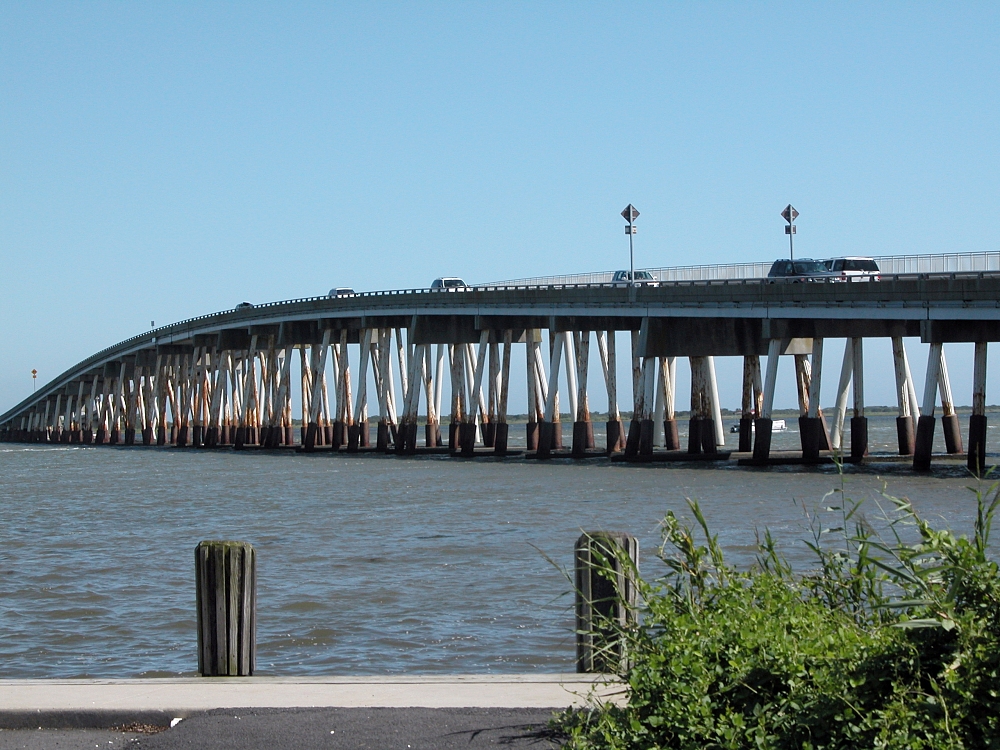
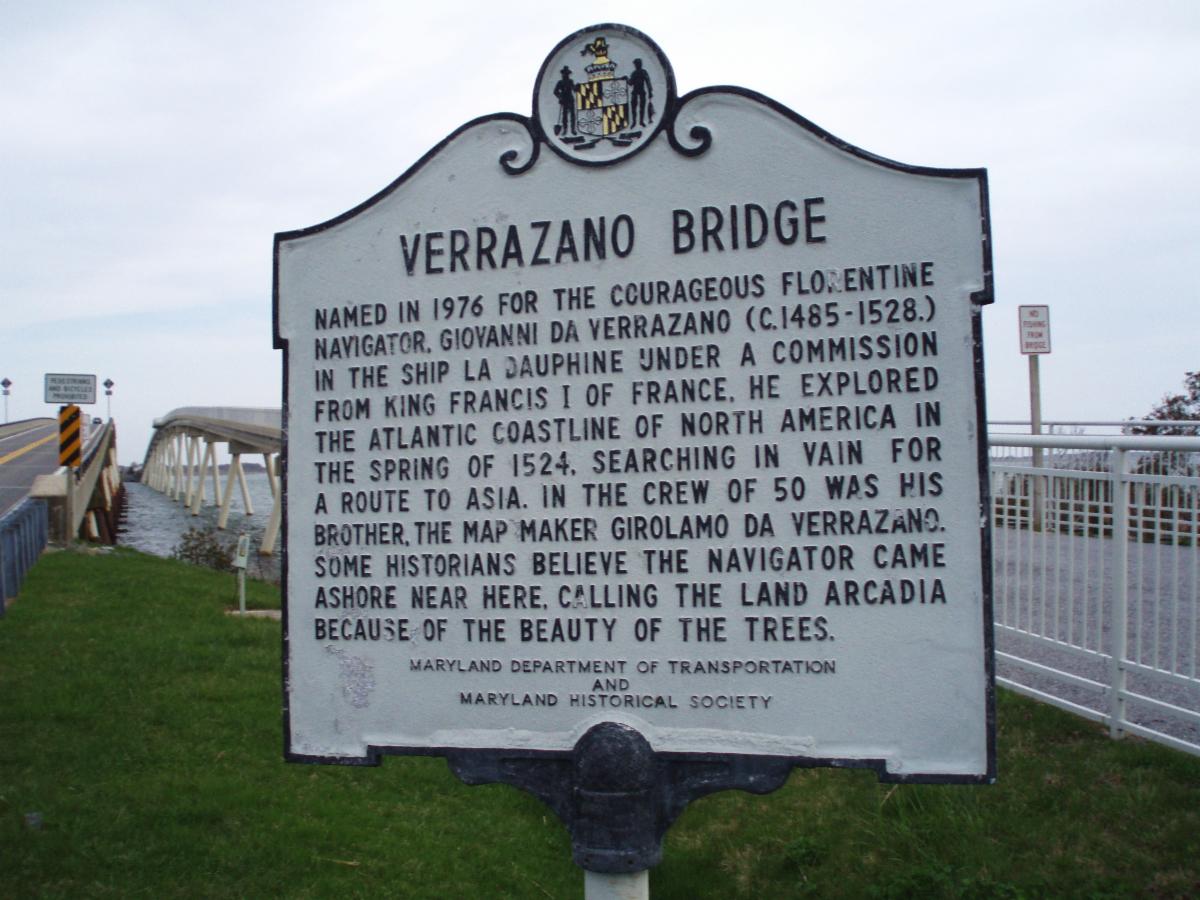
Maryland bridge
Marker, “Verrazano Bridge”
West end of bridge crossing the Sinepuxent Bay, Sandy Point, Berlin MD, 21811
|
|
• Inscription:
“Named in 1976 for the courageous Florentine navigator, Giovanni da Verrazano (c. 1485-1528.) In the ship La Dauphine under a commission from King Francis I of France, he explored the Atlantic coastline of North America in the spring of 1524, searching in vain for a rout to Asia. In the crew of 50 was his brother, the map maker Girolamo da Verrazano. Some historians believe the navigator came ashore near here, calling the land Arcadia because of the beauty of the trees.
Erected by Maryland Department of Transportation and Maryland Historical Society.”
|
|
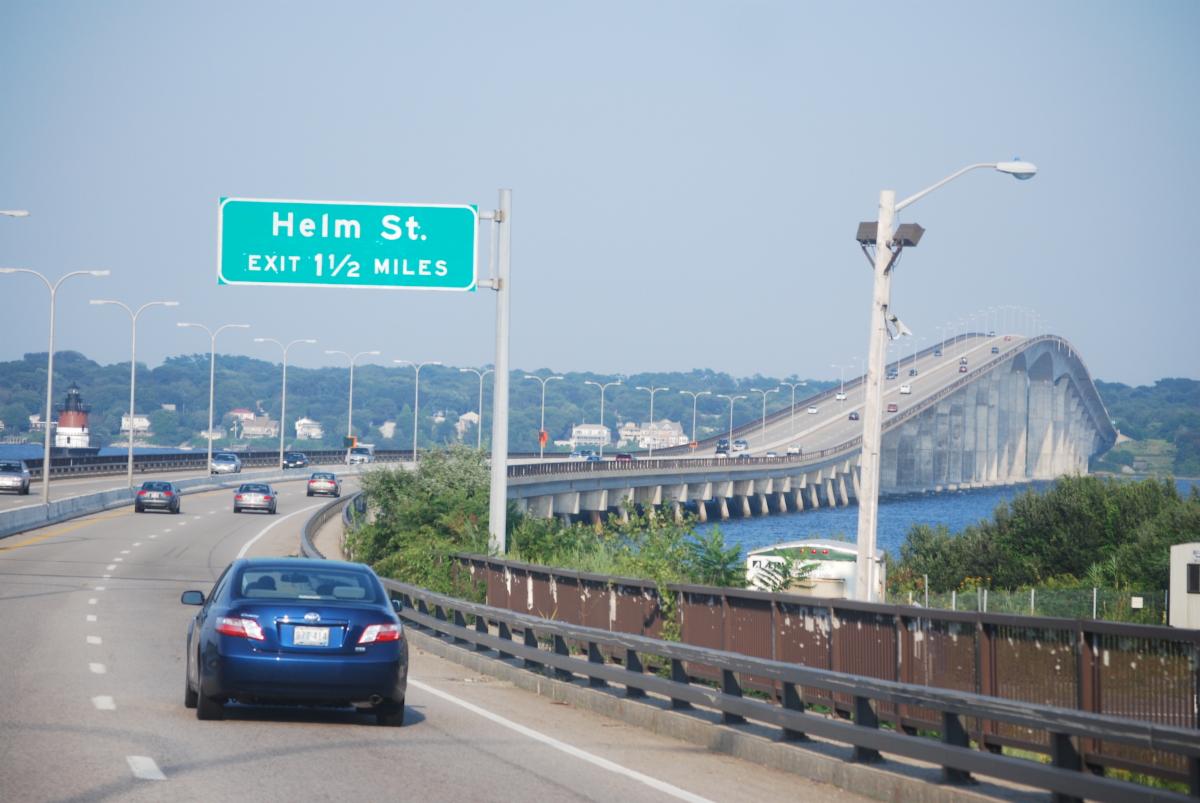
Jamestown Verrazzano Bridge, Rhode Island |
|
Bottom: Giovanni da Verrazzano, La Dauphine, and the Discovery of Narragansett Bay
|
|
Construction began in 1985 and was completed in 1992.
In 1975, the Rhode Island Legislature acknowledged Verrazzano’s accomplishment, passing a law to officially acknowledge April 21 as
"Dauphine Day"
“in honor of the arrival of the “Dauphine” to Rhode Island in 1524.
2014 Rhode Island General Laws
Title 25 - Holidays and Days of Special Observance
Chapter 25-2 - Days of Special Observance
Section 25-2-17 - Dauphine Day.
§ 25-2-17 Dauphine Day. – The twenty-first day of April shall be set apart as a day to be known as "Dauphine Day" in honor of the arrival of the "Dauphine" to Rhode Island in 1524. The day is to be observed by the people of this state with appropriate exercises in public places.
|
|
French General Consulate, New York |
|
Photo: By Thierry Chaunu © 2021 American Society of Le Souvenir Français, Inc
Vestibule of French General Consulate, 934 Fifth Avenue, New York, NY 10021
|
|
• Inscription (translated in English)
"In April 1524
The caravel "La Dauphine"
Commanded by Antoine de Conflans
Led by Jean de Verrazane
Discovered New York Bay
The name of "Terre d'Angoulême" was given
To the site where today stands
New York City"
• Signature (In English):
"Erected by the Central Committee of French Speaking Societies, New York
On the 425th anniversary of the discovery of New York Bay"
|
|
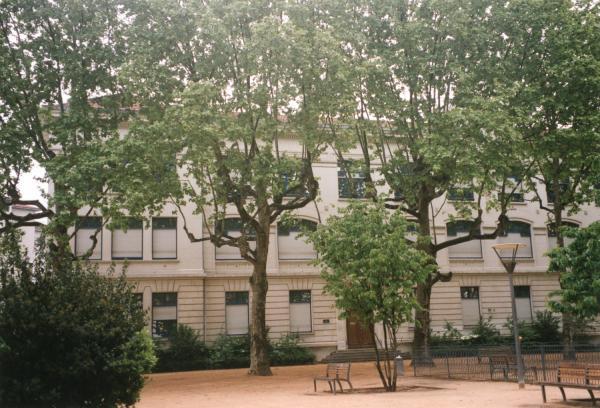
Collège Jean de Verrazane, and
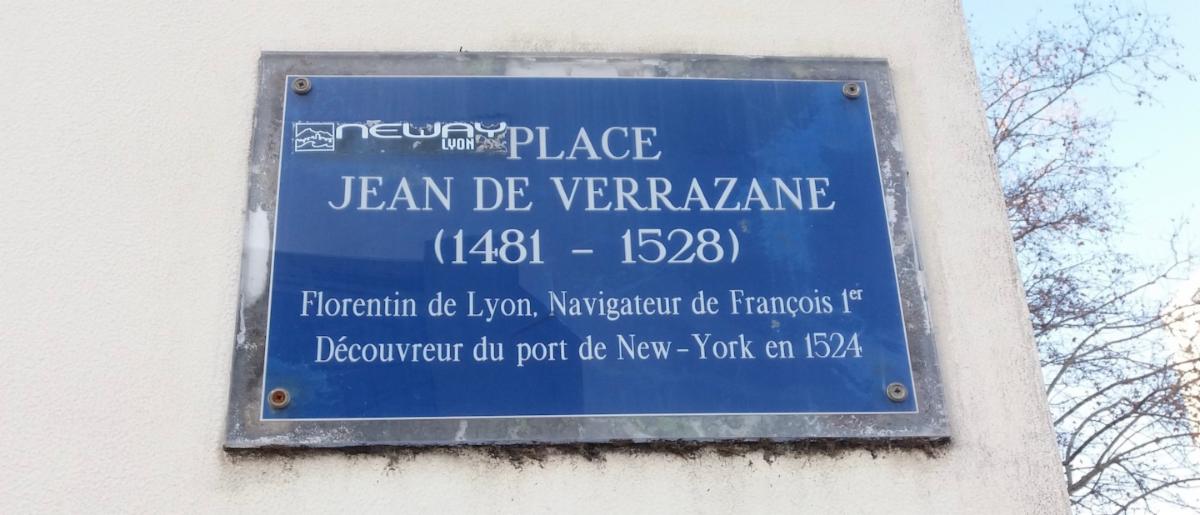
Place Jean de Verrazane, Lyon, France
|
|
A public middle school in Lyon, France, bears his name.
5 Place Ferber, 69009 Lyon, France
Photo: Bibliothèque municipale de Lyon / P0981 003 00021
There is also a Place Jean de Verrazane in the 7th arrondissement of Lyon:
Street sign: "Place Jean de Verrazane (1481 - 1528), Florentine of Lyon, Navigator of François 1er, discoverer of the port of New York in 1524".
Maybe, some day, there will be a Verrazzano High School this side of the Atlantic!
|
|
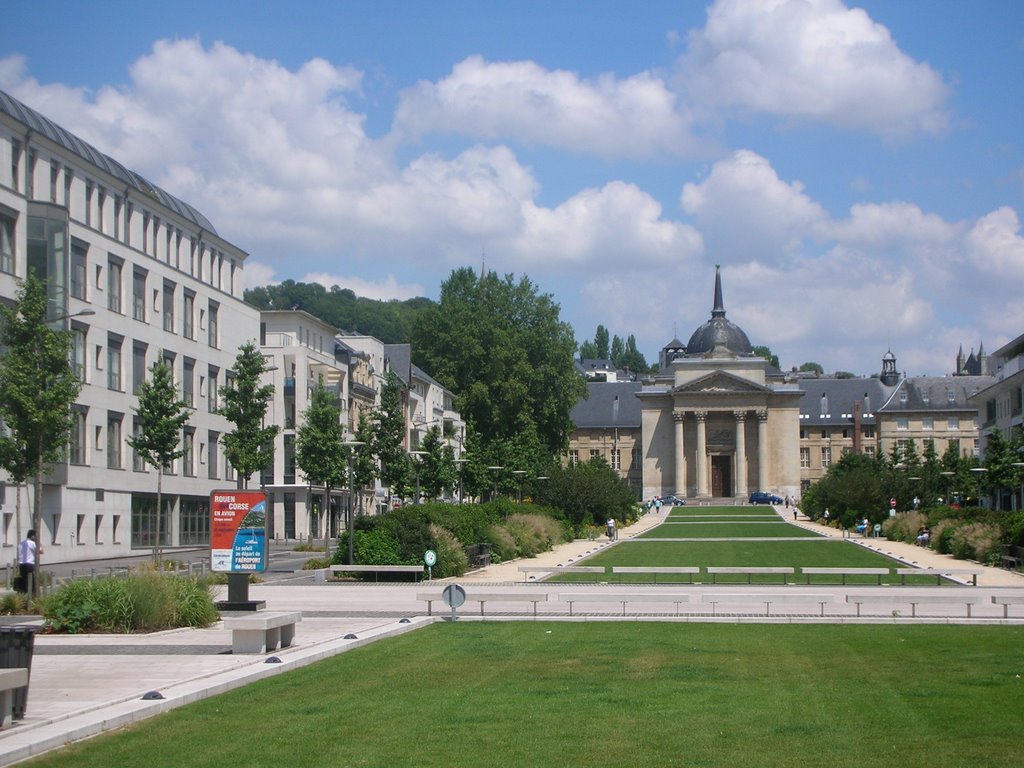
Jardin Jean-de-Verrazane, Rouen, France |
|
Located Rue Montaigne, bordering the avenue Pasteur, quai de Boisguilbert, and quai Gaston-Boulet 76000 Rouen, France
|
|
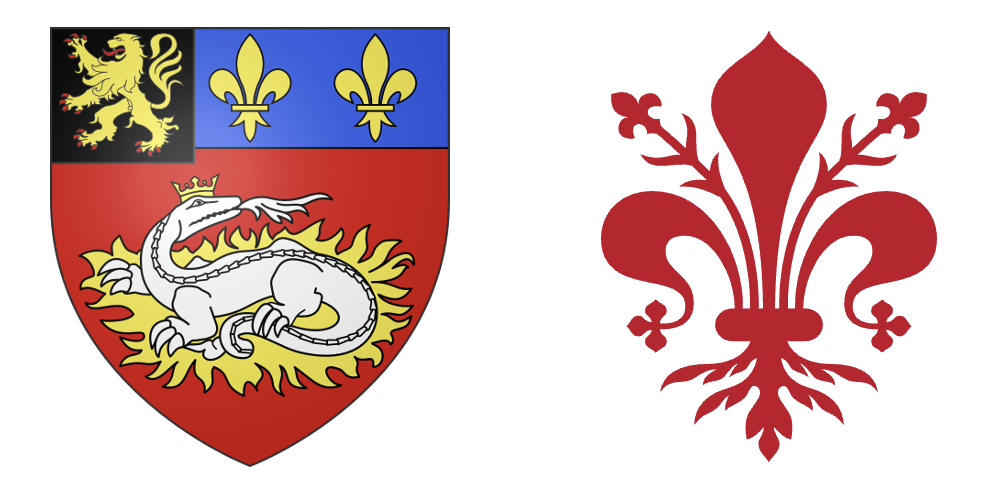
Above Left: current Coat of arms of Le Havre The salamander is the symbol of François Ier. The lion is from the Belgian coat of arms; it replaced a fleur-de-lis in 1926 to honor the Belgian government in exile in Le Havre during the First World War.
|
|
For several centuries this great explorer's discoveries were eclipsed, quite unfairly, due to several cartography errors, a succession of suspicions (did he really existed, did these voyages really take place?) Fortunately, thanks to the study of many manuscripts heretofore long forgotten, in-depth research led by historians from several nations, we now have a fairly solid grasp of Jean de Verrazane's accomplishments.
English navigators who later sailed along the North American coast, such as John Smith or Henry Hudson renamed all the spots identified on Verrazano's maps. This was their practice around the world, such as the Clipperton island in the middle of the Pacific, originally named île de la Passion in 1711 by Michel Dubocage.
France, who still controls the island today, kept the English name...
François Ier had imprudently declared that it was not enough to have discovered a new land to own it, but that it was necessary to maintain a presence there to guarantee its sovereignty, which he did not do, being too busy fighting in Europe. This neglect by France caused it to lose all claims to the coast between Florida and Canada.
This is not a reason to forget the past and not pay homage to Jean de Verrazane, captain Antoine de Conflans and the 50 intrepid Norman sailors from La Dauphine. We look forward to next year, in 2024, and hope to join forces with the Lower Manhattan Historical Association, other like-minded civic and patriotic associations as well as the French, Italian, Dutch and British consulates to celebrate the 400th anniversary of the discovery of the site of our city!
Jean de Verrazane was a true Renaissance man, a humanist, the first one to describe landscapes and natives in such a detailed manner.
Whenever you drive on the Belt Parkway or cross the Narrows on the Verrazzano bridge, please have a thought for this great explorer from a distant era, who served and remained loyal to France and its king until his tragic end!
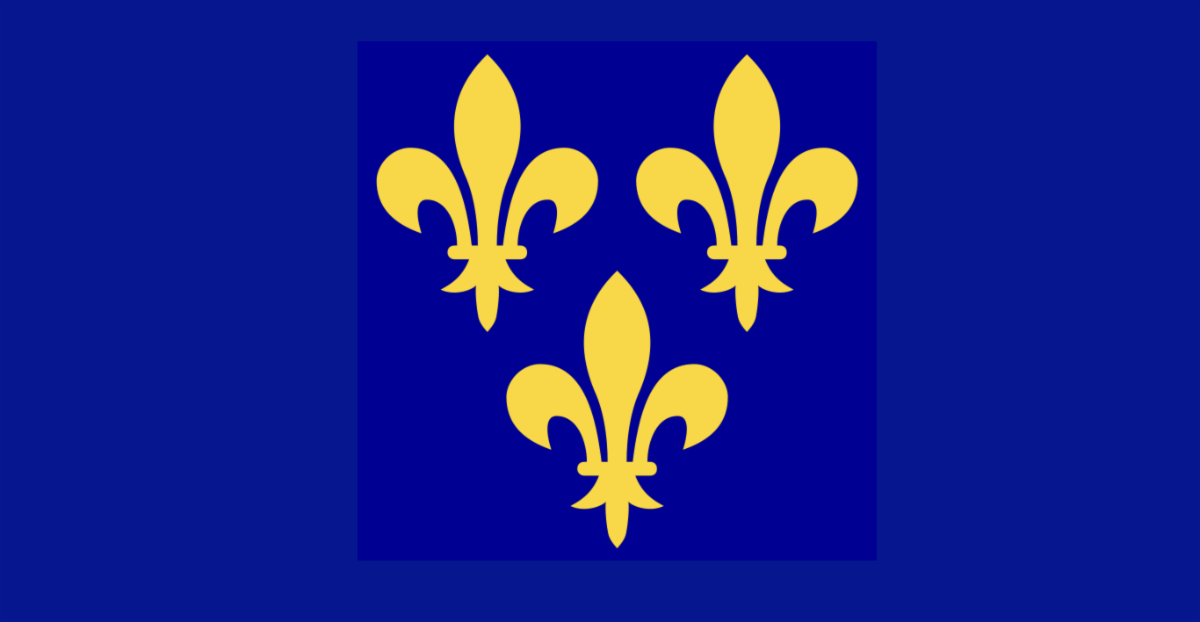
Below: Flag of France during the 14th through 16th centuries, before the Bourbon dynasty.
|
|
PART NINE OF THE SERIES
"LAFAYETTE, GUEST OF THE NATION"
If you missed the episodes from our past Bulletins...
• President James Monroe invited Lafayette, the last surviving major general of the American Revolutionary War, to tour the United States, officially to celebrate the nation's 50th anniversary but also to instill the "spirit of 1776" in the next generation of Americans at a time of great political divide. His tour drew large crowds and sparked a renewal of patriotism.
• From July 1824 to September 1825, Lafayette made a tour of all 24 States in the United States. He was received with a hero's welcome everywhere he stopped. Immense crowds, children, old veterans would come from miles away and wait hours to have a chance to see him, approach him, touch him. Many honors and monuments were presented to commemorate and memorialize the visit.
• The 24 states visited were: Alabama, Connecticut, Delaware, Georgia, Illinois, Indiana, Kentucky, Louisiana, Maine (ex-Massachusetts / North part), Maryland, Massachusetts, Mississippi, Missouri, New Hampshire, New Jersey, New York, North Carolina, Ohio, Pennsylvania, Rhode Island, South Carolina, Tennessee, Vermont, Virginia, Washington D.C.
• The main means of transportation were stagecoach, horseback, canal barge, and steamboat.
• Throughout the years 2024 and 2025 each city will celebrate this most illustrious Frenchman, ranked alongside the Founding Fathers, practically on a par with George Washington. If anyone harbors any doubt about it, one only needs to read some of the hundreds of local newspaper articles and the accounts or memoirs of contemporary witnesses accounts.
|
|
• Several of his stops are memorialized with markers and plaques, some decades-old, and an increasing number of brand new ones, thanks to the energy and enthusiasm deployed by Julien Icher, president of the LafayetteTrail.org, whose goal is to dedicate all 175 markers by 2024.
• These new markers from the LafayetteTrail.org are all made in the same distinctive blue and red cast metal and signed by the William C. Pomeroy Foundation which is generously funding this gigantic project.
• The American Society of Le Souvenir Français Inc. is honored to partner with these two like-minded organizations, as well as all other American patriotic associations and volunteers who are participating in these celebrations, under the umbrella of America250.
|
|
As we started with the August 2022 Bulletin, we continue our narration every month with some of the most salient episodes of this remarkable journey of the corresponding month 199 years ago, while keeping you abreast of the many celebrations planned by the local committees of the American Friends of Lafayette in 2024 and in 2025.
For this series we borrow primarily from the testimonies of a privileged close witness, Auguste Levasseur, Lafayette’s personal secretary, who traveled along with the Marquis and his son, George Washington Lafayette, and who published his extensive daily journal: “Lafayette en Amérique 1824-1825, ou Journal d'un voyage aux Etats-Unis" (Published by the Librairie Baudoin, Paris, in 1829). We also rely on other well-documented sources, such as Samuel Lorenzo Knapp. “Memoirs of General Lafayette : with an Account of His Visit to America and His Reception By the People of the United States; From His Arrival, August 15th, to the Celebration at Yorktown, October 19th, 1824”(Published in November, 1824)
|
|
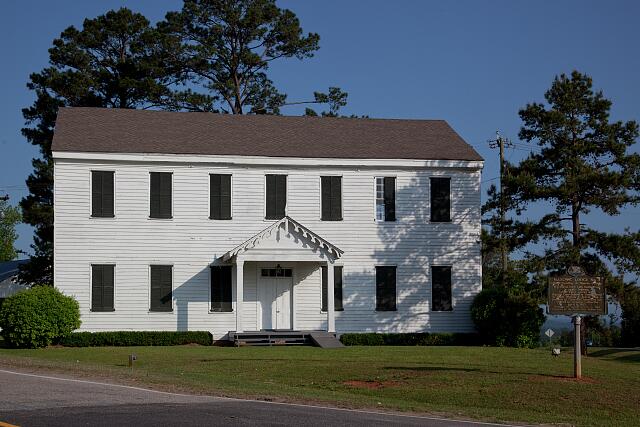
• April 3 – Arrived in Montgomery
• April 4–6 – Party boards the Balize and the Henderson and makes its way over the Alabama River through Selma, Alabama, through the capital city of Cahaba, and then meet with members of the French "Vine and Olive Colony" near Demopolis, then makes an overnight visit to Claiborne, where he was entertained at a ball in the Masonic Lodge, still standing today.
• April 7 – Arrived in Mobile, Alabama
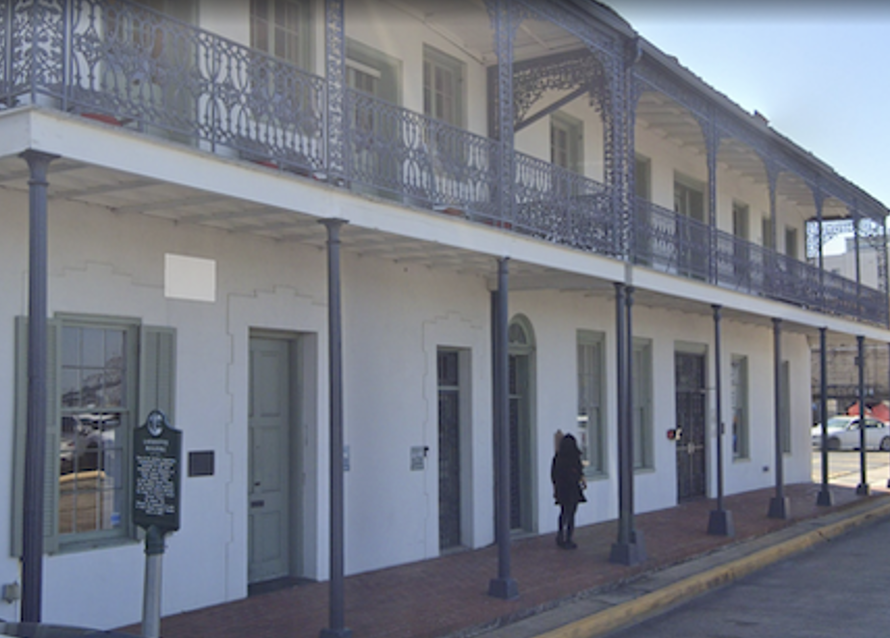
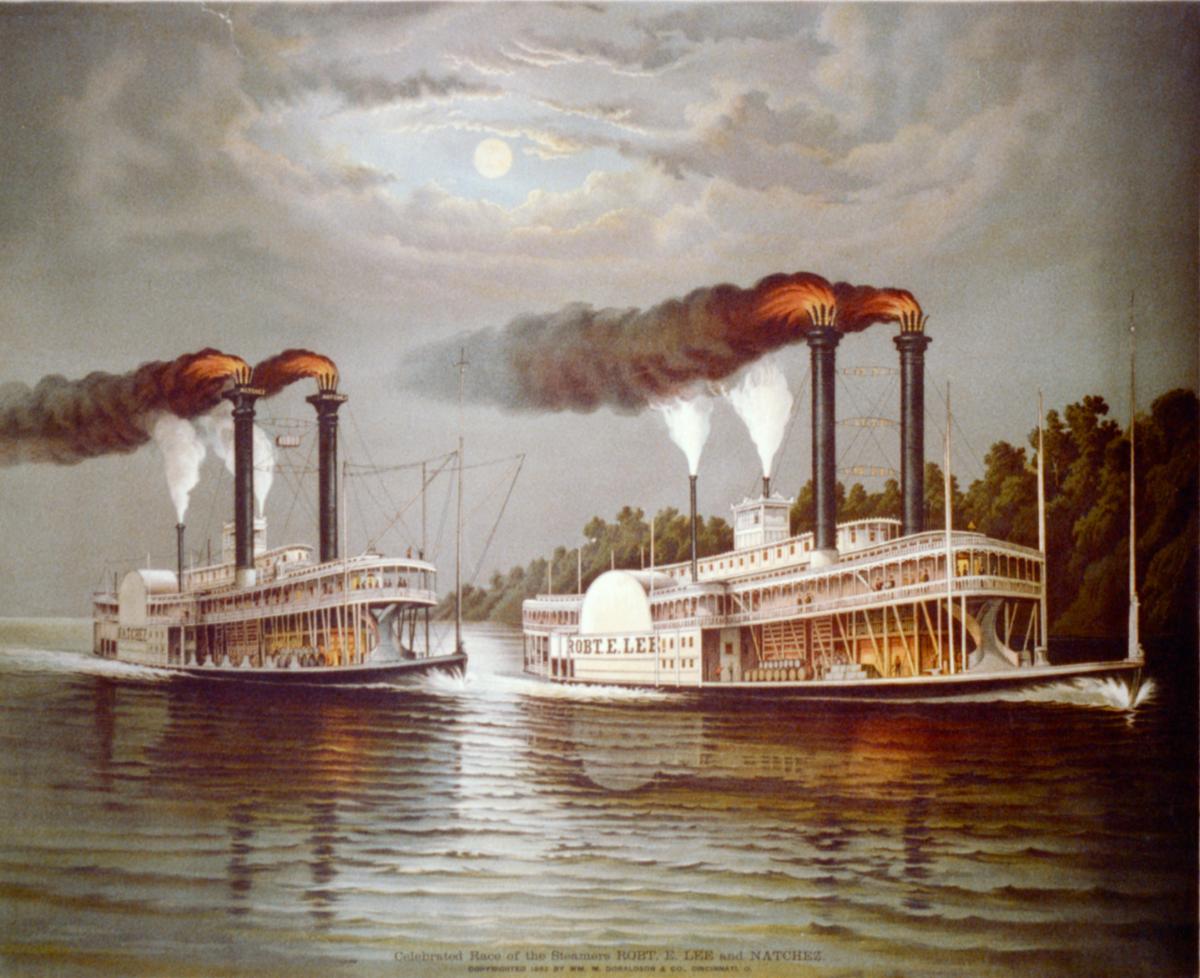
• April 8 – Governor Israel Pickens accompanies Lafayette by steamboat down Mobile Bay to Mobile Point, where he joins an official welcoming party from Louisiana, then boards the steamer Natchez which takes him to New Orleans
• April 11 – Arrived in Chalmette, Louisiana, site of the 1815 Battle of New Orleans, lodges in The Cabildo, site of the Louisiana Purchase transfer ceremonies in 1803
• April 15 – Departs New Orleans on the steamer Natchez up the Mississippi River towards Baton Rouge, Louisiana
• April 16 – Baton Rouge for a reception and banquet, leaving just before nightfall, April 18 – Stopped at Natchez, Mississippi
• April 28 – Natchez ties up for the evening at Carondelet, Missouri
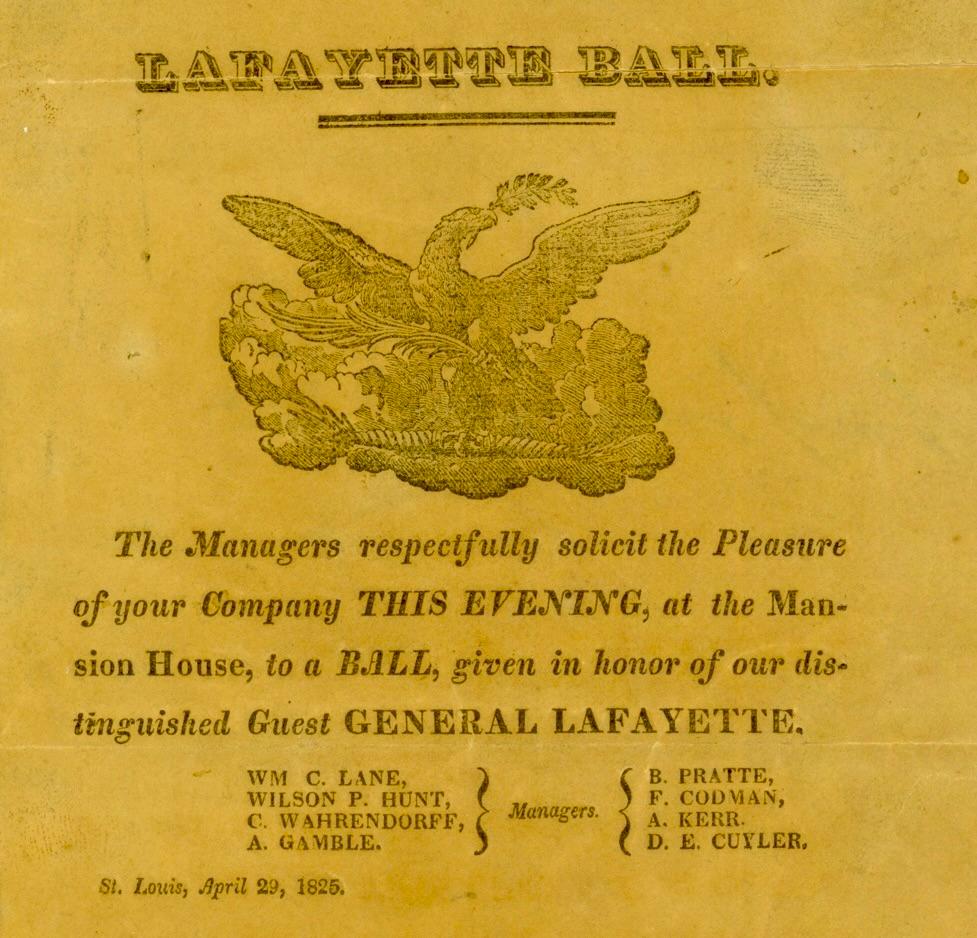
• April 29 – Visits St. Louis, Missouri
• April 30 – Governor Edward Coles hosts Lafayette in Kaskaskia, Illinois, once the French capital of Upper Louisiana; dignitaries included Pierre Ménard and William Stephen Hamilton, son of Alexander Hamilton
|
|
Lafayette in Indian country
March 31st - April 3rd - Montgomery Alabama
|
|
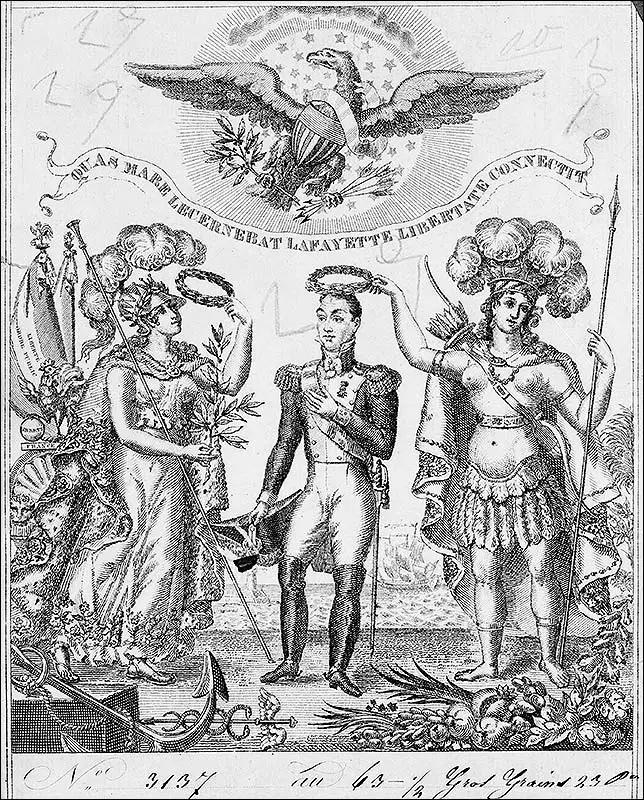
An apotheosis drawing, likely created between 1810 and 1820, depicts the Marquis de Lafayette receiving laurel wreaths from figures that represent American Indians and France. (Illustration from Colonial Williamsburg https://www.colonialwilliamsburg.org/trend-tradition-magazine/autumn-2016/my-heart-was-enlisted/)
|
|
“...It was on the banks of the Chatahouche that we met with the first assemblage of Indians, in honour of the general. A great number of women and children were to be seen in the woods on the opposite bank, who uttered cries of joy on perceiving us. The warriors descended the side of a hill at a little distance, and hastened to that part of the shore which we were to disembark. “The variety and singular richness of their costumes presented a most picturesque appearance.” […]
“At the moment the general prepared to step on shore, some of the most athletic seized the small carriage we had with us, and insisted that the general should seat himself in it, not willing, as they observed, that their father should step on the wet ground. The general was thus carried in a kind of palanquin a certain distance from the shore, when the Indian whom I have spoken of as the chief, approached him and said in English, that all his brothers were happy in being visited by one who, in his affection for the inhabitants of America, had never made a distinction of blood or colour; that he was the honoured father of all the races of men dwelling on that continent. After the chief had finished his speech, the other Indians all advanced and placed their right arm on that of the general, in token of friendship.”
Excerpt from “Lafayette in America in 1824 and 1825”, Vol. II, page 150
By Auguste Levasseur
|
|
Lafayette at Selma, Alabama
April 4, 1825
|
|
April 4, 1825
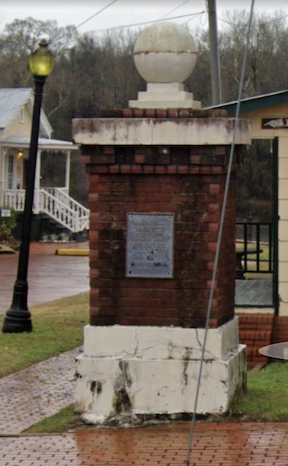
Tablet, “Visit of Lafayette”, Selma, AL
“The Brick Pillar”, in front of St James Historic hotel
1149 Water Ave, Selma, AL 36703
Image capture Feb 2022 (c) 2022 Google
|
|
• Inscription:
This tablet commemorates the visit of
LAFAYETTE
“Soldier of France
Volunteer in the cause of
American Liberty
Guest of the Nation
Entertained in Selma
On his way to Cahaba
1825
Placed by the Cherokee Chapter
Daughters of the American Revolution
Selma, Alabama
June 14, 1931”
|
|
Lafayette in Montgomery, Alabama
April 4, 1825
|
|
April 4, 1825
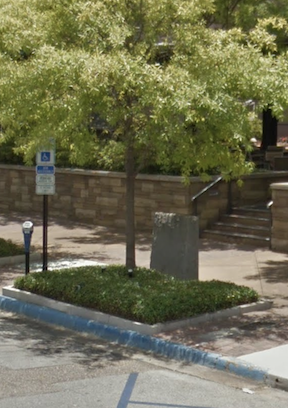
Marker, Lafayette’s visit, Montgomery, AL
181 Commerce St, Montgomery, AL 36104
Image capture June 2019 (c) Google 2022
|
|
• “We passed the next day at Montgomery, and left it on the night of the 4th and 5th, after a ball, at which we had the pleasure of seeing Chilli M’Intosh dance with several beautiful women, who certainly had little idea that they were dancing with a savage...” [Chili M’Intosh was a 28 year-old Indian well educated in a US school who accompanied Lafayette and his party for a short segment of the trip].
Excerpt From: Auguste Levasseur “Lafayette in America in 1824 and 1825, Vol. II.”
• Inscription:
"On this site stood, until December 1899, the house in which Marquis de Lafayette was given a public reception and ball, April 4, 1825, while on his last tour through the United States.
This tablet is placed by the Society of the Sons of the Revolution in the State of Alabama in lasting memory of this illustrious patriot and soldier of the Revolution, the friend of Washington and the youthful champion of liberty.
April 4, 1825 - April 4, 1905
Erected by Society of the Sons of the Revolution in the State of Alabama".
|
|
Lafayette in Perdue Hill, Alabama
April 6, 1825
|
|
April 6, 1825
Plaque & Marker, Lafayette’s tour, Perdue Hill, AL
42 Co Rd 1, Perdue Hill, AL 36470
|
|
• Inscription (excerpt):
“Oldest Building in Monroe County
Erected in 1824 with funds from a public lottery. Lower floor served as a Baptist Church and a Court Room in which William B Travis, then a resident of Claiborne, practiced law. Visited by General LaFayette April 6, 1825
Moved to its present location in 1884.
Preserved by the Perdue Hill’s Women's Club
Erected 1971 by Alabama Historical Association.”
• A few feet away is a marker from the LafayetteTrail.org:
Lafayette's tour
“On April 6, 1825, general
Lafayette, descending the
Alabama river, was honored
in Claiborne where he was
addressed by James Dellet.”
William G. Pomeroy foundation 2022"
|
|
Lafayette in Mobile, Alabama
April 7, 1825
|
|
April 7, 1825
Marker, “Le Marquis de Lafayette visited Mobile”
301 Government Street, Mobile AL 36602
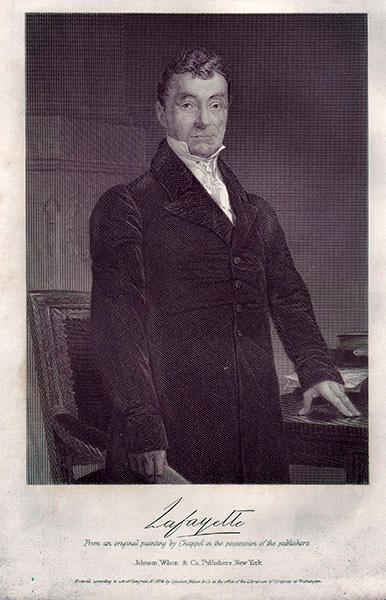
American Revolution hero Gilbert du Motier, the Marquis de Lafayette (1757-1834), in an 1873 engraving commissioned by Johnson, Wilson and Company Publishers for the book Portrait Gallery of Eminent Men and Women of Europe and America by Evert A. Duyckinck.
|
|
...“The arrival of the steam-boat in the bay, was announced by discharges of artillery from Fort Condé; and when we reached the wharf at Mobile, the general found the committee of the corporation and all the population assembled to receive him. He was conducted to the centre of the town under a triumphal arch" […] “He was then led to an immense hall, expressly constructed for his reception. He there found all the ladies, to whom he was presented by the governor” […] “In returning his thanks to the orator and the citizens of Alabama, the general took a rapid survey of the struggles for liberty in which he had borne so important a part, and concluded by expressing his deep conviction of the necessity of the closest and most intimate union among the states. The inhabitants of Mobile, hoping that the general would pass some days with them, had made great preparations for entertainments to him, but the most part were rendered useless. Limited in his time, he was obliged to yield to the solicitations of the deputation from New Orleans, who pressed him to depart the next morning. Nevertheless he accepted a public dinner, a ball and a masonic celebration; after which we went on board the vessel which was to take him to New Orleans, to obtain a few hours of that repose, which a day filled with so many pleasant emotions had rendered absolutely necessary.”
Excerpt From "Lafayette in America in 1824 and 1825", Vol. II page 170-171
By Auguste Levasseur
• Inscription:
“On this site stood the home of Mayor Samuel H. Garrow, where the Marquis de Lafayette was entertained on his visit to Mobile, April 7, 1825. Lafayette, French officer, statesman, and hero of the American Revolution, visited the United States as "Guest of the Nation" in 1824-1825. Mobile gave an enthusiastic welcome to the distinguished general.”
“Erected 1975 by the Historic Mobile Preservation Society.”
(Original marker was erected in 1936)
|
|
Lafayette in New Orleans, Louisiana
April 9-15, 1825
|
|
April 9-15, 1825
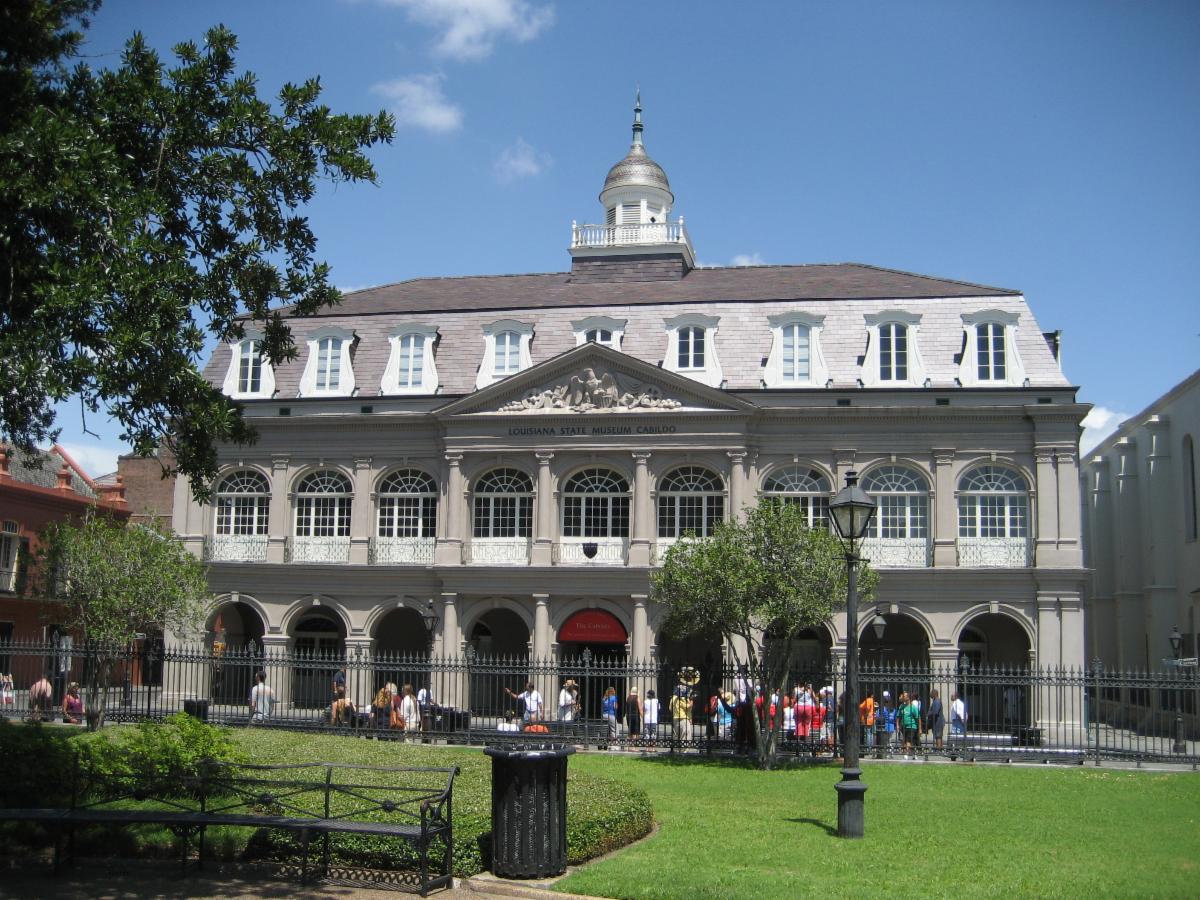
Plaque, “The Cabildo”
National Historic Landmark, Louisiana State Museum
701 Chartres Street, New Orleans LA 70116
Photo: By Infrogmation of New Orleans - Photo by Infrogmation, CC BY-SA 3.0, https://commons.wikimedia.org/w/index.php?curid=2869033
|
|
• ...“Astonished at the cries of Vive la liberté, vive l’ami de l’Amérique! vive Lafayette! in the French language, we hastened on deck. What was our surprise on seeing the shore covered with French uniforms! For an instant we believed that we were transported back to the bosom of our country, once more freed, and our hearts beat with joy. General Lafayette disembarked in the midst of the thunder of artillery, and the acclamations of an immense multitude...”
Excerpt From Lafayette in America in 1824 and 1825, Vol. II by Auguste Levasseur
• Inscription (excerpts):
Louisiana State Museum
"Here on December 20, 1803, were signed the documents transferring the Louisiana Purchase Territory from France to the United States. In 1825 the Cabildo was converted into a fine residence for the visiting General Lafayette.
On this site stood a French colonial Corps de Garde [police station] - 1724 - and a prison and criminal court room (chambre criminelle) - 1730.
The Corps de Garde, rebuilt in 1751, burned in 1788. The remains of its massive brick walls were incorporated in the present Cabildo building in 1795. [...]
The Cabildo has been designated a Registered National Historic Landmark.
Under the provisions of the Historic Sites Act of August 21, 1935, this site possesses exceptional value in commemorating and illustration the history of the United States.
U.S. Department of the Interior, National Park Service.
Erected 1963 by the Orleans Parish Landmarks Commission and the National Park Service."
|
|
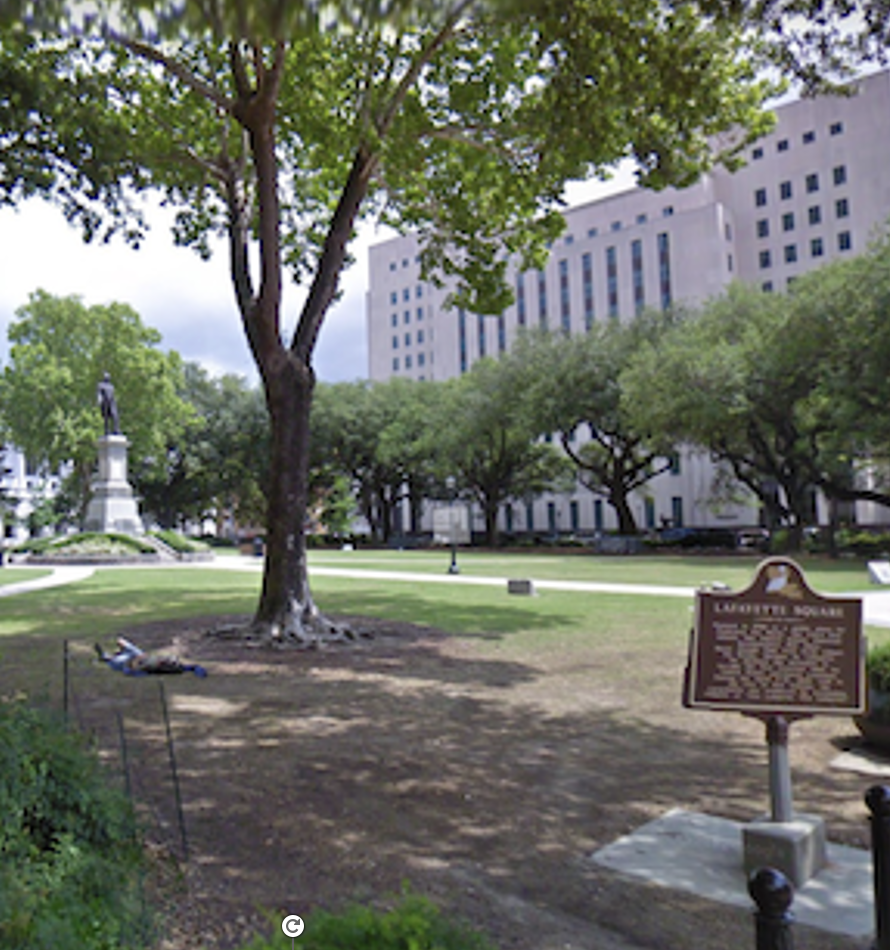
Marker, Lafayette square, New Orleans, LA
St. Charles Avenue, New Orleans, LA 70130
Photo: Image capture May 2012 (c) Google
|
|
• Inscription:
(Obverse) ”Planned in 1788 as a public place for Faubourg Ste. Marie, the City's first suburb, this Square honors American Revolutionary War Hero, Marie Joseph Paul Yves Roch Gilbert Du Motier, Marquis de Lafayette. He declined the invitation to become the first Governor when the United States purchased Louisiana. During his April 9-15, 1825, visit to the City of New Orleans, his popularity was evidenced by resounding cheers of "Vive Lafayette, Vive Lafayette!"
(Reverse) ”Conçue en 1788 comme place publique du Faubourg Sainte-Marie qui fut la première banlieue de La Nouvelle-Orléans, cette place commémore Marie Joseph Paul Yves Roch Gilbert Du Motier, Marquis de Lafayette, héros de la Guerre d'indépendance Américaine. Lafayette déclina l'offre qui lui était faite de devenir le premier gouverneur au moment de l'achat de la Louisiane par les Etats-Unis. Entre le 9 et 15 avril 1825, Lafayette visita La Nouvelle-Orléans et fut chaleureusement accueilli.”
Erected 1985 by France-Amérique de la Louisiane."
|
|
Lafayette in Baton Rouge, Louisiana
April 16, 1825
|
|
April 16, 1825
Plaque & Marker, Lafayette’s tour, Baton Rouge, LA
301 Lafayette St, Baton Rouge, LA 70801
Photo: Image capture Mar 2022 (c) Google 2022
|
|
• “On leaving Baton-Rouge, we had the mortification to part again with some of those who had accompanied us from New Orleans, and among others, with Mr. Duplantier, senior, whose active and tender friendship, as well as that of his son, had been of great service to the general.”
Auguste Levasseur, “Lafayette in America in 1824 and 1825, Vol. II. p.248
• Inscription:
“342-348 Lafayette Street
Baton Rouge, Louisiana
Erected 1762
Legendary site
of Lafayette's
1825 visit.
Erected 1991 by Isaac Monet Chapter
National Society Colonial Dames XVII Century.”
|
|
Lafayette in Natchez, Missouri
April 19, 1825
|
|
April 18-19, 1825
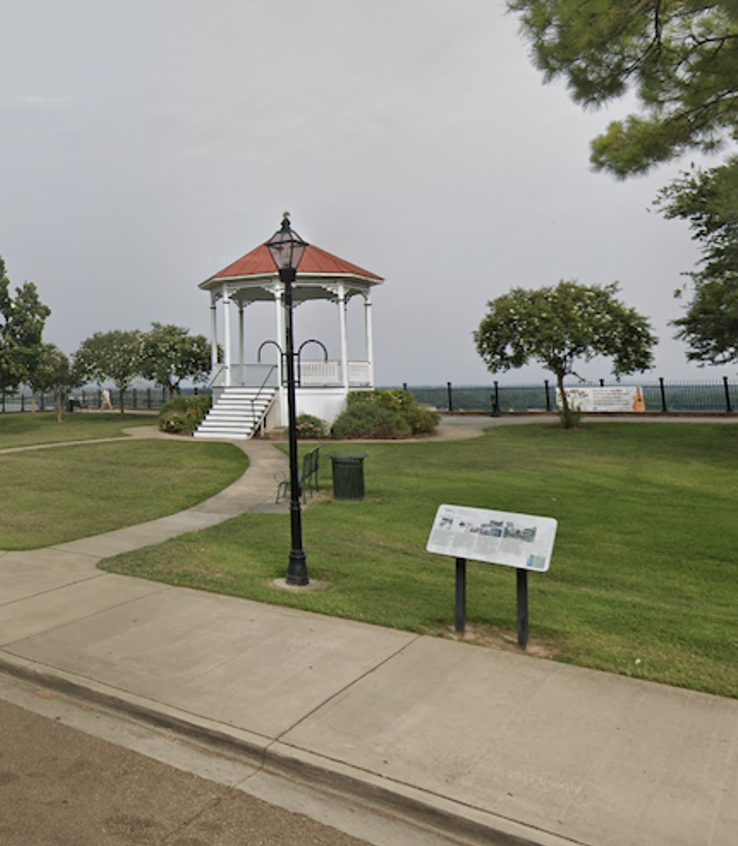
Marker, Lafayette’s tour, Natchez, MS
41 Silver St, Natchez, MS 39120
Episode "Follow the Frenchmen" on YouTube:
Illustration: by William M. Donaldson Lithograph,
Wikimedia Commons., Public Domain, https://commons.wikimedia.org/w/index.php?curid=14800016
|
|
• ...“The general willingly complied with this wish of the children of Natchez, who marched in order before him, placing successively one of their little hands in that which had fought for the liberty of their fathers. The parents, spectators of this scene, contemplated it with silence and emotion. On its termination, I heard them congratulate each other on the happy influence which this day would have upon the future characters of their children. “When they have grown up,” said they, “and come to read their country’s history, they will find the name of Lafayette intimately connected with all the events which led to the freedom of their fathers, they will recall the gentleness of his manners, the mildness of his voice, when he received them in their infancy, and will feel an increased love for a liberty won by such a man.” Auguste Levasseur. “Lafayette in America in 1824 and 1825", Vol. II. p. 254
• Inscription:
“On April 18, 1825, General
Lafayette visited Natchez,
spoke on the bluff,
dined at the Steamboat Hotel & attended
a ball at Traveller’s Hall.”
William C. Pomeroy 2021
|
|
Marker, “Natchez Trails”
107 S Broadway St, Natchez, MS 39120
Episode "Follow the Frenchmen" on YouTube:
Photo: Image capture May 2022 (c) Google 2022
|
|
• “The inhabitants of Natchez neglected nothing which could contribute to the pleasure of their guest during the twenty-four hours he remained with them. The public dinner concluded with toasts, To the Nation’s Guest—The triumph of Yorktown—France fighting for the liberty of the world—The victory of New Orleans—in fact to all glorious and patriotic American recollections. It was not until after the ball which closed about daybreak, that the general could think of embarking. The ladies employed all the charms of mind and person to retain him as long as possible, but our minutes were counted... ” Auguste Levasseur. “Lafayette in America in 1824 and 1825", Vol. II. p. 254
• Inscription (excerpts):
When the Spanish laid out the town of Natchez about 1790, they set aside land on the bluff for use as a public park.[..].” The Bluff Park has long been a center of public activity. The Marquis de Lafayette, a French hero of the American Revolution, spoke in the Bluff Park in April 1825. ” [...]
...In 1909, President William Howard Taft addressed a large crowd on the bluff as he traveled the Mississippi River. More recently, Vice-President George H.W. Bush spoke from the gazebo to a large crowd in 1984....”
|
|
Lafayette in Saint Louis, Missouri
April 28-29, 1825
|
|
April 28, 1825
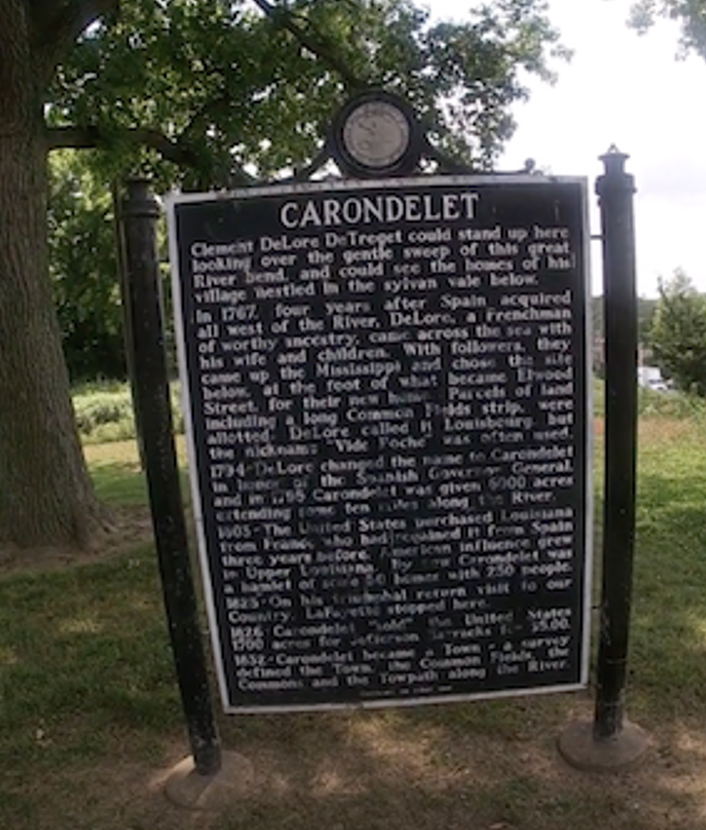
Marker, « Carondelet”, Saint Louis, MO
5570 South Broadway, Saint Louis MO 63111
Photo: Image capture May 2022 (c) Google 2022
|
|
• “On the evening of the 28th, we arrived at a poor little village which the French formerly founded under the sad name of Empty Pocket, better known at the present day by the name of Carondelet. [...] “No sooner were the inhabitants of Carondelet informed of the presence of General Lafayette in their vicinity, than they came in crowds on board the boat to see him. They were nearly all Frenchmen.” Auguste Levasseur, “Lafayette in America in 1824 and 1825", Vol. II., p. 272
• Inscription (excerpts):
“Clement DeLore DeTreget could stand up here looking over the gentle sweep of this great River bend, and could see the homes of his village nestled in the sylvan vale below. In 1767, four years after Spain required all west of the River, DeLore, a Frenchman of worthy ancestry, came across the sea with his wife and children. With followers, they came up the Mississippi and chose the site below, at the foot of what became Elwood Street, for their new home. [...]DeLore called it Louisbourg, but the nickname "Vide Poche" was often used.
1794 - DeLore changed the name to Carondelet in honor of the Spanish Governor [...]
1803 ~ The United States purchased Louisiana from France, who had regained it from Spain three years before. American influence grew a hamlet of some 50 home with 250 people.
1825 ~ On his triumphal return visit to our Country, LaFayette stopped here.” [...]
Erected 1970 by Carondelet Historical Society
|
|
April 29, 1825
Lafayette’s visit, Pierre Chouteau’s house
5570 South Broadway, Saint Louis MO 63111
Courtesy of the Missouri Historical Society, St. Louis
|
|
•...“an elegant calash drawn by four horses approached the shore, to conduct him to the city, through all the streets of which he was drawn in the midst of the acclamations of the people. He was attended by Mr. Augustus Choteau, a venerable old gentleman by whom St. Louis was founded, Mr. Hempstead, an old soldier of the revolution, and the mayor. These gentlemen conducted him to the house of the son of Mr. Choteau, prepared for his reception, which was thrown open to all citizens without distinction, who desired to visit the national guest. Among the visitors, the general met with pleasure Mr. Hamilton, son of General Alexander Hamilton, the former aide-de-camp to Washington, whom he so much loved, and an old French sergeant of Rochambeau’s army named Bellissime. This last could not restrain the joy he felt on seeing a countryman thus honoured by the American nation.” Auguste Levasseur. “Lafayette in America in 1824 and 1825", Vol. II. p. 273
• Lafayette was feted at the home of Pierre Chouteau (Auguste Chouteau’s son), at Locust and First streets. Lafayette’s promenade partner was Alzire Menard, daughter of Illinois Lt. Gov. Pierre Menard. She wore a Paris-made dress of embroidered white muslin. Lafayette slept that night on the Natchez, which headed downriver in the morning.
|
|
WE WILL CONTINUE TO TRAVEL WITH LAFAYETTE
OVER THE NEXT 5 MONTHS!...
|
|
PAST MONTHLY BULLETINS
OUR GOAL: turn the spotlight on a famous, or less famous, episode or historical figure during the long shared history between France and the United States, with illustrations and anecdotes.
You can have access to all our past Monthly Bulletin
since February 2021 by visiting our website:
You can click on the photos throughout our bulletins and also on the links indicated in blue for more information and direct access to sources.
|
|
Next month in May we will devote our Bulletin to all the statues of Joan of Arc throughout the United States.
|
|
THE SCULPTURE OF LE PETIT PRINCE
SOON AT HOME IN NEW YORK
|
|
Photos and illustration courtesy of sculptor Jean-Marc de Pas (work in progress)
|
|
Our association The American Society of Le Souvenir Français is at the origin of the Little Prince sculpture project in Manhattan.
For the record, our association had already honored Antoine de Saint Exupéry in the year 2000, by placing a plaque at 3 East 52nd Street, but wanted to pay homage to him with a sculpture, as is the case in several countries. The idea of a sculpture was first proposed by the late Colonel Roger Cestac, president of our association in the 1990's.
Antoine de Saint Exupéry wrote The Little Prince entirely in New York, and his name is among the 463 volunteers and conscripts from New York who “Died For France”.
Originally intended for Central Park, it couldn't be materialized for a host of reasons and the project lingered for several years. Immediately upon his election at the head of our organization in 2021, Thierry Chaunu, along with fellow Board Members Jean-Hugues Monier & Francis Dubois decided to make it a top priority.
With the unfailing and constant support of The Antoine de Saint Exupéry Youth Foundation headed by its Vice-president Mr. Olivier d'Agay (great-nephew of the author), Nicolas Delsalle-Mun, General Delegate of the Foundation, and members of the Saint-Exupéry family, a “Steering Committee” composed of MM. Nicolas Delsalle, Jean-Hugues Monier, Francis Dubois and Thierry Chaunu pursued the project from start to finish.
The Board of our association selected the renowned French sculptor Jean-Marc de Pas in March 2022.
This project received in May 2022 the high patronage of the French Ambassador in the United States Mr. Philippe Etienne and the General Consul of France in New York, Mr. Jérémie Robert.
An Honorary Committee, co-chaired by American author Stacy Schiff (Pulitzer Prize) and Mr. Olivier d'Agay was formed in June 2022 and co-signed a fundraising campaign, to which many French and American donors, individuals and companies, responded enthusiastically.
Finally, among several possible locations, the choice of Cultural Services-Villa Albertine on Fifth Avenue was chosen in September with the active support of the Cultural Attaché Mr. Gaëtan Bruel.
We officially presented the project on October 13, 2022, at the French Cultural Services - Villa Albertine in New York.
To date, the sculpture is in the process of being examined by the Landmark Commission, after having received a very favorable opinion during a preliminary hearing (8 votes "for", 1 abstention) on March 14, 2023.
The final version of the sculpture is about to be transported to the foundry, then will be transported to New York by Air France, for an installation in August and an inauguration scheduled for around September 20, 2023.
We will keep you informed in the coming Bulletins.
|
|
ANNOUNCEMENT FROM
THE NATIONAL ARTS CLUB & THE PARIS AMERICAN CLUB
INVITATION TO A GALA DINNER
JUNE 13, 2023
|
|
On Tuesday June 13 a gala dinner by the Paris American Club will be held at the National Arts Club to pay tribute to Antoine de Saint Exupéry, author of The Little Prince. Stay tuned for more details! |
|
THE LAFAYETTE TRAIL.ORG
Newly released YouTube video:
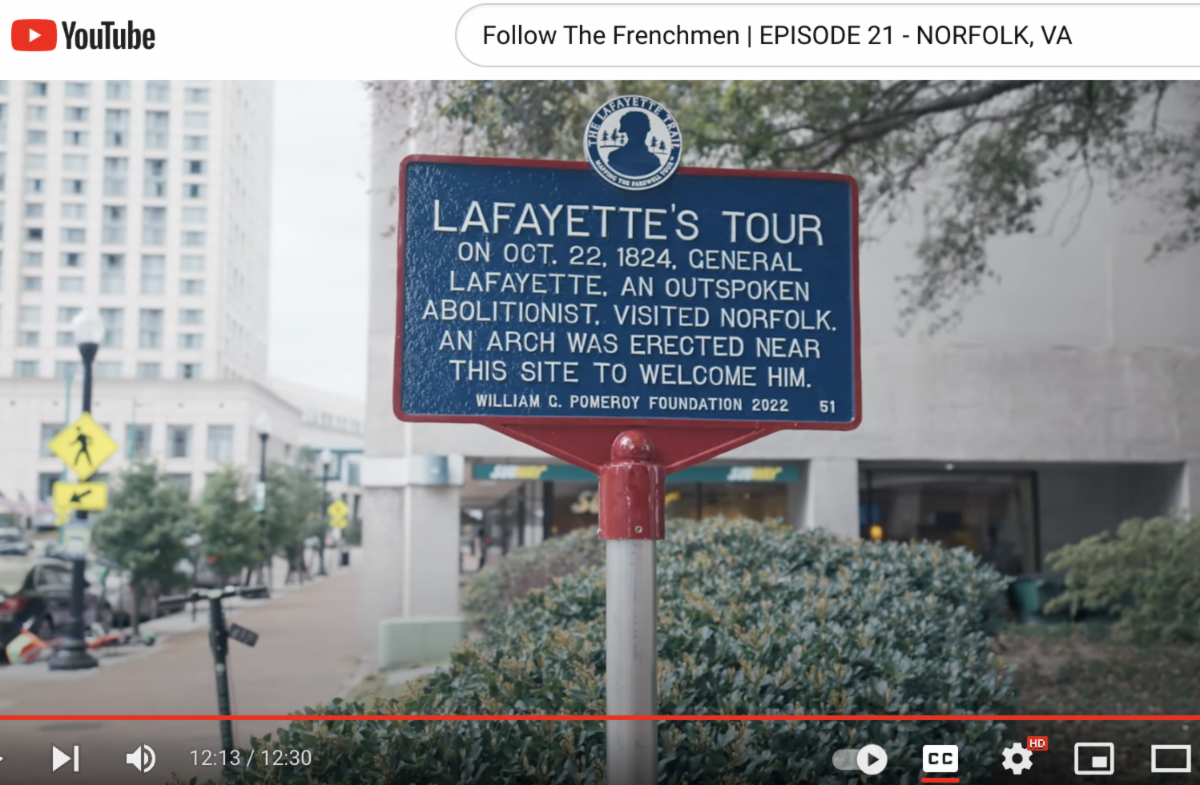
Follow The Frenchmen | Episode 21: Norfolk, VA
|
|
A message from Julien Icher, President, The Lafayette Trail, Inc:
We are pleased to announce the release of episode 21 of Follow The Frenchmen, our Video Series about the Lafayette Trail! The episode takes place in Norfolk, VA.
In this episode, find out about Lafayette's arrival in Norfolk, Virginia on October 22, 1824. An arch was erected at the corner of Main Street and Market Square to welcome the Frenchman to the city.
Lafayette was a Revolutionary War icon. Yet, the site where the arch celebrating his arrival was erected has been traditionally associated with the Civil War in local history. Why is that?
In this episode, find out how focusing on Lafayette's 1824 visit to Norfolk helps to shift the narrative away from the divisiveness surrounding the 1861-1865 Civil War timeframe to focus instead on the universal ideals of the American Revolution.
Hear the opinion of local residents about how the newly installed Lafayette Trail marker contributes to improving the city's social fabric.
This video will also introduce the viewer to some of Norfolk's public buildings widely celebrated for their architecture.
|
|
ANNUAL CELEBRATION OF
FRENCH ALLIANCE DAY
Washington Memorial Chapel, Valley Forge, Pennsylvania
|
|
Valley Forge Memorial & Washington Memorial Chapel
2000 Valley Forge Park Rd, Valley Forge, PA 19481
|
|
The Treaty of Alliance between France and the United States, signed in Paris in February 1778, turned the tide of America's struggle for independence during the American Revolution.
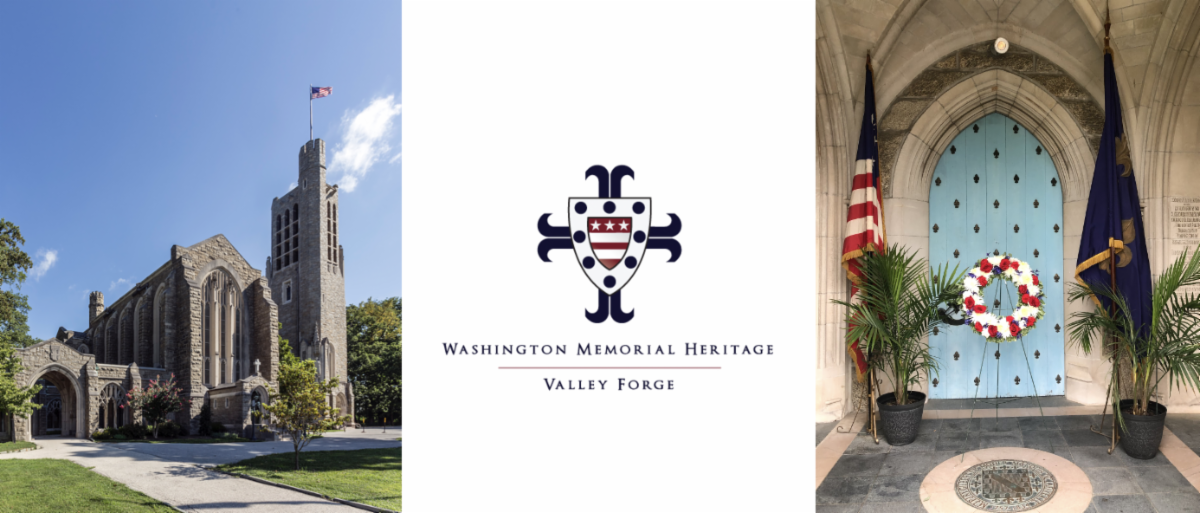
Every year, on the first Sunday in May, Washington Memorial Chapel at Valley Forge commemorates the Treaty and its celebration at the Valley Forge encampment on May 6, 1778. This year, the Chapel's commemoration service will take place on Sunday, May 7 at 2:00PM. A representative of the French Embassy will attend the service, deliver an address, and lay a wreath in tribute to soldiers and sailors, French and American, who died in the struggle for American independence.
The Chapel is both a place of worship and a memorial to George Washington, the Founders and Patriots, and the Continental Army. It seeks to ensure that the ideals and principles of the American Revolution are understood and kept alive by contemporary and future Americans. The mission of Washington Memorial Heritage, a 501 (c ) 3, is to preserve the Chapel and support its secular mission.
|
|
ANNOUNCEMENT FROM
THE FEDERATION OF FRENCH WAR VETERANS, NEW YORK
|
|
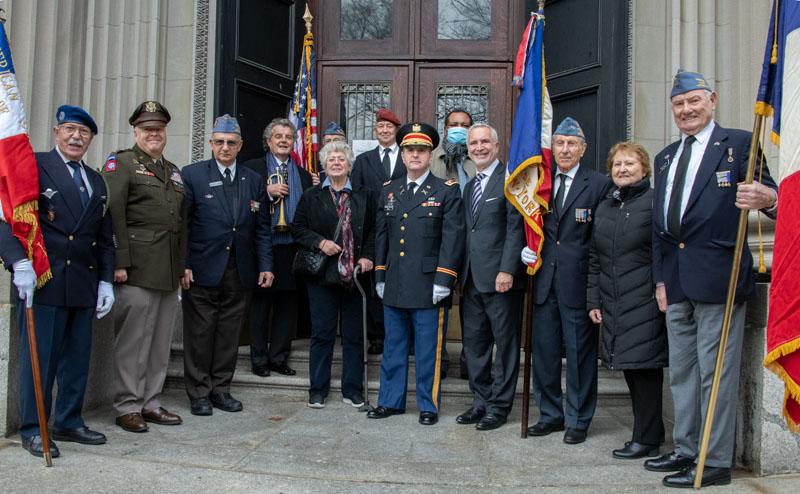
Members of the Federation of French War Veterans and guests in front of Eglise Notre Dame, 405 West 114th Street, NY, NY 10025
Photo: Daniel Falgerho, November 13, 2022
|
|
Sunday, May 7, 2023 - Eglise Notre-Dame at 11:00AM – Mass of the
Victory of May 8, 1945 by Father Michael Holleran, Chaplain of the
Federation. This mass will also celebrate the Mass of the Deported of WWII, as well as the mass of Saint Joan of Arc. There will be a wreath-laying ceremony in front of the marble plaques of the 463 "Morts Pour la France", French and American conscripts and volunteers from New York City who Died for France in the two World Wars.
A luncheon will be held at the restaurant Le Monde – 2885
Sunday May 28, 2023 – 10:00AM - Park Avenue Armory at 643 Park
avenue – 66 & 67th Street: Ceremony organized by Brigadier General (Ret) Thomas J. Principe of the New York National Guard facing the memorial
of the Seventh Regiment (67th street & fifth Ave).
Monday May 29, 2023 – Little Neck – Douglaston – Memorial Day parade.
Details to follow in our next bulletin.
|
|
SAVE THE DATE!
MAY 20TH, 2023
"Follow the French: Rochambeau Festival"
|
|
Three Encampment Site Tour / Event:
Audio digital tour overlay and customized individual site events:
Hartsdale, NY: Odell House - Rochambeau Headquarters
Yorktown Site, 99 Moseman Road, Yorktown, NY (one of five 1781 encampment locations, AKA Yorktown Grange Fairgrounds)
North Castle, Smith’s Tavern
Odell House - Rochambeau Headquarters
425 Ridge Rd, Hartsdale, NY 10530
Free, Open to the general public
(Flyer#1 below)
Yorktown Site, Yorktown Grange Fairgrounds
99 Moseman Road, Yorktown, NY 10598
Free, Open to the general public
(Flyer#2 below)
North Castle, Smith’s Tavern
440 Bedford Rd, Armonk, NY 10504
(Details to follow)
|
|
EXCITING NEWS FROM THE WASHINGTON-ROCHAMBEAU REVOLUTIONARY ROUTE (W3R) |
|
"Rochambeau 300" has been selected as one of the signature event which will be part of W3R-US America 250 celebration. The project is to celebrate the 300th anniversary of the birth of Jean-Baptiste Donatien de Vimeur, Comte de Rochambeau on July 1st, 1725 in Vendome, France.
At age 57, he was chosen by Louis XVI and his ministers to lead the army that would reinforce Washington's forces. "Expédition Particulière" was the code name for the army sent to America.
In the summer of 1781, the French army marched through the 9 states and DC from Newport, RI to Yorktown, VA which are now forming the Washington Rochambeau Revolutionary Route.
Plans are for this celebration to start in July 2025 in Newport, RI during the annual observance of the arrival of the French army in July 1780.
It would end on October 19, 2025 in Yorktown as part as of the commemoration of the 224th anniversary of the surrender of Lord Cornwallis to General George Washington and its allied French troops.
|
|
The Annual Meeting of the American Friends of Lafayette
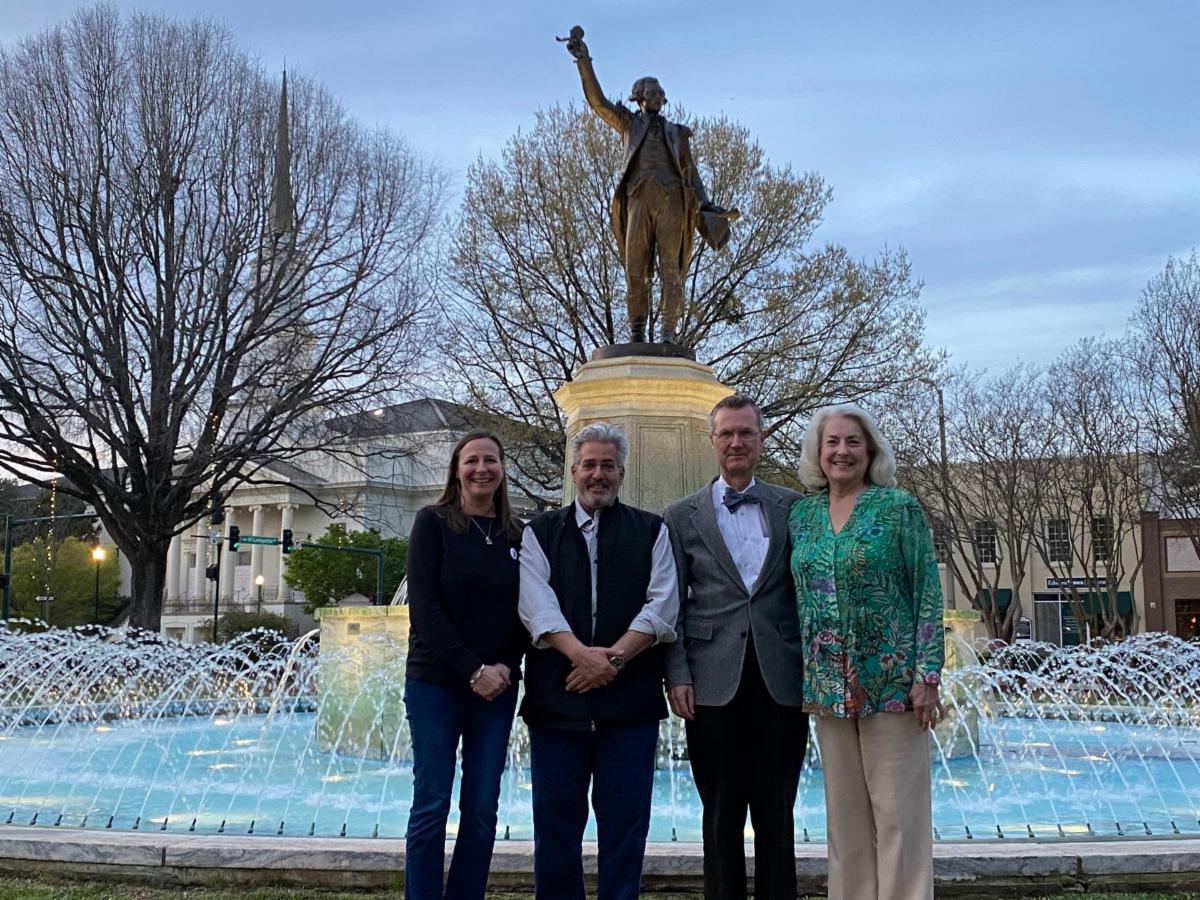
June 8 to June 11, 2023 in LaGrange, Georgia
|
|
A message from Chuck Schwam, COO, American Friends of Lafayette
The Lafayette Alliance, led by Dr. Richard Ingram, is ready to roll out the red carpet for AFL members. Richard, his lovely wife Janice, along with a cast of many have planned a very entertaining weekend. Their excitement was palpable, as was their pride in the charming city of LaGrange. AFL members are going to fall in love with LaGrange and its Lafayette Fountain.
This could also be our most economical annual meeting ever. We will be staying at the Courtyard Marriott at the center of town, directly across from the famous Lafayette Fountain on the main square for only $129 per night (double) or $139 per night (king) plus taxes. Quaint shops and restaurants surround the hotel. More on booking rooms below.
REGISTRATION DEADLINE IS SUNDAY, APRIL 30th
This year’s registration fee is only $200 which includes all meals from Thursday night through Sunday morning and all transportation within the itinerary. Your registration fee also includes a weekend PACKED with scholarly and fun activities. We will see Lafayette artifacts and places he visited. We will see art devoted to Lafayette, including paintings, sculptures, architecture, drama, music, and dance. It could be the most unique itinerary we’ve ever seen.
The closest airport is in Atlanta (Hartsfield-Jackson Atlanta International Airport). If you plan on flying to this meeting, you will not have to rent a car if you do not want to. There is a shuttle that operates 24/7 that will take you from the Airport to LaGrange for $44pp each way. Once in LaGrange, all of our activities are either within walking distance of the venues or transportation is provided (motor coach or trolley). Full details regarding the shuttle service (Groome) between the airport and LaGrange will be shared with registrants in May.
Here is what you need to do (read carefully)...
-
Book your hotel stay now. Please call the Marriott Courtyard in LaGrange at 706-668-5600 and mention that you are with the Lafayette Alliance group to get your discounted rate.
- If you are flying, book your flight now. PLEASE NOTE: If using the airport shuttle to get to and from the meeting…
-
On Thursday, June 8th, please arrive at Atlanta’s airport (ATL) no later than 2:00pm. That will give you plenty of time to catch the shuttle (every hour on the half hour), check into your room, freshen up and be at our first event which is the welcome reception which starts at 6:30pm (doors open at 5:30pm). Details regarding the shuttle service will be emailed in May.
-
On Sunday, June 11th, please book a flight that leaves Atlanta’s airport (ATL) at 3:00pm or later. Although the shuttle runs every hour (at quarter past the hour) we want to get you to the airport in plenty of time and in a relaxed state. Our last event on June 11th is breakfast and tours, starting at 9:00am and ends whenever you are finished. Feel free to leave this venue after breakfast (10am) or after the program (about noon). I would budget two hours to get from the Sunday venue to the Atlanta Airport. Then budget more time to check bags and go through security. Again… Details regarding the shuttle service will be emailed in May.
- If you plan on driving, parking is FREE.
-
PLEASE: Register for the upcoming annual meeting (and pay your $200pp), by clicking here: REGISTER
REGISTRATION DEADLINE IS SUNDAY, APRIL 30th
|
|
News from Battle of Rhode Island Association |
|
SUPPORT US AND BUY (OR OFFER) OUR E-BOOK ON AMAZON! |
|
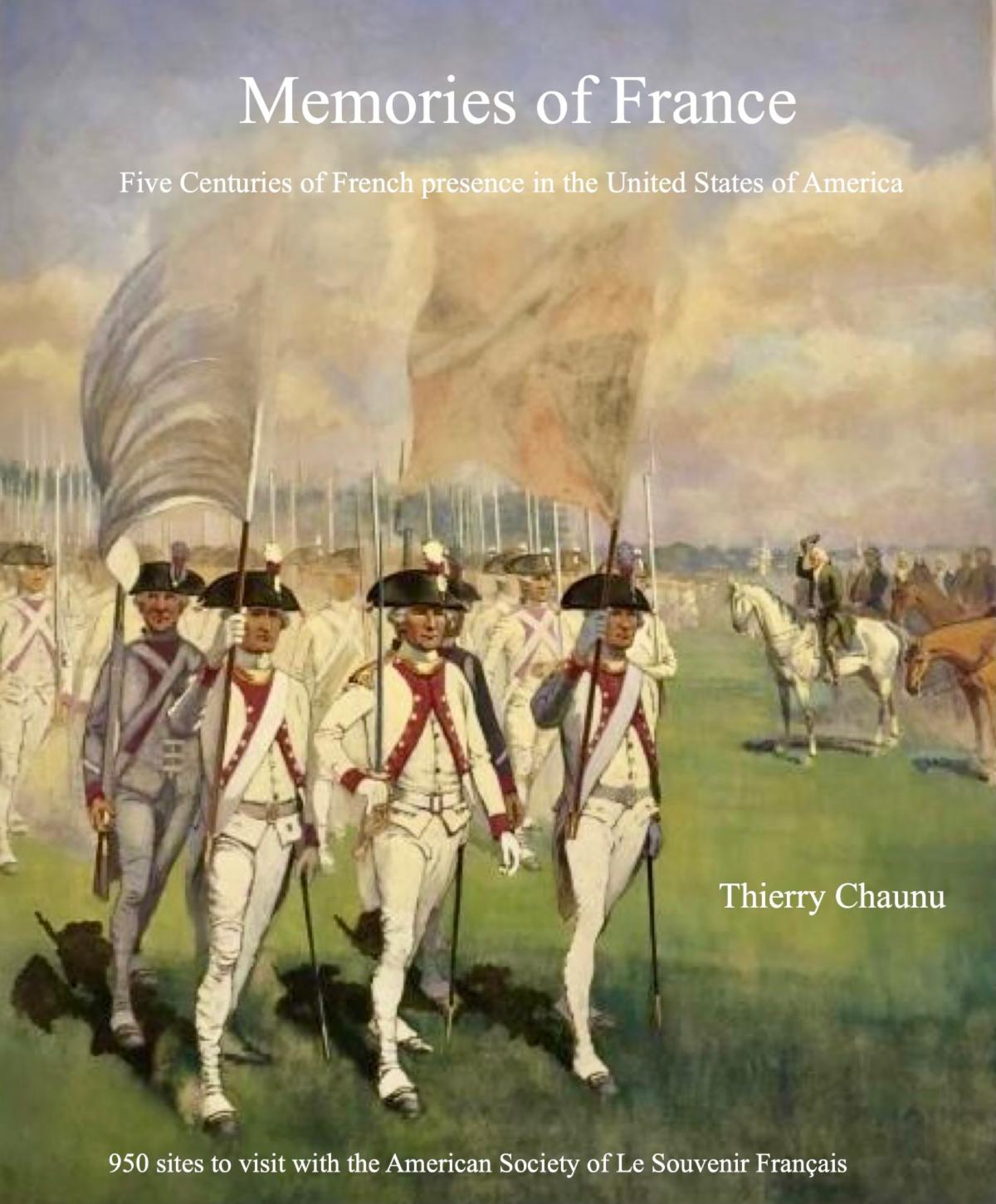
Book Cover : "Scenes from the American Revolution: The French "Soissonnais" Regiment Being Reviewed at Philadelphia by President Washington and Congress, 1781". By Charles MacKubin Lefferts (American, 1873 – 1923). Reproduced with permission of the New York Historical Society Museum. |
|
Support our organization! Purchase or offer this e-book which makes great reading for all ages. All royalties go to the American Society of Le Souvenir Français, Inc. Simply click on this link: Amazon.com
We are pleased to have given to the Consulate General of France several dozens of sites for the application mapstr. The complete and extensive descriptions are only available in our book, copyrighted by our organization.
MEMORIES OF FRANCE
950 sites of French presence in the United States over the past 5 centuries
Everyone knows that Lafayette, the Statue of Liberty, or New Orleans, were all French imports…
But did you know what the first protestant prayer in America, the first recorded birth of a European in North America, the first commercial artist, the first free school west of the Mississippi, the first discovery of Niagara Falls, the first grapefruit planter in Florida, the first discoverer of oil in America, the first Pulitzer Prize in history, the first archbishop of New Mexico, to name just a few, have in common? (Hint: they were all French)
CONTENTS:
Guide - historical directory of more than 950 sites where a French footprint has been left across the 50 states of the present United States, from 1524 to the turn of the 20th century.
It is written in two versions: in English and in French.
It is a tribute to explorers, missionaries, soldiers, adventurers, French, illustrious or unknown, who left their mark in the United States and are recognized, whose memory is honored by a monument, a statue, a stele, a panel, a billboard, a plaque...
Each page corresponds to one site and includes:
• Photo (with url link)
• Address with postal code
• Exact GPS coordinates
• A brief historical explanation
• The exact transcription of the inscription appearing on the pedestal or plaque
• One or more internet links directing the reader to more detailed information
• Some divider pages are dedicated to a brief biography of a related historical figure
This Guide can thus be compared to:
• An “Enthusiast’s dictionary” compiling the traces left by Frenchmen in the United States
• A collection of French postcards from the 50 States
• A tourist guide for all lovers of US history
Available in e-book
• E-book price: $19.50
• The book is copyrighted © American Society of Le Souvenir Français, Inc.
|
|
OUR MISSIONS:
• To preserve the memory of the French soldiers, sailors and airmen who gave their lives for freedom, and who are buried in the United States.
• To honor French Citizens who did great deeds in the United States, or with a strong connection with the United States,
• To promote the appreciation for French culture and heritage in the United States, and the ideals that unite our two nations, in order to pass the torch of memory to younger generations.
• To strengthen the long-standing traditional bonds of friendship between the American and French peoples, and to this end: erect or maintain memorials and monuments and encourage historical research, public presentations and publications in the media.
We are looking to complete our geographic coverage with Regional Delegates for the SouthWest in cities such as Austin, or Houston, and Louisiana, in cities such as New Orleans or Baton Rouge.
The American Society of Le Souvenir Français, Inc. is an independent American corporation, apolitical, established in 1993 in NY, with 501 (c) 3 non-profit status.
|
|
Board of Directors
American Society of Le Souvenir Français, Inc.
Members (2023):
Françoise Cestac, Honorary President • Thierry Chaunu, President • Yves de Ternay, Treasurer • Patrick du Tertre, 1st Vice President • Henri Dubarry • Francis Dubois • Alain Dupuis, 2nd Vice President • Daniel Falgerho, General Secretary • Pierre Gervois • Caroline Lareuse • Clément Mbom, Education Advisor • Jean-Hugues Monier, Auditor • Harriet Saxon • Nicole Yancey
Regional Delegates:
Jacques Baisnenou, Great Lakes and Midwest • Bruno Cateni, South
Prof. Norman Desmarais, New England • Alain Leca, Washington D.C. •
Marc Onetto, West Coast • Brigitte Van den Hove – Smith, Southeast • Nicole Yancey, Yorktown & Virginia, former Honorary Consul of France in Virginia
|
|
Help us implement several historic commemorative projects celebrating the 245-year-old Franco-American friendship and alliance! |
|
The American Society of Le Souvenir Français, Inc. is a registered NY State non-profit corporation and has full IRS tax exempt 501(c)3 status. All donations are tax deductible.
Copyright © 2023 The American Society of Le Souvenir Français, Inc.
All Rights Reserved
Merci de nous contacter si vous souhaitez recevoir ce bulletin dans sa version traduite en français.
Contact: Thierry Chaunu, President
697 Third Avenue #341 New York, NY 10017
|
|
|
|
|
|
|