|
Greetings All
Read on to learn about the historic big happenings nationally, including calls for public comments about the health effects of wireless radiation by not one, but TWO U.S. government agencies. Shortly following was the long-awaited FCC response to the D.C. Circuit Court’s 2021 ruling regarding the failure to revise its 1996 RF radiation exposure limits.
We’re also giving an update on Tucson’s continuing Fiber-to-the-Premises rollout and the status of 5G “small” cells in the city.
| |
|
HHS and FCC ask for public comments on the health effects of wireless radiation
News is coming in at warp speed from groups across the country about the unprecedented call for public comments from both the Department of Health and Human Services and the Federal Communications Commission, released on September 21st and 17th with one month to respond.
Here is the essential information from Environmental Health Sciences.
Important things to know:
1. The U.S. Federal Communications Commission (FCC) is reopening a docket for public comment on issues that the D.C. Circuit Court (2021) found the agency had failed to adequately address—including children’s vulnerability, long-term exposure, environmental and wildlife impacts, and potential health effects involving reproduction, the immune system, and DNA damage. The FCC Notice was released on September 17 and published in the Federal Register. Comments are due October 22, 2026.
2. The U.S. Department of Health and Human Services (HHS) issued a Request for Information calling on the American public, scientists, physicians, educators, industry, and public health professionals to provide input on EMF and health, including impacts on children, personal experiences, whether current exposure limits adequately protect health, the highest-priority research gaps, and what regulatory changes may be needed. Submit a comment. Comments are due October 21, 2026.
What can you do?
- Submit a comment with your own experience of exposure to wireless radiation and other EMFs, or some piece of scientific evidence that stands out to you.
-
Send a comment--even if it’s just a sentence or two--or a photo. You can find photos of 5G small-cells in front of Tucson’s homes and schools at this link--download and send one in to show what people are being exposed to involuntarily in their own homes and schools (HHS is asking for exposure information).
Here are instructions on
How to submit comments
along with key scientific studies
- Attend an informational webinar next Wednesday and learn more about what’s going on and what kinds of comments would be the most impactful.
| |
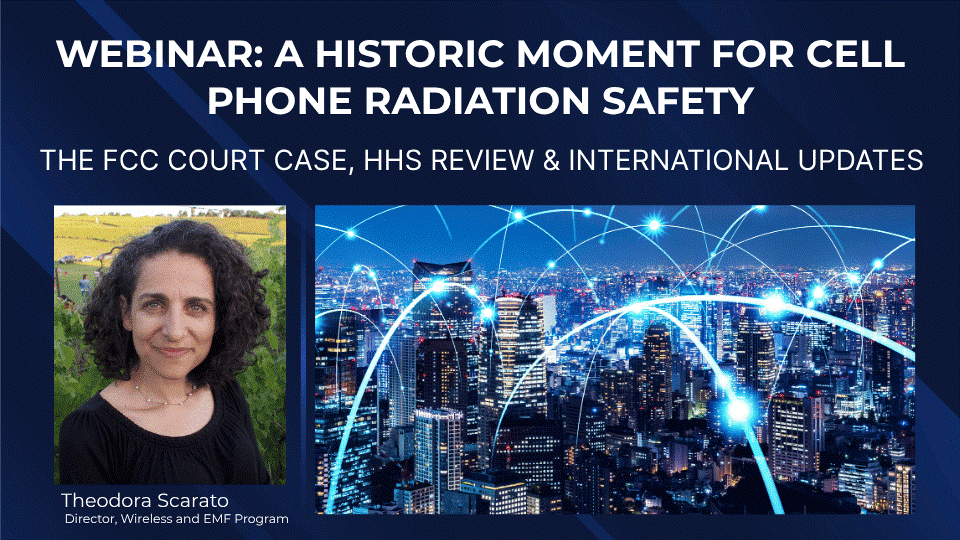
Featuring Theodora Scarato, Director of the Wireless and EMF Program at Environmental Health Sciences.
Date: Wednesday, October 7th, 2026
Time: 9 am PT (Tucson time)
Zoom Link to register
| | |
FCC finally responds to the 2021 D.C. Circuit Court order
| | | |
We’ve been waiting a long time for this. After five years of doing nothing, the FCC has finally responded to the 2021 Federal Court Order to explain why it decided not to change its 1996 RF radiation exposure limits—even in the face of 11,000 pages of evidence on the negative health effects of RF radiation.
Theodora Scarato was a petitioner in the original 2021 lawsuit. Here below she gives her opinion on the FCC’s (lame) response:
“2026 technology. 1996 radiation limits. Three decades of technological innovation, but the radiation limits have not kept pace. FCC’s 1996 limits were written for a wireless world that no longer exists, before smartphones, ubiquitous Wi-Fi, 5G and the coming 6G era transformed our daily life. Children are exposed to an ever-increasing number of wireless devices at home and at school.
The FCC says nearly five years is ‘not unreasonable.’ But how reasonable is it to accelerate wireless deployment under 1996 exposure limits without first determining whether those limits adequately protect people and the environment today?
The FCC says that acting any faster would ‘divert resources from other pressing matters’, but what could be more important than determining whether the nation’s decades-old cell phone and cell tower radiation limits adequately protect public health and the environment? Our children deserve safe technology.”
Read more here.
Both the Children’s Health Defense and Environmental Health Trust were the main organizational petitioners in the 2021 court case. Information from them on the FCC’s recent response and requests for comments is at these links.
https://childrenshealthdefense.org/defender/hhs-investigate-health-risks-wireless-radiation-calls-public-input-due-oct-21/
https://ehtrust.org/historic-filing-fcc-finally-responds-to-federal-court-order-in-ehts-2021-legal-win/
| | | |
Update on Tucson’s Fiber-to-the-Premises program
| |
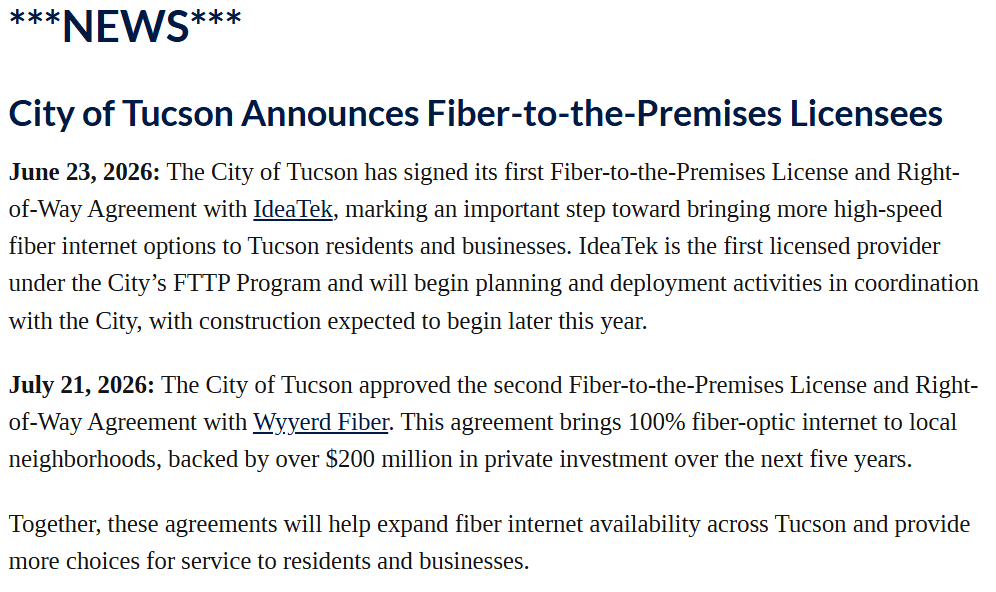
As announced in our September 2025 newsletter, the City of Tucson has launched a Fiber-to-The-Premises (FTTP) program with the objective of 100% fiber coverage to all city homes and workplaces by 2029. This is a licensing program that enables third-party private businesses to build, own, and operate fiber-optic internet services that will be available to all residents and businesses in Tucson.
Here is the latest news from the City of Tucson Fiber-To-The-Premises home page
| | |
We are still investigating the EMF implications of fiber optic internet. Meanwhile, we repeat here what we stated in the September 2025 newsletter one year ago:
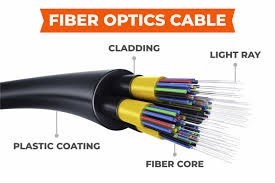
Tucson’s new FTTP program is good news. Fiber optic cable -based internet is known to be faster and more reliable, more secure and sustainable than either cable or wireless (read more from Earthlink and “Reinventing Wires” by the National Institute for Science, Law & Public Policy). Fiber optic cable does not use Radio Frequency radiation to transmit data wirelessly through the air. Instead, it sends pulses of light through a physical cable. With no need for a connection from wireless infrastructure to home routers, it should mean lower RF radiation exposure.
However, as with any major change in technology, there may be costs along with benefits when it comes to public safety. Will Tucson’s fiber build-out spur more wireless infrastructure? What will become of existing small cells? What kind of “smart city” innovations are envisioned? Will it lead to a reduction in our exposure to RF radiation over which we have no control? What does the build-out mean for people’s exposure to EMFs other than RF radiation, such as dirty electricity, aka electromagnetic interference?
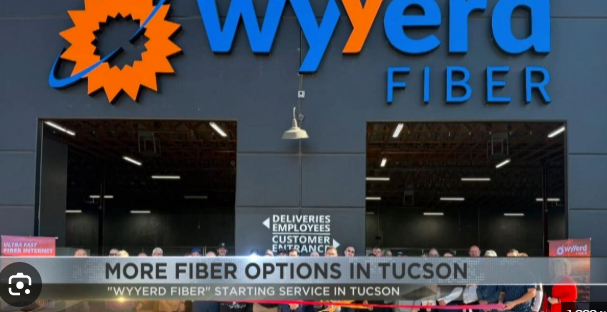
Click this image to hear about fiber in the news on KVOA Tucson.
| |
Update on 5G “small” cells in Tucson
| | |
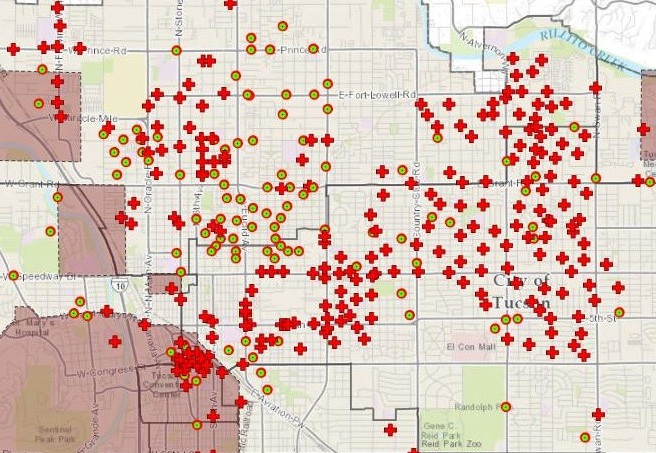
A total of 491 small-cell towers were installed in Tucson between 2018 and 2023, the large majority by Verizon and AT&T. These towers emit RF radiation 24/7, 365 days a year blocks into the surrounding area, cloaking people, plants and animals with an environmental pollutant thousands of studies show is harmful. The small-cell roll out--without consent--is what led to the start of Safe Tech Tucson advocacy efforts.
We were told that the towers are necessary to accommodate increased coverage needs as the demand for cell phone connectivity increases. But we now know their main purpose is to provide a type of home internet service called “Fixed Wireless Internet”. After installation, the telecommunications company launches an advertising campaign to get nearby homes to discontinue their current service and sign up for theirs, for example, Verizon’s “5G Home Internet”.
This use of wireless technology is totally unnecessary: fast, wired internet is easily accessible in Tucson. Cell towers are only needed for mobile applications like cell phones and, even then, do not need to be installed in close proximity to homes and schools to achieve cell phone coverage. The rollout of these towers was motivated not by dire need, but by profit.
After 2023 there was a long lull in small-cell installations. Then, earlier this year a lone tower was installed at 1200 N. Wilson Avenue in the heart of the historic Blenman-Elm neighborhood.
| | |
1200 N Wilson Avenue, Blenman-Elm, Tucson. If you can get a photo of the small-cell tower at this address please send it in to us: safetechtucson@gmail.com
In our December 2025 newsletter we reported we had been informed that both Verizon and AT&T were planning to re-start their rollouts in Tucson, with a primary focus on the East side. There has been no sign that this is happening. According to the Tucson small- cell (“streetlight”) map, with the exception of 1200 N. Wilson, there have been no new reserved locations or installations by Verizon or AT&T. If anyone sees a small-cell tower being installed, please inform us at safetechtucson@gmail.com!
Blast from the past:
Below is a May 20, 2022 small-cell map, near the height of installations in Tucson. The circles are reserved locations for small-cells—almost all now have installed towers (the red crosses), along with the many others throughout the city.
| | | | |