IBANYS Weekly E-Newsletter | | |
IBANYS’ new Fiscal Year begins November 1st. Our dues renewal notices and invoices will be sent on November 3rd. Please watch for them – and email me with any questions: Johnw@ibanys.net
With the new Fiscal Year, IBANYS thanks outgoing Chairman Phil Pecora (Genesee Regional Bank) for his outstanding leadership and service to our association and New York's community banking industry this past year. . .Effective Nov. 1, new Chairman, Mark Lavarnway (Watertown Savings Bank) will take the helm, along with incoming Vice Chair Tim Dickey (Bank of Holland and newly elected Secretary/Treasurer Kelly Wade (Cayuga Lake National Bank). Phil Pecora completes the Executive Committee as Immediate Past Chairman. We thank them all for their commitment!
. . . . .
Please be sure to read through the Deposit Insurance Reform items in the "Legislative" portion under our Federal Update below. ICBA is pushing hard to make sure this reform is a benefit for all community banks. Any questions, please contact me (Johnw@ibanys.net)
. . . . .
HERE IS SOME INFORMATION ON UPCOMING WEBINARS FROM IBANYS’ PREFERRED PARTNERS AT NEWCLEUS & STIFEL. . .
-
NEWCLEUS (IBANYS Preferred Partner) WEBINAR: “Solutions for Success: Retain and Reward Your Key Personnel in Today's Economy” Virtual meeting: Wednesday, November 12 – 10:00 – 11:00 a.m. What are banks doing to keep top talent motivated — and thriving? Dive into creative strategies your peers are using to reward and retain employees. From 401(k)s and SERPs to BOLI and beyond, they’ll break down opportunities that can make a difference for your team & bottom line. To register: https://us06web.zoom.us/meeting/register/QmsJkUfyQgKgKJO3p3PI1Q
-
Stifel Solutions for Year-End Planning -- Thursday, October 30 | 1:00 – 2:00 p.m. The Fed has resumed its monetary policy easing cycle with an interest rate cut of 25 bps after a period of holding rates steady. Two more quarter-point cuts are expected by yearend and one in 2026. Depositories should benefit from interest rate cuts -- but persistent inflation could mean the Fed doesn’t cut rates as much as expected, which may dampen the current projected improvement to net interest income for next year. This webinar will discuss current economic landscape, market conditions and actionable strategies designed to help your institution improve '26 earnings: 1) Investment Portfolio and Balance Sheet Trends: Analyzing current trends to inform future strategies; 2) Year-End Investment Strategies: How to optimize investment portfolios strategies as the year closes; 3) Funding and Swap Strategies: Tools to manage funding costs and interest rate risk; 4) Balance Sheet Positioning for 2026: Strategies to prepare for next year’s economic environment. To Register: https://stifel.zoom.us/webinar/register/WN_o0QRNoFgT2ajpoB6bhyA3w#/registration
ALSO: PLEASE SAVE THESE IMPORTANT 2026 DATES for two major IBANYS conferences:
-
Our 50th Annual Convention & Trade Show at Resorts World Catskills in Monticello, New York June 8-10, 2026 -- a New Date & Location, but still our same Premier Event. Mark Your Calendars. . . and please share the news with your officers and management teams!
-
Our 2026 Executive Leadership Symposium October 5-7, 2026 at 1000 Harbor Hotel in Clayton, New York.
. . . . .
Visit our website at https://ibanys.net/ to review information about IBANYS, our mission and what we do for New York community banks. We’re still the sole voice at the table representing ONLY New York community banks, as we have been since we were formed by community bankers from across the state over a half-century ago.
Thanks for all you do for your local customers and communities, our community banking industry in New York. . . and of course, for IBANYS.
. . .John
| | Stay tuned! As meeting agendas are finalized, details and registration information will be shared via email, the IBANYS website (ibanys.net/meetings-schedule), and in upcoming e-newsletters. | | | |
Human Resources
Tuesday, December 9, 2025
8:30 – 11:30 a.m.
Zoom - Live Webinar
| | | |
Regulatory Compliance Update
Tuesday, February 3, 2026
9:00 a.m. – 3:00 p.m.
Live Webinar – Zoom
| | | |
2026 Bank Directors Conference
Tuesday, March 3, 2026
8:45 a.m. – 3:30 p.m.
Live Webinar – Zoom
| | | |
Virtual Spring Meeting
April 14-15, 2026
9:00 a.m. - 2:30 p.m.
Live Webinar - Zoom
| | | | |
New Dates. New Location. Same Premier Event.
IBANYS’ 50th Annual Trade Show & Convention is headed to Resorts World Catskills!
Mark your calendars and save the date—June 8-10, 2026.
We look forward to celebrating this milestone event with you!
| | | | |
Executive Leadership Symposium
October 5-7, 2026
1000 Harbor Hotel
Clayton, NY
| | ASSOCIATE & PREFERRED PARTNERS | | |
Chris Catanzarite
Sr. Manager Growth and Client Success
245 Commerce Blvd.
Liverpool, NY 13088
(315) 572-5805
chris@directlink.ai
https://directlink.ai
| |
IBANYS Welcomes our newest Associate Member - Directlink
Directlink is a Conversational AI platform purpose-built for community banks and Credit Unions. Directlink’s voice banking solutions leverage AI to enhance customer interactions, streamline operations, and provide personalized banking experiences by phone. Our focus on seamless self-service solutions ensures an enhanced experience for both customers and operators, driving meaningful engagement and operational success.
Through AI-powered automation and fraud prevention tools, Directlink improves efficiency, security, and service quality.
| |
Client Alerts - OCC & FDIC Propose Revisions to Supervisory Framework
October 20, 2025
On October 6 and 7, 2025, the OCC and the FDIC announced several proposed rules and issued new guidance that will together substantially revise numerous aspects of the supervisory framework for national banks, federal savings associations, and state nonmember banks. Luse Gorman is publishing three Legal Updates with our key takeaways related to each of these developments:
-
For our Legal Update on the OCC and FDIC’s proposed rule to establish a uniform definition for the term "unsafe or unsound practice" and revise the process for issuing MRAs, see here.
-
For our Legal Update on the OCC and FDIC’s proposed rule to prohibit the agencies from taking adverse action against an institution on the basis of reputation risk, see here.
-
For our Legal Update on the OCC’s actions to reduce burdens on community banks, including changes to examination procedures and expanded access to expedited application procedures, see here.
Luse Gorman, PC regularly advises financial institutions on regulatory and compliance developments and enforcement actions from, and licensing applications to, the federal banking agencies. If you have any questions related to these Legal Updates, please contact Brendan Clegg at (202) 274-2034 or bclegg@luselaw.com, or your regular Luse Gorman contact. To learn more about our firm and services, please visit our website.
| |
Building a Single Customer View: What Banks and Credit Unions Can Learn from Fintechs
Fintechs have set a new standard for customer engagement—delivering real-time, personalized experiences built on a complete view of each customer. Community banks and credit unions can achieve the same results by developing a unified customer relationship management (CRM) strategy.
A single customer view connects data across systems—core banking, loans, payments, and digital channels—to create a 360-degree profile that enables personalization, proactive service, and smarter decision-making.
Engage fi outlines how financial institutions can bridge data silos, optimize CRM tools, and build a culture of adoption to improve efficiency and growth. Their proven, data-driven approach helps institutions design the right strategy, reduce risk, and accelerate results.
By Engage fi — Read Article
| | |
THE WEEK OF OCTOBER 20, 2025
The Municipal Market Monitor is a weekly overview covering key themes of the general municipal market. The update includes the AAA yield curve, municipal to treasuries ratio, fund flows, expected issuance volume and Piper Sandler’s weekly calendar, along with brief commentary, designed to provide issuers and investors insight into current market conditions.
| | |
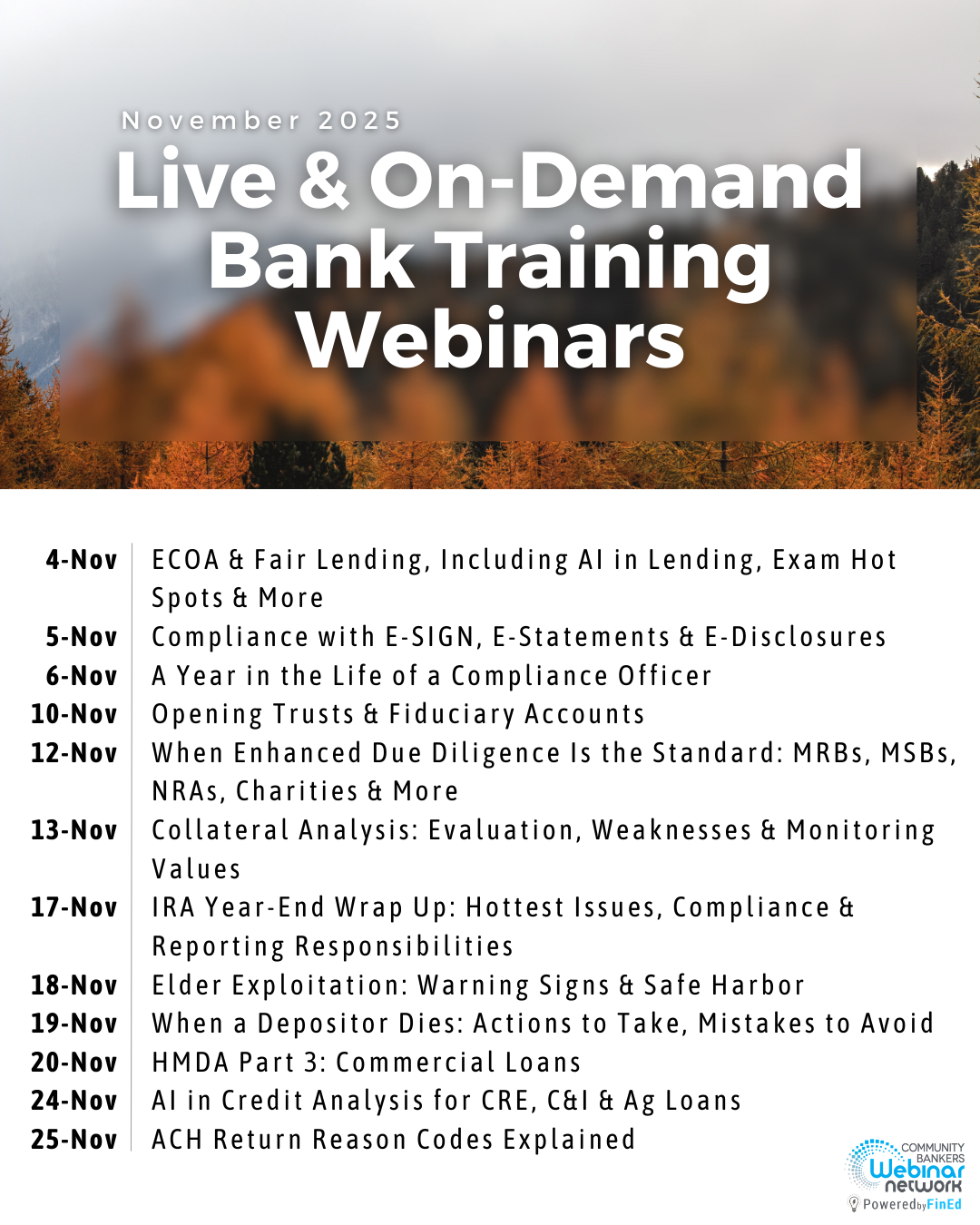
Barret Compliance Series
November 4-6, 2025
Barret Compliance Topics:
Lending
- Fair lending/Reg B
- ATR-QM
- HPML/HOEPA
- Lending to service members
- Mortgage origination, including TRID
- Mortgage servicing
- RESPA Anti-Kickback Rule developments
- Appraisal issues
- Flood insurance- updated FAQs
- FCRA Litigation
- Fair Debt Collections Practices Act
- Cosignor vs Guarantor Issues
- Valid When Made/True Lender Doctrines
- UCC Article 9 Developments Bankruptcy update
| | |
Operations/Deposit
- Reg CC
- Reg DD
- Reg D
- Reg E
- Converting Retail Accounts and Charging Fees on Free Accounts
- Garnishments and Garnishing Federal Benefit Payments
- Privacy
- Social media and advertising
- UDAAP developments
- NACHA Rule Updates
- Wire transfer and ACH fraud issues
- Mobile/Remote Deposit
- Technology Litigation
- ADA Website Accessibility guidelines
- IRS Tax Reporting update
- Cybersecurity Risks and Mitigation
Bank Secrecy/ Anti-Money Laundering:
- FFIEC Exam Procedures and risk assessments
- Suspicious Activity Reporting
- CIP
- Beneficial Ownership
- Cannabis and Hemp
- Elder financial abuse
- Recent penalties
| | |
FEATURES:
- Day one (seven hours) covers Lending Compliance
- Day two (seven hours) focuses on Operations/Deposit Compliance
- Day three (three and one-half hours) concentrates on Bank Secrecy Act/Anti-Money Laundering
- CPE credit is available
Pricing:
Barret Compliance Series, All-Access Pass (3 Days)
In Person and Virtual (Zoom) Available: $795
Lending Compliance
In Person and Virtual (Zoom) Available: $345
Operations, Deposit, BSA, AML
In Person and Virtual (Zoom) Available: $475
BSA, AML
In Person and Virtual (Zoom) Available: $225
| | |
May 17-22, 2026
Barret Graduate School
Our three year graduate program. Annual one-week residency session.
Barret Graduate School Curriculum in Brief
One week per year for three years • 130+ hours of core classroom study • Nine on-campus case studies• Eight home study problems.
Over the three year graduate program, participants will have access to 200+ hours of training.
| | | |
Registration is open for ICBA LIVE 2026
Registration is now open for ICBA LIVE 2026, the world’s largest gathering of community bankers.
Details: Set for March 6-9 at the San Diego Convention Center, ICBA LIVE is where ICBA members connect with peers, are inspired by new ideas, and gain practical insights to stay competitive.
Theme: The theme for ICBA LIVE 2026 is Anchored in Purpose to recognize community bankers as the anchors of their communities—providing stability and support during turbulent economic times—and ICBA as an anchor for community banks.
More: ICBA LIVE features industry-leading speakers, education opportunities for community bankers, a lively expo floor, and more.
LEARN MORE AND REGISTER
| | |
In “Making a List, Checking It Twice,” Jim Reber, President and CEO of ICBA Securities, offers timely year-end reminders for community banks as 2025 draws to a close. Reber highlights strategies for gain/loss harvesting, SBA loan sales, and proactive risk management amid shifting interest rate expectations. He also reminds bankers to review and update key policies—including investment, liquidity, and interest rate risk—and ensure proper documentation of board and management actions. With favorable economic conditions and stable industry performance, Reber closes with a lighthearted nod to the season and a look ahead to 2026.
Read Article
| |
-
State legislators appear ready for a difficult budget cycle: Gov. Hochul mainly cited fiscal concerns in vetoing more than two dozen bills this month, as state leaders navigate less federal aid and a government shutdown. The governor squashed a variety of proposals in the last two weeks that could address affordability, including insurance reforms, health-related bills and other proposals. Read More.
-
Gov. Hochul has vetoed a variety of proposals “that could address affordability,” including insurance reforms, health-related bills and other proposals. One would have prohibited minimum rent costs for mortgage loans – or penalized by lenders for not setting high enough rent on all or part of the real estate – because it was too vague and would create significant uncertainty in the real estate market that could increase borrowing costs and limit supply. She noted “banning any terms related to minimum rents precludes provisions that federal regulators and best practices require or promote to ensure responsible lending, such as debt service coverage ratios." Hochul said there's added affordability concerns for New York, with federal cuts and a cumulative $34.3 billion state budget gap through 2029.
-
The NYS Financial Services Department has issued Guidance on Managing Risks Related to Third-Party Service Providers DFS states Covered Entities must evaluate and mitigate cybersecurity risks relevant to their own business. The Guidance highlights risks associated with TPSPs as well as strategies to manage these risks as part of an effective cybersecurity program. As third-party service offerings expand and evolve, so too will TPSP-related cybersecurity risks. Managing these risks appropriately requires performing, at regular intervals, careful analysis of the sufficiency of administrative, technical, and physical controls to manage third-party risk, as required by Part 500.” Read the DFS Press Release: https://www.dfs.ny.gov/reports_and_publications/press_releases/pr20251021
-
Earlier this year, NYS DFS drafted regulations that would “establish new prohibitions on harmful overdraft practices, enhance customer communications, and bar banking organizations from processing transactions in a manner meant to maximize their fees.” DFS said it took a data-driven approach to developing the regulation, considering the existing regulatory landscape, market trends, responses to a request for information sent to banking organizations in 2022 and a subsequent 2023 Department-issued overdraft study, then released draft regulations for a pre-proposal comment period. Comments received from some banking organizations asserted the Pre-Proposal would be costly or limit availability of overdraft protections for customers, yet organizations “did not provide data to support their assertions”. As a result, DFS solicited further information on overdraft and insufficient funds-related policies, procedures, costs, and revenues – including from banking organizations that previously commented to substantiate statements made relating to costs, feasibility, service availability, and overall impact on business. Comments were due October 20. With questions, email DFSOverdraftRFI@dfs.ny.gov.
-
Governor Hochul has signed a legislative package “to strengthen homeownership and protections for renters.” Hochul said the homeowner package will make homeownership more attainable through tax incentives and laws that combat home appraisal discrimination, and help tenants by extending protections on security deposits, limits on excessive fees for bounced checks, and banning collusion using algorithm-enabled rent price fixing. WGRZ
| |
|
The Government Shutdown
-
Federal credit unions marked "International Credit Union Day" Oct. 16 by offering products to members specifically impacted by the federal government shutdown. Some are offering six-month lines of credit with zero-percent interest to federal workers who haven't been paid during the shutdown, and many others are offering similar products. A credit union exec in California noted: "Members should let their financial institution know that they've been impacted by the shutdown. . .credit unions all offer different kind of programs to help provide that type of relief." https://abc7.com/post/federal-credit-unions-introduce-programs-help-members-affected-government-shutdown/18053363/
. . .Regulatory
-
CFPB 1033, Part I. ICBA called on the Consumer Financial Protection Bureau to exempt from its 1033 rule requirements all community banks with assets $10 billion and under. In a letter responding to the CFPB’s proposed rule on implementing Section 1033 of the Dodd-Frank Act, ICBA said the bureau should: 1) Expand the exemption for small data providers from banks with less than $850 million in assets to all community banks with assets $10 billion and under; 2) Limit mandatory data sharing to third parties that act in the consumer’s best interest; 3) Allow banks to charge a reasonable fee for developer interface access; 4) Oversee larger third-party data recipients to ensure they protect consumers’ private data. . .Section 1033 of the Dodd-Frank Act requires covered financial institutions to make available to consumers certain data relating to consumers’ transactions and accounts upon request. In August the CFPB released an advance notice of proposed rulemaking to collect information on how it should implement Section 1033 standards. ICBA then urged the agency to focus its rulemaking on including needed protections for community banks and their customers.
-
CFPB 1033, Part II. The CFPB’s proposed rule comes after the CFPB this summer requested a stay in a lawsuit challenging the 1033 rule and said it has decided to initiate a new rulemaking. The CFPB previously asked a federal court to vacate its 1033 rule, saying the rule is unlawful. ICBA has long expressed concerns over the rule’s impact on consumer data security and privacy. ICBA and others recently issued a statement correcting the record on the Section 1033 rulemaking following misleading claims from a group of fintech and retail organizations.
-
White House OMB Director Vought wants to close down the CFPB and expects to succeed in the next few months, despite the Trump administration's claims in court that the bureau is just being downsized. Read full article »
-
CDFI Fund, Part I. ICBA and other groups urged the Trump administration to reconsider actions to eliminate Community Development Financial Institutions (CDFI) Fund resources. In a letter to Treasury Secretary Bessent and OMB Director Vought, ICBA and others said: 1) The CDFI Fund has long stood as one of the government’s most effective, market-based strategies for fostering economic opportunity and expanding homeownership in low- and moderate-income communities; 2) Since its establishment in 1996, the CDFI Fund has provided the framework through which financial institutions expand access to capital in markets that might otherwise remain underserved. Its programs are invaluable in helping banks and other lenders meet community credit needs, create jobs, and build local wealth. In a previous national news release ICBA cited the harmful economic impact eliminating the CDFI Fund would have on local communities and urged continued support from policymakers. ICBA is working with key House and Senate offices to weigh in directly with the Treasury and OMB to preserve the successful CDFI programs. On Oct. 10, American Banker (subscription needed) reported policymakers are moving to abolish the CDFI Fund, though ICBA noted in its statement that a recent Treasury review determined the fund is performing its statutory functions as required by law.
-
ICBA and the Community Home Lenders of America called on Treasury and FHFA to permit Fannie Mae and Freddie Mac to use their portfolios to help reduce the historically wide spread between 30-year mortgage rates and 10-year treasuries (30/10 spread). Their letter to Treasury Secretary Bessent and FHFA Director Pulte noted housing accounts for nearly 20% of GDP, and affects all homeowners, and renters -- especially those in underserved and rural communities. They noted action is critical to address homeownership affordability and lending challenges. ICBA and CHLA said: 1) Treasury and the FHFA should amend the Preferred Stock Purchase Agreements to enable Fannie Mae and Freddie Mac the limited authority to purchase their own mortgage-backed securities or Ginnie Mae MBS at a higher ceiling than currently exists; 2) The agencies should give each of the government-sponsored enterprises the ability to purchase up to $300 billion in MBS for when the 30/10 spread is above 170 basis points. In no way would this authority replicate the unlimited authority the GSEs exercised in the past regarding their retained portfolios.
. . .Legislative
-
Deposit Insurance Reform Part I. With Congress deliberating deposit insurance reform proposals, ICBA released recommended principles to inform the debate. In a new Main Street Matters blog post, ICBA said: 1) The large bank failures of 2023 demonstrated the clear need to reform the nation’s deposit insurance system. 2) Recently introduced bipartisan legislation has provided a good starting point for these discussions. 3) ICBA will continue to advance its principles to ensure reforms reinforce ongoing depositor confidence in community banks, protect community banks from high-cost assessments, and curb the implicit guarantees now offered to the largest too-big-to-fail banks. ICBA recently expressed support for the Main Street Depositor Protection Act (S. 2999) by Sens. Hagerty (R-TN.) and Angela Alsobrooks (D-MD). In a letter, ICBA said the bill is a great step to promote balanced deposit insurance coverage across the banking industry, strengthen the deposit insurance system, and support small businesses that use transaction accounts for payroll and other recurring expenses.
-
Deposit Insurance Reform Part II. Treasury Secretary Bessent has indicated support for congressional efforts to modernize deposit insurance. Bessent said he was “encouraged to see emerging bipartisan support for increasing FDIC insurance limits on noninterest-bearing transaction accounts.” ICBA last month called on Congress to consider deposit insurance reforms in a statement for the record for the Senate Banking Committee hearing on deposit insurance reform. Through ICBA’s Deposit Insurance Working Group, ICBA is working to advance principles for deposit insurance reform for community banks. Revisiting deposit insurance requirements is a key platform in ICBA’s “Repair, Reform, and Thrive” plan.
-
ICBA continues to ask community bankers to urge their senators to ensure proposed crypto market structure legislation bars all digital assets market participants from offering yield, interest, or rewards on payment stablecoins. The GENIUS Act stablecoin law prohibited payment stablecoin issuers from paying yield or interest directly to stablecoin holders, though this prohibition can be evaded by marketing the interest as “rewards” to stablecoin holders and having payments come from affiliates, exchanges, and other third parties instead of directly by the stablecoin issuer. Community bankers: Use a customizable message on ICBA’s Be Heard grassroots action center to tell their senators to minimize risks to the banking system and local economies by extending the prohibition to crypto exchanges and other third parties. IBANYS offers: 1) A summary of the GENIUS Act for community bankers that includes insights on the regulatory framework for payment stablecoins, policies on bank issuance, and more. 2) An on-demand community banker briefing on the GENIUS Act and other digital asset policy developments.
-
ICBA expressed strong support for a Senate bill that would raise the currency transaction reporting and Suspicious Activity Reporting thresholds to $30,000 and $10,000, respectively, and index the CTR threshold for inflation every five years. In a letter to Senate Banking Chairman Scott (R-SC) and Kennedy (R-LA) ICBA: 1) Thanked them for introducing the Streamlining Transaction and Ensuring Anti-Money Laundering Improvements for a New Era (STREAMLINE) Act; 2) Said the updated thresholds would result in more targeted, useful information for law enforcement while allowing community banks to redirect resources toward serving their communities; 3) Noted current reporting thresholds under the Bank Secrecy Act are significantly outdated and capture far more transactions than originally intended. In a statement for the record for a House subcommittee hearing on FinCEN, ICBA said it strongly supports H.R. 1799, to effectively implement a Government Accountability Office recommendation by raising the CTR and SAR thresholds. ICBA in August met with Treasury Department officials to discuss reducing the burdens of CTRs and SARs.
-
ICBA encourages community bankers to urge their senators to ensure proposed crypto market structure legislation bars all digital assets market participants from offering yield, interest, or rewards on payment stablecoins. The GENIUS Act stablecoin law prohibited payment stablecoin issuers from paying yield or interest directly to stablecoin holders, though this prohibition can be evaded by marketing the interest as “rewards” to stablecoin holders and having payments come from affiliates, exchanges, and other third parties instead of directly by the stablecoin issuer. Community bankers can use a customizable message on ICBA’s Be Heard grassroots action center to tell their senators to minimize risks to the banking system and local economies by extending the prohibition to crypto exchanges and other third parties. ICBA also offers: 1) A summary of the GENIUS Act for community bankers that includes insights on the regulatory framework for payment stablecoins, policies on bank issuance, and more; 2) An on-demand community banker briefing on the GENIUS Act & other digital asset policy developments.
. . .Political & Economic Snapshot
-
A new poll found nearly two-thirds of Americans believe the U.S. is headed in the wrong direction, fueled by dissatisfaction with President Trump's impact on the economy, immigration, race relations and the nation's global standing. The new poll with a vast sample across racial and religious lines showed even among Republicans, nearly 30% gave President Trump low marks on the economy and how the government is functioning. The survey offers a snapshot of the nation's sour mood just more than a year before the 2026 midterms — and suggests that anger could rewire political alliances and test the durability of Trump's support. The “American Values Survey by Public Religion Research Institute” tracks the nation's religion, values and mood, and has been a reliable pre-election barometer.
| | | | |