INTERCONNECTED
News from Democracy around the Globe
October 2026
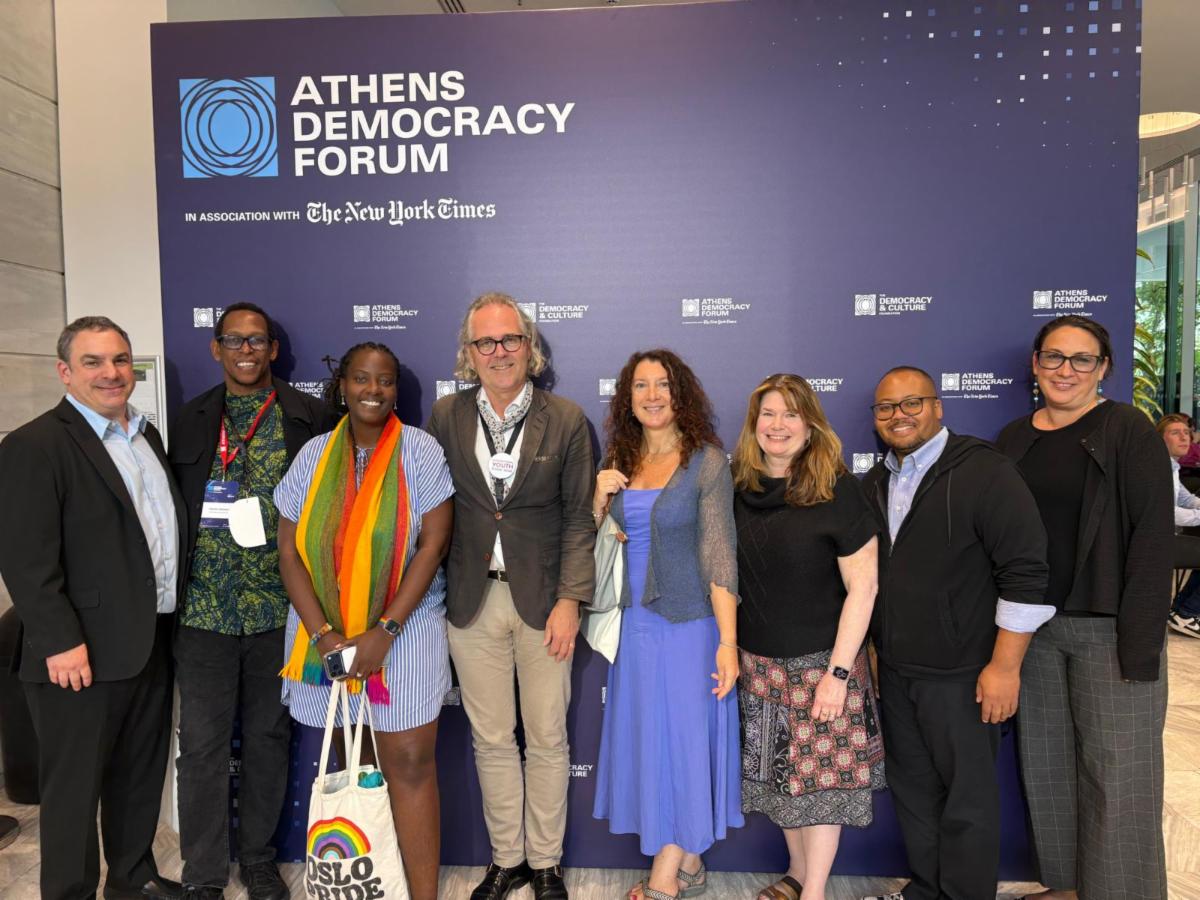
| | Athens Democracy Forum and Global Democracy Coalition Global Forum | | Building Order Out of Chaos was the theme of this year’s Athens Democracy Forum (ADF), organized by The Democracy and Culture Foundation in association with New York Times International. The Kettering Foundation was represented by the Democracy around the Globe team, Lisa Boone-Berry, Paloma Dallas, Phillip Lurie, and Ileana Marin; Tayo Clyburn, KF chief strategy officer and senior advisor to the president; and three of this year’s CFK Global Fellows Clare Byarugaba, Patrick Gathara, and Urban Strandberg. | | | |
This year’s agenda and theme recognized the continued backsliding of democracy around the world and the need to confront this moment by reimagining democracy. “Why democracy, and how must it evolve to be fit for purpose in an era of exponential change?” was the main question framing the three-day conference, which featured thinkers, policymakers, civil society, activists, technologists, artists, and young leaders. The program stated, “From the erosion of core principles in established democracies to the rise of authoritarian alternatives, the question is no longer whether democracy is under threat, but how it can adapt, deliver, and inspire in the 21st century. Together, we will reimagine democracy—not as a static ideal, but as a living system capable of learning, adapting, and delivering for all.”
Alongside the forum agenda, highlights of the conference included the City of Athens Democracy Award given to Pedro Sánchez, prime minister of Spain; and the Kofi Annan NextGen Democracy Prize awarded to Lara Parizotto, cofounder and executive director of the Migrant Democracy Project.
| |
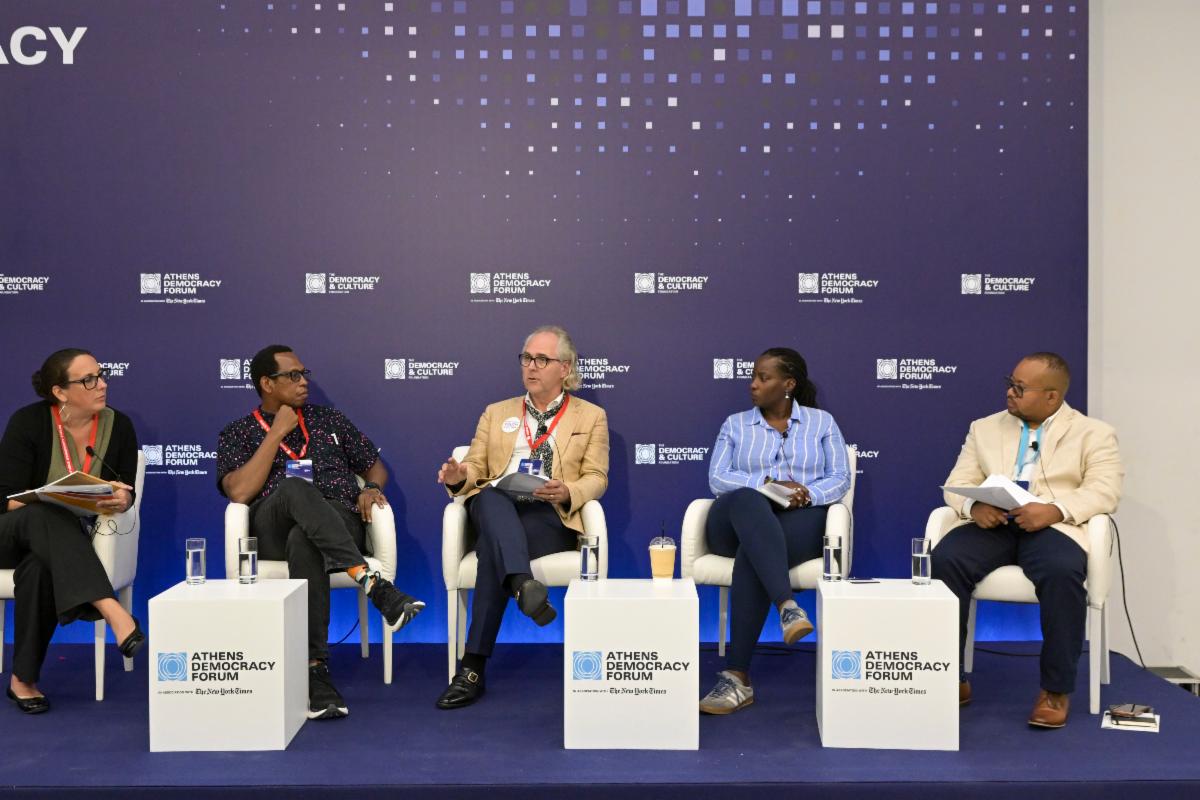
 | | The Kettering Foundation hosted a preforum session, titled “Inclusive Democracies: What Does It Mean for Those Democracy Has Written Off?” The overarching question for the discussion was, What would it take for groups forced to the margins to be meaningfully included and for their self-organizing to gain political salience? The session, which featured all three global fellows and Clyburn in a dialogue moderated by Dallas, highlighted the complexity of advancing inclusive democracy from distinct perspectives and what is being done on the ground in several countries. During the Q&A portion of the panel, it was remarked that how we define inclusive is critical. For example, when defined solely as an intentional act of including particular marginalized groups, it can fail to recognize their agency. Gathara responded that it’s more about understanding people where they are. It is also about opportunity and the ability to make choices for oneself, removing barriers to participation. Clyburn added that inclusion is about more than representation; it is also about people having a meaningful hand in shaping the conditions of their own lives. Further, he emphasized that it is important to not only bring people into the democracy we already have but also to remain open to what excluded people can teach us about what democracy could become.
| | |
A strong desire to get beyond diagnosis and get to action breathed throughout each session and encounter during the Athens Democracy Forum and into the Global Democracy Coalition’s (GDC) Global Forum, which immediately followed ADF. Titled Democracy and Trust: From Diagnosis to Collective Action, the Global Forum was cohosted by ADF and sponsored by the Kettering Foundation, the Carter Center, and the National Endowment for Democracy.
Pita Limjaroenrat, former leader of Thailand’s Move Forward Party, participated as a panelist during the Athens forum and gave keynote remarks to open the GDC Global Forum. In the 2023 election, Limjaroenrat and Move Forward won the most votes and seats in Parliament. He was unable to form a government, however, due to a lack of support by the Senate, which was backed by the military. The following year, the party was disbanded by the country’s Constitutional Court and he was barred from political office for 10 years. Limjaroenrat’s remarks focused on the importance of the rule of law and the need for judicial reforms.
This year’s Global Forum was conceived not as a traditional conference but as a collective platform for collaboration, designed to strengthen democratic resilience by helping build alignment around challenges and priorities, and amplifying democratic innovations emerging from different regions of the world. Building on a unique global-to-regional-to-local model, the 2026 forum brought together insights, priorities, and solutions identified in the regional forums in Asunción, Nairobi, Prague, and Seoul, and connected them to the global stage.
It is convenings like these two conferences held at this time of geopolitical uncertainty and shifting global priorities that demonstrate that collaboration is not only necessary but possible and that safe spaces to reconnect democratic practice with collective action, combined with shared knowledge, cocreation, and collective ownership can produce greater impact than isolated efforts.
Phillip Lurie and Ileana Marin, program officers for Democracy around the Globe
| |
Humanizing Democracy: Reflections from the Athens Democracy Forum
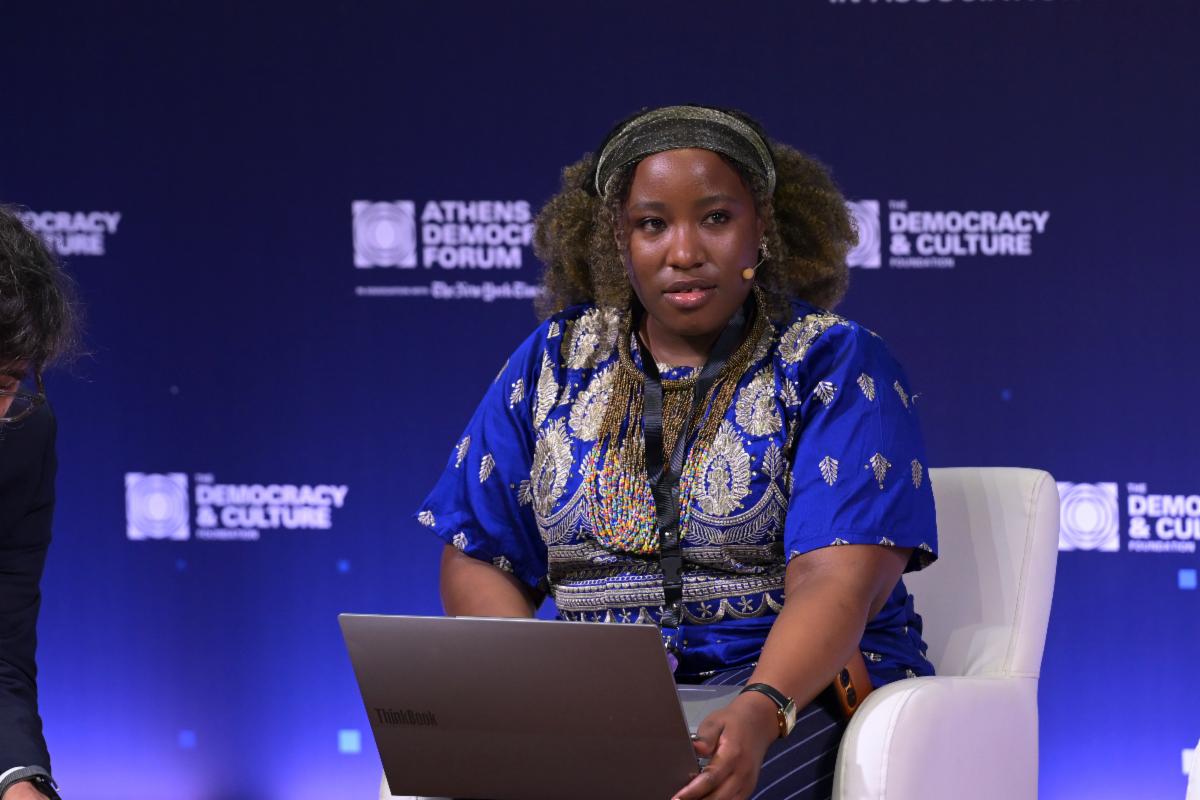
Mary Yvonne Ododah, leader of Kenya's Nuru Trust Network, also attended the Athens Democracy Forum. She graciously shared her perspectives on the event.
There is something humbling about discussing the future of democracy in the city that gave the idea its name. Athens wears its history openly. You turn a corner and the Acropolis is there above you, honey-colored against the sky, as if keeping watch over the conversations happening below.
| | |
I came to the 14th Athens Democracy Forum, carrying the questions I work with every day in Nairobi. Who gets to speak? Who gets heard? And who is left outside the room?
The venue itself felt like a quiet ode to the forum. The Athens Conservatoire sits beside the remains of Aristotle's Lyceum, the school he founded in 335 BC. His students were known as Peripatetics because they walked as they argued, testing ideas in motion. Long before that, the Lyceum grounds had also served as a meeting place for the Athenian assembly. Gathering there to ask how democracy must change felt fitting; ideas were never meant to sit still.
A Forum That Refused to Stay Narrow
With the theme of Building Order Out of Chaos, this year’s program asked a blunt question: Why democracy, and how must it evolve to be fit for purpose today? The opening debate was framed as democracy's identity crisis during a time when its defenders seemed fewer and autocratic strongmen seemed bolder.
What struck me was the range. We spoke about migration, not as a crisis to be managed but as a reality to adapt to. We spoke about the economy and the role of the state under geopolitical and technological pressure. We spoke about the wars unfolding right now, including a case study on Iran and what the conflict means for a whole region. And art was woven through it all, through performances that reminded us that democracy is also something we feel, not just something we legislate.
Then there were the teen sessions. Young people leading conversations with experts and policymakers on social media, mental health, and what they would do if they ran the world. Brilliant, right? I will come back to that.
What Gave Me Hope
First, the simple fact that democracy is still being spoken about, seriously and in public. In a season when many are asking what democracy has done for them lately, it matters that people still travel across continents to argue about it, question it, and try to make it better.
Second, the diversity in the room. There were voices from Africa, Asia, Europe, Latin America, and beyond. I want to celebrate that honestly, with one caveat. Much of that diversity arrived through larger institutions sending representatives. That is progress, but it is not the same as the grassroots organizer, the county youth leader, or the community journalist being in the room in their own right.
The Lines We Work Within
There is a lot of gatekeeping in the democratic space.
I say that without pointing fingers, because I recognize it in myself and in the sectors I work in. We build our work within lines: mandates, funding cycles, networks, the language our institutions reward. Those lines give us focus. But when we never step back to see the wider context, it becomes difficult to see past them. We end up speaking mostly to people who already speak like us.
I hope that going forward we can be braver. Brave enough to step outside our lines, to share what we know more freely, and to work together no matter where we live. Democracy is not an abstraction debated in conference halls. It is the mother queuing for a permit, the young person deciding whether voting is worth it, the artist using a stage to say what a podium cannot. Humanizing democracy is not a nice extra. It is necessary.
The Future Was in the Building
Back to the teens. Seeing young people at the forum was a highlight. But much of their deliberation happened in a separate, closed-door setting, away from the main conversations.
I understand the instinct. We want to protect young people and give them a safe space. Yet I kept asking myself: Why behind closed doors? We keep calling this generation "the future," and here the future was, sitting in the same building, while most of us did not hear them.
We do not need polished language to listen to young people. We just need to hear them. If we intend to influence policy, shape laws, and advocate for better futures, the people who will live longest with those decisions should be in the conversation, not alongside it.
This is where intergenerational dialogue becomes essential, uncomfortable as it may be. Those of us in these rooms will not always be here. The next generation should be prepared to understand all the dynamics at play: the good, the bad, and the ugly. That preparation does not happen in a separate room. It happens when we share the same table, disagree openly, and learn from each other.
Where We Go from Here
If democracy is to be humanized, the spaces where we talk about it must look more like the world it serves. Two things would help.
First, the global majority should host these forums too. Athens carries a powerful symbolism, and it should. But the questions discussed there are lived every day in Dhaka, Lagos, Nairobi, and São Paulo. This year's Global Democracy Coalition Global Forum, held alongside the Athens program, drew on regional dialogues in Asunción, Nairobi, Prague, and Seoul. That is a model worth building on: not satellite events feeding a center, but rotating centers of gravity.
Second, visa regimes must stop deciding who gets a voice. Too many colleagues from the global majority face costly, slow, or refused visas for convenings like this one. When a visa decides who can attend, it quietly decides whose experience shapes the conclusions. Organizers, host governments, and funders can work together on facilitated visa processes, earlier invitations, and hybrid participation that is treated as equal, not secondary.
None of this is about lowering the bar. It is about widening the door.
A Closing Thought
All in all, I left Athens hopeful but restless. Hopeful because the conversation is alive. Restless because the people with the most at stake are still too often outside the room, held back by gatekeeping, by distance, by a visa stamp, or by a closed door.
It felt right that one of the forum's honors, the Kofi Annan NextGen Democracy Prize, is named after a man who understood this so clearly. In his words:
No one is born a good citizen; no nation is born a democracy. Rather, both are processes that continue to evolve over a lifetime. Young people must be included from birth. A society that cuts off from its youth severs its lifeline.
Democracy needs to be humanized. Let us be braver, open the doors wider, and make sure the next generation is not just discussed, but heard.
Mary Yvonne Ododah, executive director, Nuru Trust Network
| |
How Democracies Revive—A Conversation with Gábor Scheiring
Join us October 22 as CFK Global Fellow Gábor Scheiring discusses his upcoming book How Democracies Revive: Why Illiberalism Keeps Winning and What to Do About It, which he coauthored with Benedek Jávor.
| | Despite occasional setbacks, illiberalism keeps winning, from India and the United States to Germany. While analytical frameworks around cultural backlash, economic grievance, and illiberal-playbook accounts each explain part of the picture, none fully captures the illiberal challenge. This talk draws on a forthcoming Stanford University Press book that blends scholarly research with insider political experience and proposes a new framework. It traces illiberalism to the contradictions of an uneven and shifting hierarchical global economic order, which generate a triple devaluation of economic status, cultural worth, and political voice that illiberal movements mobilize. The talk will also draw on successful cases of democratic revival, from South Korea and Uruguay to Hungary in 2026, to identify what durable democratic countervailing power requires. | | | |
Please join us on Zoom for this event.
Thursday, October 22
12:00 – 1:30 p.m. ET
To register, click here.
| |
2026 Election in Brazil
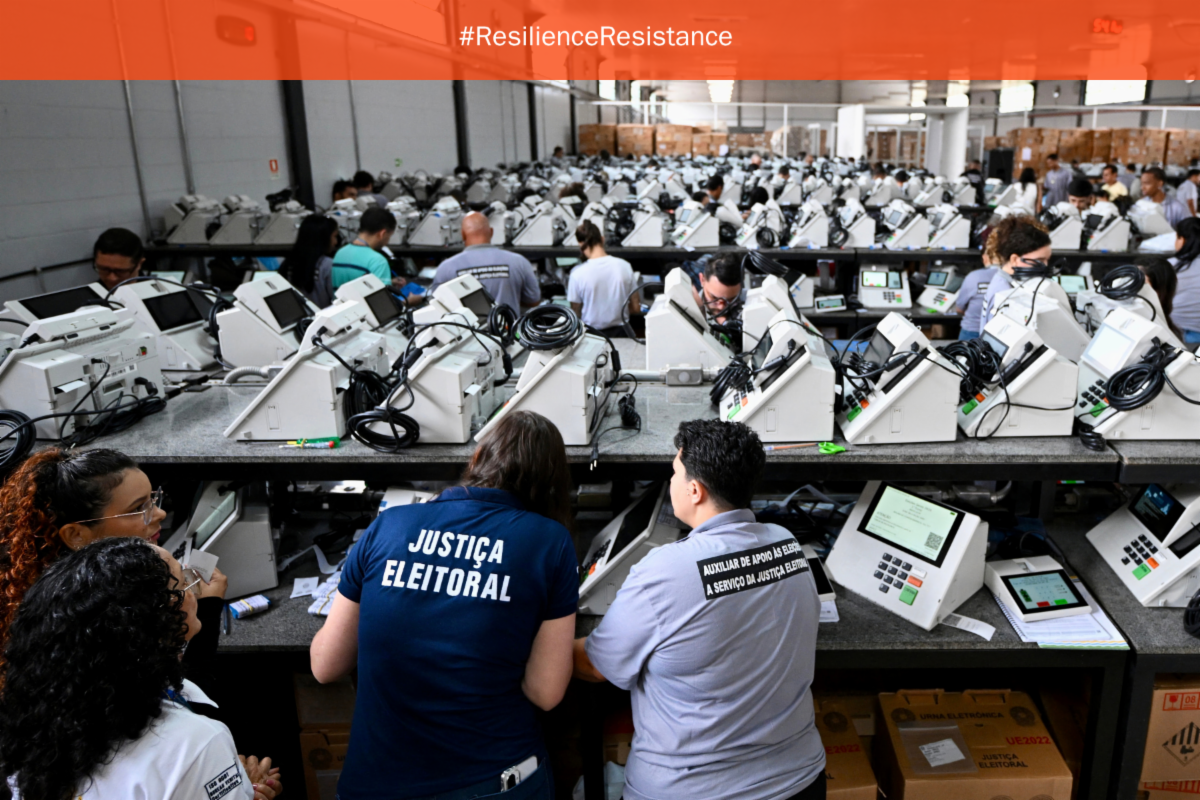
On Sunday October 25, democracy defenders around the world will have their eyes on Brazil as the country holds the second round of its presidential elections. In “Brazil’s Democratic Pact Is on the Brink of Collapse,” which was recently published by Stanford University’s Center on Democracy, Development, and Rule of Law, coauthors Natália Neris and Sami Sternberg of Pacto pela Democracia explain the dire circumstances the country is up against no matter the election result and explore how they arrived at this crossroads.
| |
Resilience & Resistance—New Posts
Don’t miss out on the latest insights in the Democracy around the Globe blog series.
| | |
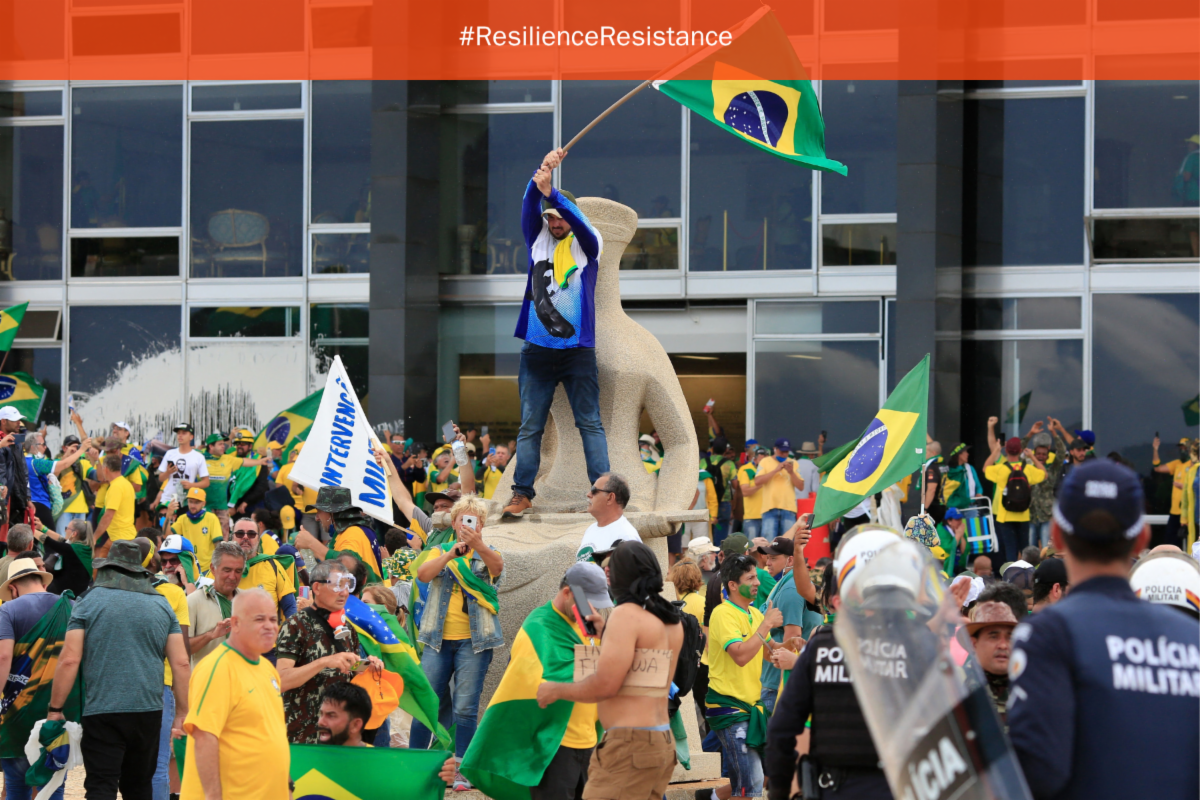
The threats posed by artificial intelligence (AI) are reported in the news almost daily. In “The Promise and Peril of ‘AI for Democracy,’” Dean Jackson states that AI does have the capacity to benefit democratic participation but that this opportunity needs to be approached wisely.
| | |
2026 CFK Global Fellows—Updates
Patrick Gathara
Continuing to reflect on world events and, in this instance, his travel to the Athens Democracy Forum, Patrick Gathara uses language to highlight differences in the journalistic treatment of the global north versus the global south.
Urban Strandberg
While Urban Strandberg was part of the Kettering delegation in Athens, he was also at the forum for his work with the International Youth Think Tank. He has shared photos and reflections (and positivity) from the event.
| |
Building Connectivity Across Diverse Sectors and Generations
Demos Kratos (from the Greek meaning “power of the people”) is a global initiative that builds the connective tissue linking actors across sectors, borders, and demographics to build collective powers that can shape a future where democracy delivers on the organization’s vision. This vision is a future of democracy transformed to deliver equity, dignity, creativity, and accountability for all.
Co-led by eight organizations and networks across the globe—including human rights defenders, feminist movements, artists, educators, students, environmental activist, and researchers—Demos Kratos broadens who has a seat at the table when democratic futures are discussed, connects grassroots voices to national, regional, and global governance debates, and builds solidarity across sectors and borders so that isolated efforts become, together, a resilient global force.
Their Approach
• Widening the Democracy Conversation—convening civil society, artists, faith communities, academic institutions, youth, and government to forge a shared vision across divides.
• Connecting Grassroots Realities to Global Debate—bringing evidence and voices from the ground to multilateral platforms where democratic values are fiercely contested.
• Cultivating Communities of Action—forging intentional relationships among diverse actors and amplifying their voices through cultural framing and storytelling as a core method of organizing, not merely communications.
To learn more about Demos Kratos and follow the efforts of network members, subscribe to their newsletter. Read the latest issue here.
| |
Insights from the Global Network
We’d like to thank Sandra Martínez of Transparencia por Colombia, a chapter of Transparency International, for sharing the following resources.
For information regarding the case studies of initiatives to monitor political finance, download Monitoring Political Finance: Compendium of Citizen Initiatives and Good Practices.
The continual occurrence of natural disasters in various parts of the world is frightening. And when these disasters occur, the risks of corruption increase significantly. Taking this into account, Transparencia por Colombia has launched the Transparencia Reconstruye initiative to continuously monitor the origin and use of funds allocated to reconstruction following Colombia’s recent earthquake will be continuously monitored.
Also part of this initiative is a compendium of recommendations that draws on the experience of the work that has been carried out in other contexts, such as the response to the COVID-19 pandemic and the reconstruction of an island in Colombia that was severely affected by two hurricanes.
| |
Global Democracy Survey
The Maxwell School of Citizenship and Public Affairs at Syracuse University is conducting Protecting and Promoting Democracy: A Global Survey. This survey maps the contemporary landscape of pro-democracy activism and advocacy and generates evidence to help funders and other stakeholders better understand and support organizations working to protect and promote democracy.
If you are a member of an organization that is working to promote or protect democracy and would like to participate in the survey, click here.
The survey is available in 16 languages: Arabic, Bangla, Chinese/Mandarin, English, Farsi/Persian, French, Hindi, Indonesian, Korean, Portuguese, Russian, Spanish, Swahili, Turkish, Ukrainian, and Urdu. The survey closes on October 26, 2026.
| |
Democracy Defenders
Freedom House, V-Dem, and other research outlets have documented that democracies around the world are backsliding. But many of us don’t need analysts to tell us this; we are experiencing the erosion for ourselves. And yet, we are also seeing people and grassroots organizations who are pushing against this trend. They are working to advance inclusive democracy, even in these troubling times. Not only are these individuals and groups inspiring, but they also have lessons and insights to share. Through this new series, we will spotlight their work.
Meet this month’s Democracy Defender Movilizatorio, which is represented here by program director Alejandra Ucros.
Is there a particular challenge, trend, or threat that led you to the work that you do?
I work at Movilizatorio, an organization born in Latin America 10 years ago from a simple but profound conviction: The complex challenges we face today, from democratic erosion to social and gender injustice, demand collaboration. We believe in sparking collective action and in building networks of actors who, together, achieve impact no single organization could reach alone.
The moment that led us to this specific work came in 2024, as Colombia entered an electoral cycle in which public language had crossed a line. This wasn't ordinary polarization. It was the systematic normalization of discourse that uses fear as a control mechanism. Phrases that would have caused scandal 10 years earlier were circulating without friction: in social media, in mainstream outlets, in family WhatsApp groups. At the center of that discourse sat a recurring target: vulnerable populations, particularly LGBTQ+ people, who were framed as a threat to children, to the family, and to the nation itself.
At the beginning of 2025, we had already started asking ourselves whether our democracy was at risk. The short answer, from our study Democracy Under Strain, was that it wasn't collapsing, but it was under strain, and the erosion wasn't happening in the laws first. It was happening in the language we were normalizing. When we analyzed the discursive tactics of presidential candidates, we found that 42 percent of them were concentrated in just five candidates, mainly through hate speech, information fog, and calls for mano dura (a set of tough-on-crime policies implemented by several Latin American goernments to combat gang violence and criminal activity).
That's when we realized fact-checking wasn't enough, and neither was a well-designed campaign. What was needed was civic infrastructure for civic and narrative change to defend and strengthen our democracy.
Please share one of your organization’s successful efforts or initiatives that you feel others working in the inclusive democracy space might learn from, recognizing that adjustments would be made for different global contexts and environments.
One initiative that I think holds real lessons for others working in the inclusive democracy space—with the adjustments any different context would require—is the Alliance for Democracy, a coalition-based effort we built in Colombia to protect and strengthen our democracy.
Build the Alliance Before You Send a Single Message
The most important thing we did before launching any campaign was build the table. In 2025, we cofounded the Alliance for Democracy, born from Colombian civil society's commitment to a strong, inclusive democracy with a future. At a moment marked by polarization and disinformation, we believed—and still believe—that Colombia has paths of possibility, participation, and trust. We are a broad, plural, nonpartisan network of social organizations from across the country, working to promote respect for the rules of the democratic game and to open spaces for a more participatory, informed, and connected citizenship. More than 60 organizations joined, bringing together legal defense, territorial leadership, communications and narrative expertise, and citizen mobilization under one coordinated strategy. This network wasn't built top-down—it was woven from years of trust-based relationships. That's what makes it hard to replicate, and what makes it powerful.
Unified Messages, Flooding the Territory
With that infrastructure in place, we built within the narratives workstream four coordinated campaigns:
• a prebunking campaign against authoritarian discursive tactics, teaching people to recognize that language before it reaches them directly;
• a campaign that activated youth voter turnout through civic values rather than partisan alignment, built from the territory inward;
• a campaign that de-escalated political language during a highly polarized moment, placing shared national identity above political trench warfare;
• and, the most strategically complex, a campaign working with more than 10 organizations to dismantle the weaponized use of “gender ideology” as an electoral disinformation tool, with content differentiated by audience, from faith communities to people who had never thought about the issue before.
This work traveled through radio, print and opinion media, a national journalism award, and well beyond the screen: a Kiki Lounge in Cali combining critical education with ballroom culture; workshops training journalists in Bucaramanga; a civic activation in a public park in Arauca; political satire theater in Tocancipá. We reached 26 departments and 78 municipalities and cities across the country.
The Power of a Distribution Network That Wasn't Ours Alone
Our combined digital reach touched more than 11 million people in six months. But that number doesn’t capture what matters most: how we got there. It wasn’t one channel or one voice. It was a distribution network that grew organically, carried by dozens of different kinds of messengers: content creators, opinion leaders, radio spots, street activations, artists, journalists, illustrators and a multiplicity of formats that very few campaigns manage to combine: posters, poems, jingles, op-eds, in-depth journalistic investigations, academic papers, trainings, online posts, physical billboards, and more. That diversity of voices and formats is what let us step outside our own echo chambers and reach audiences who almost never hear this kind of message.
In Colombia's 2026 elections, voter turnout rose 5.4 percentage points compared to 2022, and women were decisive: 54 percent of runoff votes came from women.
On Trust, Our Most Valuable Asset
If there's one thing we cherish most from this process, more than any reach number, it's the trust that was built between organizations that never used to share a table. Collective action isn't sustained by strategy or budget; it’s sustained by trust, and trust can’t be decreed, only built over years of relationship. That, for us, is the hardest infrastructure to replicate and the most valuable to protect.
What We Think Travels and What Wouldn't
What we believe is transferable to other contexts: building the coalition before the campaign rather than around it, treating message diversity (formats, messengers, entry points) as a strategy rather than an afterthought, and using prebunking to build recognition of manipulative language before it circulates, rather than only correcting it after the fact. What almost certainly needs local adaptation: which specific narratives and targeted groups are at the center of the disinformation (context-specific), the electoral and media calendar, and which local institutions and relationships of trust already exist to build on. This kind of network can't be imported, only grown.
Where do you find your strength and/or inspiration?
Our strength doesn't come from an electoral outcome. It comes from what the work left standing: an alliance of more than 60 organizations that is still active, trust-based relationships that didn't exist before, and civic infrastructure we can keep drawing on for whatever comes next.
What gives us hope is what we built together: a big tent where dissent is valued rather than punished, where organizations that never shared a table learned to build trust with one another. That’s the infrastructure that outlasts any single election cycle—and it’s what we keep investing in.
This isn’t the hope of “everything will be fine.” It’s the hope of people who build something knowing the road is long and choose to keep building anyway. That’s where I find mine.
And we find it, too, in gratitude. None of this would have been possible without the generosity of dozens of allied organizations who chose to share their time, their credibility, and their audiences with us, often with nothing to gain but the shared conviction that this work mattered. Ceding the spotlight, lending their name and community to a shared cause, and holding difficult conversations without breaking the table. That generosity is trust put into action. Organizations and people didn't just participate; they put something on the line for this work. Being trusted with that is, honestly, where a lot of our strength comes from.
| |
Who Cares for Those Who Care?
This month we’re featuring an article by Laura Vidal. In this piece, she shares the origin story and the impactful efforts of Vita Activa, an organization that works on democratic challenges indirectly—by nurturing and supporting those who do work directly and tirelessly to defend and expand inclusive democracy.
There is a particular kind of fatigue that comes from watching your country from a distance you didn’t fully choose. It’s the weariness of following the news from your country each morning before anything else, of translating between worlds that don't quite understand each other, of carrying a story that people abroad want simplified and people back home sometimes no longer recognize as fully theirs. For those of us who work observing civil society networks while also belonging, however imperfectly, to a diaspora, connection itself becomes something we have to build. We depend on borrowed digital spaces to feel accompanied that we’re not alone, and even in those spaces it can be tricky to fit completely, to show all sides of yourself comfortably and in ways people can understand what we bring into the space.
For years, I didn’t have a name for this particular exhaustion. It wasn’t burnout in the way the term usually gets used—no single job, no single deadline, no clear edge to point to and say, here, this is what broke me. It was something more diffuse: the weight of holding complexity that most conversations aren’t built to hold, and the quiet, persistent question of whether what I was feeling even classified as a struggle that deserved a name and that needed to be cared for. When I came across Vita Activa, a helpline and care network for journalists, activists, and human rights defenders across Latin America, it was the first time I saw that exhaustion described plainly, as a structural condition of this work rather than a personal failing.
What follows draws on a conversation with Vita Activa’s founder, Lu Ortiz, and on the organization’s own record of its work: six years of annual reports and blog posts tracing how one helpline grew into a wider argument about care.
The Beginnings
Vita Activa’s actual origin predates Vita Activa itself. Around 2018, Ortiz and researcher Estrella Soria ran Hacks de Vida, a transcontinental study that spoke with feminist and cyberfeminist organizations across Latin America. The findings were consistent everywhere: This work got done without pay, without training, in whatever free time was left—nights, early mornings, vacations. Care, disproportionately carried by women, by people from the global south, by racialized people already navigating complex lives, had been normalized as something owed for free. Ortiz has since described it as the moment she understood the task ahead: Dignify the work, pay for it, professionalize it, and bring people together to do it collectively. Hacks de Vida, in her words, is “the mother of Vita.”
Vita Activa itself launched in 2020, in the middle of the pandemic, in what its team calls a year defined by economic, political, and social uncertainty—"un año marcado por ese sentimiento de desazón.” Tejiendo Fuerza, its first initiative, opened confidential, anonymous, community spaces for feminist activists, cyberfeminists, journalists, and freedom of expression defenders in Argentina, Bolivia, Colombia, Ecuador, El Salvador, and Nicaragua. The following year confirmed the crisis wasn’t only medical. The organization notes that 2021 was defined by mental health cases, the effects of lockdown, isolation, and the loss of work, school, and social life.
By 2022, one of Vita Activa’s own users had put language to the question underlying all of it: "quiénes cuidan a las que cuidan" (Who cares for those who care?) She wrote that activists, journalists, and human rights defenders put their bodies on the line in feminist and intersectional struggle every single day. Meeting Vita Activa felt like recognizing a companion because in an environment this hostile, we have to find each other to persist. The answer the community built for itself was collective, not delivered from outside: "nos cuidamos entre nosotras y nosotres" (We care for each other.) It’s why "Persistir y Resurgir" (Persist and Resist) carries a political meaning in the plural. By scale, this meant more than 300 people were reached daily through community circles that year.
Growth That Didn’t Outgrow the Collective
Without losing its communal core, what began as a focused helpline grew from the 6 original countries in 2020 to 20 by 2023—with the largest share of cases coming from Argentina, Colombia, El Salvador, and Mexico. The expansion wasn't only geographic; it was a shift from listening to producing knowledge that could travel on its own. In 2024, the organization launched its first podcast, VitaCast, and produced the Manual de Primeros Auxilios Psicológicos y Digitales, the product of 10 months of free training offered in Arabic, English, and Spanish. That same instinct carried the work beyond its founding region entirely: in late 2023, Vita Activa began offering psychological and digital first aid training to women and LGBTQ+ people, journalists, and activists in the Middle East. This was not aid moving in one direction, but a dialogue between communities of the global majority navigating comparable pressures.
Who was actually arriving, and why, became clearest in the organization’s 2023 Germinar report, which stated that the correspondents were overwhelmingly cisgender women (91.2 percent), 40 percent of them journalists, just over half under 30—reaching out over chronic exhaustion, online harassment, nonconsensual sharing of intimate images, and digital surveillance.
Rest as a Political Practice
Vita Activa closed out 2025 with an idea that folds its philosophy into a single practice: Caring for others also means learning to rest. Vita’s executive director was inspired by a line from US poet Tricia Hersey, “The dreaming is our work, the resting is the goal.” With that purpose in mind, she initiated Media Fest for the team. Thirteen people joined from around the world for a deliberately unhurried day built around a collective collage exercise. Its centerpiece was, quite deliberately, an exercise in producing nothing at all: a guided 30-minute nap, described internally as a profoundly political act of resistance. What surfaced afterward was the need for a shared bank of resources, the recommitment to circles, rest, tenderness, the body—and that confirmed something the team had been learning: collective care isn’t peripheral to this work. It’s what makes the work possible to sustain.
If there’s one thing this history argues for, it is care in more than one direction. It is the idea that those who care are cared for and that those who care for the carers are cared for too. That we keep widening the networks, the tools, and the spaces built for this, until our movements build care into their structure rather than reaching for it only after the damage is done.
If you or anyone you know needs help, you can contact vita-activa.org.
Laura Vidal is a Venezuelan researcher in digital rights, a freedom of expression advocate, and an intercultural communication educator. Her work also includes community and movement building and strategic communications among civil society organizations. She works as the communications manager for Digital Action and is a regional writer for IFEX.
| | Do you know someone who would be interested in news from Kettering’s Democracy around the Globe focus area? Please forward this email and direct them to the Subscribe button below. | | | | |
Dayton Office
200 Commons Road
Dayton, OH 45459
937.434.7300
800.221.3657
Washington Office
1299 Pennsylvania Ave. NW
Suite 1120
Washington, DC 20004
202.393.4478
info@kettering.org
| | | | |