Monthly News & Updates


October 11, 2024 | #10


Plan to Harmonize and Share Data from Your Next Investigation

The first step in accessing the National Trauma Research Repository is to apply for an account. Once you have an account, CNTR staff can assist you with uploading study data.


Go to: NTRR.NIH.GOV and click on Get Started to learn how to get an account.


Group Authorship Guidelines Provide for Acknowledgement

At a recent CNTR Stakeholder Advisory Council meeting, we discussed the changes that many journals have made to their criteria for how many authors can be in a byline. A member organization representative noted that this disadvantages the large teams of contributors on multi-center investigations, many of whom may believe they won't get credit for their work.


We want to make sure that investigators are aware that most journals now provide for group authorship, which allows for a study group name to appear as one of the primary authors. When a group name appears in the byline, the names and institutional affiliations of the individual members of the group can be included in the article text. In this case, they are entered as collaborator names in the MEDLINE citation.


Since each journal handles group authorship a little differently, be sure to consult the author instructions so that all the individuals on your study teams receive proper recognition.

Read the MEDLINE Instructions


CNTR MEMBER SPOTLIGHT

The Western Trauma Association (WTA) is a Stakeholder member of the coalition.


WTA is committed to the improvement of trauma care through research, education, sharing of clinical experiences, and the development of physicians of all specialties who are involved in the care of trauma patients. The group's focus on camaraderie and interaction on the ski slopes each year enhances collaboration and emotional wellbeing.


WTA LEADERSHIP IN CNTR


Board of Directors

  • Mitch Cohen, MD, FACS - Stakeholder Member at Large

Stakeholder Advisory Council

  • Mitch Cohen, MD, FACS (Chair)

Scientific Advisory Committee

  • Bellal Joseph, MD, FACS

Equity, Diversity & Inclusion Committee

  • Rich Betzold, MD
  • Juan Duchesne, MD
More About WTA

Article About Bleeding Deaths Following Injury Now Open Access


In late 2023, the Dallas Morning News and the San Antonio Express-News published a six-part article series exploring trauma deaths due to blood loss. The series documents how gaps in health care systems leave paramedics unequipped to treat massive blood loss.


The publisher is now making the first story in the series available to the public to raise awareness. CNTR encourages you to read and share it.


Read Bleeding Out

CNTR Was Busy at AAST Last Month!


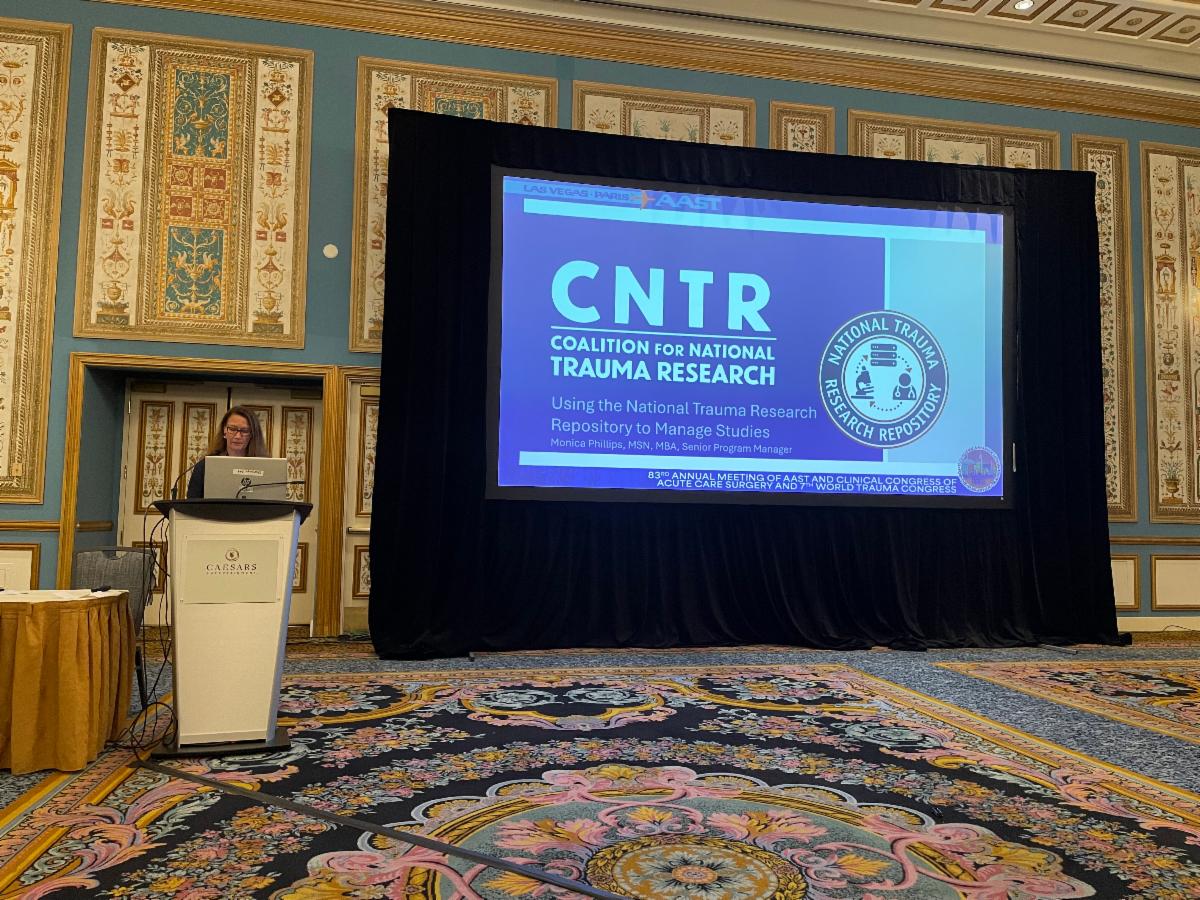
The Coalition for National Trauma Research had a big presence at last month's 83rd Annual Meeting of the American College of Surgeons in Las Vegas. Aside from our usual informational booth, where we educated attendees about our study management services and new investigator resources, CNTR featured prominently in several presentations and posters.


Read our AAST Recap

NTRAP Research Gaps Spotlight


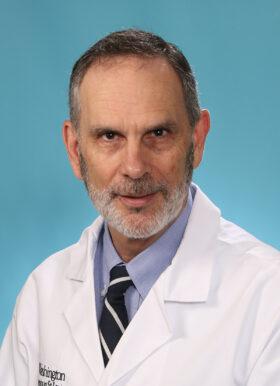
Jeff Bailey, MD, NTRAP Trauma Systems & Informatics Research Gap Delphi Panel leader.

Top Priorities for Research in Trauma Systems & Informatics

Each month in 2024, we're showcasing the highest priority research gaps identified by panels of subject matter experts in 11 topic areas as part of the National Trauma Research Action Plan (NTRAP). Following are the top three gaps identified by the Trauma Systems & Informatics Panel:


  • In severely injured trauma patients in hemorrhagic shock, does the use of pre-hospital blood products decrease mortality compared to saline or no infusate?
  • Does routine use of prehospital transfusion (pRBC vs liquid plasma vs whole blood) in trauma patients (including non-compressible torso (and/or junctional) hemorrhage) improve outcomes in patients who do not have rapid access to a trauma center (within the golden hour) compared to those who do not undergo prehospital transfusion?
  • In combat trauma, do small surgical teams (5 or less personnel with one surgeon) at the casualty collection points (within 2km of the injury) decrease mortality versus TCCC and transport to a more robust surgical team (10 or more person team) or a Field Hospital?
Query NTRAP Data or Find a Study Topic
 

Secondary Analysis of NTRAP Resuscitation Research Gaps published in JTACS October Issue

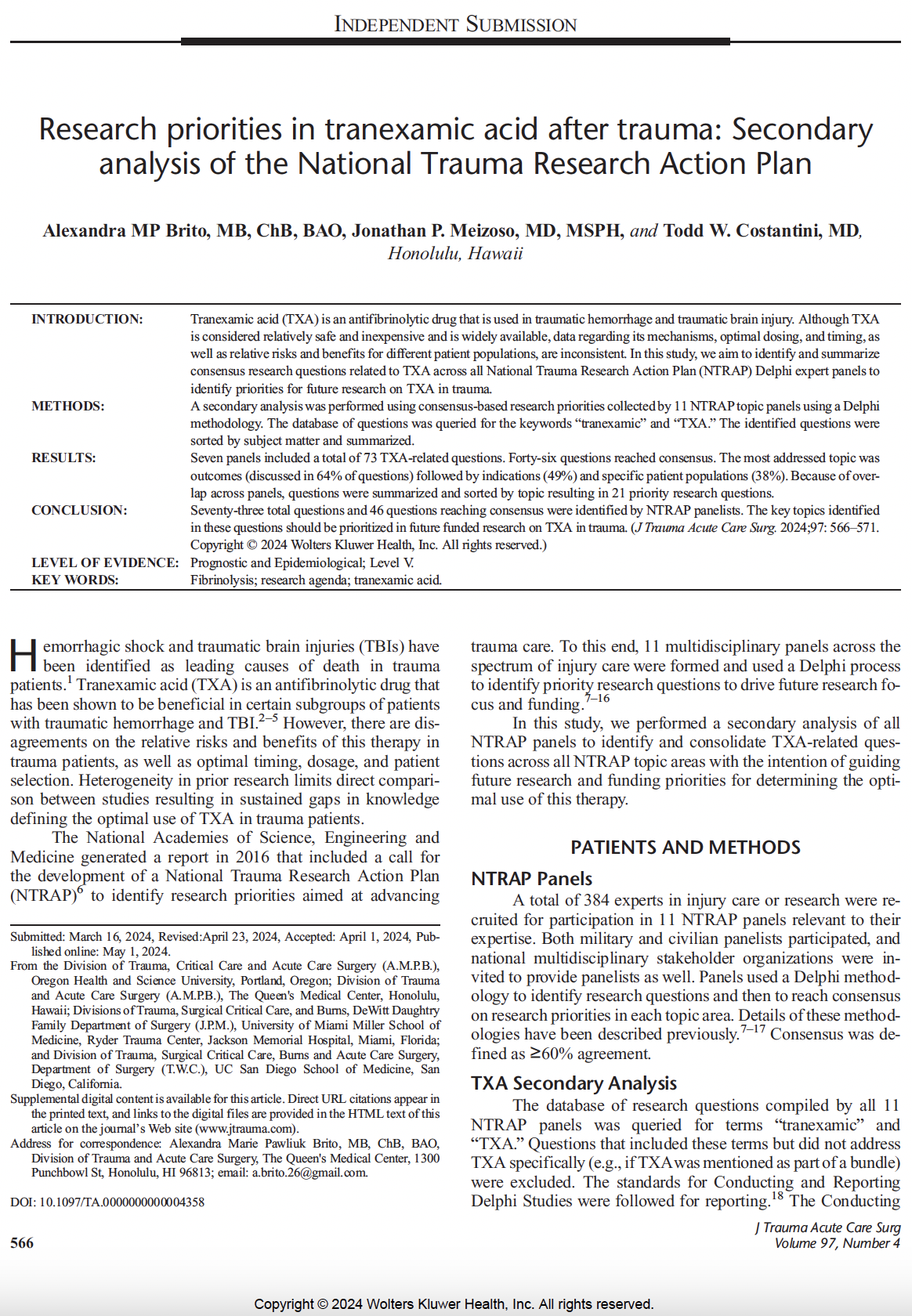
Alexandra Brito, MB, Johanthan Meizoso, MD, and Todd Costantini, MD published a new analysis, "Research priorities in tanexamic acid after trauma: Secondary analysis of the National Trauma Research Action Plan." The researchers identified 73 TXA-related questions identified across seven of the 11 NTRAP panels, 28 of which were highly prioritized. Generally, research topics relate to specific patient populations, setting/timing, indications, dose, route and outcomes.


Read the Article

 
X  LinkedIn