|
|
|
POLICY & ADVOCACY UPDATE
Issue #25, 11 July 2024
| | | |
- Government signals WHM second and third year will remain
- International student numbers continue to fall
- Latest International and National Visitor data
- ABS Staff and Business turnover
| |
|
Government signals WHM second and third year will remain
In good news for the industry, in a discussion paper released for comment on regional migration, the Government has sent a strong signal that it will not be accepting a recommendation of last year's immigration review panel to limit the Working Holiday Maker visa to one year. The government's discussion paper says, in part, that such a limitation would "would significantly damage local economies in regional Australia." However, they do say that "it is clear that worker exploitation in the Working Holiday Maker program has existed unchecked for too long and the Government will consider a range of options to address this as part of this evaluation." In our extensive engagement with Ministers and the department it is clear that the primary exploitation concerns are connected with the agricultural industry. Over the last 12 months, we have been advocating strongly against the government accepting the panel recommendation, and this comment in the paper was welcome.
In our response to the discussion paper, we will be:
- supporting the need for an ongoing regional work commitment for WHM to access second and third year visas but asking that the definition of specified work for our industry be expanded to embrace all regions, not just remote. Also, as a (possibly in part) alternative to regional work, the WHM could demonstrate mobility by working in different locations.
- seeking access by regional employers to all, or at least most, skilled occupations for both permanent and temporary migration sponsorship even if this means retaining two lists
- supporting greater connection to our pacific neighbours by potentially trialing apprenticeship opportunities in cooking.
- Improving responsiveness to regional needs by a better process in establishing and working within Designated Area Migration Agreements (DAMAs)
- Building on all of the arguments in our recently submitted comments on the Draft Core Skills Occupation List.
Our submission on regional migration is due in two weeks' time, so if members have any comments to contribute, these would be welcome by sending them to policy@accommodationaustralia.org.
| |
|
International student numbers continue to fall
In response to the negative media and public attention on migration, the government has introduced a range of measures in the last few months that have, and will, continue to see international student numbers fall. A slow-down in processing and a crackdown on dodgy providers largely in the VET system have resulted in only 330,500 approved student visas in the year to May 2024, which is back level with 2016 numbers, and well below the 577,300 approved in 2022-23. More recently, in a surprise move, the Government announced on 1 July 2024 a significant increase in the non-refundable student visa application fee, from $710 to $1600, making the fee the highest in the world and well above competing countries such as the US, Canada and the UK. This action to reduce international student numbers has the potential to hurt the availability of a vital source of workers for our industry, as well as having an economic impact on a major export industry, with a potential cost of over $5 billion to the economy and the loss of over 20,000 jobs in the international education sector.
As a consequence of these detrimental impacts, the independents in the House and the Senate have pushed back on the Government's proposed legislation to cap the number of international student places at each provider. However, given the Opposition's policy is even stronger on cutting back student numbers, any proposed amendments to the Bill may meet with limited success if the Opposition votes with the Government to support the caps.
In our own lobbying with relevant ministers on this, we have expressed concern that the student numbers should not fall below those experienced prior to the pandemic as the students are an important part of our workforce. Although we have been assured that it is not the intention of government to drop the numbers too radically, unfortunately in this type of market, decisions such as the visa fee increase could make a significant impact on decisions taken by students who may now choose to study elsewhere where they are made to feel more welcome.
| |
Latest International and National Visitor data
Tourism Research Australia recently released the latest data from the international and domestic visitor survey. In relation to domestic trips, the year ending March 2024 saw similar results when compared to year ending March 2023, with total spend up by 1% or $1.3 billion to $109.4 billion, overnight trips up 1% or 1.1 million to 113.0 million, but nights away from home were down 2% or 8.2 million to 401.2 million. Of those nights, 28.5% were spent in hotels/motels/resorts which was actually a higher percentage than for 2023. It also compares favourably to pre-COVID 2019, where 25.1% of nights by domestic tourists were spent in hotels and resorts. This compares with the 33.6% of nights spent by domestic tourists in the homes of friends and relatives, and only 9.3% of nights to March 2024 spent in rented houses and apartments.
International visitation to Australia continues to recover, with 7.2 million trips to Australia recorded in the year ending March 2024. The top reasons for travel to Australia in the year ending March 2024 were:
- Holiday travel with 2.9 million trips, 75% of March 2019 levels, with spend $9.7 billion, 96% of March 2019 levels.
- Visiting friends and relatives was 2.5 million trips, equivalent to year to March 2019, with spend in Australia $4.8 billion, 15% up on March 2019 levels.
- Business travel with 742,000 trips, only 74% of 2019, but spend in Australia was $2.1 billion, which was 93% of March 2019 levels.
- Education with 463,000 trips, 9% of year to March 2019, and spend in Australia $11.3 billion, 97% of March 2019 levels
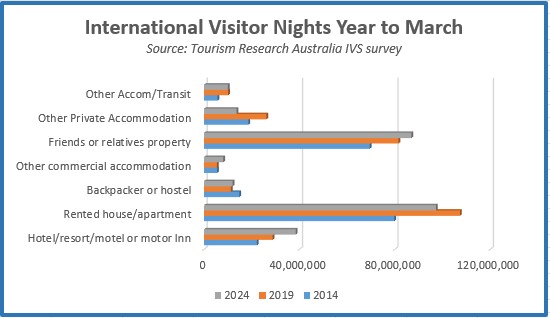
International visitors spent 267 million nights in Australia in the year to March 2024, and the graph below shows how this compares with 2019 as well as ten years ago in 2014. Importantly, the share of the nights spent in hotels/resorts has risen from 10.6% in 2019 to 14.4% in the year to March 2024. The share of nights spent in rented houses and apartments, at 36.5%, is much higher for international visitors than for domestic tourists, due to the number of students and visitors primarily here for study or employment.
| |
|
ABS Staff and Business turnover
The most recent survey of employed people indicated that in the year to February 2024, job mobility, which measures the frequency of job changes, decreased by 8%. Unsurprisingly, younger workers are more mobile than older workers, with 13% of people aged 15 to 24 years changing jobs over the year. Of the 14 million people employed in February 2024, over half (57%) had been employed in their current job for less than 5 years. About 19% had been in their job for less than one year.
Of those who started their current job in the year ending February 2024, 1.5 million entered or re-entered employment without any previous job activity during the last 12 months (i.e. they did not change jobs during the year). These 'new entrants' into employment include people who have never worked before and started their first job, started a new job after leaving or losing a previous job more than 12 months ago or resumed a held job or returned to a previous job after a period of absence. Our industry, accommodation and food services, recorded the second highest number of new entrants, with Health care the industry with the greatest number. Our industry remains the highest ranked for job mobility, although the percentage fell from 19.1% in the year ending Feb 2023, compared with 15.7% in the year to February 2024. The industry with the second highest mobility was media and telecommunications, with agriculture experiencing the lowest mobility.
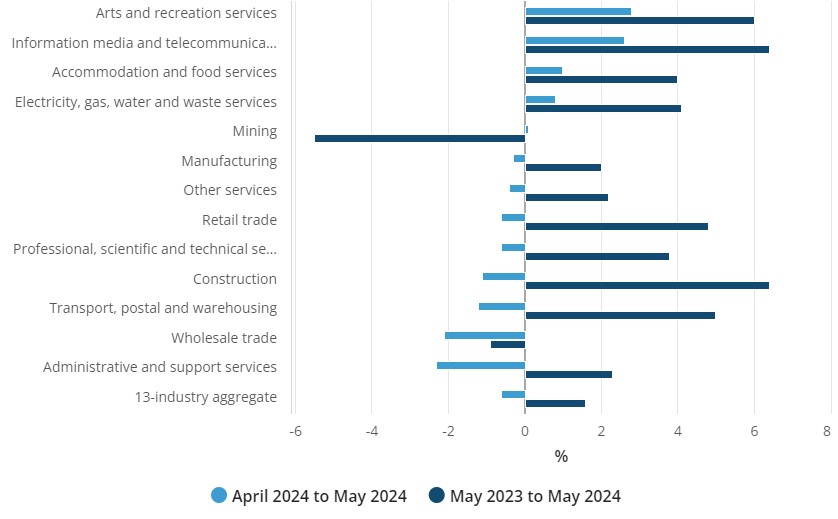
In the latest data on business turnover released for the month and year to May 2024, turnover in our industry sector rose higher than the all-industry average for both May 2024 and the year to May. As the graph below shows, across a 13-industry aggregate, turnover actually declined by 0.6% over the month, compared to a rise of 1% for accommodation and food services (AFS). Year-on-year rises were seen in 11 of 13 published industries, with an average rise of 1.6%, compared with an increase across the year for AFS of 4%. For the year, industries with a stronger performance than ours included construction, transport, media, arts, and retail.
ABS Business Turnover indicator seasonally adjusted
| |
|
Drop me an email at policy@accommodationaustralia.org or give me a call on 0418 277 919 if you have any national policy issue that you think AA should be following up. If you know an AA member who is not receiving this advocacy report but wants to, then encourage them to email me and we can add them to the distribution list.
Kind Regards
Jenny Lambert OAM
National Policy & Research Advisor
Accommodation Australia
| | | | |