Trump Administration Ends Effort to Seize Minor Patients’ Records from UPMC’s Gender-Affirming Care Clinic | | |
The Trump administration has dropped its appeal after young patients from UPMC’s gender-affirming care clinic and their families, represented by the Public Interest Law Center and Ballard Spahr, successfully quashed a subpoena from the Department of Justice seeking their personal healthcare records.
“That’s a win for patients, but it came with a great cost,” said Law Center legal director Mimi McKenzie. “They faced the possibility of harassment from the federal government and the fear that their private healthcare records would be in the hands of people who think that transgender and nonbinary people shouldn’t exist. And that’s not speculation; that’s based on the statements of Trump’s own people, including the then-attorney general. In seeking these records, the administration’s goal was to scare patients from seeking this healthcare and intimidate providers from offering it.”
Healthcare providers around the country have been caving to the administration’s demands and agreeing to end gender-affirming care and even create “de-transition” clinics. Gender-affirming care is legal in Pennsylvania; gender-based discrimination is not. The Law Center has called upon UPMC to follow the law and not cave to a hostile administration.
Read more here.
| | Under Threat of Litigation, School District of Philadelphia Fixes Policy for Students with Disabilities | | |
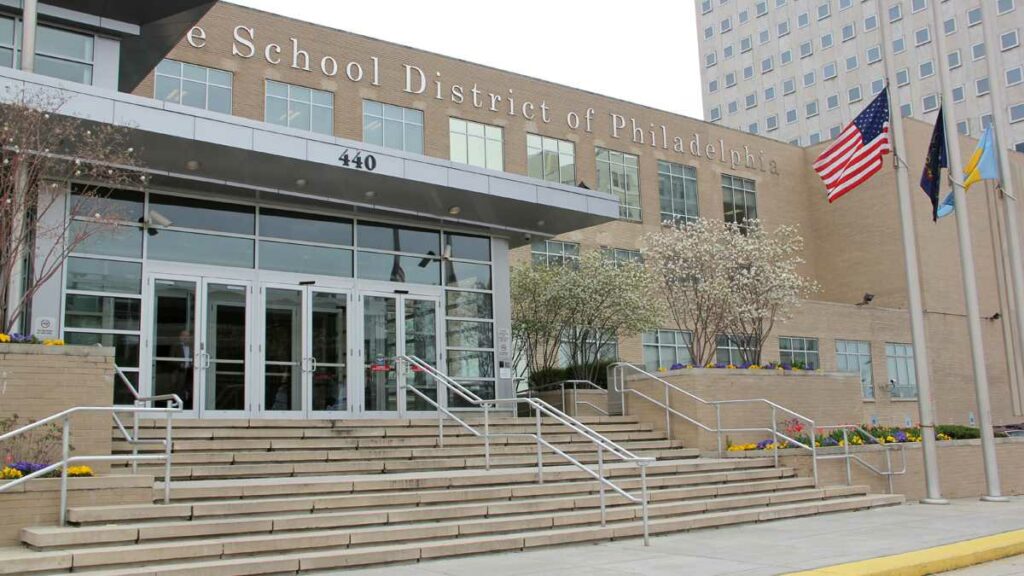
Under threat of litigation from a family represented by the Public Interest Law Center, the School District of Philadelphia changed its “criteria-based school” application process for students with disabilities. This change removes a policy that, among other things, punished students with disabilities who requested a reasonable accommodation through a process known as Individualized Review.
Seeking to end this policy, the Law Center, on behalf of a child punished by this double-bind, alerted the district that it intended to file a lawsuit alleging the policy violates the Americans with Disabilities Act and the Rehabilitation Act.
The district asked to enter settlement discussions and soon entered into an agreement to change the policy. Now, impacted students may seek reasonable accommodations in their application process.
And there is no punishment for doing so.
Read the Inquirer’s coverage here.
| | Defending Hard-Won Tenant Protections | | |
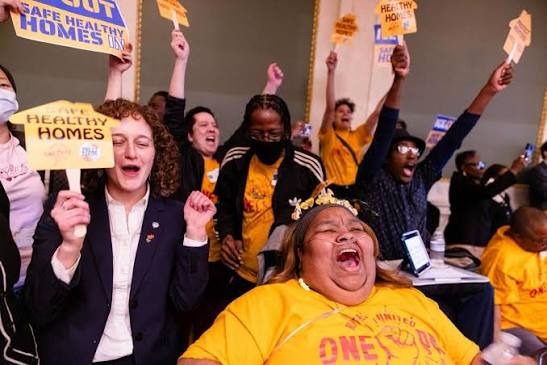
Housing advocates celebrate the passage of Safe Healthy Homes
Earlier this year, after a decade of advocacy from renters, Philadelphia City Council passed the Safe Healthy Homes legislative package, strengthening tenant protections in the city to safe, stable housing.
As the legislation was pending, the board president of the Homeowners Association of Philadelphia (HAPCO), a landlord lobbying group, filed suit to enjoin it. HAPCO’s suit does not challenge any specific piece of the legislation but rather argues that the entirety of it places large “cumulative burdens” on small landlords.
On behalf of two renters’ rights organizations, TURN and OnePA, we filed a brief in support of the city’s motion to dismiss the litigation. We argued that enshrining or strengthening existing rental protections come nowhere near demonstrating a violation of a landlord’s constitutional rights.
Read our full brief here.
| Advocating for Proactive Rental Inspection Ordinances | |
Almost one in ten rental units in Pennsylvania qualifies as either moderately or severely inadequate, meaning they may have water leaks, cracked walls or ceilings, or lack consistently functioning toilets, hot or cold water, or working heating equipment, among other serious problems. This damaged and dilapidated housing stock causes injuries and exacerbates chronic health conditions, such as asthma. Housing advocates and experts largely agree that one of the best ways to ensure safe and healthy housing is to pass proactive rental inspection ordinances.
These ordinances work because they result in a vastly increased number of rental inspections to identify housing code violations. They've been shown to improve the quality of rental housing as they decrease health conditions associated with substandard housing, like childhood lead poisoning.
The Law Center filed a brief in support of affirmative housing inspections on behalf of TURN and OnePA. In it, we argued that these ordinances are a critical tool for ensuring that Pennsylvania residents have safe, healthy homes, and that they are consistent with constitutional protections against unreasonable searches.
Read our brief here.
| Advocating for Transparency About Riverview Wellness Village | |
The Law Center filed a brief on behalf of our client Coleman Terrell supporting his right-to-know request for records created for use at Riverview Wellness Village. Riverview is a recovery center operated by the city of Philadelphia where patients reside and receive treatment for addiction. It opened to much fanfare in 2025 and the city is directing millions of dollars—including almost two-thirds of the city’s opioid settlement funds—into the creation and operation of the program.
After the Office of Open Records ordered production of resident and orientation handbooks, an orientation presentation, and other standard forms given to residents upon their admission to Riverview, Merakey Parkside Recovery appealed, claiming that the records are confidential and proprietary and trade secrets. But as we argue in our brief, these records are not, in fact, confidential. The Right to Know Law was passed so that the public can have oversight of what public agencies are doing with public money, and the city’s third-party contractors cannot cherry-pick materials to withhold from the public eye without basis.
Read our brief here.
| | “You Have Options for How to Vote, and You Will Get to Vote” | | |
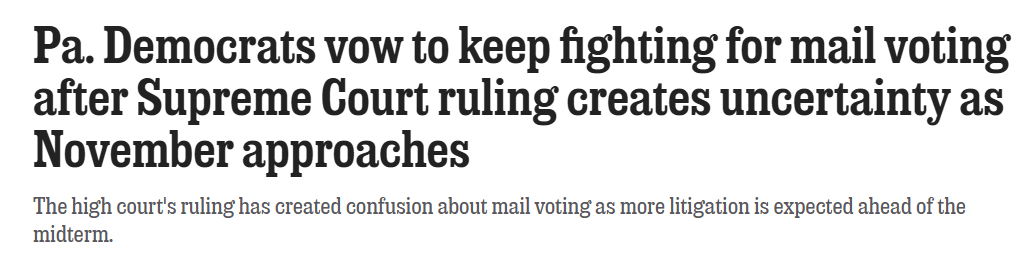
The Inquirer spoke to Law Center senior attorney Ben Geffen and several other voting experts about the U.S. Supreme Court’s decision on mail-in voting.
“Whatever may ultimately happen in this litigation, I’m pretty skeptical that anything is going to change for this November’s election,” said Ben Geffen, staff attorney at the Public Interest Law Center in Philadelphia, a nonprofit group that monitors election issues. . . .
“Turning that battleship around in a matter of days is extremely unlikely,” Geffen said. . . .
Geffen’s advice for those concerned is to start early. Get your mail ballot application in right away, and as soon as you receive your ballot, fill it out and return it. For now, you can still send your ballot through the U.S. mail. But you can also drop it off at your county election board, and many counties offer satellite locations and drop boxes.
If you prefer to vote in person on Election Day, go in the morning, he said.
“You have options for how to vote, and you will get to vote. Nobody’s taking away the election, and just jump on it early,” he said.
Read the full story here.
| | WHYY Reports on Tenant Organizing | | |
WHYY published an article about the growing power of organized renters in Philadelphia, referencing the recent settlement of a class action lawsuit brought by the Law Center against Odin Properties, the passage of the Safe Healthy Homes Act, and the efforts of Renters United Philadelphia.
You can read the article here.
| | Brent Landau to Speak About the Pennsylvania and U.S. Constitutions | |
Law Center Executive Director Brent Landau will speak at “A Constitutional Celebration: How the U.S. and PA Constitutions Shape Us” on September 28, 2026 at the Parkway Central Library. Sponsored by the Law Center in collaboration with Pennsylvanians for Modern Courts and Carpenters’ Hall, panelists will explore how the federal and state constitutions have jointly shared our rights, government, and civic life.
Register here.
| Special Education Legal Clinic | |
On September 29, 2026, in partnership with Lift Every Voice Philly, the Law Center will hold a free Special Education Legal Clinic at 3675 Market Street in Philadelphia. Attendees can expect a know-your-rights training, 1-on-1 legal help, dinner, and childcare.
Register here.
| Get your Tickets to A Night of Impact | |
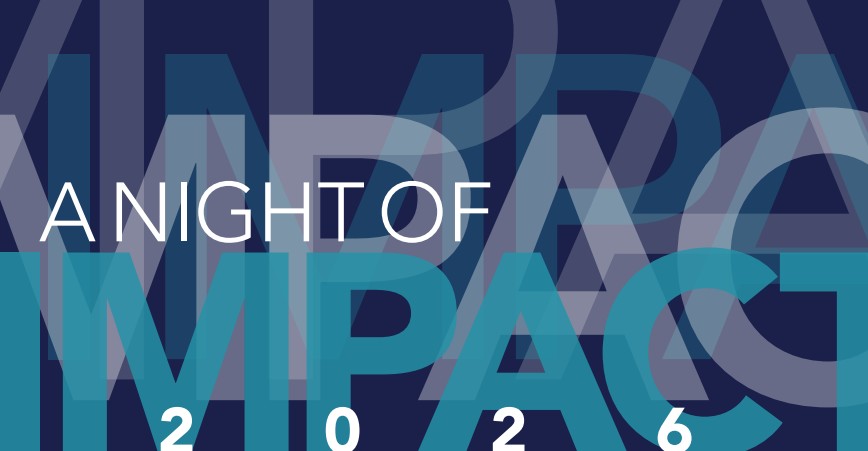
You’re invited to our annual celebration! Please join us for A Night of Impact from 6-9 p.m. on October 8, 2026 at the Bellevue in Philadelphia as we celebrate the Law Center’s work to protect fundamental civil rights across Pennsylvania and beyond. This year we are honoring our anonymous young clients and their parents who won important rulings protecting private medical records, and our pro bono co-counsel in those cases, Ballard Spahr.
The evening includes a cocktail reception, plated dinner, silent auction, and more festivities. Individual tickets are $250, with discounted tickets of $100 available for teachers, students, and non-profit colleagues. Click the link below to get yours today
| The event is generously supported by our sponsors: you can see a list here. It’s not too late for your firm or business to join! Download the sponsorship packet for details. | | This fall, the Law Center is welcoming three legal interns to our office: Sarah Hahn DuPont is a 2L at Temple Law School, Joe Mariani is a 2L at Penn Carey Law School, and Sam Sheldon is a 3L at Penn Carey Law School. We are excited to have them here! | | |
Please consider making a contribution to support our work:
| | The official registration and financial information of the Public Interest Law Center may be obtained from the Pennsylvania Department of State by calling toll-free, within Pennsylvania, 1-800-732-0999. Registration does not imply endorsement. | | | | |