Whether a story is for online publication within an hour or magazine publication within weeks, it is always crucial to follow a set of principles that define good journalism. Anything less than meticulous journalism can have catastrophic consequences.
“The moment they can undermine practically anything that you say in a particular piece means that that piece suddenly becomes worthless,” says Yvonne Rolzhausen, research chief at The Atlantic. “There are lawyers out there who literally just trawl all day long news reports to see if someone has basically made an accusation against their clients that they can then go after and sue.”
Sourcing your story
- Find the source closest to the story, whether that’s a local reporter over a national one, or the case detective rather than the police chief.
- Websites are often wrong. Always verify the credibility of online sources and where they are getting their information.
- If your story identifies a person or entity, be sure to seek comment from them. If necessary, you can point to a statement or comment given to someone else, as long as it tells their side of the story.
- “Every lawyer out there says an anonymous source is a non-existent source because they’re not going to show up in the courtroom when we get hauled in for libel,” says Rolzhausen.
- Go back to each of your sources and confirm the quotes that you will publish, even if you think they might change their mind and blow up your story. “Any good editor wants it to blow up prior to publication,” Rolzhausen says. “I can then figure out, ‘Have we made a mistake … is this so legally problematic that we should be getting a lawyer involved?’ ”
Exercise care and caution
- Every piece of your story must be verified, even if it only seems like a minor detail.
- Only state facts and never assume. If your story is about an arsonist who hasn’t been charged in court, they are an alleged arsonist, even if there was an eyewitness or confession. If you don’t know what Rolzhausen describes as a “full enough understanding” of the facts, keep interviewing people who do.
-
Be aware of biases in yourself and others. “We all have biases. We all reinforce our own biases all the time,” Rolzhausen says. For a list of different types of unconscious biases, click here.
Journalistic principles
- The same fact-checking fundamentals and journalistic principles apply regardless of the length of the story.
- Showing both sides of the story is not necessary when one side of the story doesn’t represent fact. For a climate change article, your story doesn’t need to give credence to deniers, since thousands of scientific studies back up climate change. “You have to ask yourself if you’re being unfair to the truth,” says Rolzhausen. However, if your article calls out an individual, it is best practice to seek comment from them.
- Following journalistic principles can help protect you from libel-related lawsuits.
|
|
Jill Geisler, Bill Plante Chair in Leadership & Media Integrity at Loyola University Chicago and Freedom Forum Fellow in Women’s Leadership, with one strategy for managers to make their teams more efficient.
|
|
|
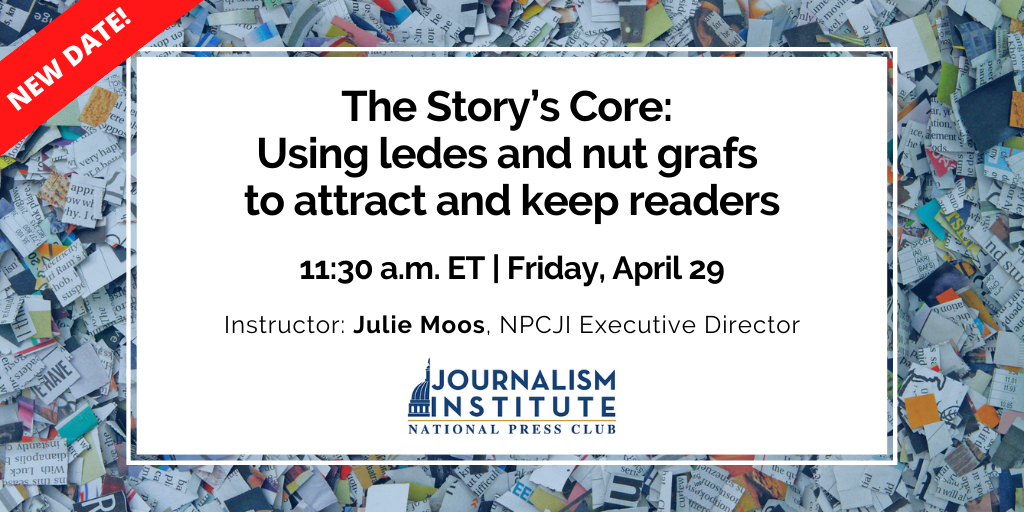
Every story competes for attention and must earn its readers by making a clear promise to deliver relevant information. Headlines may hook us, but ledes draw us in, and nut grafs keep us.
As journalism changes, this is constant: Readers must know what’s at stake in a story and why it matters to them (or should). This hour-long, hands-on workshop for reporters and editors will demonstrate how to make those stakes clear by:
- Deconstructing the difference between ledes and nut grafs
- Identifying common mistakes in crafting nut grafs
- Offering solutions that help an inclusive community connect your journalism to their lives
Registration is open for this program, which will take place from 11:30 a.m. to 12:30 p.m. ET Friday, April 29, on Zoom. Registration is $25. Tickets for National Press Club members are $20.
|
|
This newsletter is written & edited by the National Press Club Journalism Institute staff: Beth Francesco, Holly Butcher Grant, and Julie Moos. Send us your questions and suggestions for topics to cover.
|
|
|
|
The National Press Club Journalism Institute promotes an engaged global citizenry through an independent and free press, and equips journalists with skills and standards to inform the public in ways that inspire a more representative democracy. As the non-profit affiliate of the National Press Club, the Institute powers journalism in the public interest.
|
|
|
|
|
|
|