|
|
|
POLICY & ADVOCACY UPDATE
Issue #15, 22 February 2024
| | | |
- AA Board Elects new President
- Closing Loopholes IR Bill passed into law
- Information session for members on new migration strategy
- AA at Friends of Tourism Event
- Occupancy Rates and the Tay Tay factor
- Overseas Arrivals
- More activity on STRA regulation
- FWC application to increase housekeeping wages a "no show"
| |
AA National Board Elects new Chair
At its meeting in Sydney this week, the Accommodation Australia Board elected a new National Chair, David Mansfield, to take over the leadership reins following the resignation of Leanne Harwood who has taken up a new role within IHG based in the US. David has been an integral part of the AA board since the amalgamation last year and was Vice President of the Accommodation Association of Australia before that. The new Chair has more than 35 years' experience in the accommodation sector and is currently the Managing Director of The Ascott Limited, responsible for overseeing Ascott’s managed operations throughout Australia including brands such as Citadines, Oakwood, lyf and Quest Apartment Hotels (see full media release).
Also at the meeting, the AA Board discussed the Closing Loopholes legislation (see below), the implications of the drop off in apprentice chefs, short term rental regulation and migration, as well as receiving an update on the progress of the Austrade grant project for the creation of a jobs and skills platform.
| |
Closing Loopholes IR Bill Passed into Law
The Government was successful on the 12th of February in passing the Closing Loopholes Bill with the support of two independent Senators including Pocock. Just prior to the Bill passing, we had a meeting with Burke’s office after the media had already reported they were close to a deal, so the meeting dialogue reflected that “done deal” situation. For his support, Pocock wanted a range of changes to Bill, including the casuals provisions. These generally make the laws more workable, particularly when added to the changes already negotiated by the AHA/AA on behalf of members at the end of last year. A summary of the additional amendments for casuals is as follows:
- Repealed the existing requirement on businesses to offer conversion, providing a single legislated pathway for casual conversion (i.e. the employee choice pathway). This will relieve the existing administrative burden on employers and make the process by which an employee can seek to convert to permanency simpler.
- Delayed commencement of the casuals provisions until six months after Royal Assent (August) to give stakeholders time to prepare for the new arrangements.
- Ensured the employment contract can still be considered by the FWC in determining whether an employee is casual or not
- Ensured that a single criterium such as regular hours should not establish a firm advance commitment to continuing and indefinite work.
- Clarified that an employer may be able to offer or refuse to offer work to a casual employee.
- Broadened the capacity for employees to enter into fixed term contracts as casual employees. The amendment would ensure all other employees may be engaged on fixed term contracts as casual; except for academics covered by certain modern awards in the higher education sector. This largely resolves concerns raised by on-hire companies offering temp contracts.
- Made it simpler for business, especially small business, to refuse casual conversion by removing the requirement to provide a ‘detailed’ statement of reasons
- Allowed employers to refuse an employee request for conversion on “fair and reasonable operational grounds”
- Lowered the barriers to casual employees in the APS converting to permanent and enabling them to apply to the FWC to deal with disputes about casual conversion.
The Bill required one more amendment which passed last week to remove any prospect of criminal sanctions on employers who do not abide by the new laws (pushed for by the Greens) for the right to disconnect. The AHA/AA legal and WR team is here to assist all members navigate the new requirements.
| |
Information session on new migration strategy
The Department of Home Affairs has set up a tailored briefing for the tourism and hospitality sectors on the new migration strategy and its implications for visa sponsorship for Wednesday, 28 February 2024 at 1 pm AEST. This is an on-line briefing so is open to any member regardless of location. You do need to register for the event by emailing your interest to biro.qld@homeaffairs.gov.au no later than close of business Monday, 26 February 2024. A teams link will be provided to those that express an interest in attending.
| |
AA at Parliament Friends of Tourism event
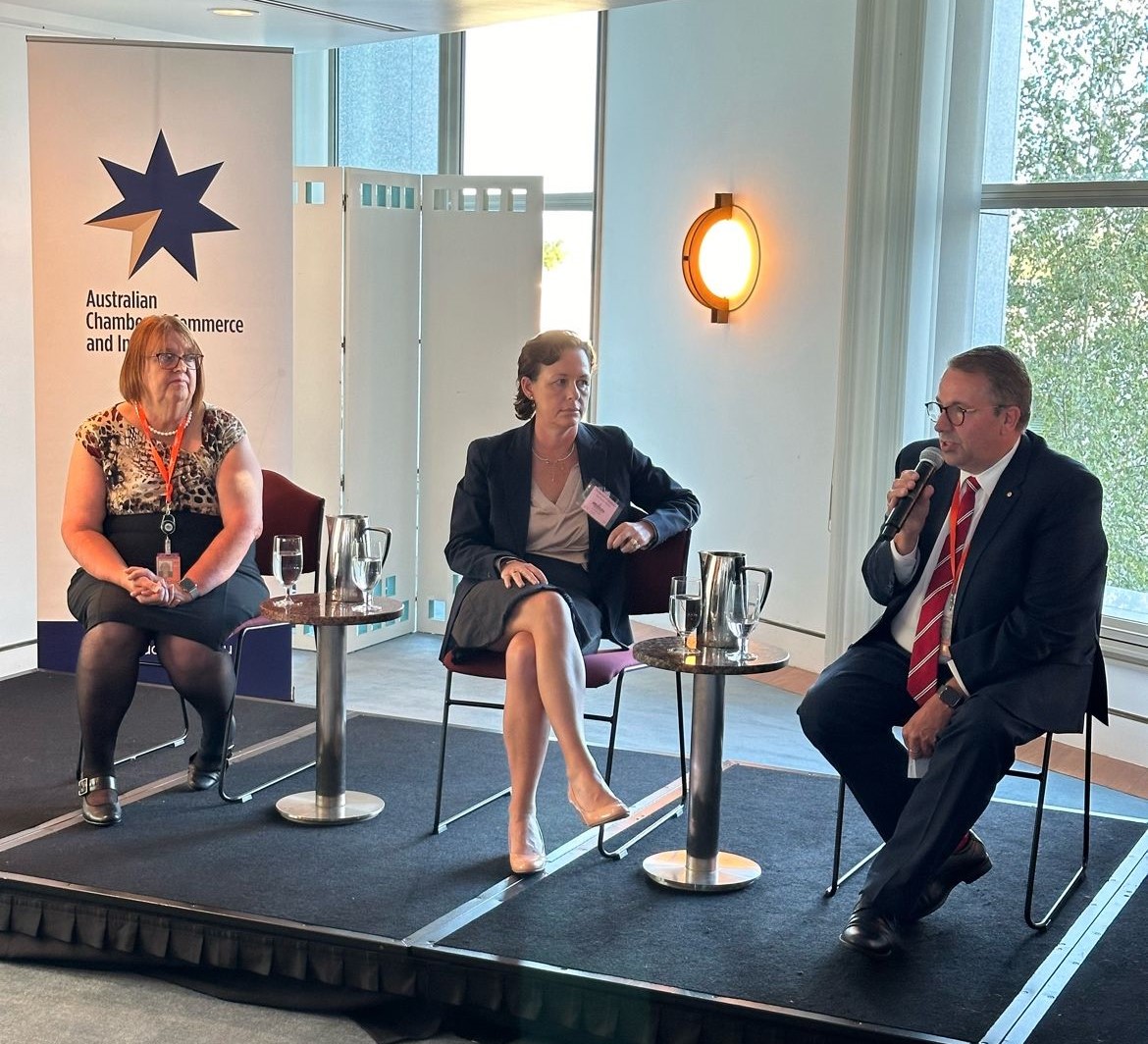
Last week AA was back in Canberra participating in an Australian Chamber Tourism Committee meeting and also a well-attended Parliamentary Friends of Tourism (FOT) event in Parliament House. The Committee meeting discussed the progress of the Tourism Strategy, Thrive 2030, and how best to progress the key common issues facing tourism issues both via the strategy and through direct advocacy. The FOT event, hosted by Tourism Training Australia (Chair John Hart OAM), was attended by the Minister for Tourism, many other Shadow Ministers and backbenchers from both sides of the aisle and the Board of Tourism Australia who were meeting the following day. The focus of the panel discussion in which I participated (see picture) was about workforce and skills for tourism and the need for more support from Governments both state and federal.
| |
|
|
Occupancy Rates and the Tay Tay factor
With Pink and then Taylor Swift concerts having such a major impact in the community, the media engagement with AA in both Sydney and Melbourne has been "off the charts", with CEO Michael Johnson and AA Vic Manager Dougal Hollis doing countless interviews in the mainstream media. Room occupancy in Melbourne was over 80% for the week leading up to the concerts and over 90% on concert days with a very strong ADR. Similarly in Sydney occupancy from the 19th was over 90% which eclipsed (but only just) the occupancies of the previous year which were boosted by World Pride.
According to the latest data from STR, the national average occupancy rate for January 2024 was 67.2% compared with 65% in January 2023, with the year to January figures being 67.2% up from 65%. For January 2024, Adelaide, Melbourne, Perth, Sydney, Gold Coast and Hobart experienced above average occupancy, and of these only the Gold Coast was lower than the previous January. Interestingly, the national average daily rate was lower than January 2023 ($257 v $262), but RevPAR was slightly up ($172 v $170).
| |
|
Overseas Arrivals for December
A total of 876,860 short-term visitor arrivals were recorded for December 2023, an increase of 227,890 compared with the corresponding month of the previous year. Preliminary total arrival figures (including returning Australians) for January 2024 were 2.12 million compared with only 1.6 million for January 2023 which demonstrates how strongly total overseas travel as returned. The visitor arrivals for December were still over 200,000 or 19% less than pre COVID December 2019. In the calendar year 2023, the median duration of stay in Australia was 14 days, down from 18 days in 2022. For 2023, 40% of short-term visitor arrivals were for holiday, 37% visiting friends and relatives and 6.2% business.
| |
|
More activity on STRA regulation
A bill was introduced this week in the WA Parliament to implement the policies announced last year to tighten regulation of Short-Term Rental Accommodation. The introduction of new legislation comes as a growing number of property owners take up a $10,000 incentive payment to switch from the short stay to the long-term rental market. Under the new regulations, owners must register their STRA properties before they can advertise and take bookings, including on online booking platforms. AA in WA remains active in advocating over the detail of the Bill to ensure the best possible outcome for members.
Meanwhile in NSW, the State Government has released a discussion paper that explores the options for further regulation of STRA. NSW already has a registration system, and the paper explores additional approaches including a levy (such as was introduced in Victoria) and caps. AA is currently drafting a submission in response to the discussion paper and also by way of follow up to the meeting we held with the office of the Minister for Housing earlier this month.
In addition, AA has in the last week engaged with the SA government as well as the City of Adelaide over STRA, and in Tasmania, as part of the election campaign, the Tasmanian Liberals has announced they would seek to introduce a 5% levy on STRA should they be returned to government.
| |
|
FWC application to increase housekeeping wages a "no show"
As reported in the last advocacy update, on 13 February 2024, the Fair Work Commission listed an application filed in December to vary the Hospitality Industry General Award to raise the award wage for housekeepers on the basis that the wage is currently inadequate, does not reflect the value of housekeeping services, the skills needed to clean the room, and the wage is "only a fraction" of the revenue earned for the room. The AHA IR team appeared in the matter but the applicant was a "no show". The matter was listed for another day, and if the applicant does not turn up again, it is likely that it will be set aside.
| |
|
Drop me an email at policy@accommodationaustralia.org or give me a call on 0418 277 919 if you have any national policy issue that you think AA should be following up. If you know an AA member who is not receiving this advocacy report but wants to, then encourage them to email me and we can add them to the distribution list.
Kind Regards
Jenny Lambert OAM
National Policy & Research Advisor
Accommodation Australia
| | | | |