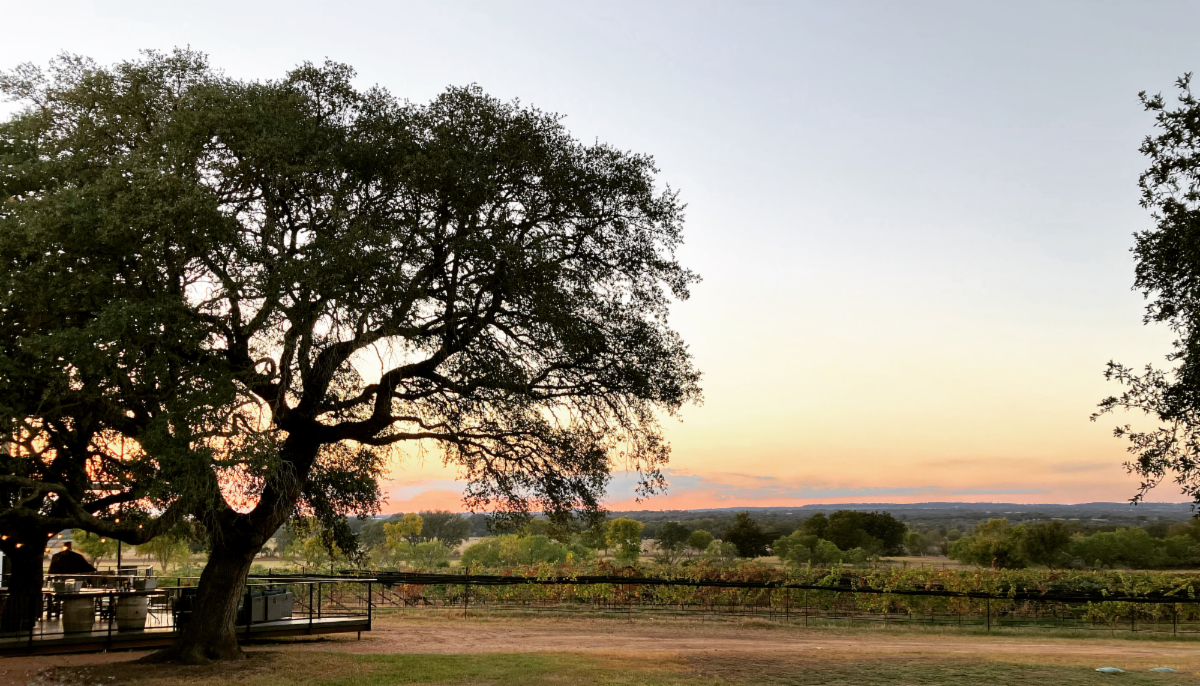
A Texas Hill Country sunset* |
|
ON LOCATION, IN REAL TIME |
|
November brought the most intensive travel schedule I've attempted since before the pandemic. Across three weeks and three states (Texas, Arkansas and California), I attended three conferences; hosted NGRA's Year-End Board meeting and dinner; toured beautiful (and tasty) Arkansas Wine Country and sampled muscadine grapes and wine, both for the first time. Here are some highlights:
At NGRA's Board meeting in Fredericksburg, TX: In our first gathering since our strategic planning meeting in July, our highly engaged Board of Directors clearly had been ruminating about "NGRA 2.0" and our research mission. With a new strategic plan to be ratified in January, and plans to revisit our industry-driven research priorities and brainstorm new and needed research in 2023, the new year is coming into exciting focus.
At the Texas Wine and Grape Growers Association's Grape Camp in Dripping Springs, TX: I met grape growers in Texas growing the Pierce's disease-resistant vines from Dr. Andy Walker's UC Davis breeding program. They had interesting—and hopeful—observations about the promising varieties' performance and seemed thrilled to have a front-row seat as research outcomes literally take root.
At the Arkansas Association of Grape Growers' annual conference in Springdale, AR (where I gave a talk about industry's role in research): I learned from fellow speaker Dr. Margaret Worthington of the University of Arkansas System Division of Agriculture about breeding efforts to improve muscadines for broader fresh-market appeal. That means developing seedless berries with thinner skins and firmer flesh. She and her breeding team hope to release two new muscadine grape cultivars in 2023.
At the Vineyard Team's Sustainable Ag Expo in San Luis Obispo, CA: I felt lucky to be in the audience to hear early, not-yet-published research from Dr. Marc Fuchs' Cornell lab that seems to have confirmed, under field conditions, that the three-cornered alfalfa hopper is in fact a (if not, the) vector for grapevine red blotch virus.
Beyond all that I learned and saw during my travel marathon this month, the best part was the immersion in the community of people who believe in science as a means of advancing the grape and wine industry. I met amazing new colleagues and joyously reconnected with others I hadn't seen in years. It was energizing yet exhausting—and I'd do it all again. Why? Because it's critical for our national organization to be engaged in conversations about grape research, on location and in real time.
To all of you I met and reconnected with, thank you—it was an absolute blast!
|
|
|
|
|
*ABOUT THE PHOTO:
William Chris Vineyards in Hye, TX, provided ample Southern hospitality, including this expansive vineyard view and dreamy sunset, for NGRA' Board dinner on November 1.
|
|
$50M Gift Funds New Texas A&M Center, Degree Programs |
|
Texas A&M University alum Arch “Beaver” Aplin III—creator of the iconic Texas-based Buc-ee’s chain of service stations and one of the university’s most successful entrepreneurs—is contributing $50 million toward establishing a hospitality entrepreneurship program and academic center at the College Station campus. The Aplin Center, which is still in the early planning stages, is envisioned to offer programs in hospitality, retail studies and food product development, as well as degree programs in viticulture, fermentation processes, coffee and food science. The facility also will house product development laboratories and food tasting centers. Key academic partners will be the university’s College of Agriculture and Life Sciences and the Mays Business School. |
|
UC Names Two New Agricultural Experiment Stations |
|
UC Merced and UC Santa Cruz this month were named agricultural experiment stations (AES). They are the first campuses in the University of California (UC) system in more than 50 years to earn the designation. “With the AES designation, Santa Cruz and Merced have the potential additional funding from the university’s budget for (agricultural) research, and they will be able to make a stronger case for competitive grants in the larger research area,” said UC President Michael Drake, announcing the new designation.
Three other UC campuses—Berkeley, Davis and Riverside—hold the AES designation and bring their individual expertise to California agriculture. UC Merced, in the central San Joaquin Valley, home to vast table and wine grape production, adds an engineering perspective through its focus on precision agriculture, including robotics to improve the food-water-energy nexus. Scientists there also look at agriculture through the lens of management of complex systems by examining water, climate and wildfire challenges; examine opportunities in soil health, air quality and the reuse of agricultural byproducts; and delve into social justice by investigating the labor force and agriculture’s effects on the communities of the San Joaquin Valley—including public health impacts and disparities. UC Santa Cruz has a long history of groundbreaking work in agroecology and regenerative agriculture. With its Center for Agroecology and ongoing efforts among campus researchers to find new ways to fight agricultural disease and pests without using chemicals, the campus has a well-earned reputation as a trailblazer in organic agriculture.
|
|
Arkansas Wine Pioneer Mathew Post Passes Away |
|
Mathew Joseph Post, Sr., a pioneer of the Arkansas grape and wine industry, passed away October 20, 2022, at the age of 97. His family’s Post Winery is the largest wine producer in the state and a cornerstone of the Arkansas Wine Producers Council, a longtime NGRA member-organization.
Mr. Post was a prolific supporter of the University of Arkansas’ Division of Agriculture, working with scientists there on numerous grape and wine research projects, providing land, equipment, labor and grants. Among his many accomplishments, Mr. Post was recognized in 2016 by the Arkansas Association of Grape Growers with an Outstanding Achievement Award for his decades of work in propelling the grape and wine industry in Arkansas. In addition to introducing the French-American hybrid Seyval Blanc and the native hybrid Steuben to Arkansas, he worked closely with Third District Congressman John Paul Hammerschmidt to establish the Altus Viticultural Area in 1984. He also was first to introduce muscadine grape production on a commercial scale. In 2004, Post was awarded the prize of Supreme Knight by the Brotherhood of the Knights of the Vine. The honor is bestowed on only a few individuals nationally and is reserved for those who are deemed to have made “monumental” contributions to the industry. He was also inducted into the Arkansas Agricultural Hall of Fame in 2012.
|
|
Melissa Hansen Wins Walter Clore Award; WA Concord Update |
|
At the Washington State Grape Society annual meeting this month, Washington Wine Commission Research Program Director Melissa Hansen, an NGRA Board member, was honored with the Society’s Walter Clore Award. As Washington State University viticulturist Michelle Moyer noted in presenting the award, Melissa “burns the candle at both ends with [her] work ethic” and has “worked tirelessly for agricultural commodities for 35 years.” Her career spans 20 years covering the grape industry for Good Fruit Grower magazine and, before that, working for the California Table Grape Commission.
In addition to honoring industry leaders, the event provides an update on the latest research and on the state's Concord crop for the year. Gary Schrimsher (formerly vineyard manager for Snake River Vineyards in Walla Walla) took home the Lloyd H. Porter Grower of the Year award. And Trent Ball of Yakima Valley College gave the “State of Grapes” economic update and outlook. He reported that Washington’s cash price for juice grapes rose over $100 per ton in 2022 to $407. The state’s Concord growers harvested 157,000 tons this year, averaging 9.9 tons per acre. There are just under 16,000 acres in Concord production there.
|
|
Wine Enthusiast Recognizes Smoke Researchers |
|
The trio of scientists working to resolve smoke exposure issues for the West Coast wine industry—Drs. Elizabeth Tomasino (Oregon State), Anita Oberholster (UC Davis) and Tom Collins (Washington State)—collectively won Wine Enthusiast Magazine’s Wine Star Award for Innovator of the Year. Their multifaceted research addresses analysis for smoke-exposed fruit, sensory perception and protocols, barrier sprays to prevent smoke compounds from entering grape berries, and lots of outreach to industry. “We’re making progress,” Tom says. “We are in a better place, certainly, than we were in 2008 when we first encountered smoke exposure effects in the U.S.” |
|
New Vit Advisor Coming to Northern San Joaquin Valley |
|
The University of California Cooperative Extension (UCCE) has named Dr. Justin Tanner as the new Northern San Joaquin Valley Viticulture Farm Advisor beginning January 3, 2023. His regional service area will include all of San Joaquin County and Southern Sacramento County, including the Lodi AVA, as well as vineyards and growers in Stanislaus County. He succeeds Paul Verdegaal who retired as the county viticulture advisor in 2018. |
|
Texas A&M Seeks an Assistant Professor & Extension Specialist |
|
The Texas A&M AgriLife Extension Service seeks a Ph.D.-level scientist, stationed at the Lubbock, TX, campus, to develop high-quality Extension educational information and presentations in support of county, regional and statewide programs on horticultural sciences and viticulture. The role also involves doing applied research in viticulture and vineyard management, producing educational programming and developing best management practices for managing vineyards in the Texas High Plains region. Learn more and apply by December 15, 2022. |
|
USDA Proposes New Import Rules for Chilean Table Grapes |
|
The USDA’s Animal and Plant Health Inspection Service (APHIS) proposes a revision to the conditions under which table grapes from Chile may be imported into the U.S. Currently, table grapes from Chile must be fumigated with methyl bromide as mitigation for the Chilean false red mite, Brevipalpus chilensis, and the European Grapevine Moth, Lobesia botrana. APHIS proposes that table grapes from areas in which the moth is either absent or at very low prevalence could be imported under a systems approach or irradiation. The systems approach would provide an alternative to methyl bromide (considered an ozone-depleting substance). APHIS prepared a pest risk assessment and a commodity import evaluation outlining the phytosanitary measures that could be applied to table grapes from new areas of Chile without increasing the risk of introducing pests. View and comment on the proposed rules by December 16, 2022.
|
|
HIGH-RESOLUTION VINEYARD NUTRITION:
MANAGING NUTRIENTS IN ARID CLIMATES
|
|
The NGRA-initiated HiRes Vineyard Nutrition research project launched a podcast this fall, ably hosted by Dr. Patty Skinkis, Professor and Viticulture Extension Specialist at Oregon State University, who also leads the Extension component of the project. In this second episode, Patty chats with Project Director Dr. Markus Keller, the Chateau St. Michelle. Distinguished Professor of Viticulture at Washington State University’s Irritated Agriculture Research and Extension Center. He shares how he came to lead the project, what they’ve learned so far and anticipates outcomes of the work. Read on for excerpts from the episode, or click to listen in on the complete conversation or read the full transcript. And consider subscribing for all the updates from this important project!
Patty Skinkis: Vineyard nutrition is an important part of vineyard health and most grape growers would agree it’s a foundation to maintaining a productive vineyard. However, it is challenging to know how to best monitor and manage vineyard nutrition amongst different growing regions, climates, weather conditions and crop production goals. While there has been research conducted on vineyard nutrition over the past 50 years, some basic discoveries and refinement of methodology are required. Since 2020, a team of 15 scientists and eight institutions across the US have been working together to address vineyard nutrition through better monitoring techniques and guidelines for grape production across the nation and all grape markets, including table, raisin, juice and wine grapes. This project is possible through a grant from the USDA’s National Institute of Food and Agriculture’s Specialty Crop Research Initiative (SCRI).
Markus, I have some questions that I hope will provide the audience with some background on the project and some insight into what’s going on in your research lab, and some of the bigger takeaways from the project after the next four or five years. But first, how did you decide to lead this big project?
Markus Keller: In fact, I didn’t decide on leading this group—it was decided for me. It was actually NGRA, the National Grape and Grape Research Alliance, that contacted me in 2019. They had already developed a pre-proposal, or a project, as part of their Integrated Production Systems Committee, and they approached me and asked if I would lead this project and develop it into something that maybe the SCRI would fund, and they helped assemble the team. You were part of that effort, Patty, as were a bunch of other people across the U.S. They [NGRA] also helped us put together the industry advisory panel for this project. The rest is history.
Patty: Can you tell us in a little bit about the research you’ve been doing for this project?
Markus: We are working on a mix of field and pot experiments. We have several field trials going on, all of them in commercial vineyards. Of these experiments, we’re testing nitrogen rate and timing of application in Syrah, Sauvignon Blanc and Concord, so, two wine grapes; one red, one white and one juice grape variety. And then we’re also testing potassium rates application in a Chardonnay block, as well. In all of these cases, we’re looking at the effects on growth, yield of course, yield components, fruit and wine composition. In some cases, like Syrah and Chardonnay, we’re also transporting our grapes from the field to the WSU Wine Science Center and they’re making wine from those different treatments, looking at wine composition, chemical composition, sensory and so on.
The focus with the nitrogen trials is mostly on phenolics, anthocyanins, tannins, flavanols and so on, vs. yeast-assimilable nitrogen or YAN. We’re also looking at foliar vs. soil application of nitrogen, as well as different rates of nitrogen. In the potassium experiment, we are looking mostly at the relationship between pH and acidity.
Of course, in all these trials, we’re also supporting remote sensing of grapevine nutrient status using spectral imaging, which is a big part of this project. That’s done by our colleagues from the WSU Center for Precision Agriculture and Automation Systems and other groups in the other states that are doing similar measurements in their production environments.
The final thing (we’re looking at is) the nutrient replacement budget. We’re noticing that growers typically do not consider how much nutrient they are losing when the leaves fall off, and in windy climates like Eastern WA, blow away. We want to know: how much are we losing, how much do we have to replace? It’s obvious that we should replace what we’re taking out with the fruit that we’re removing at harvest. But it’s not so obvious that we should also replace what we might be losing with the leaves.
Those are the field experiments. Then we have some pot experiments, which are really just getting started. They’re mostly designed to look at uptake and distribution, especially of nitrogen and potassium. So, when do vines take up most of those nutrients? How do they allocate them to the fruit versus the leaf versus the roots, and so on? And what is the influence of, for example, water deficit or vapor pressure deficit? (Water deficit in the soil or in the air which is linked to temperature and humidity.) Just a little finetuning of what we’re doing in the field, with more defined treatments and obviously, smaller plants.
Patty: What do you think are the biggest takeaways producers across the US might obtain from this project?
Markus: A primary objective is to revise nutrient standards for tissue sampling rather than relying on standards that were developed inthe 1960s for table grapes in California and applied for all grape types across the nation. We want to have nutrient tissue standards coupled with sampling protocols, which would tell you where to sample, when to sample and what type of tissue to sample. Should you sample petioles or leaf blades? Keep them separate or pool them? Can you sample something else?
A second very important aspect of this project is remote sensing. Whether we use a drone flying over the vineyard or a set of cameras mounted on a tractor or an ATV, we would like to use something that remotely senses, non-destructively, the nutrient status of a plant, and therefore, vineyard. The sensors would detect reflected light spectra that are correlated with nutrient standards we’re developing that can then be used to map the whole vineyard, rather than just having a single sample for an entire vineyard block. You now have a map that details the nutrient status of that vineyard and that is available, hopefully, the next day, so a grower could act upon that map, applying fertilizer specifically where it’s needed.
Finally, we want to have recommendations that will optimize nutrient supply by grape type—wine juice, table or raisin grapes—and by region—warm, dry versus cool, wet. For example, we have Chardonnay as a common variety across the different regions in the Eastern US as well as over here in the West, both in eastern Washington and the Willamette Valley of Oregon. Hopefully, by testing the same set of standard protocols on Chardonnay across the nation, we should be able to tell whether something is a soil-based influence or climate-based influence. Do we need to adapt nutrient standards for a single variety depending on the region? Or can we use just a single, one size fits all approach for a specific variety?
Those are the main takeaways: remote sensing, revised nutrient standards for tissue sampling and recommendations for optimizing nutrient supply by grape type, market or maybe even by variety, ultimately.
Patty: For more information about the project team, about Markus and what we’re doing, you can go to https://highresvineyardnutrition.com, where we have project reports and more podcasts to come.
Episode 1 of the HiRes Vineyard Nutrition podcast featured NGRA Board Chair Russ Smithyman chatting about how the project came to life. Check it out!
|
|
The Specialty Crop Research Initiative (SCRI) makes available three types of grants: planning grants, coordinated agricultural projects, and standard research and extension projects. Projects must address at least one of five focus areas:
- Research in plant breeding, genetics, genomics and other methods to improve crop characteristics
- Efforts to identify and address threats from pests and diseases, including threats to specialty crop pollinators
- Efforts to improve production efficiency, handling and processing, productivity, and profitability over the long term (including policy and marketing)
- New innovations and technology, including improved mechanization and technologies that delay or inhibit ripening
- Methods to prevent, detect, monitor, control and respond to potential food safety hazards in production efficiency, handling and processing
Note that an industry match (which can be in-kind) is in effect for FY 2023 awards. Pre-applications are due January 12, 2023.
RELATED: SCRI Technical Assistance Webinar
Got questions about the request for pre-applications (RFPA) for the 2023 Specialty Crop Research Initiative? Get them answered on December 9, 2022, when NIFA staff hosts a Zoom-based SCRI RFPA Technical Assistance Webinar. Learn more.
Created to address high-priority issues related to pests and their management using IPM approaches at the state, regional and national levels, the CPPM program addresses IPM challenges for emerging issues and existing priority pest concerns that can be addressed more effectively with new and emerging technologies. The outcomes of the CPPM program are effective, affordable and environmentally sound IPM practices and strategies needed to maintain agricultural productivity and healthy communities. Deadline is February 13, 2023.
For decades, methyl bromide has been critical to the management of soilborne and postharvest pests. Addressing the immediate needs and costs of transition resulting from its phase-out, this program focuses on integrated commercial-scale research on methyl bromide alternatives and associated Extension activity to foster their adoption. Projects should cover a broad range of new methodologies, technologies, systems and strategies for controlling economically important pests for which methyl bromide has been the only effective pest control option. Deadline is February 13, 2023.
|
|
Applying for a grant? Request a letter of support!
NGRA is pleased to provide letters of support for research projects that directly address our industry-set research priorities. Request a letter by completing our online request form at least two weeks prior to the grant deadline (or any internal deadline you may have). Requests are reviewed and approved by NGRA Research Committee leadership, so processing times may vary. |
|
November 21, 2022 | Finger Lakes Times
What kind of new and novel beverages and products can be made from Concord grapes? The finalists for the New York Concord Grape Innovation Award have some good ideas. The first-of-its-kind competition is a collaboration of Cornell AgriTech and the New York State Center of Excellence for Food and Agriculture, aimed at stimulating innovation and development of new products and markets for one of New York’s largest and most historic grape industries. Finalists will compete at a live judging summit on December 9; more than $100,000 in prizes will be awarded. RSVP to attend!
November 21, 2022 | Good Fruit Grower
Vineyard soil took center stage at the Traverse City, MI, conference titled “Dirt to Glass: Elevating Michigan Wine from the Ground Up.” Hosted by Michigan State University Extension in August, the conference included a day in the field examining the below-ground environment, discussions of healthy vineyard soils and practical tips for building them. Conference co-organizer MSU’s Paolo Sabbatini hoped growers left the conference with a better understanding of the importance of “soil management and carbon sequestration for the creation of a more sustainable grape and wine industry.”
November 18, 2022 | UC Agriculture and Natural Resources
University of California Cooperative Extension and the USDA California Climate Hub are launching new web-based tools to provide farmers with locally relevant, crop-specific information to reduce climate risk. The website, called CalAgroClimate, was designed to support climate-enabled decision-making around production for the California specialty crop industry, including table and wine grapes.
November 16, 2022 | Cornell Chronicle
Next spring, a small army of Cornell-developed PhytoPatholoBots (PPB) will be deployed to four grape breeding programs across the U.S., rolling through vineyards, using computer vision to gather data on the physiological state of each grapevine. By combining this data with a decade of grape breeding breakthroughs, Cornell researchers are refining the PPB to allow grape breeders and growers to evaluate their vineyards, leaf by leaf, in real time, down to the chemical level. The PPB rollout is happening in the first year of the SCRI-funded, NGRA-initiated VitisGen3 project.
November 14, 2022 | Good Fruit Grower
Growers in New York combat sour rot with a combination of insecticides and antimicrobial products. When risk factors line up in warm, wet years, they might spray weekly. But physically sorting damaged is even more expensive, at 10 or more man-hours per acre. Plus, evidence is mounting that fruit flies are building up resistance to pyrethroid insecticides. Cornell scientists are exploring a number of management strategies, suspecting “there is not going to be a single silver bullet to managing sour rot, (but) rather a combination of approaches to minimize impact,” entomologist Greg Loeb says.
November 11, 2022 | Western Farm Press
Higher populations of brown marmorated stink bug have been recorded in Oregon in 2022 than in the last five years, posing a serious threat to the state’s agricultural crops. “It’s unusual for (them) to feed on fruit and vegetable crops,” said OSU Extension agent Nik Wiman. “Growers use preventative measures so we’re surprised we’ve seen so many.” It’s unclear why the population exploded this year, he said.
November 8, 2022 | Town & Country
The Avignonesi winery in Montepulciano, Italy, is developing a 10-acre vineyard called La Stella (The Star) focusing on the interdependence of nature to achieve a thriving environment of not only grapevines, but bushes, herbs, grasses and fruit trees, insects, birds, bats and other animals. The new “biodiversity sanctuary” is intended as a model for addressing climate change and soil health. The plot has been cleared and will rest for three years. The first trees will be planted in 2023; vines in 2024.
November 8, 2022 | Wine Business Monthly
CH Engineering of Krov, Germany, is the first company in the world to make a machine harvester that can be used on slopes with up to 75% grade and that works on vineyard terraces. With this steep slope harvester, two people can do the job of dozens of hand pickers, depending on the ground speed. Sonoma’s Gundlach Bundschu is the first U.S. winery to use it.
November 4, 2022 | Research Square
Seeking to address a gap in real-time plant water status—in-season methods are labor-intensive, post-season too late—a UC Davis-led research team adapted the Taylor-Priestly index as a real-time indicator of water status/stress in vineyards using a commercial surface renewal station. Validated over two growing seasons, the team’s results indicate that this method provides a proxy for physiological responses in vineyards and thus an economical and reliable method for measuring actual evapotranspiration. It is a powerful new tool for irrigation management.
November 2, 2022 | Western IPM Center
With a grant from the Western Sustainable Agriculture Research and Education program, New Mexico State University scientists are exploring the use of native plants that can encourage pollinators and other beneficial insect populations as vineyard cover crops. The cover crops can help prevent soil erosion and increase soil organic matter and more, while providing a habitat for native pollinators and other insect species. “Vineyards are a ready resource to integrate into environmental conservation, a nexus between agriculture and conservation. Those don’t have to be antagonistic,” says extension viticulture specialist Gill Giese.
November 2022 | Wine Business Monthly/Practical Winery & Vineyard Journal
E. & J. Gallo Winery Research Scientist Peter Cousins explains how, thanks to advances in virus testing, nurseries should soon be able to deliver 100% virus-free plant material. He also explains that, while our understanding of the genetic basis of disease resistance has improved, there are still few instances where we know the DNA differences that drive “genuine, important and meaningful performance differences, such as in ripening time, cluster compactness or aroma. This sequencing information “will be functionally central to how we choose and use clones,” Peter writes. (For story, flip to page 80.)
October 24, 2022 | APS Publications
A Cornell-led team evaluated the nighttime application of germicidal ultraviolet (UV-C light) as a means to suppress three diseases of grapevine—powdery mildew, downy mildew and sour rot—on Chardonnay and Vignoles in New York vineyards. Results varied based on the dose and frequency of application and variety, but in some instances disease incidence was reduced to nil, with no adverse effects to fruit quality or yield.
October 20, 2022 | Vineyard Team Podcast
Think most nematodes are parasitic? In this podcast, University of Vermont soil scientist Deborah Neher explains that the majority are actually beneficial and can provide biological control for bacteria, fungi and other nematodes. Listen in to learn how nematodes fit into a healthy soil system.
October 2022 | Wine Business Monthly/Practical Winery and Vineyard Journal
Grapevines host more than 95 viruses—many more than those associated with the major viral diseases, fanleaf, leafroll and red blotch. There’s no cure for grapevine viruses. And management strategies are often difficult to implement, in part because symptoms aren’t always visible, vines continue to produce fruit (even if at lower quality), and solutions may be misunderstood, or perceived to be ineffective (as with certification programs) or prohibitively expensive. Here, Cornell’s Marc Fuchs shares thoughts about behavioral changes and technology innovations that could make a difference. (For story, flip to page 48.)
September 29, 2022 | American Vineyard Magazine
As they cope with California's historic drought, winegrape growers seeking to conserve water may think recycling winery wastewater back into the vineyard would seem useful. But that water tends to be high in soil-damaging salts and chlorides. New research from the Dept. of Viticulture & Enology at Fresno State finds that certain cover crops planted in vineyard rows could remove the unwanted additives.
September 21, 2022 | Napa Valley Wine Academy
Take a deep dive into sensory science with this article by wine writer Jamie Goode. As he explains, some of the aromatic compounds in wine are present in grapes, some are made by yeasts during fermentation and still others may come from the wood of the barrel or other microbes that grow in wine. Of the 800 to 1,000 aromatic compounds found in wine, not all are smellable—but they may still have an effect on your nose.
|
|
Find these stories and more, published every weekday, on our Facebook and Twitter feeds. Use #graperesearch to grow the conversation!
|
|
December 1, 2022
Napa Farm Bureau Vineyards and Wineries Continuing Education Class Series
Virtual event
December 1, 2022
Lodi Winegrape Commission
Lodi, CA
December 5, 2022
California Department of Food and Agriculture
Virtual event
December 8, 2022
Napa Farm Bureau Vineyards and Wineries Continuing Education Class Series
Napa, CA; Virtual option
December 9, 2022
USDA National Institute of Food and Agriculture
Virtual event
December 9, 2022
Cornell Cooperative Extension Lake Erie Regional Grape Program
Virtual event
December 15, 2022
Napa Farm Bureau Vineyards and Wineries Continuing Education Class Series
Virtual event
January 11, 2023
Easton, CA
January 13-18, 2023
San Diego, CA
January 23, 2023
NGRA Annual Meeting of the Members and First-of-Year Board Meeting
Sacramento, CA
January 24-26, 2023
Sacramento, CA
January 24 and 25, 2023
Washington State University Workshop Series
Walla Walla, WA (24th) and Prosser, WA (25th)
January 25, 2023
Sacramento, CA
February 6-9, 2023
Kennewick, WA
February 14-15, 2023
Portland, OR
|
|
The monthly NGRA Update is provided as a service to the U.S. grape and wine industry.
|
|
|
|
|
|
|