Weekly update from the National Housing Conference | | News from Washington | By Brittany Webb | | |
President issues EO restricting single-family home purchases by institutional investors
President Trump issued a widely anticipated executive order (EO) aimed at restricting the role of large institutional investors in the single-family housing market. The executive order seeks to limit or prohibit institutional investors, such as private equity firms, hedge funds, and large asset managers, from purchasing or owning single-family homes at scale. While many details remain to be seen, primarily the definition of what will be considered an institutional investor, the EO titled, “Stopping Wall Street from Competing with Main Street Homebuyers,” specifically exempts build-to-rent properties and stops short of outright banning institutional investor activity.
The EO rather directs multiple federal agencies to limit the use of federal housing and financing programs to support institutional acquisitions and instead prioritize sales to owner-occupants through measures such as first-look policies, enhanced disclosure requirements, and anti-circumvention safeguards. The EO also calls on the Treasury Department, the Department of Justice, and the Federal Trade Commission to review investor activity and increase scrutiny of potential anti-competitive behavior. In addition, HUD would require greater transparency around institutional ownership of single-family rentals participating in federal housing programs, and the White House will develop legislative recommendations to codify these policies.
“Hardworking young families cannot effectively compete for starter homes with Wall Street firms and their vast resources,” reads the accompanying fact sheet. “Neighborhoods and communities once controlled by middle-class American families are now run by faraway corporate interests. People live in homes, not corporations.”
Many housing market observers and policy experts have questioned both the effectiveness and rationale behind the proposed ban on institutional investors. Data shows that large institutional buyers own a relatively small share, around 3%, of all single-family homes nationally, meaning the policy may have limited impact on affordability while doing little to increase overall housing supply.
| | | |
REGISTRATION NOW OPEN
On April 8, 2026, the National Housing Conference will convene housing communications leaders from across the country for Solutions for Housing Communications, hosted at the National Press Club in Washington, D.C.
This one-of-a-kind event is the only national convening dedicated exclusively to housing communications, bringing together housing experts, thought leaders, policymakers, and journalists for a full day of dynamic discussions. Attendees will explore proven and emerging communications and messaging strategies to elevate public understanding of the importance of affordable housing—both nationally and within local communities.
Whether you’re shaping narratives, influencing policy, or engaging the media, this convening offers practical insights and valuable connections to strengthen housing advocacy through effective communications.
Sponsorships Available
Elevate your organization's profile and actively participate in the conversations that are shaping the future of housing by sponsoring NHC’s Solutions for Housing Communications convening. We offer sponsorship levels tailored to fit every organization’s needs, starting at $1,000. Click here to learn more.
Members of the media receive complimentary registration.
Please contact kbeigay@nhc.org for more information.
| | |
Congress strikes compromise, advances FY26 funding
The House passed fiscal year (FY) 2026 funding for the U.S. Department of Housing and Urban Development (HUD) as part of a broader appropriations package on a bipartisan basis by a vote of 341 to 88. The vote followed the House and Senate Appropriations Committees’ joint release of the bipartisan FY26 Defense, Homeland Security, Labor-HHS, and THUD minibus. The bill provides $77.3B in net funding for HUD ($84.3B in programmatic funding offset by $6.9B in receipts), an increase of $7.3B over FY25. The bipartisan compromise funds critical priorities, rejects harmful proposals that would undermine HUD’s mission, and includes protections for certain programs.
Of note, the bill provides:
- $34.9B for Tenant-Based Rental Assistance contract renewals, including the Housing Choice Voucher (HCV) program, an increase of $2.4B year-over-year (YoY).
- $18.5 billion for project-based rental assistance contract renewals, a $1.65B increase YoY.
- $4.4B for Homeless Assistance Grants, a $366M increase YoY.
- Critically, it requires HUD to renew Continuum of Care grants expiring in the first quarter of calendar year 2026 for 12 months, sets a timeline and requirement for additional renewals if a new NOFO does not go into effect, and requires timely distribution of grants in the future under a new NOFO.
- $1.25B for the HOME Investment Partnerships Program, flat YoY.
- $158M for NeighborWorks America, an increase of $10M YoY.
- $50M to continue the PRO Housing grant program.
- $156M for the Family Self-Sufficiency program, up slightly YoY.
|
| | |
HUD Secretary testifies at oversight hearing
U.S. Department of Housing and Urban Development (HUD) Secretary Scott Turner made his first appearance before the House Financial Services Committee last week for an oversight hearing.
“We’ve made tremendous strides over the past year, and under President Trump’s leadership, we’ll continue promoting housing affordability and cultivating the independence, freedom, and enterprise that pave the way to the American Dream of homeownership,” Secretary Turner said in his opening statement.
During the at-times contentious hearing, members of both parties highlighted priorities related to the Continuum of Care program, Community Development Block Grant Disaster Recovery, public housing accountability and quality, boosting housing supply, and reauthorization of the Native American Housing Assistance and Self-Determination Act (NAHASDA). Republicans also raised deregulatory priorities and proposals in the committee’s recently passed bipartisan Housing for the 21st Century Act.
Democrats additionally raised concerns related to staffing cuts, fair housing enforcement, and more. Ranking Member Maxine Waters (D-Calif.) opened with critical remarks, saying “Homelessness is surging and high housing prices are locking millions out of homeownership. Instead of meeting the national housing crisis with urgency, or competence, it seems that you have made this crisis even worse, and even Trump knows it.”
In a press release regarding the oversight hearing, HUD also announced that it has established a HUD Efficiency Task Force that intends to improve efficiencies at the agency.
| | | |
Remembering Kurt Pfotenhauer
Kurt Pfotenhauer, a longtime and deeply respected leader in the mortgage and title industry, passed away on January 21 while serving as executive vice president and vice chairman of First American Financial.
“Kurt will be remembered not only for his professional achievements, but also for the kindness and integrity he showed to everyone he encountered,” said First American CEO Mark Seaton. “His ability to connect with people and uplift those around him is a testament to who he was and the profound impact he made on so many.”
Pfotenhauer’s career spanned decades of leadership across housing finance, policy, and advocacy. He served as chief of staff to Sen. Gordon Smith (R-Ore.) before joining the Mortgage Bankers Association (MBA) as senior vice president for policy and government affairs. From 2007 to 2011, he served as CEO of the American Land Title Association (ALTA), a period widely credited with strengthening the organization’s national profile and influence.
“Kurt Pfotenhauer’s impact on ALTA and the broader title insurance industry was transformational,” said Chris Morton, CEO of ALTA. “His passion for advocacy, his strategic vision during challenging market cycles and his deep belief in the value of title professionals and our industry helped shape ALTA into the strong, respected association it is today.”
At the time of his passing, Pfotenhauer served on the MBA Board of Directors, the ICE Mortgage Services Board, and the Housing Policy Council’s executive committee.
“Kurt was an industry icon, friend and mentor to countless mortgage bankers, an eloquent voice for the importance of what we do, and a man of deep and abiding faith,” said MBA President and CEO Bob Broeksmit. “He leaves a void we all must aspire to fill.”
| | | |
Proposal would allow 401(k) withdrawals for down payment
The Trump Administration is reportedly considering a proposal allowing consumers to use their 401(k) accounts to fund down payments for homes. However, the idea was notably absent from the President’s recent speech at the World Economic Forum in Davos, Switzerland, and soon after was criticized by the President himself. The proposal would remove tax penalties from withdrawing funds from the retirement savings before age 59 ½, or as young as 55 if a person has lost their job. A 10% penalty is typical under current IRS standards. Down payments remain one of the most substantial barriers to homeownership, taking typical buyers seven years to save up.
Some economists have urged caution for the idea, arguing that it does little to address core affordability concerns and also has a substantial impact on financial firms and investors. White House economic advisor Kevin Hassett noted during an interview that the Administration is exploring how to navigate concerns for retirement plans.
| |  | |
Ginnie Mae issues FY25 annual report
Ginnie Mae released its fiscal year (FY) 2025 Annual Financial Report, highlighting continued strong performance and market confidence in its mortgage-backed securities (MBS) program. According to the report, Ginnie Mae financed approximately 1.4 million households during the fiscal year, including first-time homebuyers, veterans, seniors, and households in urban, rural, and Tribal communities. Total MBS issuance reached $526.4 billion, driving a 7.2% year-over-year increase in the outstanding portfolio. The report emphasizes Ginnie Mae’s role in supporting housing affordability and market stability by providing liquidity for loans insured or guaranteed by the Federal Housing Administration, the Department of Veterans Affairs, the U.S. Department of Agriculture Rural Development, and HUD’s Office of Public and Indian Housing.
| | | |
USDA launches new rural lending data tool
The U.S. Department of Agriculture (USDA) launched a new public data tool intended to improve transparency and accountability in federal lending programs that support rural communities, including housing and community development. According to USDA, the new Lender Lens Dashboard on Rural Data Gateway provides program-level data on loan and guarantee activity across the agency’s Rural Development portfolio, allowing users to view trends by lender, geography, and program type. The dashboard is designed to make it easier for stakeholders to assess how USDA-backed capital is reaching rural borrowers and communities through at-a-glance data visualizations.
“The Lender Lens will highlight where USDA has expanded access to capital for businesses and rural communities who need it most and demonstrate how Rural Development funds are being used across rural America. It will help rural stakeholders see where investments are being made to expand or improve access to health care, save and create jobs and provide safe drinking water in their communities,” said USDA Deputy Secretary Stephen Vaden.
The dashboard is publicly available and will be updated on an ongoing monthly basis.
|
| | |
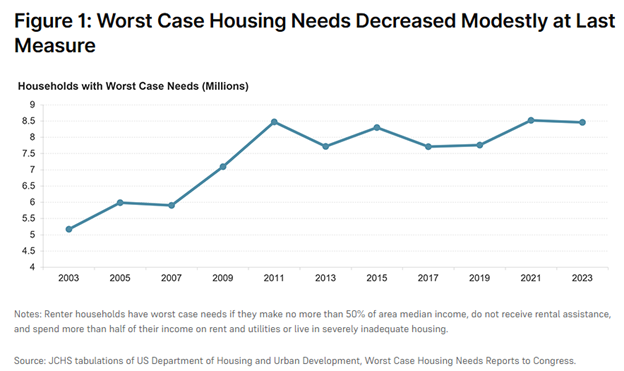
Worst case housing needs among very low-income renters remain critically high despite recent decline
New analysis from the Harvard Joint Center for Housing Studies finds that renter needs remain at near record-high rates, though the number is decreasing for the first time since 2017. According to HUD data measuring worst case scenario housing needs, 8.46 million very low-income renter households faced worst case needs in 2023, meaning they have very low incomes, receive no housing assistance, and either pay more than half of their income for rent or live in severely inadequate conditions. The measure peaked at 8.5 million in 2021. Roughly 98% of affected households spend at least half of their already limited income on rent, leaving little room to cover other basic necessities. As a result, even modest changes in income or rent levels can quickly push these renters into deeper financial hardships.
| | |
The latest edition of POLITICO’s Morning Money explores how escalating tensions over President Trump’s push to acquire Greenland are spilling over into the U.S. housing market, with trade war fears driving up long-term Treasury yields that underpin mortgage rates. Despite a nearly one-point decline in the average 30-year mortgage rate over the past year, home sales remain sluggish as economic uncertainty and volatile rates keep many would-be buyers on the sidelines. Housing analysts note that a single day’s rate spike erased recent gains from a $200 billion federal purchase of mortgage-backed securities, reinforcing how policy and markets are undermining the buyer confidence and complicating efforts to improve housing affordability.
A new report from the Georgetown Center on Poverty and Inequality, Abundance for Who?, examines how the recent waves of housing construction are—or are not—translating into stable, affordable homes for low-income renters. The analysis evaluates new development patterns across multiple large metropolitan areas to assess who benefits from “abundance” strategies that emphasize boosting supply, raising questions about whether supply-side reforms alone can resolve the affordability crisis for households with the lowest incomes. Georgetown’s findings underscore that without intentional policies to link new production to deep affordability, millions of renters who rely on public benefits and face persistent barriers in the safety net are likely to remain cost-burdened and at risk of housing instability, even in markets seeing significant new construction.
HousingWire reports that Fannie Mae and Freddie Mac ramped up foreclosure-prevention efforts in October as new forbearance plans surged alongside a modest pickup in refinance activity driven by easing mortgage rates. The uptick in relief may reflect growing stress among borrowers facing higher costs and economic uncertainty, even as some homeowners seize the opportunity to refinance and lower monthly payments. Building on a recent Federal Housing Finance Agency report showing that the GSEs have already completed millions of foreclosure-prevention actions since conservatorship, the latest moves signal a renewed focus on keeping struggling borrowers in their homes and preventing a wave of distress sales as forbearance volumes climb.
| | |
Monday, January 26
No events listed.
Tuesday, January 27
WHF Lunch & Learn - Demystifying the CFPB’s Proposed Disparate Impact Regulation | Women in Housing Finance, 12 – 1 PM ET
Housing Innovators: Modernizing Access to Rental Housing | Bipartisan Policy Center, 1 – 2 PM ET
Fundamentals of Commercial Insurance Issues and Problems | MBA, 2 – 3:30 PM ET
2026 NMHC Apartment Strategies Conference | NMHC
2026 NMHC Annual Meeting | NMHC, January 27 - 29
Wednesday, January 28
From Tangled Title to Shared Prosperity | Next City, 1 – 2 PM ET
Generating Additional Funding with Recycled Bonds | NCSHA, 1:30 – 4:30 PM ET
2026 AHTCC Annual Meeting | AHTCC, January 28 - 29
Thursday, January 29
MAA Quarterly Webinar: Policy Priorities in a Mid‑Term Election Year Webinar | MBA, 3 – 4 PM ET
Friday, January 30
No events listed.
| | The National Housing Conference is a diverse continuum of affordable housing stakeholders that convene and collaborate through dialogue, advocacy, research, and education, to develop equitable solutions that serve our common interest. | | Defending Our American Home since 1931 | | Copyright © 2024. All Rights Reserved. | | | | |