Included in this issue of the newsletter:
- Message from Sasakawa USA's Chairman, Satohiro Akimoto
August Activities
- Policy Briefing: USMC Force Design 2030: New Deterrence Strategy Views from Japan with LtGen. Koichi Isobe (JGSDF, Ret.), LtGen Chip Gregson (USMC, Ret.), and LtGen Larry Nicholson (USMC, Ret.)
- Washington Kenkyu Group: A Discussion with Dr. Peter Skerry
Publications
- Japan Political Pulse: Will Suga Survive (Curtis)
Upcoming Activities
- Policy Briefing: Understanding the Role of Japanese Automakers and Suppliers in the U.S. Automotive Industry
- Congressional Program on U.S.-Japan and the Indo-Pacific: Now Accepting Applications
- SEED: Announcing Delegation on Public Health January 2022
Announcements
- USJETAA Mini-Grant Program: Funding Awarded to JET Alumni Association of Washington, D.C.
|
|
Message from Sasakawa USA's Chairman, Satohiro Akimoto |
|
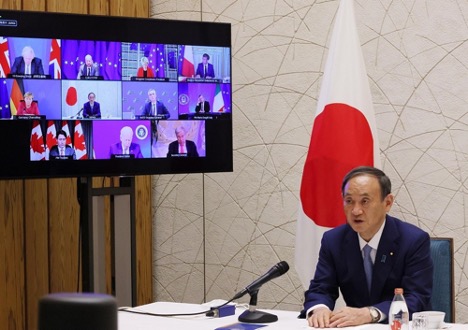
The decision to hold the Tokyo Olympics as scheduled amid the COVID-19 crisis was a calculated political gamble for Prime Minister Suga to improve his political prospects.
The media and the opposition parties heavily criticized the decision by the Suga cabinet to go ahead with the Games in collaboration with the International Olympic Committee, which Japanese people felt did not seem to show any concern for their well-being. Mayuko Wakuda, one of NHK’s two main casters of the opening ceremony, presented doubt over the government’s decision to hold the Olympics by saying, “in addition to Japanese domestic voices, the voices of international media asking what this Olympics is for and who it is for, have been heard.”
Japanese citizens were also skeptical about going ahead with the Tokyo Olympics despite the fact the government seemed to be behind the curve in administering vaccine shots and preventing infections from spreading. After all, the Tokyo Olympics were held while Tokyo was under the declaration of a state of COVID-19 emergency. The Asahi Shimbun poll held on July 17 and 18 showed 55% of Japanese people were against holding the Olympics, while only 33% of Japanese people were for holding the Olympics. 68% of Japanese people thought a “safe and secure Olympics” was impossible, while only 21% of Japanese people thought a “safe and secure Olympics” was possible.
Prime Minister Suga’s calculus of holding the Tokyo Olympics despite widespread opposition among Japanese people to do so, was that he could begin regaining the confidence of the Japanese people and reverse the negative political mood by successfully holding the Tokyo Olympics without serious COVID-19 problems. In fact, canceling the Tokyo Olympics was not an option for Prime Minister Suga as it meant a total political failure of the government under his leadership to deal with the COVID-19 crisis. In other words, holding the Tokyo Olympics seemed to be the only option, which Prime Minister Suga realistically had after the disappointing results in the Tokyo Metropolitan Assembly election, to preserve and hopefully improve prospects of being reelected for a new full term as LDP president and continuing as prime minister.
The Tokyo Olympics were a success. The Games were held according to the plan without outbreaks of infections among the Olympians, coaches, officials, staff, and volunteers. In fact, most of the foreign participants seemed to have enjoyed their experiences and left with positive images of the Tokyo Olympics. The Suga administration could have advertised that Japan had provided a model for how to hold a large-scale international gathering while administering measures against a pandemic. Even Japanese people, who opposed the Tokyo Olympics, enjoyed the Games thanks to the Japanese Olympians, who were unfortunately underappreciated before the Olympics, but nevertheless valiantly fought to capture a total of 58 medals, including 27 gold medals.
As a matter of fact, views of Japanese people on the Olympics have quickly turned positive after the Games finished. According to FNN polls taken on August 21 and 22, 55.6% of Japanese agree “it was good that the Tokyo Olympics were held” as compared with 35.5% of Japanese who don’t agree “it was good that the Tokyo Olympics were held.”
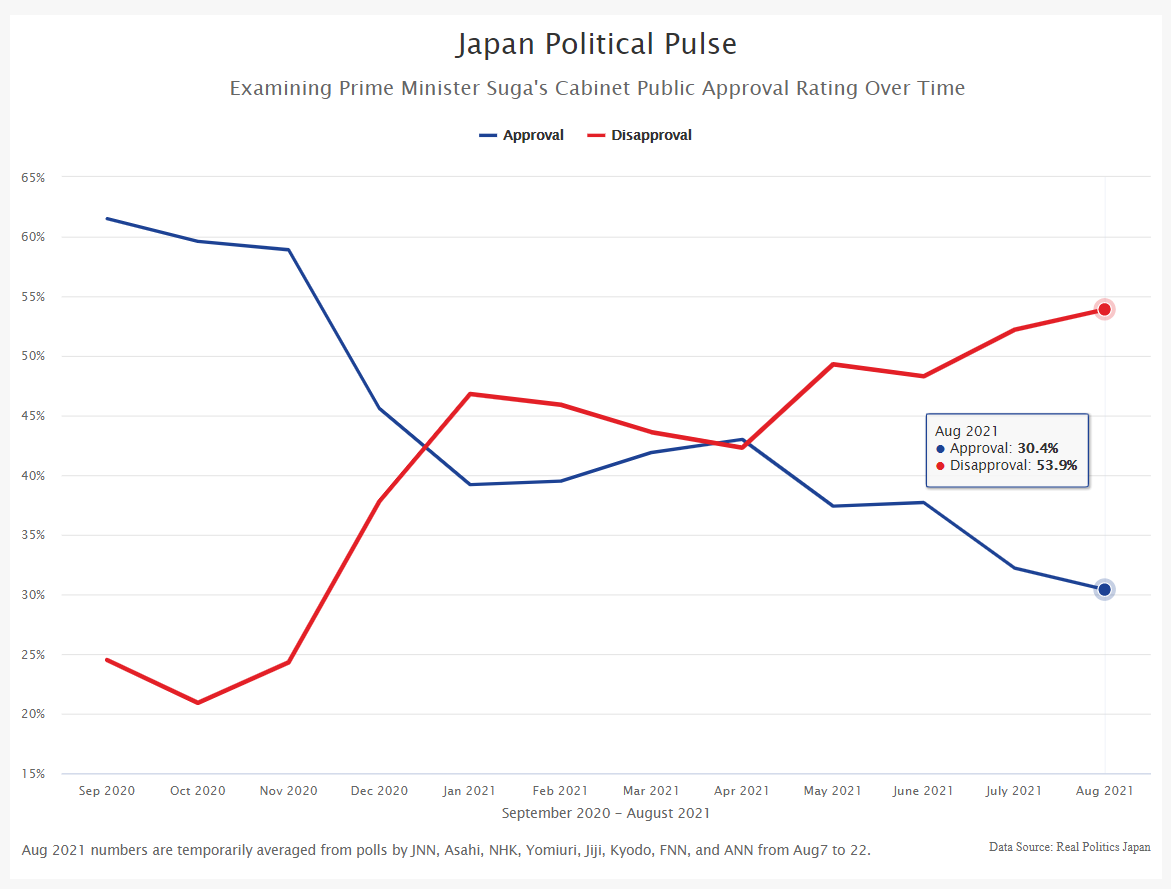
A big disappointment for Prime Minister Suga has been that change of Japanese people’s views on the Tokyo Olympics has not altered their views on him. On the contrary, approval for his cabinet has continued to slide as the COVID-19 crisis worsens following the Tokyo Olympics. The latest polls for the Suga cabinet reveal a dangerous trend. Approval for the Suga cabinet declined 3.8 points to 25.8% from 29.6% in the previous month in an ANN poll taken on August 21 and 22. Approval for the Suga cabinet declined 6.9 points to 32.1% from 39.0% in the previous month in FNN polls taken on August 21 and 22. An average of eight major polls in August show 30.4% approval and 53.9% of disapproval.
In this month’s newsletter, I am delighted that Dr. Gerald Curtis, Burgess Professor Emeritus of Political Science at Columbia University, helps us make sense of the current Japanese political landscape in his Sasakawa USA’s Japan Political Pulse article, “ Will Suga Survive,” which was published yesterday. Dr. Curtis goes beyond the short-term issue of whether Prime Minister Suga will be able to hang on as prime minister by pointing out problems arising from Japan’s lethargic political culture which is too slow to change to meet the challenges of a quickly changing world.
In terms of the U.S.-Japan relationship, both the U.S. and Japan have gained much from seven years and eight months of political stability under Prime Minister Abe. Despite whatever happens in the political landscape in the coming months, one thing Japan needs to avoid is domestic political instability and indifference to global engagement arising from a carousel of weak prime ministers.
|
|
Policy Briefing: USMC Force Design 2030: New Deterrence Strategy Views from Japan with LtGen. Koichi Isobe (JGSDF, Ret.), LtGen Chip Gregson (USMC, Ret.) and LtGen Larry Nicholson (USMC, Ret.) |
|
On August 26, Sasakawa USA hosted a Policy Briefing featuring a keynote by LtGen. Koichi Isobe, JGSDF (Ret.), 37th Commander of the Eastern Army (2013-2015); and commentary provided by LtGen Chip Gregson, USMC (Ret.), Assistant Secretary of Defense, Asian and Pacific Security Affairs (2009-2011); and LtGen Larry Nicholson, USMC (Ret.), Commanding General of III Marine Expeditionary Force (2015-2018). In this on-the-record discussion, LtGen. Isobe explained what the U.S. Marine Corps Force Design 2030 means to Japan and its impact on the ever-important U.S.-Japan security alliance. He outlined three main points to understand the future of USMC-JSDF cooperation: (1) the growing threat of adversaries’ precision strike capabilities; (2) the future role of the Marine Corps, focusing on deterrence; and (3) the Marine Corps’ “back to basics” return to being the nation’s naval expeditionary force in readiness. LtGen Gregson and LtGen Nicholson followed with the American perspective commentary highlighting the need for increased collaboration, cooperation, and interoperability with Japan in this changing nature of modern warfare and the need to integrate space and cyber assets to best protect the First Island Chain. The video and recap of the event are available here. |
|
Washington Kenkyu Group: A Discussion with Dr. Peter Skerry |
|
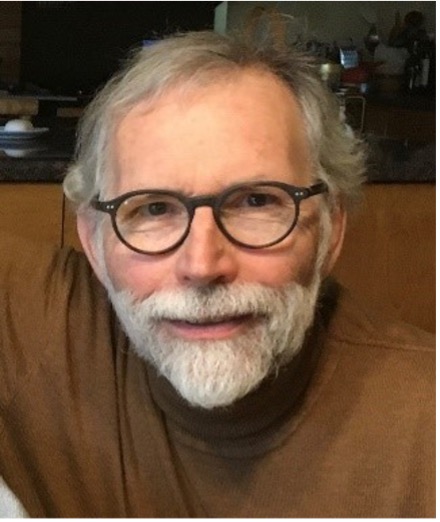
On August 10, Sasakawa USA Washington Kenkyu Group welcomed Dr. Peter Skerry, Professor of Political Science at Boston College for a discussion on the Black Lives Matter movement. For this off-the-record, virtual event, Dr. Skerry examined the African-American history of the United States and explained the details of how the Black Lives Matter movement was founded and is now structured. Drawing on key points featured in his article, published by National Affairs, ”Why ‘Black Lives Matter’ Matters,” he describes the nuances of the Black Lives Matter movement given its political setting of the 21st century and digital age. Following Dr. Skerry’s presentation, the event continued with a lively discussion with the attendees, including Japanese representatives of the media, think tanks, private sector, and government. Dr. Skerry’s remarks furthered the understanding of an important American societal matter that can strengthen how members of the Washington Kenkyu Group engage with their American colleagues in Washington, D.C.
Photo: Dr. Skerry
|
|
Japan Political Pulse: Will Suga Survive (Curtis) |
|
In this month’s Japan Political Pulse article, “ Will Suga Survive,” guest author Dr. Gerald Curtis, Burgess Professor Emeritus of Political Science at Columbia University, examines the variety of factors affecting the increasingly uncertain electoral picture and political viability of Prime Minister Suga’s leadership this fall. On top of his administration’s dissatisfactory response to the COVID-19 pandemic and lack of effective communication with the public, Dr. Curtis also scrutinizes the Japanese government’s recent debacle in evacuating Japanese citizens and Afghani allies out of Afghanistan after the Taliban seized power. Dr. Curtis concludes that regardless of who becomes the next prime minister, numerous challenges still impede the advancement of Japan’s political culture and international standing globally. You can read the article here.
|
|
Policy Briefing: Understanding the Role of Japanese Automakers and Supplies in the U.S. Automotive Industry |
|
In September, Sasakawa USA will host the virtual event, “Understanding the Role of Japanese Automakers and Suppliers in the U.S. Automotive Industry.” This event will feature Mr. Manny Manriquez, General Director of the Japan Automobile Manufacturers Association's U.S. office, and Ms. Jennifer Heckmann, Senior Manager at DENSO, for a discussion on the important role that Japanese companies play in the U.S. automotive industry and in strengthening the U.S.-Japan economic relationship. The event will further explore Japanese companies' contributions to U.S. economic competitiveness through the creation of high-quality jobs, workforce development initiatives, mature supply chains and innovative technologies. |
|
Congressional Program on U.S.-Japan and the Indo-Pacific: Now Accepting Applications |
|
Applications for the Fall 2021 Congressional Program on U.S.-Japan and the Indo-Pacific (CPUSJ) are open. The program will consist of a series of seven, 75-minute interactive discussions for Congressional staffers, held weekly on Capitol Hill. Certificates of completion will be awarded to participants who attend at least four of the seven planned sessions. Speakers will come from government agencies, think tanks, universities, and other policy institutions. Session topics are set to include: The U.S.-Japan Alliance as the Cornerstone of Indo-Pacific Peace, Security, and Stability; U.S.-Japan Technological Partnership and Competition; Economic Challenges and Areas of Cooperation; U.S.-Japan Frontier Defense and Technology Cooperation; Vaccine Diplomacy; U.S.-Japan Engagement with ASEAN; as well as Great Power Competition. The program will commence on September 28 and conclude on October 26. Please visit the Sasakawa USA website for more details. |
|
SEED: Announcing Delegation on Public Health January 2022 |
|
Applications for the 2021 Sasakawa USA Emerging Experts Delegation (SEED) are now open. SEED engages the next generation of U.S. policy experts and opinion leaders to improve their understanding of Japan and U.S.-Japan relations. Each SEED program is developed around a selected theme and the 2021 SEED program is centered around a case study on the events of the Diamond Princess Cruise Ship. The program‘s objectives are to provide American and Japanese public health professionals the opportunity to increase mutual understanding of a serious global pandemic and each side’s unique perspective to allow for future collaboration in the event of a similar scenario. If you or someone you know is interested in applying for this year’s SEED program, please access the application here, or submit any questions to Mr. Benjie Canady, Associate Program Officer at Sasakawa USA at bcanady@spfusa.org. |
|
USJETAA Mini-Grant Program: Funding Awarded to JET Alumni Association of Washington, D.C. |
|
Sasakawa USA and USJETAA are excited to announce the first recipient of our 2021-2022 Mini-Grant Program for JETAA Chapters and Subchapters in the United States. The JET Alumni Association of Washington, D.C. will receive a mini-grant to support the expansion of the five-month mentorship program that they successfully launched with a Sasakawa USA/USJETAA mini-grant in 2020. This program supports the professional development of JET alumni in the DMV area and strengthens the talent pipeline of future U.S.-Japan leaders. Additional details on the program can be found on JETAADC's website. Sasakawa USA and USJETAA will continue to review mini-grant proposals from other JETAA chapters until the second-round application deadline on October 1, 2021. Additional information on the Mini-Grant Program can be found on USJETAA’s program page. |
|
Sasakawa Peace Foundation USA
1819 L Street, NW
Suite 300
Washington DC 20026
202.296.6694
|
|
|
|
|
|
|