Robert Hiett
Executive Director
| | Creating Regional Solutions Since 1971 | |
Flood Resiliency Blueprint releases final Neuse River Basin Action Strategy, identifying 113 priority flood resilience actions
RALEIGH – The North Carolina Department of Environmental Quality’s (DEQ) Flood Resiliency Blueprint program released the Neuse River Basin Action Strategy, a comprehensive framework to support flood resilience planning and decision-making across the basin.
"The Neuse River Basin Action Strategy will help communities keep their residents and critical infrastructure safe in the face of more frequent and severe flooding,” said DEQ Secretary Reid Wilson. “This strategy, the first of its kind in North Carolina, prioritizes resilience actions so that communities can make smart investments to reduce their flooding risk.”
The strategy identifies 113 prioritized flood resiliency actions across the Neuse River Basin that met baseline criteria, including their potential to reduce flood risk and support from local input, planning efforts and vulnerability assessment findings. The actions include structural and nonstructural projects such as stormwater system improvements, transportation and roadway upgrades, critical infrastructure protection, nature-based solutions, structure-level mitigation projects, such as elevating or floodproofing buildings in floodprone areas, and policy and planning actions.
Further evaluation and consultation with local leaders identified 29 high-priority actions that are recommended for early consideration as potential first steps toward implementation, based on local buy-in, feasibility and capacity, and potential impact and benefit. These actions represent a range of approaches, including floodplain and stream restoration, drainage and culvert improvement, roadway and critical infrastructure upgrades, floodproofing and elevation of critical facilities, early flood warning systems, and other stormwater and flood mitigation measures. The recommendations are intended to help guide initial investment and coordination while allowing flexibility for communities as funding, capacity and priorities evolve.
The recommended actions are stored and maintained in the Flood Resiliency Blueprint tool. Communities can update their plans and develop new ones with the support of Blueprint staff as new information and opportunities develop.
The action strategy is informed by a basin wide vulnerability assessment, community capacity assessment and gap analysis, as well as extensive engagement with local governments, state and federal agencies, nonprofit organizations and other partners throughout the Neuse River Basin. Local governments developed Local Action Plans, which outline locally identified flood resilience actions, and submitted them using the Flood Resiliency Blueprint Tool. The Neuse River Basin Advisory Group, which brings together subject matter experts from state agencies, local and regional governments, nongovernmental organizations and academic institutions, also provided technical input and guidance throughout the process. Together, these analyses and collaborative efforts helped identify flood risks, local capacity and resilience needs, and priorities for reducing the impacts of current and future flooding.
The Neuse River Basin Action Strategy and supporting materials are available here.
DEQ will continue collaborating with local governments and partners as they use the Flood Resiliency Blueprint Tool as a resource to support flood resilience planning and maintain up-to-date information on resiliency actions and funding opportunities. The Blueprint currently serves six of North Carolina’s 17 river basins. The River Basin Action Strategy Process will help to ensure that the Blueprint Tool reflects evolving local priorities and project needs and serves as an ongoing resource for flood resilience planning and decision-making. The remaining five river basin action strategies (Tar-Pamlico, Lumber, Cape Fear, White Oak, and French Broad) will be released in the coming months
For More Information
Contact: Sascha Medina
Phone: 919-707-8672
| | |
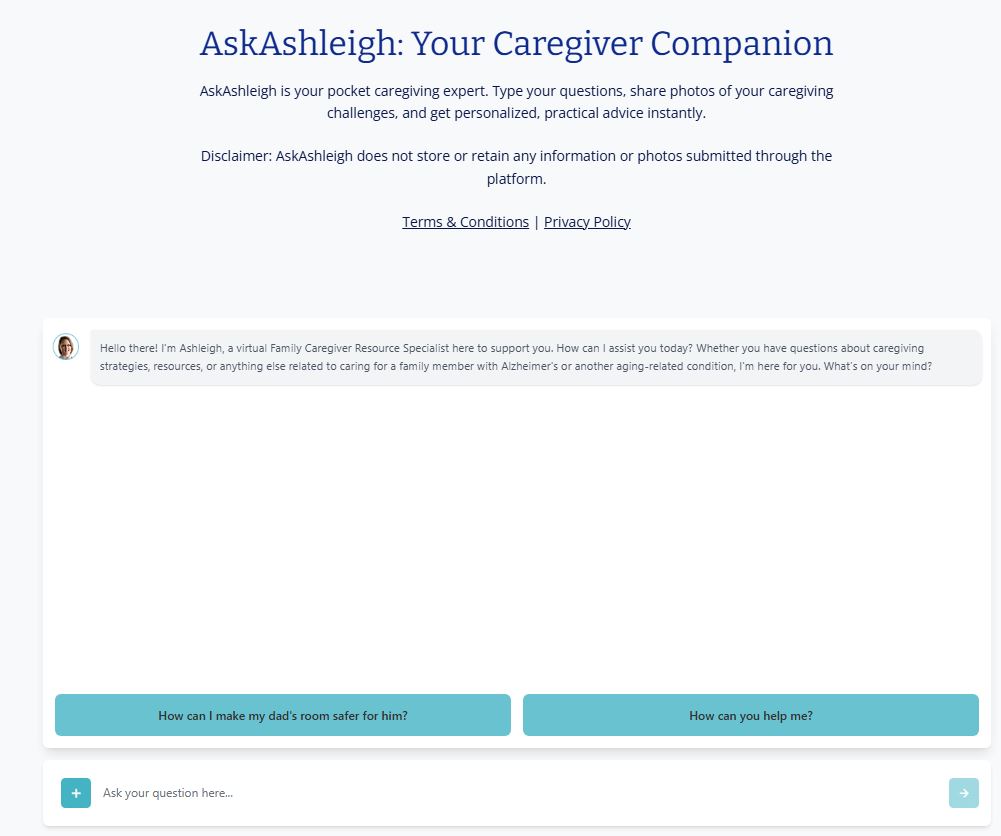
AskAshleigh is the first virtual caregiver integrated into an Area Agency on Aging in the nation. AskAshleigh provides immediate, personalized support with deep local knowledge, accessible at any hour of the day or night. Imagine having the expertise of Family Caregiver Resource Specialists right at your fingertips, helping you navigate caregiving challenges with real, actionable advice.
Caregiving is often an unexpected journey, filled with late nights, endless questions, and emotional challenges. For many families, especially those caring for loved ones with dementia, the journey can feel overwhelming and isolating.
This isn't just technology; it's a promise that no caregiver has to navigate this journey alone. For residents of Edgecombe, Halifax, Nash, Northampton, and Wilson counties, AskAshleigh is ready to provide the support you need.
Learn more: https://ucpcog.org/askashleigh/
| | Funding Opportunites and Resources | |
NCDHHS Announces $10 Million for EMS Workforce Through NC Rural Health Transformation Program
The North Carolina Department of Health and Human Services announced that it will provide $10 million to 39 local EMS agencies through the NC Rural Health Transformation Program. The funds awarded by the NCDHHS Office of Emergency Medical Services for Mobile Integrated Health will strengthen the EMS workforce and expand rural communities’ access to mental health and substance use disorder treatment and services.
“Every North Carolinian deserves access to safe, affordable, quality health care, no matter where they live,” said Governor Josh Stein. “Investing in our EMS workforce and expanding behavioral health services in the rural parts of the state will help North Carolinians get the care they need closer to home.”
“Improving access to care starts with investing in our health care providers, including our frontline EMS workforce,” said NC Health and Human Services Secretary Dev Sangvai. “By strengthening EMS-led Mobile Integrated Health programs, we can provide timely treatment, support life-saving recovery, and ultimately reduce preventable overdoses.”
This NCRHTP funding gives EMS providers across North Carolina the tools, training, and resources needed to support residents with substance use disorders beyond the initial 911 call. In 2021, rural North Carolinians experienced higher rates of both fatal drug overdoses and overdose-related emergency department visits compared to those rates for urban North Carolinians. The awarded funds enable EMS agencies to address these trends by providing medication for opioid use disorder, supporting rapid follow-up care after overdose events, and connecting individuals to treatment and recovery services. These locally led initiatives developed by EMS providers allow rural residents to receive direct care in their communities when they need it most.
“EMS professionals are uniquely positioned at the intersection of emergency response and health care delivery, serving as a critical link in the continuum of care for rural communities,” said Tom Mitchell, Chief of the NCDHHS Office of Emergency Medical Services.
The NCRHTP investment recognizes EMS as an essential component of North Carolina’s health care workforce and a vital partner in expanding access to behavioral health care and substance use disorder treatment. This initiative represents an important step toward ensuring that rural residents have greater access to the services and support they need to achieve long-term health and recovery.
The Mobile Integrated Health grant recipients include:
- Alamance County EMS
- Alleghany County EMS
- Anson County EMS
- Avery County EMS
- Brunswick County EMS
- Buncombe County EMS
- Burke County EMS
- Cabarrus County EMS
- Cape Fear Valley Mobile Integrated Health (MIH)
- Camden County EMS
- Caswell County EMS
- Catawba County EMS
- Cherokee County EMS
- Clay County
- Columbus County EMS
- Davie County EMS
-
Edgecombe County EMS
- Franklin County EMS
- Gaston County EMS
- Graham County EMS
- Henderson County EMS
- Lenoir County EMS
- McDowell County EMS
- Mitchell County EMS
- Nash County EMS
- Onslow County EMS
- Orange County EMS
- Pasquotank County EMS
- Perquimans County EMS
- Person County EMS
- Rowan County EMS
- Stanly County EMS
- Stokes County EMS
- Surry County EMS
- Washington County EMS
- Watauga County EMS
- Wilkes County EMS
- Yadkin County EMS
- Yancey County EMS
For more information on the North Carolina Rural Health Transformation Program, including ways to get involved, visit the NCDHHS NCRHTP webpage.
| | |
Each year, the Golden LEAF Foundation invites organizations from counties from a different Prosperity Zone to participate in our $11 million Community-Based Grants Initiative (CBGI). The process is competitive, but organizations from all counties within the Prosperity Zone will have an opportunity to apply.
The CBGI is designed to identify projects with the potential to have a significant impact. It is a focused process with grants targeted toward investments in the building blocks of economic growth. Funds are limited to projects that address job creation and economic investment, agriculture, and workforce preparedness.
Available Funds Eligible Entities Process Regional Projects
A total of $11 million is available to support projects in the region. Awards are limited to no more than three projects in any county and may total no more than $1.5 million in any county. Not all proposals will be funded and there is no assurance that there will be a funded project in every county. Funds may also be awarded for regional projects (see information below), which will not count toward the limit of projects in a county, but regional projects are funded through the overall $11 million program budget.
Counties from the North Central Prosperity Zone are invited to participate in our Community-Based Grants Initiative (CBGI). The counties in the North Central Prosperity Zone are Chatham, Durham, Edgecombe, Franklin, Granville, Harnett, Johnston, Lee, Nash, Orange, Person, Vance, Wake, Warren, and Wilson.
| | |
USDA and EDA Update Resources in Joint Guide to Boost Economic Development in Rural Communities
The Stronger Together: Federal funding and planning opportunities designed to promote sustainable economic development in rural America guide has been updated to provide a handy summary of EDA and USDA Rural Development programs that can be used to support common rural development strategies
| | |
Congratulations to the 2026 Legacy Tree Fund Grant Winners! We're proud to provide grants to the Towns of Conetoe and Enfield for their community planting projects. Both projects make significant environmental investments in these historically underserved small towns and will directly benefit town residents of all ages.
For more information about the projects or to donate to our Legacy Tree Fund visit: https://www.ncufc.org/Legacy-Tree-Fund.php #PlantYourLegacy
| | |
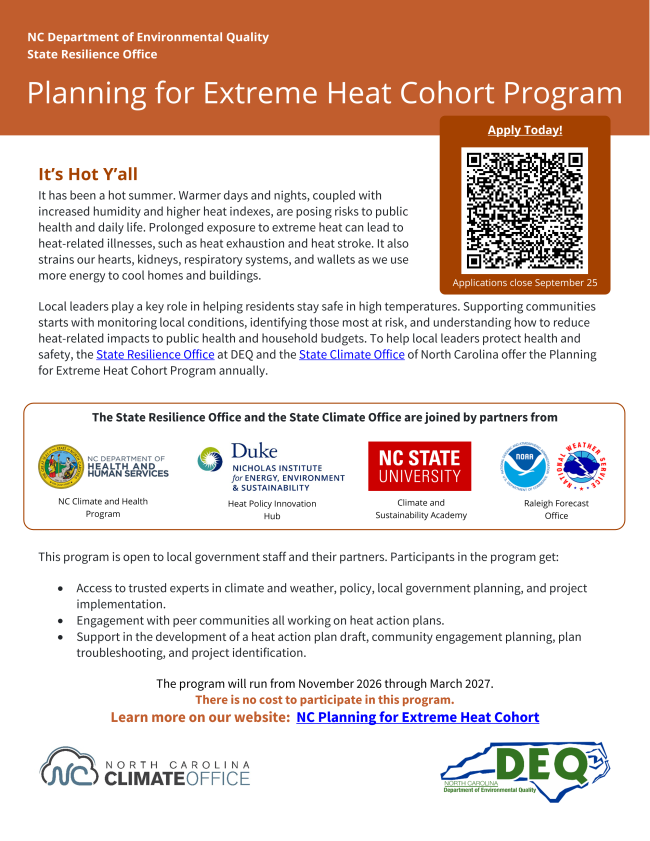
Call for Applications: North Carolina’s Planning for Extreme Heat Cohort
It has been a hot summer. When heat indexes spike, residents and visitors are at a higher risk of experiencing heat-related illnesses and death. These higher temperatures also increase utility bills and have far-reaching economic impacts. To help local leaders mitigate these impacts, the State Resilience Office in the Department of Environmental Quality and the State Climate Office of North Carolina invite local governments and their partners to apply for the 2026-2027 NC Planning for Extreme Heat Cohort. Over the course of five months, cohort participants will develop a heat action plan for their community. To learn more about this free program, attend the informational webinar on Monday, September 14, 2026, from noon – 1pm. Register today!
Interested applicants can also learn more on the Planning for Extreme Heat Cohort program page.
Applications are due Friday, September 25, 2026.
| | |
Are you doing a wetland restoration or reforestation project in North Carolina? Share the impact of your work with the NC Department of Natural and Cultural Resources!
Share data on your shovel-ready restoration or reforestation projects initiated after July 1, 2020, in NC. De-identified, aggregated survey data will be incorporated into a forthcoming public dashboard to track and celebrate our collective restoration progress. The survey is intended for reporting projects funded by local governments, foundations, federal grants, companies, individual donors, or other non-state sources. (We are already gathering aggregated data on state-funded projects.) When responding, you'll want to have the following information handy: 1) Project location, timeline, partners and funders; 3) restored habitats, acreage, and restoration methods; and project benefits. We are seeking wide participation - please share with relevant North Carolina colleagues! The survey will close on August 21st. Link and directions: https://arcg.is/0GXuWa3. Contact maya.cough-schulze@dncr.nc.gov if you need additional information!
| |
Resources for Hurricane Season in North Carolina
In the heart of hurricane season, we know that local governments are at the forefront of safeguarding their communities. Effective hurricane preparedness protects lives and property and strengthens overall community resilience.
Discuss what storm preparedness looks like for your community. Build a plan and stay informed at ReadyNC.gov. Keep an eye on GROW NC's Recovery Resources Hub this hurricane season in the event that a natural disaster does impact your community.
| | |
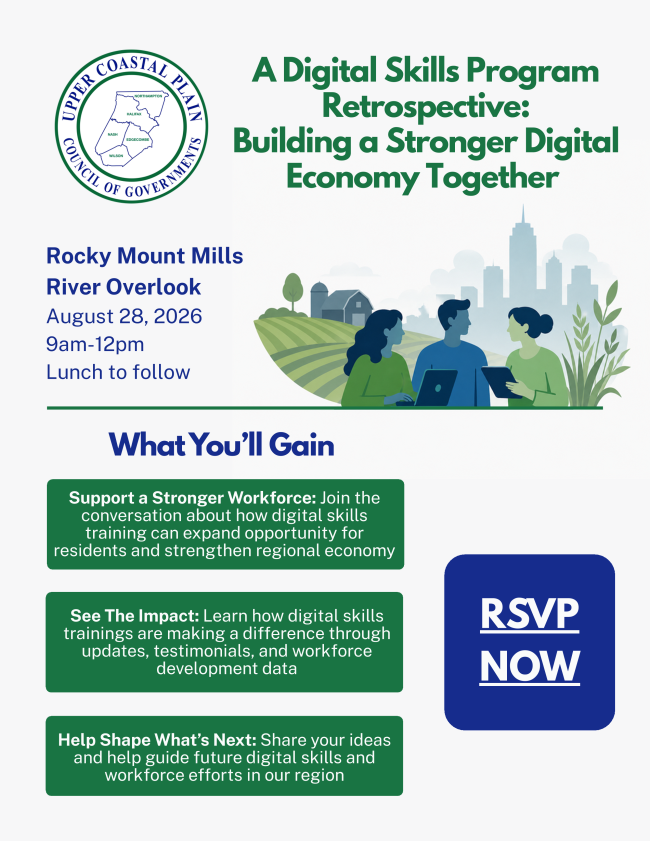
Digital Skills Training Available to Local Government Personnel
Computer Skills Training Available to Local Government Personnel
Get free training and a free laptop! A free self-paced training offered through UCPCOG includes internet basics, email, Microsoft Word, Excel, social media, career searching, tele-health and more.
Upon successful completion of the 17-module Northstar training, trainees receive a certification of digital skills, and a free laptop from the Kramden Institute.
UCPCOG is pleased to extend this training program to all member governments.
Everyone is eligible:
- Employees of local governments
- Local elected officials
- Local appointed board members
UCPCOG will help set each trainee up in Northstar and provide assistance as needed.
Northstar is a self-paced, virtual training portal. The online modules can be done at work or home. Each module may take about an hour to complete, depending on the self-paced timing.
The trainings are a good refresher or first course in computer skills. They give staff and officials the training necessary to use computers and online resources safely and efficiently.
Contact Ben Farmer (BFarmer@ucpcog.org) for more information on how to get started.
The Digital Economies Project, funded by NC Department of Information Technology, is a collaboration between UCPCOG and the three local community colleges (+ CADA & AMEXCAN) to train community members on digital skills using the Northstar Digital Literacy platform.
| |
EPA Launches Transparent, Interactive Permitting Map
Accessible public tool breaks down permitting barriers and removes confusion to unleash American prosperity
WASHINGTON – Today, U.S. Environmental Protection Agency (EPA) is launching the EPA Permitting Authority Map. The interactive map—accessible via EPA’s website—identifies which regulatory agencies have the authority to issue permits covering all of EPA’s permitting programs and environmental statutes. The development of the map is an integral resource in advancing Pillar 3 of Administrator Lee Zeldin's Powering the Great American Comeback initiative: Permitting Reform, Cooperative Federalism, and Cross-Agency Partnership.
The EPA Permitting Authority Map supports federal agencies, states, territories, Tribal nations, local agencies/governments, and the general public with:
- The ability to make a quick determination whether the permitting authority is with EPA or if there has been an approved delegation, primacy, or authorization given to a state, territory, Tribal nation, or local agency.
- The use of a Geo Platform based web map, which provides maximum flexibility for site visualization and project planning ability.
EPA also released new informational tools and resources to help community members, local officials, data center developers, and other interested parties assess the viability of Brownfield and Superfund sites as possible locations for industrial reuse. EPA's Redevelopment Mapper for Superfund and Brownfield Sites can help screen for suitable site characteristics on a Brownfield or Superfund site. The Mapper provides site locations and options for adding data layers that highlight site features and surroundings.
| | |
Visit the Carolinas Development Assistance and Siting Hub!
NCCETC leads the Carolinas Development Assistance and Siting Hub (DASH) project as part of a U.S. DOE-funded program designed to support large-scale renewable energy development. The new hub will launch this week, featuring an ordinance database, numerous resources, upcoming events, and an extensive FAQ section. Be sure to check the website later this week to access the new features!
Visit the Website ➔
| | |
Announcing the
NC Resilient Communities
Planning Guide!
We are pleased to announce the publication of NCORR’s newest resource:
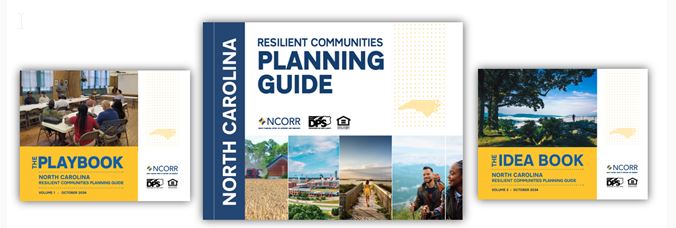
The NC Resilient Communities Planning Guide!
The Guide is a collection of resources tailored to help North Carolina communities develop a resilience plan or integrate resilience into existing planning documents, such as a comprehensive plan or strategic plan. Because each community’s needs are unique, the Guide doesn’t offer a fixed approach. Instead, it provides users with a set of considerations, options to up- or down-scale its approaches and examples of other communities’ actions.
The Guide consists of two volumes: the Playbook and the Idea Book.
The Playbook takes users through the stages of resilience planning, from preparation through plan implementation. Each section of the Playbook includes checklists and questions for consideration, to allow the user to customize their planning process to their organization’s specific needs. While the target audience is local governments, the content will also help community organizations or regional groups craft resilience strategies.
The Idea Book provides insight into strategies that advance resilience across 14 categories. These categories include environmental topics, like Stormwater Management and Flooding; social topics like Communication and Education; and economic topics like Business and Local Economy. For each topic, we explain its connection to resilience, demonstrate strategies for increasing resilience in this area and offer an in-depth case study of a community’s resilience project.
| | |
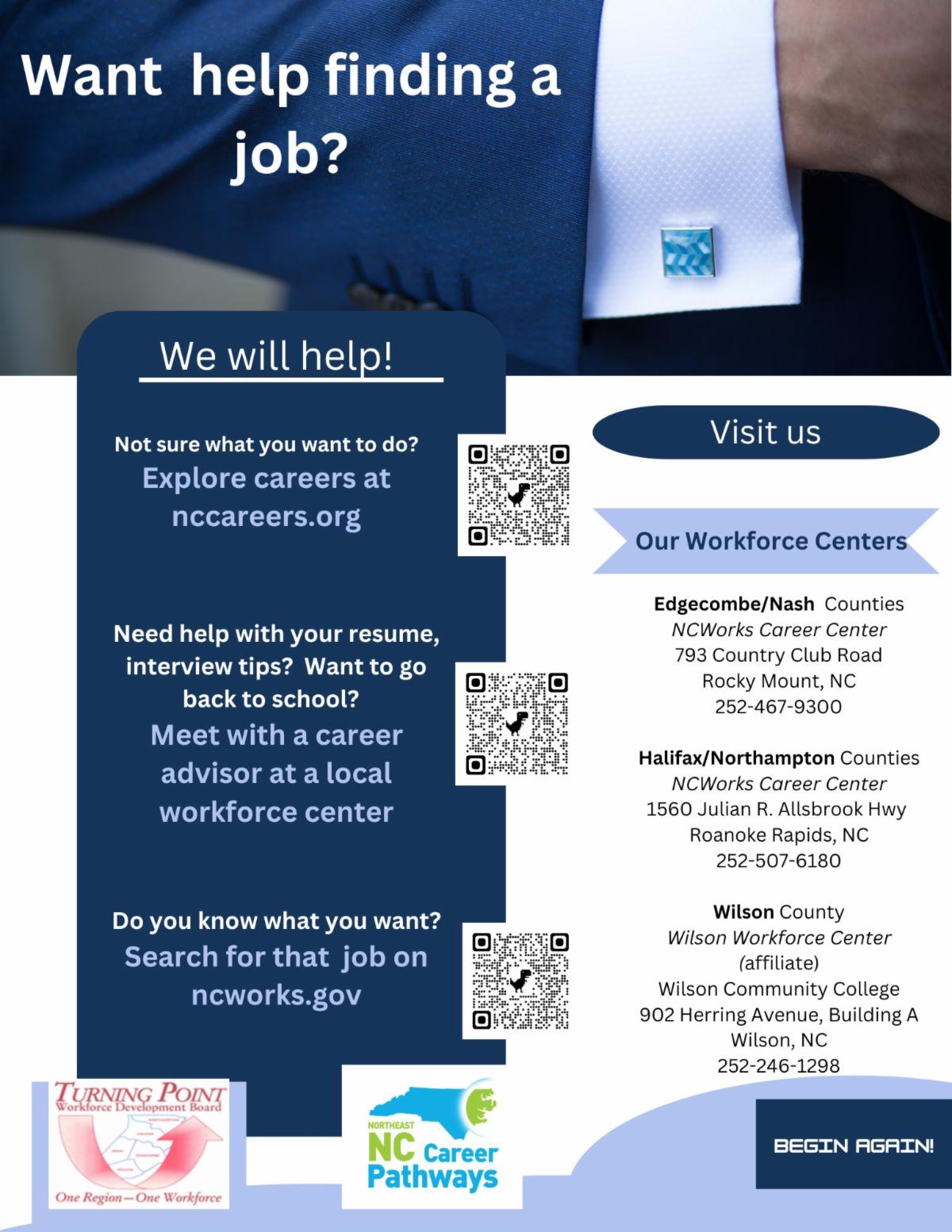
NC Works Career Centers assists both JOB SEEKERS AND EMPLOYERS; Feel free to reach out to the Centers in the Turning Point Region and let a team member know how they can assist! Occasionally, the NC Works Centers (Rocky Mount and Roanoke Rapids share information about events and services), however, feel free to also follow the State's general NC Works page for general information that is statewide, regarding what basic job seeker and employer services are available and what Career Centers basically offer daily; some services are set on a different schedule such as resume writing courses and other partner-offered services throughout the week, however in an effort to assist customers, this information can be shared, just call or visit! The Wilson Workforce Center, powered by Turning Point Local Area is also a resource, located at Wilson Community College campus.
NC Works Career Centers:
NCWorks Career Center, Rocky Mount
NCWorks Career Center, Roanoke Rapids
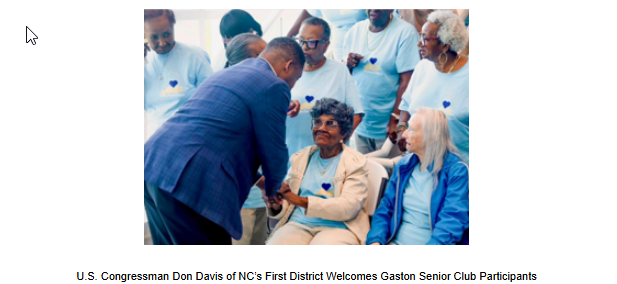
| | The Upper Coastal Plain Council of Governments Area Agency on Aging’s Long-Term Care (LTC) Regional Ombudsmen, Tyronda Whitaker and Annetta Brown, recently hosted the impactful "Seas the Day" conference. Dedicated to elder abuse prevention, the event featured an interactive mock trial where the many faces of ageism were creatively "found guilty" of stereotypes, assumptions, exclusion, and a lack of dignity and respect. Attendees also heard an inspiring speech from Congressman Don Davis, who emphasized the critical need for intergenerational family conversations to equip younger generations with the tools to help care for our aging population. | |
New Mobile Crisis Dispatch Program to Improve Response for People Experiencing a Mental Health Crisis
PRESS RELEASE — The North Carolina Department of Health and Human Services announced a new pilot program to improve Mobile Crisis Teams’ response when someone experiencing a mental health crisis calls for help. The $1.5 million investment to Trillium Health Resources establishes a real-time dispatch process that streamlines response to individuals in crisis wherever they are.
The North Carolina Department of Health and Human Services today announced a new pilot program to improve Mobile Crisis Teams’ response when someone experiencing a mental health crisis calls for help. The $1.5 million investment to Trillium Health Resources establishes a real-time dispatch process that streamlines response to individuals in crisis wherever they are.
Mobile Crisis Dispatch (MC Dispatch) is now operating in 10 counties in eastern North Carolina. The initiative is directly in line with Governor Josh Stein’s Executive Order 33 that calls on NCDHHS to strengthen the mental health crisis system. MC Dispatch will get people directly into mental health care with a mobile response team, freeing up law enforcement resources.
"This initiative will connect people in crisis to the care they need by making sure they receive the appropriate level of response more quickly and efficiently," said NC Health and Human Services Secretary Dev Sangvai. "Streamlining this process will help achieve our goal of creating a stronger coordinated system of care."
"During a mental health crisis, seconds can make a difference," said Kelly Crosbie, MSW, LCSW, Director, NCDHHS Division of Mental Health, Developmental Disabilities and Substance Use Disorders. "This new platform will help mobile crisis teams respond quicker. These highly trained counselors can come to a location of the caller’s choosing and will ensure they get the help they need."
MC Dispatch is managed by REAL Crisis Intervention, Inc., North Carolina’s 988 service provider. When someone calls the 988 Suicide and Crisis Lifeline experiencing a mental health crisis that requires Mobile Crisis response within the pilot region, MC Dispatch will either send a mobile crisis team or connect the caller with a provider and other local resources. MC Dispatch is partnering with mobile crisis teams from Integrated Family Services and Easterseals PORT Health in the pilot counties.
The MC Dispatch platform will track key performance metrics to assess response efficiency and service accessibility including:
- Response times and adherence to service-level agreements (SLAs)
- Client demographics and payer information
- Request resolution outcomes
- Travel distances for responses
- Disposition outcomes and follow-up actions provided
The ten counties involved in the first phase are: Duplin, Edgecombe, Greene, Halifax, Lenoir, Nash, Sampson, Warren, Wayne and Wilson counties. The pilot is expected to be operational in 27 eastern North Carolina counties by the end of April with the ultimate goal of expanding it statewide. MC Dispatch is one part of NCDHHS efforts to support a coordinated system of mental health care that makes services easy to access when and where they are needed.
This investment is part of the NC General Assembly’s historic $835 million investment in mental health in 2023, with funds targeted for expanding and improving mental health care in North Carolina.
| | |
Now Recruiting: NC Senior Tar Heel Legislature Alternate – Edgecombe County
Do you have a passion for advocacy and improving the lives of older adults? We are seeking an Alternate Representative for Edgecombe County to serve on the NC Senior Tar Heel Legislature (NCSTHL).
NCSTHL is made up of volunteers age 60+ who raise awareness of issues affecting older adults and encourage the NC General Assembly to address gaps and shortages in supportive services. Who better to speak on behalf of older adults than older adults themselves?
NCSTHL meets 3 times a year: March, June, and October
Interested or want more information?
Contact Ty Whitaker, AAA Liaison to NCSTHL
252-234-5963
twhitaker@ucpcog.org
Your experience matters. Your voice matters. Help shape a better future for older adults in North Carolina.
| |
Healthy Aging Highlights
Staying active is an important part of healthy aging! To help those interested in learning more about exercise, NIA created an Exercise and Older Adults Toolkit to share reliable health information, research news, infographics, publications, and videos that highlight the benefits of physical activity. The materials are designed for older adults, caregivers, and health care providers.
Explore and share the toolkit to help encourage safe, enjoyable exercise at any age
| | |
September 11, 2026 | Chapel Hill
9:00am-4:00pm | Course Cost: $495
Open to professionals and elected officials
Did you know that emotional intelligence is a better predictor of workplace effectiveness than IQ? And it's up to five times as important when you compare people within the same career?
When you think about what behaviors characterized your most effective and least effective bosses, you are probably thinking about emotional intelligence skills such as motivating you and others, caring about you as a person, listening effectively, addressing conflict in timely and effective ways, communicating well, creating a high morale work environment, and many more. These are all emotional intelligence skills, and they can be learned.
What You'll Learn:
- Complete the Emotional Quotient Inventory 2.0
- Receive coaching about your results
- Identify simple strategies you can begin using to increase your emotional intelligence
- Understand what emotional intelligence is and how it affects your daily work behaviors
| | |
September 17, 2026 | Chapel Hill
9:00am-3:00pm | Course Cost: $225
Open to professionals and elected officials
Do you aspire to have more active participation in your local government processes? Are your citizens disengaged, or is your community engagement framed solely by what the Open Meetings Law either requires or allows?
Community engagement is a vital part of democracy. Elected officials can create inviting and accessible avenues for citizen engagement if armed with some actionable tools that help make it doable for all.
What You'll Learn:
- How to assess your civic eco-system
- The differences between citizen engagement and public participation
- Different strategies for policy-making engagement and service delivery engagement
- Opportunities related to citizen academies, advisory boards and committees, public agency engagement, and elected official engagement
- Which electronic tools can improve community engagement
- Resources that can help even the most under-resourced communities
| |
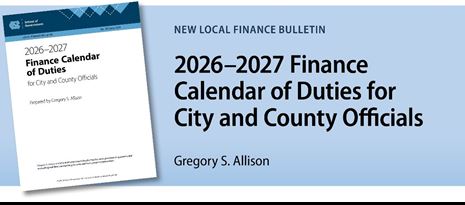
New Local Government Finance Calendar of Duties
The “2026–2027 Finance Calendar of Duties for City and County Officials” is an annual School of Government publication that outlines key accounting, financial reporting, and budgeting responsibilities for city and county officials throughout the fiscal year.
Download the bulletin from the publications website.
| | Ben Farmer, Planning and Development Director, and Victoria Newcombe, Mayor of Rich Square, will be sitting on a panel focused on Housing and Main Street. | |
Best Practices for Files and Filing Workshop
The State Archives is excited to open registration for our August workshops: Best Practices for Files and Filing. This free, virtual workshop is open to any government employee and will cover creating a filing system that matches with retention schedules, organizing a filing structure that helps you find records more efficiently, and best practices for naming and managing electronic files.
Interested government employees can register for one of the following sessions:
Tuesday, August 11th from 1:30 PM to 3:30 PM
https://www.zoomgov.com/webinar/register/WN_-paKK6HeSpaQyPI4N86Y_w
Thursday, August 27th from 10:00 AM to 12:00 PM
https://www.zoomgov.com/webinar/register/WN_Bc9SeYp0SWC4CPnAMXB82g
We look forward to seeing you next month at these workshops! If you have any questions about these workshops, please contact Kayla Leonard, Essential Records Analyst, at kayla.leonard@dncr.nc.gov.
| | |
Sustainable Fleet Tech Conference & Expo invites you to return for 2026!
Register for the 10th annual Sustainable Fleet Technology Conference and Expo as we return Durham, NC on August 25-27, 2026! Early-Bird pricing (before July 11th) for standard attendees is $349. Members of promotional partners such as SGFMA, NC APWA, Black Fleet Network, NAFA, many Clean Cities, and more receive a further discounted Early-Bird rate of $299 by selecting “Member of Promo Partner” during registration!
The SFT conference serves as a premier platform exploring the
latest advancements in fleets, with a focus on data-driven solutions. Attendees
will gain invaluable insights on enhancing fleet efficiency and sustainability
across fuel types, while simultaneously reducing emissions and costs. Our
lineup of speakers comprises seasoned fleet managers and industry leaders,
offering those who attend varied expert perspectives and practical advice.
Other event highlights include:
- 12 Breakout sessions and more than 60 panelists
- 4 Mainstage Keynotes & Plenaries
- 2 Expo Hall Networking Receptions
- Green Fleet Awards Announcement & Presentation, and
- Off-site events, including Durham Bulls Baseball social & Tour of the Hendrick Automotive Center at Wake Technical College
| |
121 W. Nash St. Wilson, NC 27893
252-234-5952
| | | | | |