|
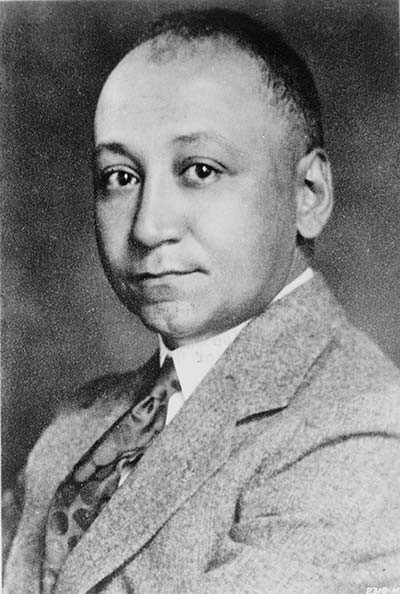
Dr. Louis Tompkins Wright was born in LaGrange, GA, on July 23, 1891. His father, Ceah Ketchan Wright, was a former slave who received his medical degree from Meharry Medical School in Nashville, TN. After his father died, his mother, Lula, remarried another African American physician, William Fletcher Penn, MD, the first African American medical graduate from Yale University.
In 1911, Wright graduated from Clark Atlanta University. Wright then graduated fourth in his class from Harvard Medical School in 1916. Shortly after completing medical school, Wright joined the Army Medical Corps and was stationed in France during World War I. While there, he served as a lieutenant, introduced the intradermal vaccination for smallpox, and was awarded the Purple Heart after surviving a gas attack.
In 1919, he moved to New York due to growing racial tensions in Georgia. There, he started a private practice in Harlem and worked closely with the Harlem Hospital, becoming the first African American on their surgical staff. During his time at Harlem Hospital, he addressed and changed the institution's issues of professionalism and standards. In 1929, he became the first African American police surgeon for the New York Police department. A few years later, in 1934, Wright became a Fellow of the American College of Surgeons (FACS) and the American Medical Association.
After medical school, he joined the National Association for the Advancement of Colored People (NAACP) and later served as a chairman on its national board of directors. Wright wrote several articles in the NAACP's magazine, The Crisis. Most of his writings focused on challenging the false idea that black people are more biologically susceptible to infectious diseases than other races. In 1940, Wright received the NAACP's Spingarn Medal for "his contribution to the healing of mankind and for his courageous position in the face of bitter attack."
Following his time in the war, Wright had significant lung damage that he never fully recovered from. In 1939, he was hospitalized for tuberculosis for three years. Ten years after being released from the hospital, in 1952, he passed away after suffering a heart attack.
Learn more about Louis T. Wright.
|