JUNE 2026

Your Peek Into Sacramento’s Coordinated Access System


Stories, updates, and data from Sacramento’s front door to homelessness services.


May Data & Analysis


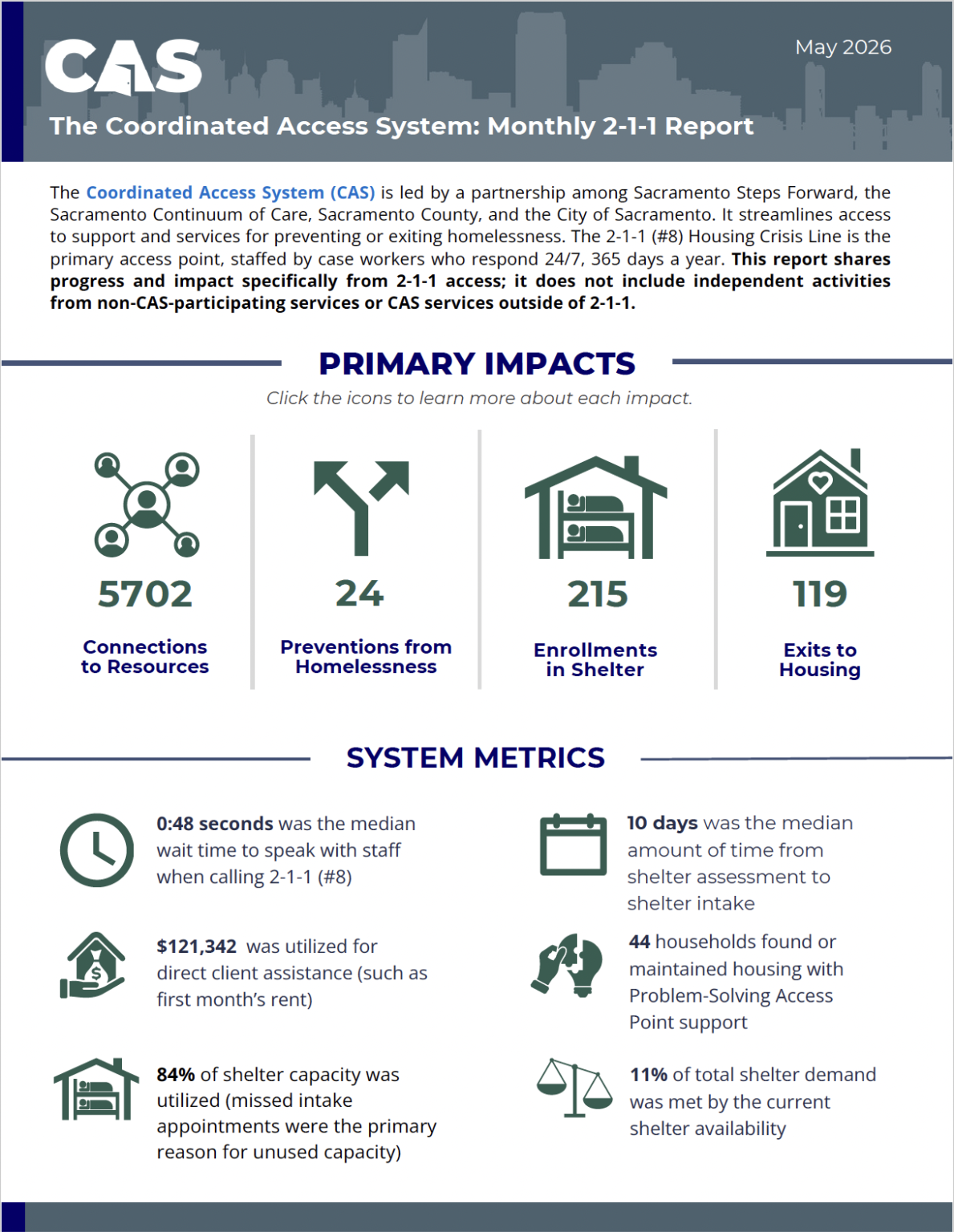
In May, we saw notable gains across several key measures that we monitor for the Coordinated Access System. Prevention outcomes increased from 11 households in April to 24 in May, while Problem-Solving services helped 44 households find or maintain housing, compared with 12 in April.


Direct client assistance also increased significantly, from approximately $31,269 in April to $121,342 in May. The additional financial assistance helped 44 households address immediate housing barriers and coincided with stronger prevention and problem-solving outcomes.


The system connected 5,702 households to resources, up from 5,596 in April, and exits to permanent housing increased from 109 to 119 households. Overall, May's results point to increased system activity and continued progress in helping households maintain or secure stable housing.


READ THE FULL REPORT & ANALYSIS ➜

The Frontline Learning Collaborative: How Providers Stay Connected 


Each month, we will take a closer look at one part of the Coordinated Access System and how it supports people experiencing or at risk of homelessness.


The Frontline Learning Collaborative is a monthly forum where service providers and community partners come together to share resources, exchange knowledge, and stay informed about changes in homelessness services. As programs, policies, and available resources continue to evolve, the Collaborative provides a reliable space for providers to build connections, strengthen their knowledge, and better support the people they serve. 


The Collaborative, hosted by Sacramento Steps Forward, creates opportunities for shared learning, allowing participants to exchange ideas, discuss challenges, and share solutions that can improve the support they provide to individuals and families experiencing homelessness. It also helps providers expand their professional networks, making it easier to connect clients with the right resources and services. 


We have been grateful to use this space to connect organizations with valuable information and emerging opportunities across the community. Over time, the Collaborative has highlighted a wide range of services, including CalAIM programs, Problem Solving services, health care resources, housing supports, and other tools that help people access the assistance they need. 


The impact of the Frontline Learning Collaborative extends beyond the meetings themselves. By helping providers stay informed, connected, and engaged, the Collaborative supports stronger coordination across the homeless response system and reduces barriers to accessing care. Participants gain practical knowledge, build meaningful partnerships, and leave better equipped to support their clients. These ongoing connections contribute to a more responsive and coordinated system, helping individuals and families access services more quickly and move toward greater stability. 

Here's what's new:


Become a Problem-Solving Access Point (PSAP)! Partner with Sacramento Steps Forward to help households at risk of or experiencing homelessness access housing problem-solving services, case management, resource navigation, Coordinated Access, and one-time financial assistance for needs such as eviction prevention, move-in costs, utilities, and more. Interested in becoming a PSAP? Request more information ➜

The People Behind the Progress


Behind every referral and placement are people working together to make it possible.


This Month’s Spotlight: Elizabeth Rios, CAS Referral Specialist at Sacramento Steps Forward


Elizabeth Rios has worked alongside the Coordinated Access System (CAS) for more than four years, first as a CAS Assessor for about three years and now as a CAS Referral Specialist for a little over a year. In her current role, she helps connect households with housing opportunities by coordinating referrals between care teams and programs. "I bridge the gap between care teams with clients that meet program requirements and programs that have openings needing to be filled utilizing HMIS," she shared.


READ THE FULL SPOTLIGHT ➜

The Q&A Corner


This month’s most-asked questions.


Q: How will I know if my client was connected to a housing opportunity? 


A: CAS Referral Specialists will notify everyone on the client’s care team about any housing opportunities. Please ensure that you are assigned to the client’s care team in HMIS to receive updates. You can also review the client’s history in HMIS to view referrals and their status. 


Q: I am a Housing Navigator and not a CAS Assessor, how do I get a client connected? 


A: Clients can call 2-1-1 then dial 8 to request completion of a Housing Conversation Tool. However, a service provider must be connected to the client in HMIS for CAS to facilitate referrals to services. 


Q: My (individual) client scored a 7 on the Crisis Assessment (CA) and is seeking emergency shelter tonight. What should I do? 


A: Call the 2-1-1 backline for Extremely Vulnerable Households (EVH). This line is intended exclusively for CAS Assessors who have completed a crisis assessment with an EVH. 


CAS Assessor Backline Phone Number: (916) 809-8006 

Available Monday through Friday, from 7:30 a.m. to 4:00 p.m.  


Definition of Extremely Vulnerable Household (EVH):  

  • Individuals: CA score of 6 or higher   
  • Families: CA score of 10 or higher   


Q: My client has received an eviction notice, how can I support them connect with a prevention program?  


A: Problem Solving Access Points (PSAP) can support landlord-tenant mediations to resolve rental arrears, late fees, and legal fees. Connect with a 211 CAS specialist by calling 211, and pressing 8 for assistance. CAS Assessors can confirm participants’ eligibility by administering the Crisis Assessment (CA) and reviewing the SSO-Eligibility Score Summary. A PSAP score of 100+ confirms program eligibility.  


HMIS Job Aid: Understanding Shelter Assessment Score Summaries 


Q: Are there any job readiness programs that offer housing support?  


A: Yes! The Saint John’s Program for Real Change offers a sober living environment, case management support, and a job readiness program for single and family households. Connect with a 2-1-1 CAS specialist by calling 2-1-1 and pressing 8 for more information. 

🏠︎ Housing Highlights


Rivo Apartments (440 Arden Way) 


Type: Project Based Voucher Program 


Status: Processing Applications 


Anticipated Move-in Date: June 24, 2026 


Service Provider: Lutheran Social Services


Madison Square 


Type: Project Based Voucher Program 


Status: Processing Applications and have started Move-ins 


Service Provider: Lutheran Social Services


Behavioral Health Service Provider: Telecare


Sequoia Hotel 


Type: Project Based Voucher Program 


Status: Processing Applications and have started Move-ins 


Service Provider: Lutheran Social Services


Behavioral Health Service Provider: Bay Area Community Services


Thank you for being part of this work.


Questions about the Coordinated Access System?

Contact: CAS@sacstepsforward.org