Green text on white background that says "Insights" on the left with a green spiral pointing upward in the upper right side of the image and below that in black text it says Developmental FX Learning Journeys

A note from the road, the clinic, and the heart of our community

Welcome to Developmental FX Learning Journeys' Insights newsletter, designed especially for clinicians. We are so happy you are here, in a space where like-minded colleagues can learn from one another’s insights and 
collectively elevate our important work.

June 2026: DIFFERENTIATION

Reflections from Tracy...


Another Perspective on Integration: Why Differentiation Matters


Integration has long been central to sensory integration practice. We often focus on helping sensory systems work together more effectively to support participation, learning, regulation, and engagement in everyday life.

Recently, our team has been exploring another perspective on integration through the lens of Interpersonal Neurobiology (IPNB), particularly the work of Dr. Dan Siegel and colleagues. Their understanding of integration offers a powerful complement to the principles of sensory integration and directly guides our Therapy That Fits® approach.


Siegel defines integration simply as: "a combination of the linkage and differentiation of parts or facets of a system" (Siegel & Drulis, 2023, p. 9).


At first glance, this definition may seem different from how sensory integration practitioners typically think about the concept. Yet, it invites us to consider an important truth: before parts can be linked, they must first be understood as distinct. Differentiation means recognizing the unique qualities of each system, each person, and each experience. In therapy, this requires us to become students of individuality.


For me, this commitment to understanding individuality has been foundational throughout my career. Every child arrives with a unique sensory-affective-motor profile. Their sensory preferences, patterns of arousal, emotional experiences, relationships, interests, strengths, and challenges create a developmental story that is uniquely theirs. When we take the time to understand these differentiated aspects of a child, we are better able to support meaningful connections among them.


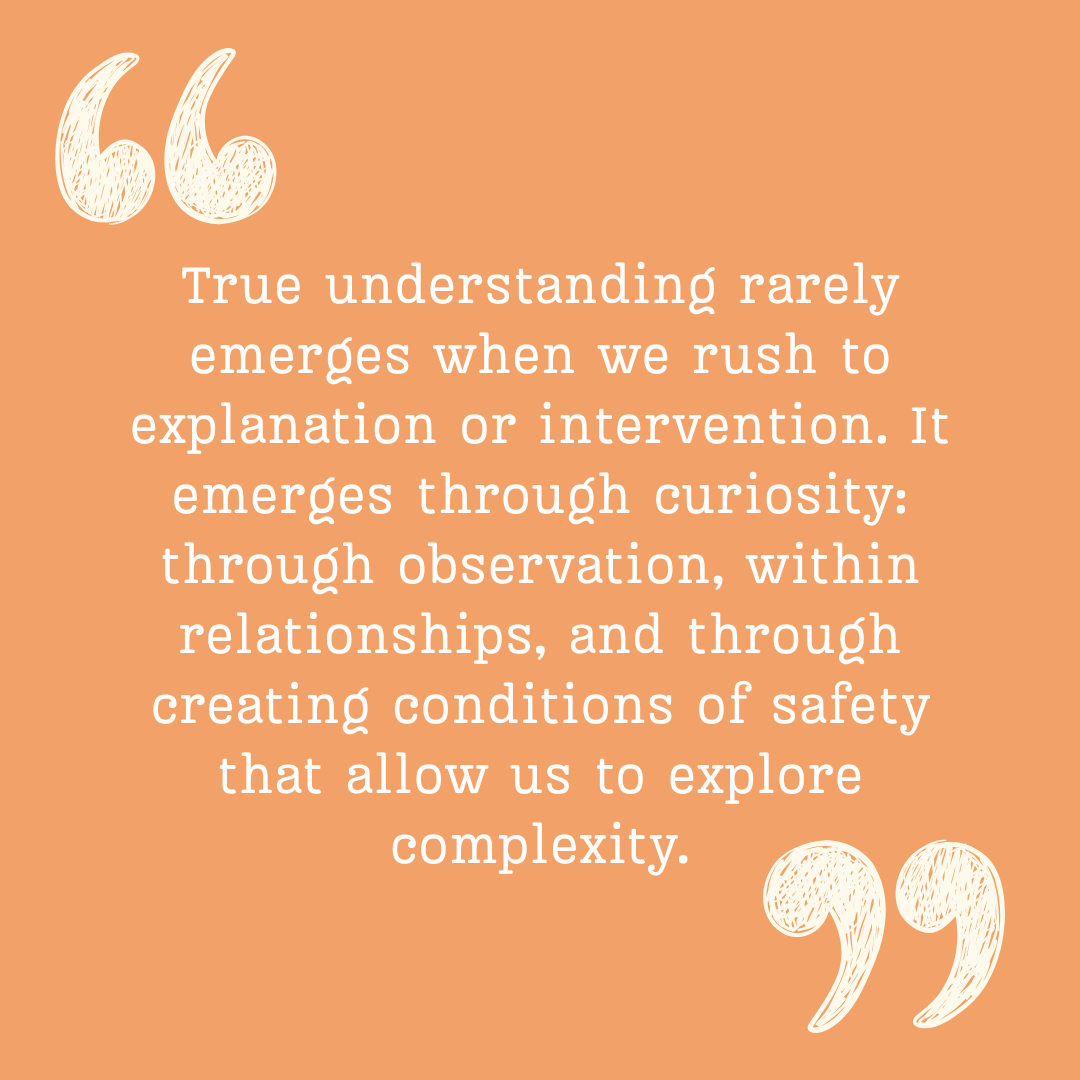
True understanding rarely emerges when we rush to explanation or intervention. It emerges through curiosity: through observation, within relationships, and through creating conditions of safety that allow us to explore complexity.

From a Polyvagal perspective, neuroception (our nervous system's unconscious evaluation of risk and safety) helps us understand why this matters.


When children, families, and even professionals experience sufficient safety, they become more available for exploration, discovery, and connection. Safety allows us to move beyond assumptions and become genuinely curious about the uniqueness of another person's experience.

This principle sits at the heart of Therapy That Fits®. Before we seek to adapt a child's participation, we seek to understand it. Before we intervene, we differentiate. Our clinical reasoning frameworks help us explore the many interconnected factors that contribute to a child's developmental journey, including how:

  • Sensory integration influences participation
  • Regulation capacities affect engagement
  • Relationships support safety and exploration
  • Tasks and environments either support or hinder success
  • A child's interests and motivations shape learning and the organization of behavior


Only after we understand these differentiated elements can we begin facilitating the connections that support growth and development.


Importantly, this perspective also reminds us that integration is not conformity. The goal is not to make all children behave, learn, or respond in the same way. The goal is to support increasingly flexible and connected functioning while honoring individuality. In this way, differentiation becomes a necessary act of respect that honors each individual. The more accurately we understand who a child is, the more effectively we can support who they are becoming.


From a developmental perspective, differentiation is not simply an assessment process; it is a prerequisite for growth. Children develop through increasingly integrated experiences that connect sensation, movement, emotion, relationships, meaning-making, and participation. Yet, these connections emerge most readily when a child’s nervous system neuroceptively registers safety.


Neuroception shapes whether a child is available for exploration, play, learning, and connection. When safety is present, children can engage with novelty, integrate experiences across systems, and develop increasing flexibility. When danger dominates, protective patterns often take precedence over developmental ones.


This perspective invites us to recognize that sensory integration therapy does more than support sensory integrative processing. It creates the foundational conditions that allow integration, development, and mental health to emerge.


Next month, we will explore how interpersonal neurobiology deepens our understanding of intersubjectivity. This pivotal concept refers to the process through which therapists and children create meaning together within the therapeutic relationship. 

Warmly, and in reflection,

Tracy

This month in the Learning Journeys Community...

For our live call this month, we’ll have a community discussion of some foundational principles of Interpersonal Neurobiology, guided by the very accessible book from Drs. Siegel and Payne Bryson, “The Whole Brain Child.” Join the Learning Journeys team as they facilitate a group discussion about IPNB and Dr. Siegel’s work. We meet live on June 25th at 2pm MT (find your time here), or catch the recording the following week in the community.


Live LJ Community Events: Spring/Summer 2026


  • June 25: Community Forum
    
  • July 30: Live Case Processing


LJ Community Forums are 
at 2:00pm MT


Upcoming Events...


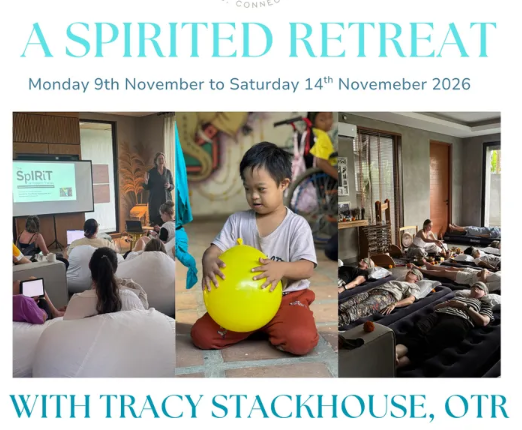
In November 2026, CPD Retreats is hosting Tracy for a second time as she leads “A Spirited Retreat” - an immersive learning experience in Bali, Indonesia focused on the SpIRiT© model. Retreat participants will take the online SpIRiT course and then join together for a week of in-person, in-depth application of the tool in small groups. We are frequently asked for more opportunities to learn how to use the SpIRiT in practice, and this is an incredible opportunity to do just that! The retreat is appropriate for learners of all levels that are looking to deepen their practice, but spots are limited. Learn more here.

DFX Learning Journeys Opportunities:

A SpIRiT© cohort will be launching in Fall 2026. This is an opportunity to pace your learning with a group of colleagues and have live meetings with Tracy and the Learning Journeys team to consolidate learning. We’ll keep you posted here when we announce dates!

Self-paced versions of the SpIRiT© and STEPPSI© are always available to support your learning. 


If you have a group that would like to set up a private cohort to work through either course, reach out to us at learningjourneys@developmentalfx.org!


Other Ways to Join Us:


  • Over three sessions across June, July, and September the Learning Journeys team, hosted by Diepistimoniko Kentro Ipeirou, is teaching “SIP Therapy That Fits: A Developmental Approach to Sensory Integrative Processing” - we just had our June course days and they were so full of learning! More on this introductory level course offering coming soon. 


  • In late June, Tracy will be teaching “How Skill Emerges: Sensory Integrative Treatment for Praxis” in Wroclaw, Poland for Promyk Slonca. 


  • In September you can catch Tracy at the 2026 PVI International Gathering - she will be presenting at the post-conference workshop day for clinicians about “Sensory Integrative Interventions: Portals to Possibility.”


Curious about integrating your pediatric practice with current neuroscience? 


Join the Learning Journeys Community to engage and learn!  

Developmental FX Learning Journeys is written in black text with an upward green spiral above it

Learning Journeys

green text on white background says "Learning Journeys Community" with a graphic of neural pathways above it

Learning Journeys Community


Square that is half purple and half beige with a yellow graphic and text that says Spirited Conversations

Spirited Conversations Podcast

LinkedIn Share This Email
Black text saying "Developmental FX" and green rectangle below with white text that says "Therapy that fits"
Facebook  Instagram  LinkedIn