|
February is a month to celebrate our love for estuaries (#IHeartEstuaries). Serendipitously, it’s also the time of year that TBEP gives an annual update on the overall status of the Tampa Bay watershed and its long-term recovery. This “State of the Bay” summary includes the results of several monitoring programs and reporting efforts—the nekton and benthic indices, seagrass assessments, and the water quality and habitat report cards—as well as an overview of the TBEP public engagement and education activities.
Overall, the trend for long-term recovery of the watershed is positive. Water quality results for 2025 show that chlorophyll a and water clarity are at acceptable levels throughout the bay, meaning enough sunlight can reach the bay bottom to support seagrass growth. However, 2025 was a very dry year in the watershed, which likely contributed to good water quality. Overly wet years could lead to reduced water quality. So to maintain good water quality for seagrass and in preparation for wet years, we should continue our efforts to reduce nitrogen loads into the bay.
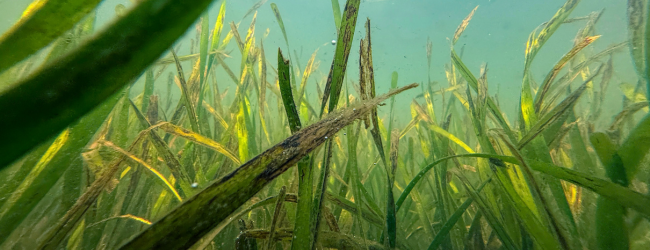
Reflecting the positive trends in water quality, on-the-ground assessments show that, overall, seagrasses are rebounding from declines observed over the past decade. Shoal grass (Halodule wrightii), in particular, has expanded in the upper bay, although recovery in Old Tampa Bay continues to lag behind other segments. Ideally, all sites in the bay would have stable or increasing trends.
The nekton and benthic indices both indicate that there is still room for improvement in fish and invertebrate populations, but baywide, their conditions are fair. In fact, there are stable or positive trends in these indicators in the middle and lower bay.
Seventeen partners completed 66 habitat restoration projects in 2025, contributing 278 more acres of habitat for wildlife. But there’s more work to be done to improve and protect native habitats in the watershed to meet our goals. The habitat report card indicates that six of the ten habitat classifications assessed by the most recent mapping efforts are not on track to meet the Habitat Master Plan 2030 targets for restoration. The Habitat Restoration Consortium used a new, stepwise process to prioritize habitat types for restoration in 2026. The process considered restoration potential, feasibility, and funding availability. The three priority habitats for restoration in 2026 are oyster reefs, forested freshwater wetlands, and coastal uplands.
Finally, in the true spirit of showing our love for estuaries, TBEP hosted 10 Give-A-Day for the Bay events in 2025, where 465 volunteers removed over 17 tons of trash from the watershed! In 2025, TBEP awarded over $98,000 to 22 Bay Mini Grant recipients and over $727,000 to six Tampa Bay Environmental Restoration Fund grant recipients. The projects these grants funded directly improve the watershed in countless ways.
2026 is already off to a busy start for Tampa Bay and we look forward to continuing to work with our partners to restore and protect the estuary.
|