Sunday, October 4, 2026

2nd Sunday of Luke


FATHER'S MESSAGE


Beloved Friends and Parishioners of Saint Eleftherios Church,


In today’s Gospel, our Lord gives us a command that is both simple and profoundly demanding: “As you would like people to do to you, do the same to them.” Christ calls us to a love that goes beyond reciprocity—to love not only those who love us, but also those who may not understand us, appreciate us, or even treat us with kindness. Such love is not a matter of feelings alone; it is a deliberate choice to respond to others with mercy, patience, and generosity.


The measure of Christian love is ultimately found in the love of God Himself: “Be merciful, just as your Father also is merciful.” We are called to become, in our daily lives, witnesses to this divine mercy. In our families, our parish, our workplaces, and our communities, we are invited to break the cycle of judgment and retaliation and instead choose forgiveness and compassion. When we love in this way, we do not simply follow a moral teaching—we allow the mercy of God to become visible through our own lives.


With Christ's love,


Rev. Nicolas Kazarian, PhD

Protopresbyter of the Ecumenical Throne

Parish Priest


***


Church Services


Sunday, October 4

2nd Sunday of Luke

Orthros and Divine Liturgy, 9:00 a.m.


Sunday, October 11

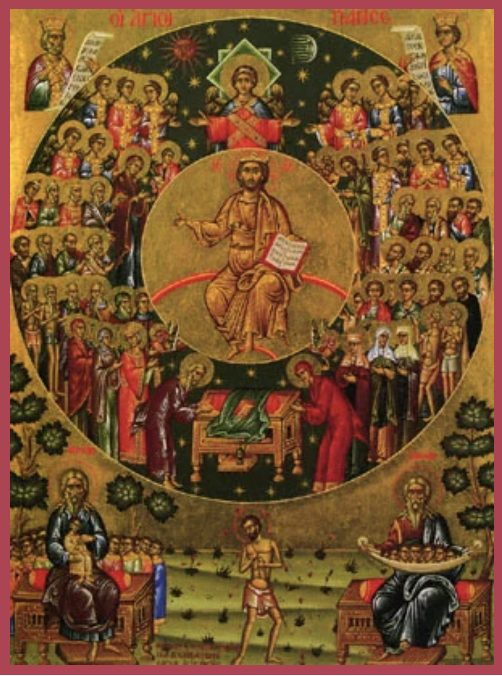
Sunday of the 7th Ecumenical Council

Orthros and Divine Liturgy, 9:00 a.m.

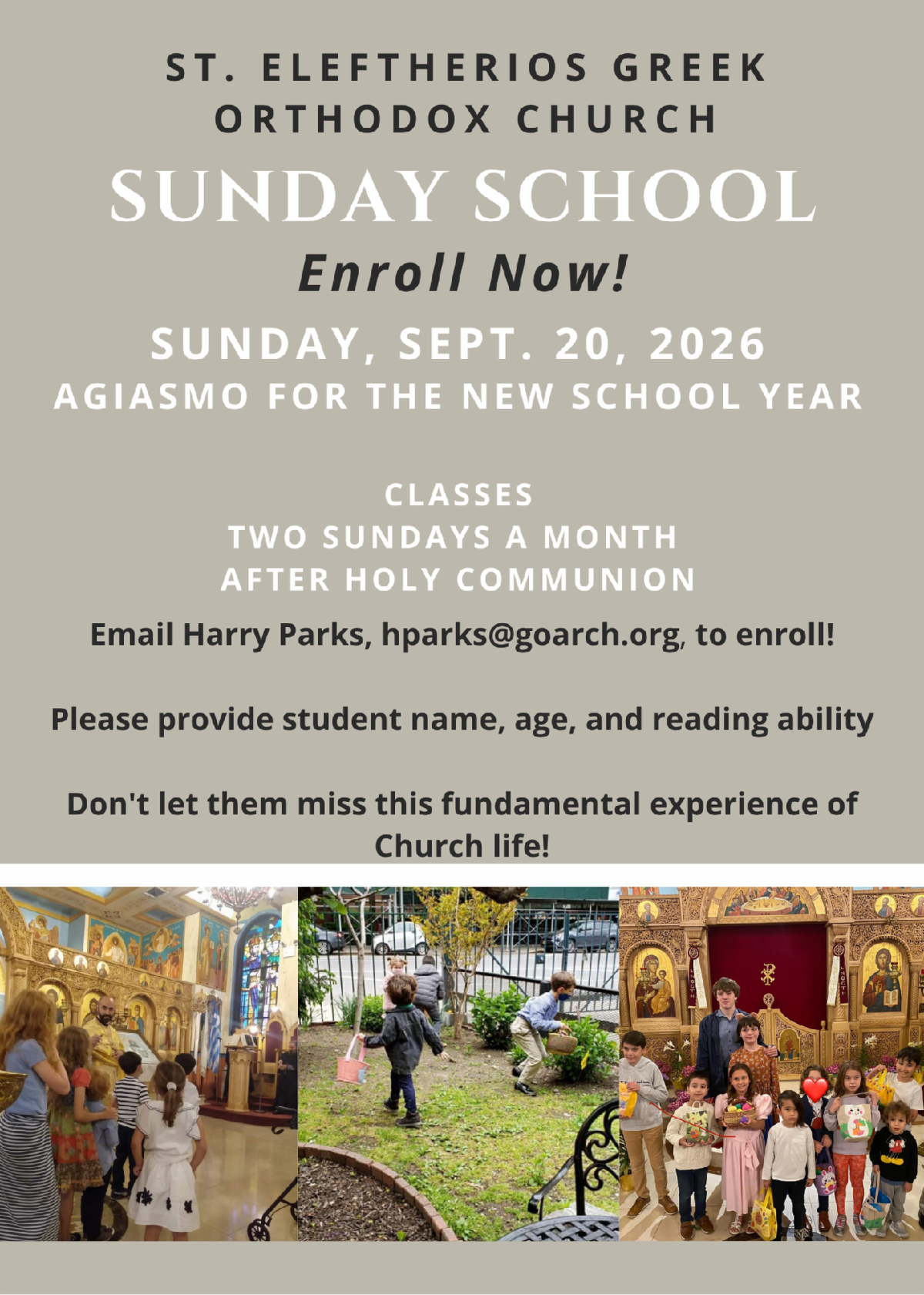
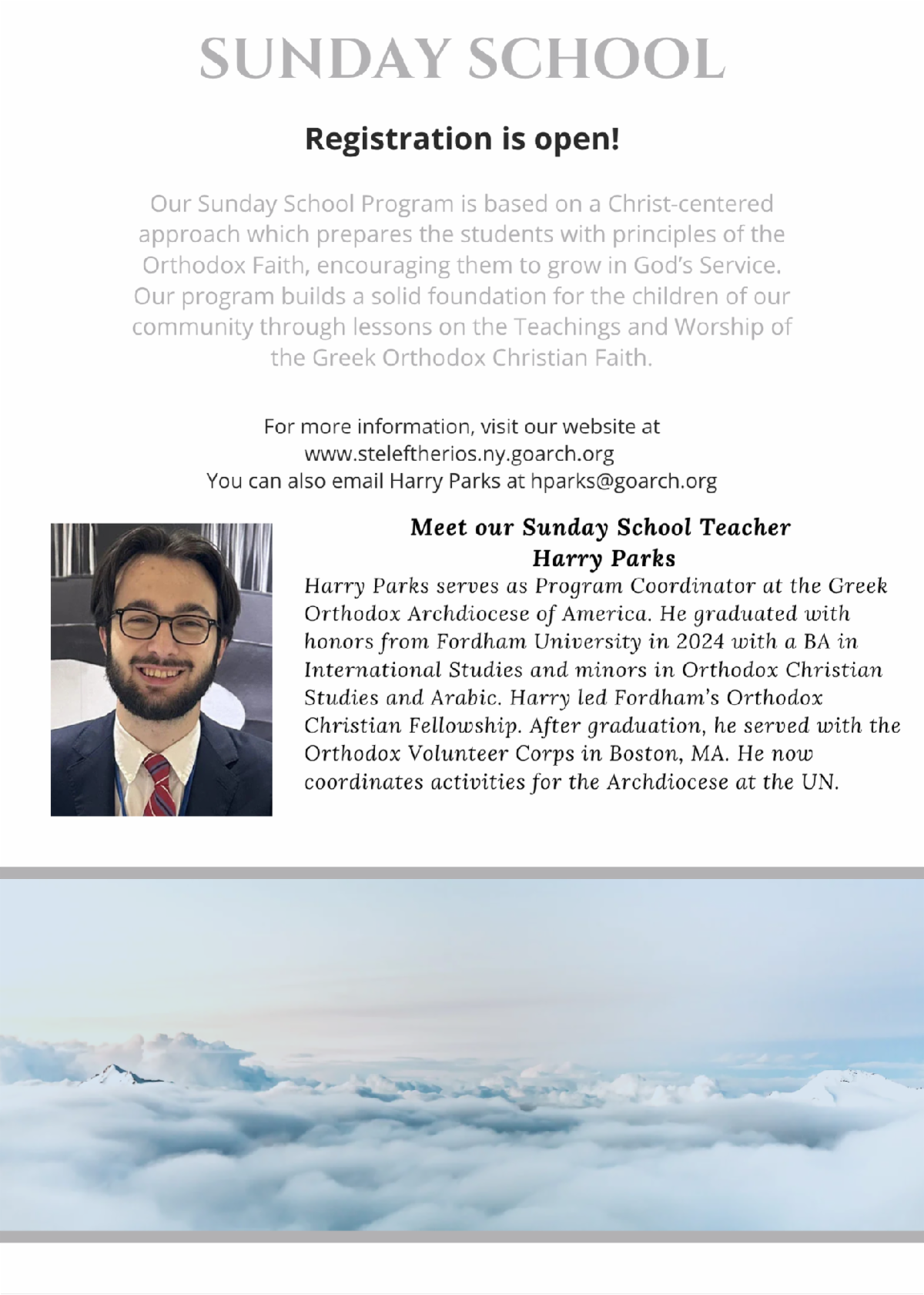
Sunday School


Sunday, October 18

Saint Luke the Evangelist

Orthros and Divine Liturgy, 9:00 a.m.


Sunday, October 25

6th Sunday of Luke

Orthros and Divine Liturgy, 9:00 a.m.

Sunday School


Sunday, November 1

5th Sunday of Luke

Orthros and Divine Liturgy, 9:00 a.m.


Sunday, November 8

7th Sunday of Luke

Orthros and Divine Liturgy, 9:00 a.m.

Sunday School


***

What does “Schism” mean? From The Original Greek: Schisma (Σχίσμα)

Fr. George Parsenios (HCHC ’96)


The word “schism” is commonly used to describe a religious division, but it does not have an inherently religious meaning. The word comes from the Greek verb schizô, which has both a strong and a weak sense. The strong sense refers to violent acts that split a thing in two, as when a storm at sea “slices” a boat in half or an axe “tears apart” a piece of wood. The weaker sense is used by Greek writers to describe less violent things, as when the Nile “divides” Egypt into two parts. The stronger sense is much more common in biblical usage. Jesus says, for instance, that putting new wine into old wineskins will “rip apart” the wineskins, and that the veil in the temple is “ripped” from top to bottom at the crucifixion. The term takes on our common sense of describing religious division when St. Paul refers to the schisms dividing the Church in Corinth (1 Cor 1:10; 11:18). Schism is distinguished from heresy by the Church Fathers, because heresy involves false teaching, while a schism is a division in the Church over politics or personalities that does not necessarily involve a deviation from true belief.


Fr. George Parsenios is Professor of New Testament at Holy Cross Greek Orthodox School of Theology. www.hchc.edu


Our education program is designed for school and preschool students as well as adults who wish to learn the Greek Language and Culture

or to improve their current skills.

For more information please call: (917) 431-4878

Facebook  Instagram

Copyright © St. Eleftherios Church


Our mailing address is:

359 West 24th Street, New York, NY 10011

Phone: (212) 924-3919; Fax: (212) 924-8011

For emergencies, call Fr. Nicolas (267) 588-2667

Email: saint.eleftherios@gmail.com


Saint Eleftherios Greek Orthodox Church is a parish under the spiritual and ecclesiastical shepherding of His Eminence Archbishop Elpidophoros of America of the Greek Orthodox Archdiocese of America, under the jurisdiction of the Ecumenical Patriarch of Constantinople.