|
LVTC Happenings!
A monthly report of events and resources for our passionate, growing local multisport community.
| | |
Welcome to the June LVTC Newsletter!
Welcome to the June edition of the Las Vegas Triathlon Club Newsletter.
As athletes, we spend a lot of time looking ahead. The next workout. The next race. The next goal. Yet one of the most valuable things we can do during a season is pause long enough to look at where we are right now.
That is the inspiration behind this month's theme: Mid-Season Check-In.
Whether your season has gone exactly as planned or taken a few unexpected turns, this is an opportunity to reflect on what you've learned, celebrate your successes, and identify areas where you can continue to grow. In many ways, the middle of a season is similar to the midpoint of a long race. The finish line is still ahead, but there is enough experience behind us to make meaningful adjustments moving forward.
In this issue, you'll find several perspectives on the idea of a mid-season assessment. Coach Hilary Mauch discusses the importance of evaluating your relationship with your coach before chasing the next "shiny object." Bob Gamble reminds us to listen carefully to what our bodies are telling us. Las Vegas Expert Bailey Hinz explores how self-compassion and mindset can influence performance and long-term success. Finally, John Mercer talks about the importance of midterm exams in the context of triathlon.
You'll also find club news, upcoming events, and a member spotlight featuring Jennifer Dion who is a great example of ‘Vegas Grit’!
Thank you for being part of the LVTC community. Your enthusiasm, support, and commitment to one another are what make this club special.
Train smart, support each other, and enjoy the journey.
#vegasgrit #strongertogether #fearless #lvtrifamily #enjoythejourney #thrive #thatsthevegasway
| |
2026 Membership
Club memberships run from January 1st, 2026 to December 31st, 2026. All club events are free with membership!
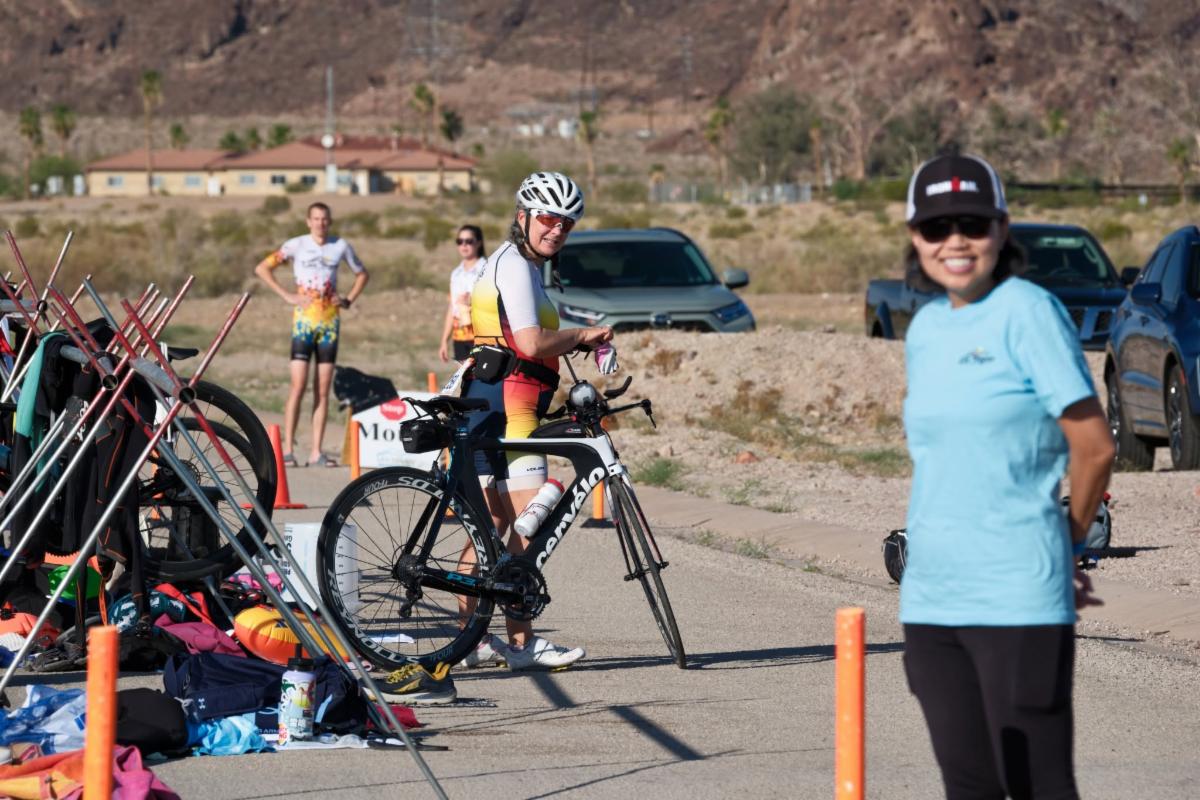
Our multi-sports events are typically between 50 and 75 athletes. We are not ‘… just another triathlon.’ Instead, we have a great ‘grassroots’ feel to our events during which members can get to know members.
All levels of athletes are welcome at our events. We have athletes completing their first event and have even had professional triathletes in our events!
But we offer more than just our four multi-sport events. We have clinics, podcasts, non-tri get-togethers, and help members connect with each other through social media channels.
We have the following membership categories:
- Single membership: $75
- Family membership: $95 (Up to 4 immediate family members. Family members must reside in the same residence or shared residence.)
- Student membership: $40 (Full time students only)
| | |
Club Hashtags
Use these hashtags in your social media posts to help share the Las Vegas Triathlon Club themes and highlight our endurance community culture:
#vegasgrit – This theme is about showing up with purpose ... training smart, supporting each other, and pushing through challenges in a way that fits your journey. It’s not about being the toughest person in the room...it’s about persistence, adaptability, and community.
#strongertogether – This theme reflects the essence of our triathlon community: achieving more through unity, supporting one another, and celebrating the shared journey of multisport life.
#fearless – This represents the beauty of taking on challenges of multisport and enjoying the rewards!
#thatsthevegasway – We made this theme as a way to point out the things that members do (e.g., loaning bikes, helping others, ...) that promote our club culture.
#enjoythejourney – This theme was selected to emphasize the importance of enjoying training and the overall process of preparing for an event/race.
#lvtrifamily – This theme was to emphasize the importance of our endurance community and to recognize that, even though triathlon is an individual sport, we never do this alone!
#thrive – This was our 2023 theme that was selected to emphasize that triathlon should bring value to all aspects of our lives.
| |
|
Sponsors
The Las Vegas Triathlon Club is a 501c(3) organization that is 100% operated by volunteers. Our annual operating budget is about $10,000-$12,000. Sponsorships are incredibly helpful for us to meet cover our operating costs and keep membership prices reasonable. You can read more about sponsorships HERE.
Thank you to our 2026 sponsors:
- Core Mental Health Services
- Elevation Physical Therapy
- Respect The Distance Coaching
- UNLV SPEED Lab
- UNLV Department of Kinesiology & Nutrition Sciences
| | |
Las Vegas Triathlon Club Events
Each year, the Las Vegas Triathlon Club hosts four multisport events. You must be a LVTC member to participate in the events.
The dates for our 2026 events are:
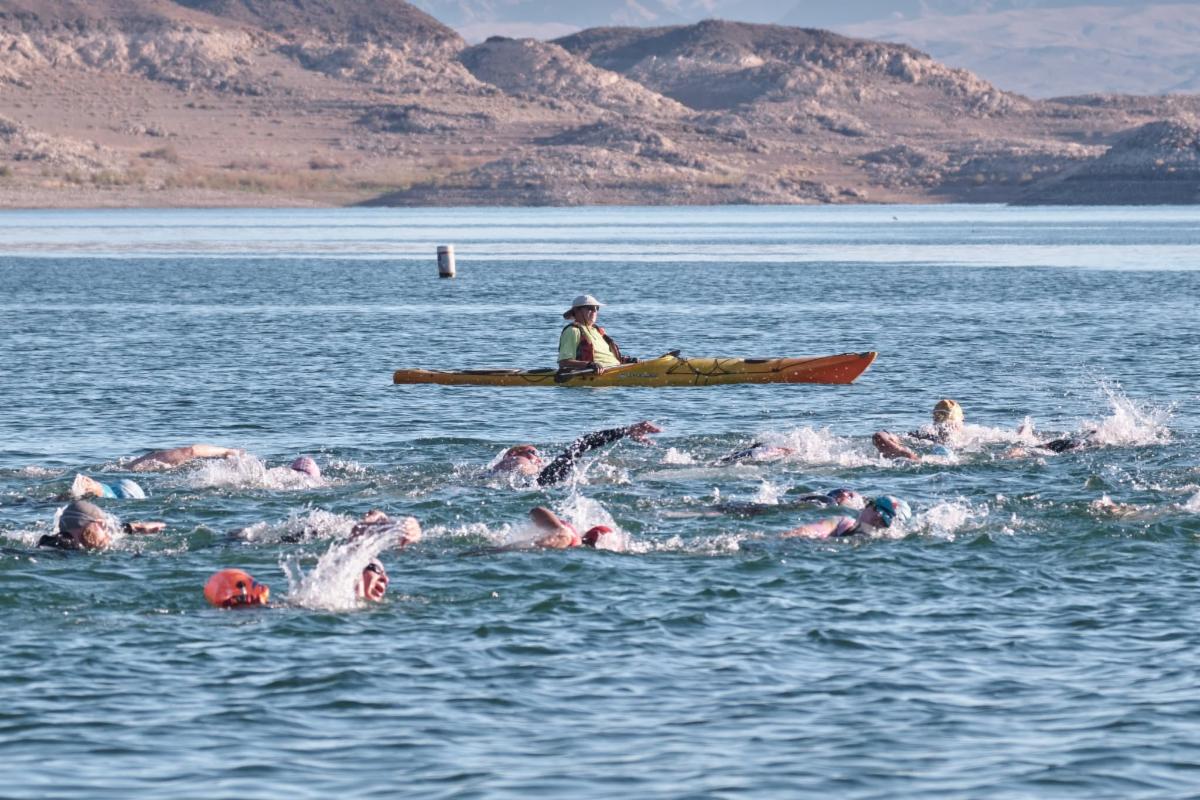
| | | Sunday, 4/12/26 | Sprint Triathlon | RESULTS | | Sunday, 5/10/26 | Sprint Triathlon | RESULTS | | Saturday, 6/6/26 | Aquabike | RESULTS
| | Saturday, 8/22/26
LAST EVENT! | Super Sprint Triathlon | Swim 300m, Bike 4 miles, Run 1.5 miles | | | |
All results are on our website.
Athletes accumulate points at each event for our LVTC Points Series Awards at the end of the season. You can see the previous winners at this link: Points Series Winners.
We also have a variety of events throughout the year. You can check upcoming events at our Las Vegas Triathlon Club Calendar.
Continue to check our Facebook Group for other happenings in our endurance community.
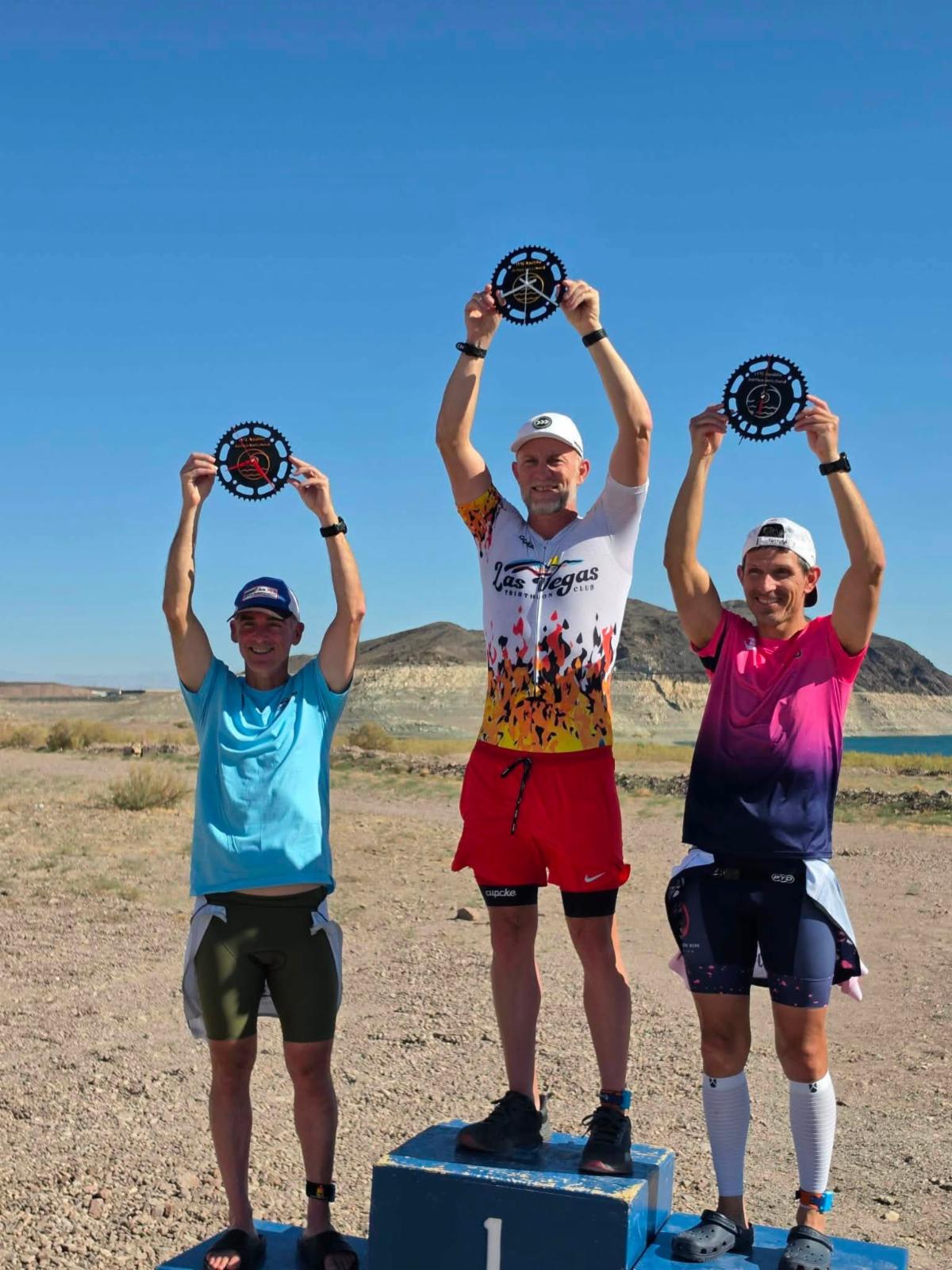
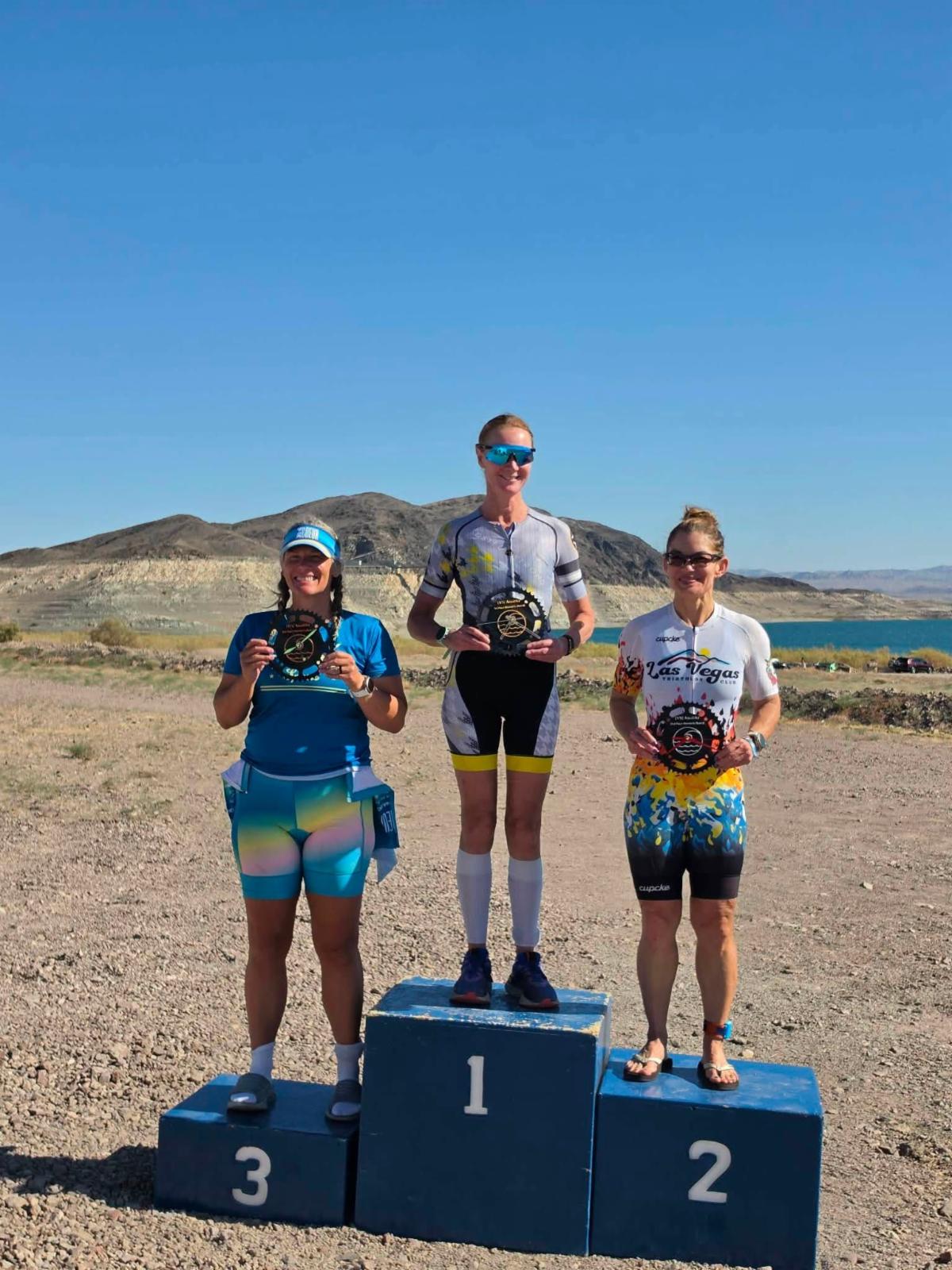
Here are the results of our 2025 events:
| |
|
Triathlete Performance Workshop
Hosted by The Movement Lab
This workshop is designed to help triathletes discover the overlooked physical limitations, weak links, and underworked muscle groups that may be preventing them from reaching their next level of performance.
Join us at The Movement Lab for a FREE triathlon performance workshop open to Las Vegas Triathlon Club members. This hands-on session is designed to help triathletes identify underworked muscle groups, movement limitations, and performance deficits that may be slowing them down or increasing injury risk.
During this workshop, we will break down common weak links that affect endurance athletes and teach practical strategies to improve efficiency, power, durability, and overall performance across all three disciplines.
What We Will Cover:
- Strength deficits affecting your swim
- Cycling muscle imbalances and power production strategies
- Running stability, and performance-focused exercises
- Underactive muscle groups commonly missed in traditional endurance training
- Injury prevention strategies for triathletes
- Strength and mobility drills you can immediately implement into your training
This is not just a lecture. Participants will go through guided movement assessments, exercise demonstrations, and performance-focused drills designed specifically for endurance athletes. Whether you are preparing for your first sprint triathlon or chasing a PR in a long-course event, this workshop will help you train smarter and move better.
Date: Saturday July 11
Time: 9:00-11:00 AM
Location:
The Movement Lab
8475 S Eastern Ave #105A
Las Vegas, NV 89123
Cost: FREE for Las Vegas Triathlon Club Members.
Space may be limited, so reserve your spot early! RSVP HERE or click the button below.
Come learn how better movement, strength, and muscle activation can translate directly into faster and more efficient racing.
| |
Socials/Training Events/Education
| |
Check out and subscribe to our calendar feature (a continuing work-in-progress):
Las Vegas Triathlon Club Calendar
These are the dates for our 2026 Club events:
-
4/12/26: Sprint Triathlon - RESULTS
- 8/22/26: Saturday - Super Sprint Tri
Sprint Triathlon:
Swim 750m; Bike 20km; Run 5km.
Aquabike:
Swim 750m; Bike 20km.
Super Sprint Triathlon:
Swim ~300m, Bike 4 miles, Run 1.5 miles.
Continue to check our Facebook Group for any additional get-togethers that may be happening, and for locals who are training in town or down at Lake Mead. Post your workouts!
Thanks everyone!
| |
Coach's Corner:
Before You Chase the Shiny Thing, Read This
We're officially in the thick of it.
If you're reading this, you're somewhere in the middle of your season and depending on where that lands for you, it looks a little different. Maybe you've already crossed a couple of finish lines and you're now setting your sights on what's next. Maybe you spotted a race you didn't sign up for earlier and you're already mentally registering for next year. Or maybe you're deep in a training block, head down, just grinding toward a goal that still feels a little far away.
Wherever you are, midseason is a natural time to pause and evaluate. And that evaluation is healthy, as long as you're asking the right questions.
The Shiny Object Problem
Here's what I'm seeing a lot of right now, and I'd be doing you a disservice as a coach if I didn't address it directly.
You're scrolling through social media on a Monday morning and your feed is full of race weekend recaps. Phenomenal finishes. Podium shots. Athletes tagging their coaches, crediting their training platforms, collecting their well-deserved kudos. And something catches your eye. Maybe it's the way someone described their breakthrough race. Maybe a caption resonated with a struggle you've been quietly carrying. And suddenly you're thinking, “maybe their coach could help me. Maybe that training platform is what I'm missing.”
Maybe. But before you go chasing that sparkly thing, I want you to slow down and do a real check-in first.
Start With an Honest Conversation
A lot of the frustration I see athletes expressing at this point in the season; coach doesn't respond, coach doesn't seem to care, this isn't what I expected and often comes down to one thing: communication. Or the lack of it.
Here's the reality. Your coach may be taking you down a very intentional trajectory that you haven't fully understood yet. You may have expected something different without ever actually saying so. And that gap between expectation and reality isn't always a coaching problem and sometimes it's a communication problem.
Ask yourself honestly: when did you last actually talk to your coach? And I don't mean catching them on a group ride and asking a quick question. I mean a real scheduled check-in. Most coaches offer monthly meetings, and have you been using yours? Are you providing feedback on your workouts, asking questions, engaging with the process? Because coaching is a two-way relationship. Your coach can build you the most thoughtful training plan in the world, but if you're not responding, giving feedback, or communicating what you need, they're working with one hand tied behind their back.
If you're someone who needs frequent feedback and consistent communication, that's completely valid! But your coach needs to know that. It may or may not align with their coaching style, and the only way to find out is to have the conversation.
Before You Jump Ship
If you've had that honest conversation and things still aren't clicking, then yes it might be time to explore other options. But do it respectfully and with some runway. Your coach has likely already built your training plan several weeks out. They've put real time and thought into your progression without knowing you were reconsidering. Honor that investment by giving proper notice and handling the transition with integrity.
The Real Midseason Check-In
Before you make any decisions, give yourself this gut-check:
Have you clearly communicated your expectations to your coach? Have you been showing up as an engaged athlete, providing feedback, asking questions, scheduling your check-ins? Is the frustration you're feeling a coaching problem, a communication problem, or a life-and-schedule problem?
If after all of that you still feel like something needs to change, then you have the clarity to make that decision thoughtfully, not reactively.
I'm not here to make the decision for you. That's not my job. My job is to give you the tools to make a good one. And sometimes the best coaching decision you can make at midseason isn't finding a new coach, it's finally having the conversation with the one you already have.
~Hilary Mauch
| |
Have you met these Coaches?
Triathlon race season is here. Do you have a coach? Are you looking for one? Well, the Las Vegas Triathlon Club is going to try to help make some connections.
Earlier this year, we sent out a google form to try to capture our local coaching expertise. We had a number of coaches (all are members of Las Vegas Triathlon Club) respond and we have featured them on this webpage:
Las Vegas Triathlon Club Coaches
We are going to continue to highlight coaches on our web page – if you would like to be part of that, please fill out this form.
| | |
Prez Corner:
Mid-Season Check-In
As a professor, one of the questions students often ask is, "Why do we have midterm exams?"
Many students view exams as a way to earn points or receive a grade. While that is certainly part of the process, I see them differently. A midterm exam is really a checkpoint. It provides students with an opportunity to demonstrate what they have learned, while also helping me identify areas where their understanding may still be developing.
The reason this is important is that learning is cumulative. The concepts we cover during the second half of the semester often build directly upon the knowledge and skills developed during the first half. If there are gaps in understanding, those gaps rarely disappear on their own. Instead, they tend to grow and make future learning more difficult.
That is why we have midterms.
A midterm gives students a chance to step back, honestly assess where they are, identify weaknesses, and make adjustments before the semester gets away from them. In many cases, a disappointing midterm grade is not the end of the story ... it is simply valuable feedback about where additional work is needed. It also helps me adjust my teaching in a way to help students have a successful overall semester.
The same principle applies to triathlon.
We are now at the midpoint of our racing season. Some of you have already achieved goals, set personal bests, completed races that challenged you, or simply enjoyed the process of training and racing with friends. Others may be dealing with setbacks, missed workouts, injuries, illness, life stress, or race results that fell short of expectations.
This is the perfect time for a mid-season check-in.
Take an honest look at your season so far. What has gone well? What are you proud of? Where have you made progress?
Then ask the more difficult questions. Are there areas that need attention? Is your swim where you want it to be? Are you consistently completing your key workouts? Have you neglected strength training, recovery, mobility, nutrition, or sleep? Are you enjoying the journey, or have you become so focused on outcomes that you've forgotten why you started?
Remember that identifying a weakness is not a failure. In both education and sport, recognizing a gap is the first step toward improvement.
The good news is that there is still plenty of season left. We have one more club race, a number local and regional events, and countless other opportunities to continue growing as athletes. The athletes who finish the season strongest are not necessarily the ones who started perfectly. They are the ones who took the time to honestly evaluate where they stood and made the necessary adjustments along the way.
So consider this the time to take your midterm exam.
Reflect on where you are. Celebrate what you've accomplished. Identify what needs work. Then use that information to build a stronger second half of the season.
As always ... train smart, support one another, and enjoy the journey.
See you at the next starting line.
#vegasgrit #strongertogether #thatsthevegasway #fearless #enjoythejourney #lvtrifamily
~John Mercer
| |
The New Triathlete
Mid-Season Assessment
Listen up.
Are you a good listener? If you ask 20 people this question, all 20 will say that they are good listeners, yes -- exceptionally good listeners. That is if they don’t ask you to repeat the question because they weren’t listening. Reality tells us, however, that most people are exceptionally poor listeners. Do you really listen, or while someone is talking, are you preparing what you are going to say as soon as they shut up?
Here’s another question for you: Do you listen to what your body is telling you? Or are you busy preparing for the next training session? Are you busy looking at your Strava volumes and times? Are you blindly loading your week’s training based on your training plan or simply what your coach specifies? If so, how much are you listening, and are you ignoring what your body is trying to tell you?
Now that we’re well into racing season – how well are you listening? I have personally made every training mistake there is, and I always thought I was listening to my body and doing the right thing at the moment. I wasn’t. Well, I may have been listening, but I wasn’t hearing what my body was saying. We know that when our plantar fascia, or our knee, or our shoulder starts to get sore, we need to back off and rest it. That’s easy. But are you truly listening to the nuanced language our body uses? How irritable are you when things don’t go well at work? Have you noticed that you are craving sugar more than normal? Are you waking up at 3:00 am when you used to sleep through the night? Are you “down in the dumps” for no apparent reason? Listen to your body and don’t ignore these things. At this point in the season, assess your health – physical, mental and emotional -- as well as your fitness, and trust your intuition.
A big mistake new Triathletes make is rigidly adhering to an arbitrary, cookie-cutter training plan without allowing their body to have a say. Please realize two things about training plans: All of us are unique in myriad different ways -- our metabolism, our strength, our nutrition, our sleep, our stressors -- but many training plans are constructed for a person other than us. We need to listen to our bodies and make adjustments. Our bodies sometimes use a strange language to talk with us. Listen hard.
~Bob Gamble
| |
Where in the World Has Our TRI Club Raced?
Check out the map below to see where our athletes have raced!
| |
The Evidence-Based Triathlete
Check out our previous episodes:
| | |
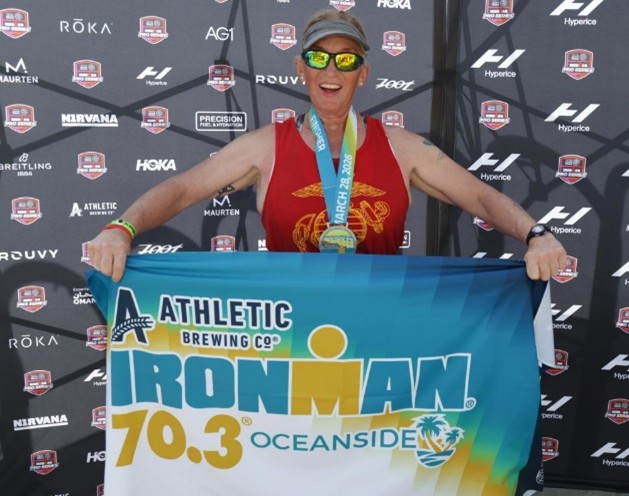
Vegas Grit Member Spotlight - Jennifer Dion
In this new feature in our newsletter, we highlight a member that exemplifies our club theme: Vegas Grit. Jennifer Dion is our Stronger Together Spotlight for this month!
Hi, I’m Jennifer. I’m 56 years old and have only been in triathlon for five years now. In fact, not quite even five years. My first triathlon was the Las Vegas Triathlon in October of 2021. Originally, it was supposed to be Rage in 2020 but we all know what happened in 2020!
I may still be a relative newcomer to the sport but far from new to the idea. My first introduction to triathlon was watching the Ironman from Kona on ABC’s Wide World of Sports back in the early 1990s. I thought how cool would it be to do something like that! But in 1992 how do you learn anything about triathlon? Not like we had small, personal computers that would fit in the palm of our hand back then. In 1992, the internet was little more than science fantasy to all but the military and a few large corporations.
So life went on. I was in the military so I was in pretty good physical condition but as so often happens when one gets out of the military, running three days a week became running once a week, to running once or twice a month, to talking about how much better shape I was in when I used to run. I prefer the term “filled out” rather than fat, but ya, I got fat.
Then, in 2010, I was diagnosed with inoperable throat cancer. 39 treatments of radiation and over a year of chemotherapy and I made it through the other side. But that experience does kind of change your perspective on things. I decided I needed to take better care of myself.
However, my biggest challenge has always been food. I have said many times before, “I don’t exercise the way I do because I like to exercise. I exercise the way I do because I like to eat!” That is truly not hyperbole. My PCP told me I was pre-diabetic and I had to make a decision. How did I want to control my blood sugar? For me, it was literally easier to increase my activity level than decrease my calorie level. It never helped that I’m built more like a bull than a gazelle.
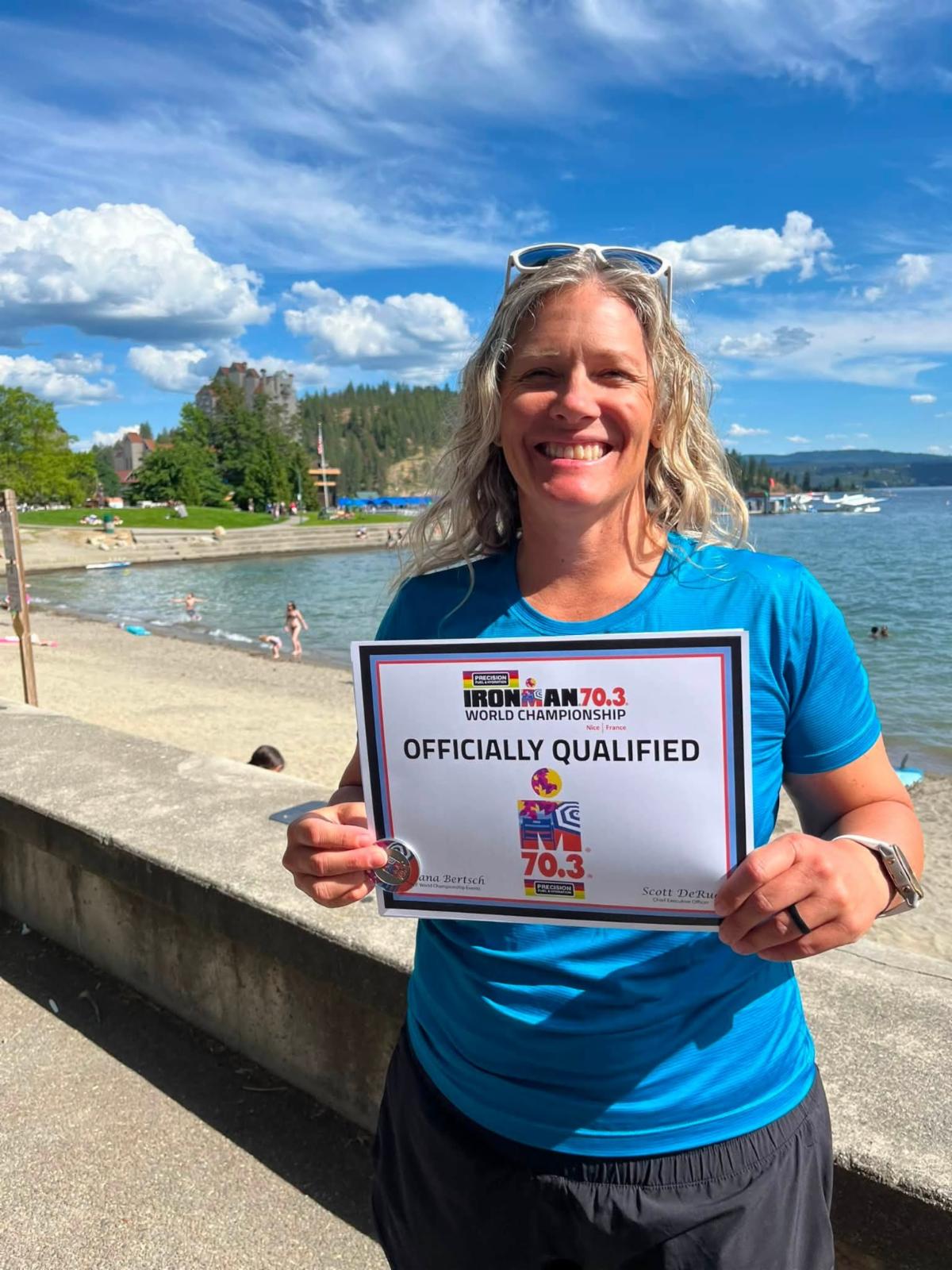
I started back running with just 5K and 10K races. Then, around 2019, someone said, “you should really give triathlon a try.” My mind flashed back to Ironman. I had never heard of a sprint. I did some research, bought a cheap, used bike that didn’t fit me correctly and started training. I completed my first sprint, thinking, “OK, I just want to finish one so I can check it off my bucket list.” But I finished the sprint and then I thought, “Well, if I can do a sprint, I can probably do an Olympic.” From there, it went to long distance events and I completed my first 70.3 in December of 2023, and then I finished Ironman Arizona in 2024. Just three years from my very first sprint!
My biggest challenge in triathlon has been long course events. Mainly because of fueling. Long term issues from throat cancer make taking in fuel during a race much more difficult. So I have a distinct trend from being competitive in short course triathlon to gradually fading back in the pack the longer the distance.
Despite that, or maybe in light of it, my full distance Ironman finish is without question my greatest accomplishment so far. I hope to notch one more full distance finish this October with Ironman California. After that, I intend to stick with shorter distance events.
But I love the sport and I promote it whenever I have the opportunity. I genuinely get frustrated at young people when I tell them about triathlon and they respond, “Oh no! I could never do that!” I tell everybody triathlon is 10% fitness and 90% mental, and I believe that. It’s a good way to prove to yourself that you’re stronger than you think.
For me, triathlon isn’t about winning, or even being competitive. It’s about reminding myself every time I’m out there that I’m both physically and mentally tougher than I think. So it doesn’t matter how slow you go just so long as you never give up.
| | |
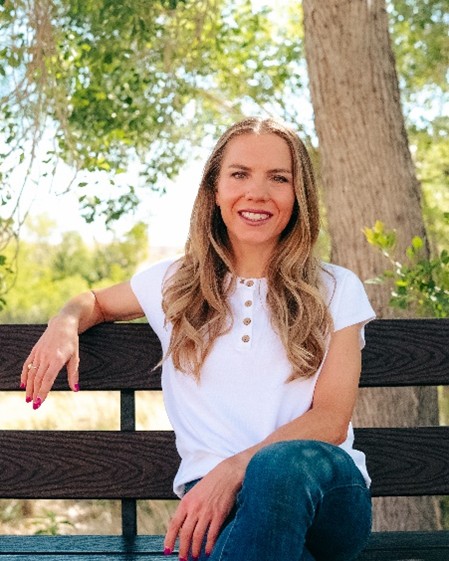
Vegas Experts: Bailey Hinz
We have some fantastic local triathlon expertise. In this regular feature, one of our local experts provides some advice for triathletes. Our expert this month is Bailey Hinz, LCSW, MT-BC, LPMT, CLCADC-1, who is the founder of Synapse Elite Performance and Recovery. Moreso, Bailey has been part of our endurance community as a (now retured) professional triathlete and currently races in road and gravel bike races.
Why You Can’t Hate Yourself Into Success
We may be in the height of summer, but I’m still thinking of the 2026 Winter Olympics. To me, they were groundbreaking. It wasn’t the gold medals or feats of human capability—it was the mindset. Figure skater Alysa Liu stated, “Winning isn’t all that, and neither is losing. It’s just something that happens… what matters is the journey.” Her post-skate “That’s what I’m f*ing talking about” lives rent free in my mind. When reporters framed second place as a “loss,” skier Eileen Gu laughed and called the question “ridiculous.” Veteran champion Shaun White reflected, “I think the way to become the best is to just have fun.”
What didn’t I hear? I didn’t hear that tired trope of, “I reminded myself how much I suck to motivate myself.” Yet, as a therapist specializing in the mental health side of athletics, I hear versions of this all the time. Athletes of all levels come to me with a belief of, “If I let my guard down, I’ll fail … If I’m satisfied, I’m giving up on my potential.” There is this pervasive belief that being hard on yourself is what drives success and that self-kindness makes you lazy, complacent, and soft.
I get where that comes from. For a lot of people, self-criticism has been effective in a very specific way. It can create pressure and urgency, getting you to work more, which can have some short-term benefits. However, working more is not the same thing as working effectively and comes with a pretty high risk of backfiring.
For most people, this approach is deeply flawed. Negative self-talk trains your brain to treat mistakes or imperfections as threats. Thanks to our inherent drive to survive, when the brain perceives a threat, it activates a fight, flight, or freeze response—the same system you’d use if you encountered a bear in the woods. That response is useful when there is actually a bear in front of you, but not particularly helpful when you’re trying to perform.
We’ll call this survival instinct the “emotion brain.” When emotion brain takes over, the prefrontal cortex - the part of your brain that helps you think clearly, make decisions, and stay present - takes a step back. Your survival instincts kick in and you get tense, reactive, impulsive or frozen. If we encounter a stressor repeatedly, the brain starts to generalize it as a threat – something to fight or flee from.
When looped into negative self-talk surrounding sport, our brains start to see that sport as a threat. The bike becomes the bear. So, instead of approaching performance with focus and intention, you start to automatically slip into emotion mind.
The good news is that this doesn’t have to be permanent. Through self-compassion and learning to calm the body, we can start to shift this pattern. Before you write that off - no, this is not about changing your goals or standards. Instead, it’s about shifting away from seeing the outcome as a threat.
There’s a concept in DBT (dialectic behavior therapy) called dialectics, which is the idea that two things can be true at the same time. In this case: I can accept myself as I am today, AND I can be capable of infinite growth. I can be proud of my fitness today and know I have room to grow. I can hope for a PR and know I’m loved still loved and worthy if I DNF. You don’t have to hate where you are to be moving forward. You can have internal success without tangible results. You don’t have to fear the outcome to lean into the process.
If you go back to athletes like Alysa Liu or Shaun White, you can see it clearly. The body performs very differently when it believes it’s about to do something (even enjoy it) versus when it believes it’s about to be attacked.
You don’t need to table your dreams or goals in this shift towards positive self-talk. But if the only way you know how to push yourself is by tearing yourself down, you’re going to hit a ceiling at some point. You can force yourself forward out of fear for a while, but you can’t build something sustainable on a foundation of self-criticism. So, if the goal is actual performance, not just suffering that looks productive, it’s worth rethinking not just how you feed your body, but how you feed your mind.
Sources
If you want to go down the rabbit hole, here are a few starting points that informed my perspective in writing this blog:
| | |
The Las Vegas Triathlon Club Legacy Scholarship
On 12/10/20, five Las Vegas athletes were killed when an impaired driver ran into a group of cyclists. The athletes were Tom Trauger, Erin Ray, Aksoy Ahmet, Michael Murray, and Gerrard Nieva. These five athletes are endearingly referred to as TEAMG (Tom, Erin, Aksoy, Michael, and Gerrard).
Following their deaths, there has been an upswell of community support for the families and survivors directly affected. There has also been a renewed call for action to create a safer environment for our athletes to train here in the Greater Las Vegas Valley.
The purpose of the Las Vegas Triathlon Club Legacy Scholarship is to honor the legacy of TEAMG as well as any local triathletes who have been killed or injured as result of distracted driving. The Legacy Scholarship is designed to encourage involvement in triathlon by new athletes, youth athletes, and/or continuing athletes in special need.
More information about the scholarship can be found at this page.
The list of our Scholarship Awardees can be found at these pages:
2026 Winners
2025 Winners
2024 Winners
2023 Winners
2022 Winners
This scholarship continues thanks to a generous donation by an anonymous donor.
| 2026 Las Vegas Triathlon Club Legacy Scholarship Awardees | | |
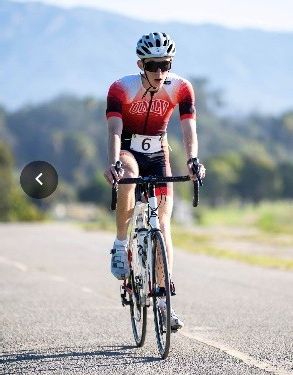
Preston Gradillas
My name is Preston Gradillas I am a full-time student at UNLV in my second year as a transfer student, studying Criminal Justice. I first learned about triathlons from my dad where I would travel with my family to many of his races across the west coast. My Dad was a inspiration to me that one day; I would get involved in the sport and complete my very first triathlon. I began triathlons in the Fall of 2025 where I joined the UNLV triathlon club, I was a runner before this and had little to no experience in the water on proper swimming. It was so bad I couldn’t get across a 25-yard pool. But with determination to train I would complete my first triathlon in February of this year! I fell in love with the sport and my ich to compete would continue to grow each and every day. I Plan on competing in triathlon for as long as I can swim, bike and run! I want to inspire others like what my dad did for me to take up a triathlon and do something you never thought you could do!
| |  | |
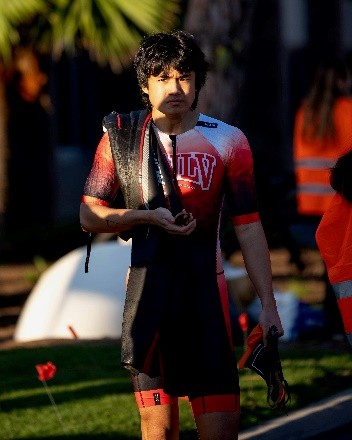
Jayden Halili
My name is Jayden Halili, and I am a third-year student majoring in Computer Science at UNLV. When I first heard about the UNLV Triathlon Club, I was quite hesitant. It was my first time learning what a triathlon even was, and I wasn’t particularly good at any of the three disciplines, especially swimming. Now, I can safely say that joining the UNLV Triathlon Club was one of the best things I’ve done in my college career. In a matter of months, triathlon has completely transformed my physical endurance and mental resilience, an achievement that I owe to my teammates. One would be hard-pressed to find another club at UNLV with as much camaraderie as the triathlon club, and I’ve found that this extends to the triathlon community as a whole: everyone is so incredibly kind and supportive, no matter the circumstances or skill level. I am incredibly grateful that I am able to be part of such an amazing community, and I hope to keep growing as a triathlete and continue to redefine my physical and mental limits.
| | | |
Paige Liberski
Paige Liberski is a senior at UNLV pursuing her Bachelor’s in Nutrition Sciences, with plans to graduate in May 2027. She came to triathlon the way many great adventures start — a random YouTube video and a “how hard could it be?” After competing in her first race on a $200 Target fixie (and spending over two hours on a 12-mile bike course), she was hooked. The bike went back the next day; a geared one came home in its place. Since then, Paige has built an impressive race history spanning sprints, relays, 70.3s, and her first full IRONMAN in 2025, with IRONMAN Wisconsin and Barcelona on the (hopeful) horizon. What keeps her going is the community — the people she meets at the start line and leans on through the hard miles. Paige joined the LV Triathlon Club in late 2022 and has made it her mission to show up: every event, every Boulder Beach swim, every potluck she can make.
After graduation, she plans to sit for the NDTR exam and eventually launch her own business serving endurance athletes — with a special focus on women and newcomers to the sport, combining her passion for fitness with her expertise in nutrition.
| | | |
Alejandro Rubio Toscano
My name is Alejandro Rubio Toscano and I am a kinesiology student at the University of Nevada, Las Vegas. I have always been passionate about sports since I was young, whether that be playing and joining soccer clubs, varsity volleyball in high school, and discovering my love for running in college. I challenged myself to race and train for marathons. In the midst of my training and completing five marathons, one of my professors introduced me to the world of triathlon, specifically the Triathlon Club at UNLV. The UNLV Triathlon Club helped me find people to train with, push me farther than what I thought I could do, challenged me to grow, pursue my goals, and remind me of the importance of consistency over occasional greatness. I’m incredibly humbled and grateful for the body I’ve built to be able to push through these long endurance events.
| | | | | |