August 2024 - Catch up on the latest news from CAARI! | |
|
Dear William,
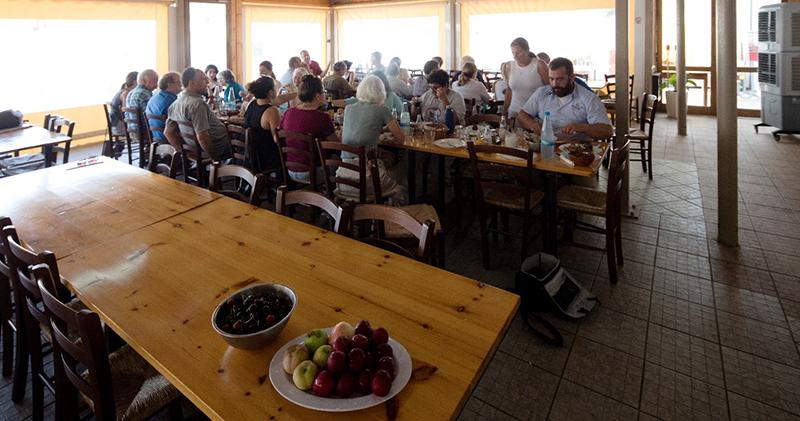
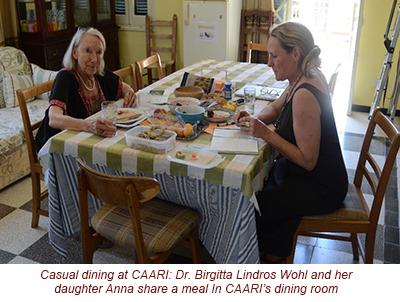
Dining heartily together is a staple feature of archaeological experience, be it in the field with team members, in garrulous groups of symposiasts or workshop participants (as in the image above), or casually with other researchers over impromptu but tasty meals prepared collaboratively in CAARI’s dining area (as below). Countless memories of unforgettable conversations over CAARI’s dining table weave through the recollections of archaeologists around the globe who have worked in Cyprus and known CAARI, bringing with them the twitch of salivary glands aroused by the evocation of succulent Cypriot cuisine.
| |
|
Right now, in August, CAARI is blanketed in searing heat, gathering energy after a hectic summer of full library and hostel occupancy, resurgent excavation activity, and the standing-room-only Summer Archaeology Workshop, resumed after three summers of pandemic suspension. In her “Message from the Director,” Dr. Lindy Crewe will relay the events of a summer season made memorable by the Institute’s own triumphs and the tragedy of forest fire in the Troodos Mountains. Following CAARI’s news, the Newsflash itself will turn instead to the indelible gustatory glory of being archaeologists on the island of Cyprus. This issue is on food in and food as archaeology. It has been edited by CAARI Trustee Dr. Laura Swantek, and she will open it with a truly delicious introduction to her savory subject.
| |
|
Message from CAARI’s Director
Dear friends and supporters of CAARI,
It has certainly been a hot and hectic time in Cyprus since our last newsflash with the heatwaves we have been experiencing causing those of us who undertake fieldwork in the summer to question our choices! Water levels are low in the dams and we very much hope for a wet winter.
The CAARI workshop was a great success, with seventeen papers presented on topics ranging from the Epipalaolithic to the vernacular boats of Cyprus and a special screening of the film Επιχείρηση Μουσείο/Operation Museum (directed by Petros Charalambous and produced by the Cyprus Press & Information Office). The film was a dramatization of the role of Vassos Karageorghis and the staff of the Department of Antiquities during the invasion of 1974 when the antiquities in the Cyprus Museum were packed up and moved to safety. It was introduced by our own Deputy Minister of Culture, Lina Kassianidou and was extremely moving. For the first time, the evening party was co-hosted with the Department of Antiquities at the Local Archaeological Museum of Ledroi, over the road from CAARI, with a joint event also celebrating the opening of a special exhibition of modern ceramics juxtaposed with archaeological materials: Converting the Archaeological Form.
| |
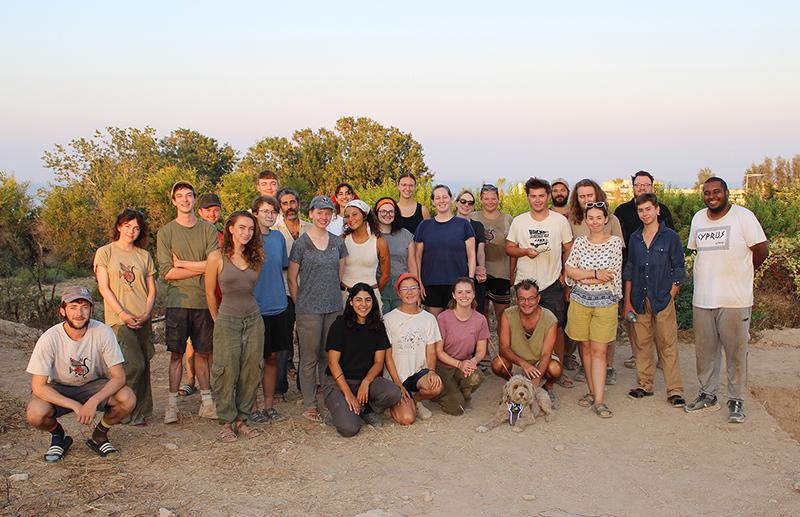
The fantastic Kissonerga-Skalia team, along with Darcey the barkaeologist, at the site on the last day of excavation. | |
I began excavating at Kissonerga-Skalia the week after the CAARI workshop and it was an excellent season with a great team of international students from the US, Canada, England, Ireland, Scotland, Lebanon, Saudi Arabia, Denmark, France, Australia and of course Cyprus! Everyone worked so tirelessly and cheerfully despite the heat and we achieved a lot. We were also delighted to receive a visit from the Ambassador of the United States in Cyprus, Julie Fisher, who also braved the hot weather for a tour and chat with our students. The most exciting new information from the season comes from our newest and largest pyrotechnical feature (over 4 x 4 metres in diameter) located in the same courtyard as the malting kiln discussed in the food section below. We haven’t yet completed excavation but it seems to comprise a sunken mud-plastered built basin and is full of ash, charcoal, plaster chunks, some pottery sherds, animal bone and ground stone tools, along with a few grape seeds. We are very excited to get back to work next season to try and figure out what on earth they might have been making in there.
In the meanwhile, next week is the big holiday week here for the Assumption of the Virgin on the 15th August and the CAARI office will be closed. After that we’ll be back to planning our autumn programme. Hoping that those of you in a summery part of the world stay cool!
Best wishes,
Lindy Crewe, PhD
Director, CAARI
| |
|
WWW.CAARI.ORG/SUPPORT
Zuzana Chovanec
CAARI Development Chair
CAARI has seen much activity this summer, filled with productive, collaborative, and convivial exchanges among the growing community of researchers that are drawn to Cyprus’ rich past. Likewise, our vibrant community of supporters – near and far – have been busy answering our calls of need. With your unfailing support, we extend our gratitude and happily report that we have achieved our first funding goal for the cost of the materials needed to repair the exterior walls of the building we call home. We hope you will assist us in achieving our next goal to initiate repairs.
WWW.CAARI.ORG/SUPPORT
or
| |
|
CAARI
11 Andrea Dimitriou Street
Nicosia 1066
Cyprus
| |  |
|
CAARI
209 Commerce Street
Alexandria, VA 22314
USA
| |
|
We also extend an invitation to an exciting event, Celebrating Cyprus’ Cultural Heritage in American Life and Learning, at the Penn Museum in Philadelphia, Pennsylvania on Sunday, November 24, 2024, 2:00-5:00 PM. Like the delectable accounts described below, the event invites those in Philadelphia and surrounding region to join an afternoon of Cypriot archaeology, culture and cuisine, which will include:
- Guests will be greeted by Mr. Evangelos Savva, Ambassador of Cyprus to the USA
- An introduction to the work of CAARI and the Cyprus Society of Greater Philadelphia in fostering knowledge of Cyprus
- A panel including Ambassador Savva and archaeologists representing CAARI to discuss current archaeological projects
- Special tours of the Museum’s recently installed Eastern Mediterranean Gallery
- A reception featuring Cypriot cuisine and wine!
-
All proceeds will benefit CAARI’s Fellowships and the Cyprus Society’s Scholarship Fund. For more information, please contact, Anna.Hadgis@gmail.com.
| |
|
Food in and Food as Archaeology
Introduction
Dr. Laura A. Swantek
Anthropology Faculty, Phoenix College
Kourion Urban Space Project, Cyprus Co-Director
CAARI Trustee
Anthropologists and other social scientists have long been aware that food is an important part of culture. Food, how we prepare it, and who we share it with convey identity and status, and strengthens social bonds. It doesn’t take a social scientist to tell us the importance food plays in human society, though. We all already know it, particularly if you’ve ever been to Cyprus! When you enter a home, a business or CAARI, you will definitely be asked if you would like a coffee, and how you would like it prepared: sketo (without sugar), metrio (some sugar) or glyko (lots of sugar). With that coffee, something sweet like a cookie or cake will likely be served and is best dipped in the hot and slightly bitter drink. You know you are a member of the family when upon entering you immediately hear, “metrio?” and you answer “naí!” There is no need for additional information: in Cyprus coffee orders are immediate and remembered.
The culture surrounding coffee on Cyprus is evident, but the importance of eating and sharing a meal with others is never more apparent than when you partake in the Cypriot meze. This wonderful feast is seemingly endless; it begins with tzatziki, taramasalata and other dips served with warm pitas, and continues with olives, grilled halloumi, village salad and vegetable dishes. Just when you think there is no way more food could be served, grilled meats arrive at the table! This meal is usually finished with a plate of the sweet and refreshing Cypriot karpouzi (watermelon)! A meze is meant to be shared, and it should take hours because it is not just about eating delicious food; it is about enjoying the company and conversation of the people you share it with. If you have not experienced the Cypriot meze, my advice is to pace yourself. You have a lot of talking and eating to do, and you don’t want to miss out on the good parts!
Sitting together, talking, eating and drinking is how you establish friendships in Cyprus that eventually become so strong, you are considered family. In anthropology we call this gaining social capital. In Cyprus, we call it a way of life. This is not a new phenomenon on the island. Food and drink have always been important. The archaeological record has given us plenty of evidence of this from the early hippo hunters of Akrotiri, to the Knights Templar who produced Commandaria, the sweet wine that now holds the distinction as the world’s oldest named wine still in production (according to the Guiness World Records). When feasting became a popular topic in the social sciences, researchers working on Cyprus were ready to publish this evidence. A Google Scholar search will return over 9000 results on “feasting” and “Cyprus,” including articles and books, and the occasional guidebook. All proof that we love to talk about food!
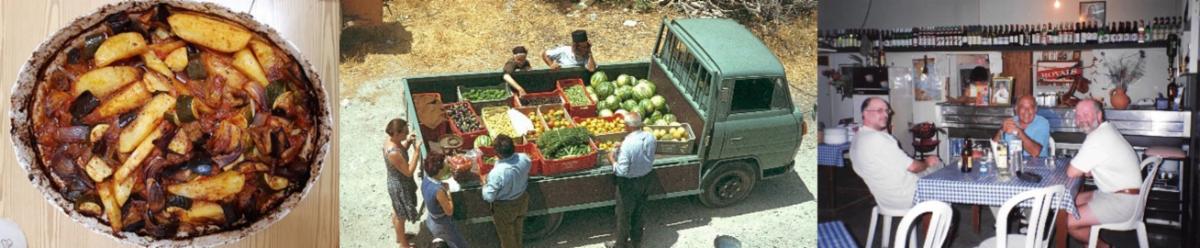
It is in this spirit that the Newsflash dedicated to food was imagined. In this issue, you will read about adventures in making sheftalia, the joy brought to us by cooks on archaeological field projects, recipes, a photo journey through traditional cooking and cheese making, archaeological evidence for the production of beer during the Bronze Age, and dining and cooking ware at the end of the Late Roman period.
As I read through the wonderful submissions for this Newsflash, I was reminded of a quote from the chef, writer and traveler, Anthony Bourdain: “Food is everything we are. It’s an extension of nationalist feeling, ethnic feeling, your personal history, your province, your region, your tribe, your grandma. It’s inseparable from those from the get-go.” I hope you feel the same as you read on!
| |
|
Archaeology and Food
Dr. R. Scott Moore
Indiana University of Pennsylvania, Distinguished University Professor
Pyla-Koutsopetria Archaeological Project, Co-Director
CAARI Co-President
| |
|
I hate to disappoint you, but this isn’t about the archaeology of food, which is a fascinating topic and one I love to incorporate into my ancient history classes since eating is something that everyone can relate to in some fashion. This is actually about doing archaeology and food, or perhaps food for archaeologists. For me, this became a connection at the end of my first year in graduate school. In the program’s second year, students spent six weeks in Bermuda mapping a shipwreck and I was given the opportunity to have my airfare covered if I served as cook, which I accepted. I had a trial period as assistant cook during that summer’s field school in Lake Superior documenting shipwrecks in the Apostle Islands, which I passed. Between the summer and fall I collected recipes and watched cooking shows, especially Alton Brown’s “Good Eats,” which often incorporated history into the show. It turns out that I liked to cook and watch cooking shows, and still do.
When I joined the Sydney Cyprus Survey Project, one of the important lessons—and there were many—that I took away from it was the importance of good and ample food for the teams, and Bernie always had great chefs/cooks: I still use several recipes I picked up on the project. When Bill Caraher, David Pettegrew, and I started the Pyla-Koutsopetria Archaeological Project, I did all the cooking for the first seasons until our numbers became too large for me to do that and actually work on the project. I can remember the great team dinners we have had celebrating successful field seasons, whether it was the Black Turtle or Militzis in Larnaka, or the Old Town Restaurant in Polis.
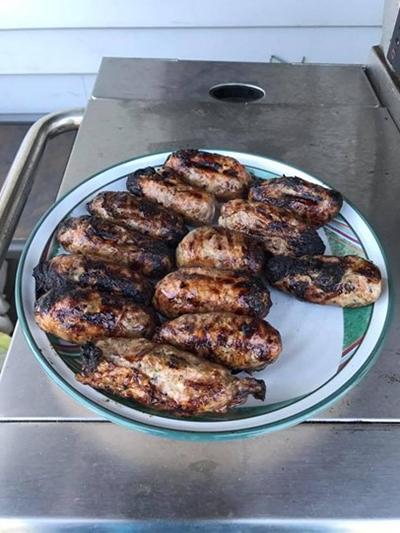
This association with food and cooking means that I have always handled the cooking for my family. As would be expected, my favorite cuisine to prepare is Mediterranean. For me, when I think of Cyprus-specific food, I think of halloumi (the squeaky cheese) and sheftalia (Cypriot sausage). I realize that it may differ for others, but I love cheese and am from North Carolina where barbecue reigns supreme—and that means pulled pork in a vinegar sauce, and I will not accept any argument on that. Anyway, I am fortunate that I can find halloumi in Pittsburgh at Stamoolis Brothers, a Greek grocer. When I decided to make sheftalia, it was harder than I thought...way harder. Finding recipes in this day and age was easy; in fact, deciding which to use or modify was difficult, particularly since my goal was for them to taste like the ones from Stou Roushia in Larnaka, which to me are my favorite on the island. The difficulty came in securing the critical ingredient of the recipe – caul. Sheftalia are wrapped in in caul instead of traditional sausage casings. I live in a small town in southwestern Pennsylvania, and after visiting our four grocery stores and local butcher, I was out of luck and had received a fair number of strange looks when I asked about it. We are only about an hour from Pittsburgh so I made a quick visit to the Strip District in Pittsburgh, and thought I was out of luck when I was told at my last hope that they had never heard of caul. Fortunately, another employee overheard us and said that they actually had caul in the freezer. So, five pounds of caul richer I headed home to try my luck. I have to admit they actually came out pretty close to what I was aiming for, both in taste and looks, maybe not as good as the best I have had in Cyprus, but close.
|  | |
|
Here is the recipe I followed:
Sheftalia:
Source: Nick Lazarides
| |
|
Ingredients
1 ½ Lemons
Ground Pork
Ground Lamb
Pork Caul
Parsley
1 Red onion
1 Yellow Onion
Cinnamon
Sea Salt
Coarse Black Pepper
| |
|
Directions
Soak caul fat in bowl of water with the juice of one lemon for 30 minutes. Dice the red and yellow onion. Add parsley, diced onion, cinnamon, juice of half a lemon, salt, and pepper to ground meat. Mix well and refrigerate for 30 minutes. Roll into sausage shapes and wrap each sausage in a layer of caul fat. Cook over a hot grill until cooked through and browned on outside, about 15 minutes - but depends on size of sausages.
| |
|
SCSP/TAESP: Cooking and Recipes
Dr. A. Bernard Knapp
Emeritus Professor, Mediterranean Archaeology, University of Glasgow Honorary Research Fellow at CAARI
Journal of Mediterranean Archaeology, Co-editor
| |
|
Given my early experiences in field archaeology, I was determined that, if ever I directed a project, the food would be a priority.
On the Sydney Cyprus Survey Project (SCSP: 1992–1996), we retained a local village woman as our cook for the first year. This left something to be desired, so for the following year and all subsequent years of both SCSP and TAESP (Troodos Archaeological and Environmental Survey Project: 1997–2003), I advertised (through colleagues and online) for a ‘chef’ who could provide Mediterranean and Asian cuisine, using (mainly) local produce, cheeses, fish and (occasionally) meat. I offered to pay their travel to Cyprus, and of course to accommodate them during the weeks of the project.
We were blessed with two outstanding women, Tracy Ireland (herself an archaeologist who worked with TAESP for a couple of years), and Annie Evans. Both were Australians so it wasn’t cheap to cover their travel, but it was so well worth it.
Team participants made their own (first and second) breakfast, but when we returned from the field each day (around 13:00), we had a basic but always inspired lunch, and for dinner (around 19:00) we enjoyed an array of world cuisine (e.g., Thai, Indonesian, Italian, Spanish) as well as the cook’s take on the local cuisine. Excepting a few Glaswegians who clamored for meat and ‘tatties’ (Tracy indulged them), nobody else complained; quite the contrary, they enjoyed what was — I feel sure — some of the best food ever served on an archaeological field project.
There is much more to be said on this topic, but for that you’ll have to wait and read the Introduction to A Casa Bernardo (working title), a cookbook in preparation for publication.
Recipes:
Pasta Santu Lussurgiu (A. Bernard Knapp). Serves 2
On a trip to Sardinia one summer, on the advice of Peter van Dommelen, we visited the medieval town of Santu Lussurgiu in Oristano province, situated some 500m above sea level at the edge of a massive extinct volcanic mountain, the Montiferru. We stayed in one of the rooms at the Antica Dimora Del Gruccione hotel, situated in the medieval centre of the town, with its own beautiful garden and restaurant. The meal included an aubergine dish, and we asked the chef (a young, local woman who had trained in France) how she prepared the aubergine. Based on her generalised reply, I attempted to reproduce the dish, as follows.
Ingredients
1 large aubergine
8-10 sweet cherry tomatoes, cut in half and topped with drops of olive oil and oregano
2-3 tablespoons of extra-virgin olive oil
A couple of anchovies
1 shallot, finely chopped
1-2 cloves of garlic (or, as much as you wish)
sea salt, roughly ground black pepper
1/2 cup dry white wine
A few crumbled saffron threads
A few chili flakes (optional; and, if you like it hot, use one fresh red chili)
300 g of small-sized pasta
small handful of Italian parsley, finely chopped
Cooking Instructions
Place washed aubergine in 200C (390F) oven (on tin-foil or in pan) and cook whole with skin on for up to 2 hours (it should almost be melted). For the last half-hour, add the baby tomatoes and bake until shrivelled. Remove tomatoes and aubergine from oven; run the latter beneath cold water, peel and chop. Saute anchovies in the olive oil in a heavy skillet over medium heat until they begin to melt; add shallot and cook for at least 5 minutes, then add garlic, some salt and pepper, and continue cooking for another minute or two. Add aubergine and stir to mix well. Turn up heat and add saffron, the tomatoes, chili and wine, and simmer 3-5 minutes.
While sauce is simmering, cook pasta in boiling salted water until al dente, then drain. Toss hot pasta into the skillet, adding more salt and pepper to taste. Sprinkle with parsley and serve with grated pecorino.
Sticky Toffee Pudding (Annie Evans). Serves 8
Ingredients
185g pitted dates
250ml (1 cup) water
1 tsp bicarbonate of soda
2 tsp baking powder
60g (2 Tbsp) unsalted butter
2 eggs
185g (¾ cup) dark brown sugar (for more intensity, add 2 Tbsp black treacle)
185g (1¼ cups) self-raising flour
¼ tsp vanilla essence
Thick (double) cream
For the Sauce
150g brown sugar
150ml (2/3 cup) cream
110g (½ cup) butter
½ tsp vanilla essence
Cooking Instructions
Preheat oven to 1900C (3750F).
Cook the dates in the water until they become ‘jammy,’ stirring frequently to break them up. Beat in the remaining ingredients and mix well. Butter and flour an oblong baking tray with edges, and pour in the mixture. Bake on centre shelf of oven for 30–35 minutes or until toothpick comes out clean.
To make the sauce, place all ingredients in a pan, bring to a boil and keep it there for 5 minutes, stirring constantly to keep it flowing.
As soon as pudding comes out of the oven, prick it all over with a fork or cocktail stick and pour about a third of the warm sauce over it, using a spatula to move it to the edges so that the entire pudding is covered with a thick, sticky glaze. Keep the remaining sauce in the pan warm. Leave for 30-60 minutes, then serve with the rest of the sauce in a jug and the cream.
| |
|
Photos of Traditional Cypriot Cooking
Dr. Michal Artzy
University of Haifa: Director, Hatter Laboratory of Coastal Archaeology
CAARI Trustee
with captions by Dr. Laura Swantek
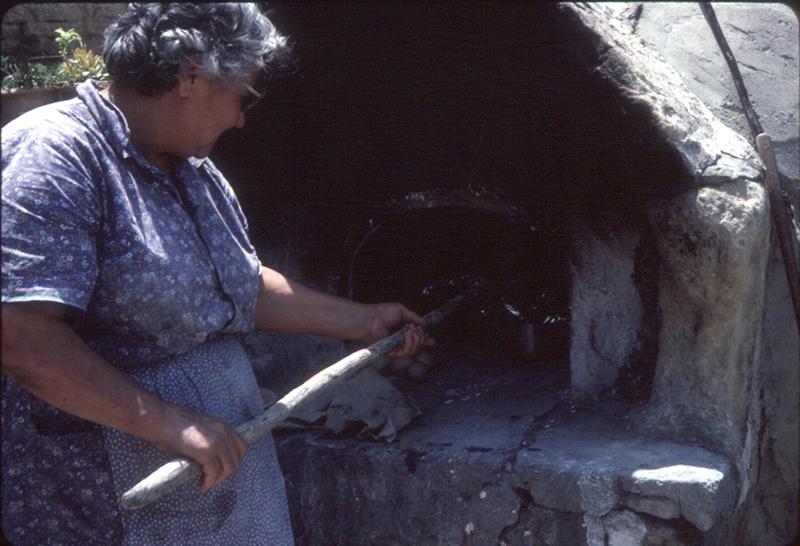
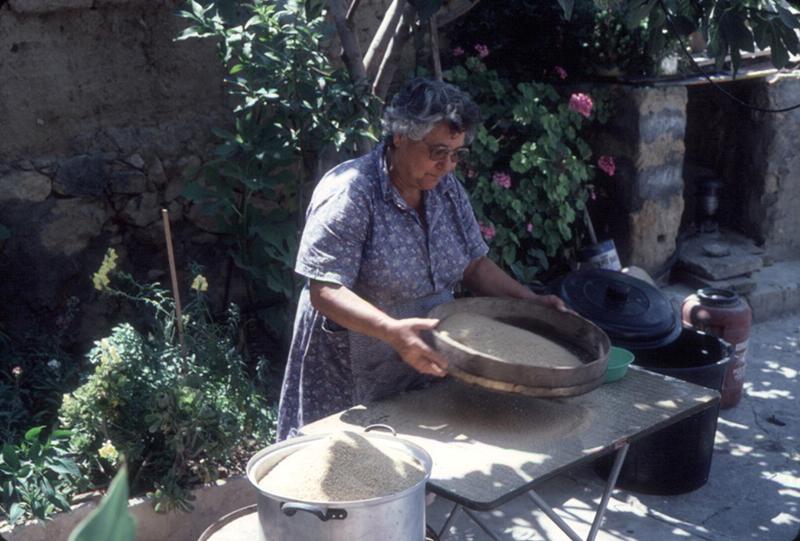
| Michal Artzy has graciously contributed some of her photographs of food preparation in Cyprus. Some readers may recognize Kyria Moustoukki, mother of Vathoulla Moustoukki, the long-time administrative assistant at CAARI. Kyria Moustoukki is remembered fondly for her delicious cakes by many who stayed at CAARI or worked on field projects. | |
Kyria Moustoukki putting food into the fournos (traditional clay oven). | |
Kyria Moustoukki cleaning flour in a traditional sieve. Sieves similar to this likely date back at least to the Bronze Age. Cypriot terracotta models from this period show individuals using a similar tool for preparing food. | |
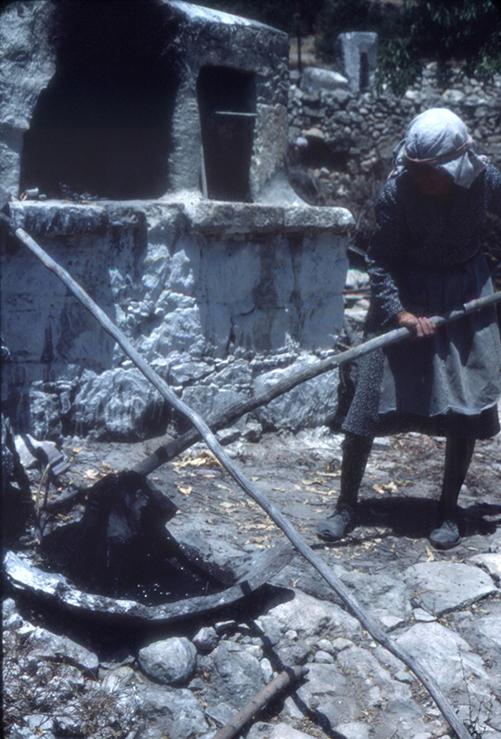
Kyria Eleni of Sotira village preparing the fournos. | |
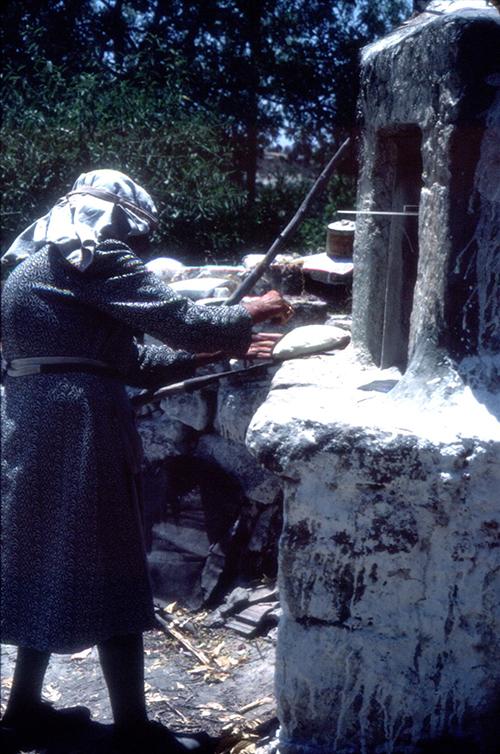
Kyria Eleni of Sotira village baking bread. | |
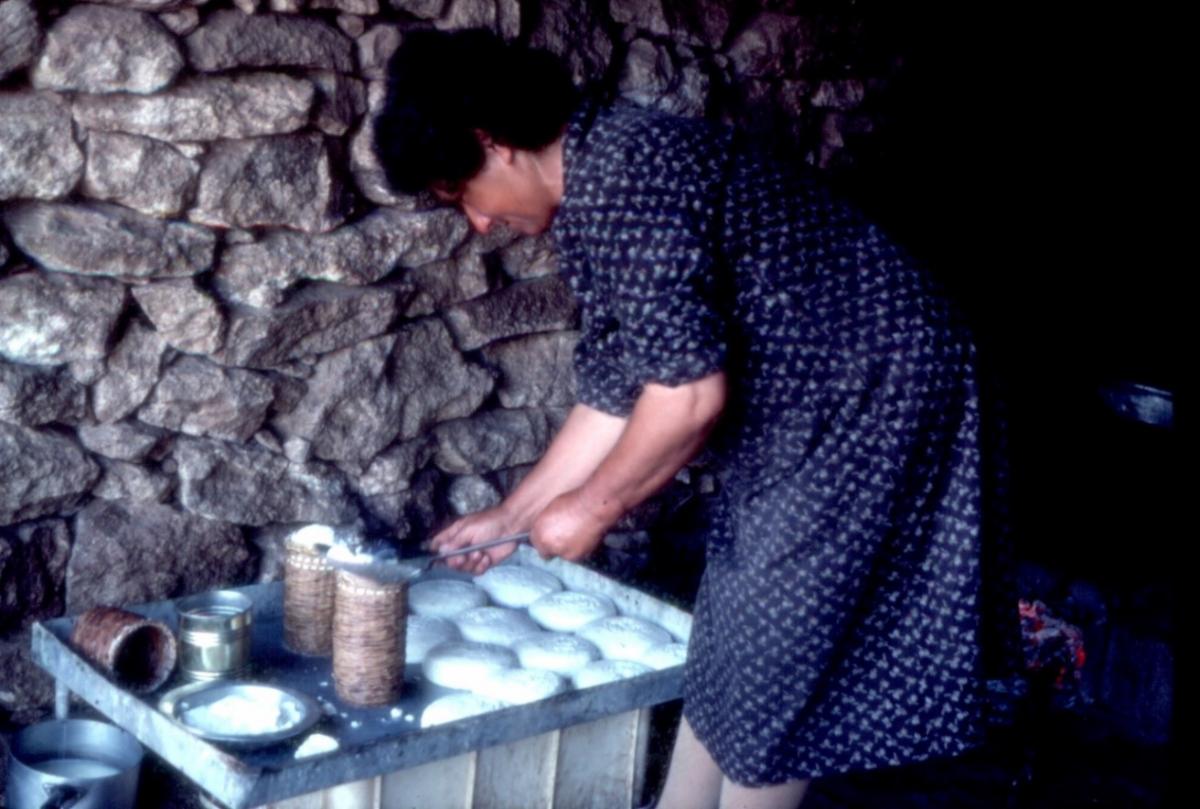
Making halloumi and anari in a mandra (sheepfold) in Erimi village in the mid-1980s. | |
Halloumi is the traditional cheese of Cyprus that grilled and “squeaks” when you eat it. Anari is the by-product of halloumi; it is a softer cheese that is drained in tall baskets, like those seen in the photograph, and bears the indentation from the basket weave when served. It is often sliced into rounds and sprinkled with sugar and cinnamon or becomes the filling of pastries like Bourekia, which are fried and sprinkled with sugar. | |
|
Brewing Beer at Kissonerga-Skalia
Dr. Lindy Crewe
Kissonerga-Skalia Archaeological Project, Director
CAARI Director
| |
|
The final phase at the settlement of Kissonerga-Skalia, dating to the transition from the Middle–Late Cypriot Bronze Age, around 1650 BC, has now yielded three large pyrotechnical features that indicate production of commodities beyond domestic scale. One oven, measuring around 4m in diameter, is still under excavation, another remains mysterious in purpose but the third feature (Feature 33, measuring 1 x 1.5m in diameter, shown here) we believe functioned as a ‘drying kiln’ used in the production of beer as well as for drying foodstuffs such as meat and fruits. Technically, early beers do count as food! Safer to drink than water and with a low alcohol content, pre-industrial beers are full of B-group vitamins and nutrients from grains and, as they probably weren’t strained, they would definitely have been on the chewy side.
As we excavated Feature 33 we came down on collapsed concave pieces of hardened mud plaster wall, indicating that the oven originally had a domed roof. On the interior beneath a series of ashy deposits (containing a few carbonised barley grains and fig seeds) we found a hard-baked flat surface with a large pithos embedded in the base at the entrance. In the base of the pithos we found charcoal and a partial cookpot that had been used as a scoop to clean out the ash. After much pondering and speculation, we deduced that Feature 33 functioned as a ‘malting kiln’. This is a type of oven where the direct heat was confined to a fire box in the base and the domed roof allowed the circulation of hot air to gently heat or dry materials on the base whilst providing higher temperatures at the roof, suitable for smoking meats. Feature 33 is located at one end of a large plaster-floored courtyard in which we found inbuilt mortars and grinding installations as well as an array of pottery, including cooking pots and juglets.
| 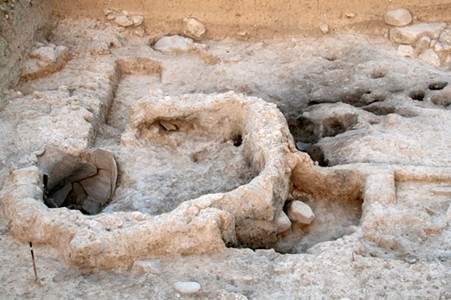 | |
Kissonerga-Skalia, Feature 33, which we believe functioned as a ‘drying kiln’ used in the production of beer | |
|
The base of beer–malt–is simply partially germinated grain (wheat or barley in Cyprus) which has had the germination process cut off by gentle heating (not above 65°C) in order to preserve the enzymes and create fermentable sugars. The malt is then mixed with water to make the ‘mash’, which again must be only gently heated to break down starches, prior to introducing yeast and sealing the mixture in a vessel for fermentation to take place. The basics required to make beer are: water; malted grain; a means to crush and process the malt; heat/fire/fuel; a vessel in which to mix the grain with hot water; and containers to collect and store the product. Feature 33 and the associated courtyard therefore contain all the necessary attributes for beer production. It is quite possible that the juglets contained a sweetener or a yeast for use in the beer process, perhaps made from figs, given the number of fig seeds present.
The next step was to conduct some experimental archaeology, in collaboration with HARP Archaeology, to attempt to replicate both the malting kiln and beer. Both aspects were successful, with the correct temperature for malting at the base of the reconstruction and the successful curing of meat at the roof. The beer itself… well, let’s just say it was technically successful but not many of us are fans of a beverage that smells like halloumi!
| |
|
Dining Like a Cypriot in the Late Roman Period
Dr. Ian Randall
Masaryk University, Postdoctoral Research Fellow in the Digital Humanities
| |
|
Food, and dining, are central to the ways that we think about ourselves. We eat every day, hopefully multiple times a day, and the ways in which we engage in this embodied activity send signals both to ourselves and to others about who we think we are, or want to be. Are we eating a vegan poke bowl? A steak, exceedingly rare? Are we consuming Chinese food, or a Cypriot doner? Are we eating with our hands, or off of expensive plates with fine silverware? Is the situation, or the company, “appropriate” for one style of eating versus another? This activity sends a number of signals both to ourselves, and those around us, that contain a great deal of culturally encoded identity information. In the past, it was no different, and the remains of these meals, and the material culture that was used to cook and eat them, offer us a great deal of information about how people saw themselves. Pottery is by far the most ubiquitous archaeological material that relates to ancient cooking and dining. In Cyprus, literal tons of the stuff is unearthed in every excavation or identified in every survey. On the surface, perhaps the most common, and identifiable, remains date to the end of the Late Roman period, say the 6th to 7th centuries CE; the period upon which I work and that I would like to discuss in this CAARI Newsflash.
By and large, these pieces of pottery that litter the surface can be divided into four categories: dining ware, cooking ware, storage jars, and transport amphorae. I’d like to discuss the first two. In the Late Roman period, dining was still largely done in groups and around a communal table. Thus, much of what we find are broad plates, done in a distinctive red fabric (most commonly from Tunisia) and with a shiny red slip. Bowls and cups are known, but tend to be less common. Cooking pots are deep, round bottomed affairs, with small handles, done in a friable fabric, known to be good at preventing thermal shock. We have little information about the Late Roman diet outside of medical texts (like De Cibis or De Alimentis) and, of course, Apicius’ volume (not actually written by him and thought to be a pastiche of earlier sources compiled in the 5th c. CE). This latter work is geared mostly towards the elite, and includes exotic recipes for things like parrots and dormice. While there has been some success in reconstructing diet in Constantinople (they seem to have been particularly fond of shellfish), in provinces like Cyprus we must rely on the occasional reference in texts from earlier or later periods. Following Christianization in the 4th century CE, fish would have been popular on Fridays, while the rest of the week would have revolved around the Mediterranean triad of bread, olive oil, and wine supplemented by legumes, dairy products, and meat, when available. A dizzying array of vegetables and fruits are mentioned offhand in various sources, including capers, lemons, and candied fruits, the which, of course, hold a special place in Cypriot cuisine today. Oranges, melons, and aubergines appear with the Arabs after the 7th century CE. Koulouri, trahanas, and loukaniko are present and appear very ancient indeed. On special occasions, braised meat would have been added to the menu, and, although it may have been more difficult to come by in Cyprus, the fermented fish sauce garum remained popular throughout Late Antiquity. For the poor, bread, stews, and porridges would likely have formed the core of their diets. These latter dishes, notably, do not lend themselves to broad plates, and thus we can already see a class-oriented distinction between types of food and the pottery involved in eating it.
For further information about Late Antique identity, pottery, and foodways, watch my future research, but in the meantime, give a thought to what you’re eating, how, and just how long Cypriots have been enjoying γλυκό του κουταλιού.
| |
|
To All our Friends and Supporters: Eat Well!
May your appetites be whetted by Dr. Swantek’s abundant offering of food and archaeology! And to those who help us keep CAARI hospitality warm and abundant, we send our sincerest thanks! As you have seen in Dr. Zuzana Chovanec’s statement above, CAARI’s colonial-era home faces a bracing financial challenge in maintaining the stability of its beautiful, historic, but slowly crumbling golden Nicosia limestone cladding. We send heartfelt thanks to those who have helped us over the first hurdle in facing this challenge. This help has been very warmly appreciated. There will be further hurdles. But with your help, we will surely preserve both our home and our fellowships uncompromised. Do help if you can!
| |
|
Annemarie Weyl Carr
Vice President, CAARI Board
| | | | | |