May is
Mental Health Awareness Month!
May is almost over, but you still have time to engage in activities and events that support mental health awareness and help start conversations about mental health research in your communities.
Along with NAMI, MHA, and many other mental health advocacy organizations, The STARR Coalition has created a toolkit for you to use to help raise awareness. Check out the downloadable graphics and informational posts we've collected to support Mental Health Awareness Month HERE.
|
|
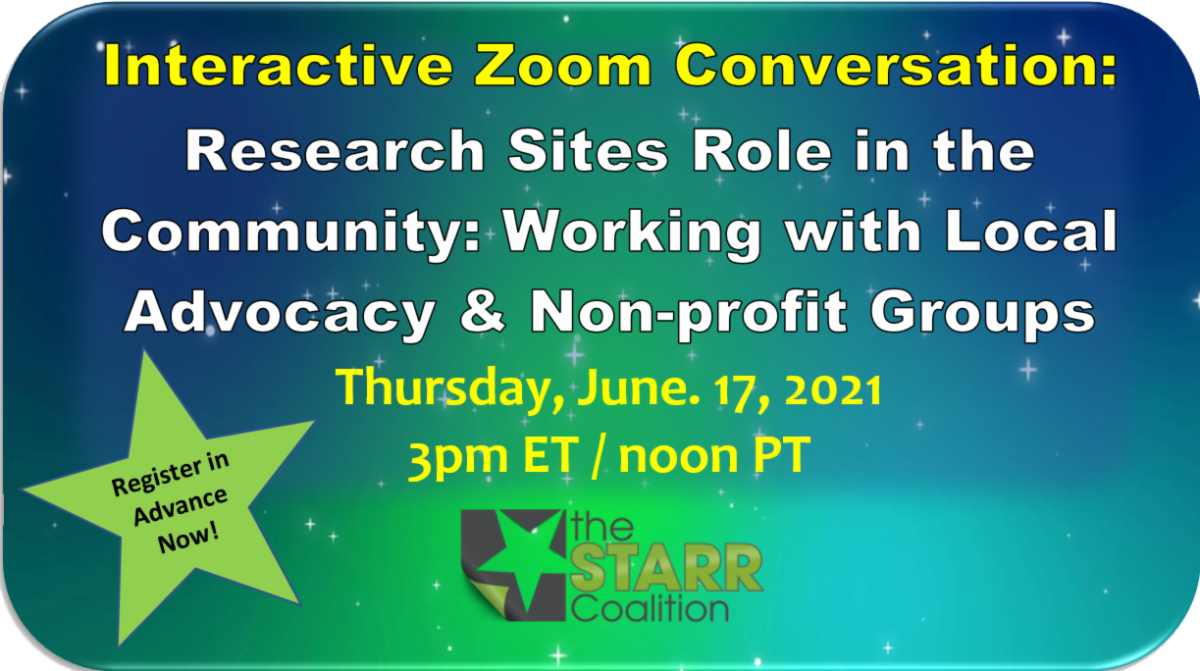
Join us for our next Zoom Conversation:
Research Sites Role in the Community: Working with Local Advocacy
& Non-profit Groups
June 17th at 3PM ET / NOON PT
The STARR Coalition is hosting an interactive conversation via Zoom for sites to hear from sites that have benefited from their relationships with advocacy on how to develop those strong working relationships with the local advocacy organizations. We would love for you to join us – register now and be sure to add the call to your calendar. Register HERE!
|
|
Many of the top mental health advocacy organizations receive a lion share of their funding from biopharmaceutical companies. This has been a point of contention for some within the mental health communities for decades. In April of 2009, Senator Chuck Grassley sent a letter to National Alliance for Mental Illness (NAMI) concerned that “money coming from pharmaceutical industry shapes the practices of nonprofit organizations which purport to be independent in their viewpoints and actions."
NAMI National and a vast majority of its affiliates voluntarily submitted detailed information on funding from industry partners and how the money was used. Although no formal action was taken against NAMI, the inquiry caused a decisive rift between advocacy and industry leaders, the ripple effects of which can still be seen today.
Mental health advocacy organizations have become guarded and now limit their outward support for the work of biopharmaceutical companies. Medication therapy is a vital part of many individuals’ recovery from symptoms of mental illness. Yet, when the primary source for education and support believe they can no longer discuss medication therapies as part of the recovery process, it effects the lives of those with lived experience.
Fast forward a decade. Biopharmaceutical companies continue to be the largest contributors to mental health advocacy organizations. Considering the percentages, one would assume many of these organizations would not be able to continue their work without it. Our society would suffer greatly without vital advocacy services such as peer-to-peer support, family support, criminal justice reform, policy, and education.
The question then becomes, what roles should the biopharmaceutical industry play in advocacy and how should advocacy best partner with biopharma companies?
To our industry friends:
- Continue to financially support advocacy. Now more than ever contributions positively impact millions of Americans through programming, policy and support.
- Never ask advocacy to support a specific product or device. It is not advocacy’s mission to attach their name to a specific product or brand. Eliminating this expectation allows advocacy to talk about broader access issues like access to medication therapies and the importance of clinical research without the pressure from those critical of their funding sources.
- Become involved beyond donations. Advocacy needs experts and volunteers. Join a local advocacy board, participate in a walk or run in your hometown, offer your time and expertise to help advocacy causes from national to local.
To our advocacy friends:
- Choose partners wisely. Support comes from many places and in many forms, from monetary to volunteers. You have the right to refuse or accept support from any source.
- Define clear boundaries. Define expectations early when building partnerships.
- Do not use your advocacy platform to support a specific product or medication. Not only does this open you up for public scrutiny and criticism, but it does a disservice to the biopharmaceutical industry and research in general, as well.
- Talk about medication therapies. Medication is a part of the larger recovery paradigm for most individuals living with mental illness. Pretending otherwise is disingenuous and potentially harmful. It can be done in a way to not promote a specific product, but to support access, affordability, and efficacy in medication therapies.
- Support brain research. Scientific research advances our understanding of the brain and the root causes of symptoms. Again, advocacy and research walk hand in hand with almost all other disease states.
|
|
Featured STARR Coalition Podcast |
|
In this podcast, Luke speaks with Andrei Pikalov, MD, PhD, Vice President, Head of Global Medical Affairs at Sunovion Pharmaceuticals.
Dr. Pikalov, a licensed & Board Certified psychiatrist, possesses a unique combination of pharmaceutical industry leadership experience with scientific background and clinical expertise. He is a passionate advocate on issues related to patient’s access to new treatment options and has been an active supporter of many initiatives leading to better recognition and treatment of devastating mental disorders. In this podcast, Dr. Pikalov discusses why continued mental health research is critically important in finding treatments – and one day even cures – for mental health disorders.
|
|
The STARR Site Certification was created to help advance mental health clinical research by promoting community engagement, empathy, and communication between research sites, staff, patients, and advocacy groups, as well as providing support for best practices around working with advocacy, suicide prevention, and other areas that enhance clinical research. |
|
|
Everything The STARR Coalition does comes from our stakeholders looking to make positive change.
|
|
ASCP Annual Meeting - June 1-4 Virtual
Bringing New & Novel Treatments Into Clinical Practice
Mental Health America 2021 Annual Conference -- June 10-12 Hybrid
NAMI 2021 National Convention - June 30 - July 3 Washington, D.C.
We look forward to seeing everyone at one of these upcoming events!
|
|
The STARR Coalition has partnered with thought-leaders across the industry and advocacy to create a National Call to Action to Support Mental Health Research. We have created a campaign consisting of actionable items anyone can do to support and help bring mental health research into the same light as cancer, diabetes or heart disease.
We need everyone's help promoting this National Call to Action!
To join the Call to Action and find ways you can support mental health research right now, visit our website at www.thestarr.org/c2a
|
|
The STARR Coalition | phone: 501.944.8653 | fax: 501.224.1340 | www.thestarr.org |
|
|
|
|
|
|