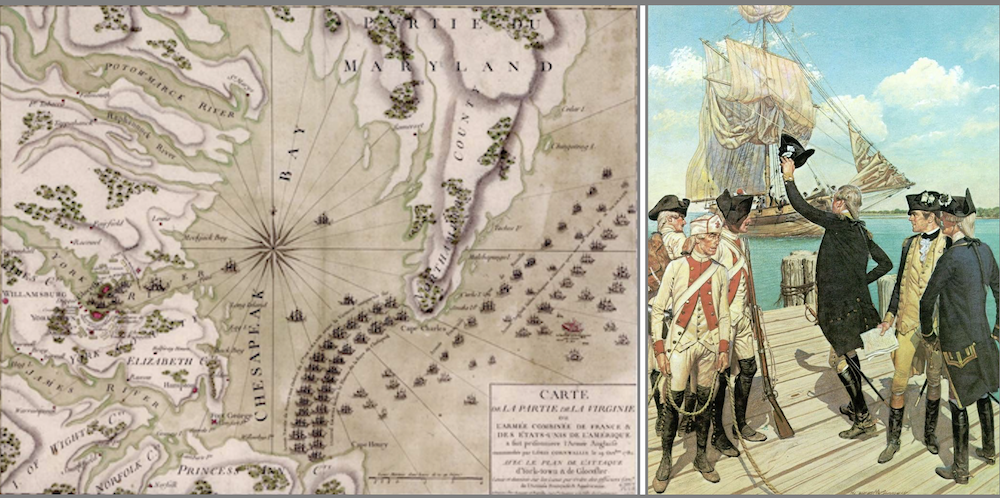
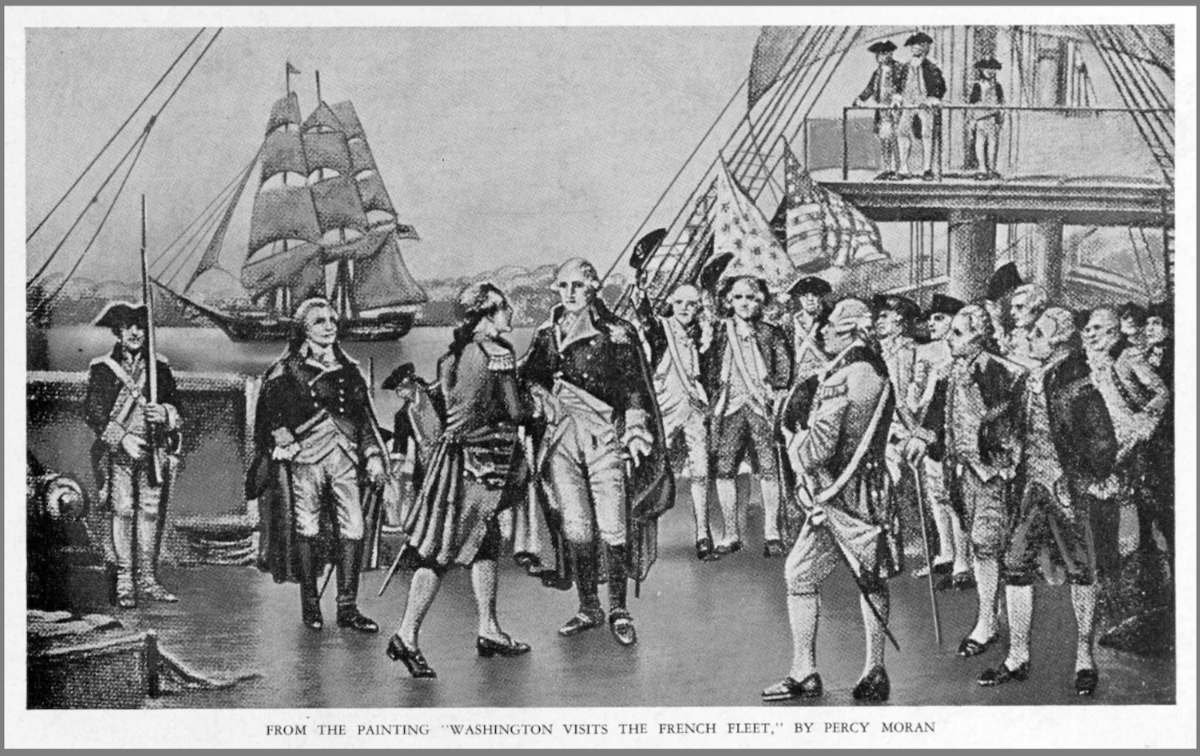
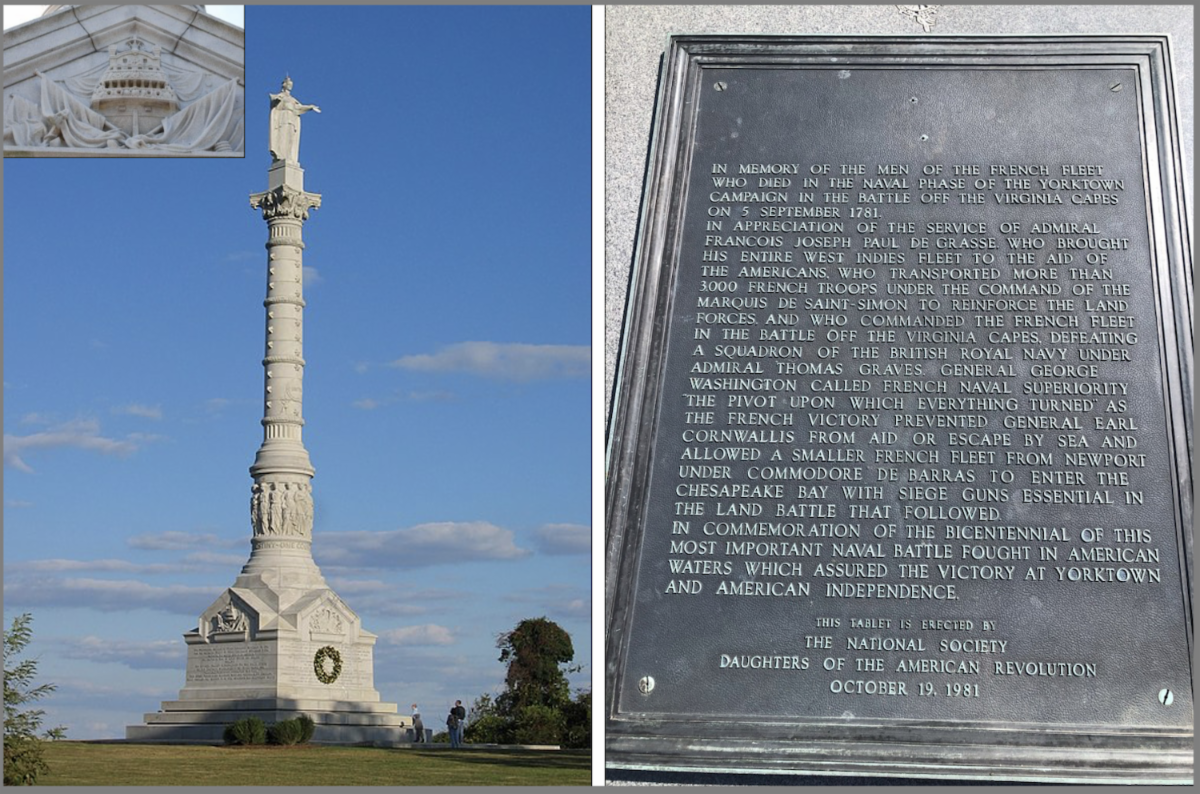
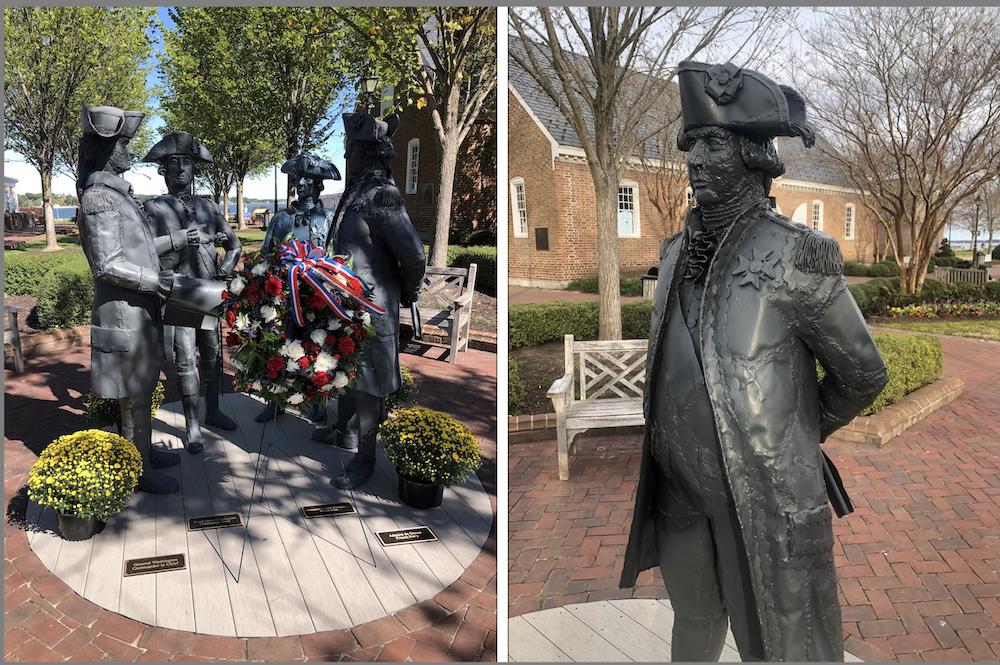
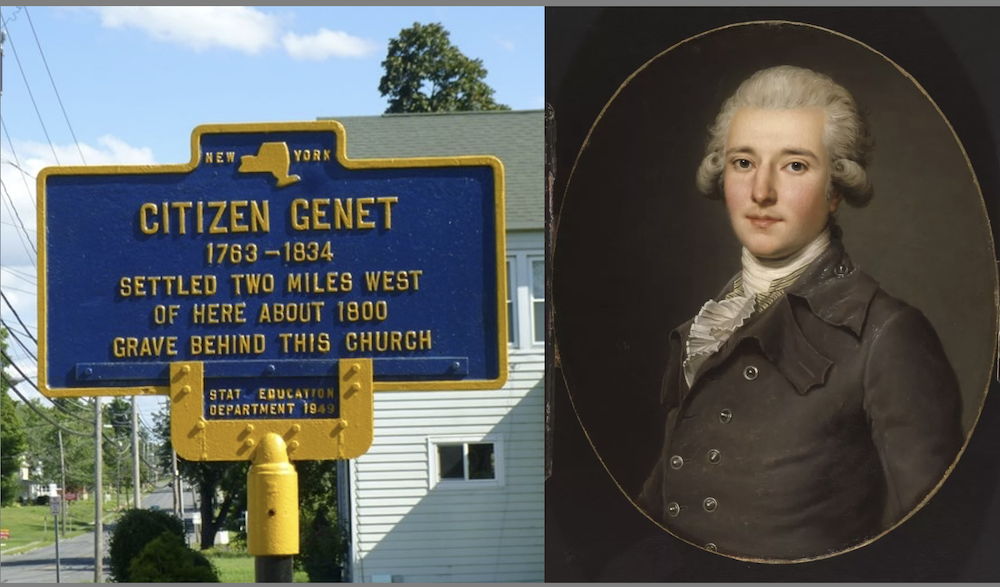
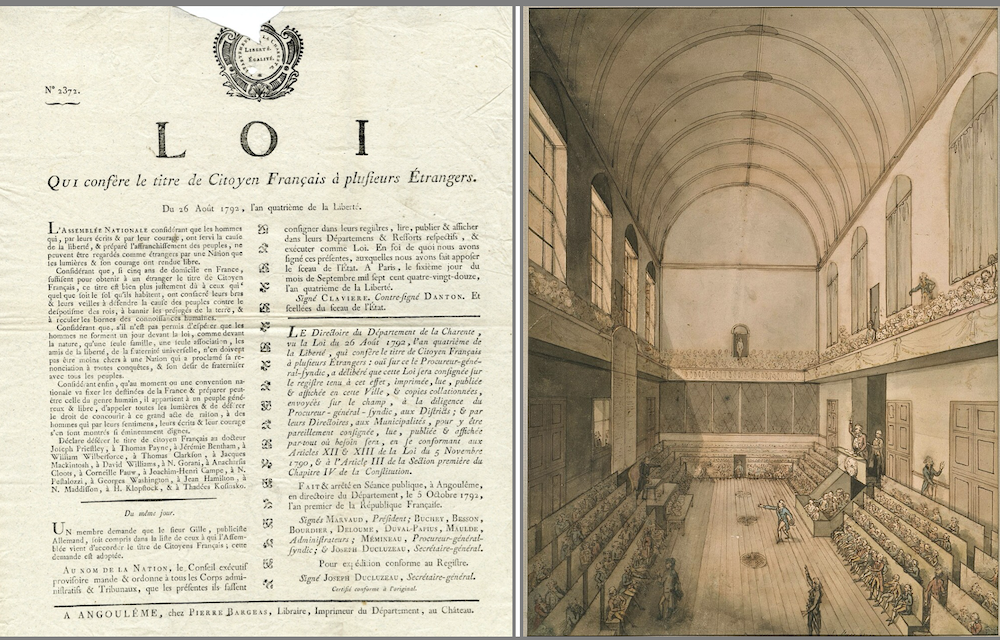
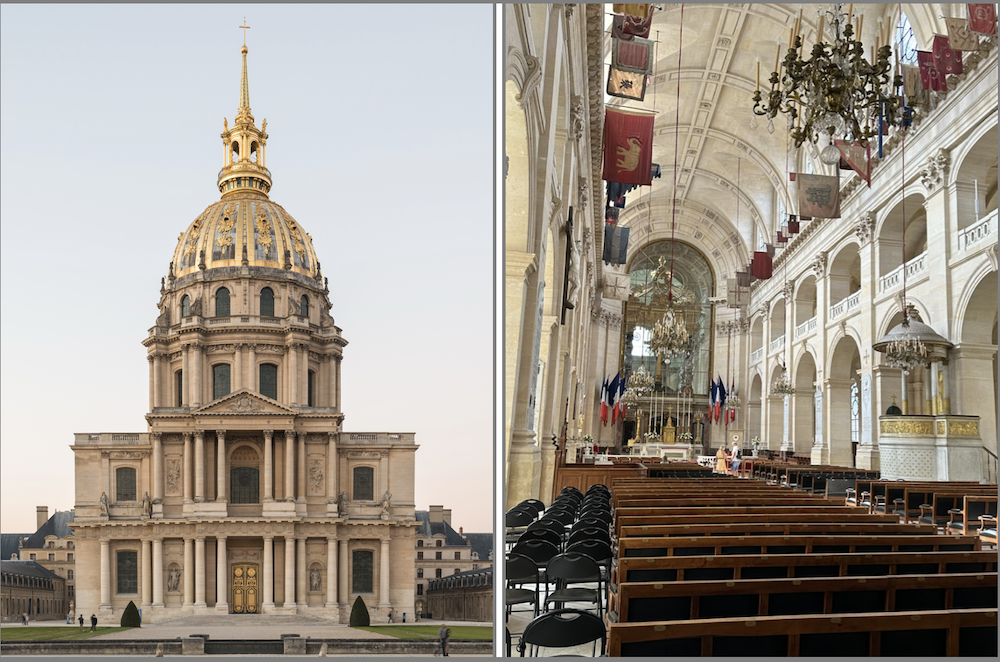
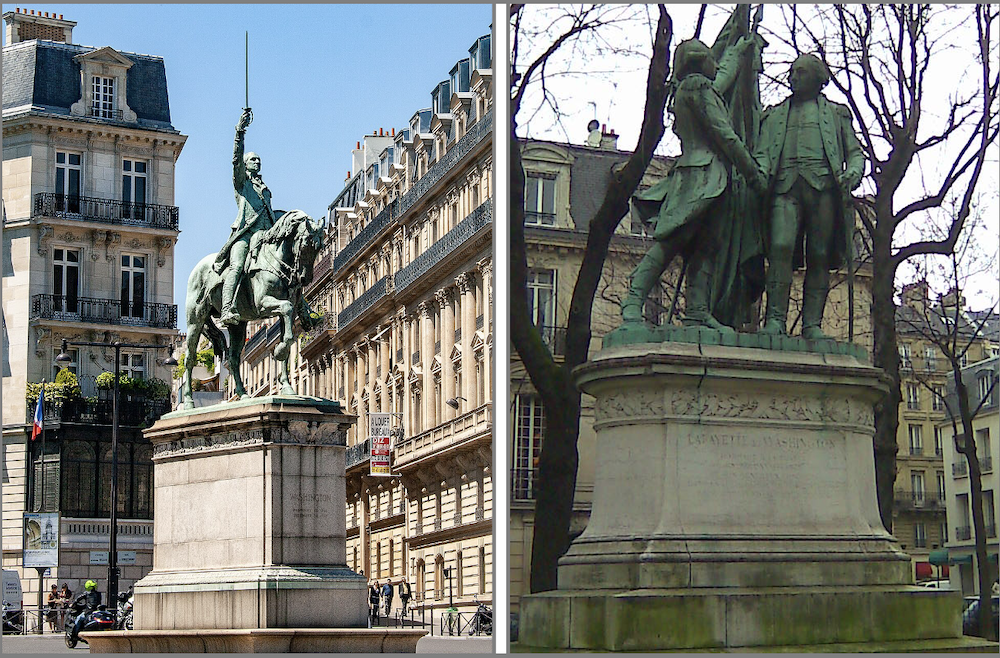
|
The American Society of
Le Souvenir Français Inc.
Monthly Bulletin - Vol. VI, No. 3
March 2026
| | |
George Washington and the French
A chronicle to celebrate America250
| | |
Editorial
Thank you for all your kind words of compliment and encouragement following last month's "Bulletin of bulletins" celebrating 5 years of monthly chronicles of French-American history. It means a lot to us!
After our January bulletin dedicated to the crucial role of France during the first phase of the American Revolutionary War — "from covert support to official alliance" — we resume our celebration of America250 by delving into the relationship of George Washington and the French.
It is a moving story, from early enmity during his years as a young officer in the British colonial troops, evolving into a guarded stance regarding the influx of French volunteers at the start of the Revolutionary War, to a deeply sincere and warm brotherhood-in-arms and a profound friendship toward several French military leaders. If Lafayette became his adopted son, many others — from Rochambeau to Chastellux and De Grasse — were graced by his trust and friendship, as he continued to correspond with them for many years.
Yes, George Washington's friendship with his French allies became sincere and sustained, and we will illustrate this throughout this Bulletin, visiting several monuments with his quotes engraved in stone, and interpretive markers dotting the landscape from Rhode Island to Virginia, as well as memorable excerpts from his correspondence and journals.
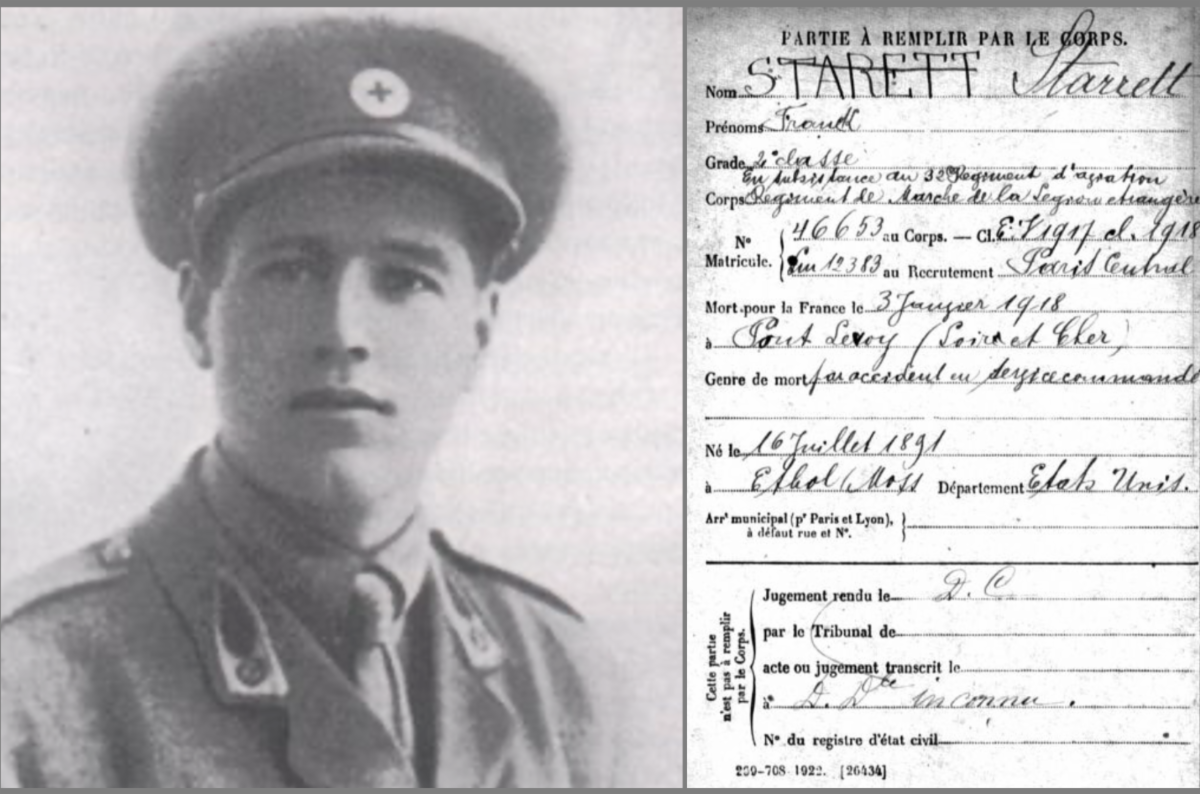
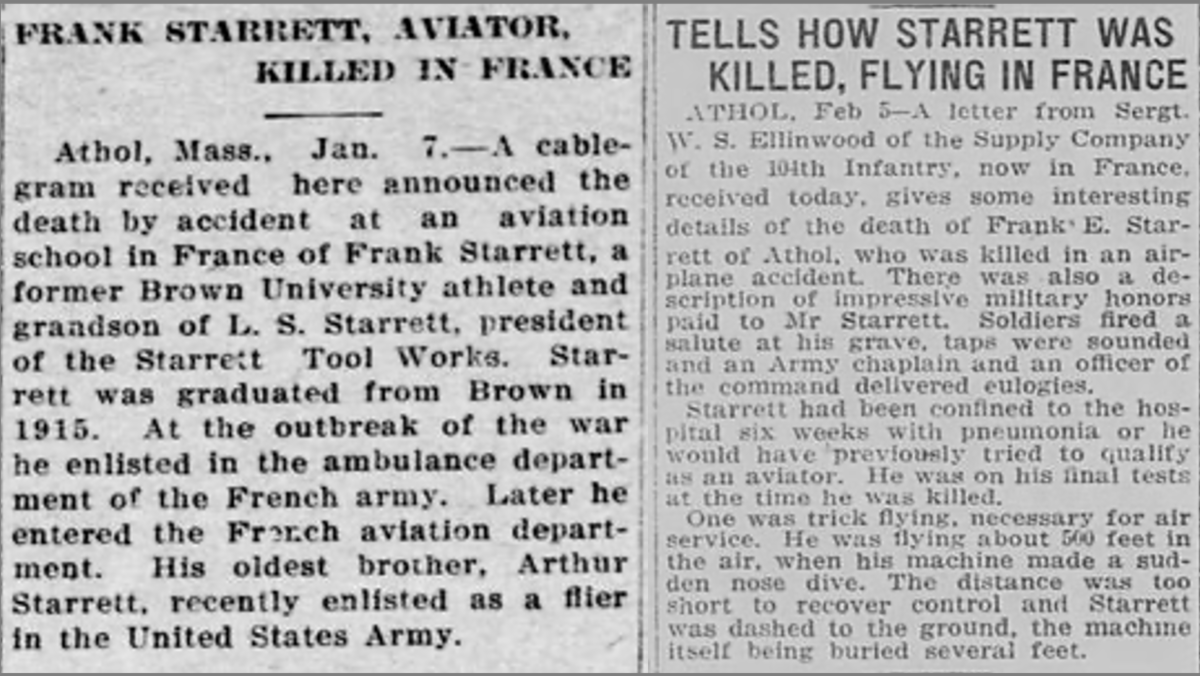
Part Two of this Bulletin continues our tradition of honoring a particular American volunteer who fought and died for France. This month we will honor Pvt Frank Elmer Starrett, "Mort pour la France" on January 3, 1918 at Pontlevoy (41 - Loir-et-Cher, France).
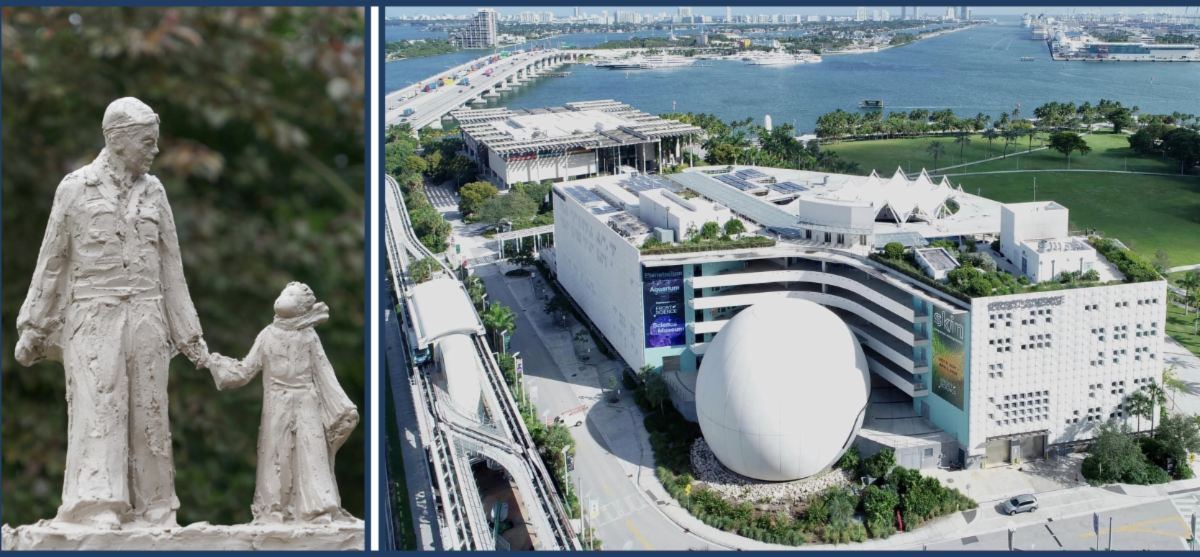
Part Three of this Bulletin, as always, is devoted to News and Save the Dates. Please scroll down and find out what is happening! Among our many projects in the works, we are very proud to confirm that the bronze sculpture of Antoine de Saint-Exupéry and The Little Prince will be installed in the heart of Miami, at the entrance of the Frost Museum of Science and Planetarium, which will house it for a minimum of 30 years. The inauguration is scheduled for the last week of January 2027!
Our General Assembly will take place on Tuesday, March 31. Details are provided at the end of this Bulletin. If you have not done so yet, please consider joining us ($50, or $25 for Veterans and students). While our monthly bulletins are free (please don't hesitate to share them widely!), you will receive more than just a 2026 membership card—you will also receive a special private link to access "Memories of France," a compilation of more than 3,000 sites of French presence throughout the 50 United States in PDF format. A great traveling companion for your smartphone! It is never too late to join or help support our activities.
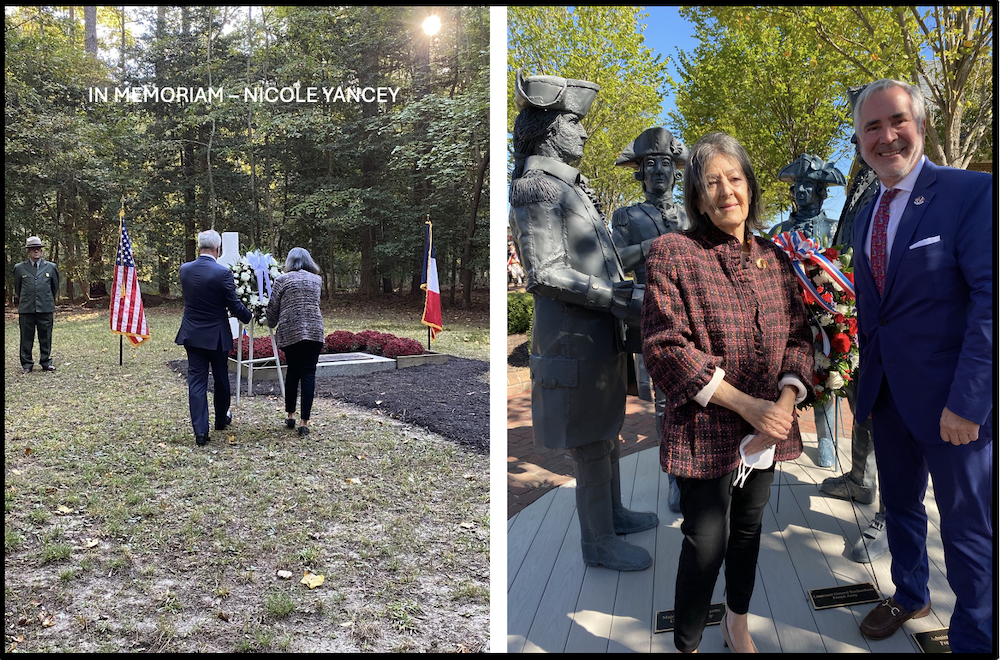
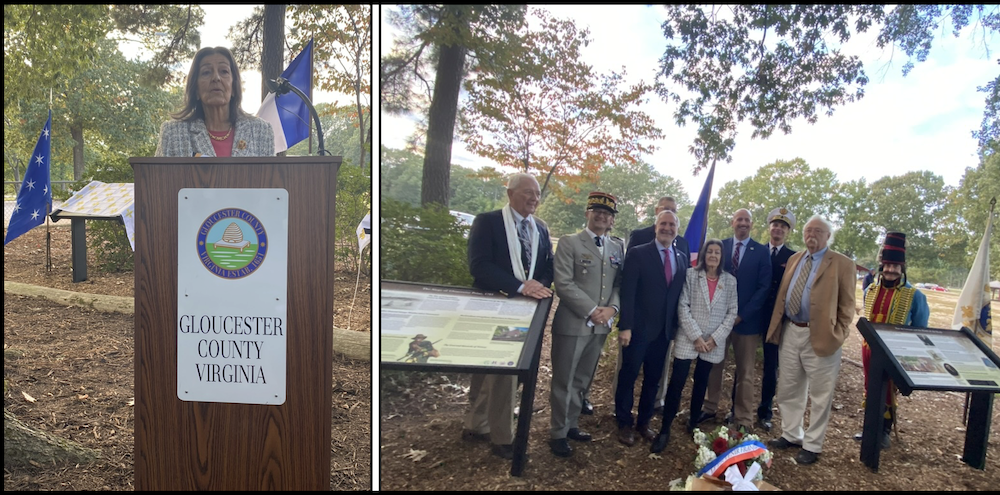
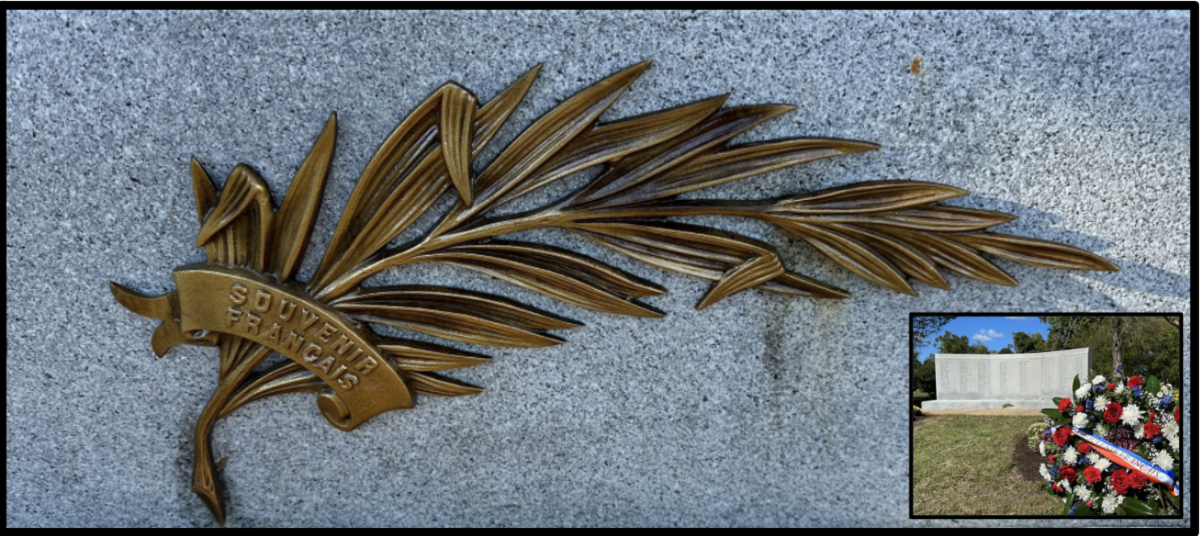
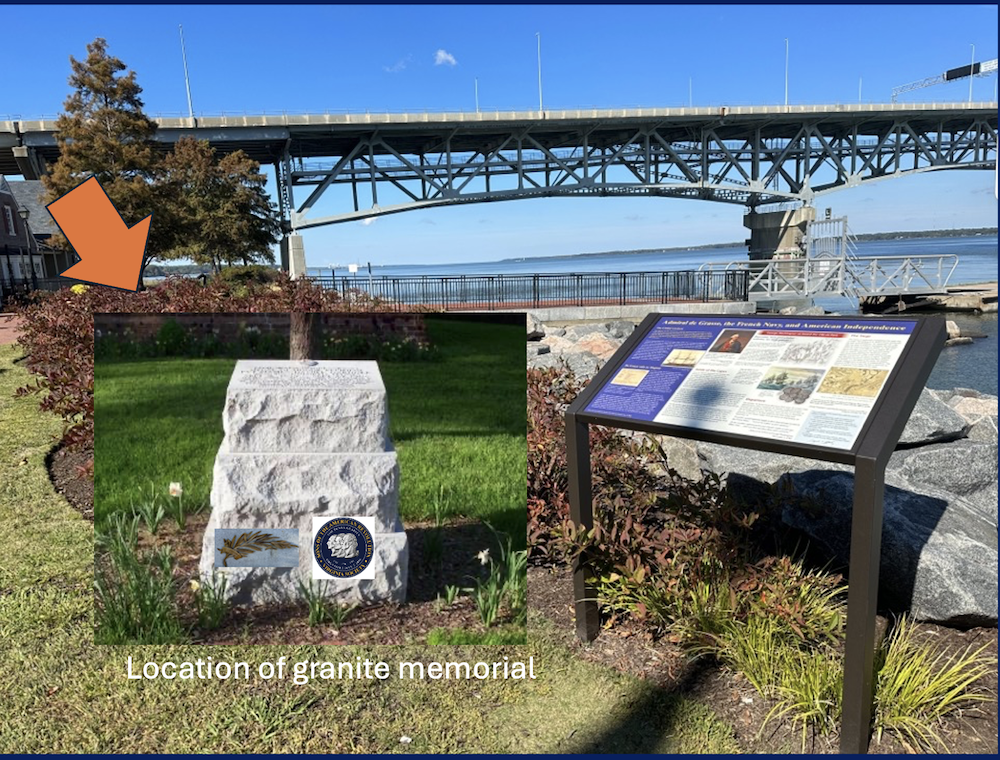
We are grieving the passing of Nicole Yancey, member of our Board and Regional Delegate of our Society in Virginia. Nicole was a former Honorary Consul of France in Virginia, Chevalier de la Légion d'Honneur, Chevalier de l'Ordre National du Mérite, and an indefatigable guardian and defender of everything French at Yorktown for the past 50 years. She was instrumental in the installation of the French Memorial in the 1980s, and always present at our annual joint French-American patriotic ceremonies. Thanks to her, we were able to plan the granite memorial to French sailors slated for inauguration this October 18. She was the living memory of France at Yorktown, and we are now orphans in many ways. We will never forget all the moments Nicole stood with us at these ceremonies, her kindness and dedication to our missions.
R.I.P. chère Nicole, "nous ne vous oublierons pas".
On behalf of the Board of Directors,
Thierry Chaunu
President, The American Society of Le Souvenir Français, Inc.
Délégué Général du Souvenir Français pour les Etats-Unis.
| | |
Historical Context
George Washington fighting the French
| | |
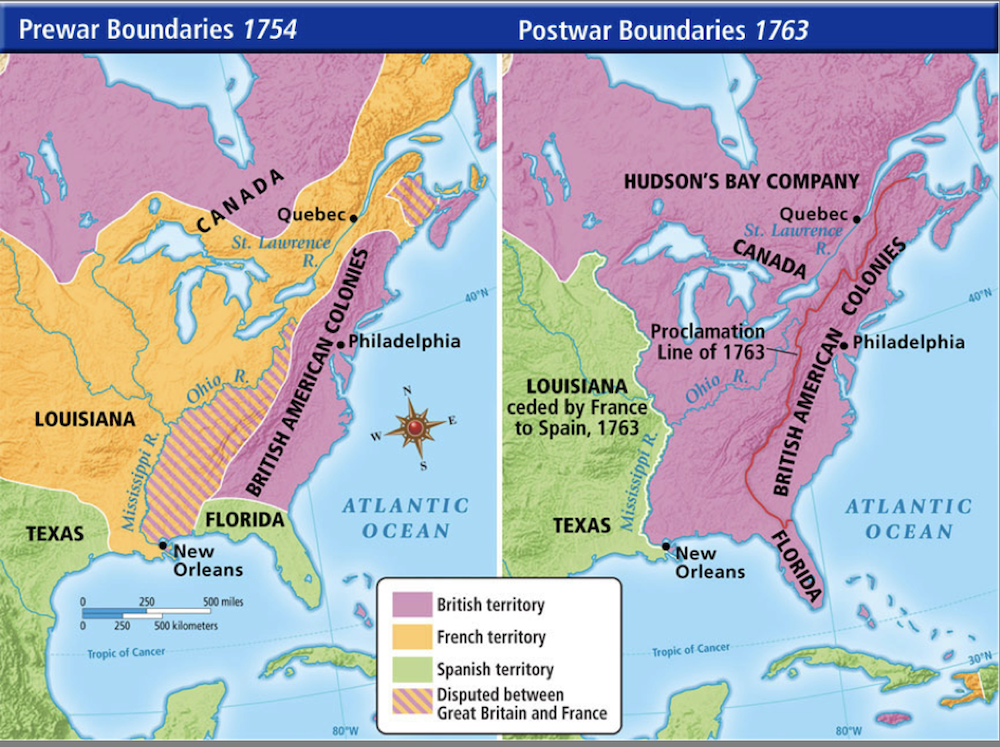
The Seven Years' War (known in America as the "French and Indian War") ended with France's loss of its North American possessions, which stretched from Canada to the Gulf of Mexico.
France lost Canada to England and turned over all its possessions west of the Mississippi — known as Louisiana — to Spain for 'safekeeping', under the Bourbon Family Pact.
The 13 Colonies were freed from the constant threat of French encroachments, but, as Minister Choiseul correctly forecast early on, they would increasingly object to the heavy hand their mother country, England, would exert over them.
Indeed, as early as 1768, Baron de Kalb was sent by France to America on a covert mission to observe the changing mood of the colonists and report back to the Court of Versailles. This was the same Baron de Kalb who, barely a decade later, would introduce Lafayette to the American envoy Silas Deane in Paris, travelling with the young Marquis to join the American insurgents as a volunteer.
During this conflict, George Washington played an important role, as we will see below. As a young officer in the British colonial troops, he fought the French and experienced one of the few defeats of his long military career. Ironically, the man fighting against the French had a French ancestor!
| | |
The French ancestry of
George Washington
| | |
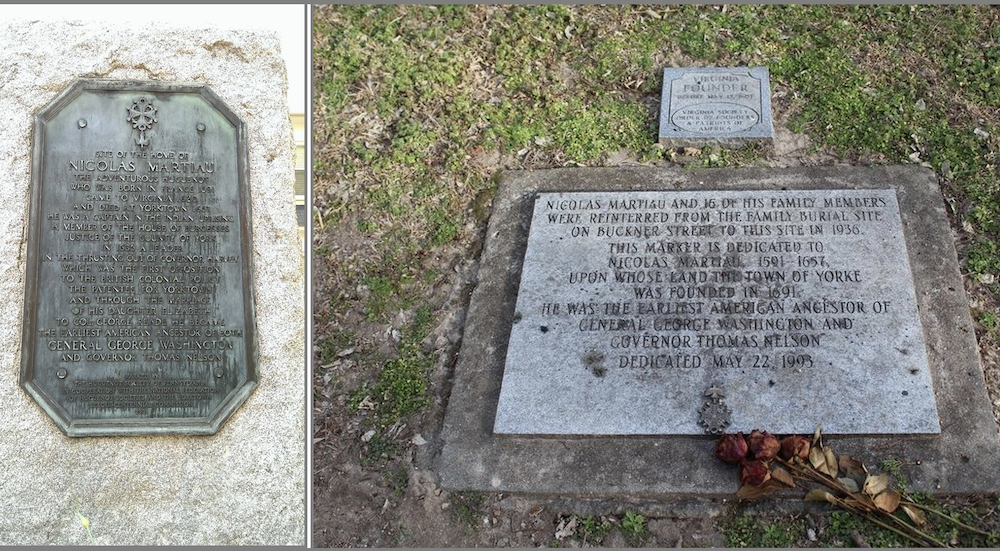
Above:
Left: Bronze tablet affixed by the Hugenot Society of Pennsylvania in cooperation with the National Federation of Hugenot Societies et la Yorktown Sesqui-centennial Commission - Erected in 1931 and visible in Yorktown, VA.
Right: gravesite of the Martiau Family in Yorktown, VA. Photo by Evan Dwyer, January 5, 2026
https://www.hmdb.org/m.asp?m=293848
| | |
George Washington's French ancestor
• Nicholas Martiau (1591–1657) was a French-born colonist and military engineer who holds the distinction of being one of George Washington's earliest American ancestors — he was his great-great-great-grandfather!
• Born in the île de Ré, in the Aunis (Saintonge region of France), likely in the Saintonge region, Martiau arrived in Virginia around 1620, making him one of the pioneering settlers of the English colony despite his French origins.
• His skills as a military engineer made him a valuable asset to the fledgling settlement, and he served in the Virginia colonial militia, helping defend the colony against Native American attacks.
• Martiau thrived in the New World, becoming a prominent landowner and earning a seat in the Virginia House of Burgesses, one of the earliest representative assemblies in the Americas.
• Through his descendants, his bloodline passed down the generations until it reached George Washington (February 22, 1732 - December 14, 1799) himself.
• It is a little-known but intriguing footnote that the man who would become America's first president carried French blood in his veins.
• The Nicolas Martiau Descendant Association (N.M.D.A.) preserves the memory of Nicolas Martiau and the several Patriots in their lineage.
There are two plaques honoring Nicolas Martiau in Yorktown, VA:
Plaque, “Site of the Home of Nicolas Martiau”
114 Ballard St, Yorktown, VA 23690
GPS: 37.236750, -76.508517
• Inscription:
“The adventurous Huguenot
who was born in France 1591
Came to Virginia 1620
and died at Yorktown 1657
He was a captain in the Indian uprising
A member of the House of Burgesses
Justice of the County of York
In 1635 a leader
in the thrusting out of Governor Harvey
which was the first opposition
to the British colonial policy
The patentee for Yorktown
and through the marriage
of his daughter Elizabeth
to Col. George Reade he became
the earliest American ancestor of both
General George Washington
and Governor Thomas Nelson”
Plaque, “Nicolas Martiau and 16 of His Family Members”
Grace Episcopal Church Cemetery, 115 Church Street, Yorktown VA 26390
GPS: 37.235817, -76.507617
• Inscription
(with official Huguenot emblem embedded):
“Nicolas Martiau and 16 of his family members were reinterred from the family burial site on Buckner Street to this site in 1936.
This marker is dedicated to Nicolas Martiau, 1591-1657,
upon whose land the Town of Yorke was founded in 1691.
He was the earliest American ancestor of General George Washington
and Governor Thomas Nelson
Dedicated May 22, 1993
Erected 1993.”
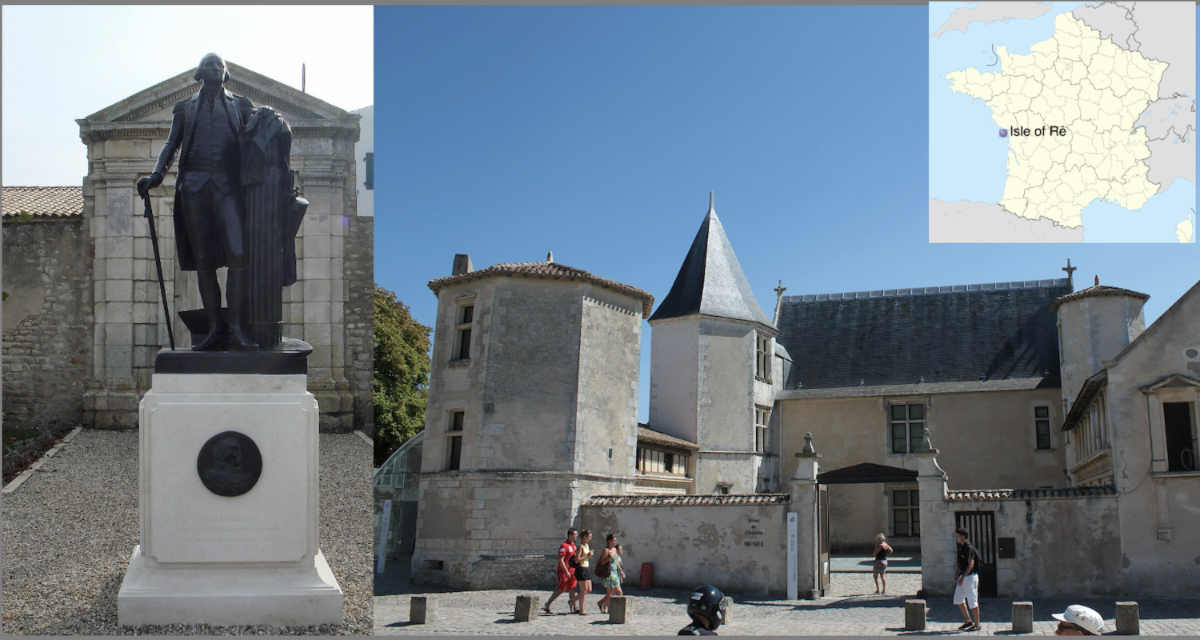
Statue of George Washington at the
birthplace of his French ancestors
Île de Ré, France
| | |
• A faint echo of George Washington's French Huguenot roots can be found in an article in The New York Times, dated April 18, 1932, which reports:
"Washington's French Ancestry Is Commemorated at Service:
Services commemorating the French ancestry of George Washington were conducted yesterday at the Eglise du Saint-Esprit, 114 East Seventy-sixth Street. The Rev. Dr. John A. F. Maynard, officiating, spoke of the high ideals that dominated the characters of Washington and his French great-great- grandfather, Nicholas Martiau. Martiau was a Norman Huguenot who went to England to practice engineering. Shortly after his arrival he was engaged by the Colonists to build palisade fortifications in Virginia.
Dr. Maynard pointed out that Martiau and Washington were alike not only in following the same profession but in their rebelliousness toward tyranny. It was Martiau, he declared, who instigated and led the rebellion against Governor Harvey of Virginia. His high-mindedness led to further quarreling. During the course of an argument with Captain Mayhew, Martiau placed his hand over his heart, "Though I am here," he said, "this part is in France."
https://www.nytimes.com/1932/04/18/archives/washingtons-french-ancestry-is-commemorated-at-service.html
• When in France, make sure to visit the beautiful island of Île de Ré on the Atlantic Coast, in the Aunis-Saintonge region, where Nicolas Martiau originated. You may be surprised to see a bronze sculpture of George Washington in the gardens of the Ernest Cognacq Museum, located in a 15th Century building.
It was erected in 2007 by the French Heritage Society and inaugurated in the presence of the American Ambassador to France Craig Stapleton.
• The medallion at the pedestal represents Nicolas Martiau with the inscription:
"Nicolas Martiau
Ancêtre de George Washington
Île de Ré 1591 - 1657 Yorktown"
• This said, George Washington's early exposure to French culture was minimal, even though he was a student of the French Huguenot Maryes, who operated a school in Fredericksburg.
• The Marye family, French Huguenots and descendants of James Marye Sr. (originally Jacques Marie), were important early settlers in Fredericksburg, Virginia. They took on roles as civic leaders, ministers, and landowners. Later, they became recognized for lending their name to Marye’s Heights, a key elevated location during the Civil War Battle of Fredericksburg.
• Be it as it may, George Washington did not receive instruction in the French language:
When Lafayette urged him to consider a visit to France in the future, he replied:
"You are pleased my dear Marquis to express an earnest desire of seeing me in France (after the establishment of our independancy) & do me the honour to add, that you are not singular in your request. Let me entreat you to be persuaded, that to meet you any where after the final accomplishment of so glorious an event would contribute to my happiness—& that, to visit a country to whose generous aid we stand so much indebted, would be an additional pleasure—but remember my good friend, that I am unacquainted with your language—that I am too far advanced in years to acquire a knowledge of it."
Letter to Lafayette, September 30, 1779,
https://www.loc.gov/item/mgw455722/
• Franklin subsequently supplemented his appeals with those of Lafayette; Washington's responded:
"The idea of making a tour together, which you suggest, after the war, would be one of the strongest motives I could have to postpone my plan of retirement, and make a visit to Europe, if my domestic habits, which seem to acquire strength from restraint, did not tell me I shall find it impossible to resist them longer than my duty to the public calls for the sacrifice of my inclinations. "
Letter to Benjamin Franklin, October 11, 1780.
https://www.loc.gov/resource/mgw4.071_0807_0809/?st=gallery
Notice the dates of these two letters. The General didn't harbor any doubt as to the outcome of the war...
Let us now delve into the heart of the matter and accompany the great general through a lifetime of eventful encounters with the French!
| | |
First phase of
George Washington's military career:
War against the French
| | |
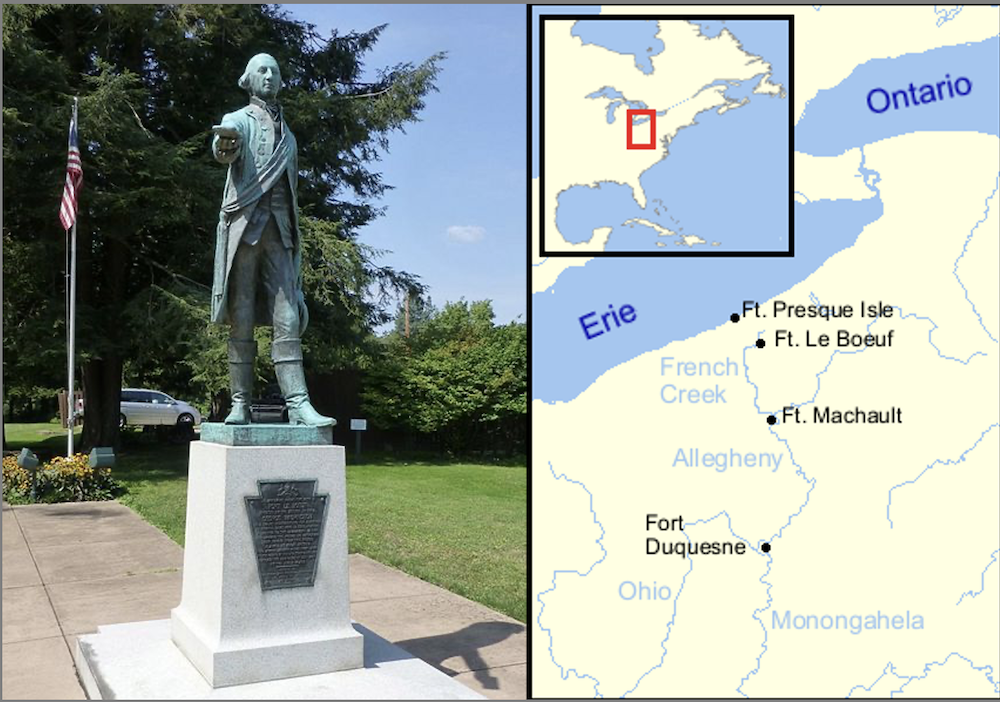
From one statue to another...
After this brief excursion to France, we are now back in the United States, in 1753, specifically the Western Frontier, near present-day Erie, Pennsylvania, nudged between the Ohio and New York states border...
By then George Washington was 21 year-old, a young major in the British colonial troops of Virginia.
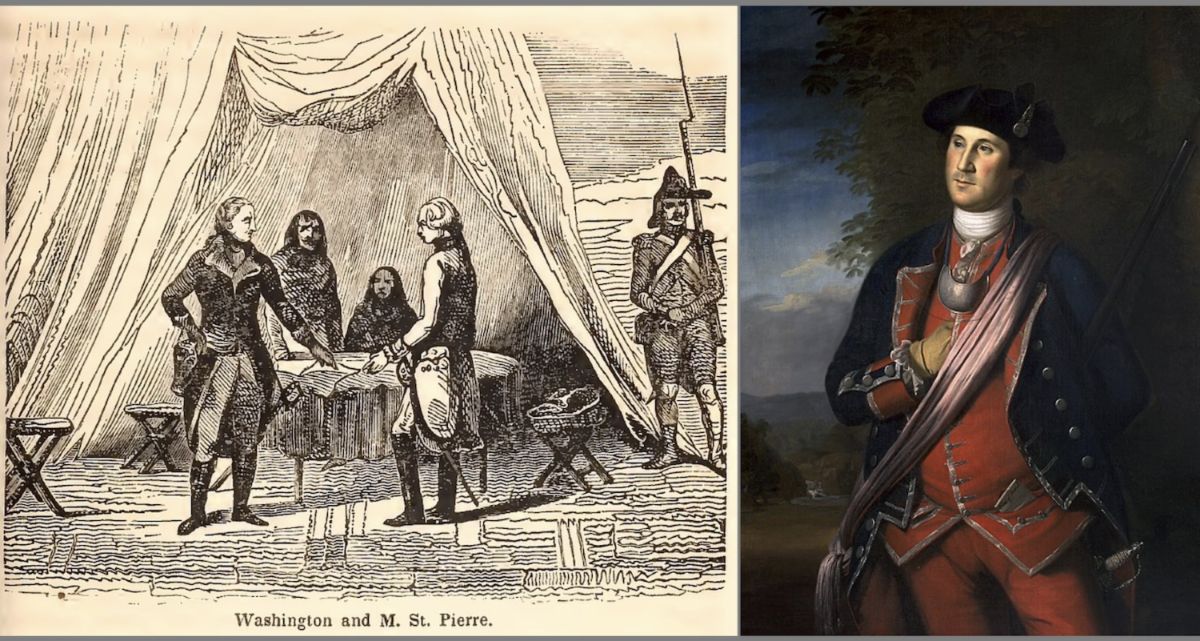
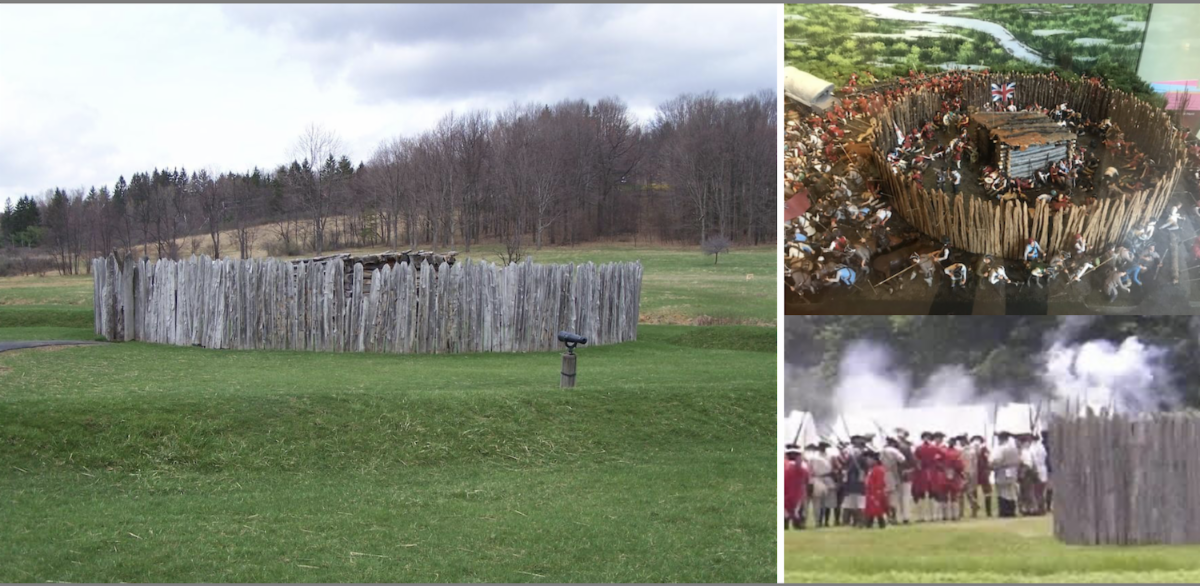
• In December 1753, the governor of Virginia, Robert Dinwiddie, sent George Washington to Fort Le Boeuf with seven escorts. His mission was to deliver a message to the French, demanding that they leave the Ohio Country.
• Jacques Legardeur de Saint-Pierre, the commandant at Fort Le Boeuf, received Washington politely but contemptuously rejected his strong ultimatum. Despite this, he allowed Washington to rest and provided him with hospitality for three days at the fort.
Saint-Pierre also gave Washington a letter to deliver to Governor Dinwiddie, which instructed the Governor of Virginia to deliver his demand to the Major General of New France in Quebec City, the Marquis Duquesne.
"as to the summons you send me to retire, I do not think myself obliged to obey it."
Plaque at the base of the pedestal:
This Monument Marks the Site of Fort Le Boeuf
George Washington Memorial Park, 32 High St, Waterford, PA 16441
GPS: 41.940050, -79.982900
• Inscription:
“This monument marks the site of Fort Le Boeuf.
Erected by the French in 1752.
George Washington
As a major representing the governor of Virginia, came here in 1753, bearing a letter to the commander of the fort, warning the French to withdraw their forces from this region claimed by Great Britain. This mission was one of the first links in the chain of events that settled forever the dominance of our land by the Anglo Saxon.”
Erected 1921 by The Pennsylvania Historical Commission and the People of Waterford and Friends.”
| | |
Above:
Left: George Washington (left) meeting with French military commander Jacques Legardeur de Saint-Pierre in 1753 By Unknown author - Image taken from "The book of the colonies; comprising a history of the colonies composing the United States" by John Frost, published in 1846, Public Domain, https://commons.wikimedia.org/w/index.php?curid=75824287
Right: The earliest authenticated portrait of George Washington shows him wearing his colonel uniform of the Virginia Regiment from the French and Indian War. The portrait was painted about 12 years after Washington's service in that war, oil on canvas by Charles Willson Peale - Washington-Custis-Lee Collection, Washington and Lee University, Lexington, Virginia, Public Domain, https://commons.wikimedia.org/w/index.php?curid=949039
| |
French-English long rivalry
erupts into full-fledged war
• An interpretive marker located nearby the statue provides an additional narrative and situates George Washington's mission into a larger context.
Marker, “Fort Sur La Rivière Aux Boeufs, Gateway to Ohio Country”
George Washington Memorial Park, 32 High St, Waterford, PA 16441
GPS: 41.940117, -79.982917
• Inscription:
"Fort le Boeuf Timeline
1749 — Céloron conducts expedition into the Ohio River Basin.1759 — French abandon and burn the fort.
1753 — Fort construction begins in summer and is completed in fall
1753 — December 11, George Washington visits the fort to demand French withdrawal.
1755 — Support from Fort le Boeuf helps in repelling Braddock's threat against Fort Duquesne.
1756 — Completion of Fort Machault takes some pressure off Fort le Boeuf.
1758 — Fort Duquesne falls to the British
1759 — Fort Niagara falls to the British, leaving Fort le Boeuf vulnerable.
A Critical Link
The construction of Fort sur la Rivière aux Boeufs (Fort le Boeuf) was the second in a chain of four forts intended to connect Lake Erie to the Ohio River. Men and materials portaged to French Creek, where bateaux were used to transport them to French settlements in Louisiana.
In December of 1753, George Washington paid a visit to the fort to inform the French commandant, Captain Jacques Legardeur de St. Pierre, that the British considered the French occupation of the territory to be an encroachment on British soil, and he demanded that the French leave. St. Pierre's refusal to withdraw led to armed hostilities between the parties the following spring.
Erected by Seaway Trial, Inc. (Marker Number 3.)"
• The French pressed on and continued to strengthen their foothold in this disputed region of the Frontier. Legardeur's successor, Claude-Pierre Pécaudy de Contrecœur, commanded a contingent of approximately 500 men and Indigenous allies to thwart an initiative by the British militia, led by William Trent, to establish a fort. On April 16, 1754, the French forces reached the forks; the following day, Trent's group of 36 men, under the command of Ensign Edward Ward in Trent's absence, consented to vacate the location. Subsequently, the French commenced the construction of Fort Duquesne, which would eventually be renamed Pittsburgh.
| |
The Jumonville Affair:
the spark that provoked a global war
| | |
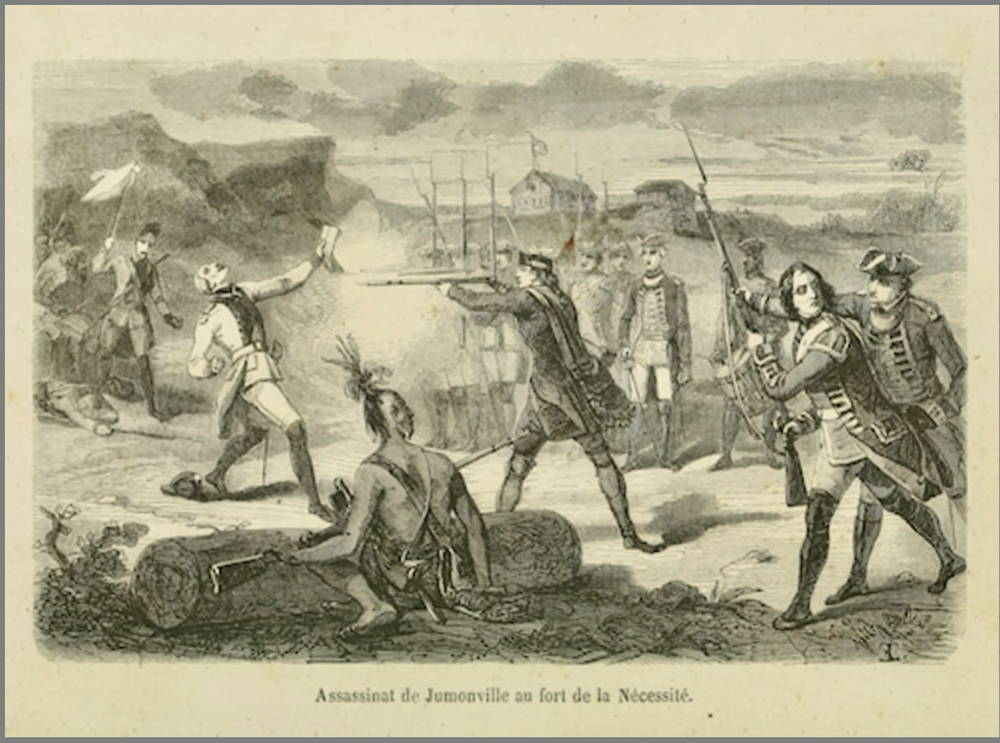
Above:
"The assassination of Jumonville", by unknown illustrator - Illustration from Alexandre Dumas: La Regence et Louis Quinze, Paris 1855. Vol. I, p. 281. Public Domain, https://commons.wikimedia.org/w/index.php?curid=11211018
In this artist's version of the incident at Jumonville Glen, the English under the command of George Washington are depicted as murdering the defenseless French commander Jumonville in cold blood. Contemporary accounts of the incident are contradictory; it is more likely that Jumonville was in fact tomahawked by the Indian leader Tanaghrisson while Washington watched without intervening.
| | |
We narrated in greater detail the incident in our November 2023 bulletin: French Forts of Ohio & Pennsylvania
https://conta.cc/3Rlqn4B (original version in English)
https://conta.cc/47pAfjf (version en français)
• On April 2, 1754, Lieutenant Colonel Washington, while stationed at Wills Creek in Maryland, received news of the French expedition expelling the British and the construction of Fort Duquesne. On May 28, Washington encountered a French scouting party near Jumonville Glen, where he launched an attack and killed 10 French soldiers while capturing 21 others. Unfortunately, many of the prisoners were later killed by Washington's Native American allies.
• When news reached France, it sparked an outrage. This incident is widely regarded as the spark of the French and Indian War, which was the North American theater of the Seven Years' War.
Several markers recount the tragic incident:
Marker, “Jumonville - the "skirmish...that set the world on fire"
1000 Old Braddock Road, Hopwood PA 15445
GPS: 39.883767, -79.645183
• Inscription:
“At sunrise on May 28, 1754, young Colonel George Washington and Seneca Chief Tanacharison ("The Half King") led a combined force of 40 Virginia militia and Iroquois warriors in an attack against 33 French soldiers camped along the large ledge of rocks now known as "Jumonville Glen"-a few hundred yards from this spot. The French, taken by surprise, were defeated in fifteen minutes, with ten soldiers killed, 22 taken prisoner, and just one escaping.
Among the dead was the French commander, Joseph Coulon de Jumonville. His death had international repercussions, for France and England were not at war, but both claimed ownership of the "Ohio Country." According to the French, Jumonville was on a peaceful diplomatic mission, was ambushed, and tried desperately to summon Washington before he was killed. Washington denied these claims. Nevertheless, this undeclared war escalated when a French force defeated Washington at Fort Necessity on July 3rd. The French commander, Louis Coulon de Villiers (Jumonville's brother) witnessed Washington's signature on the surrender document that included a phrase admitting to the "assassination”. Despite debate over whether Washington really knew he had admitted to murder, the account of the Jumonville affair was widely publicized in Europe, leading England and France toward another "War for Empire" in North America. In the words of historian Francis Parkman, "this obscure skirmish began the war that set the world on fire."
Erected by National Park Service and the American Battlefield Protection Program.
Marker, “Washington's First Battlefield, Prelude to the French and Indian War“
Jumonville Road County Road 2021, Hopwood PA 15445
GPS: 39.879617, -79.640467
• Inscription:
“Lieutenant Colonel George Washington in command of a company of Virginia militia, forty in number assisted by the half king Tenacharisson and a company of Indians, surprised, killed, wounded or captured the entire engaged French force under command of Ensign Coulon de Jumonville hidden below this ledge of rocks since known as "Washington's Rocks." May 28, 1754.”
"This obscure skirmish began the war that set the world on fire." Francis Parkman
Erected by Westmoreland-Fayette Branch of the Historical Society of Western Pennsylvania.”
Marker, “Surprise attack“
Jumonville Road County Road 2021, Hopwood PA 15445
GPS: 39.879467, -79.639717
• Inscription:
“About 7:00 a.m., most of the 32 French troops camped here were preparing breakfast or just arising. Suddenly, the French saw enemy soldiers at the edge of their camp, called out an alarm, and ran for their muskets stacked nearby. Lt. Col. George Washington ordered his men to fire, and their volley was echoed by Captain Adam Stephen's men above the glen.
Confusion reigned. The French soldiers tried to escape down the glen. But when they encountered the Indians with tomahawks, they ran back toward the British with their hands in the air. As Washington accepted the French surrender, some Indians continued to scalp the dead and wounded. They wanted to take the prisoners, too, but Washington refused to release them.
When the attack ended, the British had suffered one dead soldier and two wounded. Ten French soldiers lay dead, including their leader Ensign Joseph Coulon de Jumonville. Although 21 were captured, one man escaped barefooted and walked 60 miles to Fort Duquesne (present-day Pittsburgh) to report this incident that became known worldwide as the "Jumonville Affair.”
Erected by National Park Service, U.S. Department of the Interior."
Marker, “ From Jumonville to a world war“
On the loop trail of the Jumonville Glen unit of the Fort Necessity National Battlefield
Hopwood PA 15445
GPS: 39.879800, -79.642167
• Inscription:
“The 15-minute skirmish fought here on May 28, 1754, had long-term consequences. One month later, 600 French soldiers and 100 Indians under Captain Louis Coulon de Villiers - Jumonville's brother - left Fort Duquesne "to avenge ourselves..." On July 3, the French and Indian force surrounded almost 400 British troops at nearby Fort Necessity and forced a surrender.
In 1755, the French and Indians defeated Maj. Gen. Edward Braddock's larger British army at the Battle of Monongahela. Tensions between the two powers increased and, in 1756, they officially declared war on each other. The "French and Indian War," also called the "Seven Years War" in Europe, was fought on four continents and three oceans before it ended in 1763.
Erected by National Park Service, U.S. Department of the Interior.”
| |
French Revenge at the
Battle of Fort Necessity
1754
George Washington captured and paroled
| | |
• Louis Coulon, sieur de Villiers (17 August 1710 – 2 November 1757) was a French Canadian military officer during the French and Indian War (Seven Years' War).
• He is the only military opponent to force George Washington to surrender.
• Villiers was leading a French force to avenge the death of his half-brother, Ensign Joseph Coulon de Jumonville, who was killed by Indians at the Battle of Jumonville Glen after having surrendered to George Washington.
Marker, “ From Jumonville to a world war“
On the loop trail of the Jumonville Glen unit of the Fort Necessity National Battlefield
Hopwood PA 15445
GPS: 39.879800, -79.642167
• Inscription:
“The 15-minute skirmish fought here on May 28, 1754, had long-term consequences. One month later, 600 French soldiers and 100 Indians under Captain Louis Coulon de Villiers - Jumonville's brother - left Fort Duquesne "to avenge ourselves..." On July 3, the French and Indian force surrounded almost 400 British troops at nearby Fort Necessity and forced a surrender.
In 1755, the French and Indians defeated Maj. Gen. Edward Braddock's larger British army at the Battle of Monongahela. Tensions between the two powers increased and, in 1756, they officially declared war on each other. The "French and Indian War," also called the "Seven Years War" in Europe, was fought on four continents and three oceans before it ended in 1763.
Erected by National Park Service, U.S. Department of the Interior.”
Marker, “Fort Necessity”
Fort Necessity National Battlefield, 3414 National Pike, Farmington, PA 15437
GPS: 39.818067, -79.587683
• Inscription:
• Fort Necessity was located about 400 yards to the south in the Great Meadows. Built and commanded, 1754 by Lieutenant Colonel George Washington, aged 22. Here, after 9 hours engagement with M. Coulon de Villiers in command of 900 French regulars and their Indian allies, Washington and his 400 raw Virginia and South Carolina troops capitulated and early next morning July 4, 1754 marched out with the honors of war.
Erected 1926 by The Pennsylvania Historical Commission and Citizens of Fayette County.
Marker, “The French Attack“
Jumonville Road County Road 2021, Hopwood PA 15445
GPS: 39.814633, -79.589117
• Inscription:
“July 3, 1754 dawned gray and drizzly. Mid-morning about 700 French and Indians approached from the far end of the meadow toward fewer than 400 British soldiers in and around Fort Necessity. French Captain Louis Coulon de Villiers saw the British standing before their trenches, in battle lines typical of European tactics.
With a cry the Indians and French advanced. Strategies quickly changed as the British withdrew into their fortifications while the French and Indians dispersed into the woods to surround the fort. Most of the French and Indians concentrated in the woods behind you where — protected by trees and within accurate firing range — they held the advantage. As rain fell throughout the day, the French exchanged musket fire with the British, most of whom were lying in water-filled trenches.
The French and Indian force approaching along Washington's unfinished military road until they reached the Great Meadows. They briefly appeared in this part of the Great Meadows, before following their scouts into the woods.
The French commander, de Villiers, positioned his troops "so as to continue the English in their fort and entirely prevent them from leaving."
The majority of the French troops and their Indian allies then fought from this position in the woods within musket range of Fort Necessity.
Erected by National Park Service, U.S. Department of the Interior.”
Marker, “Surrender Negotiations“
Jumonville Road County Road 2021, Hopwood PA 15445
GPS: 39.879800, -79.642167
• Inscription:
“Soon after 8:00 p.m. on July 3, 1754, the British crossed this meadow to discuss the surrender terms being offered by the French under Captain Louis Coulon de Villiers. The timing was fortunate for the British as about half of their 400 soldiers were sick, wounded, or dead. Surrounded by some 700 French and Indians, they had little chance of escape. Over the next four hours, French and British officers negotiated the surrender details.
At daybreak on July 4, the British marched from Fort Necessity between two facing ranks of French troops. The surrender terms allowed the British to carry out their arms, supplies, and wounded, and "return to their own country." Soon after it was vacated, the French burned Fort Necessity and left it in ruins.”
Erected by National Park Service, U.S. Department of the Interior.
When he returned to Williamsburg, Washington surprised many by resigning from the Virginia militia. Washington was recognized for his "punctual observance" of his responsibilities, his "frankness, sincerity, and openness of soul," and the "mutual respect that has always existed between you and your officers."
| | |
The battle of the Monongahela
1755
Braddock's Defeat
Washington almost killed
| | |
Above:
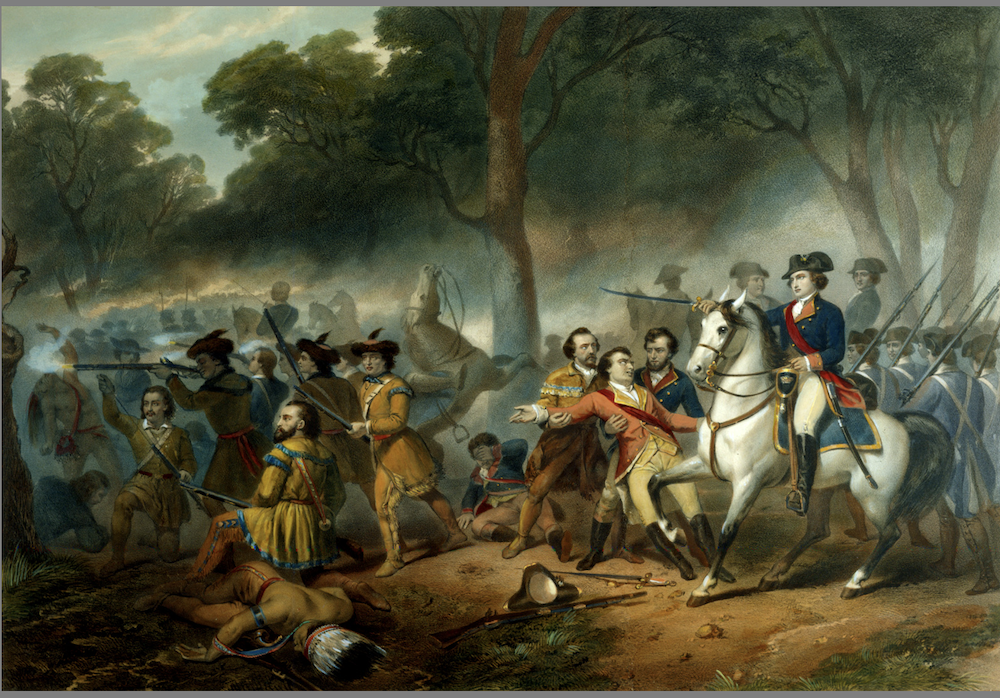
Washington the Soldier -- Battle of Monongahela, July 9, 1755. Claude Regnier, after Junius Brutus Stearns, 1854. United States Library of Congress's Prints and Photographs division, http://www.loc.gov/pictures/item/2003677702/. Public Domain, https://commons.wikimedia.org/w/index.php?curid=75151447
| | |
On July 9, 1755, at the start of the French and Indian War, a battle took place at Braddock's Field, which is now known as Braddock, Pennsylvania, located 10 miles (16 km) east of Pittsburgh. A British army led by General Edward Braddock was attempting to seize Fort Duquesne but was defeated by French and Canadian forces under Captain Daniel Liénard de Beaujeu, along with their American Indian allies.
Contrary to his expectation (there being "about three hundred French and Indians," wrote Washington; "our numbers consisted of about thirteen hundred well-armed men, chiefly regulars", the French won the day. "By the all-powerful dispensation of Providence, I have been protected beyond all human probability and expectation; for I had four bullets through my coat, and two horses shot under me, yet escaped unhurt, although death was levelling my companions on every side of me. We have been most scandalously beaten."
Washington to his brother John, May 14, 1755
This defeat ended the Braddock Expedition, during which the British aimed to capture Fort Duquesne and control the important Ohio Country. Both Braddock and Beaujeu lost their lives in the battle. Braddock was severely injured and died during the retreat close to what is now Uniontown, Pennsylvania. He requested that George Washington, by then a Colonel, who was with him on the march, manage his burial. The rest of the British troops retreated to the southeast. Fort Duquesne and the surrounding area stayed under French control until it was taken in 1758.
The rest is, as we say, history. Despite these initial successes, France was at a distinct disadvantage with too few colonists and too vast (and stretched) possessions. The tides of war turned, and a series of defeats led to the conclusion of the Peace Treaty of Paris in 1763, by which France abandoned North America after 200 years of continuous presence.
With this type of combat experience against the French, it is probable that Washington harbored strong anti-French sentiments and prejudices, even more so than other British colonists, or those who would be called a few years later "Loyalists" during the American Revolution.
| | |
Rebellion of the 13 Colonies:
George Washington named
Commander in Chief
| | |
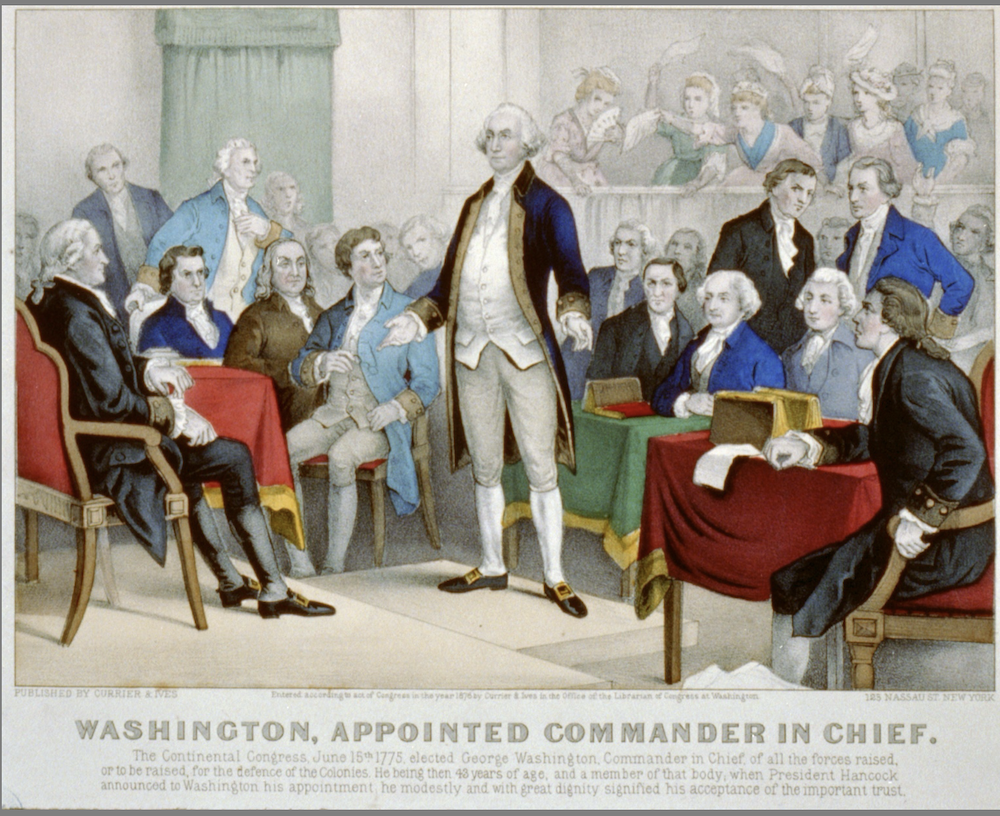
After the Treaty of Paris of 1763, France was no longer an enemy to contend with in North America. Britain had incurred significant debt to finance the war, and started exacting increasingly burdensome taxes from the 13 Colonies - - planting the seeds for discontent, and ultimately revolt.
We will not delve on the series of events leading to this situation. By 1775, the Colonists had elected their Continental Congress and were determined to sever ties with Britain.
Washington found it difficult to accept that the English were truly the enemy; for a long time, he tried to convince himself that the conflict was not with England and her King, but merely with the ministers and their soldiers, whom he referred to as the "ministerials."
In a letter to G.W. Fairfax in England while attending the Continental Congress, Washington gave him an account of the clash between the "provincials" of Massachusetts and "the ministerial troops": "Before this Letter can reach you, you must, undoubtedly, have received an Account of the engagement in the Massachusetts Bay between the Ministerial Troops (for we do not, nor cannot yet prevail upon ourselves to call them the King’s Troops) and the Provincials of that Government"
Washington to G.W. Fairfax, May 31, 1775
This continued until the proclamation of independence. By letter of March 19, 1776, Washington notified John Hancock, President of Congress, of the taking of Boston, that "The Ministerial Army evacuated the Town of Boston, and that the Forces of the United Colonies are now in actual possession thereof..."
In the same letter to Fairfax, Washington regrets this state of affair "Unhappy it is though to reflect, that a Brother’s Sword has been sheathed in a Brother’s breast, and that, the once happy and peaceful plains of America are either to be drenched with Blood, or Inhabited by Slaves. Sad alternative! But can a virtuous Man hesitate in his choice?"
Two weeks later, George Washington would be named Commander-In-Chief of the Continental Army. George Washington was a natural choice. Even though Washington had not achieved the commission he had desired in the British army, he acquired important military, political, and leadership skills during the French & Indian war. He also gained considerable public recognition both in the colonies and overseas. By closely studying British military strategies, he developed a deep understanding of their strengths and weaknesses, which became crucial during the Revolution. He showed his resilience and bravery in challenging circumstances, including setbacks and retreats. His physical presence—due to his size, strength, endurance, and courage in combat—made him seem like a natural leader to the soldiers, who followed him without hesitation.
By the time of the Saratoga victory, in October 1777 - 2 years after being named Commander in Chief of the Continental Army, 16 months after the Declaration of Independence - 16 months after the Declaration of Independence, the French no longer filled Washington with disdain or hatred; he was starting to judge them more fairly, but his heart was still not won over...
| |
2nd Phase: from enmity to irritation
First interactions with French volunteers
| |
Above:
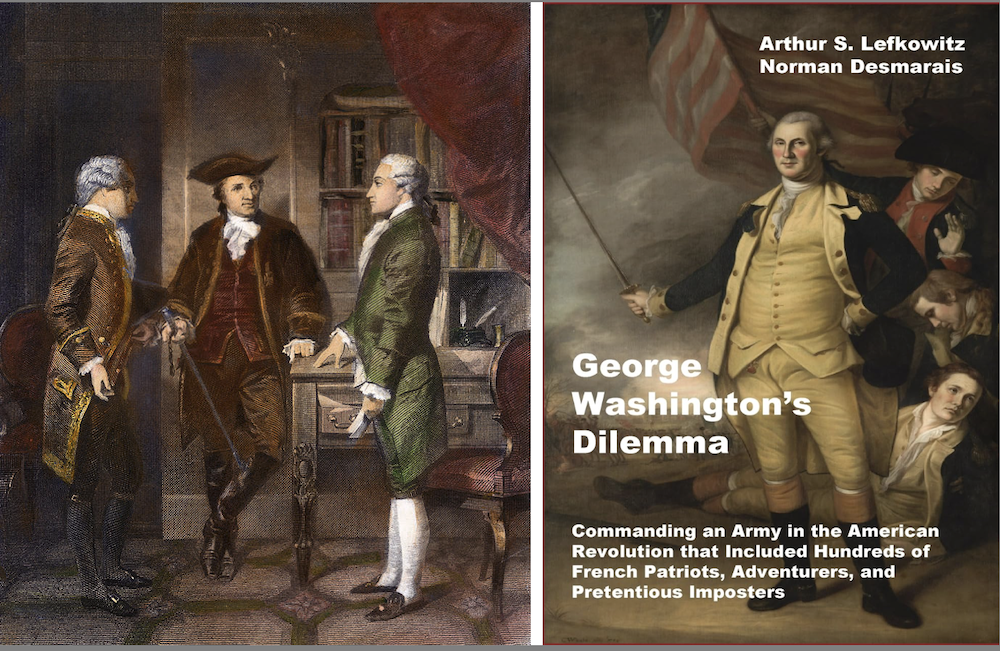
Left: Baron de Kalb Introducing Lafayette to Silas Deane (1879 Print) By Alonzo Chappel, Public Domain, https://commons.wikimedia.org/w/index.php?curid=34907276
Right: Book cover of "George Washington Dilemna" by Prof. Norman Desmarais and Arthur S. Lefkowitz, Amazon.com
| |
By that time, the French no longer filled Washington with disdain or hostility; he was starting to judge them more fairly, yet his heart was still not won over. Early on, French volunteers began to join the American army, with some being more of a burden than a benefit. "They seem to be genteel, sensible men," Washington wrote to Congress in October 1776, "and I have no doubt of their making good officers as soon as they can learn so much of our language as to make themselves well understood."
We quote the opening of the book "George Washington's Dilemma" recently published by Prof. Norman Desmarais:
"Some 200 French volunteers were commissioned as officers in the Continental Army during the first years of the American Revolution. Their number included a few officers from other European nations who were educated in France or covertly encouraged by the French government to join the Patriot Army. Some of these volunteers made significant contributions to the success of our Revolution. However, many of them spoke little or no English and came with inflated resumes and wearing impressive uniforms. They were commissioned by the Continental Congress after arriving in America and told to report to George Washington’s headquarters for assignments. It was left to Washington to deal with these Frenchmen. He had to unravel which of them were valuable additions to his army and which of them were pretentious frauds. This was George Washington’s dilemma."
Among them, we could cite Tronson du Coudray, named Major General of the Continental Army who, although military competent, had managed to upset every American officer and George Washington himself. His premature death in an accident was seen as a relief by all, including Lafayette. We mention also Thomas Conway, an Irish-born officer of the French Army, Brigadier General of the Continental Army, who mounted a cabal against George Washington, thwarted by the same Lafayette (as we will narrate below).
Not to mention several soldiers of fortune and imposters who gave George Washington insufferable headaches, and created much animosity towards the French among American officer. We encourage you to read "George Washington Dilemna" to discover many of these colorful characters.
Indeed, many were great officers with precious skills, such as artillery, and engineering.
We told the story of several of them in past bulletins, notably our February 2023 Bulletin: "George Washington’s French engineers:
https://conta.cc/3XBjqMp (original version in English)
https://conta.cc/412e0Nr (version en français)
Of course, the most famous, and the one who arguably changed George Washington's bias against the French was Lafayette. Their father-son relationship is not exagerated.
| |
3rd phase:
From irritation to enthusiasm
First meeting with Lafayette
August 3rd, 1777
| |
Above:
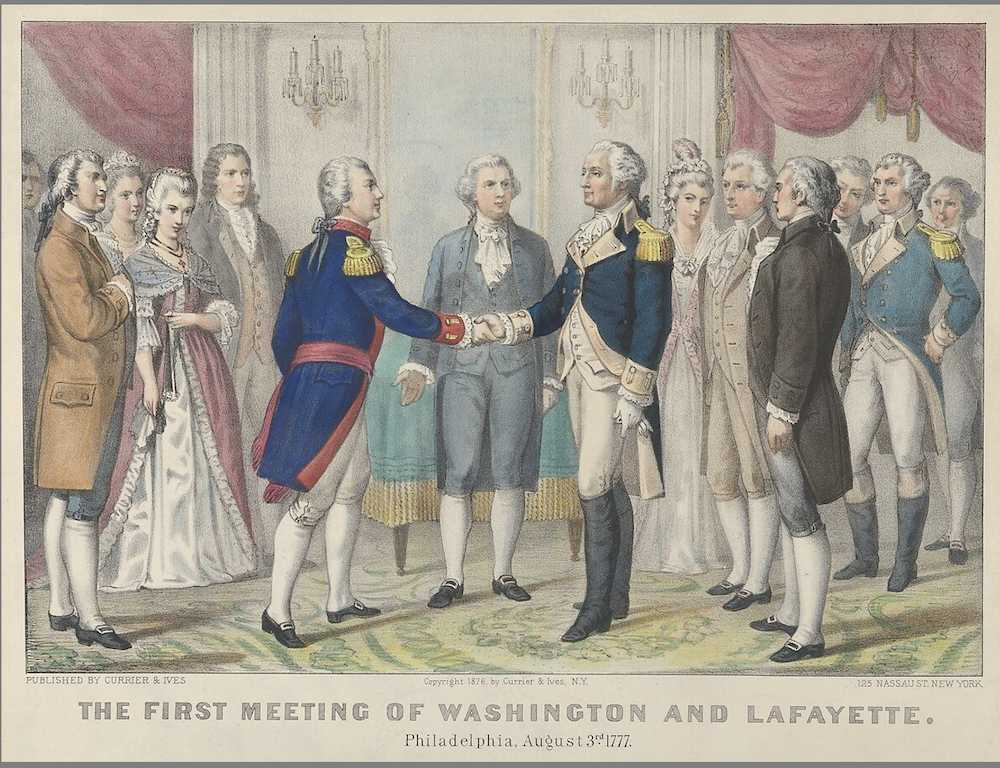
Top: The First Meeting of Washington and Lafayette—Philadelphia, August 3rd, 1777 - Hand-colored lithograph (1876) by Currier & Ives (American, active New York, 1857–1907) – The Met, Public Domain, https://www.metmuseum.org/art/collection/search/659889
The costumes depicted, facial features of Lafayette, and decoration are pure fantasy, in the tradition of the French "image d'Épinal" (Épinal print) with vivid colors and a naïve description of the scene.
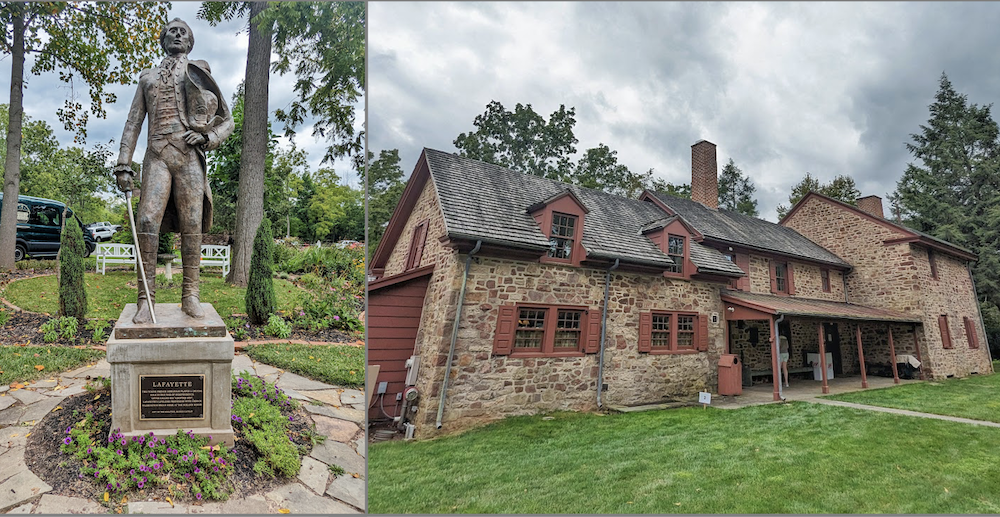
Bottom Left: Lafayette statue in the Colonial-style garden at Moland house, By Rgs25 - Own work, CC BY-SA 4.0, https://commons.wikimedia.org/w/index.php?curid=136660441
Bottom Right: Moland House, By Rgs25 - Own work, CC BY-SA 4.0, https://commons.wikimedia.org/w/index.php?curid=136661016
| |
Shortly after landing on June 13, 1777 in the aptly named town of Georgetown, South Carolina, Lafayette went to Warminster near Philadelphia to meet George Washington at a dinner organized by members of the Continental Congress on August 3rd. Washington, who was increasingly doubtful about the influx of foreign officers wanting roles in the Continental Army, was very quickly impressed by the young Frenchman. At just 19 years old, Lafayette displayed a mix of noble demeanor and true republican zeal that distinguished him from many of the self-serving adventurers Washington had grown tired of encountering.
Immediately prior to this meeting, Washington was weary of the arrival of Lafayette. Washington wrote this in August 1777, shortly after Congress had appointed the 19-year-old French nobleman as a volunteer Major General in the Continental Army. At the time, Washington was overwhelmed with foreign officers seeking commissions and was frustrated by Congress sending them without clear instructions, prompting him to label the unexpected addition as "one more encumbrance":
In a letter of August 1777 to Benjamin Harrison, Washington wrote: "What the designs of Congress respecting this gentleman were, and what line of conduct I am to pursue to comply with their design and his expectation, I know no more than the child unborn, and beg to be instructed."
Very quickly, Washington was won over by Lafayette.
The two men formed an almost immediate connection at that dinner. Washington is said to have taken Lafayette on a tour of his troops afterward, and despite the shabby, poorly equipped condition of the Continental Army, Lafayette reacted with respect and admiration instead of the disdain Washington might have expected from a French nobleman. Lafayette later remembered being inspired by the soldiers' spirit despite their dire circumstances. Washington, for his part, reportedly told Lafayette that he was welcome to make headquarters his home. This marked the start of one of the most profound friendships of the Revolutionary period — Washington would come to see Lafayette as almost a son, and Lafayette would see him as a father and a mentor. Lafayette remained loyal to Washington for the rest of his life.
Washington's Headquarters are known as Moland House Historical Park and can be visited:
Statue of Lafayette at Moland House
1641 Old York Rd, Warminster, PA 18974
GPS: 40.235967, -75.092633
• Inscription:
“This young French nobleman played a crucial
Role in our war of independence
Often called his “adopted son”
Lafayette’s lifelong friendship with George
Washington began here at the Moland House
Gift of the sculptor Murrie Gatsum”
Lafayette was not the only idealist among these volunteers. Many young French aristocrats grew up in the Age of Enlightenment and the philosophy of Voltaire, Rousseau, Montesquieu, Diderot, d'Alembert, and the writings of Beaumarchais, to cite a few. They were enthused by the ideals of liberty.
Washington soon began to recognize that one unique quality in those former foes made them deserving of his friendship: their ability to show selfless passion for a beloved cause.
| |
Washington & Lafayette
at Brandywine
| |
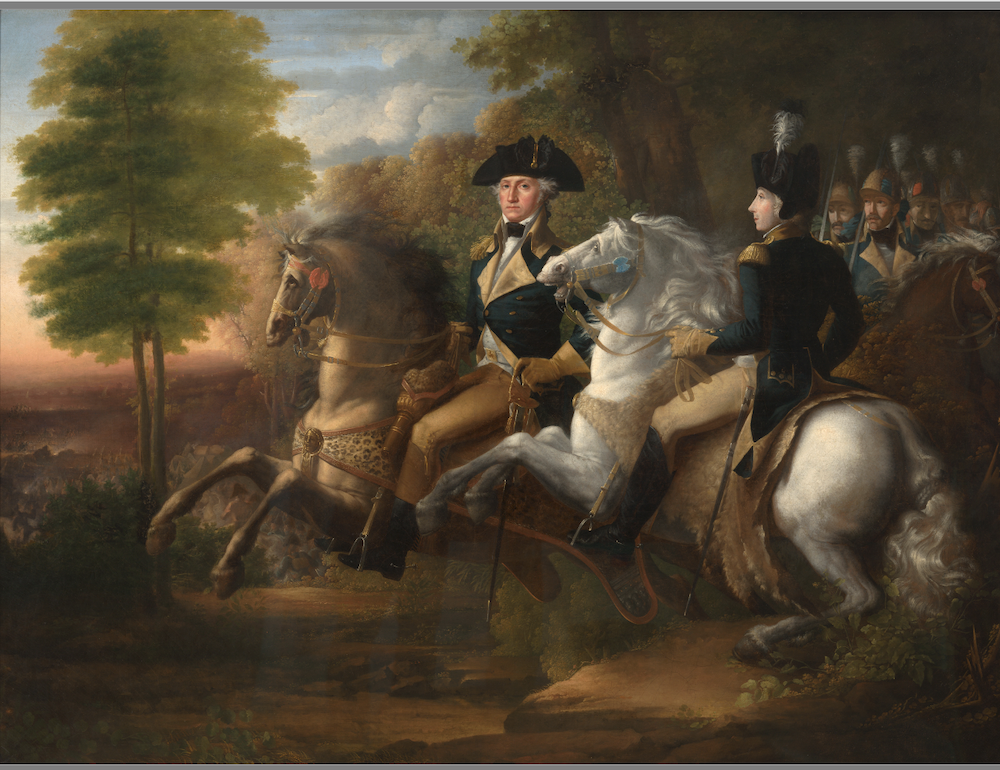
Above:
Washington and Lafayette at the Battle of Brandywine, oil on canvas by John Vanderlyn (American, 1775–1852), circa 1825, Gilcrease Museum, Tulsa, OK
https://collections.gilcrease.org/iiif/manifest/object/011018
| |
It did not take long for Washington to be impressed by Lafayette's military skills and courage.
• Lafayette was wounded at the battle of Brandywine with a bullet through his calf. The Moravian Dairy (the town's record of events) wrote: "The young Marquis de Lafayette with a suite of French officers"... "having been disabled by a wound received at the battle of the Brandywine has come here for medical treatment.”
• Washington had given directions that Lafayette was to be treated "as if he were my son." The family of George Frederick Beckel agreed to take Lafayette into their home since the local hospital was overflowing with wounded.
• Lafayette wrote: ”Messieurs the English paid me the compliment of wounding me slightly in the leg." He added that the doctors "are astonished at the rapidity with which it heals …pretend it is the rarest thing in the world. For my part I think it most disagreeable, painful wearisome; but tastes often differ."
• While recuperating, Lafayette wrote to his wife, “Do not be concerned, dear heart, about the care of my wound…. When he [Washington] sent his chief surgeon to care for me, he told him to care for me as though I were his son, for he loved me in the same way.”
Lafayette's own narration of George Washington's attentiveness:
• On February 25, 1825, Lafayette granted Poulson's Advertiser, one of Philadelphia's leading newspapers, an interview. In the piece, Lafayette recalled receiving his wound at Brandywine:
"The ball went through and through; I was on foot when I received my wound; a part of our line had given way but a part still held its ground. To these I repaired. To encourage my comrades, and to show them I had no better chance of flight than they, I ordered my horse to the rear. The news of my being hurt was conveyed to the commander-in-chief, with the usual exaggerations in such cases. The good General Washington freely expressed his grief that one so young, and a volunteer in the holy cause of freedom, should so early have fallen; but he was soon relieved by an assurance that my wound would stop short of life, when he sent me his love and gratulation that matters were no worse. On the field of battle the surgeon prepared his dressings, but the shot fell so thick around us, that in a very little time, if we had remained, we should both have been past all surgery. Being mounted on my horse I left the field, and repaired to the bridge near Chester, where I halted and placed a guard, to stop fugitive soldiers, and direct them to join their respective regiments. I could do no more; becoming faint, I was carried into a house in Chester and laid on a table, when my wound received its first dressing. The general officers soon arrived, when I saluted them by begging that they would not eat me up, as they appeared to be very hungry, and I was the only dish upon the table in the house. The good general-in-chief was much gratified on finding me in such spirits, and caused a litter to be made, on which I was conveyed to the Indian Queen [a tavern/hotel] in Philadelphia, and was there waited upon by the members of Congress, who were all booted and spurred and on the wing for a place of greater safety to hold their sessions. The enemy continuing to advance, I was removed to Bristol, and thence in the coach of President Laurens (and coaches were rare in those days) to Reading [here Lafayette's memory fails him — he was actually moved to Bethlehem], where I remained until so much recovered as to be able to repair to head-quarters."
Marker, “Lafayette wounded”
534 Main St, Bethlehem, PA 18018
GPS: 40.621300, -75.381867
• Inscription:
“Here stood the George Frederick Beckel house, 1762-1872, famed as the place where General Lafayette convalesced from a leg wound suffered at the Battle of Brandywine, 1777. Beckel was then superintendent of the community farm here in Bethlehem.
Erected 1987 by Pennsylvania Historical and Museum Commission.”
| |
Washington & Lafayette at Valley Forge
Shivering together
| | |
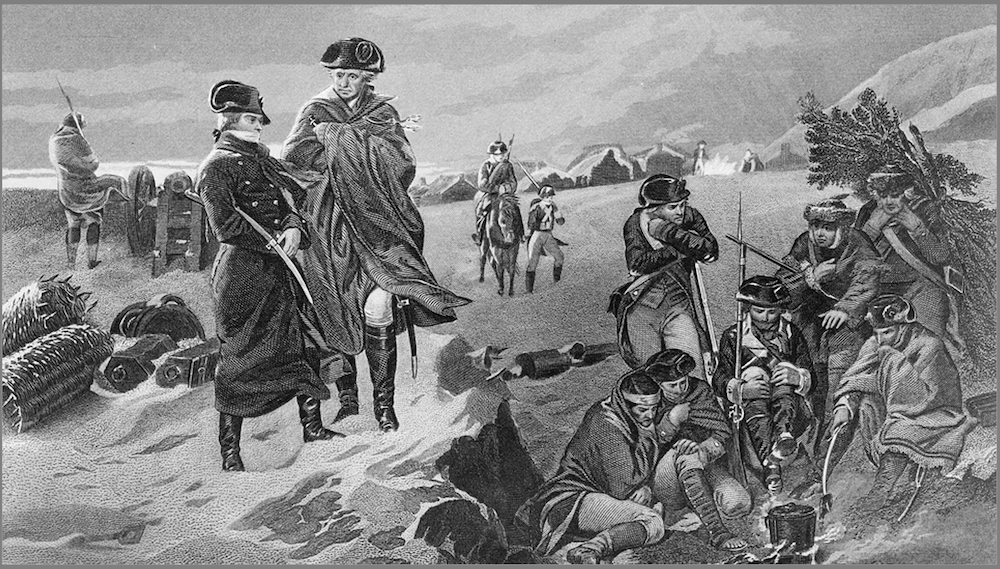
Above:
The French military leader Marquis de Lafayette and General George Washington at the Valley Forge encampment of the Continental Army during the winter of 1777–78 (AP) - Copy of engraving by H. B. Hall after Alonzo Chappel, National Archives https://catalog.archives.gov/id/532877
| |
The winter encampment at Valley Forge from 1777 to 1778 was one of the most grueling chapters of the American Revolutionary War, and it was here that the bond between George Washington and the young Marquis de Lafayette was truly forged.
Lafayette had quickly won Washington's admiration with his enthusiasm, bravery, and genuine commitment to the American cause. Washington, who had no biological children of his own, came to regard Lafayette almost as an adopted son, and the two grew especially close during the long, bitter months at Valley Forge. Despite the terrible conditions — soldiers suffering from cold, hunger, and disease — Lafayette proved himself a steady and loyal presence at Washington's side, helping to maintain morale among the troops.
In February 1778, Washington entrusted Lafayette with a command of his own, sending him on a reconnaissance mission to Canada, a testament to the trust and confidence he had placed in the young Frenchman. The shared hardship of Valley Forge deepened a friendship that would last the rest of their lives, and Lafayette would later look back on those difficult months as some of the most formative of his remarkable career.
| | |
Lafayette's loyalty to Washington
"The Toast that Saved America"
| | |
Above:
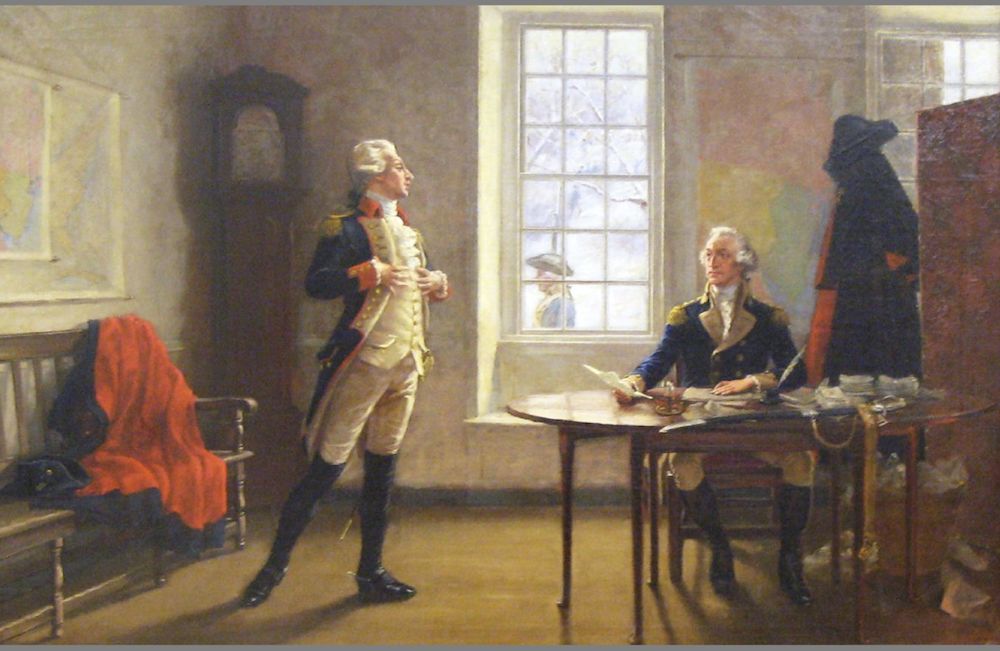
Valley Forge - Lafayette at Washington's Headquarter's 1777-1778, oil painting (1907) by John Ward Dunsmore (1856-1945), Frances Tavern Museum, property of the Sons of the American Revolution in the State of New York https://frauncestavern.pastperfectonline.com/
| | |
• During the time of the so-called Conway cabal, Lafayette unexpectedly got a commission from Congress to lead an expedition to invade Canada, but it was sent to him without the Commander-in-Chief's knowledge.
• Lafayette quickly went to Washington, presented the commission, and explained that he understood the entire scheme. He sought Washington's advice while affirming his complete loyalty and dedication to his leader. Washington responded that it was an honorable opportunity and encouraged him to accept it. Even though Lafayette went to Albany to gather a force, Congress took no further action to fulfill its stated goal. After waiting three months, he returned to Valley Forge.
• Some officers were part of the “Conway Cabal”, trying to convince Congress to strip George Washington of its command in favor of General Horatio Gates who had just won the battle of Saratoga.
• Thomas Conway was an Irish-born officer of the French Army who had been named Brigadier General of the Continental Army. Conway led the main brigade on the American right side during the Battle of Germantown and received praise for his efforts. However, Washington was against his promotion to major general, feeling that several American-born officers with more extensive and significant service were more deserving of the title; this led to a rift between Washington and Conway.
• In December 1777, Congress appointed Conway as a Major General despite Washington's disapproval and also made him the Inspector General of the American army.
• The "Conway Cabal": Conway wrote a letter to Horatio Gates, calling Washington a "weak general" and criticizing his tactics against British General William Howe. When the letter became public, Conway lost his command. He resigned from the Continental Army and went back to France, but did apologize to Washington in writing. Years later, he was accepted into the Society of the Cincinnati.
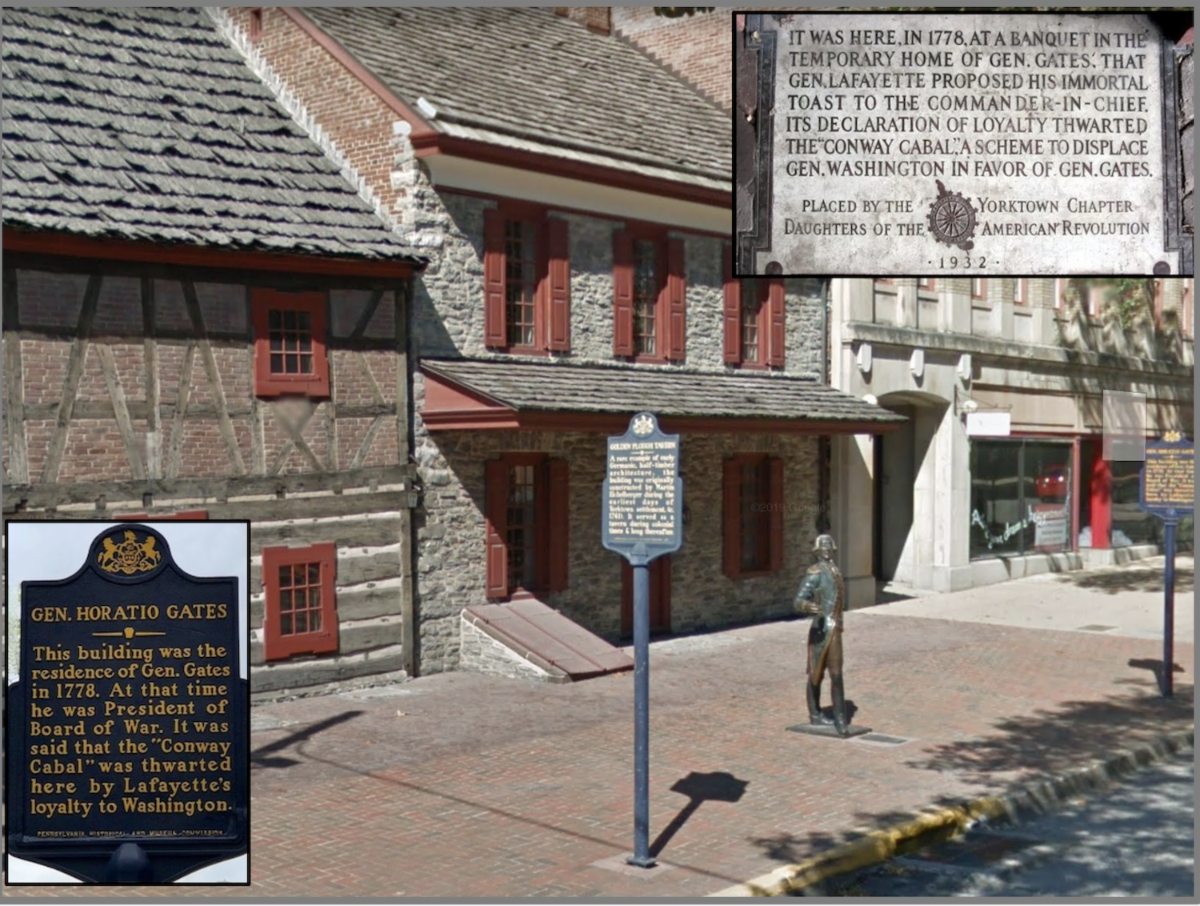
• In this house, Lafayette thwarted the Cabal with a famous toast to General Washington at dinner in front of Gates and all the officers. Members of Congress were keen to keep the support of France. It was called “the toast that saved America”.
Plaques and markers commemorate this episode:
| | |
Lafayette Plaque at Gates House
157 W Market St, York, PA 17401
GPS: 39.961400, -76.731400
• Inscription of the marble tablet:
“It was here, in 1778, at a banquet in the temporary home of Gen. Gates, that Gen. Lafayette proposed his immortal toast to the Commander-in-Chief. Its declaration of loyalty thwarted the "Conway Cabal", a scheme to displace Gen. Washington in favor of Gen. Gates.
Placed by the Yorktown Chapter Daughters of the American Revolution 1932”
• Inscription of the marker “Gen. Horatio Gates":
“This building was the residence of Gen. Gates in 1778. At that time he was President of Board of War. It was said that the "Conway Cabal" was thwarted here by Lafayette's loyalty to Washington.
Erected by Pennsylvania Historical and Museum Commission.”
• Inscription at the base of the statue:
General Marquis de Lafayette
1757-1834
“Member Society of the Cincinnati of France”
Presented jointly by the State Society of the Cincinnati and the City of York, Pennsylvania,
this day January 27th 2007.
"Serving America is to my heart an inexpressible happiness"
| | |
The catalyst:
Treaty of Alliance with France
| | |
Above:
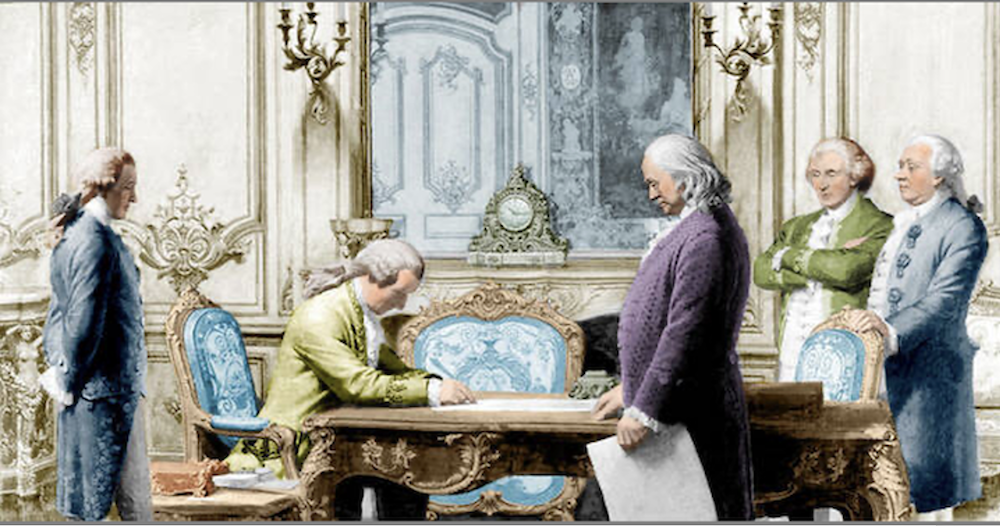
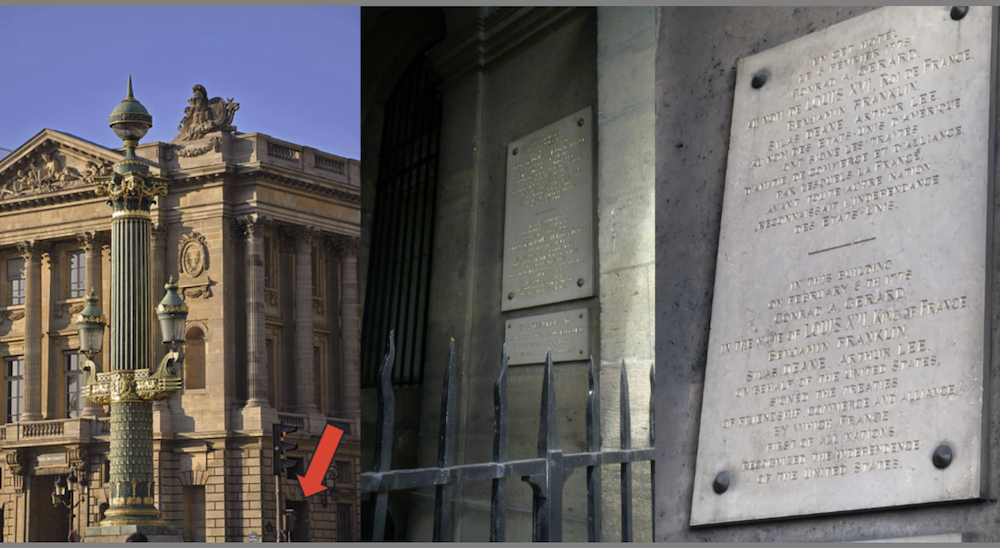
Top: Reproduction of a c.1910 painting by Charles Elliott Mills depicting The Signing of the Treaty of Amity and Commerce and the Treaty of Alliance between France and the United States. It was commissioned for the lobby of the Franklin Union Building in Boston - This image is available from the United States Library of Congress's Prints and Photographs division, Public Domain,
https://commons.wikimedia.org/w/index.php?curid=45583820
In the center is seated Monsieur Conrad Alexandre Gérard de Rayneval with Benjamin Franklin holding a paper. To the right, Arthur Lee has his arms folded and Silas Deane has his on a chair. At the left is Franklin's grandson, William Temple Franklin.
Bottom: Marble plaque at the angle of Place de la Concorde and rue Royale, Paris,
Photos: TC © ASSFI 2021
| | |
• The Treaty of Alliance between France and the United States was concluded at Paris, February 6, 1778 and ratified by Congress May 4, 1778. When word of the Alliance and its ratification by the Continental Congress reached Valley Forge in early May 1778, General George Washington issued the following general order: “…Upon a signal given, the whole army will huzza, 'Long Live the King of France.’ ”….
• And he also issued the following General Order: “It having pleased the Almighty Ruler of the universe to defend the course of the United States, and finally raise up a powerful friend among the princes of the earth*, to establish our Liberty and Independence upon a lasting foundation, it becomes us to set apart a day for gratefully acknowledging the Divine goodness, and celebrating the important event which we owe to His Divine interposition.” (General Orders, May 5, 1778)
* Washington refers to King Louis XVI.
• Every year, on the first weekend in May, Washington Memorial Chapel at Valley Forge, in observance of Washington’s instructions, commemorates the Treaty of Alliance with France.
• This ceremony is organized by the Washington Memorial Heritage and the Washington Memorial Chapel with the participation of numerous American patriotic societies dedicated to the recognition and perpetuation of French-American friendship. The French side is represented by the Association of French Reserve Officers in the United States (ACREFEU), the Federation of French War Veterans, the American Society of the Souvenir Français Inc., the Honorary Consul of France in Philadelphia and the Embassy of France.
| | |
An alliance almost derailed
Washington works with Admiral d'Estaing & Lafayette
to appease tensions
| | |
• Following the Franco-American alliance of February 1778, France sent a fleet under Admiral Count d'Estaing to support the American cause against Britain.
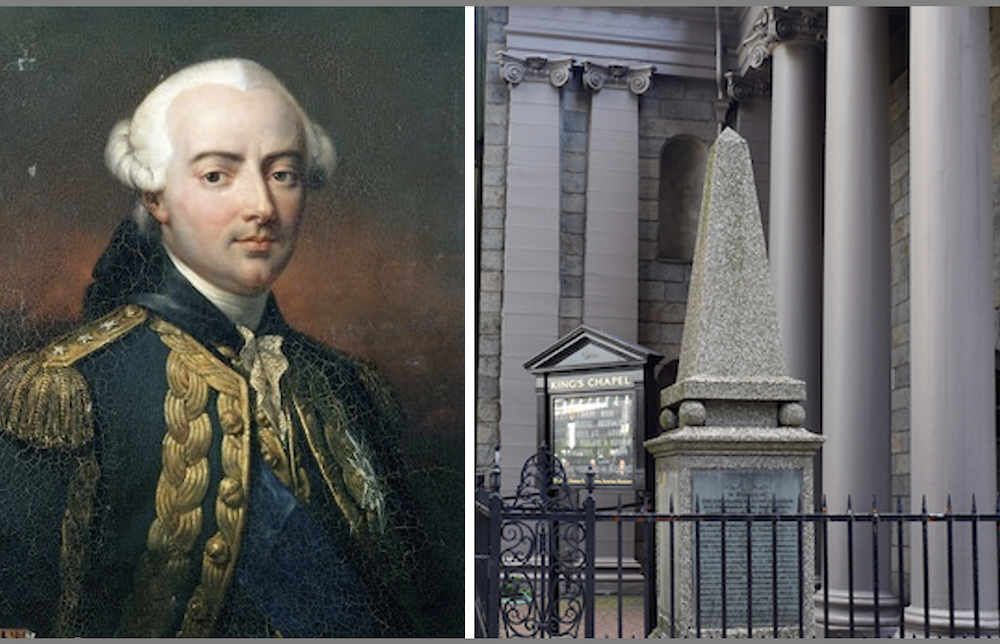
• Among the officers was Chevalier (also Comte) Jean-Baptiste Amédée de Grégoire de Saint-Sauveur(1750-1778) a lieutenant aboard the Tonnant and First Chamberlain to Count d'Artois, brother of Louis XVI. After the fleet suffered storm damage while attempting to attack the British in Newport, R.I. in concert with the Americans, the ships docked in Boston for repairs (this episode was itself a subject of heated recriminations, although d'Estaing, in all fairness, was not at fault).
• On September 9, 1778, a riot broke out near the fleet's bakery, and Chevalier De Saint Sauveur was fatally struck in the face while attempting to restore order. He died a week later on September 15. Fearing that the incident would drive France to withdraw its forces, the Massachusetts Bay General Council quickly voted to honor him with a memorial. He was buried in a private ceremony in the basement of King's Chapel, with Count d'Estaing himself drafting the monument's inscription on September 28, 1778.
• The monument was finally approved and built in 1916. Designed by architect A.W. Longfellow and constructed by Emerson & Norris of Boston, the fourteen-foot granite structure stands directly above Chevalier De Saint Sauveur's burial site at King's Chapel. It features four cannonballs, green slate panels on two sides bearing d'Estaing's original inscription, and an English translation added for local readers.
Memorial Saint Sauveur
Intersection of Tremont Street and Beacon Street, Boston, MA 02108
GPS: 42.358134, -71.060216
•Inscription:
In Memory of
The Chevalier de Saint Sauveur
first Chamberlain of his Royal Highness, Count d'Artois,
brother of his Majesty the King of France
(English translation - - the rest of the inscription is engraved in French):
"This officer, aide-major of the French squadron and lieutenant de vaisseau [on the Tonnant] after having had the pleasure of risking his life for the service of the United States, was fulfilling his duty when he was the victim of a riot caused by malicious people: his death came [on September 15, 1778] with the same attachment to America, the bonds of duty and inclination that attach his compatriots to the city of Boston were only more tightened. May it be so unsuccessful as ever to make every effort one might try to separate France and America. This is the prayer that will be made in the centuries to come to God almighty, every Frenchman and every American who will cast their eyes on the mausoleum of a young man, taken from friends who can only comfort themselves from the loss by seeing such funerary flowers spread on his tomb."
"This inscription was prepared by the Comte d'Estaing, the Admiral commanding the first French squadron sent to the United States of America."
Erected 1917.”
• General Washington, who was made aware of the riot, was quite satisfied to find out that it had ended in such a way as to assure the French that no public insult was meant by the citizens of Boston. He wisely suggested that every effort should be made " to cultivate harmony between the people and the seamen " who, he apprehended, would "not be so easily reconciled as their officers, not having so much sense to direct them. "
— Geo. Washington, Letter of Sept. 22, 1778, "Heath Papers" Vol.1, p.95 (Mass. Hist . Soc. Coll.)
• Another example of Washington's ability to ease tensions, particularly after Admiral d'Estaing's failure at the siege of Savannah in October 1779 and the mutual recriminations that followed, was when he wrote to General Lincoln:
« While I regret the misfortune, I feel a very sensible pleasure in contemplating the gallant behavior of the officers and men of the French and American army; and it adds not a little to my consolation to learn that, instead of the mutual reproaches which often follow the failure of enterprises depending upon the co-operation of troops of different nations, their confidence in and esteem of each other is increased. »
Letter to General Lincoln, December 12, 1779
| | |
An alliance strenghtened
Washington rejoices:
"The French are coming!"
| | |
Above:
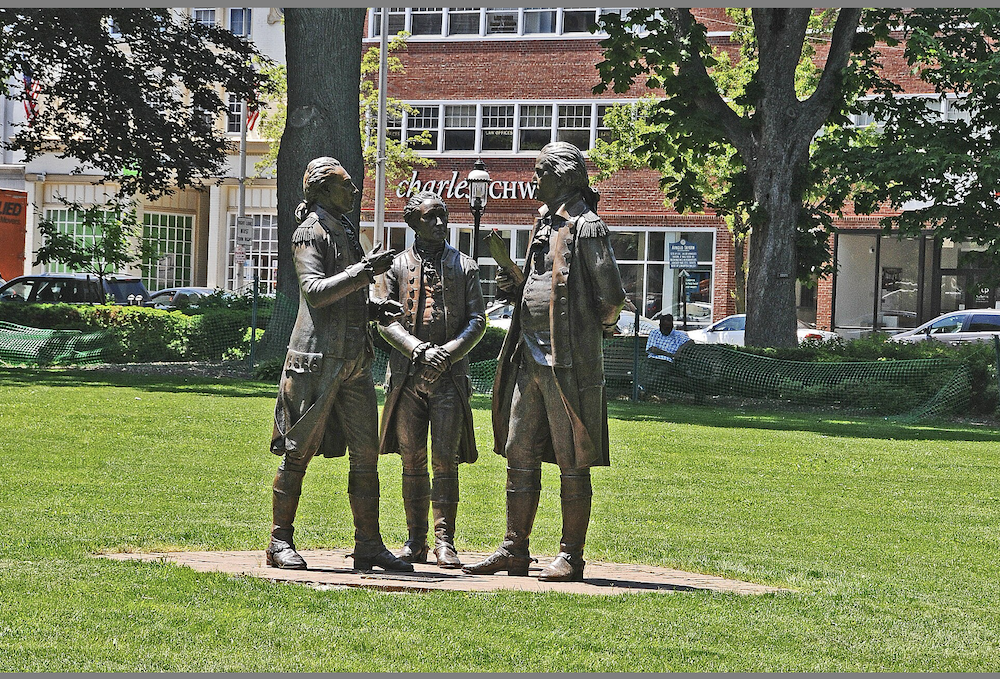
Located in the middle of the green is this group of life-size statues representing George Washington, Alexander Hamilton, and Lafayette at the moment in 1780 when Lafayette informed Washington that France was sending an army to fight. In the background, just right of center, is a historical marker for Arnold's Tavern (demolished), which served as Washington's headquarters, January 6 to May 29, 1777.
Bronze sculptural grouping designed by StudioEIS, Brooklyn, Photo by Jerrye & Roy Klotz, MD - Own work, CC BY-SA 3.0, https://commons.wikimedia.org/w/index.php?curid=33178969
| | |
• Lafayette came back to France in January 1779 for several key reasons.
First, he had technically departed France without the king's approval when he first went to America in 1777, which caused some diplomatic issues. His return allowed him to mend relations with the French court and regain his reputation.
• More importantly, Lafayette took this opportunity in France to actively support the American cause. He urged the French government to offer more military and financial aid to the struggling American forces. His efforts were very successful — he helped secure a promise from King Louis XVI to send a significant French expeditionary force to America, which would later become the army led by General Rochambeau.
• He also had the chance to spend time with his wife Adrienne and meet his daughter, as family life had mostly been put on hold due to his military pursuits.
• Lafayette returned to America in April 1780, onboard the newly built and fast French Navy frigate Hermione (which came to be known as "The Freedom Frigate") before Rochambeau's army, partly to prepare Washington for the arrival of the French troops and to assist in coordinating the alliance between the two armies. His return was warmly welcomed by Washington, who appreciated both his military skills and his special role as a link between the American and French commands.
• This sculpture, known as “The French Are Coming”, in Morristown, NJ, commemorates the meeting of George Washington, the young Marquis de Lafayette and young Alexander Hamilton, depicting them discussing aid of French Navy ships and troops being sent by King Louis XVI of France as support for the budding nation.
“The Alliance Statues” & marker: “The French are coming!”
Morristown Green historical park, Morristown, New Jersey, 07960
GPS: 40.797229, -74.480727
• Inscription of marker:
“General George Washington and
Colonel Alexander Hamilton
are advised at Morristown by
the Marquis de Lafayette
that the French are coming to
support the American cause.
May 10, 1780”
Washington was aware of the news shortly prior to Lafayette's arrival. On May 1, 1781, he wrote in his journal (solely for himself): "our generous allies." On that day, Washington's heart was truly captured.
| | |
Phase 4:
Admiration, Brotherhood and Friendship
The French Army lands in Newport, R.I.
July 11, 1780
| | |
Above:
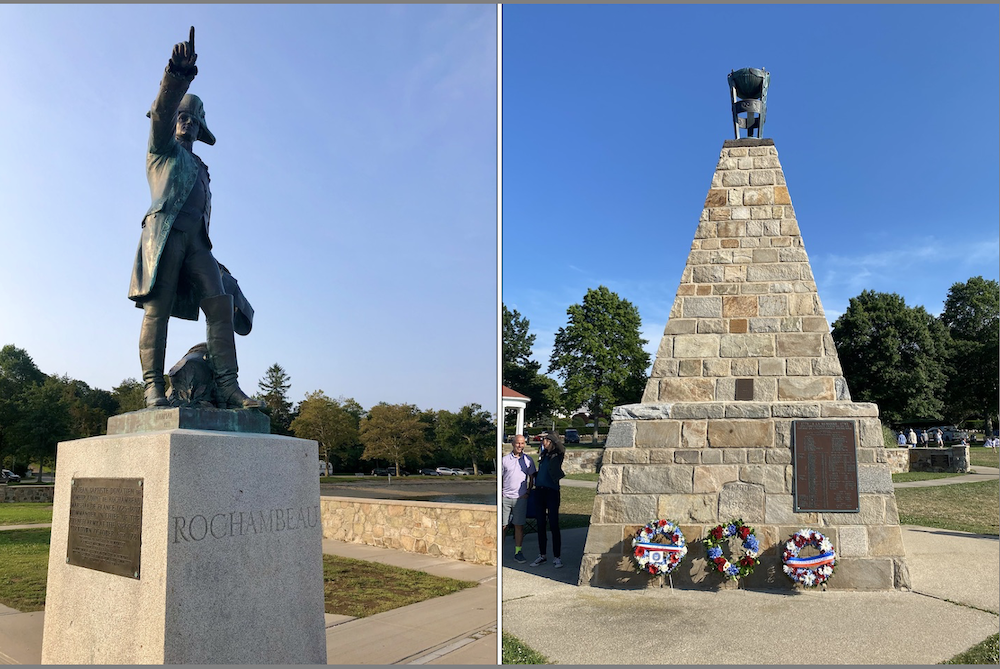
Statue of Rochambeau and Monument to the French Fleet, King Park, Newport, R.I.
Photos: TC © ASSFI 2022
| | |
Dr. Robert A. Selig, Ph.D., esteemed Member of our Society, who wrote hundreds of articles on the French role during the American Revolutionary War (and composed many of the National Park Service markers, including our own markers in Yorktown and Gloucester), gives us the composition of the "Expédition Particulière", which was the code name for Rochambeau's forces:
"On 2 May 1780, a convoy of 32 transports and cargo ships protected by seven ships of the line, four frigates, four flutes, a cutter and a schooner left Brest for the United States. Besides their crews of about 7,000 sailors, his ships carried the Bourbonnois, Soissonnois, Saintonge, and Royal Deux-Ponts regiments of Infantry of about 1,000 men each, a re-enforced battalion of the Auxonne Regiment of Artillery with a strength of about 450, the 600-man strong Lauzun’s Legion, and a pioneer detachment, altogether about 450 officers and 5,300 men. Around 10:30 a.m. on the morning of 11 July, the French fleet sailed into Newport Harbor..."
https://battleofrhodeisland.org/rochambeaus-engineers-at-butts-hill-fort-july-1780-june-1781/
• The Memorial to the French Fleet (official name) is a stone pyramid, erected 1928 by Newport Historical Society in King Park (Newport, Rhode Island).
• The Rochambeau Statue and Memorial was erected in 1934 and generously restored by the Alliance Française de Newport in 2017. It is a replica from the original in Vendôme, France which was inaugurated in 1900.
• The American Society of Le Souvenir Français Inc. lays a wreath at the foot of the statue every year around July 11 during a “Tribute to France” weekend organized by the City of Newport and the Newport Historical Society along with numerous civic and patriotic associations.
• Note the quote of George Washington engraved on the pedestal:
Statue of Rochambeau & Memorial to the French Fleet, Newport, R.I.
At the waterfront in Kings Park, Newport R.I. 02840
GPS: 41.476733, -71.321555
• Inscription:
[ South side : ]
"Near this spot the French army of 6000 men led by General Rochambeau our allies in the War for Independence first set foot upon American soil "
[ East side : ]
" I welcome the news of your arrival
A new mark of friendship
from his most Christian Majesty "
-
George Washington
July XIII 1780
To borrow from Casablanca: it was the beginning of a beautiful friendship!...
| | |
Washington and Rochambeau
A military and diplomatic convergence
| | |
Above:
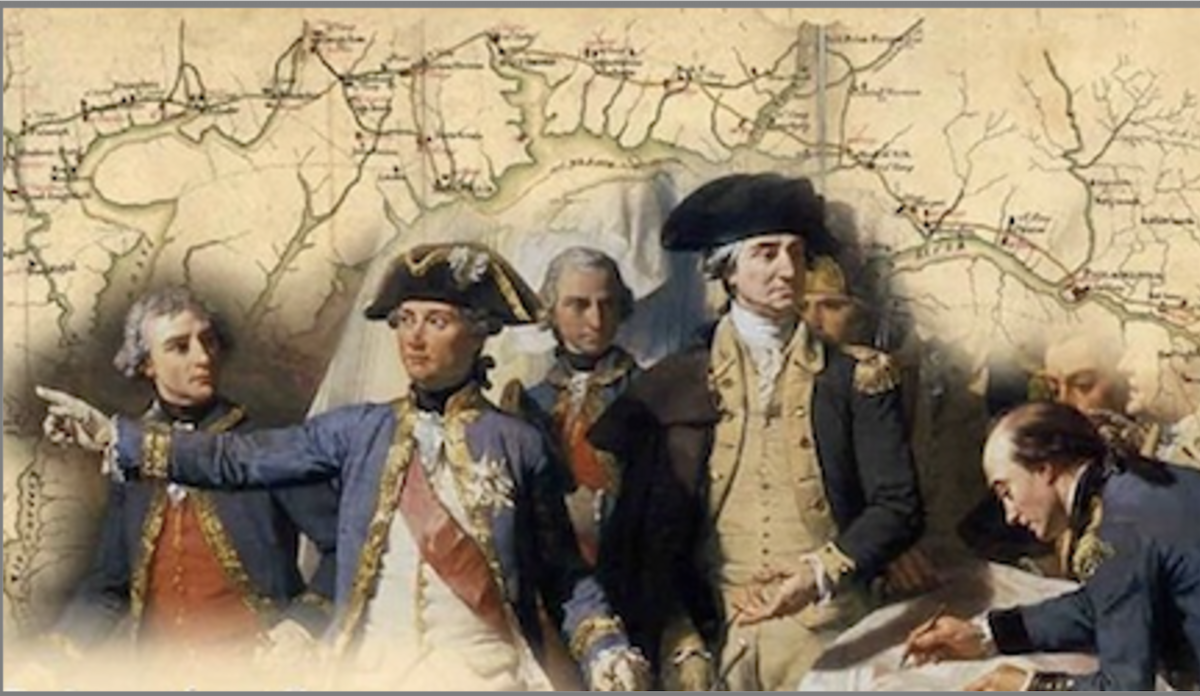
Illustration: “France joins the Cause”, National Park Service brochure and website landing page for the Washington-Rochambeau Revolutionary Route
| | |
There are dozens of plaques and information panels along the Washington-Rochambeau Revolutionary Route, designated by the U.S. Congress, from Newport, R.I. to Yorktown, VA (nearly 1,000 km).
We list only a few of them, located at the sites of their strategic conferences.
Marker “The First Meeting of Washington and Rochambeau”
At the Old State House 800 Main St, Hartford, CT 06103
GPS: 41.765883, -72.672567
• Inscription:
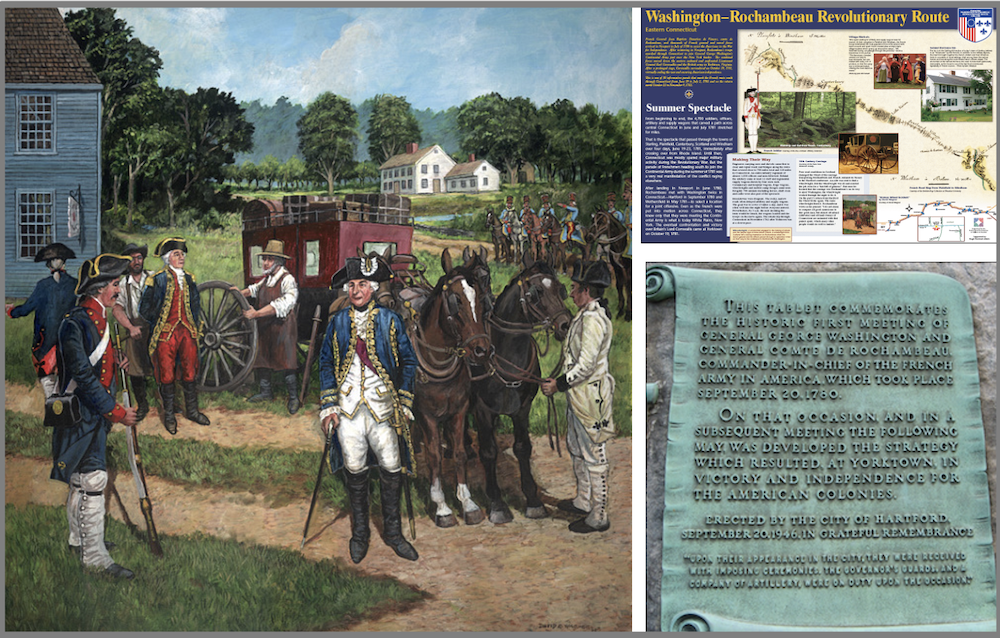
“This tablet commemorates the historic first meeting of General George Washington and General Comte de Rochambeau, commander-in-chief of the French army in America, which took place September 20, 1780.
On that occasion and in a subsequent meeting the following May, was developed the strategy which resulted, at Yorktown, in victory and independence for the American Colonies.
Erected by the City of Hartford, September 20, 1946, in grateful remembrance
"Upon their appearance in the city, they were received with imposing ceremonies. The Governor's Guards, and a company of artillery, were on duty upon the occasion."
“Erected 1946.”
| | |
• Soon after their arrival, Rochambeau, along with the admiral de Ternay and Axel de Fersen, the Sweden-born young aide-de-camp/interpreter (and a close confident of Marie-Antoinette) rushed to meet with George Washington.
• On the way to Hartford, a significant carriage incident took place near Scotland, Connecticut, when the axle of a carriage carrying Rochambeau and the Admiral de Ternay suddenly broke.
Let's let Rochambeau tell the story with his dry sense of humor:
“I will here venture to intrude on the kind attention of the reader with an anecdote, which is strikingly characteristic of the manners of the good republicans of Connecticut. The conveyance in which I proceeded to the conference, in company with Admiral de Ternay, who, by the way, was very infirm, broke down. I dispatched my first aide-de- camp, Fersen, to fetch a wheelwright, who lived about a mile from the spot where the accident occurred. He soon after returned to us , however, and informed us that he had found the man sick with the ague, and that he had positively declared to him that for his hat full of guineas he would do no work at night . I prevailed on the admiral to accompany me to the man's shop, and we repaired thither ; we told him that General Washington would arrive at Hartfort the same evening, to confer with us the following day, and that unless he could repair our carriage, we should be too late to meet him. " You are no liars, at any rate," he replied ; " for I read in the Connecticut paper that Washington was to be there to confer with you ; as it is for the public service I will take care that your carriage shall be ready for you at six in the morning. "
He kept his word ; and we proceeded on at the promised time.
As we returned, another wheel broke, and we were 'once more obliged to have recourse to our old friend. " Well ! " said he, " so you want me to work again for you at night ? " " Aye ! indeed, we do, " I replied : “ Admiral Rodney has arrived to reinforce threefold the naval forces against which we are contending, and it is of the highest importance that we should return without delay to Rhode Island to oppose him. " " But what can you do," he continued, " with your six ships against the twenty English ?" " It will be the most glorious day of our life if they attempt to break our line . " " Come, come," said he, “ you are good honest fellows ; your carriage shall be put in repair by tomorrow morning at five o'clock. But tell me,before I set to work, although I do not wish to inquire into your secrets, how did you like Washington, and how did he like you ? "
We assured him that we had been delighted with him; his patriotism was satisfied, and he kept his word. I do not mean to compare all Americans to this good man ; but almost all the inland cultivators and all the land owners of Connecticut are animated with that patriotic spirit , which many other people would do well to imitate.”
Excerpts from the "Memoirs of the Marshall Count de Rochambeau, relative to the War of independence of the United States" translated from the French by M. W. E. Wright, Esq, Paris, 1838.
• The man's name was Samuel Kirkland. This often-ignored roadside event took place along the Washington-Rochambeau Revolutionary Route, near the still-standing Huntington Homestead, a.k.a. Samuel Huntington Birthplace.
• An interpretive marker in front of the house recounts:
“The Scotland Marker”
Huntington Homestead, 36 Huntington Road, (Route CT14) , Huntington CT 06264
GPS: 41.699248, -72.085591
• Inscription:
"Poor road conditions in Scotland damaged the wheel of the carriage transporting Rochambeau and French Admiral de Ternay to the Hartford conference. An aide was sent to find a wheelwright. But the wheelwright was ill and resisted the job even for a “hat full of guineas.” But once he learned that the carriage was Rochambeau's on its way to meet Washington, the wheelwright worked through the night to fix it. On the party's return from Hartford the wheel broke again. The same wheelwright fixed it. Rochambeau wrote in his journal: "I do not mean to compare all good Americans to this good man; but almost all inland cultivators and all land owners of Connecticut are animated with that patriot spirit, which many other people would do well to imitate."
| | |
Washington and Rochambeau
at the Wethersfield Conference, CT.
May 21-22, 1781
The ties deepen
| | |
Rochambeau, an experienced and cautious military leader, felt that engaging in military operations too close to winter would endanger the position of his army. He convinced George Washington to be patient. Too many of his soldiers were in local hospitals still recovering from a long Atlantic passage, and he was waiting to receive additional promised reinforcements. This wise decision enabled the French army to acclimate itself to the country and its inhabitants.
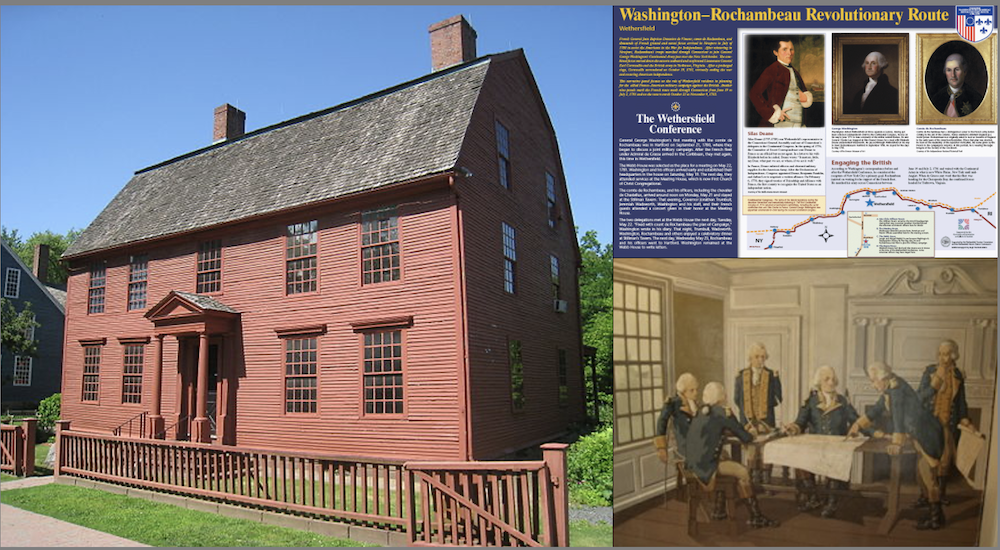
• In May 1781, Washington and Rochambeau held their second strategy meeting at the Webb House, 211 Main Street. It was agreed that De Grasse’s fleet, which had been sent by Louis XVI to the Caribbean, was critical to support any major land offensive.
• This house, now the Webb-Deane-Stevens museum, was designated a National Historic Landmark for its significance as the location of the five-day military conference.
• The Comte de Rochambeau, and his officers, including the chevalier de Chastellux, arrived around noon on Monday, May 21 and stayed at the Stillman Tavern. That evening, Governor Jonathan Trumbull, Washington and his staff, and their French guests attended a concert given in their honor at the Meeting House (now First Church of Christ Congregational)
• “Fixed with count de Rochambeau the plan of Campaign” Washington wrote in his diary...
Marker, “Joseph Webb House”
211 Main St, Wethersfield, CT 06109
GPS: 41.712064, -72.653107
• Inscription:
“Webb House
Here Washington and
Rochambeau Planned
The Campaign Ending
At Yorktown, 1781”
Marker, “The Wethersfield Conference”
At Village Tavern, 222 Main Street Wethersfied, CT 06109
GPS: 41.712570, -72.652493
• Inscription (excerpts):
“General George Washington's first meeting with the comte de Rochambeau was in Hartford on September 21, 1780, where they began to discuss a joint military campaign. After the French fleet under Admiral de Grasse arrived in the Caribbean, they met again, this time in Wethersfield…The comte de Rochambeau, and his officers, including the chevalier de Chastellux, arrived around noon on Monday, May 21 and stayed at the Stillman Tavern.
The two delegations met at the Webb House the next day, Tuesday, May 22. "Fixed with count de Rochambeau the plan of Campaign," Washington wrote in his diary. That night, Trumbull, Wadsworth, Washington, Rochambeau and others enjoyed a celebratory dinner at Stillman's Tavern…” [...] “According to Washington's correspondence before and after the Wethersfield Conference, he considered the recapture of New York City a primary goal. Rochambeau insisted on waiting for the French fleet. He marched his army across the Connecticut River between June 19 and July 2, 1781 and waited with the Continental Army in what is now White Plains, New York, until mid-August. When de Grasse sent word that his fleet was heading for Chesapeake Bay, the combined forces headed for Yorktown, Virginia.”
| | |
Washington and Rochambeau
side by side at Odell House, Greenburgh, NY
July 6 - August 19, 1781
| | |
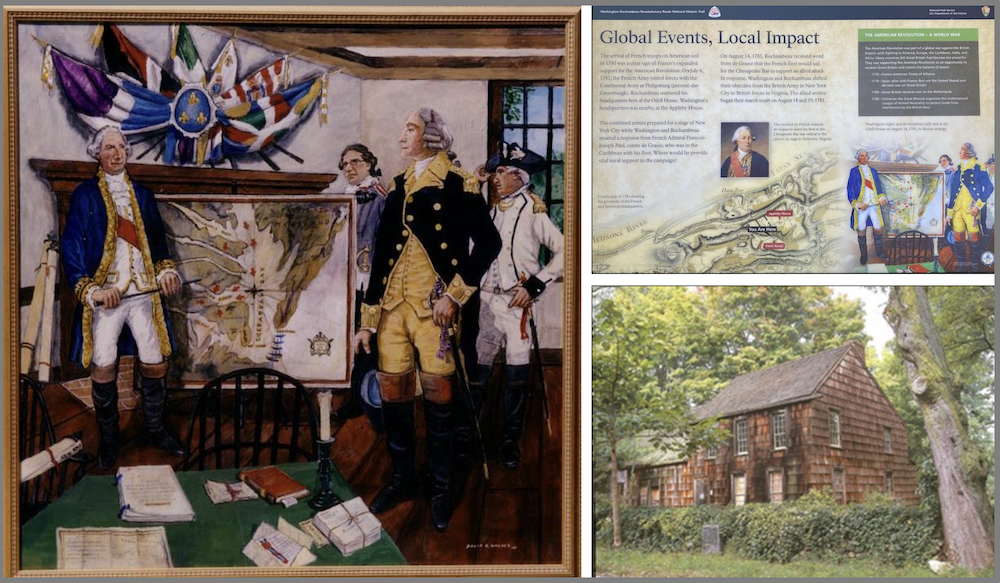
On July 6, the French army arrived at Greensburgh and set up camp next to the Continental Army. Junction of the two armies had been made at last! Rochambeau established his headquarters at Odell Farm. John Odell was a local farmer and guide for Washington. Rochambeau would stay there almost 6 weeks, while George Washington was keen on attacking New York City. Reconnaissance missions concluded that this plan would probably fail.
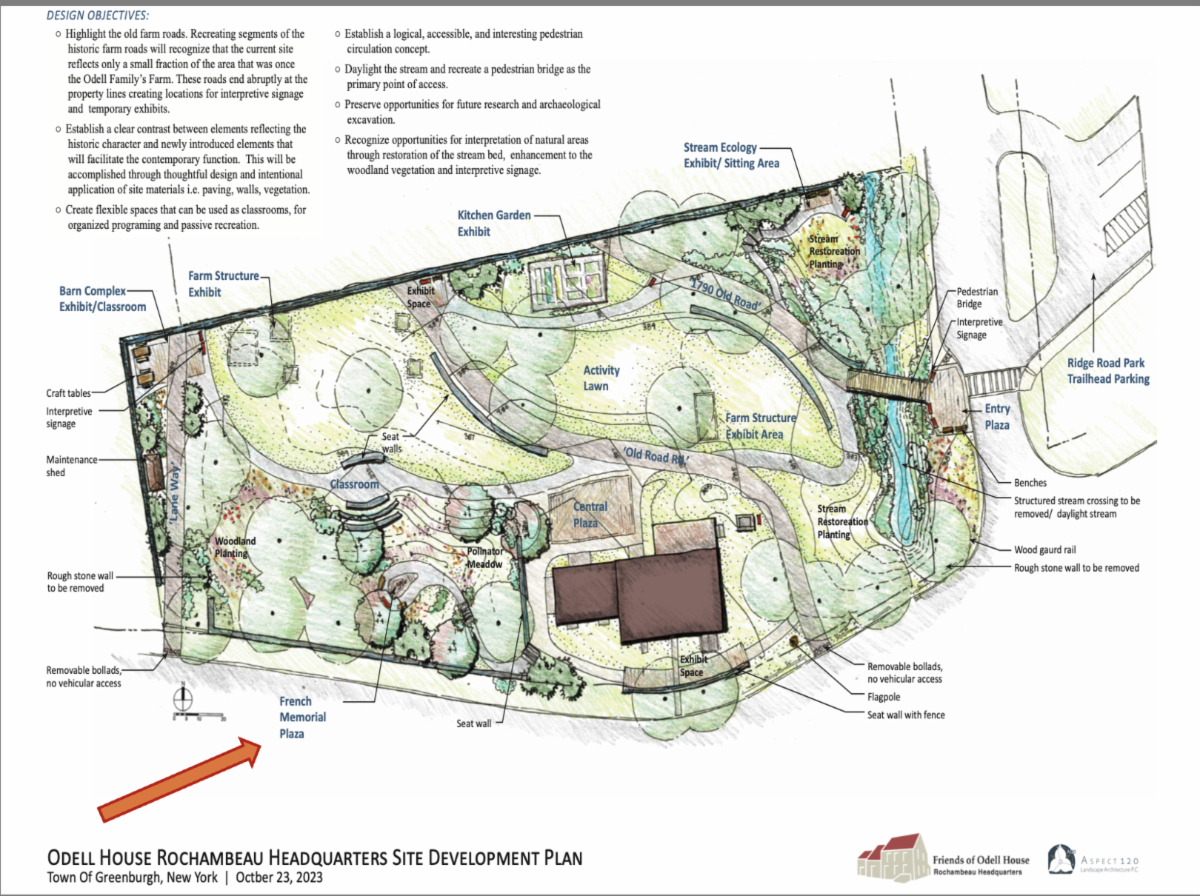
• Located 21 miles north of New York, off I87 and just south of White Plains, this farm, amazingly, survived in its quasi-original state. It is currently undergoing renovations for conversion into a museum thanks to the Friends of Odell House - Rochambeau Headquarters.
• In the painting above, Washington (left) and Rochambeau (right) met at the Odell House on August 14, 1781 to discuss strategy.
• Ultimately, Washington followed Rochambeau's recommandation to bypass New York and march instead to Yorktown.
• On Friday, 3 October 1845, a “Mrs. Churchill, born Taylor, living on the Tuckeyhoe Road near Hart’s corner,” told McDonald that she "was a girl 15 or 16 years of age in 1781 when the French army lay south of the Bates House now occupied by Jackson Odell. This house was the Head Quarters of General Rochambeau during all the time (sic) the French army was encamped on the high ground between the [Ikendahl] Allaire road and Sprain Brook on the south side of the Dobbs Ferry Road. While there General Rochambeau gave four or five large dinner parties to the French and American officers in the old barn northwest of the house which was then owned by Mr. Bates, afterwards by Colonel John Odell, and is now owned by Jackson Odell."
• A plaque was installed in 1905 on a granite rock with the seal of the Daughters of the American Revolution at the top.
• Several interpretive markers surround the property.
Odell House, headquarters of General Rochambeau
425 Ridge Rd, Hartsdale, NY 10530
GPS: 41.019507, -73.816878
• Inscription:
“The House Within Was The Headquarters,
July 6 To August 19, 1781, Of
General De Rochambeau, Commanding The French Army,
Then Posted On These Heights.
This Tablet Was Erected In 1905 “
Markers “Global Events, Local Impact”
“Path to Victory”
At Odell House, 425 Ridge Rd, Hartsdale, NY 10530
GPS: 41.019507, -73.816878
• Inscription:
“The arrival of French troops on American soil in 1780 was a clear sign of France's expanded support for the American Revolution. On July 6, 1781, the French Army joined forces with the Continental Army at Philipsburg (present-day Greenburgh). Rochambeau stationed his headquarters here at the Odell House. Washington headquarters was nearby, at the Appleby House. The combined armies prepared for a siege of New York City while Washington and Rochambeau awaited a response from French Admiral Francois-Joseph Paul, comte de Grasse, who was in the Caribbean with his fleet. Where would he provide vital naval support to the campaign? On August 14, 1781, Rochambeau received word from de Grasse that the French Fleet would sail for the Chesapeake Bay to support an allied attack.In response, Washington and Rochambeau shifted their objective from the British Army in New York City to British forces in Virginia. The allied armies began their march south on August 18 and 19, 1781.”
Inset:
“The American Revolution was part of a global war against the British Empire, with fighting in America, Europe, the Caribbean, India, and Africa. Many countries felt Great Britain had become too powerful. They saw supporting the American Revolution as an opportunity to weaken Great Britain and restore the balance of power.
1778-Franco-American Treaty of Alliance
1779—Spain allies with France (but not the United States) and declares war on Great Britain
1780—Great Britain declares war on the Netherlands
1780-Catherine the Great (Russia) organizes the multinational League of Armed Neutrality to protect trade from interference by the British Navy”
Interpretive markers installed by the National Park Service
| |
George Washington:
From military parades to social entertainment
| |
Above:
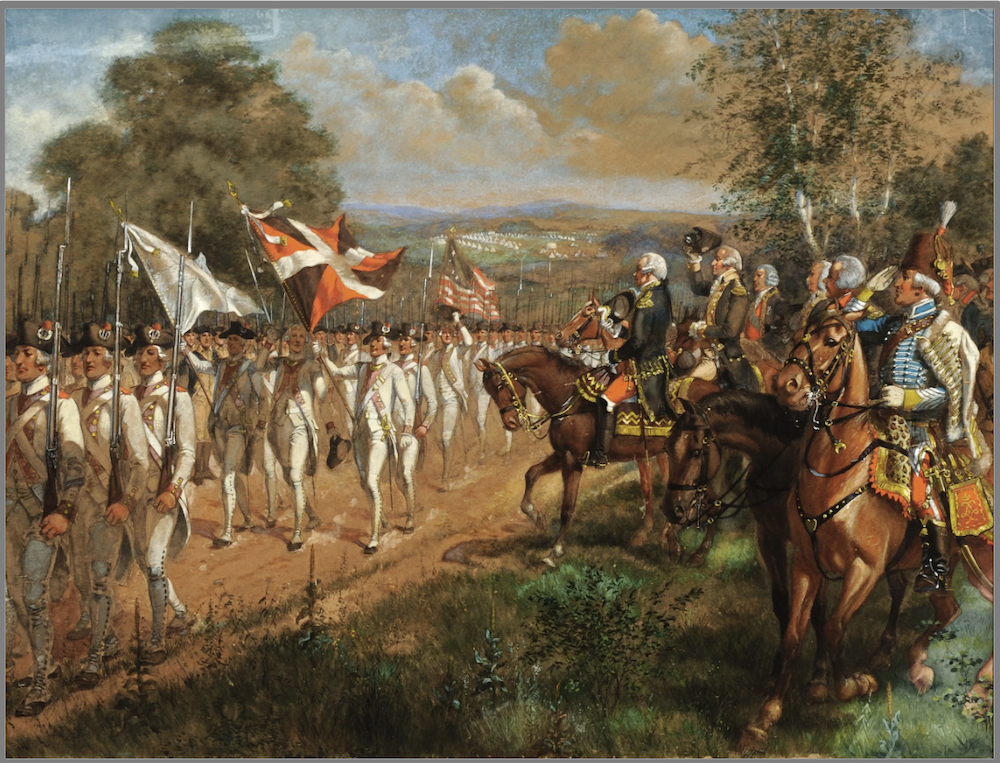
Top: Washington Reviewing Our Ally—the French—1781 gouache on paper, by Henry Alexander Ogden, 19th Century, The Society of the Cincinnati, Washington, DC.,
On July 10, 1781, a grand review was held by / Washington of the French regiments encamped near / Dobbs Ferry. / Washington with Rochambeau and the French / Minister, Luzerne, are saluting the colors of the / "Soissonnais" regiment as they pass. / Behind Washington are his generals, Lincoln / and Knox. / The Duc de Lauzun commanding the French / Hussars, is at the extreme right. https://americanrevolutioninstitute.pastperfectonline.com/webobject/E1D71C88-747B-4148-BE9E-054186270788
Middle: George Washington Receiving French Generals at Mount Vernon. Unknown author. (U.S. National Archives and Records Administration, Public Domain, https://commons.wikimedia.org/w/index.php?curid=17069740
Bottom: This 1906 painting by John Ward Dunsmore (1856-1945) represents Gen. George Washington presenting French General Rochambeau and their aides to his wife Marha, with neighboring friends in front of the house, Fraunces Tavern Museum
| |
Before and after the junction with the Continental Army at Greensburgh, NY on July 6, 1781, George Washington reviewed the troops on several occasions.
The high point was the parade of September 5th in Philadelphia in front of George Washington and the Continental Congress.
• It must have been an intense source of satisfaction for General Washington to see a splendid professional army passing in front of his eyes. All observers at the time raved about the discipline and appearance of Rochambeau's troops.
The Freeman's Journal reported on September 5th that "the appearance of these troops far exceeds any thing of the kind seen on this continent, and presages the happiest success to the cause of America."
• But George Washington did not only fulfill his military tasks. He was also a very attentive host. Markers tell us of what happened at his estate of Mount Vernon. an overjoyed George Washington, reunited to his wife Martha, whom he had not seen for six years and five months, and hastily preparing for the reception of Rochambeau and his top aides.
Incredibly, in spite of the stakes and the demands of imminent battle, while troops where marching through Delaware and Virginia or embarking at Heald of Elk to rush to the Yorktown peninsula, George Washington invited General Rochambeau and his staff to visit Mount Vernon.
Washington rode ahead of his guests 60 miles each day in two days, arriving on September 9th to prepare his estate for their visit, ....A "tour de force" for someone aged 47...
• This, however, was not just a social visit. The Allies continued their important strategy talks.
On September 12th, at 5:00AM in the morning, Washington and Rochambeau and their staff rode all day and spent the night in Fredericksburg, where Washington grew up, and continued to Williamsburg where they arrived on September 14th, meeting the Marquis de Lafayette, all hurrying to entrap Cornwallis in Yorktown.
Marker, “Washington-Rochambeau Route”, September 10, 1781
Mount Vernon, Alexandria VA 22309
GPS: 38.712024, -77.088433
• Inscription:
“General Washington, in 1781, rode 60 miles in one day from Baltimore to Mount Vernon, which he had not visited for over 6 years. General Rochambeau arrived next day with his and Washington’s staff. They spent Sept. 10 and 11 at Mount Vernon before going on to Fredericksburg.
The Marking of this Route is a gift from the French Government, Committee of the Bicentennial, 1776–1976.
Erected 1976 by the French Government, Committee of the Bicentennial.”
Marker, “The Washington-Rochambeau Route to Victory”, September 10-11, 1781
Mt Vernon Memorial Hwy &, VA-235, next to bus parking lot, Mt Vernon, VA 22309
GPS: 38.712033, -77.088400
• Inscription (excerpts):
“...Washington and Rochambeau, accompanied by a few of their staff officers, took a different route from the main army. From Baltimore, they crossed the Potomac River at Georgetown (now part of Washington, D.C.), passed through Alexandria, Virginia, and then stopped briefly at Mount Vernon, Washington’s plantation home, which he had not visited for more than six years. To prepare for his French guests, Washington rode ahead of the party and covered a remarkable 60 miles in one day. Rochambeau and the staff officers arrived the next day. The allied commanders rested at Mount Vernon on September 10 and 11...
Erected 2004 by The Virginia Daughters of the American Revolution"
| |
Tribute from Washington to Rochambeau
Washington, D.C.
| | |
Above:
Left: General Comte de Rochambeau memorial, Lafayette Square, Washington, D.C., USA. Sculptor: J. J. Fernand Hamar (1869-1943). Dedicated 1902. By Daderot - Own work, CC0, https://commons.wikimedia.org/w/index.php?curid=21105014
Right: Detail of the inscription, Photo TC © ASSFI 2023
| | |
• The statue of the American Revolutionary War hero, General Comte de Rochambeau, in Lafayette Park, Washington, D.C., erected in 1902, stands as the reaffirmation of Franco-American relations in the first years of the twentieth century.
• In June 1900, a statue of Rochambeau by French sculptor Fernand Hamar was unveiled in Vendôme, France. Yet before the erection of this statue, the French chancellor to the United States, Jules Boeufvé, had proposed that a replica of the statue be erected in Washington as well. It was cast by the Pal d'Osne foundry in France
• He presented an ideal figure to symbolize the official relations between France and the United States. Largely because of the efforts of Boeufvé, Congress provided funds and passed legislation in April 1901 authorizing Fernand Hamar to cast a replica statue for the United States.
• On May 24, 1902, President Theodore Roosevelt, members of Congress, the Diplomatic Corps, and thousands of spectators along with French military and civil delegations dedicated the Rochambeau statue at the southwest corner of Lafayette Square.
• France was represented by ambassador Jules Cambon, Admiral Fournier, and General Henri Brugère, as well as a detachment of sailors and marines from the French Navy battleship Gaulois. Representatives of the Lafayette and Rochambeau families also attended.
• George Washington's quote is inscribed in the pedestal:
Rochambeau Statue, Washington D.C.
Southwest corner of Lafayette Park, Washington D.C.
Corner of Jackson Place NW & Pennsylvania Avenue
GPS: 38.899027, -77.037711
• Inscription:
“We Have Been
Contemporaries
And Fellow Labourers
In The Cause
Of Liberty
And We Have Lived
Together
As Brothers Should Do
In Harmonious Friendship”
“Washington To Rochambeau
February 1, 1784”
By the Congress May XXIV MDCCCCII"
If, after Lafayette, Rochambeau certainly ranks second in terms of proximity and sympathy, we should not forget the high esteem that George Washington held for admiral de Grasse - - although the two only met on two occasions, and the latter never stepped foot on American soil. To wit:
| | |
Washington and admiral de Grasse
Mutual respect and friendship
| | |
Above:
Left: The Battle of the Chesapeake (1781), painting by V. Zveg from the collections of the Hampton Roads Naval Museum, Virginia, U.S., By V. Zveg (US Navy employee) - US Navy Naval History and Heritage Command: Public Domain, https://commons.wikimedia.org/w/index.php?curid=1177171
"September 5, 1781 — the Battle of the Chesapeake. Admiral de Grasse defeated the British fleet off Cape Henry, sealing Cornwallis's fate by cutting off any hope of rescue by sea. Washington later wrote that he could not express how indebted he was to de Grasse and his fleet.”
Right: Portrait of Admiral de Grasse by Jean-Baptiste Mauzaisse - Joconde, Public Domain, https://commons.wikimedia.org/w/index.php?curid=10628855/
| | |
• Admiral François Joseph Paul, Comte de Grasse, Marquis of Grasse-Tilly (13 September 1722 – 11 January 1788) is best known for his command of the French fleet at the Battle of the Chesapeake in 1781. It led directly to the British surrender at Yorktown ensuring the Independence of the United States.
• In 1779, he joined the fleet of Count d'Estaing in the Caribbean as commander of a squadron. He contributed to the capture of Grenada and took part in the Battle of Martinique (1780) against Admiral Rodney. De Grasse was promoted to lieutenant-general of the Navy (vice-admiral) in March 1781, and was successful in defeating Admiral Samuel Hood and taking Tobago.
• De Grasse responded to Washington and Rochambeau when they appealed for his aid in 1781, setting sail with 3,000 troops from Saint-Domingue. He decisively defeated the British fleet in the Battle of the Chesapeake on September 5, 1781. He drew away the British forces and blockaded the coast until Lord Cornwallis surrendered at Yorktown.
• He acted decisively, had a jovial temper, hosted George Washington for dinner on board his flagship 104-cannon “Ville de Paris”, however didn’t set foot on American soil, which maybe explain while his role, although crucial, is usually overlooked and unjustly forgotten. His statue at Cape Henry, VA, is inside a US Navy installation and difficult to visit, unfortunately.
• On September 5, 1781, the Battle of the Capes took place just off the sand dunes of Cape Henry. Local residents watched as French and English naval forces engaged in an epic sea battle.
• Thanks to Admiral François de Grasse, commander of the French fleet sent to support the American cause, the British were unable to relieve Lord Cornwallis at Yorktown. This sea battle was critical in securing America's independence from England by assuring Cornwallis was trapped at Yorktown.
| |
Above:
Left: Carte de la Partie de La Virginie ou l’armée combinée de France & des États-Unis de l’Amérique a fait prisonnière l’Armée Anglaise commandée par Lord Cornwallis le 19 Octobre 1781. Avec le plan de l’attaque d’York-town & de Glocester. Paris: Esnauts et Rapilly, ca. 1782. Geography and Map Division. Library of Congress, http://hdl.loc.gov/loc.gmd/g3884y.ar146200
Right: French Troops at Chester, Pennsylvania: Rochambeau and Washington, 1781, by H. Charles McBarron, Jr. - United States Army, Center of Military History., Public Domain
https://commons.wikimedia.org/w/index.php?curid=57581779
The painting depicts Washington waving to Rochambeau and shows a group of enlisted men from the French Soissonais Regiment, and an American and a French staff officer. General Washington and the American staff officer wear the black cockade with white center in honor of their French allies, and the French staff officer wears a white cockade with a black center in honor of the Americans.
| |
As Rochambeau took a boat down the Delaware river from Philadelphia to Chester, he saw "a very tall American Officer on shore, waving his hat, twirling a white handkerchief over his head, and capering while bellowing something indecipherable".
"...I caught sight of of General Washington waving his hat at me with demonstrative gestures of the greatest joy"...
The duke de Lauzun said "I never saw a man more thoroughly and openly delighted than was General Washington at this moment".
Another witness, Colonel Guillaume de Deux-Ponts, said: " I was surprised and affected by the great and true joy which General Washington showed. Of a natural coldness and a noble approach, which so well adorns the chief of a whole nation, his feature, his whole bearing and deportment were now changed in an instant. For the moment he put aside his character as arbiter of North America and contended himself with that of a citizen happy beyond measure at the good fortune of his country."
| | |
Plaque “Meeting of Three Commanders”
George Washington, Comte de Rochambeau et Admiral de Grasse
September 18, 1781
Lynnhaven Colony Park at 3125 Shore Drive, Virginia Beach, VA 23451
GPS: 36.910066, -76.079953
• Inscription:
“Admiral de Grasse, commander of a large French fleet, gained control of the Chesapeake Bay after defeating a British fleet off the Virginia Capes on 5 Sept. 1781. Gen. George Washington, commander in chief of the combined American and French armies, and the Comte de Rochambeau, commander of the French expeditionary army, met with de Grasse aboard his flagship near here on 18 Sept. The officers planned to entrap the British army at Yorktown. As Washington and Rochambeau left, sailors atop the masts of the French ships saluted them with running musket fire known as a feu de joie while the flagship fired its cannons. The siege of Yorktown began on 28 Sept. The British surrendered on 19 Oct.”
Erected 2019 by Virginia Department of Historic Resources”
Marker, « Amiral de Grasse, the French Navy and American Independence“
Riverwalk, 323 Water Street, Yorktown VA 23690
GPS: 37.238921, -76.508253
• Inscription (excerpts):
"George Washington on board the Ville-de-Paris
Bienvenue, mon petit général - welcome, my little general!
This is how Admiral de Grasse, 6'4" tall, greeted General George Washington, at 6'2" also much taller than most of his contemporaries, as he boarded the Ville-de-Paris.
Though the greeting may be apocryphal, de Grasse heartily welcomed Washington in the morning of September 18, 1781. Washington, accompanied by the Comte de Rochambeau, the Chevalier de Chastellux and Generals Henry Knox and Presle Duportail had come to plead with de Grasse to stay beyond the deadline of October 15. Washington received the answer he had hoped for. De Grasse would stay until the end of October."
| | |
Tribute to Admiral de Grasse
Yorktown, VA.
| | |
Above:
Left: Monument to the Alliance & Victory, Yorktown, VA, erected by Congress in 1881
Inset: Admiral de Grasse's flagship Ville-de-Paris is carved at the west frontispice
Right: Bronze plaque on the ground, located a few feet near the column
Photos: TC © ASSFI 2021
| | |
Marker, « In memory of the men of the French Fleet »
A few feet near the Monument to the Alliance & Victory, Yorktown, VA
GPS: 37.233462, -76.504745
• Inscription (bold characters by us):
“In memory of the men of the French Fleet who died in the naval phase of the Yorktown campaign in the Battle off the Virginia Capes on 5 September 1781.
In appreciation of the service of Admiral François Joseph Paul de Grasse who brought his entire West Indies Fleet to the aid of the Americans, who transported more than 3000 French troops under the command of the Marquis de Saint-Simon to reinforce the land Forces, and who commanded the French Fleet in the battle off the Virginia Capes, defeating a squadron of the British Royal Navy under Admiral Thomas Graves. General George Washington called French naval superiority “the pivot upon which everything turned” as the French victory prevented General Earl Cornwallis from aid or escape by sea and allowed a smaller French Fleet from Newport under Commodore de Barras to enter the Cheasapeake Bay with siege guns essential in the land battle that followed. In commemoration of the bicentennial of this most important naval battle fought in American waters which assured the victory at Yorktown and American Independence.
This tablet is erected by The National Society Daughters of the American Revolution October 19, 1981”
| | |
Statues of George Washington,
de Grasse, Lafayette and Rochambeau
Yorktown, VA
| | |
Above:
Left: Statues of the artisans of the victory at Yorktown: Washington, Rochambeau, de Grasse, Lafayette
Photos: TC © ASSFI 2021
| | |
• A few days before the British surrender, Washington wrote: "I cannot but acknowledge the infinite obligations I am under to his Excellency, the Count de Rochambeau, the Marquis de Saint-Simon, commanding the troops from the West Indies, the other general officers, and indeed the officers of every denomination in the French army, for the assistance which they afford me. The experience of many of those gentlemen in the business before us is of the utmost advantage in the present operation.... The greatest harmony prevails between the two armies. They seem actuated by one spirit, that of supporting the honor of the allied armies."
Letter to to Thomas McKean, "Before York", 12 October 1781
This tribute is personified by these 4 statues:
• The statues standing at Riverwalk Landing were only two when inaugurated in 2005: General George Washington, Commander of the American forces and Admiral Francois DeGrasse, Commander of the French Fleet. A bronze plaque at the foot indicated that "While Washington and de Crasse were closely linked by their leadership roles, they met only twice. Both meetings were held on de Grasse's flagship, Ville de Paris. The first was on September 20, 1781 to complete planning for the attack on Yorktown and the other was on October 21, 1781, after Cornwallis surrender on October 19, 1781, to explore future operations in the south."
• On October 18, 2017, General Lafayette joined them, and on October 18, 2021, Comte de Rochambeau joined his comrades-in-arms and the conversation for eternity.
• The display was celebrated as a symbol of French and American friendship that several people.
• Cyd Player, is a Williamsburg-based artist who sculpted the four statues.
• The American Friends of Lafayette led the fundraising for the statue and credited the Celebrate Yorktown Committee for being the top donor. The Massachusetts Society of the Cincinnati and members of the Ordre Lafayette contributed as well.
Marker “Four Heroes of Yorktown”
Riverwalk Landing, sidewalk along Water Street, Yorktown, VA
GPS: 37.238536, -76.508676
• Inscription:
“Although these four great leaders never stood altogether as represented here, each of them rendered critical and significant contributions ot the decisive Franco-American victory at Yorktown in October 1781 that led to American independence. Since late April 1781, General Lafayette, with a modest force of Continental soldiers and Virginia militia, had defended Virginia from the worst ravages of a British invasion and closely followed the British into the area around Yorktown. When the French fleet under Comte de Grasse arrived of the Virginia coast in late August bringing French troops as reinforcements to Lafayette's forces, British General Lord Cornwallis and his army found themselves surrounded, but Lafayette needed more soldiers to lay siege to the British fortifications. General George Washington and the Comte de Rochambeau had marched south from New York with a combined French and American army of over 6,000 men* to join Lafayette's carefully positioned troops. On September 5, Admiral de Grasse defeated a British naval force off the Chesapeake Bay, blocking any Royal Navy support from reaching Cornwallis. On September 18, Washington and Rochambeau, accompanied by their staff officers, conferred with de Grasse on his flagship the Ville de Paris to discuss plans for the siege. The arrival of the main allied armies in Williamsburg on September 26 closed of Cornwallis' escape route on land. Cornwallis was trapped. That same day Washington sent Lafayette to de Grasse to finalize the French Fleet's role in the siege and the positioning of his vessels in the bay to establish the siege ring on water. The final meeting between de Grasse and Washington occurred on October 21, when the general, accompanied by Lafayette, boarded the Ville de Paris to express his gratitude and to make an unsuccessful attempt to persuade de Grasse to engage in naval operations off the coast of the Carolinas. The leadership, foresight, sacrifice, and courage of these four men and the soldiers and sailors under their command led to recognition of the national independence that Americans had so boldly declared in July 1776.” Erected 2021 by York County."
| | |
Tribute to Admiral de Grasse
Fort Story, VA
| | |
Above:
Left: Statue of French fleet commander Admiral de Grasse, a gift of the French government
Photo credit: Colonel Mathieu Brulais, French Army (2022)
Right: granite memorial depicting the naval victory of the French Navy, with quotes from Gen. George Washington and admiral de Grasse at its base, National Public Gallery, Public Domain https://npgallery.nps.gov/
| | |
Marker, “Battle of the Capes”, Cape Henry, VA
600 Atlantic Ave, Virginia Beach VA 23459
(Located inside Fort Story Military Reservation in Virginia Beach, VA. Parking lot - corner of Atlantic Avenue and New Guinea Road
GPS: 36.928295, -76.00903
• Inscription:
"…I wish it was in my power to express to Congress how much I feel myself indebted to the Count de Grasse and his fleet…"
G. Washington Oct 19, 1781
"…I consider myself infinitely happy to have been of some service to the United States …reserve me a place in your memory …"
de Grasse Nov. 3, 1781”.
| | |
Honoring admirals de Grasse and d'Estaing
Washington, D.C.
| | |
Above:
Left: Statue of Lafayette and his Compatriots, Photo National Park Service, Public Domain
Right: Detail of the statues of Admiral de Grasse and d'Estaing, Admiral de Grasse (Left) and Admiral d’Estaing (Right). Photo by Slowking4 - Own work, Public Domain,
https://commons.wikimedia.org/w/index.php?curid=13257245
| | |
At the other corner of Lafayette Park stands this monument, erected by Congress to honor Lafayette and his French compatriots. The park itself — directly facing the White House — is a permanent, symbolic acknowledgment of the French contribution to American independence.
Statues of Admiral d’Estaing and Admiral de Grasse
(at the base of the statue, "Lafayette and his compatriots"
Southeast corner of Lafayette square
Pennsylvania Ave NW &, 16th Street Northwest, Washington, DC 20001
GPS: 38.8988889,-77.0352778
• The East and West faces have pairs of bronze statues of French military figures associated with the American Revolutionary Wars.
• The East face has statues of Comte de Grasse and Comte d’Estaing in military uniform, conversing, with an anchor symbolizing their command of French naval forces.
• When the installation of the statue was completed in April 1891, there were no funds left to hold a dedication ceremony. For many years, the Sons of the Revolution laid a wreath on Lafayette's birthday, September 6; and the 200th anniversary of Lafayette's birth was celebrated in 1957.
• The statue is listed on the National Register of Historic Places.
| |
The Society of the Cincinnati
13 Chapters and the French branch
| |
Above:
Left: Bataille de Yorktown, by Auguste Couder, 1836 - Galerie des Batailles, Château de Versailles - Rochambeau stands at the center, gesturing to his right, seemingly addressing Col. Christian de Deux-Ponts—the French officer dressed in white on the left. To the left of Deux-Pont, holding his hat, is Maj. Gen. Louis Duportail, a French volunteer who is the senior engineer in the Continental Army. Washington is positioned to Rochambeau’s left, with the two men standing closely together. Behind and between them is the marquis de Saint-Simon, a French general. Lafayette is located behind Washington’s left side. On the right, the marquis de Chastellux—who acted as a liaison between the French and American forces—examines a map. All these officers will become members of the Cincinnati.Public Domain, https://commons.wikimedia.org/w/index.php?curid=7029460.
Right: Badge of the Society, c. 1783. By JNUORTEVA - Own work, CC BY-SA 4.0, https://commons.wikimedia.org/w/index.php?curid=46975042
Note the colored stripes of Rochambeau's tent and the ribbon of the badge...
| |
The Society of the Cincinnati
The Society of the Cincinnati is a fraternal and hereditary organization established in 1783 to honor the American Revolutionary War and the formation of the United States and is the nation's oldest patriotic organization.
Its founding document, known as the Institution, was adopted on May 13, 1783, in Newburgh, NY. The Society was created to maintain the memory of American Independence, to safeguard the rights and freedoms of humanity, and to ensure lasting friendship among the officers of the Continental Army who fought in the Revolutionary War.
Membership
Initially, membership was mostly restricted to officers who had served in the Continental Army or Navy for a minimum of three years, or who served until the war concluded. It also encompassed officers from the French Army and Navy of specific ranks. The institution specified that the Society “does itself the honor to consider” as members the following officials and officers: “His Excellency The Chevalier De la Luzerne, Minister Plenipotentiary; His Excellency The Sieur Gerard, late Minister Plenipotentiary; Their Excellencies, The Count D’Estaing, The Count De Grasse, The Count De Barras, The Chevalier Des Touches, Admirals and Commanders in the Navy; His Excellency The Count De Rochambeau, Commander in Chief – and The Generals and Colonels in his Army.”
Leadership
George Washington was elected the first President General of the Society, serving from December 1783 until his death in 1799.
The French Branch
It was at the initiative of George Washington that the French branch was established. Lafayette announced the formation of the Society in the December 23, 1783, edition of La Gazette de France. The French Society of the Cincinnati was formally authorized on July 4, 1784 by King Louis XVI.
Vice Admiral d'Estaing served as its first president until the branch was disbanded in 1792 (the French branch resurrected in 1923).
For officers of regiments sent by the King of France after 1778, eligibility required proof of service. Not knowing where to submit their applications, many wrote directly to General Washington - again more headaches! - or other American figures, who were quickly overwhelmed as they had no records to verify these requests. Once the French branch was established, it took over responsibility for handling all such applications.
Today
The Society includes thirteen member societies in the United States and one in France, continuing the brotherhood between descendants of the original officers of both nations.
Badge of the Society of the Cincinnati
The idea of using the bald eagle as Cincinnati's symbol came from Major Pierre L'Enfant, a French officer who joined the American Army in 1777 who would design years later the layout of the new Federal capital, Washington, D.C.
L'Enfant served in the Corps of Engineers and was one of the Society's first members.
He noted that "[t]he Bald Eagle, which is unique to this continent, and is distinguished from those of other climates by its white head and tail, appears to me to deserve attention."
In 1783, L'Enfant was tasked with going to France to create the first eagle badges based on his design, made by Parisian jewelers.
A one-of-a-kind diamond-studded "eagle", known as the "Diamond Eagle", was presented to George Washington by Admiral Comte d'Estaing on behalf of the French Navy officers. Washington accepted it on May 11, 1784, during a meeting of the General Society in Philadelphia. Since then, it has been the official symbol of the Society's president and is passed on when a new president assumes the role.
| |
Postwar years
Continued friendship and correspondence
| | |
Above:
Washington and Lafayette at Mount Vernon, 1784 (The Home of Washington after the War) oil on canvas by Thomas Pritchard Rossiter (1818–1871) and Louis Remy Mignot (American, Charleston, South Carolina 1831–1870 Brighton)1859, The Metropolitan Museum of Art, Public Domain
https://www.metmuseum.org/art/collection/search/11957
| | |
After the war, like Cincinnatus and his plow, George Washington returned to his beloved estate at Mount Vernon.
His correspondence with his French friends, among them Rochambeau, Ambassador La Luzerne, and Chastellux, never stopped. Washington kept his French friends informed about the country's progress and his aspirations for its greatness.
George Washington would also continue to answer all sorts of requests from French officers asking for certificates of service and the like (a continued headache!).
• His correspondance with François-Jean de Beauvoir, Marquis de Chastellux, Major General who served as liaison between Rochambeau and Washington is particularly interesting in revealing George Washington's surprising range of emotions. Visit the Mount Vernon online page to judge by yourself. The Marquis de Chastellux had been long half-forgotten until Dutch historian Iris de Rode discovered a trove of manuscripts in the castle of the Marquis' descendants in Burgundy.
• Correspondance with Rochambeau continued for many years, although the turn of events taken by the French Revolution interrupted their exchanges.
Upon leaving the United States, Washington wrote:
In his letter of farewell to Rochambeau, in mid-December 1782, Washington expressed “of the happiness I have enjoyed in our private friendship. The remembrance of which will be one of the most pleasing Circumstances of my life.” Rochambeau replied similarly, recognizing their friendship and assuring Washington of his “most inviolable personal attachment & respect.”
In one of his last letters in 1790, after the French Revolution started, Rochambeau wrote: " “Do you remember, my Dear general, the first repast we made together". “The soup,” you remarked, showed “the difference of the character of our two nations, the french in burning their throat, and all the Americans waiting wisely of the time that it was cooled. I believe, my dear general, you have Seen” in the past year "that our nation has not changed character. We go very fast – God will that we come at our aims.”
• Of all his correspondents, none exchanged more letters with Washington than Lafayette, who came back to visit him in 1784 (illustration above). At the end of his five-month return visit to the United States, Lafayette visited George Washington at Mount Vernon, and was so moved to see his old general, friend, and mentor that he wrote to his wife saying he was 'reveling in happiness'.
For the first time, the two men could simply enjoy each other's company without the stress of war — talking, sharing memories, and relaxing together in the quiet of the countryside. Lafayette wrote to his wife : “I assure you that in retirement General Washington is even greater than he was during the Revolution.”
• When they said goodbye on November 28, 1784, both men sensed it was probably for the last time. Washington was 52 and Lafayette was just 27. They continued to write letters and send each other gifts for the rest of Washington's life, but they never met again.
"My Dr Mrqs, ...In the moment of our separation, upon the road as I travelled, and every hour since, I have felt all that love, respect, and attachment for you which length of years, close connection, and your merits have inspired me. I often asked myself, when our carriages separated, whether that was the last sight I should ever have of you. And though I wished to say, no, my fears answered, yes. I called to mind the days of my youth and found they had long since fled, to return no more; that I was now descending the hill I had been fifty-two years climbing, and that, though I was blessed with a good constitution, I was of a short-lived family and might soon expect to be entombed in the mansion of my fathers. These thoughts darkened the shades and gave a gloom to the picture, and consequently to my prospect of seeing you again. But I will not repine; I have had my day."
Letter to Lafayette, December 8, 1784
• In 1824, Lafayette came back to the United States for his triumphal Farewell Tour as "Guest of the Nation". He went to Mount Vernon to honor George Washington. Lafayette meditated for an hour at Washington's tomb, and came back to his group with tears in his eyes.
| | |
George Washington and
the French Revolution:
An increasing distaste
| |
|
Above:
Left: Road marker, located at 688 Columbia Turnpike, East Greenbush NY 12061
GPS: 42.588533, -73.699517
Right: Edmond Charles Genet (1763-1834), by Adolf Ulrich Wertmuller, ca. 1784, Bequest of Nancy Fuller Genet, [1978.6.1]. Courtesy Albany Institute of History & Art. https://www.albanyinstitute.org/collection/details/edmond-charles-genet-1763-1834-alt
| |
If at first George Washington seemed to welcome the French Revolution (during its initial phase, evolution from absolute monarchy to constitutional monarchy), soon after its radical turn, the execution of Louis XVI, and the ensuing Reign of Terror, reprobation, and revulsion were in order.
Diplomatic incidents between the two republics soon started. The most famous episode is the "Genêt Affair", named after the then French Ambassador to the United States.
• Edmond-Charles Genêt, born on January 8, 1763, and died on July 14, 1834, was a French diplomat later known as Citizen Genêt.
• Genêt was born in Versailles in 1763. His father worked as a chief clerk in the foreign affairs ministry. By the age of 12, Genêt was a remarkable talent, a child prodigy able to read French, English, Italian, Latin, Swedish, Greek, and German! At 18, he became a court translator, and by 1788, at just 25, he was sent to Saint Petersburg as ambassador to Russia.
• Despite his meteoric rise principally based on merit, Genêt grew disillusioned with the old regime. He began to dislike not only the French monarchy but also all monarchies, including Czarist Russia under Catherine the Great. In 1792, Catherine declared him persona non grata, stating that his presence was "not only unnecessary but even intolerable." That same year, the Girondins took power in France and appointed Genêt as the minister to the United States.
• The "Citizen Genêt affair" started in 1793 when he was sent to the United States to gain support for France's conflicts with Spain and Britain.
Genêt reached Charleston, South Carolina, on the French ship Embuscade on April 8. Instead of going to Philadelphia to meet President George Washington, Genêt chose to stay in South Carolina. The people of Charleston welcomed him warmly, hosting several celebrations in his honor. In South Carolina, Genêt aimed to recruit and equip American privateers to assist French missions against the British. He commissioned four privateering ships: the Républicaine, the Anti-George, the Sans-Culotte, and the Citizen Genêt. Collaborating with French consul Michel Ange Bernard Mangourit, Genêt organized American volunteers to combat Spain's allies in Florida. After forming a militia, Genêt set off for Philadelphia, making stops to gather support for the French cause, and arrived on May 16.
• His actions put American neutrality at risk during the conflict between France and Britain, which Washington had clearly stated in his Neutrality Proclamation on April 22. When Genêt met with Washington, he requested a halt to American neutrality to aid France. After being rejected by Secretary of State Thomas Jefferson and told that his actions were not acceptable, Genêt objected. At the same time, Genêt's privateers were seizing British vessels, and his militia was getting ready to act against the Spanish.
• Genêt kept ignoring the United States government's requests, seizing British ships and turning them into privateers. In response, Washington wrote a lengthy complaint letter, following the advice of Jefferson and Hamilton. This was one of the rare times that Federalist Hamilton and Republican Jefferson saw eye to eye. Genêt stubbornly replied to the letter. As a result, President Washington and his Cabinet insisted that France recall Genêt as its Ambassador.
• By January 1794, the radical Mountain faction had taken control from the Girondins in France and issued an arrest warrant for Genêt. Fearing execution by guillotine, Genêt sought asylum from Washington. Hamilton, who was strongly against Genêt, persuaded Washington to allow him to stay safely in the United States. He lived a long life in upstate New York until 1834, living the life of a prosperous gentleman farmer and author, often keen on voicing his opinion on US foreign policy.
The "XYZ Affair" and Quasi-War:
George Washington was no longer President when the two nations went to the brink of war.
The XYZ Affair was a diplomatic scandal that took place in 1797-1798, during the early years of the American republic. After years of tensions between the United States and France — largely stemming from America's decision to sign the Jay Treaty with Britain — the government of the French republic began seizing American merchant ships. President John Adams sent three diplomats to Paris to negotiate a solution and ease the growing crisis. However, instead of being welcomed into formal talks, the American envoys were approached by three anonymous French agents (referred to in dispatches simply as "X," "Y," and "Z") who demanded a large bribe and a loan to France just to get a meeting with the French Foreign Minister, Talleyrand.
The Americans refused, and when Adams reported the incident to Congress and the public, it caused outrage across the country. The phrase "Millions for defense, but not one cent for tribute!" became a rallying cry, capturing the national mood of indignation. The affair pushed the two countries into an undeclared naval conflict known as the Quasi-War. The crisis was eventually resolved through diplomacy in 1800.
• George Washington left the presidency in March 1797, and it was his successor, John Adams, who had to deal with both the XYZ Affair and the Quasi-War with France. Washington was retired at Mount Vernon during this period, though he was briefly called out of retirement in 1798 when Adams appointed him to lead a provisional army in case the conflict with France escalated into a full-scale war. So while Washington was no longer president, he wasn't entirely removed from the situation either — just no longer the one in charge...
| |
French Hommages to George Washington
Made French Citizen
August 22, 1792
Solemn Requiem at the Invalides
February 8, 1800
10 Days of national mourning
| |
Above:
Left: Law of the Assemblée Nationale naming George Washington a French Citizen along with others, notably Thomas Paine (who was later elected at the Convention Nationale)
Right: View of the National Legislative Assembly sitting in the Riding Hall on August 10, 1792, by Louis-Joseph Masquelier (1741–1811), Musée Carnavalet, Paris, Public Domain, https://commons.wikimedia.org/w/index.php?curid=90878424
| |
George Washington never travelled to France, yet he was extraordinarily popular there from 1776 onwards. His name had become synonymous with the fight for Liberty and the Independence of the United States.
After the American Revolution, the Marquis de Lafayette returned to France filled with admiration for the man he considered both a mentor and a surrogate father, and repeatedly invited Washington to come and visit. Washington declined — the risk of capture by British ships was likely the main deterrent in the early years, and once he had been elected President, the idea of such a long sea voyage was simply out of the question.
Yet the two men maintained their extraordinary bond across the Atlantic through a rich and voluminous correspondence, keeping each other informed of the momentous events unfolding on both sides of the ocean.
George Washington made a French Citizen in 1792:
On August 26, 1792, during the early stages of the French Revolution, the National Assembly of France granted honorary French Citizenship to "men who, through their Writings and their Courage, have Served the Cause of liberty and prepared the freedom of the people."
"The National Assembly,
Believing that men who, through their writings and their courage, have served the cause of liberty and prepared the liberation of peoples, cannot be considered foreigners by a Nation that enlightenment and courage have made free.
Believing that five years of residence in France suffice to obtain for a foreigner the title of French Citizen, this title is much more justly due to those who, wherever they may reside, have dedicated their arms and their vigilance to defending the cause of peoples against the power of kings, to banishing prejudices from the earth, and to pushing back the boundaries of human knowledge.
Wheras, while it is not permissible to hope that men will one day form, before the law as before nature, but a single family, a single bond, the friends of liberty and universal brotherhood should be no less dear to a Nation that has proclaimed its renunciation of all conquests and its resolve to fraternize with all peoples.
Wheras, finally, that at the moment when a National Convention is about to establish the destinies of France and perhaps prepare those of humankind, it belongs to a generous and free people to call upon all enlightened minds and to dedicate the right to contribute to this great endeavor of reason to men who, by their sentiments, their writings, and their courage, have shown themselves so eminently worthy.
Declares that the title of French citizen is conferred upon Doctor Joseph Prieftley, Thomas Payne (sic), Jeremy Bentham, William Wiberforce, Thomas Clarkfon, Jacques Mackintosh, David Williams, N. Gorani, Anacharlis Cloots, Corneille Pauw, Joachim-Henri Campe, N.Pefalozzi, Georges Washington, Jean Hamilton, N. Maddifion, H. Klopftock, and Thadées Kolinsko."
• A rarely mentioned historical footnote: the American flag — a powerful symbol of freedom and republican ideals to French revolutionaries — was displayed in the hall where the National Convention met in Paris, a silent but eloquent tribute to the inspiration France had drawn from the American Revolution.
| |
Above:
Left: The Cathédrale Saint-Louis-des-Invalides, part of Les Invalides as seen from south, the beginning of the Esplanade du Souvenir Français, 75007 Paris, By Daniel Vorndran / DXR, CC BY-SA 3.0, https://commons.wikimedia.org/w/index.php?curid=31548206
Right: Nave of the Cathedral, where a solemn Requiem service for George Washington was ordered by First French Consul Napoléon Bonaparte. Photo: TC © ASSFI 2024
| |
Solemn Requiem mass at the Invalides
• A requiem service and eulogy in honor of George Washington was delivered on February 8, 1800 (19 Pluviôse, Year VIII) at the Temple of Mars (Hôtel des Invalides) in Paris, in the presence of Napoléon Bonaparte, then First Consul. This was a symbolic ceremony of homage organized by France.
• On February 9, 1800, Napoléon Bonaparte ordered all French army flags and standards draped in black for ten days and a ten-day period of national mourning: "Washington is dead. This great man fought tyranny. He established on a safe basis the liberty of his country. His memory will ever be dear to the French people as well as to all the free men of the two worlds, and especially to French soldiers, who, like himself and the American soldiers, fight now for equality and liberty."
• Excerpts from the eulogy pronounced by Louis de Fontanes, French poet and politician (1757-1821), President of the Empire Legislative Chamber (1804-1810):
(translated from the French)
"France, which has always been great and generous enough to welcome foreign virtues and glory without fear or jealousy, pays public homage to the memory of Washington. She is at this moment settling the debt of both worlds. No government, whatever its form or opinion, can refuse respect to this founder of liberty....
The mourning that the First Consul ordered for Washington signaled to France that the examples he had set were not lost....
What Frenchman, endowed with a vivid imagination, does not recall with rapture the first moment when fame announced that liberty was raising its banners among the peoples of America? The old world, bowed under the weight of the vices and calamities that plagued its old age, rediscovered some enthusiasm and turned its eyes toward those distant lands where a new era seemed to be beginning for humankind. Then all hopes were for liberty; and these very hopes manifested themselves even in palaces and on thrones. The seas of Europe were astonished to bear royal fleets that flew to the defense of the republicans of America.
O time of the sweetest hopes! O memories of our early youth! With what anxiety we then questioned all the navigators arriving from the ports of Charles Town and Boston! How we pitied the setbacks of those brave American militias, whom their disasters, their weariness, and their needs never discouraged! How all our hopes joined with Washington's first triumphs! Was not Franklin, the wise negotiator who aided him in such a noble cause, surrounded by our homage when he came to demonstrate in Paris, and even in Versailles, the noble simplicity of republican values? He lived on the banks of the nearby river, opposite the place where we are gathered. Several of you, like me, saw the venerable countenance of this old man, who resembled the ancient Scythian legislator, traveling in Athens...
Their two names, so often intertwined in the same praises during their lives, should not be separated after their deaths. If Franklin's soul returns to wander these shores he long cherished, it will surely applaud the honors Washington receives from us...
It is to the warriors around me, to them alone, that Washington will determine his place among the illustrious captains. His successes seemed to possess more solidity than brilliance, and judgment prevailed over enthusiasm in his command and combat. Moreover, the military feats performed by the French troops have diminished the renown of all those who distinguished themselves in the same field... But Washington offers us other examples no less worthy of emulation. Amidst all the disorder of the camps and all the excesses inseparable from civil war, humanity took refuge in his tent and was never driven away. In triumphs and in adversity, he was always calm as wisdom and simple as virtue. Gentle affections remained in the depths of his heart, even in those moments when the interests of his own cause seemed to somehow legitimize the laws of vengeance...
With what compassionate care did Washington not delay a judgment that the laws of war permitted him to hasten! He waited until a then all-powerful voice[1] crossed the vastness of the seas and begged for a pardon he could not refuse. He was easily moved by this voice, which resonated with the promptings of his heart, and the day that saved an innocent victim must be inscribed among the most glorious of independent and victorious America...
There are prodigious men who appear, at intervals, on the world stage with the character of grandeur and dominion. An unknown and superior cause sends them, when the time is right, to found the cradle or to repair the ruins of empires...
But it was in vain that he relinquished first place: the first name of America was still that of Washington...
It was France's duty to be the first to respond to this mournful cry, which must resound in all great souls. These majestic vaults were fittingly chosen for the apotheosis of a hero..."
[1] He refers to Marie-Antoinette, who had pleaded personally and successfully to George Washington for the grace of British Captain Asgill, who had received a death sentence.
• In the middle of the nave stood a bust of Washington, surrounded by flags and laurels. The scene echoed an earlier moment across the Atlantic: in Independence Hall in Philadelphia, the flags captured at Yorktown had been ceremonially placed at the feet of the President of Congress and the French minister, Gérard de Rayneval. Now, in Paris, Général Lannes — who would later become one of Napoleon's most celebrated marshals — stepped forward and laid 96 flags seized from the armies of Europe before the bust of the man honored by the French Republic.
| |
Statues of George Washington
in Paris
| |
Above:
Left: Equestrian statue of George Washington in Paris. By Szilas - Own work, CC BY-SA 4.0, https://commons.wikimedia.org/w/index.php?curid=158092235
Right: Statue of Washington and Lafayette by Auguste Bartholdi. Bronze, 1890. Place des États-Unis, Paris. By Bustahump8001 - Own work, Public Domain, https://commons.wikimedia.org/w/index.php?curid=3563214
A replica is at Morningside Avenue, New York. Our Society laid a wreath at its pedestal upon the Bicentennial of Lafayette's Farewell Tour, on September 14, 2024.
| |
• A decree to erect a statue was prepared by Talleyrand, noting that "this nation which is sure to be one day a great nation, and is even now the wisest and happiest in the world, and which mourns for the death of the man who did more than any, by his courage and genius, to break her shackles and raise her to the rank of independent peoples.... One of the noblest lives which have honored mankind has just passed into the domain of history...."
Due to the vicissitudes of war and political upheaval, it would take nearly a century before a statue of Washington was finally erected in Paris — this time by the Americans themselves.
• "General George Washington" is a bronze equestrian statue created in 1900 by American sculptors Daniel Chester French and Edward Clark Potter. It is situated in the center of Place d'Iéna in the 16th arrondissement of Paris.
George Washington was sculpted by French, while the horse was crafted by Potter. It was unveiled on July 3, 1900, marking 125 years since General Washington assumed command of the Continental Army in Cambridge, Massachusetts, on July 3, 1775.
• This statue was a gift from the women of America and was presented to the city by the Daughters of the American Revolution.
• Inscription in French:
"Offert Par Les Femmes des États Unis d'Amérique en Mémoire de L'amitié et de L'aide Fraternelle Données par la France à leurs Pères pendant leur Lutte pour L'indépendance"
("Presented by the Women of the United States of America in Memory of the Friendship and Fraternal Aid Given by France to their Fathers during their Struggle for Independence")
| | |
Above:
Left: The "Flag of the Alliance" was flown in the United States 1781 and 1782, with the French fleur-de-lys adorning the 13 stars of the 13 Colonies.
Below: The portraits of Washington and Lafayette are imbedded on the wall on each side of the Speaker of the House at the U.S. Capitol — a symbolic, permanent partnership. Two commanders, two nations, one shared cause. The story of American independence is, at its heart, a Franco-American story.
| | |
A great article by Robert Middlekauff published on line at MountVernon.org is titled: "How Washington Won Over the French". As you have seen in the pages above, we would respectfully submit that our bulletin could as well be titled:
" How the French Won Over Washington".
The subtitle "From Enemies to Allies" captures the evolution over his lifetime of George Washington's perception of the French, perfectly told by Ambassador Jean-Jules Jusserand's 1916 book "With Americans of Past and Present Days" which earned him a Pulitzer Prize.
As we all know, diplomatic relations fluctuate according to circumstances, political rivalries, geopolitics, diverging or converging national interests, the mood of leaders and ministers, the press and public opinion. Even Washington himself remained prudent, writing: "Hatred of England," he wrote, "may carry some into an excess of confidence in France.... I am heartily disposed to entertain the most favorable sentiments of our new ally, and to cherish them in others to a reasonable degree. But it is a maxim founded on the universal experience of mankind that no nation is to be trusted farther than it is bound by its interest, and no prudent statesman or politician will venture to depart from it." This, he wrote in a lettter to Henry Laurens on November 14, 1778, soon after France (alone) had recognized the new nation, and was at war with England.
If it is true that "nations have no friends, only interests", it is remarkable that the values of Freedom and Democracy defended by the United States and France over these past 250 years — a quarter of a millenium! — are grounded in the values personified by George Washington and Lafayette.
Portraits of these two towering figures are permanently set into the walls flanking the Desk of the Speaker of the House of Representatives at the U.S. Capitol in Washington, D.C.
May these values continue to be defended by the two nations, each in their own way, always.
After all, the orderly book used by Washington is still in existence at the National Archives, and from it, we learn that the parole and countersigns given for the day of Feb 6, 1783 was :
General Orders
Head Quarters Newburgh Thursday February 6th 1783
Parole:
"America & France,"
and the countersigns:
"United, forever."
| | |
PART TWO
Tribute to the American Volunteers
who joined the Lafayette Flying Corps:
Every month, we are paying tribute to an American volunteer who fought for France, freedom and democracy. This month, we honor:
Soldier 2nd Class Frank Elmer Starrett
"Mort Pour la France"
January 3rd, 1918
at Pontlevoy
(41 - Loir-et-Cher, France)
Note*: "Mort pour la France" meaning "Died for France," is a legal term in France. It is an honor given to men or wome who lost their lives in conflicts while serving the country. This phrase appears on their death certificates. Both French citizens and foreign volunteers can receive this recognition.
| | |
Above:
Top Left: Soldat 2e Classe Frank Elmer Starrett, in his ambulance volunteer driver uniform.
https://www.uswarmemorials.org/html/people_details.php?PeopleID=1922
Top Right: Livret Militaire, French Ministry of Defense, https://www.memoiredeshommes.defense.gouv.fr:443/ark:40699/m00523a01364e00a.moteur=arko_default_66fa612acbc0d
Bottom Left : article in The Courier News, 1/7/1918 , photo added by Suef, https://www.findagrave.com/memorial/138196981/frank_elmer-starrett#view-photo=264029349
Bottom Right: article in The Boston Globe, February 6, 1918, photo added by Faces of the Past Project, https://www.findagrave.com/memorial/138196981/frank_elmer-starrett#view-photo=179194839
| | |
Frank Elmer Starret was the son of Frank Elmer and Lena Dora (Hoehm) Starrett; he was born in Athol, Mass., on July 16, 1893.
• He graduated from the Athol High School, from Worcester Academy, Worcester, Mass., and from Brown University.
• He played football and baseball at Worcester Academy; at Brown, he was manager of the track team, member of the Beta Theta Pi Fraternity, the Camarian and Sphinx Clubs.
• He volunteered in the American Field Service, Nov. 1, 1916, and served six months in France, in Red Cross Section 5-646, a unit which won the Croix de Guerre.
• He afterward enlisted in the French Aviation Service, and was assigned to the Lafayette Escadrille. He was detained in the hospital for some time by illness so that he fell behind his class, but on his return from the hospital, he continued his training.
• While making the first lap of the triangle from Tours to Pontleroy, which was part of the trial test, suddenly the plane peeked over and dived for the earth about two kilometers from the hangars, never redressing. Starrett died instantly.
• He is buried at the Lafayette Escadrille Memorial, Marnes-la-Coquette, Département des Hauts-de-Seine, France
• Decoration:
Croix de Guerre. Officially designated as "Mort Pour la France"
| | |
PART THREE
NEWS, ANNOUNCEMENTS & SAVE THE DATES
| | |
IN MEMORIAM
Nicole Yancey
| | |
We are deeply saddened to announce the passing this week of Nicole Yancey.
Nicole held multiple distinguished roles at The American Society of Le Souvenir Français, Inc: Member of the Board of Directors and Regional Delegate for Virginia, as well as Deputy General Delegate of Le Souvenir Français in the United States.
For 25 years, she served as Honorary Consul of France in Virginia, a role that reflected a lifetime devoted to the bond between two nations. Her extraordinary contributions to Franco-American relations earned her France's most prestigious honors: Chevalier de la Légion d'Honneur, Chevalier de l'Ordre National du Mérite, and the Gold Medal of the Renaissance Française for Culture, Solidarity, and Francophonie.
Born in the Berry region and raised in Orléans, she carried France with her always — including its darkest chapters. She partnered with the Holocaust Museum to share her family's own story, the Gugenheim family's experience under the Occupation, ensuring that history would not be forgotten.
Her passion for the Franco-American alliance — a friendship forged in the American Revolution and tested through two World Wars — was both personal and lifelong. She helped organize and promote commemorations on both sides of the Atlantic for the U.S. Bicentennial from 1976 to 1983. In 1981, she led events marking the 200th anniversary of the victory at Yorktown, and was actively involved with the Yorktown Day Association.
A founding member of W3R-US, she served on its board and was the founding chair of the W3R-VA chapter, chaired its Franco-American committee, and acted as French Liaison. She also served on the board of Les Amis de Rochambeau and was a Member of The American Friends of Lafayette. For nine years, she worked tirelessly alongside the French community in the U.S. and abroad to lobby Congress for the official National Park Service designation of the national historic trail, which was granted in 2009.
Perhaps her proudest achievement was the French Memorial monument on the Yorktown Battlefield. Mandated by former French Ambassador Emmanuel de Margerie, she was a member of the Committee which planned, oversaw, and dedicated the memorial in 1989 — and every year from that point forward, she organized with the French military contingent at NATO in Norfolk the annual ceremony there on Surrender Day. She called it her pride and joy. She was equally involved in bringing the Rochambeau statue to the Yorktown waterfront, a collaborative effort among Les Amis de Rochambeau, The American Friends of Lafayette, W3R-US, and the Washington-Rochambeau Revolutionary Route National Historic Trail.
She leaves behind monuments in stone, in law, and in the enduring friendship between France and America — each one a testament to a life magnificently lived in service to both.
Thanks to her, we dedicated the interpretive marker "De Grasse and the crucial role of the French Navy in the Revolutionary War" at Riverwalk in Yorktown (2022), the interpretive marker "The Duc de Lauzun and his Legion of Hussars at the Battle of the Hook" at Abingdon Elementary School in Gloucester (2023), the granite memorial to the 5 hussars of the Legion of Lauzun who gave their lives for American Independence at the Battle of the Hook (2024), and the projected granite memorial to the 3,520 French Sailors who gave their lives for American Independence at Riverwalk, Yorktown, to be inaugurated on October 18, 2026.
We will honor her memory with a wreath of the American Society of Le Souvenir Français, Inc. at her funeral as well as future patriotic commemorations at Yorktown on October 18th and 19th.
She was the living memory of France in Yorktown, a pillar of our association, and she will be greatly missed.
We extend to her family and friends our deepest condolences. A funeral mass for Nicole Yancey is set for Thursday, March 19th at 11:00am at St. Bede Catholic Church (3686 Ironbound Rd, Williamsburg, VA 23188).
R.I.P. chère Nicole.
| | |
Announcement from
The American Friends of Lafayette
| | |
The Lafayette Speaker series
In September of 2025 we had two events where all three Lafayette interpreters attended: Ben Goldman, Michael Halbert and Mark Schneider. They gave insights regarding their work as interpreters and discussed the incredible job they did during the Bicentennial of Lafayette's Grand Tour. Now you can hear what they have to say as well:
~~~~~~~~~~~~~~~~~~~~~~~~~~~~~~~~~~~~~~~~~~~~~~~~~~~~~~~
On Tuesday, March 24th at 7:30pm EST,
AN EVENING WITH MARK SCHNEIDER.
Please find the Zoom link here: https://us06web.zoom.us/j/88426336235
~~~~~~~~~~~~~~~~~~~~~~~~~~~~~~~~~~~~~~~~~~~~~~~~~~~~~~~
On Thursday, April 16th at 7:30pm EST,
AN EVENING WITH MICHAEL HALBERT.
Please find the Zoom link here: https://us06web.zoom.us/j/84584744814
~~~~~~~~~~~~~~~~~~~~~~~~~~~~~~~~~~~~~~~~~~~~~~~~~~~~~~~~~~~
On Tuesday, April 28th at 7:30pm EST,
AN EVENING WITH BEN GOLDMAN.
Please find the Zoom link here: https://us06web.zoom.us/j/85952262589
~~~~~~~~~~~~~~~~~~~~~~~~~~~~~~~~~~~~~~~~~~~~~~~~~~~~~~~~~~~
On February 12th, 2026, Lin-Manuel Miranda was interviewed at Lafayette College by college president, Nicole Hurd.
Please enjoy the recording of this interview by clicking: HERE
| |
The Washington-Rochambeau
Revolutionary Route Association
(W3R)
| |
We are pleased to relay these news from the Washington-Rochambeau Revolutionary Route Association (W3R-US):
From Clay to Bronze — A Turning Point for Middlebury’s Rochambeau Monument – CT
"With mold-making complete, roughly thirty mold sections have now been transported to a Pennsylvania foundry, where the next phase will unfold. There, wax versions will be created from the molds, reviewed and refined, and ultimately used to cast the final bronze. It is a slow, deliberate process — one that favors precision over speed.
Many Middlebury residents have already noticed the plaza taking shape at Meadowview Park. Stonework is in place, and the site is highly visible. What happens inside Falcone’s studio is less public, but just as consequential. Once the molds leave the studio, there is no undo button. The clay figure has done its job.
The soldier taking form commemorates the thousands of French troops who passed through Connecticut in 1781 as part of General Rochambeau’s march to Yorktown. In Middlebury, that history is no longer just remembered — it is being made permanent, one careful step at a time."
Click here for more information
| | |
An Atlantic crossing
from Brest to New York by sailboat
to celebrate 400 years of the French Navy
| | |
The École navale, which trains tomorrow's French Navy sailors at its Lanvéoc-Poulmic site in Finistère, Brittany, and its American counterpart, the United States Naval Academy (USNA), will cross the Atlantic in May 2026. It is organized as part of the 400th anniversary of the French Navy and the 250th anniversary of American independence.
We are issuing an urgent appeal to our supporters and Franco-American companies to contribute to the success of this project, which will culminate on July 4 in front of the Statue of Liberty.
Click above to help make this crossing a reality!
| | |
From the Fondation
Josée & René de Chambrun
Paris
International Symposium
April 20-21, 2026
| | |
Upcoming inaugurations
2026
| |
|
Re-dedication of the
Lapérouse Memorial
and inauguration of our Society's marker
Maui, Hawaii
May 2026 (date to be announced)
| | This restoration of the lava rock monument and installation of the marker would not have been possible without the constant support of Marc Onetto, West Coast Regional Delegate. We will announce the exact day of the rededication ceremony (most likely in May 2026) in our next Bulletin! | | |
Inauguration
The Rochambeau Monument Project
Meadowview Park, Middlebury, CT
June 27, 2026
| | |
Middlebury’s Role in the American Revolution
The Rochambeau Monument Project is a major initiative of the Middlebury Historical Society, commemorating a pivotal moment in our town’s Revolutionary War history.
Timed to coincide with the 250th anniversary of the Declaration of Independence and the start of the Revolutionary War, the monument honors the French troops who marched through Middlebury in 1781 under the leadership of General Jean-Baptiste de Rochambeau. Their presence was part of the critical French-American alliance that helped turn the tide of the war. More than 2,000 of these soldiers died in the fight for American Independence.
It is now confirmed that the Memorial Park and statue will be inaugurated on Saturday, June 27, 2026. More details to follow.
As Ms. Alice DeMartino, Board Secretary of the Middlebury Historical Society wrote:
"What makes this monument especially distinctive is that it does not portray a general or statesman— instead, it honors the French foot soldiers themselves: the men who marched, suffered, and in many cases died for American independence. Their courage and sacrifice are too often overlooked. Our project includes a major fundraising effort, a commissioned sculpture by Tony Falcone, and educational materials for the public".
The groundbreaking ceremony took place on Saturday, October 7, which was attended by our 1st Vice President, Col. (H) Patrick du Tertre. He paid tribute to both nations’ shared struggle for liberty, declaring, “Our duty today is to protect this heritage, to cherish and defend all that unites us—for the good of the world and of the next generations.”
The Middlebury Historical Society need your help!
We invite you to visit our dedicated website to learn more:
https://www.middleburyhistoricalsociety.org/
| | |
Inauguration of marker honoring
Capt. Louis d'Ohicky Arunder
First French officer Volunteer killed
of the American Revolutionary War
Gwynn Island, VA.
July 9, 1776 - 2026
| | |
It is confirmed!
On Thursday July 9, 2026, at 10:00AM, at Morningstar Marinas, 249 Mill Point Rd, Hudgins, VA 23076 we will inaugurate a bronze marker funded by our Society honoring Capt. Louis d'Ohicky Arundel at a ceremony organized by the Virginia Society of the Sons of the American Revolution, exactly 250 years later after the tragic death of the first French casualty of the War of Independence. Virginia and French Embassy officials are being invited. More details will be forthcoming.
In our March 2025 Bulletin, we publicized an article written by Mr. Patrick Hannum published in the Journal of the American Revolution of February 26, 2025.
https://allthingsliberty.com/2025/02/cricket-hill-and-gwynns-island-captain-arundels-only-fight/
| | |
Inauguration of our
Memorial to French Navy Sailors
Riverwalk, Yorktown, VA
October 18, 2026
| |
In 2022, we installed an interpretive marker dedicated to Admiral de Grasse explaining the crucial role
of the French Navy 1778-1783. It has been seen by thousands of tourists on the Riverwalk, a few steps from the 4 sculptures of General Washington, Rochambeau, Lafayette and admiral de Grasse.
We have received the authorization from Yorktown authorities to install a granite memorial "to the Memory of 3,520 French Navy sailors who lost their lives for American independence", who do not have tombs as there are resting at the bottom of the ocean. We have received the support from the Virginia Society, Sons of the American Revolution. The inauguration is planned for October 18, 2025, on the eve of the 245th anniversary of the joint French-American victory.
| |
Inauguration of a Memorial
honoring 4 soldiers of the
Royal Deux-Ponts
Odell Rochambeau Museum
Greenburgh, NY
Fall 2026
| |
Our granite memorial honoring 4 Soldiers of the French Army who died in the vicinity while American and French troops camped side-by-side will be inaugurated this Fall. This was the site of Rochambeau's headquarters from July 6 to August 19, 1781, and the site where Rochambeau and George Washington met to adopt the winning strategy to march to Yorktown.
The names of the 4 Soldiers of the Royal Deux-Ponts Regiments engraved on the memorial are:
David Petter, ✝︎ July 18, 1781
Antoine Houllier, ✝︎ July 31, 1781
Adam Steel, ✝︎ July 14, 1781
Johannes Anneury, ✝︎ August 9, 1781
A date will be announced by Friends of Odell House Rochambeau Headquarters and their president Susan Seal.
Click on the photos above to watch the video produced by the Odell Rochambeau Museum, "Dear France, thank you"
| |
Our sculpture of
Antoine de Saint Exupéry and The Little Prince
Miami, Florida
The sculpture is being created!
| | |
If our Petit Prince sculpture in New York is any indication, this life-size sculpture in front of Miami's Frost Museum of Science is sure to become a big hit with locals and tourists alike — and one of the most 'Instagrammable' sites in Miami.
Thanks to the generosity of small and large donors, we ordered the sculpture! It will take about 9 months to complete—including molding at the foundry, shipping across the Atlantic, and installation on site.
The inauguration is now tentatively set for Saturday, January 30, 2027 (to be reconfirmed) as the Frost Museum celebrates "Children Day", in the presence of American and French dignitaries. We will keep you posted with more details in upcoming bulletins.
We are still in need of funding. Please contribute any amount you can—and let us know if you're aware of any organizations or individuals who might be able to make significant donations. Thank you!
Please send your donation (specify: Petit Prince)
by ACH wire to:
The American Society of Le Souvenir Français Inc.
TD BANK - 1031 1st Avenue, New York, NY 10022
Routing # 026013673 - Account# 4326011741
Or by check, made payable to:
The American Society of Le Souvenir Français Inc.
500 East 77th Street #2017, New York, NY 10162
or via PayPal:
https://www.paypal.com/donate/?hosted_button_id=WP5E5SCTBTFMN
| | |
Members in good standing are cordially invited
to participate to our Annual General Assembly
via Zoom:
https://us02web.zoom.us/j/89461547332
Meeting ID: 894 6154 7332
One tap mobile
+16465588656,,89461547332# US (New York)
+16469313860,,89461547332# US
Join instructions: HERE
- No need for prior registration, however in order to be let in and to vote, you need to be current with your 2026 dues as per our by-laws.
- Agenda:
- Opening of the meeting and welcoming remarks
- Proposal and adoption of the agenda submitted
- Review of Past Year Activities: President’s general report (submission for adoption) and Financial report by the treasurer (submission for adoption)
- Open Forum for Member: Questions and Suggestions
- Closing Remarks
If you have not done so already....
Please renew now your Membership for the year 2026!
Whether you are renewing, joining us for the first time, or after an absence, we send you our warm greetings of welcome.
Your contribution is essential to our activities!
- $ 25 for Veterans and Students
- $ 50 for a membership ($80 for a couple)
- $100 for a Supporting Level membership
- $150 for a Benefactor Level membership
- $250 donation for the 'America250 special fund' (installation of a bronze plaque at Gwynn Island, VA)
- $500 donation for our granite memorial at Riverwalk, Yorktown, VA to honor the 3,250 French sailors who died at sea for the independence of the United States (1778-1783)
-
Any amount for the sculpture of Le Petit Prince and Antoine de Saint Exupéry in Miami (with $1,000, your name will be on the Donors plaque inside the Museum)
- We are an IRS-qualified 501(c)3 non-profit organization. Dues and/or donations are tax deductible. Donations of $250 or more automatically include membership for 2026
Note: We heartily thank those who responded to our last bulletin. If you joined in the final quarter of 2025, your membership is automatically extended through the entirety of the calendar year 2026.
The list of our activities, achievements, projects, is extensive and can be discovered on our site: www.SouvenirFrancaisUSA.org as well as our monthly Bulletins.
Please help us promote the historical ties between France and the United States. We thank you for your membership and any donations you may make to help us promote our missions and values!
| | |
You can send your Membership or donation
via PayPal:
https://souvenirfrancaisusa.org/donate/
(100% secure - no need to have an account with PayPal - major credit cards accepted)
or
By check, payable to "American Society of Le Souvenir Français, Inc"
Mailing address:
Yves de Ternay, General Secretary
5650 Netherland Avenue #4G Bronx NY 10471
You will receive a Membership e-card, a donation receipt,
and
a unique link to access our compilation of French sites in the U.S.A.
(a $19.5 value)
| | |
The 3rd edition of Memories of France (Revised & Augmented) is now available on Amazon documents 3,000 sites of French presence across all 50 states and five centuries of American history, up from 2,000 from the previous edition.
Join us and receive a special link to access a free PDF special version !
| |
OUR MISSIONS:
• To preserve the memory of the French soldiers, sailors and airmen who gave their lives for freedom, and who are buried in the United States.
• To honor French Citizens who did great deeds in the United States, or with a strong connection with the United States,
• To promote the appreciation for French culture and heritage in the United States, and the ideals that unite our two nations, in order to pass the torch of memory to younger generations.
• To strengthen the long-standing traditional bonds of friendship between the American and French peoples, and to this end: erect or maintain memorials and monuments and encourage historical research, public presentations and publications in the media.
The American Society of Le Souvenir Français, Inc. is an independent American corporation, apolitical, established in 1993 in NY, with 501 (c) 3 non-profit status.
| | |
Board of Directors
2025 - 2028
Directors:
Françoise Cestac, Honorary President • Gabriel Chalom • Thierry Chaunu, President • Yves de Ternay, General Secretary • Patrick du Tertre, 1st Vice President • Francis Dubois • Alain Dupuis, 2nd Vice President • Daniel Falgerho • Dr. Patti Maclay, M.D. • Domitille Marchal-Lemoine • Mathias Maisonnier, Treasurer • Clément Mbom, 3rd Vice President • Jean-Hugues Monier, Auditor • Patrick Pagni • Harriet Saxon
Regional Delegates:
Jacques Besnainou, Great Lakes and Midwest • Bruno Cateni, South
Prof. Norman Desmarais, New England • Alain Leca, Washington D.C. •
Marc Onetto, West Coast • Brigitte Van den Hove – Smith, Southeast
| | |
MONTHLY BULLETINS
OUR AIM: To turn the spotlight on a famous, or less famous, episode or historical figure during the long shared history between France and the United States, with illustrations and anecdotes.
You can have access to our past monthly Bulletins
(in English and French) at: www.SouvenirFrancaisUSA.org
Click on the illustrations on each page for further access to sources and references
| | |
The American Society of Le Souvenir Français, Inc. is a registered NY State non-profit corporation and has full IRS tax exempt 501(c)3 status. All donations are tax deductible.
Copyright © 2026 The American Society of Le Souvenir Français, Inc.
All Rights Reserved
Merci de nous contacter si vous souhaitez recevoir ce bulletin dans sa version traduite en français.
Contact: Thierry Chaunu, President
Email: tchaunu@SouvenirFrancaisUSA.org
| | | | |