March 2026

Shifting the needle on Australians' physical activity levels 

Authors


Matthew Mclaughlin

Adjunct Research Fellow, School of Human Sciences, The University of Western Australia


Jo Salmon

Deakin Distinguished Professor, Faculty of Health, Deakin University


Peter McCue

PhD Candidate, School of Population Health, UNSW Sydney

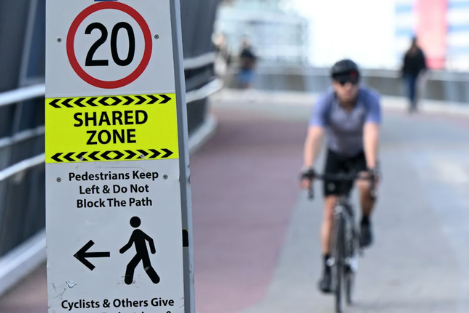
Off the back of National Ride 2 School day last week, The Conversation published a thought-provoking piece on what it will take to lift Australia's low daily physical activity rates at national scale. 


Authors Matthew McLaughlin, Jo Salmon and Peter McCue have commented on the Australian government's updated physical activity guidelines, which include a comprehensive "24-hour movement" . approach with specific recommendations for 7-9 hours of quality sleep.


While these evidence-based updates are a welcome step, experts warn that simply telling people to move more has failed to shift national activity levels, which have remained "stubbornly low" since 1999. The core issue is that these guidelines frame health as a personal responsibility, largely ignoring the physical and social barriers—such as cost-of-living pressures and urban design—that make an active lifestyle difficult to achieve at a population level.


ACHPER has consistently lobbied the educator sector to protect children's opportunities for movement by supporting active play at recess and to ensure minimum curriculum time for HPE is met.


The recent pledge by the South Australian government (here) to ensure 150 minutes per week of active learning in SA schools is also welcome news!


However, the authors argue that to truly "shift the needle," we must look beyond individual motivation and toward radical policy shifts: did you know that while every kilometre walked benefits the national economy by $6.30, the government subsidises driving by a staggering $8 billion annually? Current federal investment in bike and footpaths is less than the price of a cup of coffee per person, yet evidence provided in the full article suggests that lowering speed limits to 30km/h and removing the red tape that keeps local shops out of residential zones could transform our car-centric cities into vibrant, "active villages". 


Read the full article (here) to discover the four specific policy ideas that could finally align Australia with the 61 other countries successfully meeting their physical activity targets.


National President’s Update - Russell Brown LMACHPER

Mandating time allocations for active learning – key learnings from previous attempts


In the lead-up to the 2026 South Australian election, the state Labor Party made a notable education and health commitment introducing ‘a mandatory requirement of 150 minutes active learning per week for all public-school students from Reception to Year 9’.


This proposal sits at the intersection of public health, education policy, and political messaging—raising two key questions: what exactly is being promised, and has anything like it been done before in Australia?


A new policy and resources were promised that would be designed to support teachers to help students be more physically active throughout the school day. The policy statement indicated that the requirement could be achieved, not only through structured sport and physical education programs, but also performing arts and making regular lessons more active by, such as active learning breaks and movement challenges to reduce sitting time in the classroom, integrating physical activity in class and across subjects and school

camps/excursions involving physical activity.


It was deemed to be a significant announcement because, historically, South Australia has

not mandated a fixed minimum time for physical activity in schools … only recommended

guidelines and curriculum frameworks.


In fact, the last time a South Australian government provided a time allocation statement was in 1995 when their Department of Education created a recommendation to schools to

engage students in the compulsory years of schooling in a total of 100 minutes per

week within their Health and Physical Education programs.


At the time ACHPER’s recommendation was a minimum of 150 minutes for the HPE learning

area. Interestingly, when the policy was evaluated 5 years later:


> 85% of schools were aware of their Department’s recommendation,


> However, 55% of primary schools and 67% of secondary schools indicated they were not achieving the 100 minutes, and significantly, across the system, 40% of children in the early years were receiving less than 100 minutes of HPE per week.


Currently, the Australia Government’s national movement guidelines recommend that

children aged 5–17 engage in at least 60 minutes of moderate-to-vigorous physical activity

per day.


This highlights an important point: schools are seen as a key, but not sole, provider of

children’s movement and physical activity experiences.


South Australia’s 150-minute physical activity pledge is innovative locally but not unique

nationally. New South Wales has already implemented a similar mandate.


Currently in New South Wales, ‘students in Years K-10 are expected to participate in a

minimum of 150 minutes of planned moderate with some vigorous physical activity across

the school week. This time includes planned weekly sport’. Previous studies, for example, by O’Brien et al found that only 59% of surveyed schools were meeting the 150-minute target in practice. Other states also experiencing challenges with enculturating such a policy.


Universally the challenges are multi-faceted … consistently reports have indicated issues

related to students’ gendered participation, geographical limitations, school administration

support, timetabling, class size, the crowded curriculum, program diversity, teacher

expertise, school coordination, parent and community support, facilities and equipment, and the one in which ACHPER across Australia plays a significant role … access to quality

professional learning in HPE, PDHPE and associated programs.


What distinguishes the South Australian approach is its broader definition of activity,

integrating movement across the curriculum rather than confining it to sport and PE.


However, whether it succeeds will depend less on the promise itself and more on how

effectively it is implemented in classrooms … a challenge that has proven difficult elsewhere in Australia and will require a whole of system, long term commitment of support from the highest levels of government to every classroom to establish enculturated quality programs and experiences for all children.

You’re invited!

Teacher survey on food and nutrition messaging in schools


A/Prof Gabriella Heruc and the research team at Western Sydney University and University of

Newcastle are inviting Australian primary and high school teachers to participate in an online

survey exploring their confidence and attitudes towards delivering and supporting food and nutrition messaging. ACHPER Australia is delighted to be a part of the advisory group and encourages your participation in shaping national guidelines for safe food and nutrition messaging in schools.


What’s involved: A confidential, voluntary online survey (15–20 minutes). Findings will inform

future recommendations on how we can improve food and nutrition messaging in schools.


There is a link at the end of the survey to go in a draw to win one of 5 x $50 online gift vouchers.For more information and to participate, head to: https://tinyurl.com/SHiNE-Teacher-Survey


Please share this opportunity tp have your say with your teacher networks!


Snow Skills - School Curriculum

Now that the 2026 Milano Cortina Winter Olympics and Paralympics are over, it is a great time to seize upon the interest and motivation of young people to learn more about the fundamental movement basis of snow skills.


We have been working with Snow Australia to develop a new school-based snow curriculum for years 5 and 6 in primary school, and years 7 and 8 in junior secondary. It is an awesome way to develop physical literacy and fundamental movement skills in your student cohort with a unique snow skills flavour!


Register your interest in bringing the snow curriculum to your school here.

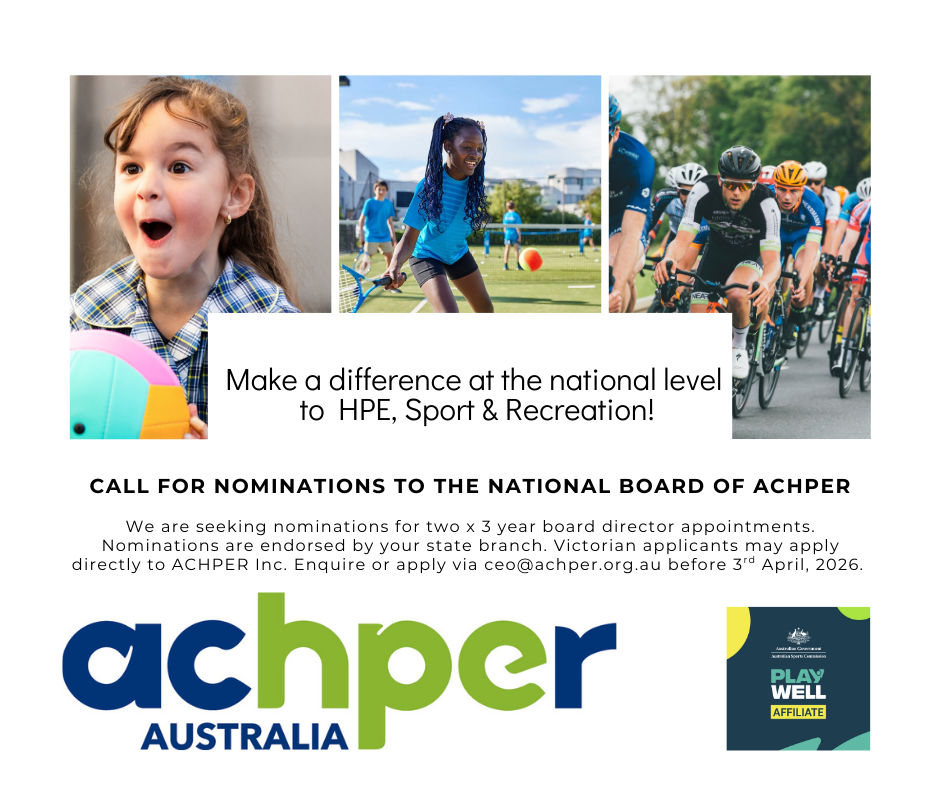
Call for Nominations for the National Board of ACHPER

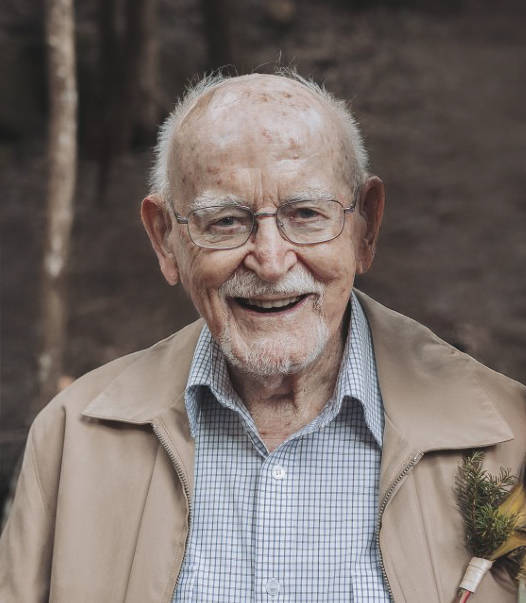
Happy 100th birthday to Geoffrey Walker!

ACHPER is delighted to celebrate the 100th birthday of Geoffrey Walker.


In Geoff's case, a century of life is the finest testament to a life lived actively.


Growing up in regional NSW, adventure wasn't a concept – it was just life. That spirit never left him. As a Scout Leader, he understood that shared adventure builds character and community.

He carried this belief into a remarkable career as one of NSW's first Education Consultants, serving schools across the North Coast for over thirty years.


For Geoff, every initiative was an invitation to adventure. His swimming schools gave children the freedom to explore water safely. Fitness camps brought together communities who discovered each other through shared experiences.


His 1956 publication ‘Physical Education Illustrated’, held in the National Library of Australia, remains a lasting record of his expertise and passion for the field.


One hundred years on, the adventure continues. Happy 100th, Geoff!


Come and find ACHPER in the FREE 2 DAY EXPO of the National Sports and Physical Activity Convention. ACHPER is an industry partner of the NSPA Convention and we are delighted to offer discounted entry for the full program. Just use the code ACHPER26 when you register. Early Bird rates are closing this week, so head over to the registration page now to secure your tickets.

Victorian and Tasmania Conferences Calendar

Check out the fantastic workshops and conferences coming your way in Victoria and Tasmania!

Register your interest for each session via ACHPER's CPD portal here.

[*Dates subject to change depending on registrations]


Use ACHPER26 Industry Partner discount code to book tickets to the National Sports and

Physical Activity Convention (Melb) here - Hurry, early bird rates are closing soon.

Tennis Survey - What do your kids think about tennis?


What is a Healthy Promoting School?

Episode 14 Part 1 & 2

Listen to this two part podcast at:

EP14 Part 1 here

Ep14 Part 2 here


Episode 14 of the Health Promoting Schools podcast is now available. This episode is so packed full of information it has two parts so make sure you catch both!


This episode sees Dr Hugh Shannon digging into the Health Promoting Schools program with authors Sue Dimitrijevich (Health Education consultant & former school principal) and Amanda Ferguson (Project development officer – Nutritionist, Foodcore Nutrition Services) about tips and insights from the latest edition of the book ‘What is a health promoting school? Increasing health literacy in WA schools’.


Open Access Read in Curriculum Studies in HPE


Physical Education (PE) teachers and PE teacher educators (PETEs) play a crucial role in implementing new curricula. The aim of this article is to scrutinise PE teachers’ and PETEs’ perspectives on the current PE curricula at the time of transition to a new curriculum.


Data were collected from a workshop held as part of a national PE research conference in Norway, attended by 43 participants representing both PE teachers and PETEs.


While some participants appreciated certain changes introduced by the curriculum, our findings generally indicate that many PE teachers and PETEs found the current curriculum problematic in several key areas. Both groups were particularly critical of what they perceived as an overly open and vague curriculum.


However, we also observed differences between the perceptions of PE teachers and PETEs. The PETEs were considerably more positive than the teachers regarding the curriculum’s emphasis on theory and reflection.


Read the entire open access article here

State Events Calendar and Membership for 2026

Click your state or territory to see upcoming events and/or become a member:


QLD

NSW & ACT

VIC

TAS

SA

WA

NT

ACHPER Australia is proud to nationally partner with Tennis Australia, the Australian Sports Commission as a Play Well Affiliate and with Netball Schools.

As always, free to share the ACHPER Advocate with your networks. We welcome new members, readers and supporters at any time.

ACHPER Australia recognises the Traditional Owners of the lands upon which we live and work and pays respect to their Elders, past, present and emerging. We extend that respect to all Aboriginal and Torres Strait Islander peoples, especially within our ACHPER membership, schools and HPE communities, partners and staff.


ACHPER Inc | www.achper.org.au

 
Facebook  Twitter