Rail Workers Weekly News Digest
Number 19 - May 12th, 2020
|
|
Below is a series of articles compiled over the previous week.
They are of interest to railroad workers.
|
|
Article 1 -
RAIL BENEFITS NEWS
RRB Pays Extended Unemployment Benefits under CARES Act
The Coronavirus Aid, Relief, and Economic Security Act, or CARES Act, recently signed into law by President Trump, authorized extended unemployment insurance (UI) benefits for railroad workers sidelined during the COVID-19 pandemic. After making necessary programming changes to agency systems, the U.S. Railroad Retirement Board (RRB) began processing and paying extended benefits on May 11.
The CARES Act authorized payment of extended UI benefits to rail workers who received UI benefits from July 1, 2019, to June 30, 2020. Under the legislation, railroad workers with less than 10 years of service may be eligible for up to 65 days of extended benefits within 7 consecutive 2-week registration periods. Workers with 10 or more years of railroad service, who were previously eligible for up to 65 days in extended benefits, may now receive benefits for up to 130 days within 13 consecutive 2-week registration periods. No extended benefit period under this provision can begin after December 31, 2020.
The RRB will identify any employees who exhausted their regular UI benefits during the benefit year that began July 1, 2019, and send them a letter and claim forms to receive the extended benefits. The agency will also load appropriate claim forms to online accounts so that individuals can file them online through
myRRB
on the agency website, RRB.gov.
|
|
Article 2 -
CORONAVIRUS NEWS
Face Coverings Important for Protecting Railroader’s Health
We have lost three BMWED Brothers to the COVID-19 pandemic. Countless others have gotten
sick
. Several of our members from across the country have been placed on medical quarantine.
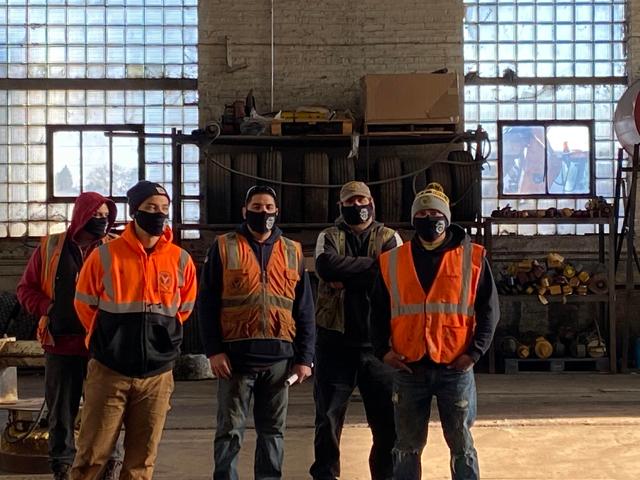
The consistent use of face coverings is an imperative tool to help prevent the spread of this virus. Like the PPE that came before it, we know that working while wearing it is at times uncomfortable and difficult, but just as hard hats and reflective vests are important to prevent unnecessary injury or death, a face covering is just as vital. Our brothers and sisters are vulnerable at work. You are, too. Please wear a face covering while working within six feet of another person.
Some of the railroads have provided adequate face coverings; others have not. Public health officials have stated that a bandana, or t-shirt, or cloth covering of the mouth and nose is enough to help contain person-to-person spread. Additionally, there are face coverings that are available for purchase that can do the same, including through the Teamsters website. We urge you to find a face covering that suits you. We will continue pressing the railroads to provide suitable face coverings for all employees.
Solidarity during this pandemic is of utmost importance. We will not be successful in keeping our fellow friends and families healthy if we do not commit to our individual roles. Thank you for wearing face coverings, practicing social distancing whenever you can, and for taking the necessary precautions to keep everyone healthy.
|
|
Article 3 -
ECONOMIC NEWS
The Bailout Is Working - For the Rich
The economy is in free fall but Wall Street is thriving, and stocks of big private equity firms are soaring dramatically higher. That tells you who investors think is the real beneficiary of the federal government’s massive rescue efforts.
Ten weeks into the worst crisis in 90 years, the government’s effort to save the economy has been both a spectacular success and a catastrophic failure.
The clearest illustration of that came on Friday, when the government reported that 20.5 million people lost their jobs in April. It marked a period of unfathomable pain across the country not seen since the Great Depression. Also on Friday, the stock market rallied.
The S&P 500 is now up 30% from its lows in mid-March and back to where it was last October, when the outlook for 2020 corporate earnings looked sunshiny. Companies have sold
record amounts of debt
in recent weeks for investment-grade
companies. Junk bonds, historically dodgy during an economic swoon, have roared back.
If you’re looking for investors’ verdict on who has won the bailout, consider these returns: Shares of Apollo Group, the giant private equity firm, have soared 80% from their lows. The stock of Blackstone, another private equity behemoth, has risen 50%.
|
|
Article 4 -
RAIL TRAFFIC NEWS
Union Pacific Shutters Operation of Multimodal Service Cold Connect
(Editor's Note: This is NOT the way to win freight traffic from the highways and compete with the trucking industry. With declines in coal, oil, frac sand, and other bulk commodities, this is exactly the type of freight that the rail industry needs to gain, not shed. NOTE: please click on READ MORE to see the original article and check out the Comments from readers.)
Customers were notified early May 8 that
Union Pacific
(NYSE:
UNP
) was ceasing operations of its multimodal service Cold Connect, which offered end-to-end transportation service for refrigerated loads.
UP spokeswoman Kristen South confirmed the closure, citing sluggish market conditions as a result of the coronavirus pandemic.
On “Friday, May 8, we notified employees that Cold Connect, a Loup Logistics service that moves refrigerated products from the West Coast to Union Pacific’s warehouse in Rotterdam, New York, will permanently close and most Cold Connect-related positions have been eliminated. This decision was not made lightly,” South said.
Customers “were notified that Friday was the last day we accepted inbound orders. Our intention is to deliver on all product in transit, until it meets its final destination. A reduced staff will temporarily remain in position to execute these final commitments,” South said.
|
|
Article 5 -
FREIGHT CARLOAD NEWS
AAR: U.S. Rail Carload Decline in April 'Worst' on Record
U.S. freight-rail traffic plunged 21.2 percent in April to 2,075,958 carloads and intermodal units compared with April 2019, a reflection of the COVID-19 pandemic's impact on the economy, according to the
Association of American Railroads
(AAR).
U.S. railroads hauled 980,535 carloads last month, down 25.2 percent, and 1,095,423 intermodal containers and trailers, down 17.2 percent, from the same month last year.
"To no one's surprise, the pandemic made April a challenging month for rail traffic," said AAR Senior Vice President John Gray in a press release.
The drop in total carloads was the worst decline in any month since AAR began keeping records in 1989, and the decline in intermodal units was the worst since the summer of 2009, Gray said.
|
|
Article 6 -
EMPLOYMENT NEWS
Top US Companies Lay off Thousands of Workers While Rewarding Shareholders Amid Coronavirus Pandemic
Companies like Caterpillar and Levi Strauss showered cash on shareholders days after cutting thousands of employees
Some of the largest companies in the U.S. have
rewarded their shareholders
amid the coronavirus pandemic after firing thousands of employees.
Companies like heavy machinery manufacturer Caterpillar, denim-maker Levi Strauss, toolmaker Stanley Black & Decker, furniture manufacturer Steelcase and World Wrestling Entertainment have doled out more than $700 million to shareholders in cash dividends while slashing jobs and shuttering facilities,
The Washington Post
reported. Many other companies have likewise rewarded shareholders while laying off workers.
Caterpillar, for example, announced a $500 million distribution to shareholders in early April, according to the report, about two weeks after it
announced
that it was "temporarily suspending operations at certain facilities." The company did not say how many workers would be impacted.
"We are taking a variety of actions globally, but we aren't going to discuss the number of impacted people," a spokesperson told the outlet. "We are taking a variety of actions at our global facilities to reduce production due to weaker customer demand, potential supply constraints and the spread of the COVID-19 pandemic and related government actions. These actions include temporary facility shutdowns, indefinite or temporary layoffs."
Levi Strauss announced that it would distribute $32 million to shareholders on April 7, the same day that the company
said it would furlough retail workers
. About 4,000 workers have been affected, according to The Post.
|
|
Article 7 -
PASSENGER RAIL NEWS
How Trains Can Survive - and Thrive - During and After the Pandemic
With much of the nation on lockdown through the spring, ridership on rail systems is plummeting. Commuter rail trains in Chicago are nearly empty, for example. Ridership has fallen by as much as 97 percent from pre-pandemic levels.
Yet there is hope. This crisis will reshape the U.S. in ways that are impossible to imagine or predict, but it’s clear that more—and better—rail service will help solve many of our economic and environmental predicaments. It must become a much more integral part of the U.S. transportation system as we move through and beyond this crisis.
First, passengers need to feel (and be) safe again. The International Union of Railways has addressed that challenge with a
set of measures
to increase confidence in rail transport in the wake of the pandemic. Social distancing, the report noted, “must be combined with other measures . . . to mitigate risk.” The other measures include screening staff and passengers for a fever before they enter stations and trains; requiring masks; making sanitizer gel easily and widely available; and regularly cleaning the filters on ventilation systems. These and other measures should be combined with an aggressive communications campaign promoting the risk-reduction policies.
Safe trains are the bare minimum for getting people back on board, of course. What about transformative change? What are the prospects for not just a rebound in ridership but a new golden era of rail transportation?
City Lab
recently noted
that the possibility that “a whole new set of riders could board trains in the future, if the service could be adapted to their needs.”
|
|
Article 8 -
HEALTH CARE NEWS
Health Care Emergency Guarantee Act Introduced in Congress
Finally, a bill that addresses the uninsurance crisis during COVID-19 is coming: the Healthcare Emergency Guarantee Act will be introduced next week by Sen. Bernie Sanders and Rep. Pramila Jayapal.
Now we need to get our legislators on board as original cosponsors. If you're reading this on a phone, connect directly to the Capitol switchboard below:
|
|
The Healthcare Emergency Guarantee Act would authorize Medicare to:
- fully cover the cost of all medically-necessary health care for the uninsured
- fully cover out-of-pocket health care expenses for those with insurance
This would continue until an approved vaccine for COVID-19 is widely available to the public.
|
|
|
|
|
|
|