The American Society of Le Souvenir Français Inc.
Monthly Bulletin - Vol. III. No 10 - October 2023
|
|
The Escadrille La Fayette
|
|
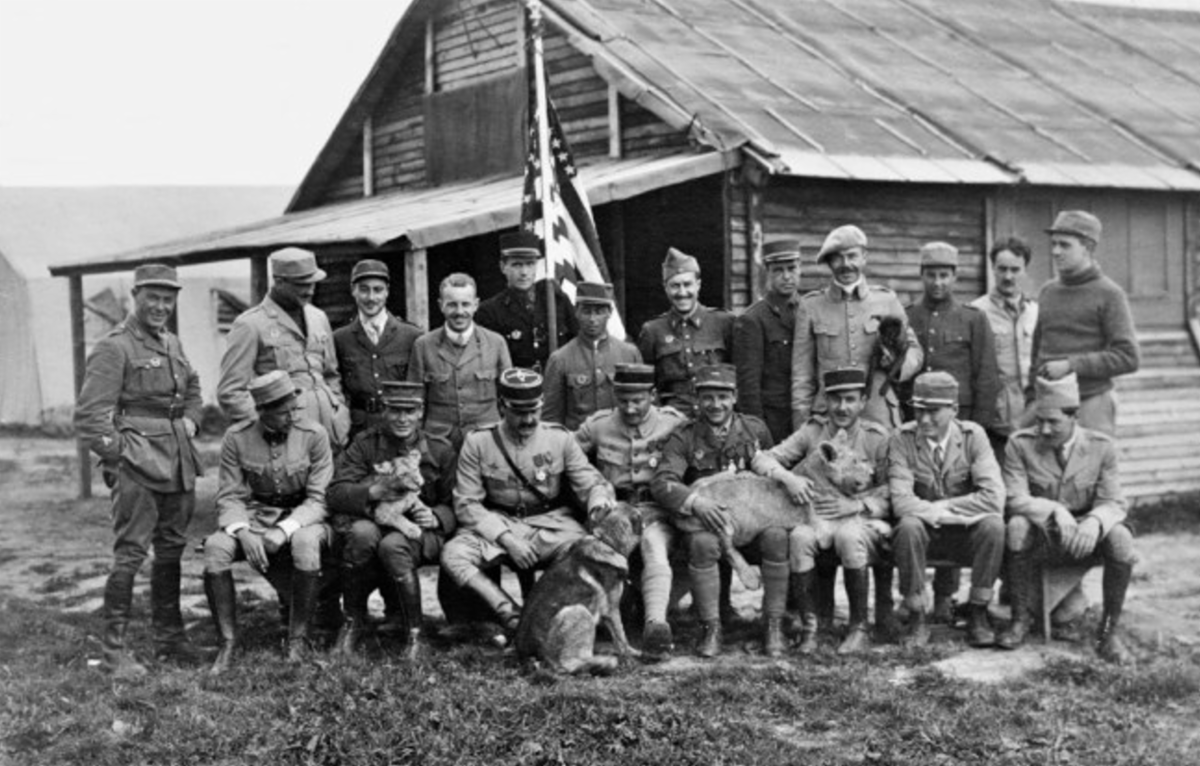
Top: The pilots of the Lafayette Escadrille at Chaudun, France, summer 1917. Posing with them are their ever-present mascots Whiskey, Soda, and Capitaine Thenault’s dog Fram. (Photo: U.S. Air Force)
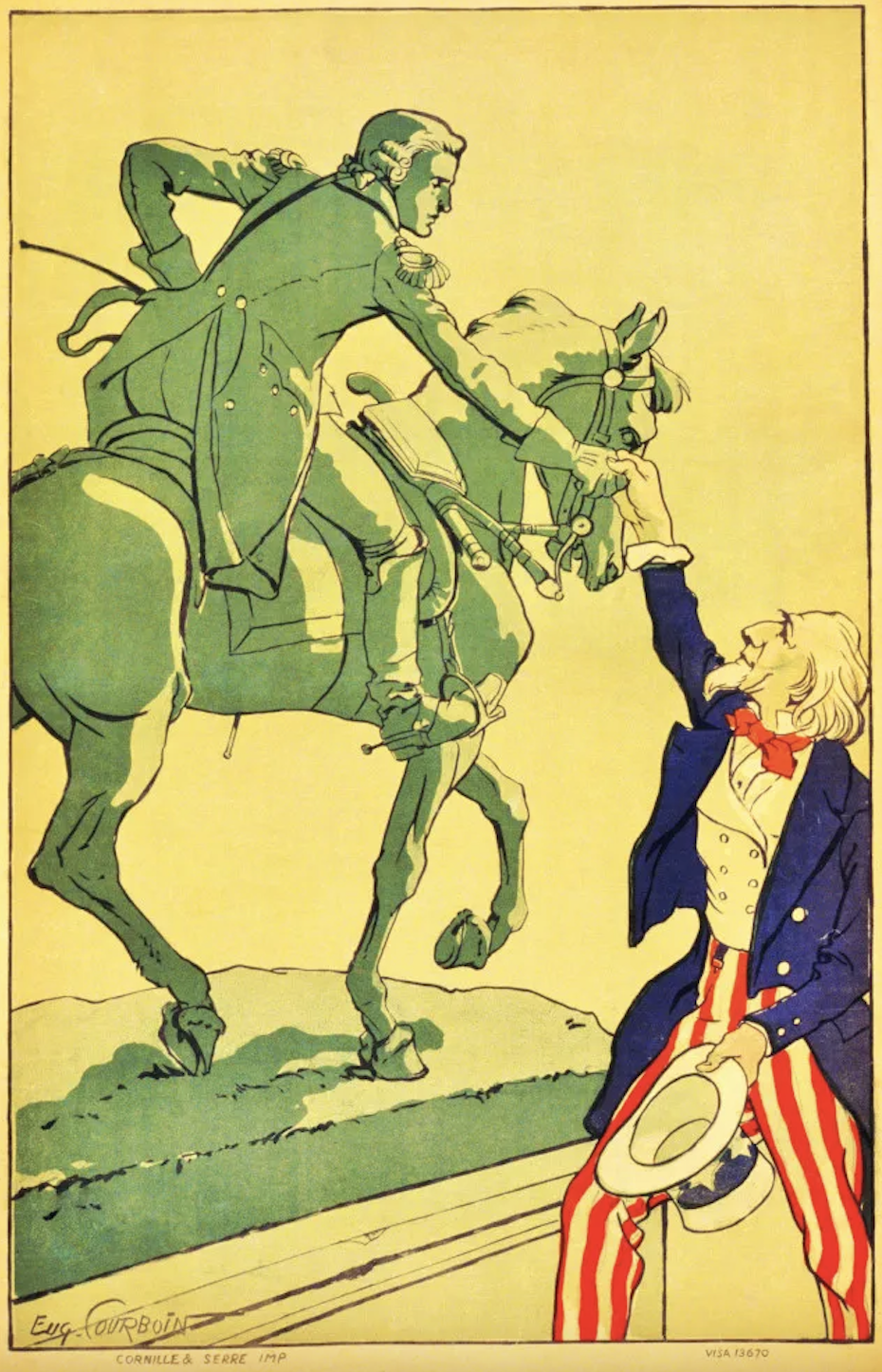
Middle: "Uncle Sam shaking hands with the marquis de Lafayette" by Eugène Courboin, Paris : Cornille & Serre, [1917], Library of Congress Prints and Photographs Division
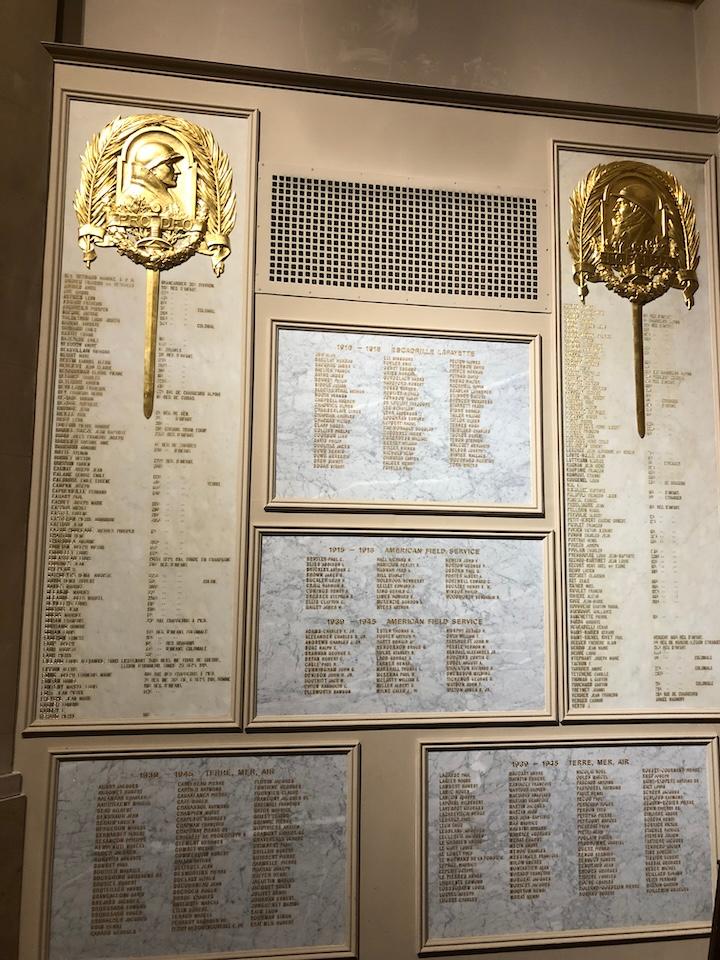
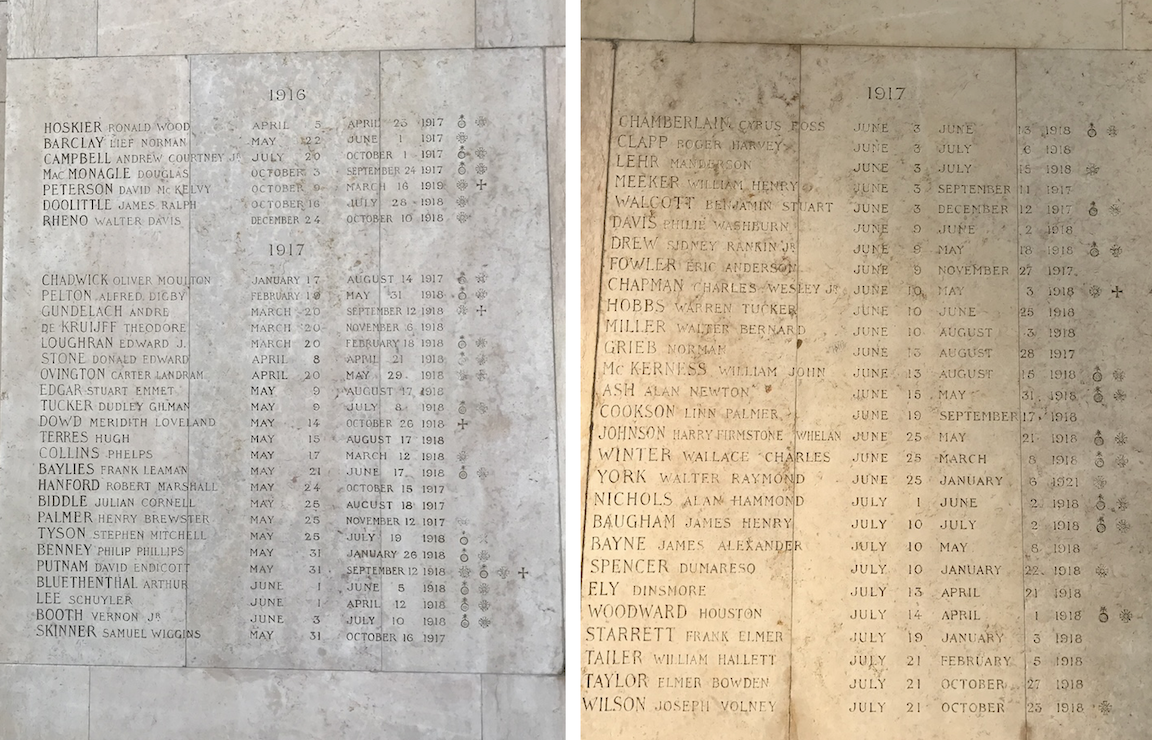
Lower: Wall of "Morts Pour la France", Notre-Dame Church, 405 West 114th Street, New York, NY 10025
|
|
EDITORIAL
On the wall of Notre-Dame church in Manhattan, 463 names of conscripts and volunteers who "Died for France" during the two World Wars are engraved on several marble plaques. One of these plaques, under the heading "Escadrille Lafayette" lists all these valiant American aviators who died during World War One in the French skies in the defense of Freedom, whether they served in the original Escadrille Lafayette unit, or in the Lafayette Flying Corps in general.
In anticipation of Veterans Day of November 11, we will start a new series paying tribute to these volunteers who served under French uniform prior to the United States entry into the war in 1917. To tell their story is to proper way to pay tribute to their deeds.
And what a story did they write, each individually, with their blood!
While Hollywood did a couple of movies on the legendary Lafayette Escadrille, we submit here that each and everyone of them are deserving of a full movie. Their bravery was legendary, and we owe it to them - - and their descendants - - to narrate their exploits. Therefore, we will inaugurate this series with nine of them, and will continue to do so regularly in future bulletins.
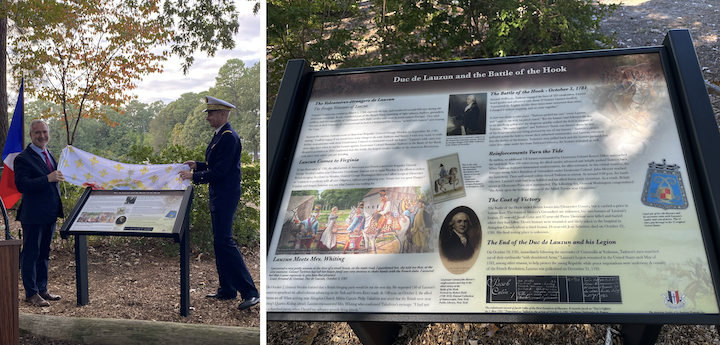
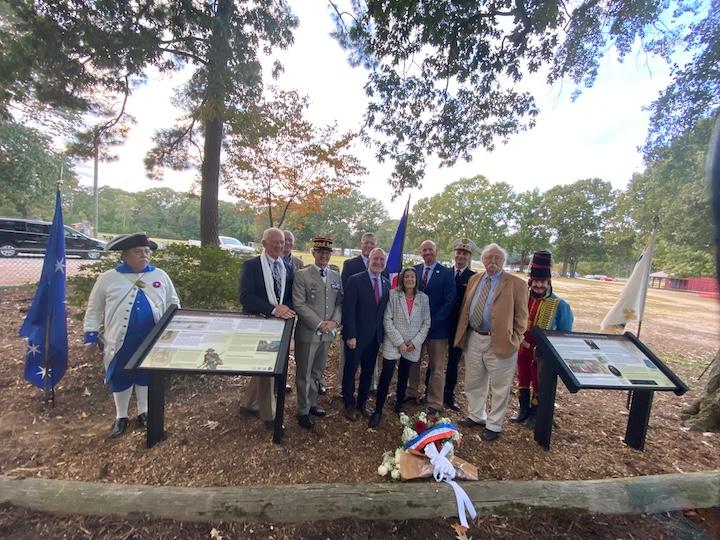
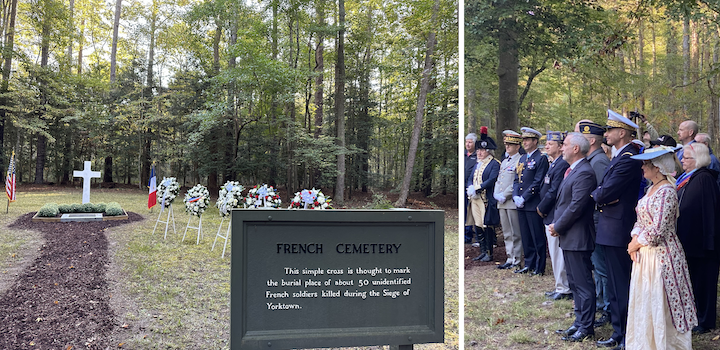
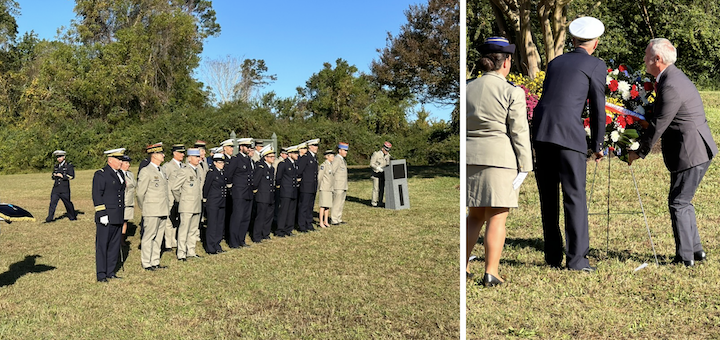
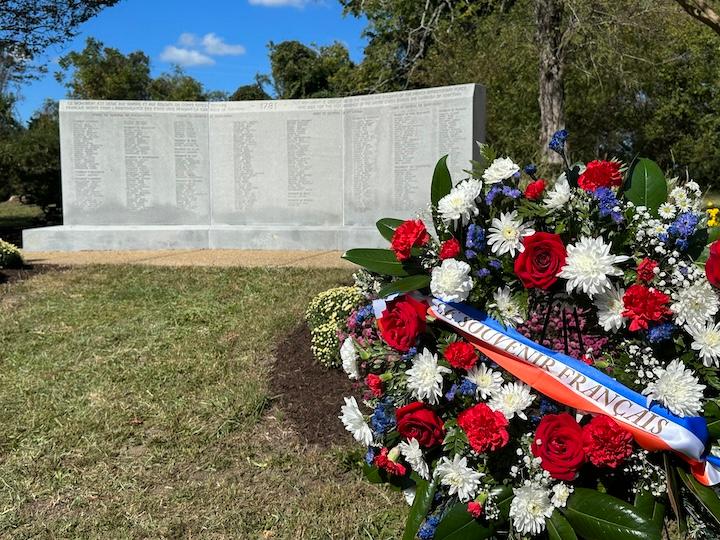
135 years before them, several French soldiers died or were wounded in the Battle of the Hook in Gloucester, Virginia to prevent the escape of Lord Cornwallis from Yorktown. This past October 18, we proudly unveiled two markers on the site of this battle and we are sharing photos from the commemoration of the French-American victory at Yorktown.
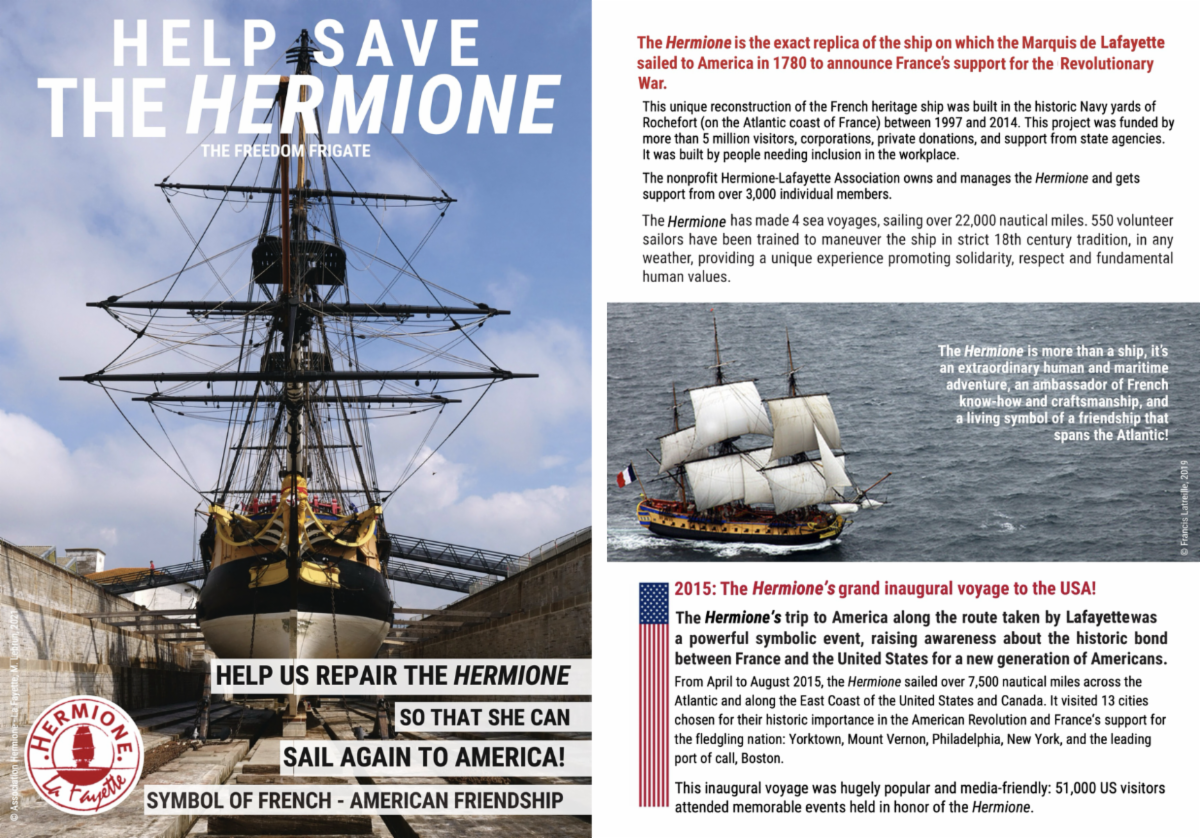
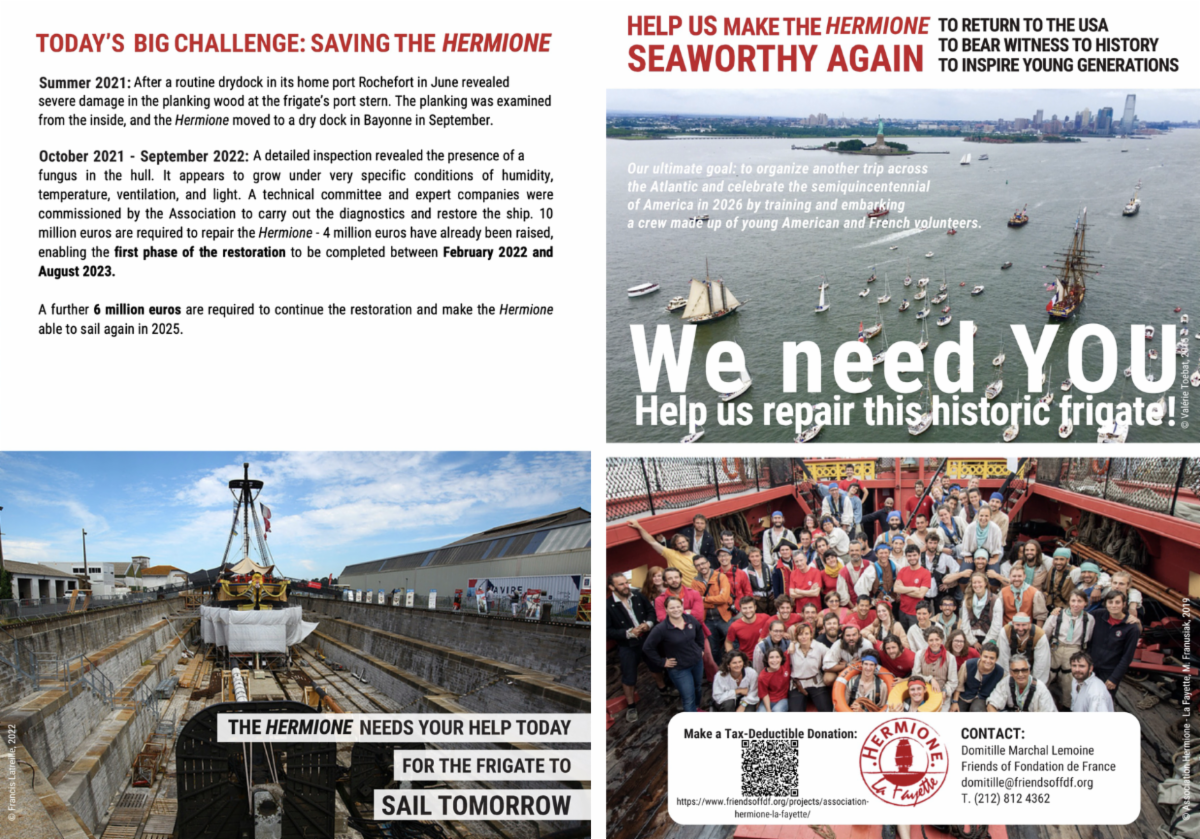
As always, we are excited to share details about upcoming events and important dates organized by associations that share our values. Among the many events and initiatives that are announced, we are kicking-off a nationwide fund-raising campaign to help repair the frigate Hermione, of Revolutionary War fame, also known here as the "Freedom frigate".
Thank you for your ongoing support. We appreciate every donation, regardless of size, as it greatly contributes to the realization of lasting concrete projects. This allows us to fulfill our mission of celebrating and preserving the historic, strong bonds of alliance and friendship between the United States and France.
On behalf of the Board of Directors,
Thierry Chaunu, President,
American Society of Le Souvenir Français, Inc.
|
|
The Lafayette Escadrille: the origins |
|
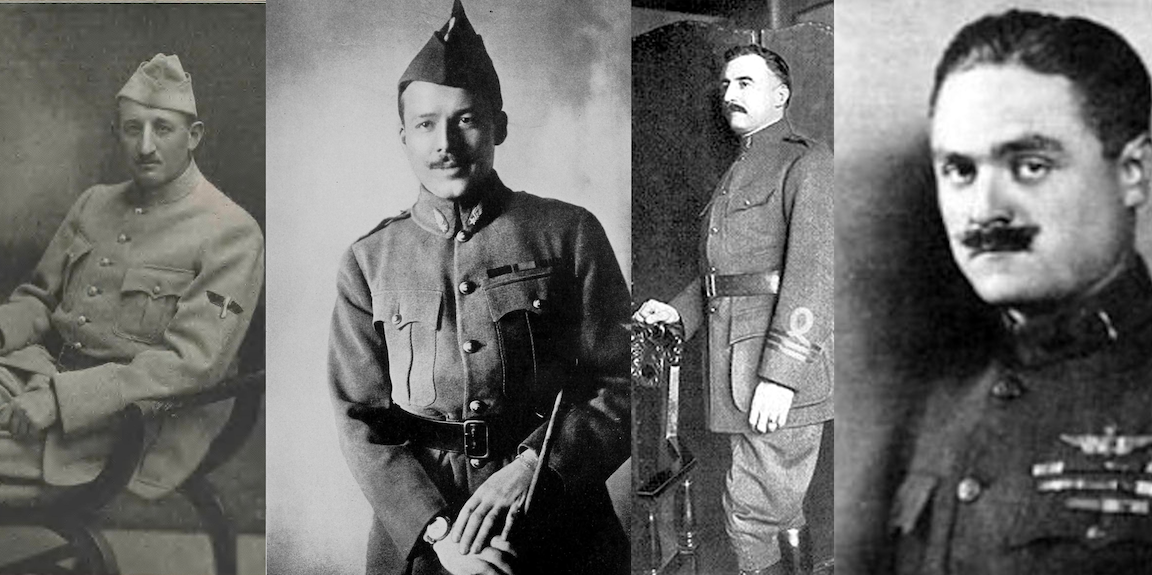
Left: Frazier Curtis, an American aviation enthusiast, who on March 2, 1915, joined the French Air Service, becoming the first American to enlist as a combat pilot in France. He helped to found the Escadrille Américaine and organized the Harvard Flying Corps to train American pilots in the United States. Public Domain, https://commons.wikimedia.org/w/index.php?curid=43561925
Center Right: Dr. Edmund Gros, an American physician living in France, who was instrumental in persuading the French Government to form the Escadrille Americaine. Later, he suggested its new name - Lafayette Escadrille. After the U.S. entered the WWI, Dr. Gros was appointed Lt. Colonel and served as a liaison between the French and U.S. Army aviation authorities. A historic photo provided by the U.S. Air Force. https://commons.wikimedia.org/w/index.php?curid=30298764
|
|
• Following the outbreak of World War I, a significant number of Americans who sympathized with the Allied cause offered their services to France as ambulance drivers and soldiers in the French Foreign Legion. However, by 1915, a group of volunteers (Dr. Edmond Gros, one of the directors of the American Ambulance Corps, Norman Price, Frazier Curtis, William Thaw) aided by Mr. Jarousse de Sillac, attaché to the Ministry of Foreign Affairs, began to lobby Colonel Bouttiaux of the French Ministry of War to create a squadron of American pilots.
• Their goal was to assist the Allied cause, so they advocated for the establishment of an all-American squadron in the French Air Service. Recognizing the need for additional combat forces and understanding the potential positive impact of Americans fighting under the French flag in gaining support from the United States for the Allied cause, and after careful consideration, the French cabinet agreed.
• On March 21, 1916, the French Air Department granted authorization for the establishment of the "Escadrille de Chasse Nieuport 124" also named "Escadrille Américaine", which was subsequently deployed on April 20 in Luxeuil-les-Bains, France, near the border with Switzerland.
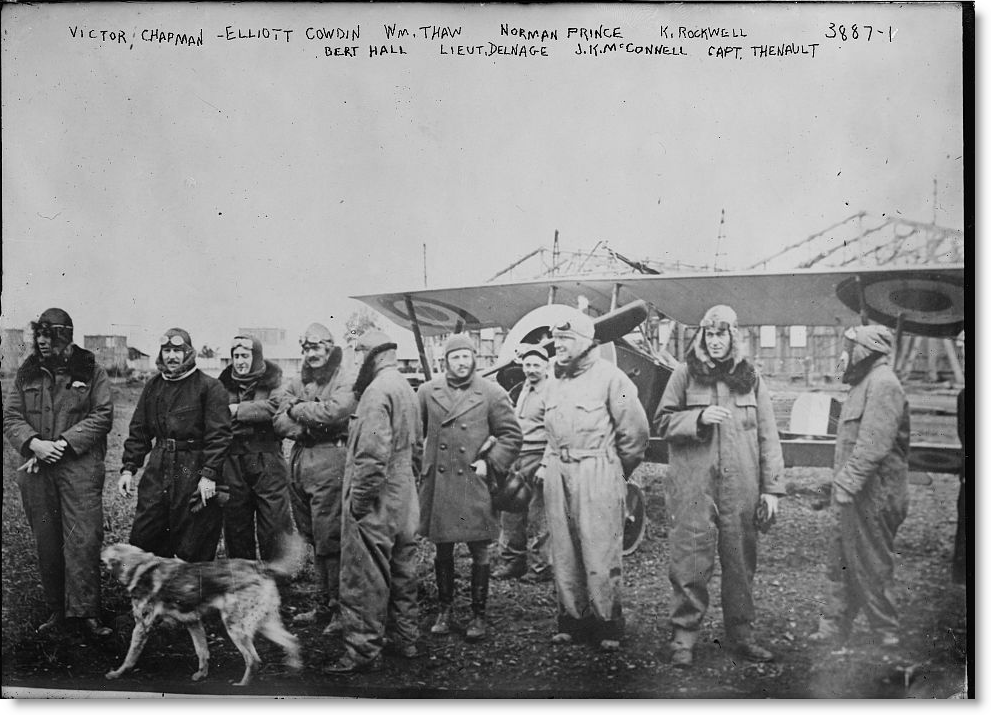
• American recruits came from the French Foreign Legion, which was a compulsory step for soldiers who were not French by birth. They were trained at Pau in Southwestern France. Initially, the unit consisted of seven American pilots: Victor E. Chapman, Elliott C. Cowdin, Bert Hall, James Rogers McConnell, Norman Prince, Kiffin Rockwell, and William Thaw II. The complete roster eventually expanded to include a total of 38 pilots.
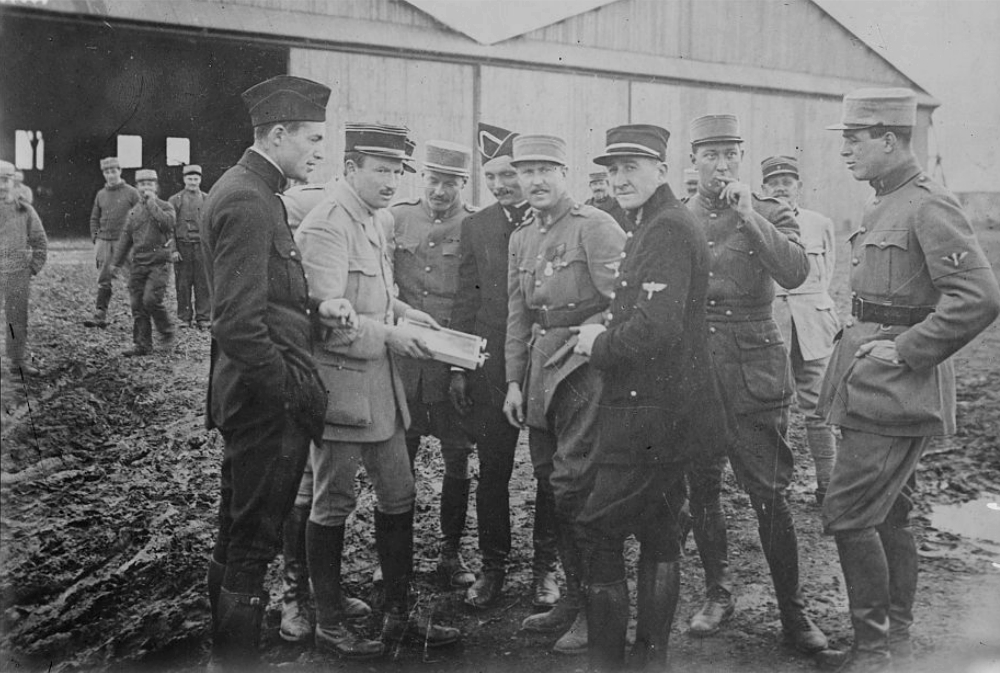
• The commander of the unit, Capitaine Georges Thénault, who had previously commanded the N 42 observation squadron, his deputy, Lt. Alfred de Laage de Meaux, along with the aircrafts, mechanics, and uniforms, were French. The squadron also had five French pilots who served in command positions at different times. Notably, Raoul Lufbery, a dual French- American national, emerged as the squadron's foremost flying ace, having achieved 16 confirmed victories.
• In December 1916, the U.S. government received a German objection regarding the actions of a purportedly neutral nation. Consequently, the name of the squadron, suggesting an alliance between the United States and France, was altered to Escadrille La Fayette, which was deemed more neutral than Escadrille Américaine.
• Throughout the course of the war, 267 Americans flew with French squadrons. This elite group of aviators came from diverse backgrounds, including authors of fiction, a professional polo player, All-American football players, an FBI special agent, and a U.S. ambassador. However, only 38 of these individuals were assigned to the Lafayette Escadrille, with the rest serving in other French flying units. Despite this, all Americans in the French Air Service, known as the Service Aéronautique, were considered part of the Lafayette Flying Corps, an unofficial designation.
• Among this group, 51 individuals lost their lives in combat, while an additional 11 individuals succumbed to causes unrelated to combat. Furthermore, a total of 15 individuals were taken as prisoners of war, while 11 pilots within the unit achieved the esteemed status of "aces". Collectively, these American aviators who participated in France's air service, known as the Aéronautique militaire, are referred to as the La Fayette Flying Corps (hence the frequent confusion between the "Escadrille Lafayette" proper, and the "Lafayette Flying Corps" which is a generic name with no specific military attribution.
• Note, the official French name was "Escadrille La Fayette", while Americans refer to it as Escadrille Lafayette.
• The disbandment of the Escadrille occurred on 18 February 1918, leading to the transfer of American personnel to the United States Army Air Service, where they became part of the 103d Aero Squadron.
• Following the conclusion of the Great War, a significant number of individuals, exceeding 4,000 in number, laid claim to membership in the Escadrille Lafayette. Among these individuals were a handful of prominent Hollywood figures and a few notable government officials.
"Since the formation of the American Escadrille, I have tried to exalt the beauty of the ideal which brought my American comrades to fight for France." – Capitaine Georges Thenault, Commanding Officer of the Lafayette Escadrille
|
|
Forging its legend in combat |
|
Lafayette Escadrille pilots with a Nieuport 16, March 1916. Pilots L-R: Sergeant Victor Emmanuel Chapman of New York City, New York; Sergeant Elliott Christopher Cowdin II of New York City, New York; Adjutant Bert Hall of Missouri, USA; Lieutenant William Thaw II of Pittsburgh, Pennsylvania; Lieutenant Alfred de Laage de Meux of Clesse, Deux Sèvres, France; Sous-Lieutenant Norman Prince of Boston, Massachusetts; Sergeant James Rogers McConnell of Carthage, North Carolina; Sergeant Kiffin Yates Rockwell of Asheville, North Carolina; Captain Georges Thenault of Paris, France, and Fram (Captain Thenault's "bon chien")
|
|
• The squadron's initial significant engagement occurred on 13 May 1916 during the Battle of Verdun, followed by Kiffin Rockwell documenting the unit's inaugural aerial triumph five days later.
• Unfortunately, tragedy struck on 23 June when Victor Chapman was shot down over Douaumont, resulting in the squadron's first fatality.
• The unit remained stationed at the front until September 1916, at which point it was relocated to Luxeuil-les-Bains within the 7 Army area. On 23 September, Rockwell met his demise when his Nieuport aircraft was brought down by the gunner aboard a German Albatros observation plane. Additionally, in October, Norman Prince sustained fatal injuries after crashing during his final approach to the airfield.
• Operating from rudimentary bases in close proximity to the front lines, these aviators took to the skies to establish air superiority during significant military campaigns of the war, such as the Battle of Verdun, the Somme Offensive, the Nivelle Offensive, the Aisne Offensive, and the Ypres Offensive. Additionally, the American flyers provided escort to Allied bombers as they launched strikes on targets situated deep within enemy territory.
• The daily combat operations carried substantial risks, with certain units enduring casualty rates that exceeded 400 percent. Flying amidst such formidable odds instilled a profound comprehension of the importance of dedication to duty and the willingness to make sacrifices.
• As the stories of the Lafayette Escadrille circulated worldwide, these youthful individuals emerged as valiant advocates of the Allied cause. The undeniable impact of their involvement in the war is evidenced by the volunteers successfully downing 199 German aircraft.
• On 8 February 1918, the squadron underwent disbandment, leading to the induction of 12 American members into the U.S. Air Service as part of the 103rd Aero Squadron. During a short duration, the squadron maintained its French aircraft and mechanics. The majority of its experienced members were assigned the task of training recently arrived American pilots. The 103rd Aero Squadron was acknowledged for achieving an additional 45 kills prior to the implementation of the Armistice on 11 November. Many of the Lafayette pilots were the seeds of the future US Air Force by training new pilots and teaching them from their combat experience.
• The Group La Fayette has been awarded a total of eight citations by the Air Army, granting them the privilege to don the "Fourragère" adorned with the ribbon colors of the Croix de guerre 1914–1918 (France), in addition to the "Fourragère" with ribbon colors of the Médaille Militaire.
• At the decommission of the unit on January 1, 1918, the following registry noted:
· 267 Americans volunteered in French aviation;
· 255 received their pilot brevet;
· 108 served at the front;
· 66 were killed, out of which 51 killed in action;
· 19 were wounded;
· 15 were made prisoners of war;
· 199 victories were known to be officially recognized.
"They were the precursors of the mighty awakening of the west — of that gigantic effort of America — unparalleled in history — the greatest of all crusades, where every qualified man was enrolled under the Stars and Stripes, for no selfish aim, for no world-conquest, but for the great ideals upon which civilization depends and for which the entire resources of the nation were unsparingly contributed to assure victory."
–Capitaine Georges Thenault, Commanding Officer of the Lafayette Escadrille
|
|
Who were these volunteers?
• The Lafayette Squadron's young aviators, with an average age of 26, were often scions of affluent American families. Their extensive connections in both France and the United States enabled them to successfully persuade a initially doubtful French government to embrace the concept of an entirely American unit. Among the 38 flyers, eleven were the offspring of millionaires. William Thaw, one of the squadron's original members, arrived in France piloting his personal aircraft, a generous gift from his father, which he subsequently bestowed upon the French government. Additionally, the squadron boasted nine Harvard alumni and five Yale graduates.
• Some individuals were motivated by the allure of adventure that aviation held, a mere twelve years following the Wright Brothers' groundbreaking flight. However, a significant number of individuals enlisted due to their inability to remain passive spectators as the United States deliberated its entry into the war. Kiffin Yates Rockwell, one of the original members, articulated his motivation by stating, "I am repaying my debt to Lafayette and Rochambeau."
• The group exhibited a combination of idealistic and individualistic tendencies, alongside a youthful exuberance. Notably, they had two lion cubs named Whiskey and Soda as mascots for their squadron, until one of the lions became overly playful with a French instructor, leading to their departure. Following Rockwell's initial victory against an enemy, his cousin gifted him an 80-year-old bottle of Bourbon. Rockwell consumed only a single sip from the "Bottle of Death," after which it became a customary practice within the squadron. Each pilot who successfully shot down an enemy aircraft was permitted to partake in a celebratory drink, symbolized by a victory belt.
• French commanders had the challenging task of handling a rowdy group of American youths with care. Despite their success, their patience was frequently pushed to the brink. They often clashed with local authorities and regularly indulged in heavy drinking at Parisian nightclubs. Their wild behavior earned them the derogatory label of "sauvages" from a French officer.
• The accounts of their achievements were eagerly consumed by the domestic media, catapulting the young aviators into the realm of popular recognition and establishing them as prominent figures in American households. This widespread coverage served as a catalyst for an increased number of American individuals who were inspired to join the French Air Force as volunteers. Consequently, this publicity not only fostered stronger bonds between the United States and France but also solidified the prevailing agreement in support of American involvement.
A few statistics:
Average age: 26 - oldest 40 and youngest 20
• 11 sons of millionaires,
•9 from upper middle-class,
• 14 average income and
• 4 rose up out of poverty
• 23 of the 38 pilots came from the east coast
• 30 of the 38 graduated or had attended college
• 25 had attended eastern schools (9 from Harvard )
• They came from all walks of life – soldiers of fortune, adventurers, architects, engineers, students, playboys, polo-players and aviators
• 9 had some pre-war flying experience
• Prior service in France: 14 were volunteer ambulance drivers and 8 came from the French Foreign Legion
The complete list of the "38 Valiants" is further down at the end of this article.
|
|
• When the squadron was formed in April 1916, each pilot chose a personal mark or emblem. These could be a letter, often the initial of their name, or a design like a die, a foot, a star, a cross, or a butterfly.
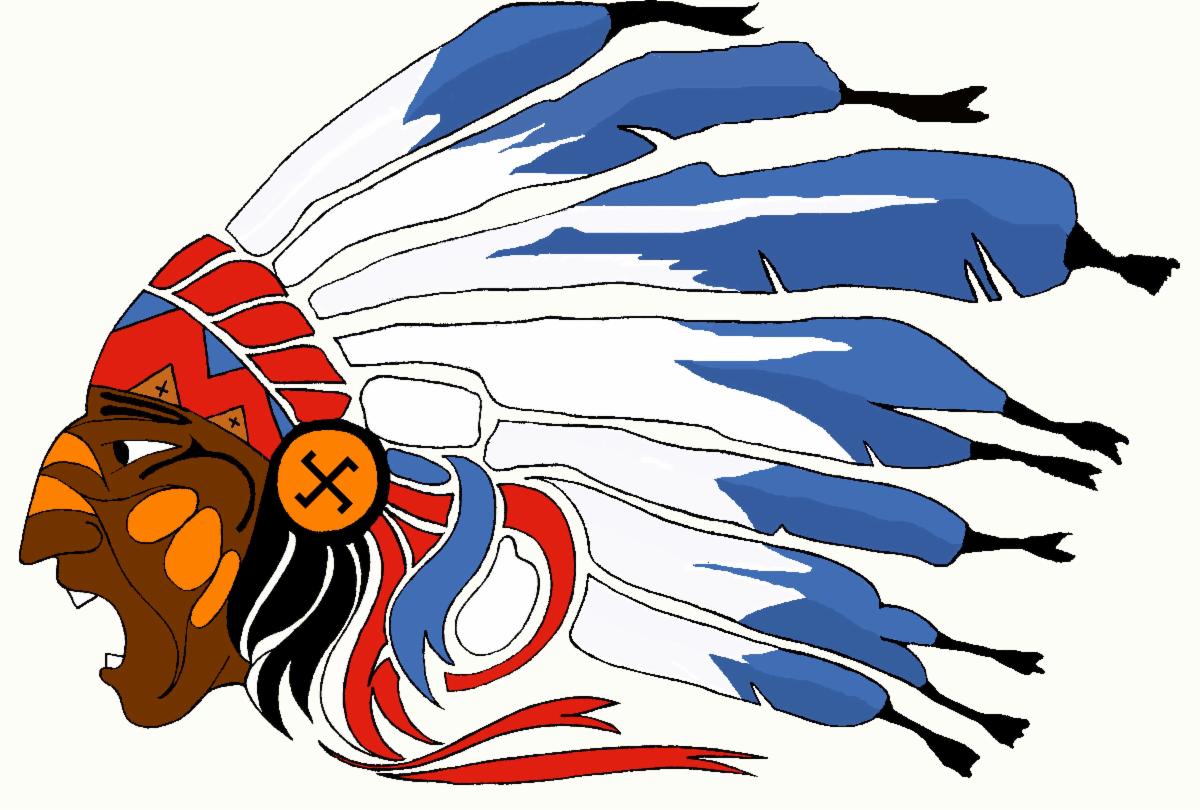
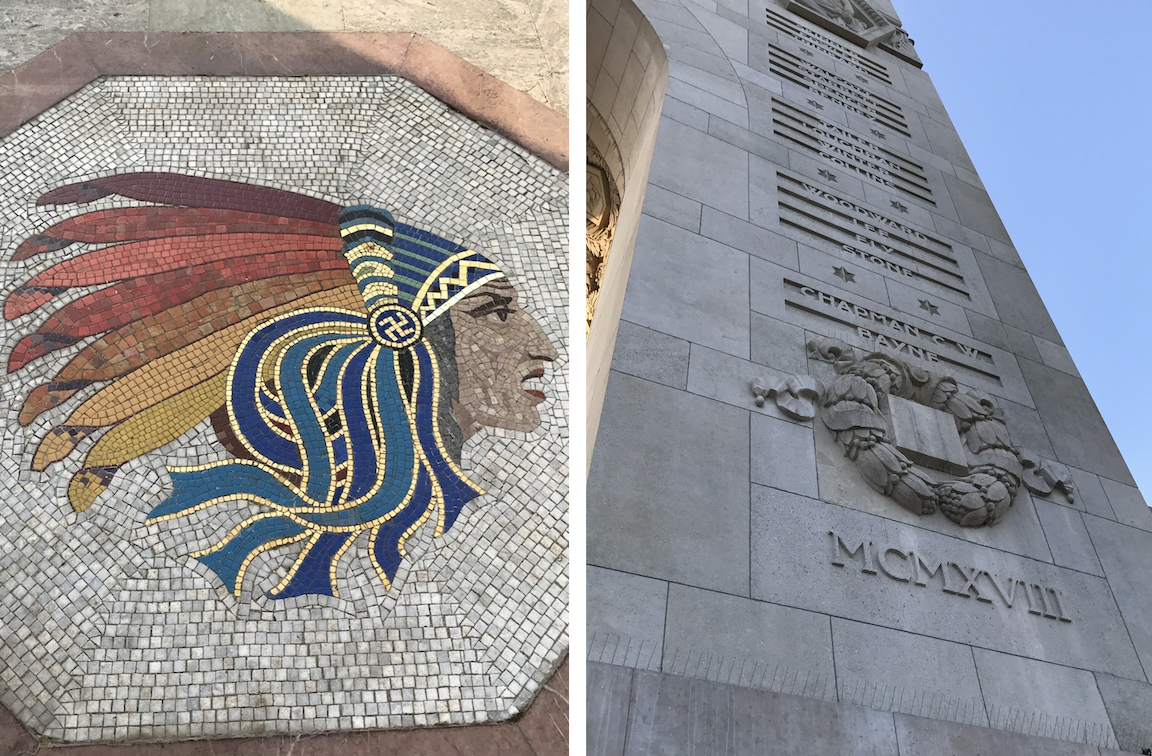
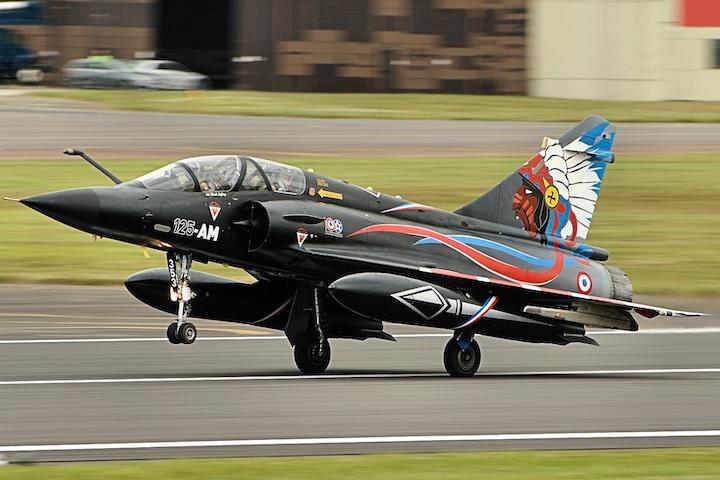
• In October 1916, the squadron became part of the Cachy escadrilles de Cachy. Captain Georges Thénault, the squadron's commander, decided on a collective emblem for the unit - a Seminole Indian head. Private Marie Suchet, a mechanic, adapted the design from the ammunition boxes of the "Savage Arms Manufactured Company", which featured an Indian head. This company supplied ammunition for the Colt machine guns used by the reconnaissance and bombing units of the French military aeronautics.
• In February 1917, a second collective emblem, designed by Sergeant Pilot Harold Willis, was adopted.
• The squadron emblem of Escadrille N 124 La Fayette consists of a Sioux head and a heraldic cross. The addition of the cross in the shape of a swastika was made by pilot Raoul Lufbery, who had been using it as his personal badge. This swastika, which has its origins in ancient India, was considered a lucky motif during that time.
• However, in February 1917, the Seminole Indian head was replaced by a more fierce Sioux head, which was easier to distinguish from a distance. This new emblem was designed by Sergeant Pilot Harold Buckley Willis and pilot and artist Edward Foote Hinkle, both of whom had previously used it as their personal symbols.
• Even with the adoption of the Indian head emblem, the pilots still used their personal markings to identify themselves and distinguish from other units.
• On July 7, 1917, squadron N 124 "La Fayette" received its flag, which was embroidered by 40 young girls who were employees the Treasury Department in Washington, D.C. The flag was officially presented by Mrs. William Gibbs Macadoo, the wife of the Secretary of the Treasury.
|
|
Let us not forget Fram, Whisky and Soda! |
|
• The Lafayette Escadrille gained notoriety not only for its exceptional achievements in aviation, but also for its distinctive assortment of furry mascots. Among these mascots was Fram, a cherished dog belonging to Capitaine Thenault, who can be seen in numerous photographs, alongside various other canines.
Fram was a rather exceptional dog. It would hear the noise of a plane several miles away, and would recognize from the engine noise his master from all the other planes!
• Additionally, some pilots formed a bond with a fox...
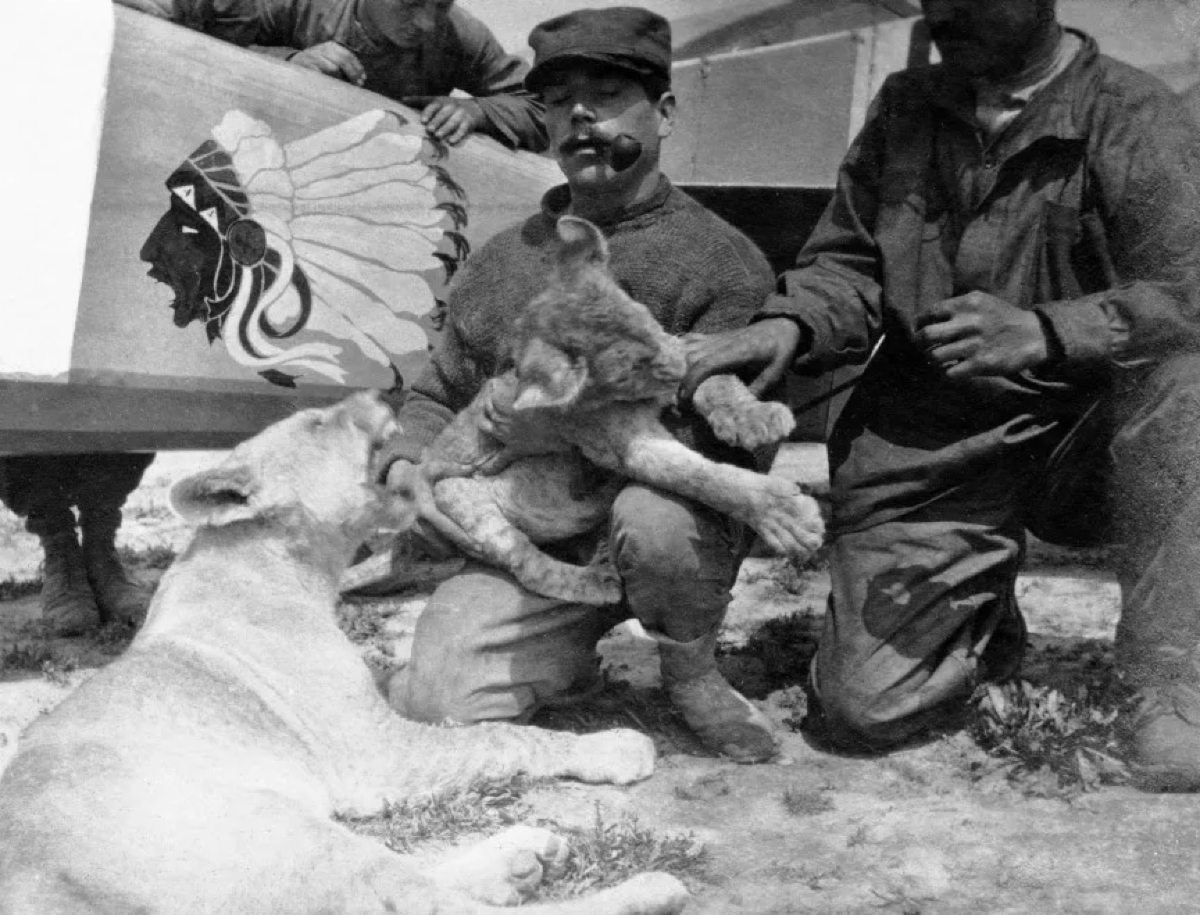
• However, the most remarkable mascots were the two lion cubs that the Americans adopted. The first one was brought by Lufbery, one of the pilots, who named it "Whiskey" due to its penchant for consuming alcohol from a saucer when it was still a small cub. As the cub matured, the men decided it required a female companion, leading them to acquire a second cub, affectionately named "Soda." Although Soda was more aggressive than Whiskey, she was fond of Lufbery and would not harm him.
• One day the pilots brought Whiskey aboard a passenger train to Luxeuil. Despite assurances that the lion was harmless, the conductor became wary after Whiskey roared and attempted to bite his finger. Two pilots from the Escadrille stayed behind to crate up the animal and bring it the following day.
• Whiskey and Soda swiftly gained widespread recognition, almost rivaling the fame of the pilots themselves, thereby further enhancing the squadron's rebellious and enigmatic reputation.
• Eventually, both lions were taken to a Paris Zoo.
|
|
The Memorial
Domaine National de Saint Cloud
|
|
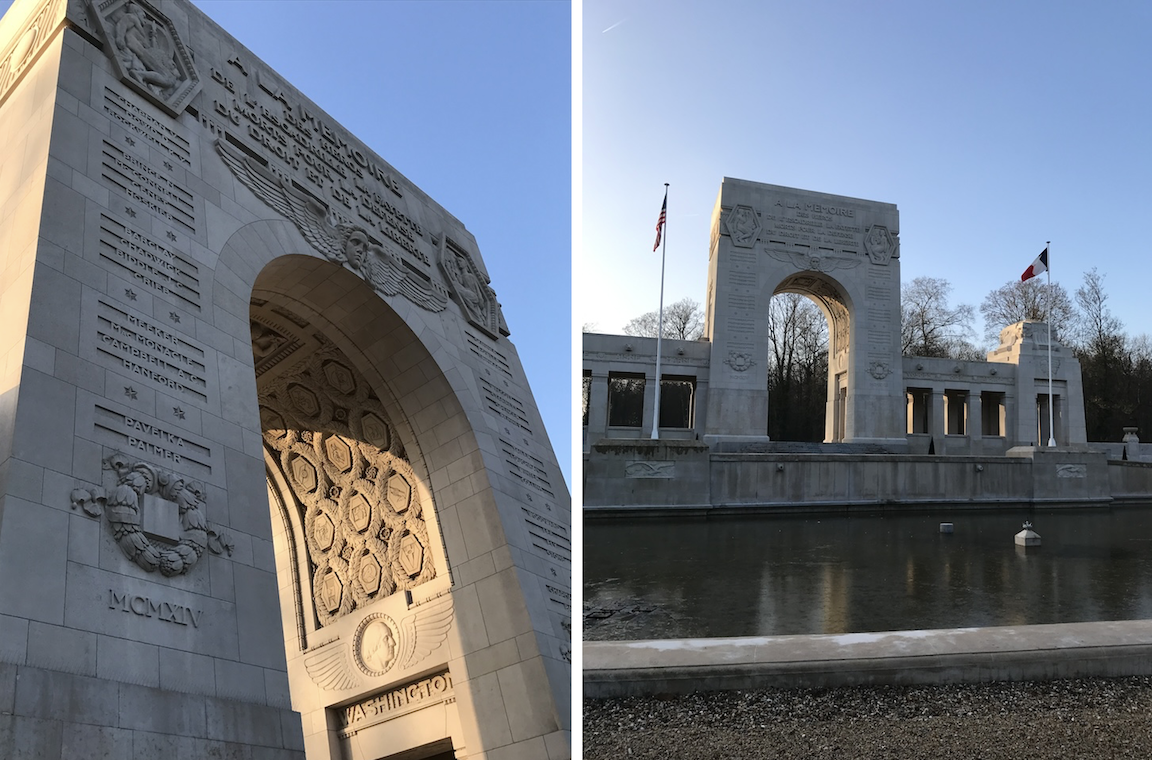
Mémorial Escadrille La Fayette, Domaine National de Saint Cloud
5 Bvd R. Poincaré - 92430 Marnes-la-Coquette (western suburb of Paris)
Photos: Thierry Chaunu (2016) © American Society of Le Souvenir Français Inc.
|
|
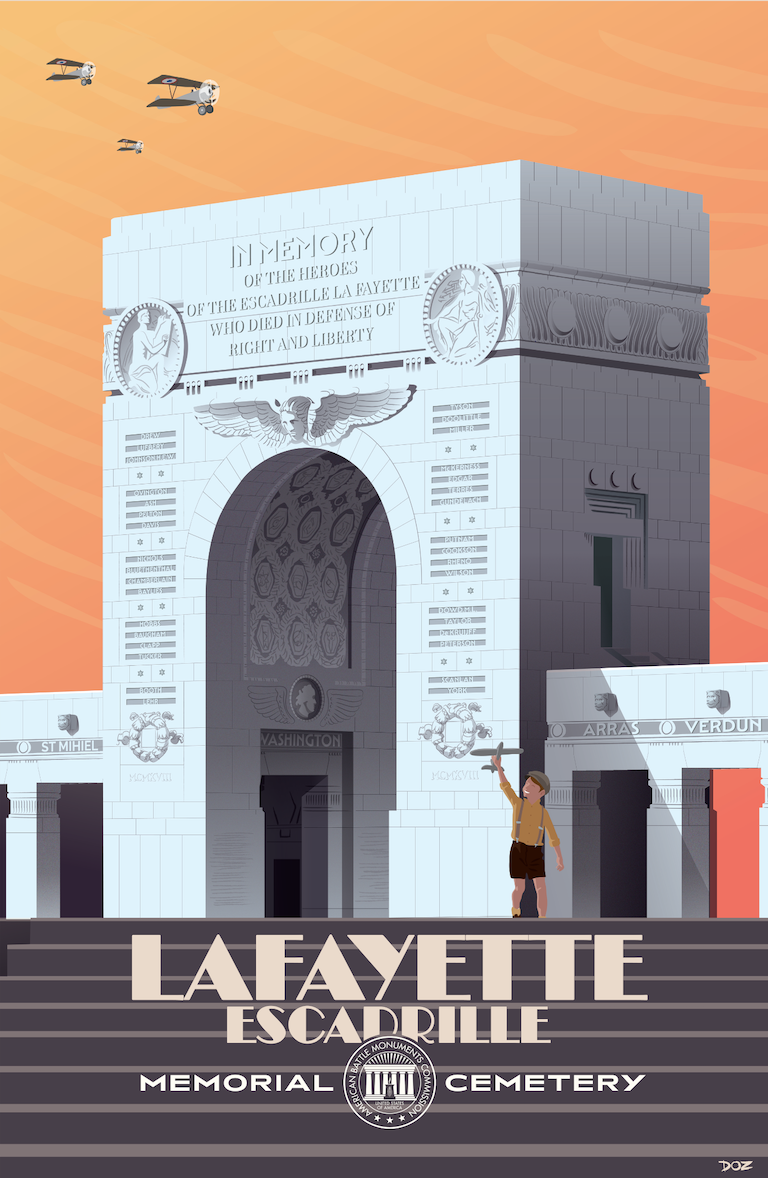
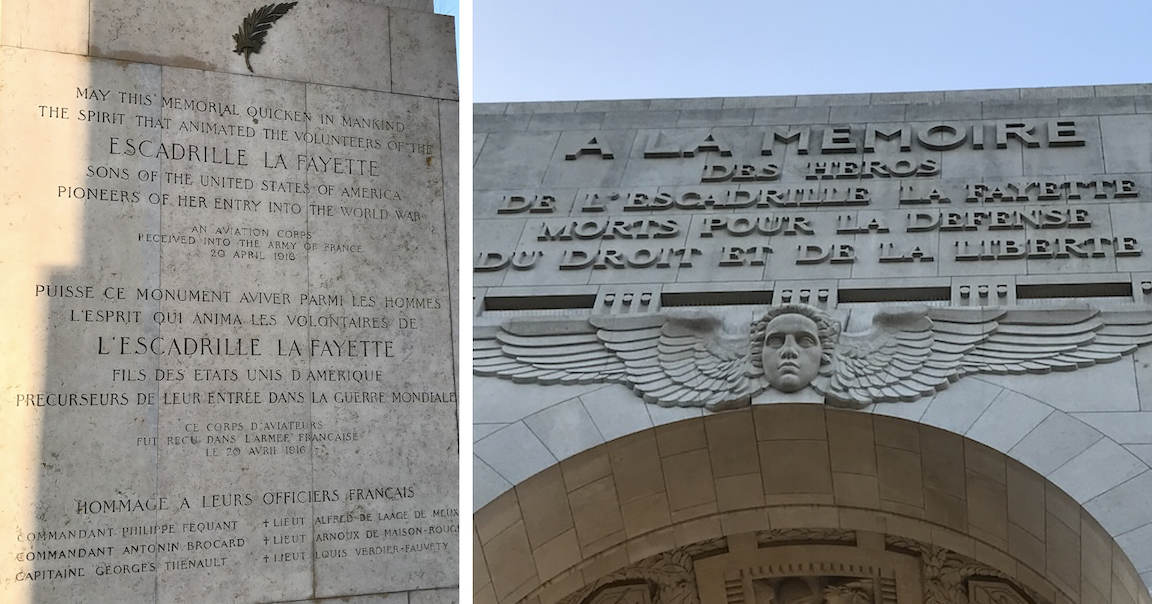
• The monument is composed of a central arch, which is half the size of the Arc de Triomphe in Paris. Carved into the stone are the names of the pilots who lost their lives in the Escadrille La Fayette and the La Fayette Flying Corps. Additionally, the names of the cities and regions where these pilots served are also inscribed. Underneath the monument, the crypt contains 68 sarcophagi, illuminated by 13 stained-glass windows created by Mauméjean. Among these windows, 11 depict battles in which the Escadrille La Fayette participated. Lieutenant-Colonel Thenault, the squadron's first leader, and General Brocard, both Frenchmen, made the decision to be buried alongside their American comrades in the crypt of the memorial. This act symbolizes the strong bond between France and the United States.
• The construction of the "La Fayette Escadrille" Memorial Arch took place from 1926 to 1928, with its official inauguration occurring on July 4, 1928, coinciding with the celebration of U.S. Independence Day. This significant event witnessed the notable attendance of Ferdinand Foch and Paul Doumer. The arch is adorned with an inscription in French, prominently displayed in capital letters at its pinnacle:
"In memory to the Heroes of Escadrille La Fayette dead for the Defense of Right and Liberty".
• Within this monument, the remains of America's first combat airmen are interred. These individuals willingly answered the call to fly and fight in the pursuit of freedom, not out of obligation, but because they believed it was the right thing to do. This is the tale of these courageous airmen and the restoration of the memorial that stands as a proud tribute to the selfless service and sacrifice of these young aviators.
• In the memorial crypt are 68 sarcophagi, one for each of the aviators of the Lafayette Flying Corps who lost their lives during World War I. Forty-nine of these aviators are entombed in the crypt along with two of their French commanding officers. The remainder rest in other locations, or their remains were never recovered
|
|
TRIBUTE TO MEMBERS OF THE ESCADRILLE LA FAYETTE WHO
"DIED FOR FRANCE"
We will introduce in this Bulletin the 11 fallen pilots "Morts Pour la France" whose names are inscribed in the French War Veterans plaques of Notre-Dame Church in Manhattan. We will do so in the chronological order of their deaths, with the exception of Norman Prince, co-founder of the Escadrille La Fayette, whom we will honor first.
We will pay tribute to the other pilots "Morts Pour la France" listed on the marble plaques, and who were part of the Lafayette Flying Corps, in future Bulletins
|
|
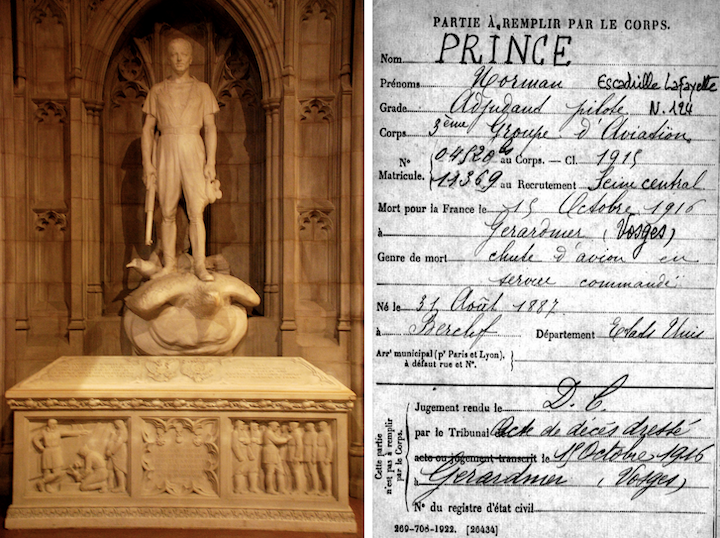
Norman Prince
Mort Pour la France, October 15, 1916, Gérardmer (Vosges)
|
|
• Norman Prince (August 31, 1887 – October 15, 1916) was an American aviator and leading founder of France's Lafayette Escadrille.
• Born on August 31, 1887, in Beverly, Massachusetts, Norman Prince was the son of Frederick Henry Prince. He attended the Groton School and graduated cum laude from Harvard College in 1908. Subsequently, he pursued his legal education at Harvard Law School, completing his studies in 1911.
• To conceal his flight training from his father, Prince assumed the alias 'George Manor'. As 'George Manor', he became the 55th American to be licensed to fly an airplane by the Aero Club of America. On August 28, 1911, at Squantum, Massachusetts, Prince successfully passed his flight test, piloting a Burgess aircraft equipped with a Wright motor.
• While practicing law in Chicago, Prince joined a group that aimed to construct and compete with a plane in the Gordon Bennett Cup Race. They enlisted the services of Starling Burgess, who built their aircraft in his boat yard located in Marblehead, Massachusetts, in 1912. Notably, in 1910, Norman's family acquired an estate in Pau, France, known as "Villa Ste. Helene". This estate, situated at 29 Avenue Norman-Prince, still exists today (it is the official residence of the Prefect of the Pyrénées-Atlantiques) and features a painting of Prince alongside an aircraft in the vestibule entrance. Alas, it is not open to the public. It is worth mentioning that the Wright Brothers had previously visited Pau, attracting significant attention through their publicized flights, passenger transportation, and pilot training activities.
• In January 1915, Prince, who possessed a high level of proficiency in the French language, as he spent his childhood summer vacations at his family's estate, embarked on a voyage to France, where he ultimately succeeded in persuading the French authorities to grant permission for the establishment of the American Escadrille (squadron) in April 1916.
• Captain Georges Thenault, the commander of the Escadrille, attributes the conception of the idea to Prince, who proposed the amalgamation of his compatriots with certain members of the French Foreign Legion in a squadron of aviators initially referred to as the Escadrille Américaine. Prince proceeded to assemble the squadron, enlisting the participation of William Thaw II, Elliot C. Cowdin, Frazier Curtis, Victor Chapman, and Greeley S. Curtis Jr.
• In an article published in the Harvard Alumni Bulletin on March 7, 1918, Elliott C. Cowdin unequivocally attributes the formation of this flying corps and its integration into the French flying service to the unwavering determination and tireless efforts of Norman Prince.
• Serving as a sergeant in the French air service, Prince actively engaged in 122 aerial combat encounters, officially achieving five victories. Additionally, it is believed that he successfully downed four more enemy aircraft, although these claims were not officially verified. It is worth noting that sources differ in their accounts of the number of aerial victories Prince attained, with estimates ranging from zero to five.
• Prince was bestowed with prestigious accolades for his valiant contributions, including the French Legion of Honor, Médaille Militaire, and Croix de Guerre.
• On October 12, 1916, Prince served as an escort during a bombing mission targeting the Mauser rifle works in Oberndorf, Germany. During this operation, he successfully shot down an enemy plane. Tragically, upon returning to his air base, Prince's landing gear collided with telegraph cables, causing his aircraft to overturn and crash.
• As a result of this catastrophic incident, Prince sustained severe injuries and succumbed to them on October 15, 1916. In recognition of his bravery and sacrifice, he was posthumously promoted to the rank of sous lieutenant and awarded the Legion of Honor.
• His remains were repatriated to the United States and interred in an elaborate tomb at the National Cathedral in Washington, D.C.
|
|
Left: Statue of Norman Prince at the National Cathedral, Washington DC, Public Domain,
Right: Excerpt of Norman Prince's Livret Militaire
|
|
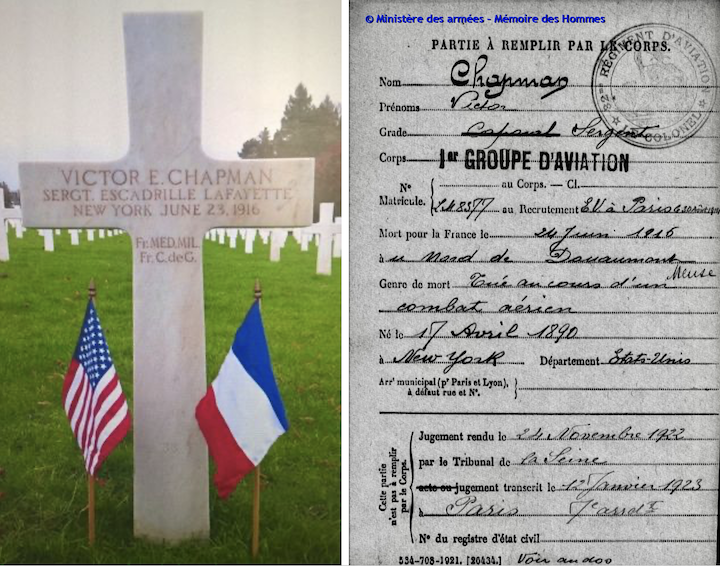
Victor Chapman
Founding Member and First Fatality
Mort Pour la France June 24, 2016 at Douaumont (Meuse)
|
|
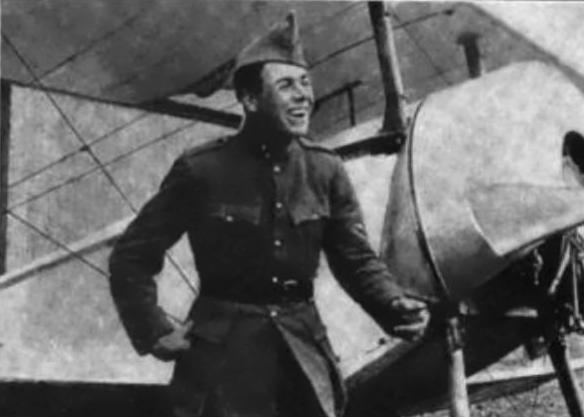
• Victor Emmanuel Chapman, born on April 17, 1890, and tragically perished on June 24, 1916, is renowned for his remarkable contributions as a French-American aviator during the course of World War I. Chapman is the first American pilot to have lost his life in this historic conflict.
• He was the great-great-great grandson of John Jay, first U.S. Chief Justice.
• Chapman, the offspring of the esteemed essayist John Jay Chapman and Minna Timmins, was born in New York City. His mother passed away in 1898, prompting him and his father to relocate to France. While residing in France, Chapman obtained dual-citizen status, being recognized as both a French and US citizen. Throughout his adolescence, his father entered into a union with Elizabeth Chanler, a member of the Astor family. At the age of 16, Chapman returned to the United States to pursue his education at Fay School (Class of 1903), St Paul's School in Concord, NH, and Harvard University. Upon the completion of his studies, Chapman ventured back to Europe, where he spent a considerable amount of time in France and Germany.
• During the outbreak of World War I, Chapman's father and stepmother relocated to London, England, while Chapman himself made the decision to remain in France. He joined the French Foreign Legion on August 30, 1914, and served in the 3rd March regiment of the Legion. Throughout his time in the trenches, Chapman developed a friendship with Edmond Genet, Norman Prince and Elliot Cowdin. When presented with an opportunity to fly in a fighter airplane. Chapman seized this chance and requested a transfer to the Aéronautique Militaire, the army's air arm. He underwent flight training and obtained his pilot certification.
• Chapman subsequently participated in numerous missions for the 1st Aviation Group and was eventually promoted to the rank of sergeant. He was selected as one of the original members of N.124, also known as the Lafayette Escadrille. On June 17, 1916, while flying over the Verdun sector, Chapman found himself under attack by four German aircraft. During the engagement, he sustained a head injury, likely inflicted by the then four-victory German pilot Walter Höhndorf. Despite his wound, Chapman skillfully landed his airplane, allowing Höhndorf to claim his fifth victory.
• While recovering from his injuries, Chapman received news that his friend Clyde Balsley had also been wounded in a separate incident. On June 24, 1916, Chapman loaded his aircraft with oranges, intending to deliver them to Balsley, who was recuperating in the hospital. As Chapman was en route to visit Balsley, he was once again attacked, this time by German flying ace Leutnant Kurt Wintgens, a close associate of Höhndorf. Engaging in combat with Wintgens, he was shot down and killed north of Douaumont.
• On the 4th of July, 1916, a commemorative ceremony was conducted in honor of Chapman. The event took place at the American Church in Paris and was attended by numerous individuals, including the American ambassador to France, American residents of Paris, and American soldiers stationed in France who were able to attend.
• Chapman received numerous medals and commendations. Chapman harbored a deep passion for the arts and writing. Interestingly, he often found himself inspired to write amidst the chaos of battle, resulting in a collection of letters addressed to his father. These letters were later compiled and published in a book titled Victor Chapman's Letters from France. In honor of his life and service, a cenotaph was erected in St. Matthew's Episcopal Churchyard in Bedford, New York.
|
|
Left: Victor Chapman's grave, Plot D Row 1 Grave 33. Meuse-Argonne Cemetery
Rue du Général Pershing, 55110 Romagne-Sous-Montfaucon, France
|
|
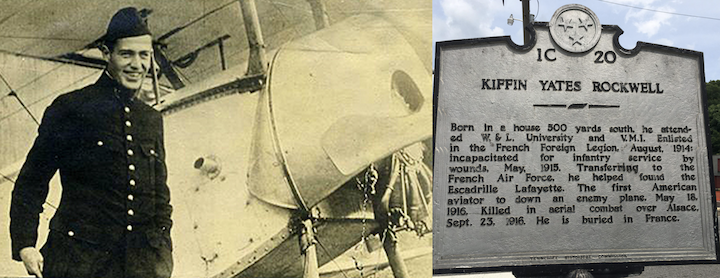
Kiffin Yates Rockwell
Mort Pour la France, September 23, 1916
|
|
Rockwell regulating his machine gun before flight, 1916. (National Air & Space Museum) |
|
• Kiffin Yates Rockwell, born on September 20, 1892, left for France in August 1914 at the onset of the war with his brother Paul. They were among the first three Americans to volunteer for service in the French Army. In April 1916 he became one of the founding members of the Escadrille. On May 18, 1916, Rockwell bravely engaged and brought down a German plane in the Alsace battlefield, thus making him the first American pilot to successfully shoot down an enemy aircraft during World War I. His extraordinary achievement earned him the prestigious Médaille militaire and the Croix de guerre, highlighting his exceptional valor and contribution to the war effort. He died tragically on September 23, 1916. His name appears on the wall of the Pantheon in Paris.
• He was born on September 20, 1892, in Newport, Tennessee. After his father's death from typhoid fever when he was six years old, the family moved often before eventually settling in Asheville, North Carolina. Kiffin grew up hearing his paternal and maternal grandfathers' tales of the American Civil War and learning fishing, hunting, and horse riding from them.
• He enrolled in Virginia Military Institute in the fall of 1908. However, he left for the United States Naval Academy in the following year. Eventually, he decided to join his brother Paul at Washington and Lee University in Lexington, Virginia.
• In 1912, Kiffin paused his studies and set off on a global exploration. He ventured to the Pacific Coast and Western Canada before eventually settling in San Francisco. At the young age of nineteen, he founded an advertising agency in San Francisco that employed twenty individuals. In 1913, Kiffin returned to Asheville and eventually joined his brother Paul at Massengale Advertising Agency in Atlanta.
• On August 3, 1914, Kiffin Rockwell and his brother Paul wrote a letter to the French Consul-General in New Orleans expressing their desire to serve France. Kiffin Yates Rockwell is believed to be the first American to have enlisted in military service alongside France at the start of the war, according to James Norman Hall's "History of the Lafayette Flying Corps." The Rockwell brothers did not wait for a response and instead boarded the SS St Paul in New York City on August 7, 1914, and sailed to Europe. Upon arrival, they joined the French Foreign Legion.
• Kiffin Rockwell was wounded in his leg during the charge of La Targette on May 9, 1915, while serving in the 1st Foreign Legion Regiment. After a six-week hospitalization, he fully recovered and went on convalescent leave in Paris, where he spent time with his brother Paul. Paul, who had suffered a severe shoulder injury earlier, was transferred to the Allied Press Mission of the French Army Grand Headquarters and worked as a war correspondent for the Chicago Daily News. Kiffin sought a transfer to France's air arm and was among the initial group of Americans to join the Lafayette Escadrille, which was authorized by the French Air Department on March 21, 1916. Paul assumed the role of a publicist for the squadron.
• On May 18, 1916, Rockwell piloted a Nieuport aircraft and successfully shot down a German two-man observation plane over the Alsace battlefield, despite facing motor difficulties. This made him the first American pilot to achieve an aerial victory by shooting down an enemy aircraft during World War I. As a result, Rockwell was awarded the Médaille militaire and the Croix de guerre in recognition of his accomplishment. On May 26, 1916, Rockwell's bravery was once again shown during the defense of Verdun.
• On September 23, 1916, Kiffin Rockwell, an American aviator, engaged in a dogfight with a German plane during his first mission after returning from leave. Regrettably, he was shot in the chest, resulting in his untimely death, making him the second American to be killed in aerial combat. Despite his tragic end, Rockwell was memorialized and honored in various ways in both France and the United States.
During his graveside service at the base at Luxeuil, French capitaine Georges Thenault, commandant of the Layfayette Escadrille, paid tribute to Rockwell's courage, stating that "His courage was sublime...The best and bravest of us is no longer here." In recognition of his bravery, Rockwell was posthumously awarded the Cross of the Legion of Honor.
• Additionally, the Veterans of Foreign Wars posts in Newport, Tennessee, and in Asheville were named in his memory, serving as a testament to his legacy as a courageous aviator.
|
|
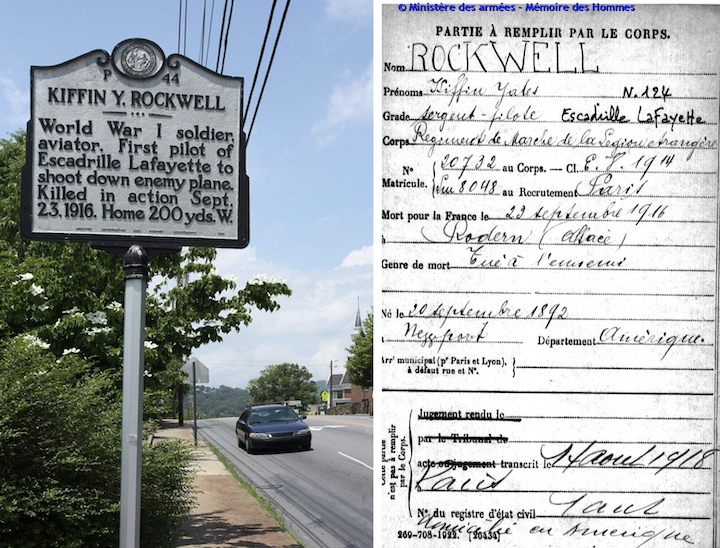
Markers, Kiffin Yates Rockwell |
|
Left: Marker at the intersection of Merrimon Avenue (U.S. 25) and Hillside Street, Asheville NC 28801
Marker 240-220 US-70, Newport, TN 37821
Right: Excerpt of Kiffin Rockwell's Livret Militaire
|
|
• Inscription:
" Born in a house 500 yards south, he attended W & L University and V.M.I. Enlisted in the French Foreign Legion, August, 1914: incapacitated for infantry service by wounds, May 1915. Transferring to the French Air Force, he helped found the Escadrille Lafayette. The first American aviator to down an enemy plane, May 18, 1916. Killed in aerial combat over Alsace, Sept. 23, 1916. He is buried in France.
Erected by Tennessee Historical Commission. (Marker Number 1C20.) "
• Inscription:
"World War I soldier, aviator. First pilot of Escadrille Lafayette to shoot down enemy plane. Killed in action, Sept. 23, 1916. Home 200 yds. W.Erected 1954 by Archives, Conservation and Highway Departments. (Marker Number P-44.)"
|
|
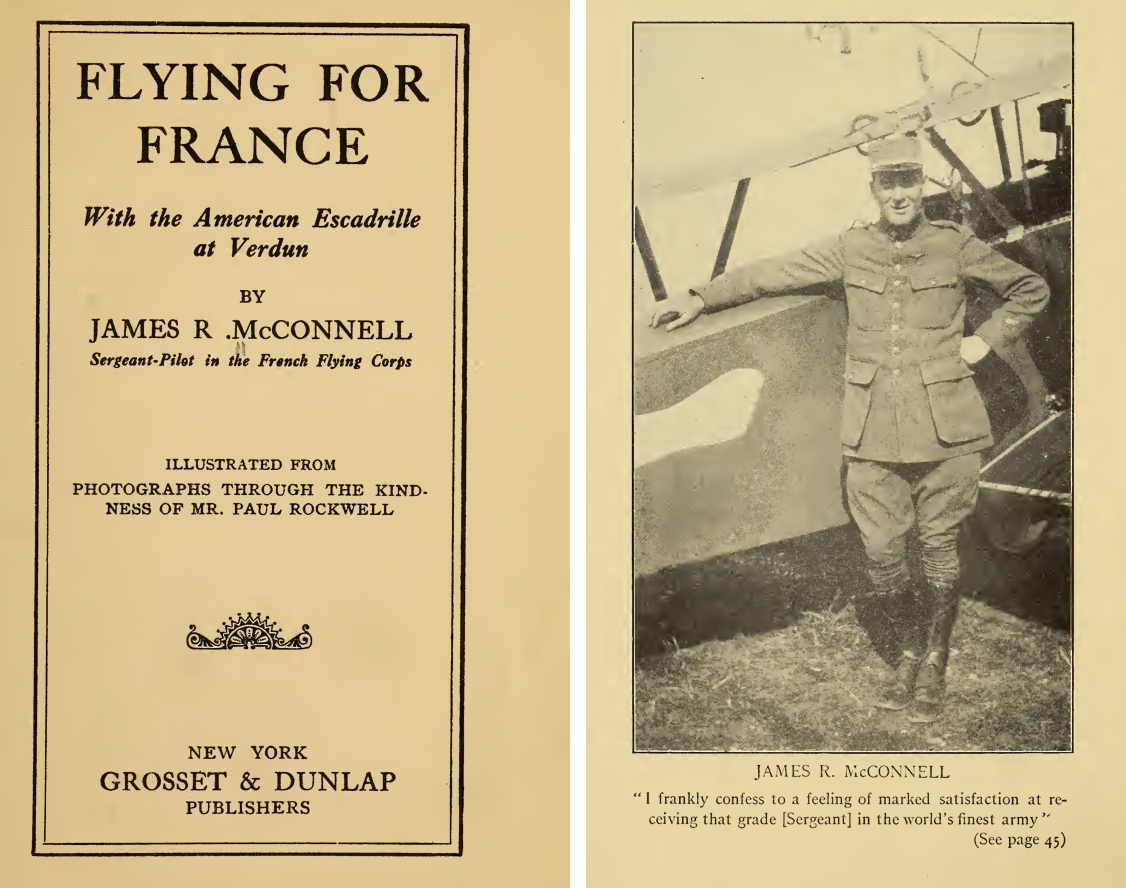
James Rogers McConnell
Author of "Flying for France"
Mort pour la France March 19, 1917 at Flavy-le-Martel, Aisne
|
|
Front cover and inside photo of "Flying for France, With the American Escadrille at Verdun", James R. McConnell, available in paperback at Amazon. This book inspired the film Flyboys (2006) by Tony Bill with James Franco, Martin Henderson and French actor Jean Reno.
|
|
• James Rogers McConnell born on 14 March 1887 in Chicago, was the son of Judge Samuel Parsons McConnell and Sarah Rogers McConnell. After his father's resignation from the bench, the family relocated to New York City and later to Carthage, North Carolina. James received his education from private schools in Chicago, Morristown, N.J., and Haverford, Pa. In 1908, he enrolled at the University of Virginia, where he spent two undergraduate years and one year in the law school. During his time at the university, he founded an "aero club". In 1910, James left law school and joined his family in Carthage, where he worked as the land and industrial agent of the Seaboard Air Line Railway and secretary of the Carthage Board of Trade. Additionally, he wrote promotional pamphlets for the Sandhills area of North Carolina. James never married.
• Additionally, he authored the notable work titled "Flying for France." McConnell holds the distinction of being the initial casualty among 64 University of Virginia students who lost their lives in combat during the war.
• During the outbreak of war in Europe, McConnell expeditiously arrived at the conclusion, as articulated in the introduction to his book, Flying for France, that the war was transitory and the sand hills would persist indefinitely, compelling him to opt for joining the American Ambulance Corps in France in January 1915. In a correspondence to an acquaintance during that same year, McConnell conveyed his enthusiasm regarding his deployment to the front alongside his unit and twelve ambulances, depicting the encounter as magnificent. His valor in rescuing a wounded French soldier amidst hostile fire merited him the Croix de Guerre from France.
• McConnell's dissatisfaction with his role in the Ambulance Corps and America's stance on the war prompted him to withdraw from the Corps and enroll in the aviation training program. He held the belief that the United States should take an active role in the fight against Germany and felt a strong urge to do more than just drive an ambulance. His desire to contribute was further intensified by witnessing the valor of the French in battle, as he did not want to be perceived as a shirker. Consequently, McConnell made the decision to pursue aviation as a means of fulfilling his patriotic duty.
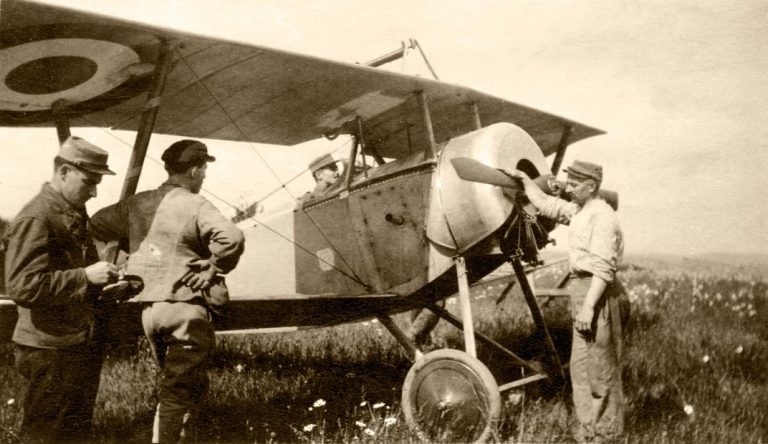
• On May 13, 1916, McConnell took part in his unit's inaugural patrol. The Lafayette Escadrille, consisting of thirty-eight pilots flying Nieuport biplanes at a speed of 110 miles per hour, operated from Luxeuil Field in eastern France. Each day, they embarked on two-hour patrols at dawn, dressed in fur-lined outfits. Initially, the planes were not equipped with machine guns, and pilots had to fire them manually while steering. It was only after the Battle of Verdun that the planes were fitted with synchronized 500-round Vickers machine guns, replacing the previous 47-round Lewis models. During his recovery from a back injury sustained in a landing accident, McConnell found the time to write his book, Flying for France.
• After enduring a severe back injury resulting from an unfortunate landing incident, McConnell dedicated a period of time to documenting his wartime encounters. The book "Flying for France" delves into McConnell's personal journey with the Escadrille, encompassing his training phase and eventual involvement in the Battle of Verdun. Within the text, McConnell highlights the implementation of stringent rules and regulations, while also acknowledging the substantial degree of autonomy granted to individuals, stating that their time was their own, except when engaged in flying or on guard duty. At the onset of the war, skepticism prevailed regarding the feasibility of American involvement in the French aviation service. However, by the autumn of 1915, six Americans had assumed the role of fully-fledged pilots, and by the summer of 1916, this number had expanded to a roster of fifteen or more, with twice that amount undergoing pilot's license training in military aviation schools. As American soldiers, McConnell and his comrades were treated with reverence and received exceptional consideration from the French Government.
• McConnell's tragic demise occurred on March 19, 1917, when he was flying over the St.-Quentin area and was shot down by two German planes. Remarkably, McConnell held the distinction of being the final American pilot from his squadron to perish under the French flag before the United States entered World War I in April of the same year. The French authorities discovered both his aircraft and his lifeless body, in a meadow on the outskirts of the village of Jussy. As per his father's wishes, McConnell was initially laid to rest there before being reinterred at the Lafayette Escadrille memorial near Paris.
• A statue sculpted by Gutzon Borglum can be seen at the University of Virginia, serving as a lasting tribute to his bravery. Furthermore, an obelisk bearing an inscription paying homage to his unwavering commitment to "Humanity, Liberty, and Democracy" was erected on the court square of his hometown, Carthage, North Carolina.
• In his final letter, found among his effects, McConnell wrote: "My burial is of no import. Make it as easy as possible on yourselves. I have no religion and do not care for any service. If the omission would embarrass you, I presume I could stand the performance. Good luck to the rest of you. God damn Germany and Vive la France."
In a fitting tribute to McConnell's memory, the Gilliam–McConnell Airfield was constructed in Carthage, North Carolina in 1994. This airfield was named in part as a homage to McConnell, forever immortalizing his legacy.
|
|
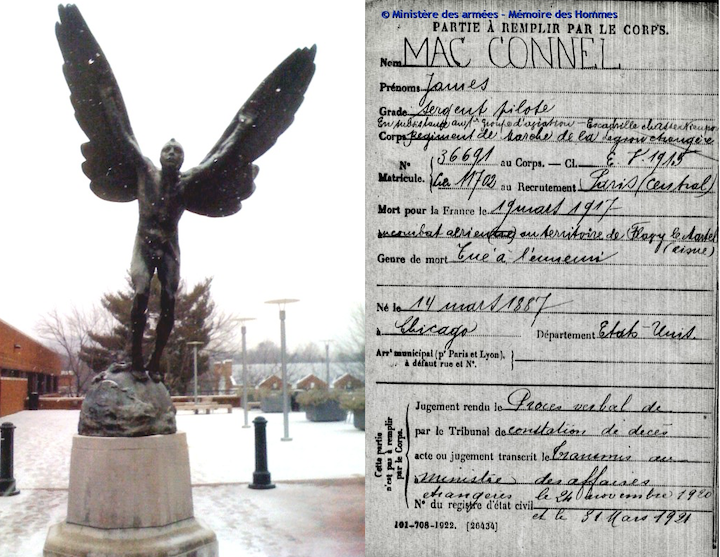
Left: Statue "The Aviator", University of Virginia, Clemens Library Plaza
160 McCormick Rd, Charlottesville, VA 22903
Right: Excerpt of James McConnell's Livret Militaire
|
|
Markers & Plaques, James McConnell, Carthage, North Carolina |
|
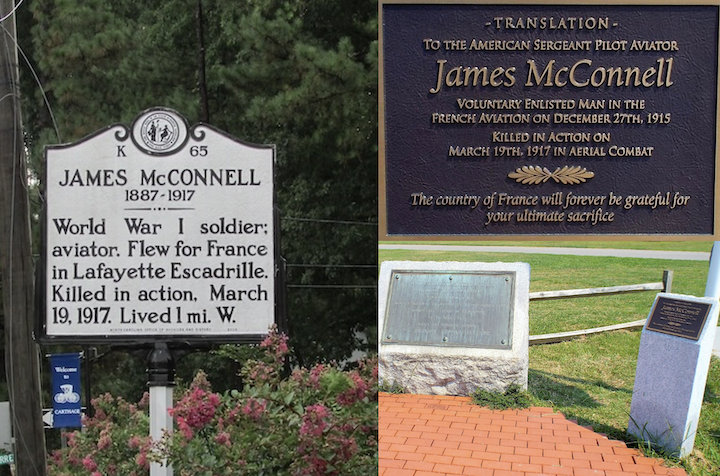
Left: Historical marker on Highway 27 in Carthage North Carolina commemorating local son and World War One aviator-hero James R. McConnell, who left the U.S. to enlist with the French Lafayette Escadrille, prior to the U.S. entry into WWI. He was killed in action in March, 1917.
204 McReynolds Street, Carthage NC 28327
Right: Flanked by the flags of the state and the nation, with a new bronze marker bearing a translation of the French message, McConnell's memorial was dedicated at last by his niece, Janice McConnell. She had flown from her home in San Diego to be present for the occasion. This ceremony was special, as it marked the unveiling of a new site by the runway at Gilliam McConnell Airfield for a bronze plaque sent by France in 1917 expressing the gratitude of the French people to "the American Sergeant pilot aviator" that voluntarily enlisted Dec. 27, 1915 and died "on the field of honor March 19, 1917 in aerial combat."
194 Gilliam McConnell Rd, Carthage, NC 28327
|
|
• Inscription of marker:
"World War I soldier; aviator. Flew for France in Lafayette Escadrille. Killed in action, March 19, 1917. Lived 1 mi. W.
Erected 2009 by North Carolina Office of Archives and History. (Marker Number K-65.)"
• Inscription of stele and bronze plaques:
"The monument dedicated to Jacques (sic) MacConnell (sic) is a bronze plaque placed on a slanted slab of granite. The monument faces away from the property and is surrounded by rocks. To the right of the monument is a sign translating the French inscription on the original plaque. The inscription on the plaque honors MacConnell’s (McConnell's) service to France during WW I."
(Text from original French):
"Au Sergent Pilote Aviateur Americain
Jacques Mac Connell
Engagé Volontaire
Dans L'Aviation Française Le 27 Decembre 1915
Tombé Au Champ D Honneur
Le 19 Mars 1917
Dans Un Combat Aérien
La France Reconnaissante"
Erected 1917.
-Translation-
"To the American Sergeant Pilot Aviator
James McConnell
Voluntary Enlisted Man in the
French Aviation on December 27th, 1915
Killed in Action on
March 19th, 1917 in Aerial Combat
The country of France will forever be grateful for your ultimate sacrifice"
• Inscription of marker:
"In January 1915 James Roger McConnell left Carthage, N.C. For N.Y. And sailed to France. He volunteered in the American Ambulance Service as an ambulance driver. He was awarded the much coveted Croix de Guerre for Bravery Under Fire. He later joined the French Flying Corps and was one of the world's first fighter pilots by the Fall of 1915. McConnell was the 4th of seven original founders of the world famous Lafayette Escadrille. (N 124), known as the “Darlings of the Air”. McConnell was shot down and killed by 2 German airplanes as he was pursuing another “Boche” plane on March 19th, 1917. He was the last of the group killed before the U.S. entered the war. He just had his 30th birthday a week before. His very good friend, Kiffin Rockwell from Asheville, N.C. Was also one of the founders and was killed before McConnell. McConnell wrote the book “Flying for France”. It was published just before his death in 1917. Another Croix de Guerre was awarded after his death. He is buried outside Paris in the Lafayette Escadrille Memorial. This monument was sent by the French Government in late 1917. It was placed at the James Rogers McConnell Hospital at Farm Life School in rural Moore County, N.C. The well could not supply enough water and the hospital and monument were moved to Pinehurst, N.C. Later it was moved to the old Town Hall in Carthage. In 2010 the Carthage Town Board approved a request by Roland Gilliam to relocate the monument to his airport. The airport is names Gilliam-McConnell Airfield. The James Rogers McConnell Chapter of the Experimental Aircraft Association is headquartered here. Plans are to build a museum bearing his name across the runway. Roland and Nancy Gilliam donated the land that this memorial occupies to the Town of Carthage."
|
|
Edmond Charles Genet
Mort pour la France, April 16, 1917 at Clastres (Aisne)
|
|
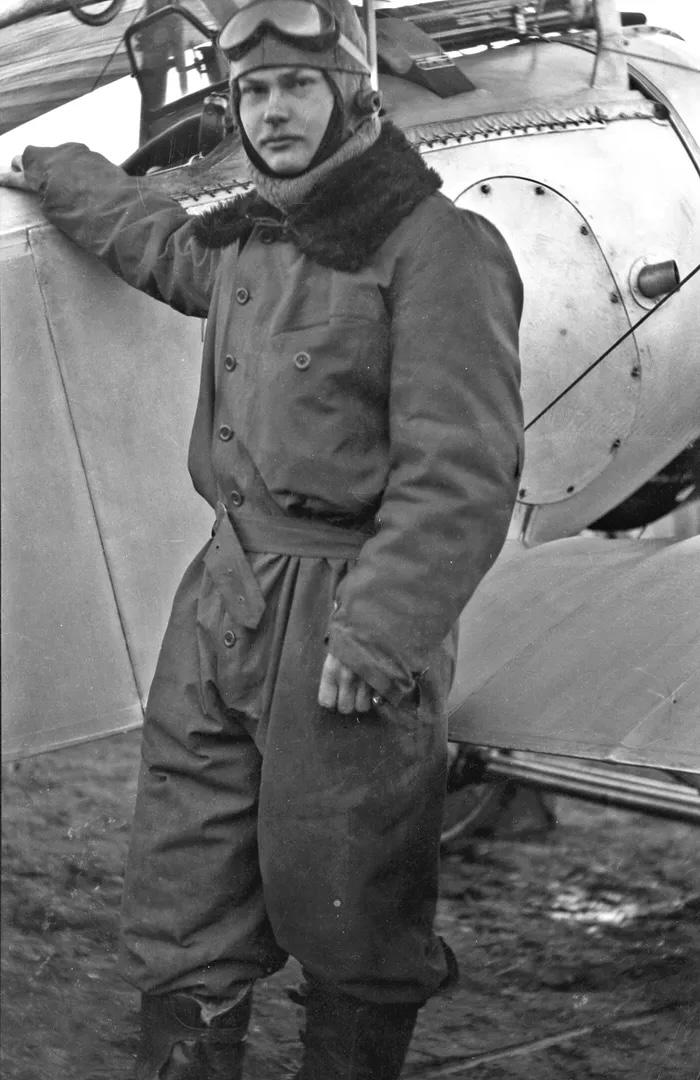
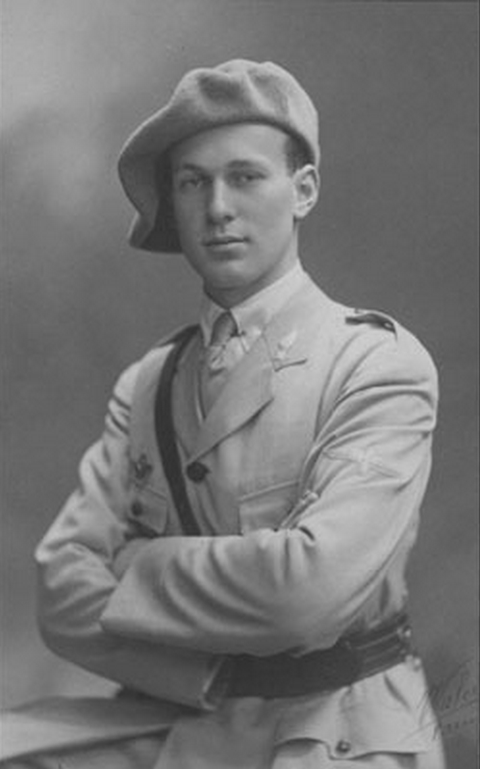
Edmond Charles Clinton Genet circa 1917 posing by his Nieuport type 17
|
|
Genet had deserted from the US Navy in 1915 to travel to France and fought for over a year with the French Foreign Legion in the trenches of eastern France. After six months of training, he joined the Lafayette Escadrille.
• Genet was born on November 9, 1896, in Ossining, New York. He was the youngest of three sons, and both his brothers served in the military during the First World War. His father was a lawyer, and his mother was involved in various organizations, including the Daughters of the American Revolution. Genet's education took place at Mt. Pleasant Military Academy. Additionally, he was the second great-grandson of Edmond-Charles Genêt, the controversial French Ambassador to the United States during the French Revolution in 1793.
• Genet interviewed for acceptance as a cadet at the US Naval Academy but failed mathematics and was subsequently rejected. He was then encouraged to join the US Navy and was assigned to USS Georgia, which was deployed to Port au Prince, Haiti. While stationed there, Genet learned about the outbreak of war in Europe. In late December, he was granted a ten-day leave but failed to return, as he had made the decision to travel to France and fight against the Central Powers. To obtain a visa, Genet falsely claimed to be twenty-one years old to the French visa official. Similarly, he secured a passport by lying about his intentions, stating that he was only going to France to inquire about his family's estate. Genet remained silent until he had obtained all the necessary documents. Just before departing on SS Rochambeau, he wrote letters to several friends and family members, expressing his belief that he would not survive the conflict.
• On January 14, 1915, Genet wrote to his mother, stating, "I never expect to come back—death seems nearer to me than any possible chances of going through the horrible ghastly conflict which is raging over Europe without meeting death. I do not fear when I think of it, Mother. I can give my life just as freely for the Tricolor as I can for Old Glory."
• Genet arrived in Le Havre, France on 29 January. He joined the French Foreign Legion and underwent training in Lyon, where he developed a friendship with Norman Prince.
• Genet spent several months in the trenches. During the Second Battle of Champagne on September 25, he found himself leading the attack alongside only one other legionary. Recognizing that the advance had been halted, they made the decision to retreat to their trench. Unfortunately, the other legionary was injured or possibly killed during their return. Remarkably, Genet was one of the 31 men out of 500 who emerged from the battle unharmed. The French suffered approximately 190,000 casualties in just three weeks of fighting.
• Genet finally got his wish of flying. Following persistent efforts by Norman Prince, the French military agreed to establish the Lafayette Escadrille. Genet became a member of this squadron one year after its establishment. After a year in the Legion and over eight months of applying, he was accepted to aviation school to become a pilot and joined the Escadrille on 22 January 1917. Within a few days, Genet received his own Nieuport 21 fighter to use on his first mission on 29 January.
• Genet, a skilled artist, adorned the Escadrille mess hall with his depictions of aerial combat. One wall proudly displayed the Indian head, which eventually became a symbol of the Escadrille.
• Genet passed away in France on 17 April 1917 at the age of 20, having completed 37 sorties. The day before, on 16 April, he flew a mission in the morning but felt unwell upon his return. Despite being advised against flying again that day, he insisted on taking off once more. Gervais Raoul Lufbery, an experienced pilot and member of the squadron, flew alongside Genet as his wingman. Unfortunately, due to low-cloud conditions, they descended and became vulnerable to anti-aircraft fire. Lufbery witnessed Genet making a turn but lost sight of him in the clouds. Upon Lufbery's return to the base, the squadron received news that Genet had crashed on a road located 5 km (3.1 mi) from the French lines. It was suspected that Genet had been injured by the anti-aircraft fire and subsequently lost consciousness. The severity of the crash, which occurred at full-engine power, resulted in extensive damage to Genet's body, making it difficult to determine if he had sustained any wounds.
• Genet was buried with full military honors in the military cemetery at Ham, Somme, in a driving snowstorm. His final wish was to be buried wrapped in the French flag and have his coffin be covered with the French and American flags to "show that I died for the two countries".
• After the war, Genet and other members of the Lafayette Escadrille were buried at the La Fayette Escadrille Memorial Cemetery in Marnes-la-Coquette, outside of Paris. Genet had lied about his age to the passport officer, causing his commanding officer Georges Thenault to believe he was four years older than he actually was. Thenault expressed shock in a letter to Genet's mother upon learning that Genet was only 20 years old at the time of his death, despite appearing much younger. Despite his "technical" act of desertion, the Secretary of the US Navy issued an honorable discharge.
• The American involvement in World War I began on 6 April. Although not a member of the US military at the time, Genet is widely regarded as the first American casualty following the declaration of war between the US and Germany.
|
|
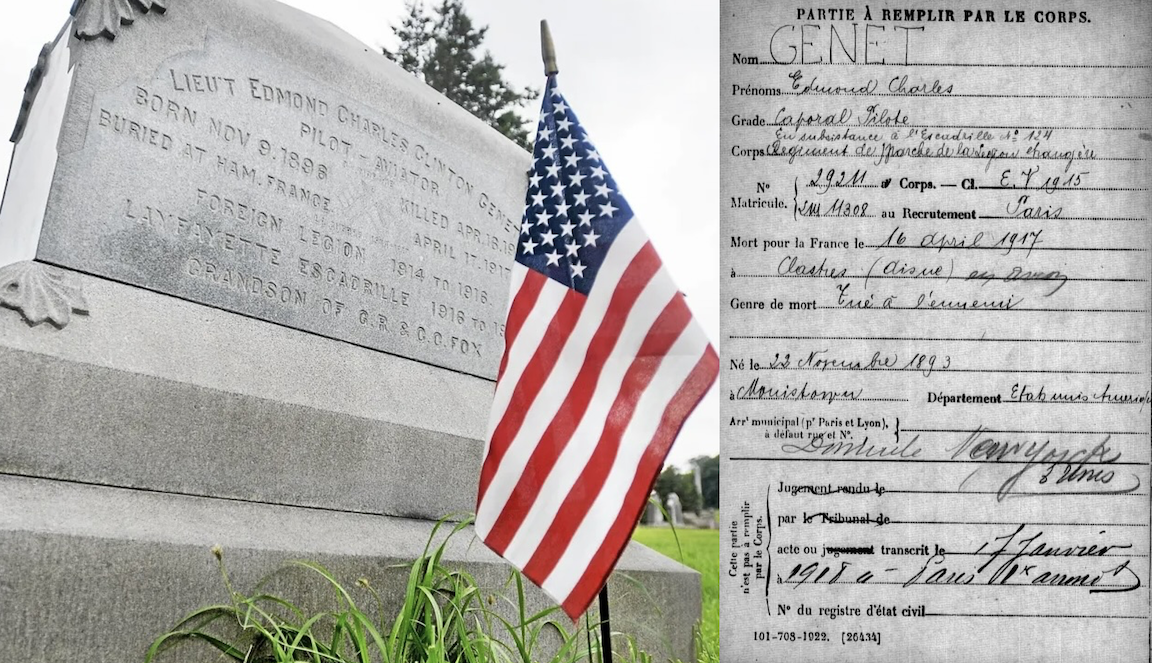
Left: Monument to Lt. Edmond Charles Clinton Genet at Montgomery Cemetery in Norristown
1 Hartranft Ave, Norristown, PA 19401
Right: Excerpt of Edmond Genet's Livret Militaire
|
|
Ronald Hoskier
Mort pour la France, April 23, 1917 at Grugies (Aisne)
|
|
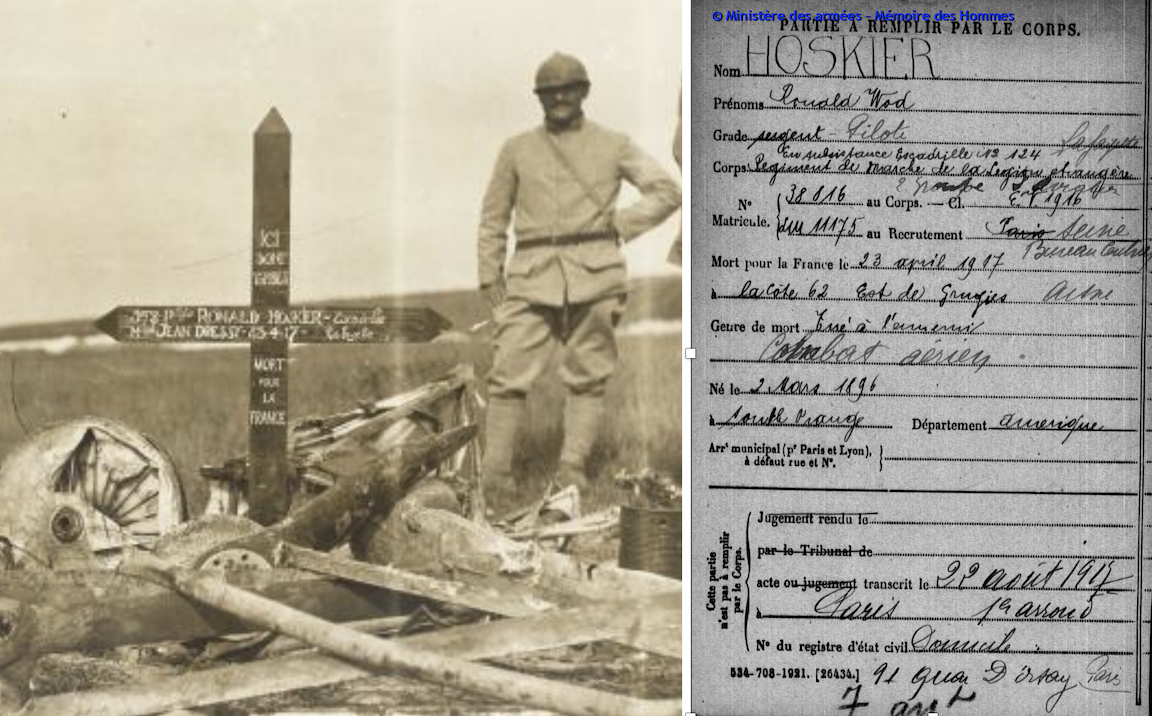
• Sgt Ronald Wood Hoskier was born 21 Mar 1896 at South Orange, Essex County, New Jersey. He was educated at St. George’s School in Newport, RI, and began college at Harvard in the fall of 1914. Hoskier left Havard in February 1916 to join his parents in Europe and served (like his parents) in the Norton-Harjes Ambulance Corps. He then transferred to the French Foreign Legion. He earned his brevet, on Aug 13, 1916, and on Dec. 11, 1916, he joined the Lafayette Escadrille.
• Hoskier flew numerous missions with the Escadrille, including many sorties from French to German territory. During a mission in April 1917 near St. Quentin, France, Hoskier found himself separated from his fellow fliers and encountered an enemy Albatros D III. Despite being attacked, Hoskier engaged in a 15-minute fight while his co-pilot manned the rear Lewis guns. Hoskier was hit in the head and his plane crashed just inside French lines.
• He received the Croix de Guerre on May 1, after his death. The New York Times praised him as one of the top American flying corps members. Initially, he was laid to rest in Ham, France, alongside fellow Lafayette Escadrille pilot Edmond Genet. Later, both his and Genet's remains were eventually moved to the Lafayette Flying Corps Memorial near Paris.
• Ronald Hoskier’s writing describes the joy of flight. “Had I crossed to France merely to learn to fly, I could have fallen upon no more wonderful opportunity”.
• He was the second American pilot to die after the official entry of the United States into the war.
|
|
Left: Gravesite on site crash at Grugies (department of Aisne) with remnants of the plane. On the wood cross is written: "Here fell - Sergeant Pilot Ronald Hoskier, Machine Gunner Jean Dressy - 23-4-17 - Escadrille Lafayette - Died for France"
Right: Ronald Wood Hoskier's Livret Militaire
|
|
Andrew Campbell
Mort pour la France le 30 septembre 1917,
Région de Long Pargny (Aisne)
|
|
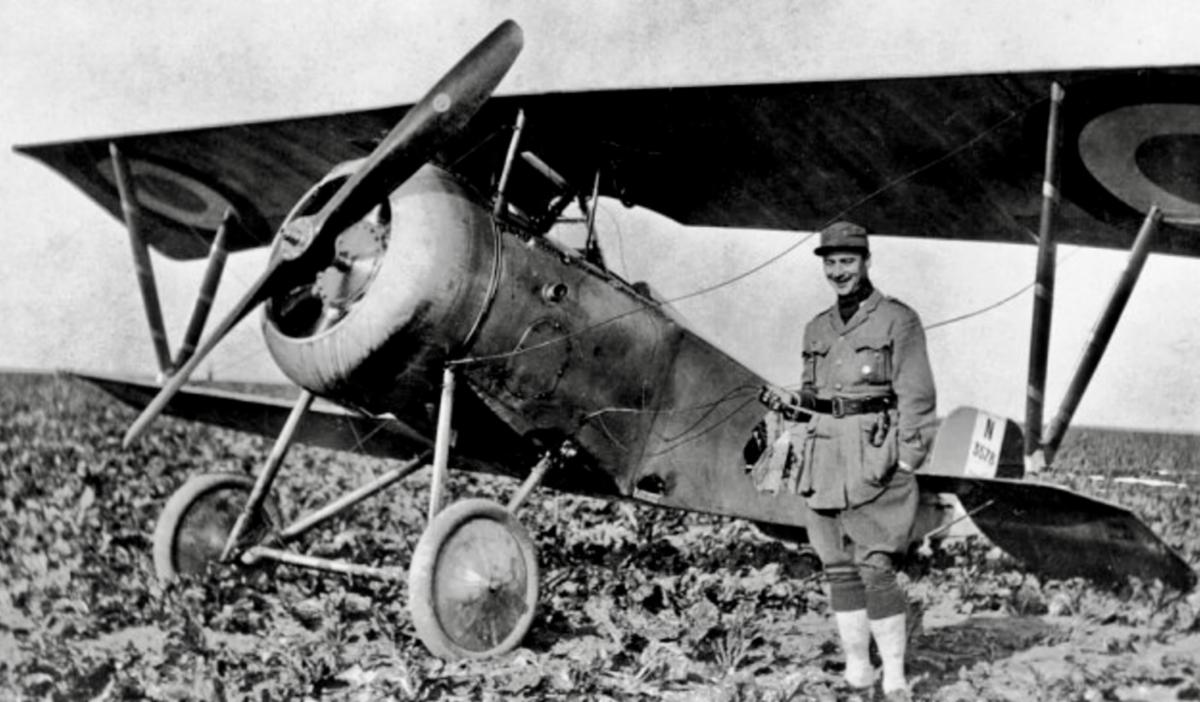
Photo: Nieuport 23 n° 3578 of Sgt Andrew C. Campbell placed in a field 10 km from Chaudun, after losing the lower left wing of his biplane, July 7, 1917-
After miraculously landing his Nieuport fighter that had just lost a wing in flight, Courtney Campbell emerged. Despite the traumatic event, he was able to function. Unfortunately, Campbell would later be killed in action. (Washington & Lee University Archives)
|
|
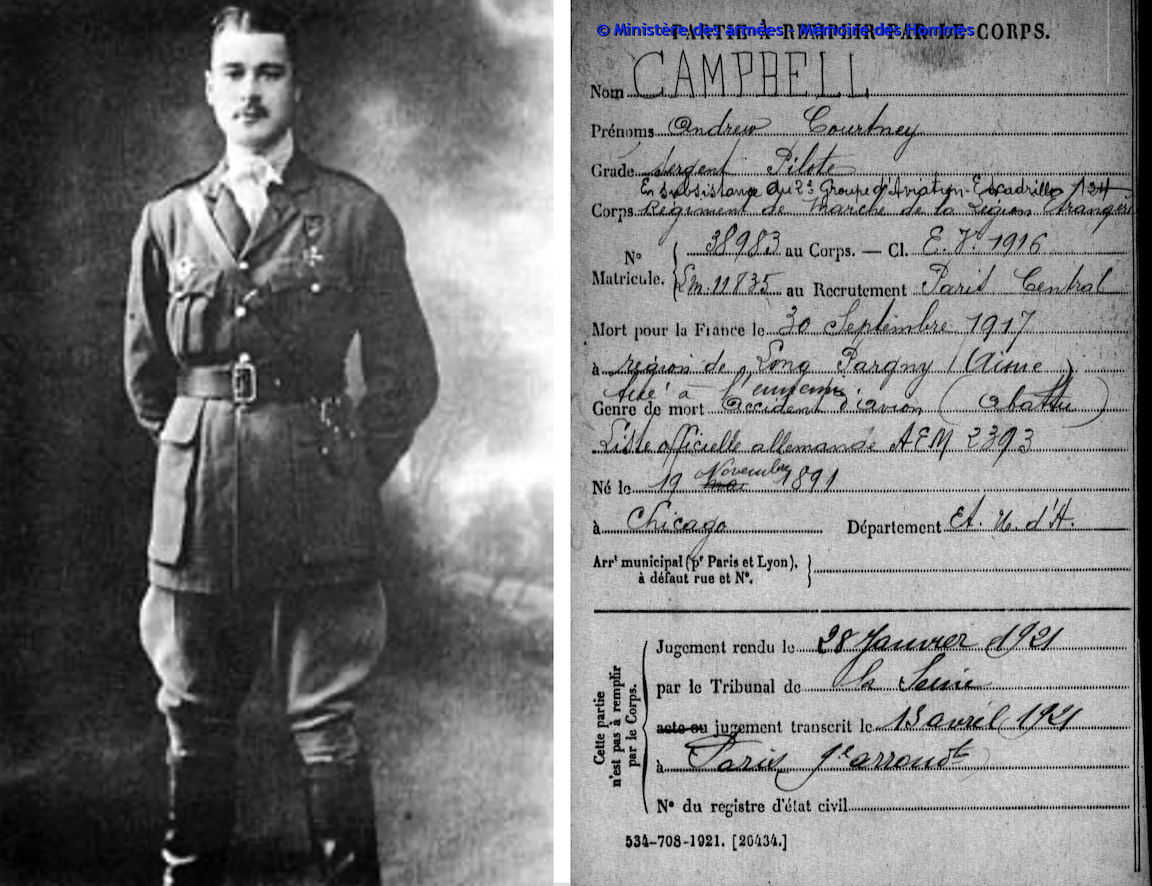
• Andrew C. Campbell, born on November 19, 1891 in Chicago, Illinois, attended New Trier High School in Winnetka and Mercersberg Academy in Pennsylvania before enrolling at the University of Virginia. In June 1916, he traveled to France and completed flying school at Buc, Juvisy, Avord, Cazeaux, Pau, and Plessis-Belleville. At Juvisy, he was the first American to graduate and achieved the highest scholastic ability. Campbell was assigned as a pilot to the French Lafayette Escardrille and began daily expeditions over Germany on May 30, 1917.
• During the test flight of a newly developed engine in his Nieuport 17 aircraft, Campbell executed a snap-loop maneuver after a brief descent. However, at the apex of the loop, he exerted excessive stress on the aircraft, resulting in the detachment of the bottom-left wing. Despite this, Campbell skillfully employed a combination of flight controls and engine torque to successfully land the aircraft in a field located six miles away from his aerodrome. A photograph accompanying this text depicts Campbell proudly posing beside his Nieuport aircraft, now equipped with three wings, in the middle of a field of beets.
• He had a reputation for recklessness and was a nuisance in the air, especially during patrols. He would fly too close to others in formation, even after being waved off. Despite pre-flight counseling and threats, he continued to do it every flight. One day, he went too far and almost caused a serious incident. While on patrol with Lieutenant Maison Rouge, he flew directly over Maison Rouge's aircraft, causing his wheels to get stuck in the fabric of Maison Rouge's upper wing. They were unable to communicate or pull away from each other, and Campbell had to use brute force to rip away, tearing apart Maison Rouge's upper wing.
• On October 1, 1917, on the western front north of Soissons, not far from Pargny, Henry Jones and Courtney Campbell ran into four German Albatross. Jones fought his way out, but Campbell was never seen again. He would be the last member of the Lafayette Escadrille to die while the unit was in French service.
|
|
Left: Andrew Courtney Campbell
Right: excerpt of Livret Militaire,
|
|
Paul Pavelka
Mort pour la France November 11, 1917
Salonika (Greece)
|
|
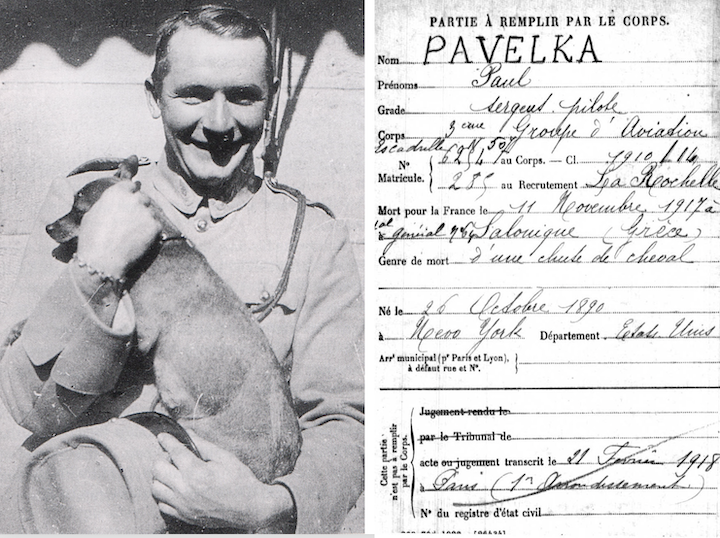
• Paul Pavelka, born in New York City (Bronx) on 26 October 1890, was the son of Hungarian immigrant parents named Paul and Anna Pavelka. The parents had emigrated to New York City and later settled in Madison, where they acquired a small farm on Copse Road. Tragically, Anna Pavelka passed away in 1907 after an unfortunate accident involving a pitchfork. Speculation arose that her husband may have been responsible, as he remarried a beautiful young local woman shortly after her death. Discontent with his stepmother, young Paul left the family home during his teenage years.
• Paul Pavelka ventured to the West, assuming roles as a cowboy and a cook. During his time there, he honed his skills as a skilled horseman. Subsequently, he transitioned to a nursing position at a hospital in San Francisco. Always seeking adventures, Pavelka embarked on a maritime career, sailing the vast oceans. Among his many nautical exploits, he encountered a shipwreck near the South American shoreline, necessitating a journey on foot across the entire continent.
• Paul Pavelka eventually ended up in New York City. World War I broke out, prompting him to seek more adventure in France. He joined the French Foreign Legion and served in the trenches of the Great War. During his service, he became friends with Paul and Kiffin Rockwell, fellow American adventure-seekers from North Carolina. In fact, he likely saved Kiffin Rockwell's life by bandaging him after Rockwell was shot in the leg on May 9, 1915. Pavelka himself suffered a bayonet wound in the thigh in June of 1915 but continued to fight until he decided to join the Rockwell brothers at the Lafayette Escadrille.
• In August 1917, Pavelka's Nieuport caught fire while flying. This was a terrifying situation for early aviators, as they did not have parachutes. However, Pavelka cleverly "wing-slipped" his plane to reduce the impact of the flames in the cockpit. He successfully crash-landed into a swamp and escaped before the plane exploded. Remarkably, the brave Madison native was back on patrol the following day.
• Paul Pavelka volunteered for duty when the French Army of the Orient started the Macedonian front in Greece and was decorated for successful missions. On November 11, 1917, when Paul found out that a former comrade from the Foreign Legion was serving as an English cavalryman in a nearby regiment, he decided to pay him a visit. On the same day, new horses had arrived at the regiment, and Pavelka, who was skilled in horse riding from his summers in the American West, asked his friend for permission to ride one of the horses. Always up for a challenge, Paul chose a horse with a vicious nature that was believed to be impossible to ride. A crowd gathered to witness "the Yank bronco-buster" mount the horse while a stable sergeant held onto the reins tightly. Once released, the horse reared, tossed, and bucked violently but failed to throw Pavelka off. Realizing that it couldn't get rid of its rider, the horse forcefully fell to the ground and rolled in the dust, crushing Pavelka underneath.He tragically passed away the next day, on November 12, 1917.
• The citation for his French Croix de Guerre with Palm personally signed and awarded by General Sarrial mentioned how "he has given every proof of eagerness to fight and devotion; has had numerous combats, frequently with his machine riddled with bullets."
• Sergent Paul "Skipper" Pavelka's body was initially buried at Saloniki with full military honors. His body was removed from the Zietenlick Cemetery in Salonika, Greece to Marseilles, and in 1928 to a crypt in the Lafayette Escadrille Memorial near Paris where it rests today in the company of his fallen comrades.. He was only 26 years old.
|
|
Left: Paul Pavelka, "The Lafayette Flying Corps: The American Volunteers in the French Air Service in World War One," by Dennis Gordon. Schiffer Military History, Atglen, PA: 2000. Pages 347-353.
Right: Paul Pavelka's Livret Militaire
|
|
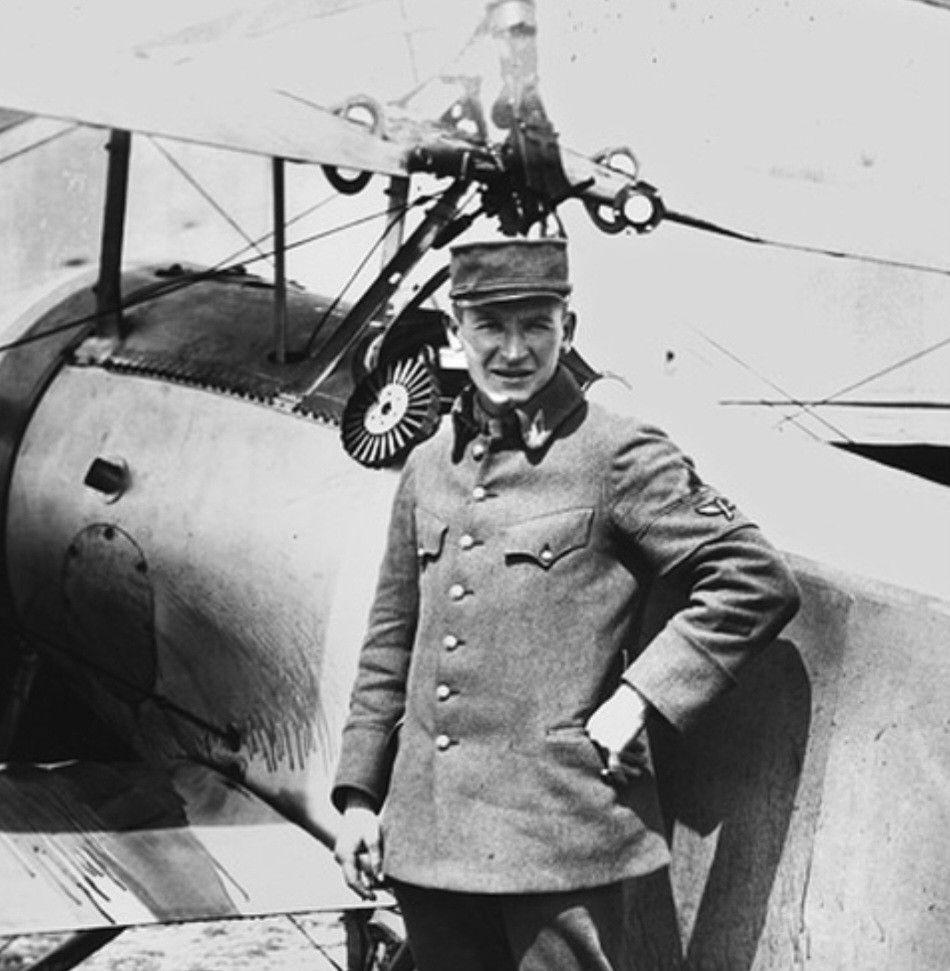
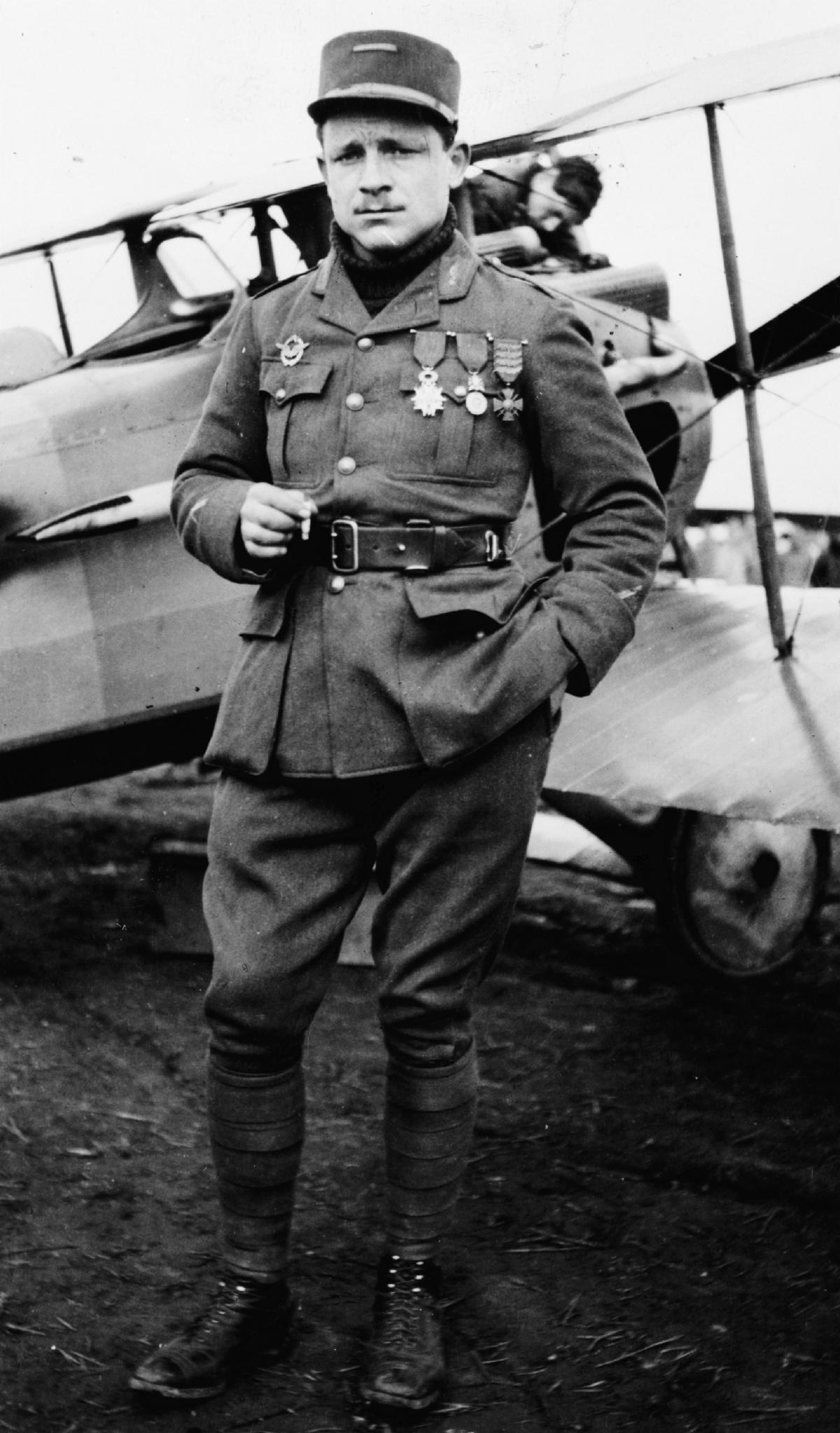
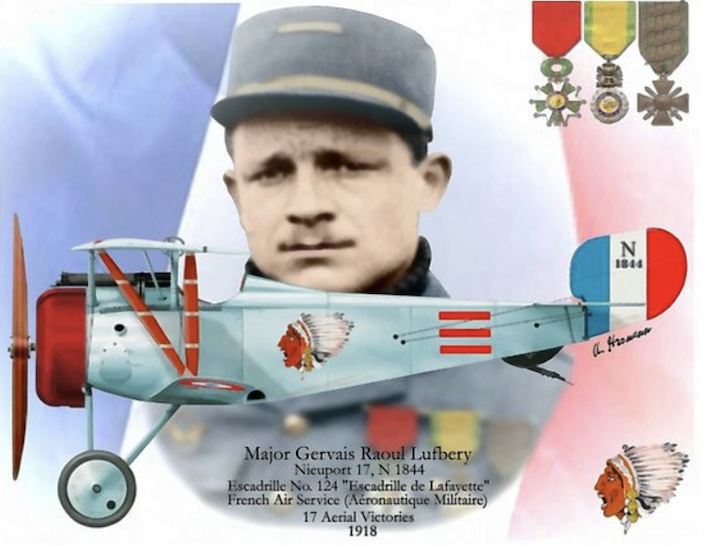
Gervais Raoul Lufbery
Mort Pour la France, May 19, 1918, Maron (Meurthe-et-Moselle)
|
|
Gervais Roaul Lufbery posing by his plane. Library of Congress, Public Domain
|
|
• Gervais Raoul Victor Lufbery, born on March 14, 1885, and tragically perishing on May 19, 1918, was a distinguished aviator who achieved the status of a fighter pilot and flying ace during World War I. His remarkable career spanned both the French Air Force and the United States Army Air Service, leading to his classification as either a French or American ace. It is worth noting that the majority of his 17 combat victories were officially credited to his service in French units.
• Raoul Lufbery, born in Chamalières, Puy-de-Dôme, France, was the youngest of three sons to American Edward Lufbery and his French wife, Anne Joséphine Vessière. Edward Lufbery's father, Charles Samson Lufbery, had immigrated to the United States from Great Britain in the mid-19th century and settled in New York. Edward himself moved to Chamalières in 1876, where he met and married Anne Joséphine Vessière. However, when Raoul was just one year old, his mother passed away, and his father returned to the United States, leaving him to be raised by his maternal grandmother, Madeline Vessière Greniere, in France.
• During his early years, Lufbery worked in a chocolate factory in Blois and Clermont-Ferrand until 1904. Despite being in France, he sent money to his father, who had started a new family in the United States. At the age of 19, Lufbery ran away from his grandparents' home and embarked on a journey to various countries, including Egypt, Algeria, Tunisia, the Balkans, and Turkey. In 1906, he and his middle brother, Charles, traveled to the United States in search of their father, unaware that he had just left for France on a business trip. Nevertheless, Lufbery was able to visit other relatives in Connecticut and stayed in Wallingford for two years, working at a silver-plating factory.
• In 1907, Lufbery joined the United States Army and served as a rifleman until 1909. He was initially assigned to Company F, 20th Infantry Regiment, at Fort Shafter in the Territory of Hawaii. Later, he was stationed at the Presidio of Monterey, California, with Company M in 1909. In 1910, he was transferred to another location.
• In the latter part of 1914, Lufbery was admitted into the pilot training program and was designated to undertake reconnaissance missions alongside Escadrille VB 106. Subsequently, he sought a transfer to fighter aircraft and underwent training on the Nieuport. Despite lacking innate piloting abilities, Lufbery achieved the status of an ace pilot through his unwavering determination and meticulous attention to mechanical intricacies. His dedication to maintaining his aircraft led to him being subjected to harassment from fellow pilots. Additionally, Lufbery diligently inspected and polished each bullet in the drum of his Lewis gun to mitigate the frequent issue of jams.
• Lufbery, despite his distinct French accent and contrasting background from his affluent and Ivy League-educated comrades, demonstrated remarkable resilience and achieved notable accomplishments during combat, thereby garnering the respect and admiration of his fellow soldiers.
• On 30 July 1916, the first triumph of the individual in question was achieved over Verdun. By 12 October 1916, the individual had successfully brought down five enemy aircraft, thus attaining the status of an ace and receiving a promotion to adjutant.
• He joined the United States Army Air Service in late 1917 as a Major, having already achieved 16 confirmed air kills and an additional unconfirmed one. The majority of his victories were achieved individually, although he did share one each with fellow aces Victor Sayaret, Paul Malavialle, and Achille Rousseaux. In the spring of 1918, Lufbery was chosen to assume the role of commanding officer for the yet-to-be-formed 94th Aero Squadron, holding the rank of major. His main responsibility was to provide instruction in combat techniques to new pilots, including Eddie Rickenbacker. The United States Army Air Service was equipped with Nieuport 28 fighters, but due to supply issues, many of these aircraft were not armed. On the 6th of March 1918, during the 94th's initial combat patrol, Lufbery led Rickenbacker and fellow pilot Doug Campbell in unarmed airplanes. While leading the 94 Squadron, Lufbery made unconfirmed claims on the 12th and 27th of April 1918.
• It was during this period that the maneuver known as the "Lufbery circle" was attributed to Lufbery. According to Eddie Rickenbacker's book, Fighting the Flying Circus, Lufbery is credited with inventing the precursor to the contemporary airport flight pattern. Prior to him, aircraft would land in various directions on the field, based on their requirements and wind conditions, resulting in confusion, near misses, and collisions. As the commander of the 94th Squadron at the time, Lufbery directed that all incoming aircraft should circle the field at least twice before landing, ensuring the observation of other aircraft taking off or landing. This process eventually evolved into the widely adopted "Down Wind, Base, and Final" standard airport pattern that is utilized by pilots in visual flight rules (VFR) on a daily basis.
• On 19 May 1918, Lufbery embarked on a mission to intercept a German Albatros C.III near the 94th's home airfield, taking off in a Nieuport 28 aircraft. As Lufbery approached the enemy aircraft to initiate an attack, the Nieuport was struck by the gunfire from the German gunner. The subsequent events following this incident have been a subject of debate among historians. According to varying accounts, Lufbery, at an altitude ranging from 200 to 600 feet, is believed to have either voluntarily jumped out of the plane to avoid a potentially fatal conflagration or attempted to make an emergency landing in the nearby Moselle River. Alternatively, some sources suggest that he was ejected from the cockpit after it overturned above the village of Maron. Tragically, during his descent, Lufbery collided with a metal garden picket fence, resulting in his untimely demise.
• In recognition of his service and sacrifice, Lufbery was laid to rest with full military honors at the Aviators Cemetery in Sebastapol, France. Subsequently, his remains were relocated to a place of distinction at the Escadrille Lafayette Memorial in Paris. Despite officially being credited with 17 victories throughout his career, Lufbery's fellow pilots attested to numerous instances where he successfully downed German aircraft that went unrecognized. Consequently, his actual tally of victories has been informally estimated to range anywhere from 25 to 60.
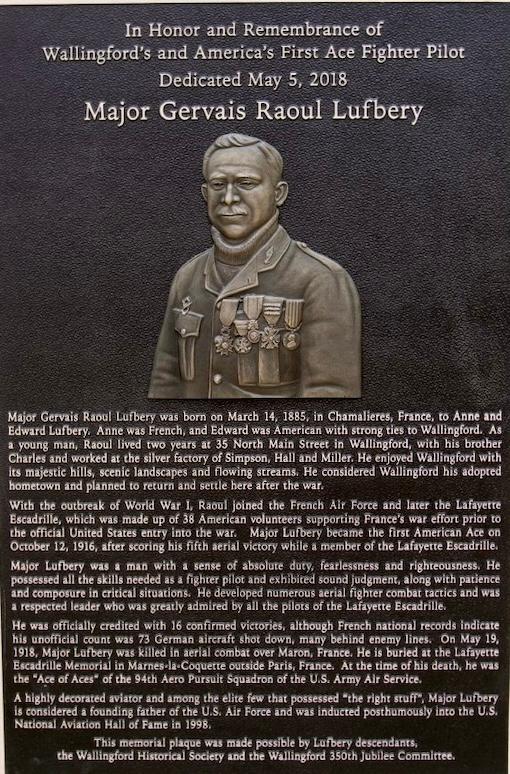
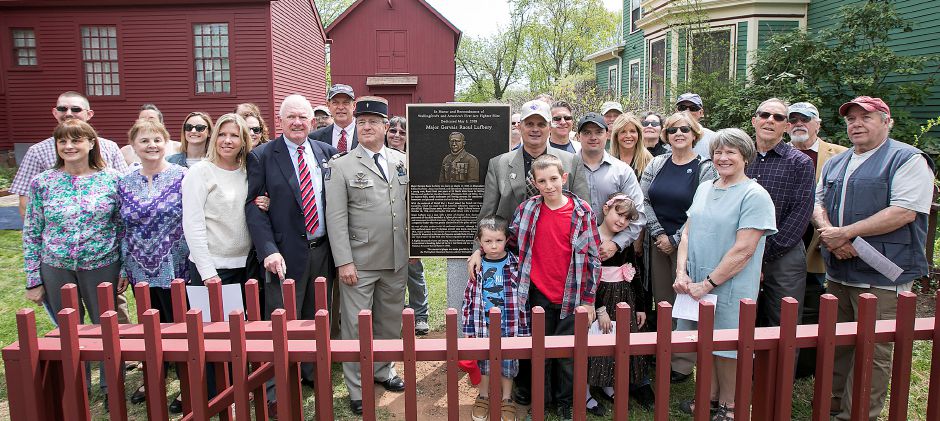
• Although he only resided in Wallingford for a brief two-year period, it was a longer stay than most of his other locations, and the town served as his official place of residence. On Memorial Day in 1918, Lufbery was commemorated by his relatives and the community in Wallingford. Presently, Lufbery Avenue and Lufbery Park can be found in the town, and the VFW is named after him as well. Furthermore, his former residence and the Wallingford Historical Society building have been adorned with commemorative plaques during the town's 350th Jubilee celebrations, marking the 100th anniversary of his passing. Notably, the road linking Interstate 91 exit 13 to Route 5 in Wallingford has been designated as the "Major General Raoul Lufbery Memorial Highway".
|
|
Bronze Plaque, Major Gervais Raoul Lufbery, Wallingford CT |
|
Top: Bronze Plaque, Wallingford Historical Society
180 S Main St, Wallingford, CT 06492
Bottom: 30 descendants of Major Gervais Raoul Lufbery stand next to a bronze plaque dedicated to him during a ceremony at the Wallingford Historical Society, Saturday, May 5, 2018. COL Patrick du Tertre, 1st Vice President of the American Society of Le Souvenir Français, and president of the Association of French Reserve Officers in the United States, stand next to the bronze plaque.
|
|
The official roster of the 38 Escadrille Lafayette pilots:
1. Horace Clyde Balsley
2. Stephen Sohier Bigelow
3. Ray Claflin Bridgman
4. Andrew Courtney Campbell, Jr. †
6. Elliott Christopher Cowdin
7. Charles Heave Dolan
8. James Ralph Doolittle †
10. William Edward Dugan, Jr.
11. Christopher William Ford
16. Thomas Moses Hewitt, Jr.
17. Dudley Lawrence Hill
18. Edward Foote Hinkle
19. Ronald Wood Hoskier †
20. Charles Chouteau Johnson
21. Henry Sweet Jones
25. Douglas MacMonagle
26. Kenneth Archibald Marr
29. Paul Pavelka†
34. Robert Lockerbie Rockwell
35. Laurence Dana Rumsey, Jr.
36. Robert Soubiran
38. Harold Buckley Willis
|
|
PAST MONTHLY BULLETINS
OUR GOAL: turn the spotlight on a famous, or less famous, episode or historical figure during the long shared history between France and the United States, with illustrations and anecdotes.
You can have access to all our past Monthly Bulletin
since February 2021 by visiting our website:
You can click on the photos throughout our bulletins and also on the links indicated in blue for more information and direct access to sources.
|
|
Next month we will complete our series on the French Forts in North America, which we started earlier this year, narrating the fortifications built in Pennsylvania and the Ohio Valley. |
|
ANNOUNCEMENTS & SAVE THE DATES |
|
Touring Exhibition
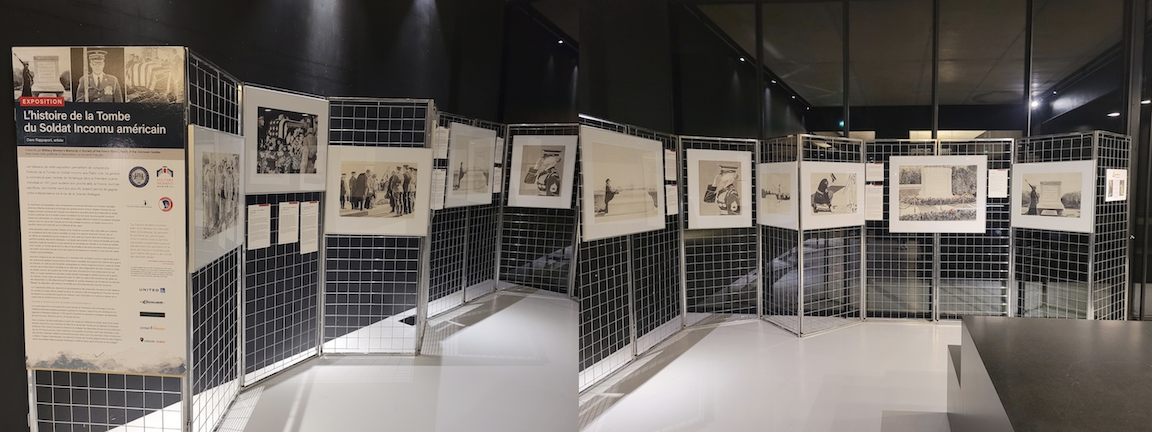
“ The US Unknown Soldier of WWI in France”
by
The Society of Honor Guard / Tomb of Unknown Soldier
Military Women’s Memorial, Arlington National Cemetery
and under the auspices of Le Souvenir Français
Verdun Memorial Oct 1-7,
Château de Castries, Oct 10-25
&
Le Souvenir Français Paris Headquarters, November 1-30, 2023
|
|
“The whole of France bows down with me before your coffin, brother from America, they can take you back to the great land from which you came, but your French family will always piously preserve your memory and the land of France will not forget that it was to it you entrusted your last dreams.”
- André Maginot, Minister of Pensions, Le Havre, Oct 25, 1921
Illustration above: One of 26 paintings by Dave Rappaport, artist
|
|
Above: click on the thumbnail to view a wonderful short movie has been created by Les Owen, using colorized archival clips from 1921, showing the journey of the Unknown Soldier from Châlons-en-Champagne to Le Havre, then on board the USS Olympia, to his final resting place at Arlington National Cemetery.
You can also access the version with French subtitles HERE
|
|
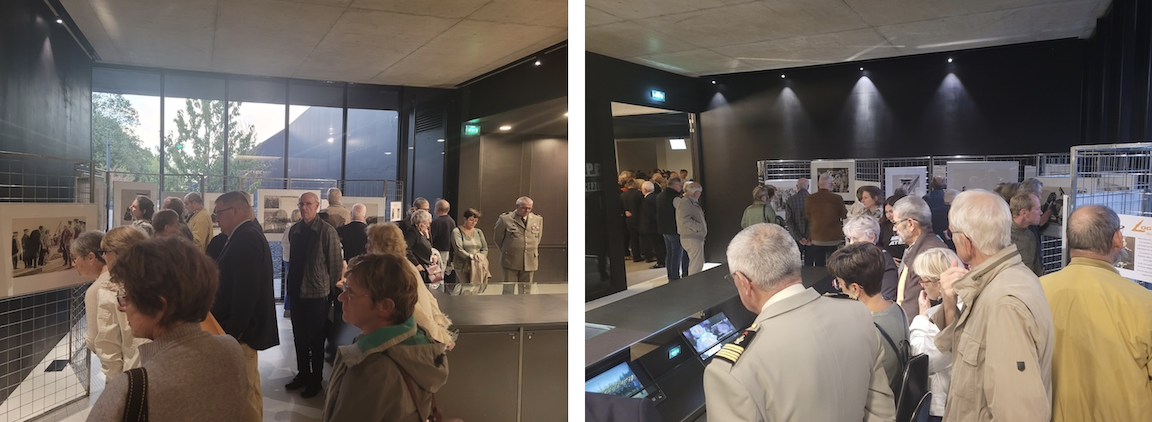
Exhibition at the Mémorial de Verdun - Champ de Bataille, October 1-9, 2023. Photos above courtesy of Mme Amélie Delobel, Head of Collections and Exhibitions.
|
|
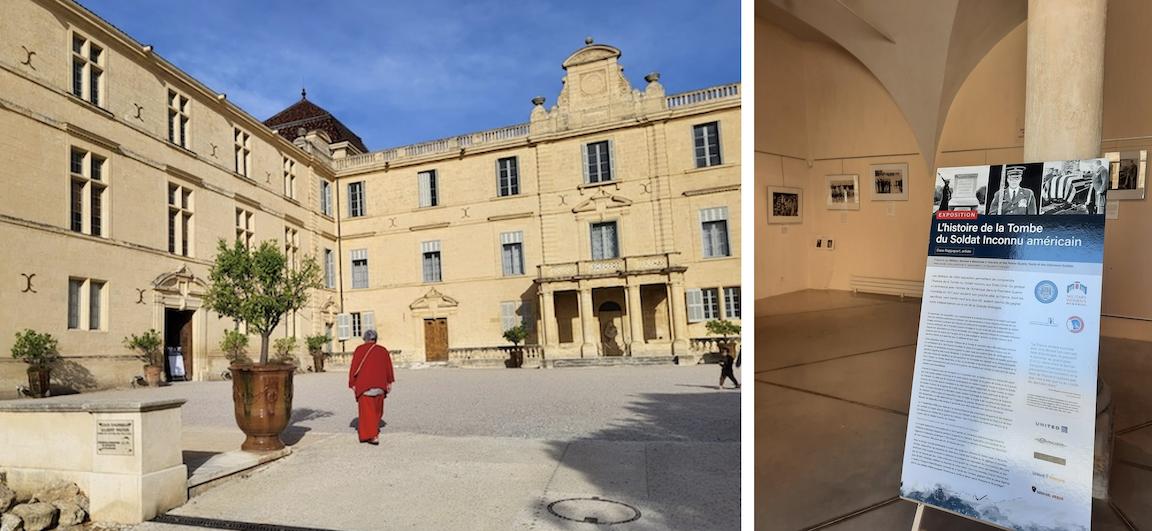
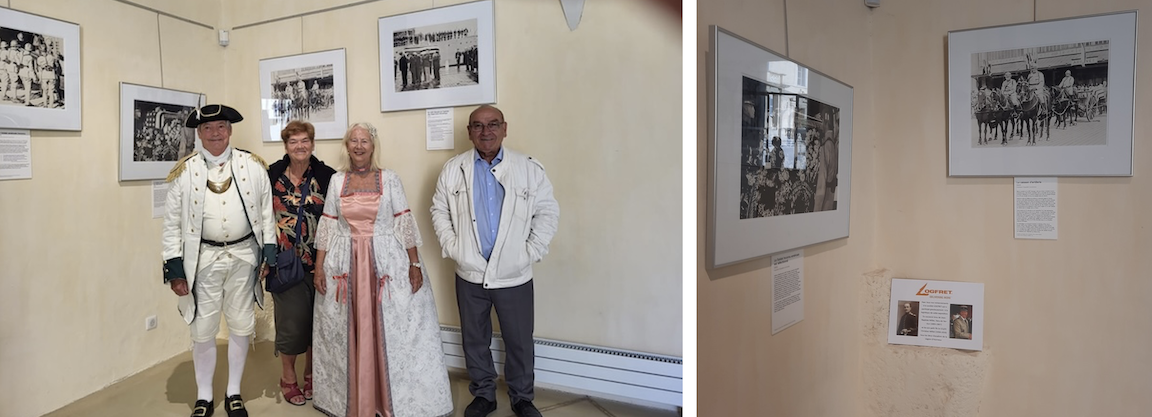
Exhibition at the Château de Castries, Rue du Château, 34160 Castries, France - October 10-25, 2023. Photos above courtesy of Brigitte van den Hove-Smith, Regional Delegate of our Society for the SouthEast. The castle was the residence of the Marquis de Castries, Louis XVI'sMinister of the Navy during the War of Independance.
|
|
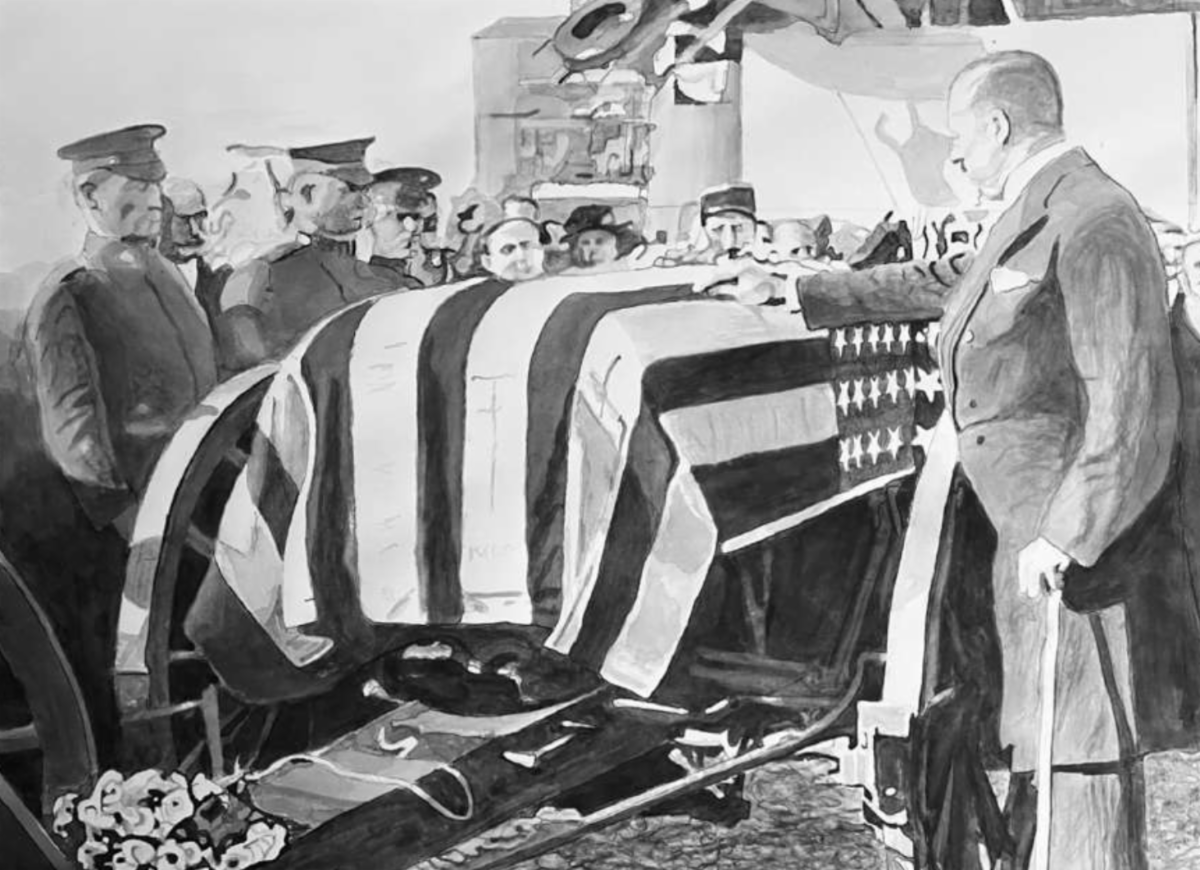
• On October 25, 1921, Minister André Maginot pinned the Legion of Honor on the coffin of the Unknown Soldier at the pier in Le Havre, moments before it was hoisted on board the USS Olympia for the voyage back home. This exhibit of 26 black & white paintings by artist Dave Rappaport retraces key moments of this poignant journey, from the battlefield of Eastern France and Châlons-sur-Marne, to Le Havre, with the people of France lining up to pay tribute to this American soldier who “Died for France” and for the cause of Freedom.
• Inspired by this exhibition that took place at the Military Women's Memorial at Arlington National Cemetery this past November, we worked hand-in-hand with Richard Azzaro, co-Founder and past President of the Society of Honor Guard, Tomb of the Unknown Soldier and Donna Houle, Senior Director of Memorial Engagement & Impact at the Military Women's Memorial to have this very moving and informative exhibition travel to France.
• We express our gratitude to Général d'armée Elrick Irastorza, former Chief of Staff of the French Army, président of the Fondation du Souvenir de Verdun, to Mr. Nicolas Barret, Director, and Mme Amélie Delobel, responsable collections et expositions at the Mémorial de Verdun - Champ de Bataille, and Dr Patrick Bernier and Jacques Fournier of the Amis du Château de Castries for hosting this exhibition illustrating the enduring bonds of alliance and friendship between France and the United States.
• Our thanks go also to Col US Air Force (Ret) Pierre Oury, member of our Society, United 4 Veterans, and United Airlines for transporting the 26 paintings to France graciously across the Atlantic, and to Jean-François Millet, chairman of Logfret Logistics Group for graciously providing domestic transportation in France.
|
|
From the American Friends of Lafayette:
Lafayette returns to America in 2024!
|
|
A message from Chuck Schwam, COO, American Friends of Lafayette:
"199 years ago today, Lafayette made his first public appearance in the United States after a forty year absence. 199 years ago today, Lafayette's 13-month Farewell Tour of America officially started. And of course....ONE YEAR FROM TODAY OUR BICENTENNIAL COMMEMORATIONS START !
Our goal is to celebrate Lafayette's legacy and to educate the American public about his contributions to the world.
In an effort to kick things off, the American Friends of Lafayette have produced a short, two-minute promotional video for you to see (and more importantly share). Our goal is to generate excitement, donations and momentum as we hurdle towards August 16th, 2024.
Please share with your family...your children and grand children.
Please share with your friends and co-workers.
Please use this video as a tool for fundraising.
Please use this video to promote your local Bicentennial efforts.
Enjoy! Spread the word (and the video)!
"
Our Society is proud to be working hand in hand with the AFL and other patriotic associations to make this Bicentennial a memorable success.
|
|
PHOTO ALBUM
YORKTOWN 2023
|
|
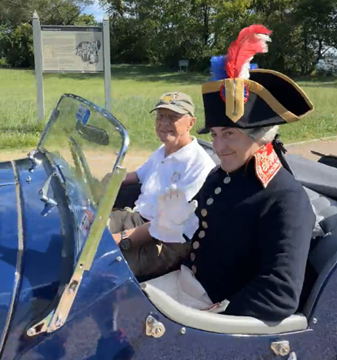
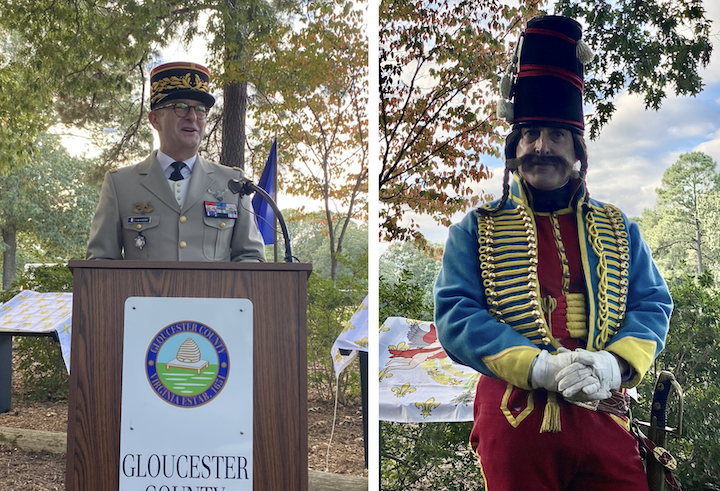
On Wednesday October 18th we proudly unveiled two interpretive markers telling the important story of Gloucester County’s 1781 Battle of the Hook. The largest cavalry battle of the American Revolution, the Battle of the Hook has often been overlooked, yet it is one of the most important episodes of the siege of Yorktown, when the Duc de Lauzun's famous Legion of hussars with 300 troops of the "Infanterie de Marine,” and Lieutenant Colonel John Mercer's Select Battalion of Grenadiers, under the overall command of Brigadier General Claude de Choisy, defeated Lieutenant Colonel Banastre Tarleton's British Legion and a detachment of the Royal Welch Fusiliers.
This marker is the work of a Committee consisting of :
Nicole Yancey • Admiral Frédéric de Rupilly
Colonel Aymeric Tardieu de Maleissye • Lt Colonel Mathieu Brulais
Johnny Carawan • Dr. Robert A. Selig, Ph.D. • P.J. Lambert •
Robert Kelly, Jr. • Warren Deal • Thierry Chaunu
Our special thanks to Brigadier General Vincent de Kytspotter, Ph.D., Head of Military and Defense Mission, French Permanent Mission to the United Nations for delivering the keynote address, to Dr. Robert A. Selig, Ph.D., who wrote the text of the markers, to Robert Kelly, Jr. Vice President, American Friends of Lafayette for his decisive role in the entire project and for the organization of this dedication, to Lawrence Abell and Ellen von Karajan, respectively Chairman and Executive Director of the Washington Rochambeau Revolutionary Route Association, who generously donated the markers' frames, to P.J. Lambert and Warren Deal for their extensive contacts and constant support, and to Nicole Yancey, former Consul of France in Virginia, and Regional Delegate of Le Souvenir Français in Virginia, who helped organize the celebrations of Yorktown for decades. We are grateful for the presence of Richard Azzaro and Lonny LeGrand, respectively co-Founder and past president and current president of the Society of Honor Guard, Tomb of Unknown Soldier, who laid a Never Forget bouquet of white roses on the site of our future stele honoring the French hussars who died on that battlefield. And our special thanks to celebrated historian, actor and re-enactor Mark Schneider for an unforgettable rendition of a Lauzun's hussard in period uniform.
To view the local news and interviews, click on:
|
|
Thursday October 19th:
On October 19, 2023, we celebrated the 242nd anniversary of the surrendder at Yorktown, and commemorated the French soldiers and sailors who died for the cause of American Independance.
8:30AM – Commemorative Ceremony at the French Cemetery, Yorktown
Battlefield:
This is where 50 French soldiers and sailors are buried in a mass grave, in a clearing along the Battlefield Road. The American Society of Le Souvenir Français, Inc. honored them with a wreath, which was laid by its president Thierry Chaunu and Rear Admiral Frédéric de Rupilly, French Navy.
9:15AM – Commemorative Ceremony at the French Memorial:
This event was organized by LCL Mathieu Brulais, French Army and the French military contingent at NATO in Norfolk, as well as the French War Veterans of Washington DC, led by its president Mr. Alain Leca, who is also the Souvenir Français' Regional Delegate for the District of Columbia. The French military contingent based in Norfolk was under the command of Captain Jean-René Degans, French Navy, for the ceremony. Thierry Chaunu, president of the American Society of Le Souvenir Français, Inc. and Rear Admiral Frédéric de Rupilly laid a wreath to honor the French Soldiers and Sailors who gave their lives for the Independence of the United States.
Both ceremonies were held in the presence of Major General Bertrand Jardin, French Air Force, Defense Attaché at the French Embassy in the United States.
10:30AM – Yorktown Day Parade and 11:15AM – Patriotic Exercises at the Monument to Alliance and Victory, Yorktown: The Spanish ambassador had been invited to be the guest of honor this year to reflect the mostly financial role of Spain, an ally in the struggle for American Independence. The new French General Consul in Washington, Mme Caroline Monvoisin, reminded the audience of the crucial role of France in helping the United States win its independance, thanks to the intervention of its army under Rochambeau and its Navy under de Grasse, delivery of arms and equipment since 1777, and considerable funding, as well as the fact that France was the very first nation to officially recognize the United States by a formal Treaty of Alliance, Friendship and Commerce signed in Paris on February 6, 1778.
Let us never forget that the French-American victory at Yorktown, which led to the Independence of the United States, involved 10,800 French troops commanded by General Rochambeau and 29 French warships under Admiral de Grasse, and 5,900 American troops, under the overall command of General George Washington. It is the perfect example of a modern operational collaboration between two countries' armed forces.
|
|
The 6-foot-tall, 17-foot-wide granite French Memorial lists the names of French soldiers and sailors is located at Fusiliers Redoubt (by the river, across the American Revolution Museum), Yorktown, VA
|
|
THE "FRIENDS OF THE CHÂTEAU DE LAUZUN"
MAKE AN APPEAL FOR DONATIONS
|
|
Château de Lauzun, Lot-et-Garonne, borders the Dordogne region.
23 Rue du Château, 47410 Lauzun, France (80 miles east of Bordeaux)
|
|
In order to support the municipality of Lauzun which just acquired the Castle (listed as a Historic Monument), its park and its outbuildings, the association aims to safeguard, encourage and integrate the castle in the regional cultural heritage. This monument, a rare example of the Renaissance with its monumental chimneys, its architecture and its park will be open to the public.
The Association Les Amis du Château de Lauzun will work alongside the village of Lauzun to develop cultural attractions and events linked to the rich history of the Dukes of Lauzun.
In addition, the installation of a Hussars museum is planned, in
link with the Association of Anciens Hussards de Lauzun, regiment
commanded by Armand Louis de Gontaud-Biron, second Duke of Lauzun, during the War of American Independence. A room in the Castle will be dedicated to the democratic ideals and the Enlightenment spirit of the 18th century and a celebration of the shared history between the United States of America and France.
The castle of Lauzun will eventually become an additional touristic site in this most magnificent region of France, which includes the castles of Duras, Bonaguil and Biron.
|
|
Celebration of Veterans Day in New York City
November 11, 2023
|
|
Like every year we will celebrate "Armistice Day" and all the Veterans on Saturday, November 11 by joining the traditional parade on Fifth Avenue.
This year the parade starts at 9:00AM and the gathering point will be on 24th Street between 5th & 6th avenues.
We will march following the Cadets Lafayette marching band, alongside the Federation of French War Veterans, the Association of French Reserve Officers, the Scouts of troop#1 deploying the two huge American and French flags from TheFrenchWillNeverForget
The next day, on Sunday November 12, the traditional mass will take place at Notre-Dame Church, 405 West 114th Street, at 11:00AM, followed by a wreath-laying ceremony at the church's Honor Wall honoring the 463 "Morts Pour la France" who left New York to fight for freedom and democracy in two world wars. This year we will pay a special tribute to the 68 from the Lafayette Flying Corps who "Died for France".
A luncheon at the nearby restaurant Le Monde will conclude this Day of Remembrance.
|
|
Celebration of Veterans Day in Houston, TX
November 11, 2023
|
|
On November 11, Texas French Veterans with Bruno Cateni, Regional Delegate and members of our Society will march in Houston's Veteran's day parade.
The day will start with a wreath-laying ceremony at the Buffalo Soldier Museum's war memorial, followed by a parade as it passes through Houston Downtown to Houston City Hall.
Last year in 2022, as in New York, marchers received exclamations of "Thank you France" from the public.
This history awareness will be emphasized this year. To this end, 8 flag bearers marching in front of the French Veterans of Texas.
• Flag of King Louis XIV of France (royal blue flag 3 fleur-de-lys) along with the Texan flag. The date 1684 for the 1st colony in Texas: "Fort Saint Louis" in Matagorda Bay, expedition of Sieur Cavelier de La Salle.
• Flag of the kingdom of France under Louis XVI (White covered with golden fleurs-de-lis and two cherubs around the king's coat of arms) surrounded by the Grand Union flag and Betsy Ross flag.
• "The Alliance Flag" Stars & Stripes with one Fleur-de-Lys among the stars which was officially used in 1781 (pictured below).
• Le "Drapeau Français de la Libération" (French flag of 1944) with the Lorraine cross alongside the American flag.
• Standard French Tricolor next to the American Stars & Stripes, celebrating 245 years of ongoing Alliance.
|
|
Tuesday, November 14
Celebrating French and American Military Resilience in Style
This event is organized by Encore DC in partnership with the
French Defense Office, Planet Aid and La Maison Française.
|
|
Join us as we celebrate and honor the incredible resilience of French and American wounded veterans while encouraging sustainable fashion as a modern means of self-expression and sustainable future!
For the November Veterans and Military families Month, we choose to celebrate and honor our veterans. This event is not just a fashion show; it’s a powerful statement about the importance of sustainable fashion in empowering self-identity and helping our heroes overcome war’s physical and mental impacts. Everyone is welcome, our audience will be as diverse as our message.
This night of celebrations will include a fashion show, a dining cocktail, and a dance party!
Two different offers are available, one VIP with early access, benefits all night long, and one general admission.
All the funds generated by this event will be split between two deserving beneficiaries dedicated to help wounded veterans and their families. One will be The Independence Fund and the other the Cellule d’Aide aux blessés de l’Armée de Terre.
You can also make donations that will be channeled through Resources USA Inc., a 501(c)(3) nonprofit organization that fosters collaboration between the US and France in Science, Technology, Culture, and Higher Education.
Moreover, you can also sponsor this event and help veterans, students to attend to it!
WHAT: Celebrating French and American Military Resilience in Style
WHEN: Tuesday, November 14, 2023 – 6 pm - 11 pm
WHERE: La Maison Française – Embassy of France – 4101 Reservoir Rd NW, 20007, Washington, D.C.
PRICE: $110 - $280
INFOS: Registration, valid ID and a ticket matching the name on the ID must be presented at the entrance. Masks recommended. No parking inside the embassy. No large bags, helmets and suitcase. Contact the organizer to request a refund.
|
|
From the Society of the 3rd Infantry Division:
November 21, 2023 at 11:00AM
at Arlington National Cemetery
|
|
Announcing the kick-off of the US Fund Raising Campaign
to SAVE THE HERMIONE
|
|
The American Society of Le Souvenir Français, Inc. is about to kick off a nationwide US fund-raising campaign to ensure that the "Freedom Frigate" can sail again and participate in America's 250th birthday. We do this is close partnership with the Association Hermione-LaFayette in France which owns and operates the ship, the American Friends of Lafayette and the Lower Manhattan Historical Association, and the Friends of Fondation de France who collects the US-tax deductible funds. We will be solliciting donations, large or small, from individuals and corporations. |
|
SUPPORT US AND BUY (OR OFFER) OUR E-BOOK ON AMAZON! |
|
Book Cover : "Scenes from the American Revolution: The French "Soissonnais" Regiment Being Reviewed at Philadelphia by President Washington and Congress, 1781". By Charles MacKubin Lefferts (American, 1873 – 1923). Reproduced with permission of the New York Historical Society Museum. |
|
Support our organization! Purchase or offer this e-book which makes great reading for all ages. All royalties go to the American Society of Le Souvenir Français, Inc. Simply click on this link: Amazon.com
We are pleased to have given to the Consulate General of France several dozens of sites for the application mapstr. The complete and extensive descriptions are only available in our book, copyrighted by our organization.
MEMORIES OF FRANCE
950 sites of French presence in the United States over the past 5 centuries
Everyone knows that Lafayette, the Statue of Liberty, or New Orleans, were all French imports…
But did you know what the first protestant prayer in America, the first recorded birth of a European in North America, the first commercial artist, the first free school west of the Mississippi, the first discovery of Niagara Falls, the first grapefruit planter in Florida, the first discoverer of oil in America, the first Pulitzer Prize in history, the first archbishop of New Mexico, to name just a few, have in common? (Hint: they were all French)
CONTENTS:
Guide - historical directory of more than 950 sites where a French footprint has been left across the 50 states of the present United States, from 1524 to the turn of the 20th century.
It is written in two versions: in English and in French.
It is a tribute to explorers, missionaries, soldiers, adventurers, French, illustrious or unknown, who left their mark in the United States and are recognized, whose memory is honored by a monument, a statue, a stele, a panel, a billboard, a plaque...
Each page corresponds to one site and includes:
• Photo (with url link)
• Address with postal code
• Exact GPS coordinates
• A brief historical explanation
• The exact transcription of the inscription appearing on the pedestal or plaque
• One or more internet links directing the reader to more detailed information
• Some divider pages are dedicated to a brief biography of a related historical figure
This Guide can thus be compared to:
• An “Enthusiast’s dictionary” compiling the traces left by Frenchmen in the United States
• A collection of French postcards from the 50 States
• A tourist guide for all lovers of US history
Available in e-book
• E-book price: $19.50
• The book is copyrighted © American Society of Le Souvenir Français, Inc.
|
|
OUR MISSIONS:
• To preserve the memory of the French soldiers, sailors and airmen who gave their lives for freedom, and who are buried in the United States.
• To honor French Citizens who did great deeds in the United States, or with a strong connection with the United States,
• To promote the appreciation for French culture and heritage in the United States, and the ideals that unite our two nations, in order to pass the torch of memory to younger generations.
• To strengthen the long-standing traditional bonds of friendship between the American and French peoples, and to this end: erect or maintain memorials and monuments and encourage historical research, public presentations and publications in the media.
We are looking to complete our geographic coverage with Regional Delegates for the SouthWest in cities such as Austin, or Houston, and Louisiana, in cities such as New Orleans or Baton Rouge.
The American Society of Le Souvenir Français, Inc. is an independent American corporation, apolitical, established in 1993 in NY, with 501 (c) 3 non-profit status.
|
|
Board of Directors
American Society of Le Souvenir Français, Inc.
Members (2023):
Françoise Cestac, Honorary President • Thierry Chaunu, President, and General Delegate, Le Souvenir Français in the United States • Yves de Ternay, Treasurer • Patrick du Tertre, 1st Vice President • Henri Dubarry • Francis Dubois • Alain Dupuis, 2nd Vice President & Deputy General Delegate, Le Souvenir Français in the United States • Daniel Falgerho, General Secretary • Pierre Gervois • Caroline Lareuse • Clément Mbom, Education Advisor • Jean-Hugues Monier, Auditor • Harriet Saxon • Nicole Yancey
Regional Delegates:
Jacques Besnainou, Great Lakes and Midwest • Bruno Cateni, South
Prof. Norman Desmarais, New England • Alain Leca, Washington D.C. •
Marc Onetto, West Coast • Brigitte Van den Hove – Smith, Southeast • Nicole Yancey, Yorktown & Virginia, former Honorary Consul of France in Virginia
|
|
Help us implement several historic commemorative projects celebrating the 245-year-old Franco-American friendship and alliance! |
|
The American Society of Le Souvenir Français, Inc. is a registered NY State non-profit corporation and has full IRS tax exempt 501(c)3 status. All donations are tax deductible.
Copyright © 2023 The American Society of Le Souvenir Français, Inc.
All Rights Reserved
Merci de nous contacter si vous souhaitez recevoir ce bulletin dans sa version traduite en français.
Contact: Thierry Chaunu, President
697 Third Avenue #341 New York, NY 10017
|
|
|
|
|
|
|