NEWS & VIEWS

Covering Kids & Families of Indiana Newsletter   

October 8, 2026

PUBLIC POLICY

FSSA Estimates Effects of HIP Work Requirements


The Family & Social Services Administration (FSSA) estimates that more than 58,000 Healthy Indiana Plan (HIP) members may not currently be in compliance with — or exempt from — the HIP Work Requirements that will begin January 1, 2027. This figure reflects the most recent data available and underscores the urgent need for members to review their status to avoid losing coverage.

Registration Is Open!


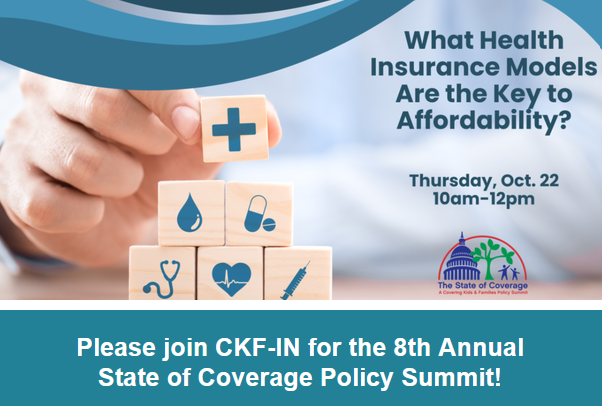
Ever heard of a MEWA? What about an ICHRA? Do risk pools sound like something a local YMCA has?


If you're confused, register now for upcoming CKF-IN has a webinar. Experts in traditional and non-traditional healthcare coverage options will offer clear and concise explanations, so participants are better able to understand the hot topics of healthcare coverage.

Health Care Price Transparency


The Trump administration finalized new rules requiring health plans and insurers to publish more standardized and accessible pricing data. Plans must attest to the accuracy of their disclosures and make personalized cost-sharing information available by phone. The rules aim to make price information more useful to consumers, employers, researchers, and innovators, though the rules do not yet cover prescription drug prices.

SCHOOLS & EARLY CHILDHOOD

Bullying Prevention Month


October is National Bullying Prevention Month. According to the 2026 Indiana KIDS COUNT Data Book, 40.6% of parents in Indiana reported their child aged 6 to 17 was bullied, picked on, or excluded by other children, which was higher than the nationwide rate of 38.4%.


Schools can find guidance on bullying instruction, anti-bullying policies, staff training, and more through the Indiana Department of Education here.

OUTREACH & ENROLLMENT

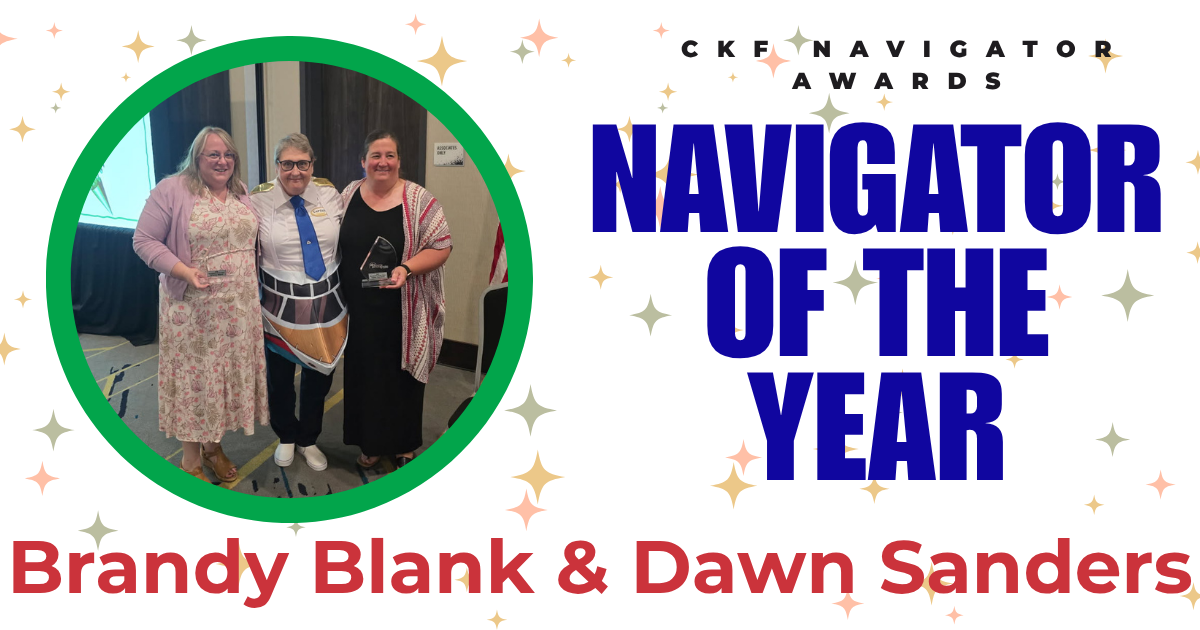
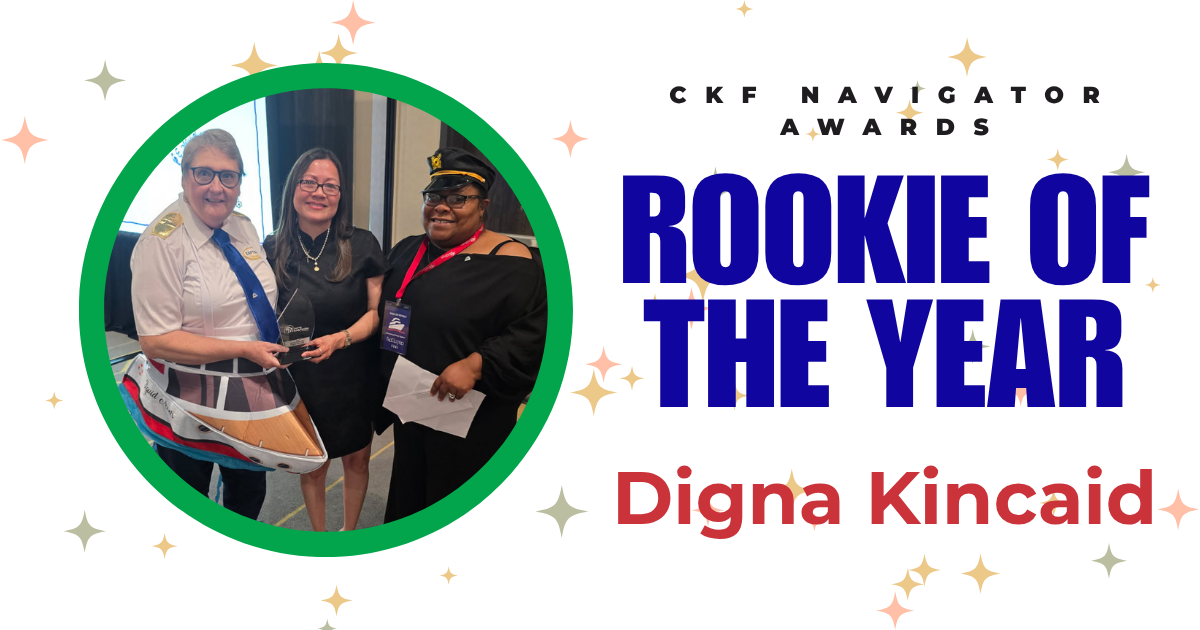
Congratulations 2026 CKF Navigator Award Winners

Changes in Coverage for Hoosier Immigrants

As reported in the September 10th edition of this newsletter, October 1st marks the beginning of policies regarding changes that affect certain immigrants in Indiana and their eligibility for full Medicaid. For individuals who qualify for Medicaid except for immigration status may still be eligible for Emergency Services Only (ESO) Medicaid. ESO does not reimburse for care outside the Emergency Department. 


Other resources include:


Call 211 for additional referrals to health care resources.

Town Halls on HIP Work Requirements


The Indiana Family & Social Services Administration (FSSA) in partnership with Covering Kids & Families of Indiana is hosting a series of public town hall meetings for Healthy Indiana Plan (HIP) members, providers, and community partners. These sessions are being held in counties across the state with focus on areas where there are a high percentage of HIP members. Each session offers context of the new rules and processes related to implementation of HIP work requirements.


Current town halls are listed below, and additional ones will be announced throughout the year.


October 12 - Ivy Tech Bloomington

Shreve Hall - 200 Daniels Way, Bloomington, IN 47404

Time: 6 to 7:30 p.m. ET


October 14 - Ivy Tech Logansport

Community Center - 1 Ivy Tech Drive Logansport, IN 46947

Time: 6 to 7:30 p.m. ET


October 20 - Ivy Tech Richmond

Johnson Hall - Auditorium - 2357 Chester Blvd. Richmond, IN 47374

Time: 6 to 7:30 p.m. ET


October 26 - Ivy Tech Kokomo

Main Building - Door 3 - Classroom M410 - 1815 E Morgan Street, Kokomo, IN 46901

Time: 6 to 7:30 p.m. ET

Tips About HIP Work Requirements for Nonprofits


If HIP members are not exempt from new work requirements, many will choose to comply with the new rules by volunteering at a nonprofit up to 80 hours a month.. In a recent article, Volunteers, Employees and Medicaid: What Indiana Nonprofits Need to Know This Fall, Morgan Riley at Charitable Advisors, says, "For nonprofits, understanding what qualifies as “volunteering”—and when volunteer hours are appropriate—is more important than ever." She also offers these pertinent insights:


  1. Track volunteer hours - If your organization already has a volunteer program, make sure you have a consistent way to record when volunteers serve and how many hours they complete.
  2. Be prepared to document service - Nonprofits may want to establish a straightforward process for responding when volunteers ask for documentation of their service.
  3. Keep volunteer service genuinely voluntary - The Medicaid rules do not change federal labor law. Someone volunteering to satisfy a Medicaid requirement does not automatically become an employee. Conversely, an employee cannot simply become an unpaid volunteer for the same work they are paid to perform (U.S. Department of Labor, 2026a).
  4. Train staff who coordinate volunteers - Volunteer coordinators and other front-line staff may be among the first people to hear questions about the new Medicaid requirements. Make sure the entire team knows where to direct people for eligibility questions rather than attempting to interpret the rules themselves.
  5. Avoid promises - A nonprofit can document the volunteer service it provides, but it should not promise that a particular volunteer activity will be accepted by FSSA. No one should guarantee that specific volunteer activities fit within the parameters of Medicaid eligibility. FSSA makes the eligibility determination.

Marketplace Training


Training for Marketplace Plan Year 2027 Assister Certification is available. Current certifications expire on October 31, 2026. 

New this year, assisters will need to use Login.gov or Id.me to verify identity before accessing the training. Learn more in this CMS memo.


Note: The Marketplace uses the term “navigator” to refer to assisters that work at an organization that has a federal Marketplace grant (ASPIN in Indiana). Indiana IDOI Certified Navigators are considered Certified Application Counselors (CACs) in Marketplace lingo.

Breast Cancer Awareness


October is breast cancer awareness month. A recent survey by the American Cancer Society found that risk-factor awareness is generally high but significant gaps exist between awareness and taking positive action to reduce risk. For Hoosier women who are underserved and underinsured, the Indiana Breast and Cervical Cancer Program is an important resource. Women who meet the criteria may qualify for free breast and cervical cancer screenings and diagnostic tests and may even qualify for a special Medicaid program for full health coverage.

RESOURCES

Update on Medicaid Waiver Level of Care Assessments


The state has ordered reassessments for people with pending Level of Care denials based on the InterRAI Medicaid waiver assessment. These are people whose initial denial is being reviewed by the Division of Disability, Aging and Rehabilitative Services (DDARS).


They are also rescinding denials for people who are in the appeals process. New assessments will be conducted for these individuals. The Office of Administrative Law Proceedings is sending letters to these individuals to retract their appeals because the assessment they are appealing is being replaced. 


This is essentially like starting over. The new assessment will replace the old one. If individuals are found eligible with the new assessment, they keep their waiver. If they are still found ineligible after the new assessment, they can still appeal. Appeal timelines and transition timelines start over with the new assessment.

Appealing a Level of Care Denial


If you are denied Level of Care (LOC) eligibility for a Home and Community-Based Services (HCBS) waiver, you can fight the decision. These free resources from The Arc of Indiana are available if you prepare a case:


You may also be interested in: The Arc of Indiana Stands with Families to Preserve Medicaid Waiver Financial Eligibility Protections.


Disclaimer: These guides are for general informational and educational purposes. It is not legal advice. Always review your own decision, appeal notice, and deadlines. 

TRAININGS

October 13-16, all day


American School Health Association is hosting their 100th annual school health conference in Plainfield, IN next week!


Information and registration here.

The Beyond the Basics annual webinar series takes place ahead of open enrollment each fall. The webinars are presented by policy experts who provide in-depth training on a wide range of eligibility and enrollment topics to help prepare assisters for open enrollment. Register for one or all here.


October 15 at 2pm ET – Verifying Eligibility

Experts from the Center on Budget and Policy Priorities will explain the marketplace eligibility verification process, how to prevent data matching issues from occurring, and how to resolve them when they do. 


October 20 at 2pm ET – Health Coverage Eligibility Based on Immigration Status

Immigration policy experts from the Center on Budget and Policy Priorities will explain immigration-related eligibility requirements for Medicaid, the Children’s Health Insurance Program, and coverage through the Affordable Care Act marketplaces.


Completed webinars are available on demand here.

October 26 at 2pm ET


In a new webinar, Election Impact: What the Midterm Results Could Mean for Health Care, Manatt Health will examine how the midterm elections may shape health care policies and priorities.


Register here.

TOBACCO PREVENTION & CESSATION

Uniting for Health Equity: Truth Initiative Hosts Unity in Public Health Reception


The Truth Initiative highlights the importance of health equity and culturally responsive tobacco prevention and cessation efforts. Most particularly among Black, Latino, and LGBTQ+ communities that have experienced disproportionate tobacco-related harms. The article discusses how the Truth Initiative’s Public Health Reception brought together many to address tobacco use, health disparities, cessation, and the need for stronger partnerships. The event also introduced a Policy Roadmap for Health Equity, developed in collaboration with the NAACP, which focuses on how tobacco industry practices have disproportionately affected Black communities and provides strategies for community action. Overall, the article emphasizes that improving tobacco-related health outcomes requires community engagement, coalition building, culturally grounded approaches, and greater access to cessation resources for populations most affected by tobacco use.

ENROLLMENT TRENDS


IHCP Membership


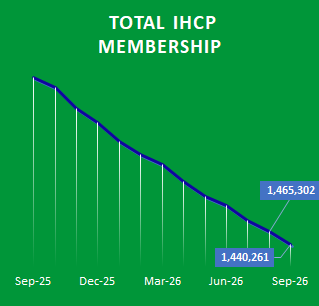
Total Membership decreased in September. With 1,440,261 members, there were 25,041, or 1.71%, less members in September 2026 than in August 2026.


Membership has dropped for seventeen months straight. 

 
Facebook  X  LinkedIn

© 2024 Covering Kids & Families of Indiana | All Rights Reserved