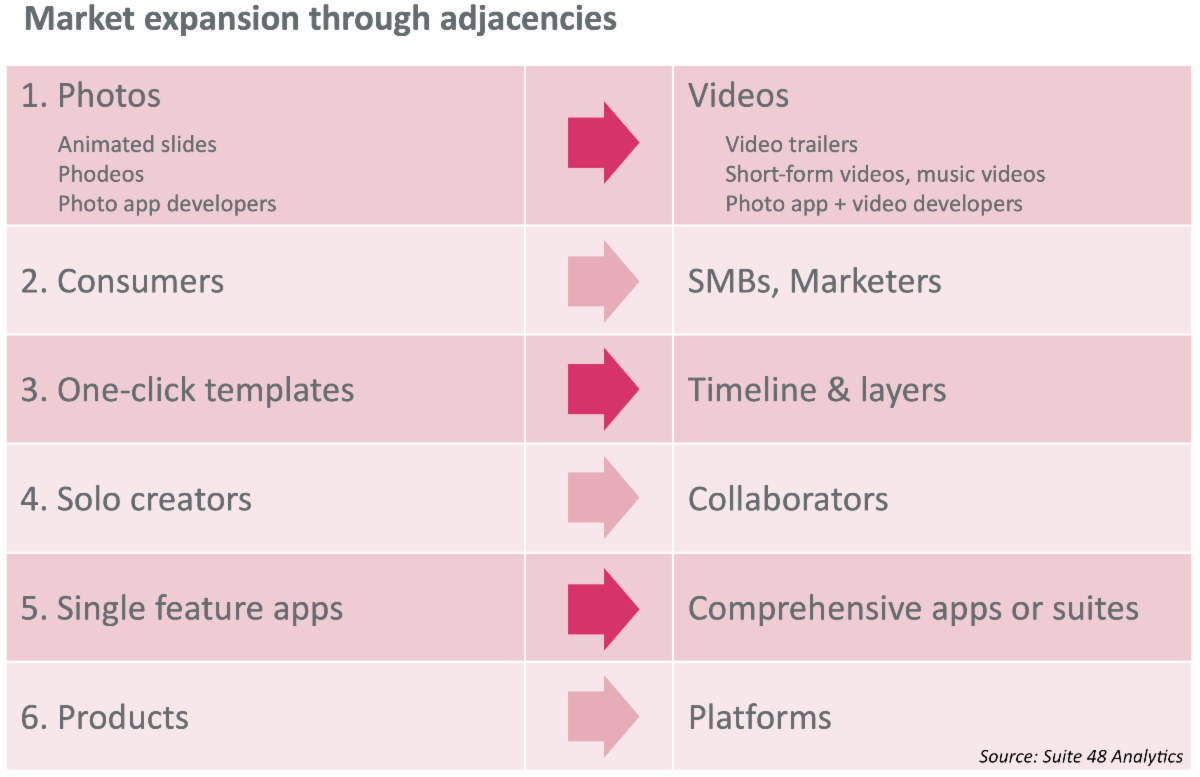
“The baby steps that take these products beyond the familiar are what has the greatest impact,” according to Hans Hartman, principal author of the study. “Too often we underestimate how fundamentally new it is for most people to work with videos. Everyone now has a device in their pocket that makes it as easy to capture videos as it is to shoot photos. But how do you make the footage shorter, more engaging, and good enough to share on social media or use for marketing purposes? That requires dealing with the complexities of an additional dimension – time – and an extra media format – audio.”
While the first generation of DIY video apps for consumers, SMBs and enterprise workers delivered the necessary tools to deal with these added elements, they were generally too complex and demanding to enable mainstream adoption, according to the study.
Conversely, apps that have embraced the alternative approach – prioritizing ease of use over creative control by offering templates and stock photos, videos and music libraries – have become popular, but have not met the needs of more demanding users, who require tools that enable their creations to stand out from the crowd.
A promising third approach, according to the study, is being taken by innovative – often AI-based – apps that manage to hit the sweet spot between ease of use and creative control, offering innovative and powerful features ranging from one-click background removal throughout the video, to typing text that changes the words spoken by people featured in the video, thereby eliminating the need to re-shoot.
The 94-page
DIY Video Creation Apps report analyzes 82 innovative DIY video creation apps in the following categories:
- “Beyond photos” video creation apps
- Web-based video creation apps
- Smartphone-based video creation apps
- Desktop-based video creation apps
- Camera manufacturer video creation apps
- Video APIs and SDKs