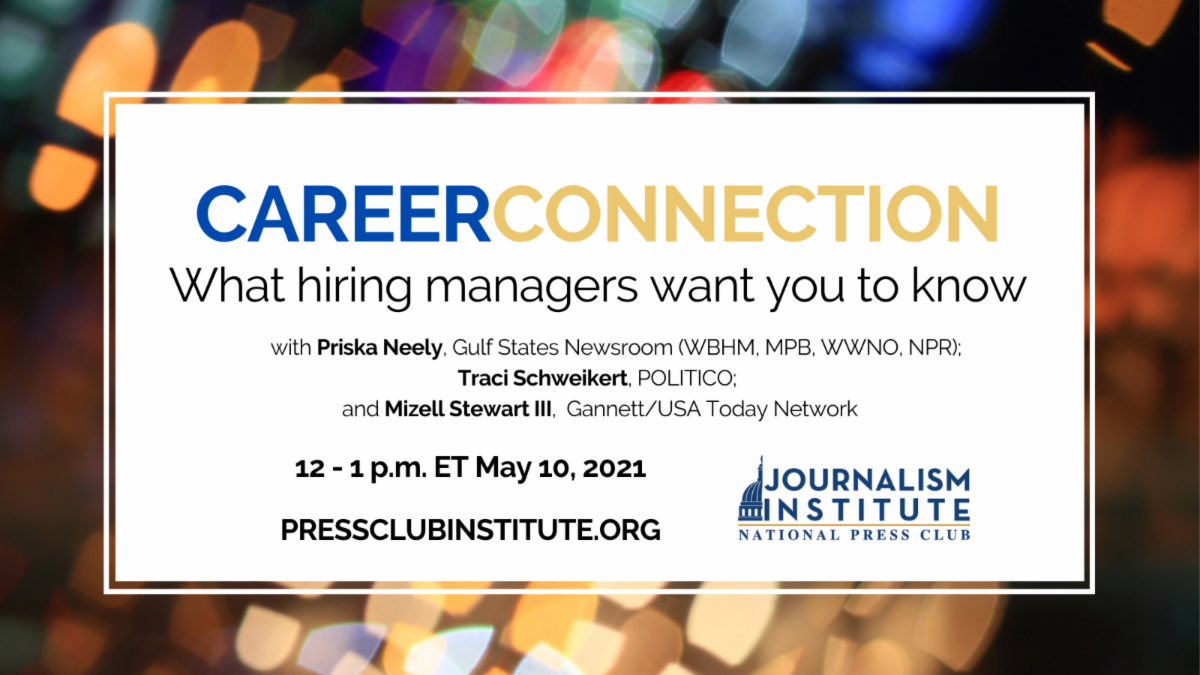
“Career Connection: Defining your digital footprint” is a weeklong series of hands-on workshops to help you create and maintain the journalism/writing identity you want to showcase to sources, employers, and publishers. The class will meet from noon to 1 p.m. ET daily, from Monday, May 10 to Friday, May 14.
Registration is open and includes all five classes. Tickets are $100 for general registration, and they are $75 for National Press Club members.
Session spotlight: What hiring managers want you to know
Hear what makes someone a ‘great’ applicant at top news organizations, with insights directly from recruiters and hiring editors. Whether you’re a mid-career professional looking for a change in responsibility or an emerging talent looking for your first newsroom, “What hiring managers want you to know” will give you tools for a successful job search in today’s market.
Panelists will include:
-
Priska Neely, Managing editor for Gulf States Newsroom (WBHM, MPB, WWNO, NPR)
-
Traci Schweikert, Chief Talent Officer, POLITICO
-
Mizell Stewart III, Vice President / News Performance, Talent and Partnerships for Gannett/USA Today Network
|
|
Advice from Jill Geisler, Bill Plante Chair in Leadership & Media Integrity, Loyola University Chicago, Freedom Forum Fellow in Women’s Leadership
Growing up, you may have been admonished by family or teachers that it is rude to interrupt people.
It is.
And yet we do it. (*Points at self*)
We have our reasons for interrupting others, not all of them bad. But even the good-to-neutral ones have downsides and must be managed carefully. Let’s review reasons, downsides and how to be strategic.
We’re extroverts who get energized by the interaction of conversations. We happily jump in to connect by finishing peoples’ sentences for them.
-
The Downside: We may seem more domineering than friendly, the speaker may feel cut off, and our visions may differ.
-
The Strategy: Pause. Think about how often you do this move. Pay attention to how people respond. What works among friends or family may not endear you to strangers — or colleagues.
We’re in charge of meetings and think some people are too long-winded. We cut them off in the interest of time.
-
The Downside: People don’t feel heard. They keep track of who gets more time than others, even if you don’t.
-
The Strategy: Establish time parameters for meetings and set agreements about editing ourselves for comments and presentations, along with an understanding that alerting people to time boundaries is an act of efficiency, not silencing.
People come to us for advice and tell a story. We believe we know the answer while they’re midway through the narrative, so we pop in with it.
-
The Downside: The first story we hear is rarely the full story. I’ve learned that from my work as a coach. Truncating the talk to provide your thoughts may keep you from learning more and helping the other person discover an answer.
-
The Strategy: Keep listening. Interrupt only if the story drags on. Either way, tell the person you’d like to ask a few questions. Make them open-ended and non-judgmental. “Can you tell me about why this seems to be happening more now?” “What would the best, most realistic outcome look like?”
Someone is sharing something that is factually incorrect. You cut them off to let them and everyone else know what you believe is accurate.
-
The Downside: If you’re not tactful in your interruption, you can come across as a bully, trying to embarrass the other person. Make certain you give them the maximum amount of respect possible.
-
The Strategy: Unless what they are saying is toxic, let them finish and then introduce your information. (“Julie, I want to be of help here. The survey you cited is several years old and its methodology has been criticized. I have some newer info…”)
Someone is saying something toxic. It is racist, sexist or any other hurtful, harmful verbiage directed at you or others, one-on-one or in a group setting. You shut them down in the moment by calling out the inappropriateness of their words.
-
The Downside: Your relationship with that person will take a hit. Depending on who it is, you could face undeserved retribution — or your courageous interruption and intervention may lead to a better relationship if the person chooses to learn.
-
The Strategy: Be guided by your values as you speak up for yourself and others. If the other person has a good track record with you and others, but is speaking from apparent ignorance, make it a teaching moment. (“I have to stop you — because you just called someone’s decision ‘retarded.’ That word causes so much harm for people with developmental challenges and everyone who cares about them. It’s wrong. And I know you don’t want to hurt people.”) But if it’s someone who is known to have malicious intent, be direct. (“That word is absolutely unacceptable in this conversation and on this team.”)
As a manager, it’s important to be strategic about your interruptions because they reflect your use of power. Better to be known as someone who hears people out rather than cuts them off.
|
|
|
Session spotlight: Tapping Twitter networks in your job search
Join Rebecca Aguilar, a freelance journalist and president-elect of the Society of Professional Journalists, as she shares practical tips on improving your Twitter identity and content strategy during your job search. Ms. Aguilar will share tips on maximizing your bio and image spaces, as well as how to keep connection and relationship-building at the heart of your Twitter interactions.
Registration is open for the Career Connection workshop series. Other topics include: How to leverage LinkedIn in your journalism job search; how to rev up your resume for today's job market; and how to create a telling digital portfolio. Tickets are $100 for general registration, and they are $75 for National Press Club members.
|
|
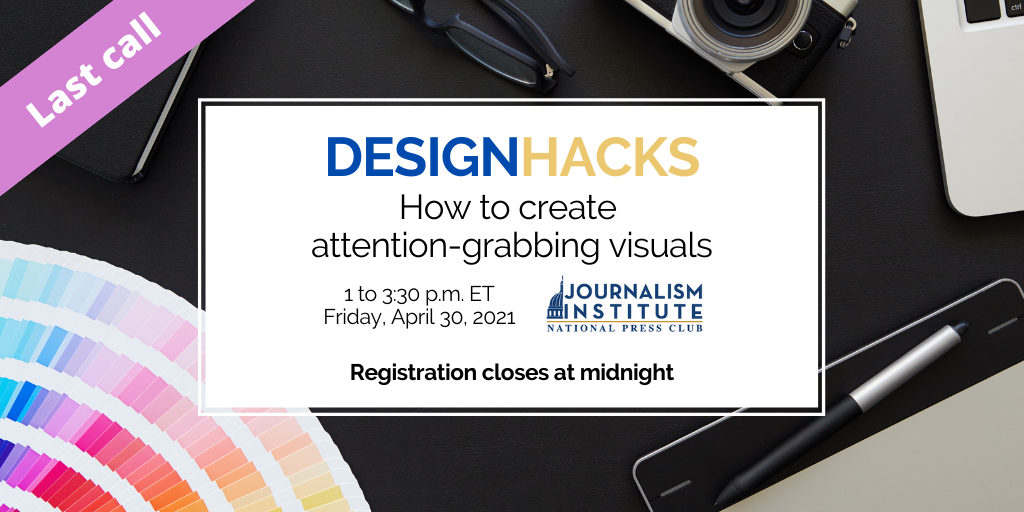
Get a head start on designing graphics and other visuals on deadline — even when you aren’t a graphic designer.
In our scroll and skim culture, dynamic visuals can make the difference in whether a reader engages with a story. But not every story can attract a graphic design professional’s time in the newsroom, especially in the continuing pandemic news cycle. If you’re a reporter, editor, social media manager now handling (or who wants to handle) quick-turn graphics, get a head start with our hacks for designing visuals when it’s not usually part of your job.
Beth Francesco, National Press Club Journalism Institute senior director, will share best practices, tools you have at your disposal from home, and exercises for creating visuals regardless of your hands-on design experience.
Registration is open for this program, which will take place from 1 to 3:30 p.m. ET Friday, April 30. Tickets are $25 for general registration and $15 for National Press Club members. Registration will close at midnight tonight.
|
|
This newsletter is written & edited by the National Press Club Journalism Institute staff: Beth Francesco, Holly Butcher Grant and Julie Moos. Send us your questions and suggestions for topics to cover.
|
|
|
|
|
|
|