Elmo Peeler Note-for-Note Piano Transcriptions
|
|
|
Today is the first day of March and time again for my monthly newsletter, to keep you informed of recent transcriptions and other news of the last month.
|
|
 |
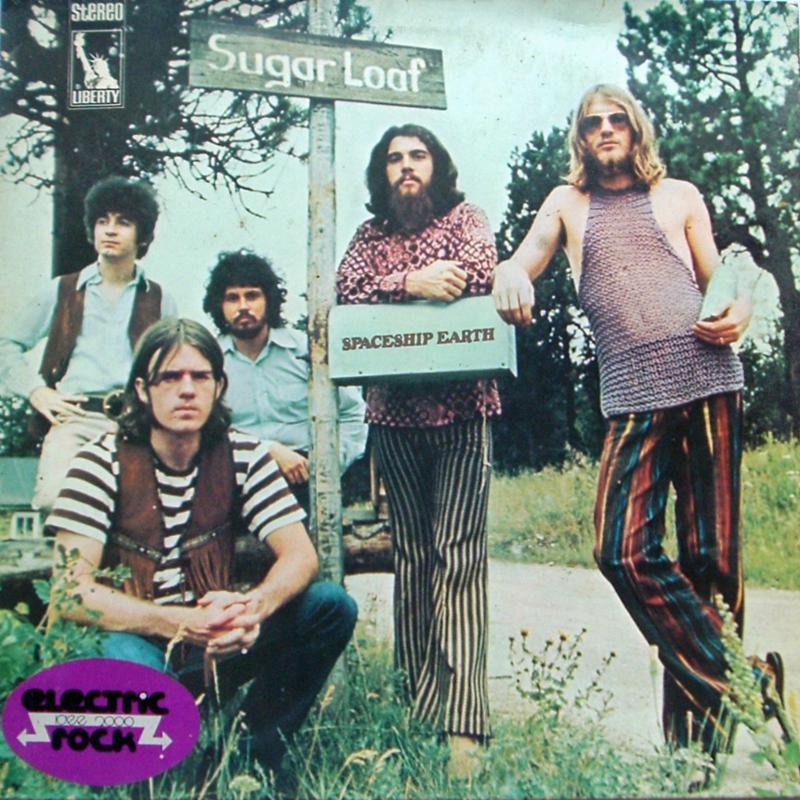
Sugarloaf - "Green-Eyed Lady"
|
|
We'll take a close look at one of rock's greatest Hammond B-3 recordings, "Green-Eyed Lady" by Sugarloaf - and not just the short radio version, but the 7-minute-long album version.
We'll also check out Ian McLagan's driving piano on the Georgia Satellites' version of "Whole Lotta Shakin'."
And, a continuation from last month on how to play drums on a piano (or organ) - a new exercise will help continue your rhythmic progress.
BTW, to make sure that my email doesn't end up in your Spam folder, please add me to your Contact list and/or mark my email as "Not Spam".
Note that every Title Heading is clickable.
|
|
|
ALL of the Sheet Music listed on my website has been personally transcribed by me, and guaranteed to be note-for-note perfect.
Whether you:
-
have a cover band and want to get your keyboard parts exactly correct,
-
are a professional who wants to study the styles of rock's greatest keyboard players, or
-
are a hobbyist that wants to learn how to play pop/rock and great piano music,
...these note-for-note transcriptions will prove extremely helpful.
And as always, if you ever need any help, just drop me a note at: elmo@manymidi.com
|
One of the Greatest B-3 Organ Tracks Ever Recorded
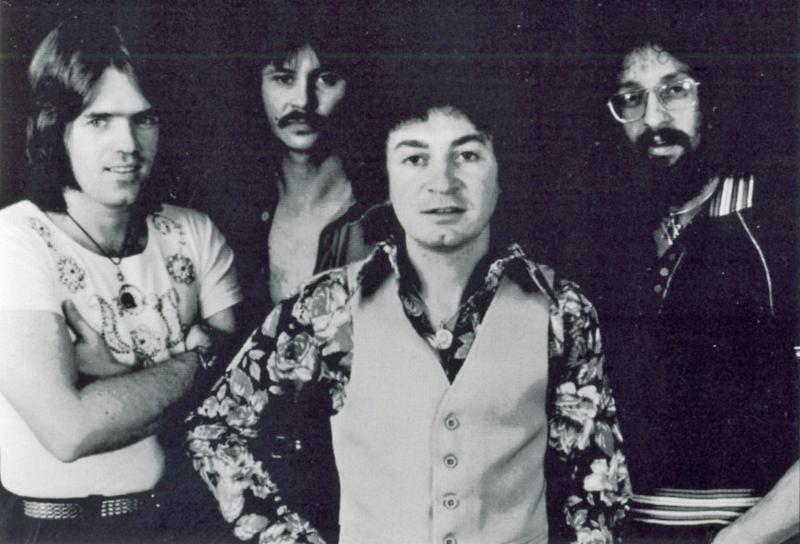
Jerry Corbetta, a Denver, Colorado native, started as a drummer at the age of 4 before switching over to keyboards by age 7.
As a teenager, he started playing keyboards and joined a few Denver-based bands. The Moonrakers was one of them, and in '67-'68 twenty-year-old Jerry led a locally popular five piece band "The Half Doesn't" that drew crowds in Denver's 3.2% beer bars that served up low-alcohol beer and live music to Colorado's 18-year-olds. During his stint in The Moonrakers, he went back to playing drums. But in late 1968, Corbetta and a guitarist friend, Bob Webber, formed the band Chocolate Hair, with one of his main reasons being his desire to return to playing keyboards.
|
|
|
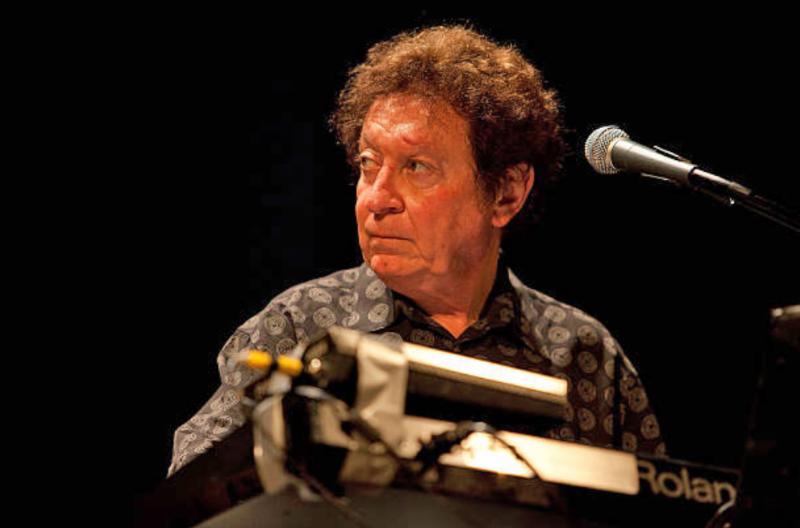
Jerry Corbetta in concert
|
Liberty Records liked the band's demos and signed them. Just before the album's release, however, the legal department at Liberty suggested the name Chocolate Hair might be taken as having racist overtones. The band members agreed to change their name to Sugarloaf, the name of a mountain outside of Boulder, Colorado, where Webber resided in an A-frame house. "Green-Eyed Lady" was recorded at Original Sound Studios in Hollywood, California, and was a last-minute addition to the album, which was released in the very late spring of 1970.
In a 1985 Rocky Mountain
|
|
|
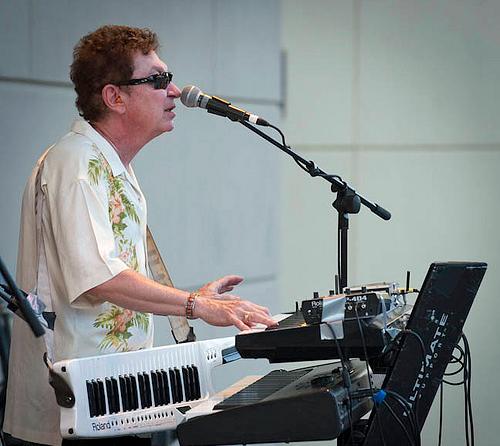
| Jerry Corbetta playing "Green-Eyed Lady" |
|
News interview Corbetta said the song was about his girlfriend at the time whose name was Cathy (Peacock), saying, "She has incredible green eyes and people were always saying stuff like, Corbetta's green-eyed lady." They first met at Metropolitan State College when he was finishing his last quarter in the music department, and moved in together within two months, living in the tourette of an old Victorian home. To quote Cathy, "Jerry and his writing partner were in the process of composing the music for Green-Eyed Lady when he turned to me one day and told me that he was going to call the song Green-Eyed Lady because he loved looking into my green eyes.
"The band was signed to their record deal with Liberty Records and their manager wanted the band to move to Los Angeles. Jerry asked me to move and I never looked back. Jerry and I stayed together until I no longer could tolerate the groupies, touring, and the rock and roll life. We broke up around 1974, but remained friends until our forties when I lost contact with him... He was a fantastic musician and a wonderful man. I hold dear those memories of Jerry and our brief romance. I thank him for giving me a peek into the psychedelic world of rock and roll of the 1970s and for Green-Eyed Lady. I never tire of hearing it on the radio or in the supermarket as the unmistakable organ riff plays, and a smile slowly appears on my face as memories come flooding back of days long since passed and I see the young man sitting at the piano, softly serenading me with a ballad he just composed for me."
Corbetta said he'd based the music partly on a scale exercise he'd found in a book. Sadly, he passed away in 2016 at age 68. But his "Green-Eyed Lady" will live on.
My new Sugarloaf transcription:
|
|
|
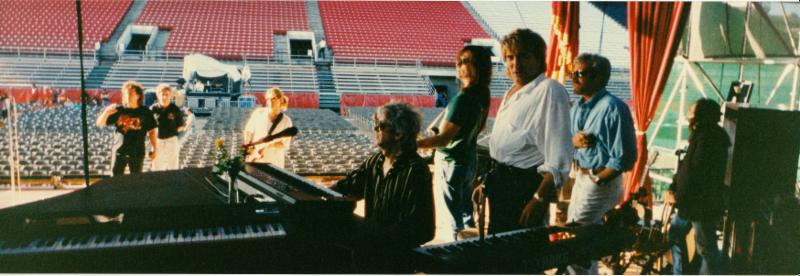
Ian McLagan at the piano with Rod Stewart during soundcheck on 'Unplugged' Tour
|
Ian McLagan, born in England in 1945,
first became interested in rock-&-roll at the age of 10 when he heard "Rock Around the Clock". At his mother's insistence he took piano lessons, and after hearing Booker T. & the M.G.'s "Green Onions" he became interested in the organ. He started playing in bands in the early 1960s, initially using the Hohner Cembalet before switching to the Hammond organ and Wurlitzer electric piano.
|
|
|
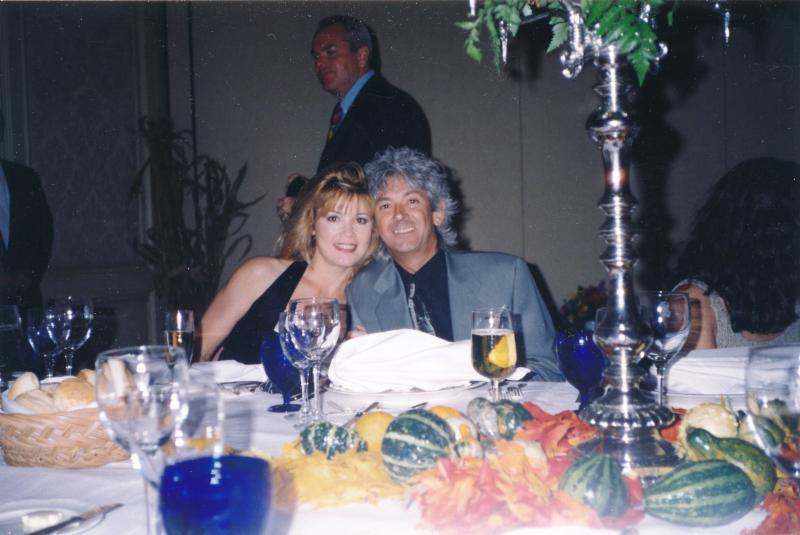
Kim & Ian McLagan at Rod Stewart's Thanksgiving Dinner on tour |
In 1965 the Small Faces' manager, Don Arden, hired 'Mac' for the sum of £30 a week ($750 in 2019 dollars), to join the band. Once the 'probation' period ended, his pay was reduced (at his request) to £20 a week ($500), which was what the other band members were getting. They never received more than that because Don Arden collected all the proceeds of their hard work, and it wasn't until 1967 that they started receiving any royalties. McLagan played his debut gig with them at London's Lyceum Theatre in November 1967. In 1969 after Steve Marriott left the group and
Rod Stewart and Ronnie Wood joined, the band changed its name to Faces.
|
|
|
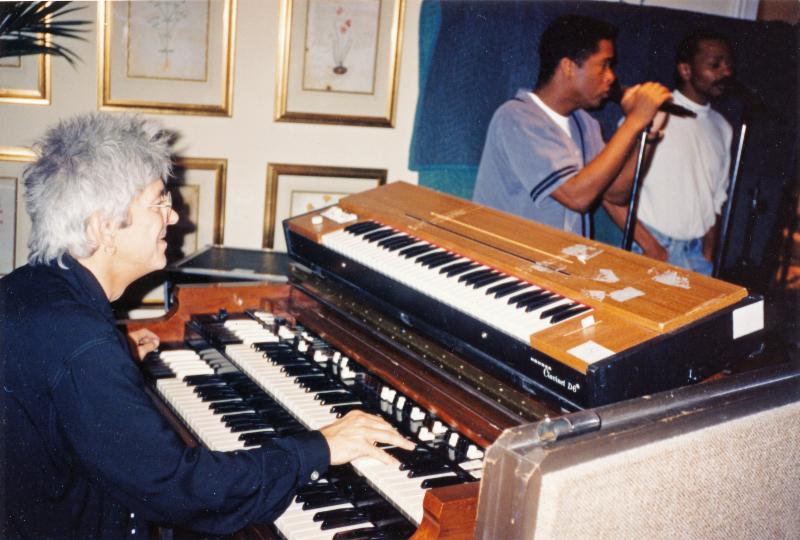
Ian McLagan in Rehearsal at Rod Stewart's L.A. home
|
|
He went on to become a sideman for the Rolling Stones, Bob Dylan, Rod Stewart (where I met Mac), John Mayer and many others. But one of his proudest achievements was meeting and marrying Kim Kerrigan, the ex-wife of Keith Moon (drummer for the Who) and a wonderful woman - sensitive, bright & caring - like Mac. They were a perfectly matched, devoted couple.
I had the pleasure of meeting and getting to know Mac and Kim during Rod Stewart's Unplugged tours of the '90s. He was the organist for the tours and I was the arranger/conductor (and keyboardist) of the 21-piece orchestra. We toured through Europe, Japan and North America, from Madison Square Garden to Wembley Stadium to even the Palace of Brunei. Before meeting Mac I didn't know what he looked like, but I'd heard his playing over the years and assumed that he must've been a big-boned, brawny Irishman whose piano sound was as big as was. Boy, was I wrong! At 5' 5" and weighing as much as a banty rooster, Ian was as diminutive as his sound was big. And he had a large personality with a wry wit and great sense of humor. Indeed, Mac was always the 'class clown' - a naturally funny person with a warm heart.
BTW, these three pics of Mac were taken by me. I'm happy to share them with the world.
My Ian McLagan transcriptions:
|
Note-for-Note Accuracy
This month I've finished one of my most important transcriptions, the long version of "Green-Eyed Lady" by Sugarloaf - not only the groundbreaking organ part but also the terrific clavinet part.
Groundbreaking because the Hammond B-3 was used in ways rarely used before, such as
pitch-bending (using the START/RUN switches) and rhythmic
'slapping' of the keys (previously used in Deep Purple's "Hush", but not in this way). And the notes themselves were more adventurous, not sticking to an E minor pentatonic but using a lot of chromatic alterations, not only in the main theme and the solo but also in some cool,
'horror-show' chords.
And the organ was not the only outstanding keyboard in the long version; the clavinet has a terrific
harmonized-in-6ths, ascending 16th-note run (yes, heavy on chromatics) that provides atmosphere for the upcoming B-3 solo.
In terms of measures this is my longest transcription, at 254 bars (by comparison, the long version of
"American Pie" is 'only' 242 bars long). Also, this transcription includes more Performance Notes than any other, eighteen. Because of its length this transcription is a little more expensive than others, but on a per-measure basis, it's actually one of my least expensive.
For those serious about Hammond B-3 playing, this transcription is a must-have.
My other new transcription this month is of Ian McLagan's piano solo and Out section on the Georgia Satellites' cover of Jerry Lee Lewis' classic "Whole Lotta Shakin' Goin' On."
Even faster than Jerry Lee's version (177 vs 161 BPM), McLagan takes a high-energy 12-bar piano solo (13 including the pick-up) complete with octaves, hammered 4ths, two-handed triplets, and classic boogie riffs. Then the entire Out section is another piano solo, continuing the high energy of the first Solo. By careful electronic processing, the Out section was able to be transcribed all the way through the fade-out to the very end, 19 bars.
This is a note-for-note transcription of both the main piano solo and the piano solo during Out section - a total of 32 bars of the legendary Ian McLagan's rollicking, high-energy piano-soloing.
|
March's New Exercise
- Play Drums on Piano (cont'd)
Make Your Keyboard Playing More Rhythmic
|
|
|
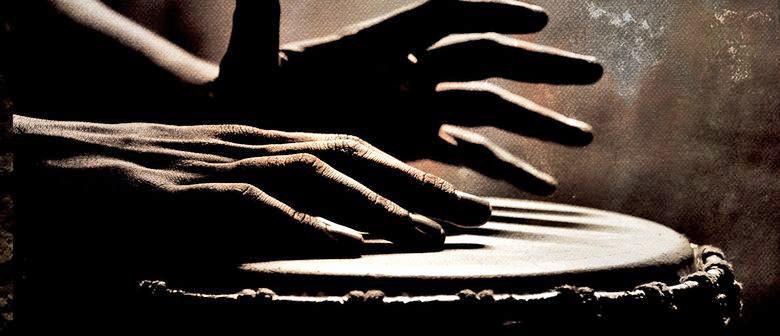
Learn To Play Drums on a Piano or Organ
|
|
As mentioned in last month's newsletter, we've all seen keyboard players that were exceptionally rhythmic, seeming almost as much a drummer as a keyboardist.
And we've all heard Jon Lord's great rhythmic B-3 playing on Deep Purple's "Hush" and Nicky Hopkins' terrific rhythms propelling many Rolling Stone tracks.
Why is it that some keyboardists can turn their keys into rhythmic drums while many others can not?
It's simple - they understand the rhythms that a drummer plays. It's not mystical. Drummers practice rudiments (paradiddles) like pianists practice scales. And those rudiments are written down and can be learned by keyboard players.
This month's new "Playing Drums on the Piano" exercise takes another common drum paradiddle - LRLLRLRR (last month's was LLRLRRLR) - and applies it to the piano keyboard. Every single measure during the 14-bar pattern uses that particular drum rudiment to help the pianist ultimately become relaxed and comfortable with the Left-Right coordination required for very rhythmic keyboard playing.
The exercise is in three parts:
1) a 14-bar chord progression using basic triads and 7th-chords
2) the same 14-bar chord progression but harmonically richer (with 7th & 9th chords)
3) the same 14-bar chord progression (7th & 9th chords) but with a subtle difference on beat 3
Performance Notes are included. If you'd like to inject more rhythm into your playing, this exercise will help.
(BTW, if you need other good, effective technical exercises, please check out
the other 60 exercises available.)
BTW, here are my other Paradiddle exercises:
|
'Custom' (to-order) transcriptions can be expensive because of the time required. And when a recording is particularly long and/or complex, the expense can be too much for one person.
Fortunately, "CrowdFunding" (I use the term generically) has now succeeded four times with important transcriptions: first Ethel Caffie-Austin's "Amazing Grace", then Don McLean's "American Pie", then Johnny Rivers' "Rockin' Pneumonia". and most recently, Chuck Berry's "You Never Can Tell". Thanks very much to everyone that contributed.
The way it works is simple: Drop me a note and let me know how much you'd like to contribute.
No contributor will b
e allowed to pay in advance, but only after the transcription is finished and distributed to all the contributors and everyone is happy with it.
As part of the process of transcribing the complete piano part for
Keith Emerson's "Lay Down Your Guns" two months ago, I discovered a rare "Instrumental Demo" of LDYG that had been recorded earlier than the album version. It's in a different key, G (instead of E-flat), and contains enough different musical material in it that it would be worthwhile to do. During my transcription of the album version I studied the demo and made enough notes that completing a note-for-note transcription of the demo at this point would not require nearly as much time as the album version took.
I'd like to put all my notes together and complete a note-for-note transcription of the earlier Instrumental Demo (in G) for "Lay Down Your Guns".
if you'd like to help 'crowdfund' a transcription of Keith Emerson's piano part in his Instrumental Demo of "Lay Down Your Guns."
Emerson fans could compare scores of the two versions and study his creative process through its evolution. The goal is $445.
My 'CrowdFunded' transcriptions to-date:
|
Boogie-woogie is one of piano's most wonderful art-forms. But it just doesn't work on other instruments nearly as well. Have you ever heard a guitarist make his instrument as exciting as Albert Ammons, Pete Johnson or Meade 'Lux' Lewis made the piano sound? No, it can't be done. The elements that comprise foot-tapping, exciting boogie-woogie are unique to the piano. They don't 'sound' on other instruments.
Are you comfortable playing boogie-woogie? Can you take any melody and turn it into an effective boogie-woogie?
It's an art form that can be learned, step at a time. And if you're serious about it, I'd be happy to help you.
I've had the good fortune to have
toured the world playing keyboards and arranging/conducting for these Rock and Roll Hall of Fame Artists:
- The Beach Boys
- Rod Stewart - All 'Unplugged' concerts
- Ricky Nelson - Stone Canyon Band
And I've also won classical piano competitions performing Beethoven,
Rubinstein a
nd
Saint-Saens' Piano Concerti. See me playing here. "Josie's Boogie" is quite the virtuoso dramatic mino
r-key showpiece; check out the ascending double-octave run at the ending... :)
Thanks to the internet, I can help you play piano better - rock or classical, by ear or by note.
Perhaps all you need is just an hour on Skype discussing rock keyboards.
If you'd like to improve, drop me a note
at
info@manymidi.com. Tell me three things:
1) Your musical background
2) Where you are currently, musically-speaking
3) Your musical goals
My students include members of:
- Weezer (Rivers & Brian)
- Vampire Weekend (Ezra & newest addition, Greta)
- Incubus (Mike)
- The Strokes (Nick)
- Rooney (Robert)
- Jason Schwartzman ("Mozart in the Jungle")
- Courteney Cox
|
|
|
|
|