Advancing Supplier and Governing Board Diversity |
|
Deadline for submissions is the 15th of every month.
|
|
September 2020 Newsletter Preview |
I. What’s New:
- Welcome from the Insurance Diversity Initiative
- Latinx Heritage Month
- Public Meetings Notice
II. In the Community:
- NAIC Announces a Special Edition of "The Regulators" on Race and Insurance
III. Words Matter
- The Problem With The Term "Hispanic"
IV. Spotlight On Diversity
- The Ongoing Impact of COVID-19 on Latino-Owned Businesses
V. Announcements
- Registration Opens Soon - 2020 Virtual Insurance Diversity Summit
VI. Upcoming CDI Meetings & Task Force Meetings
- TeleTownhall Meetings with Commissioner Lara
- 3rd Quarterly Insurance Diversity Task Force Meeting
- Governing Board Diversity Advisory Group Meeting
- Supplier Diversity Advisory Group Meeting
- 2020 Virtual Insurance Diversity Summit Planning Meeting
VII. Diversity Events Calendar
|
|
In our excitement to send this month's newsletter, we made a small glitch. So, let's try this one more time.
Hi (again) Diversity Stakeholder,
Keep an eye out: September 15 - October 15 marks Latinx Heritage Month (also called Hispanic Heritage Month but we'll get into the semantics later in the newsletter). For now, just know that these 30 days are meant to recognize and celebrate the contributions of our friends, families, neighbors, and colleagues who trace their roots to Spain, Mexico, Central America, South American and the Spanish-speaking nations of the Caribbean have made to American society, history, and culture.
Our Diversity Initiative remains focused on increasing the industry's procurement from diverse suppliers as a means to advance the economic empowerment of diverse businesses. In 2017, the Department of Insurance's survey results indicated that insurance companies spent $149 million with Latinx businesses in California, and $749 million, nationwide. We expect these numbers to rise in the coming years, as Latinx businesses are the fastest growing entrepreneurial group. According to a recent Stanford University study, the number of Latinx business owners grew 34% in the past decade, compared to 1% for all business owners in the United States.
Also, check out the public notices, links and contact information for this month's upcoming public meetings towards the latter portion of this newsletter and online at www.insurance.ca.gov/diversity. We look forward to having you join us!
Be well,
The Insurance Diversity Initiative Team
|
|
NAIC Announces a Special Edition of "The Regulators" Podcast on Race and Insurance
|
|
The National Association of Insurance Commissioners (NAIC) released a special edition of its podcast "The Regulators" focused on Race and insurance. Season 2, Episode 7 brings together regulators, the industry and consumer advocates to discuss diversity and equity in the insurance industry, an issue that the NAIC is addressing as part of its new race and insurance special committee, announced in July.
This special episode is guest hosted by Connecticut Commissioner Andrew Mais and discusses racial equality in how insurance products are delivered and sold, and racial diversity within the insurance industry. His guests are: California Insurance Commissioner Ricardo Lara; New Jersey Department of Banking and Insurance Commissioner Marlene Caride; Aflac Chief Executive Officer, Dan Amos; and Consumer Advocate and Chair of the Connecticut Insurance Department Subcommittee on Big Data, Sonja Larkin-Thorne.
"This podcast is just one of the many conversations that commissioners are having about how we can work together to identify and address biases," said Mais. "Advancing issues related to racial equity requires talking openly about Race and Insurance practices, even if the conversations are difficult."
The Regulators podcast is available on NAIC.org, Apple or the choice platform you use to access podcasts.
# # #
|
|
WORDS MATTER:
THE PROBLEM WITH THE TERM "HISPANIC"
|
|
Are the terms Hispanic and Latinx interchangeable. For some people, you would think so, but talk to the people that are affixed with these descriptors, and you may be surprised to see the fallacy of using them as one in the same.
The understanding of these terms is so contested that on June 24, 2020 the Associated Press (AP) Stylebook tweeted their most current definitions of each."Latino is often the preferred noun or adjective for a person from, or whose ancestors were from, a Spanish-speaking land or culture or from Latin America. Latina is the feminine form," its first tweet read. "Some prefer the gender-neutral term Latinx, which should be confined to quotations, names of organizations or descriptions of individuals who request it and should be accompanied by a short explanation...Hispanics is also generally acceptable for those in the U.S. Use a more specific identification when possible, such as Cuban, Puerto Rican, Brazilian or Mexican American."
The tweets were met with confusion, disagreement, anger, and frustration. Why? Because 240-characters cannot include the historical etymology, nor can they accurately distinguish the differences of race and ethnicity. Populations move, morph, and blend; these shifting cultural beliefs continually alter how we all think of and define both. The dilemma of using Latinx or Hispanic is just the tip of the iceberg. Underneath lies the centuries of history—including the slavery, colonialism, activism, and subsequent attempts to fix past wrongdoing operating across more than two dozen countries, islands and territories. In fact, the term “Hispanic” was socially constructed and first introduced in the 1970 U.S. Census to categorize people whose place of origin or descent included Mexico, Puerto Rico, Cuba, Central or South America.
Is self-identification the solution? Yes and no. Self-identification is perfectly fine for an individual however their descriptor may not mean the same they intend on a social level.
There are, still, some agreed-upon parameters (according to academia): To be considered Latina/Latino/Latinx, you or your ancestors must have come from a Latin American country: Mexico, Dominican Republic, Puerto Rico, Cuba, French-speaking Caribbean nations, Central or South America (though English-speaking regions). Latinx is an ethnic and cultural category, where as Hispanic is a linguistic division. People who live in or are descended from a Spanish-speaking culture can define themselves as Hispanic. This includes people from or descended from Spain—but Spain is part of Europe, and thus not part of Latin America. Therefore, Spanish people could be described as Hispanic, but not Latinx.
Can someone be both? Yes, and you can also be Chicano, a term for someone of Mexican origin or descent, and Hispanic and Latinx.
As we continue to honor the contributions that the Hispanic and Latinx people have made to our state, country, and world-- let's take some time to learn the history of the language that shapes their cultural identities and the richness of the individual stories behind them.
|
|
SUPPLIER DIVERSITY SPOTLIGHT |
|
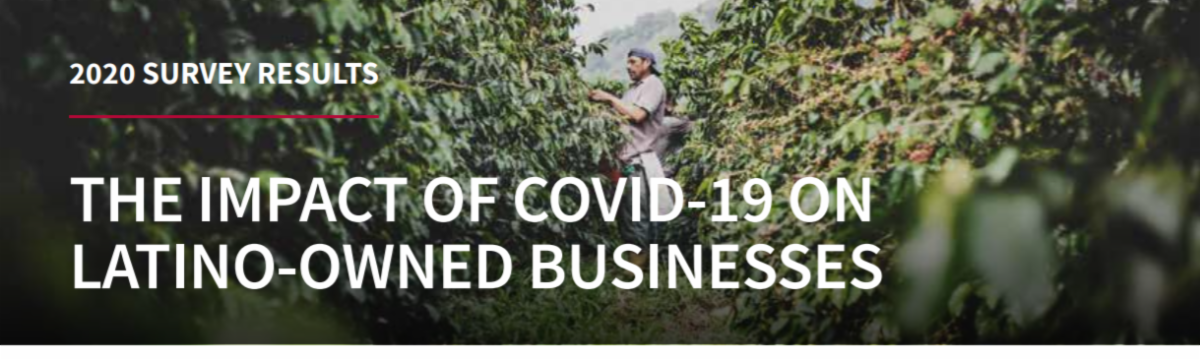
The Ongoing Impact of COVID-19 on Latino-Owned Businesses
|
|
On March 25, 2020, two weeks after the World Health Organization declared the COVID-19 viral disease a pandemic, the Stanford Latino Entrepreneurship Initiative (SLEI) administered its first business pulse survey to understand the immediate impacts on Latino-owned businesses — a demographic group starting businesses at a faster rate than all others in the United States. Three months later, SLEI Research collected a second wave of data to follow up on the same businesses. Also in June, we collected a much larger sample of Latino-owned businesses for our annual survey of Latino businesses
and a comparison group of white-owned businesses. This research brief presents results first from the follow-up survey administered to our proprietary research panel of Latino business owners and then to the larger sample, the 2020 SLEI Survey of U.S. Business Owners. Taken together, we highlight insights on the ongoing impact of COVID-19 on Latino-owned businesses, their access to resources and relief aid, and what new and unforeseen challenges and opportunities exist as a result of the pandemic.
With unemployment rates soaring to nearly 15% in April 2020, we focus on employer firms in this research brief. Employer firms are those with at least one paid employee other than the owner. Using the latest census data available, there were nearly 400,000 U.S. Latino owned employer firms in 2017, employing 3.4 million people and generating nearly $500 billion in annual revenue. Since the number of Latino business owners has been exploding over the last 10 years, growing in number by 34% compared to 1% for all other business owners, the current experiences and subsequent recovery of this business segment will be an important benchmark to track against pre-COVID trends.
# # #
|
|
GOVERNING BOARD DIVERSITY SPOTLIGHT |
|
Latinas on California Public Boards
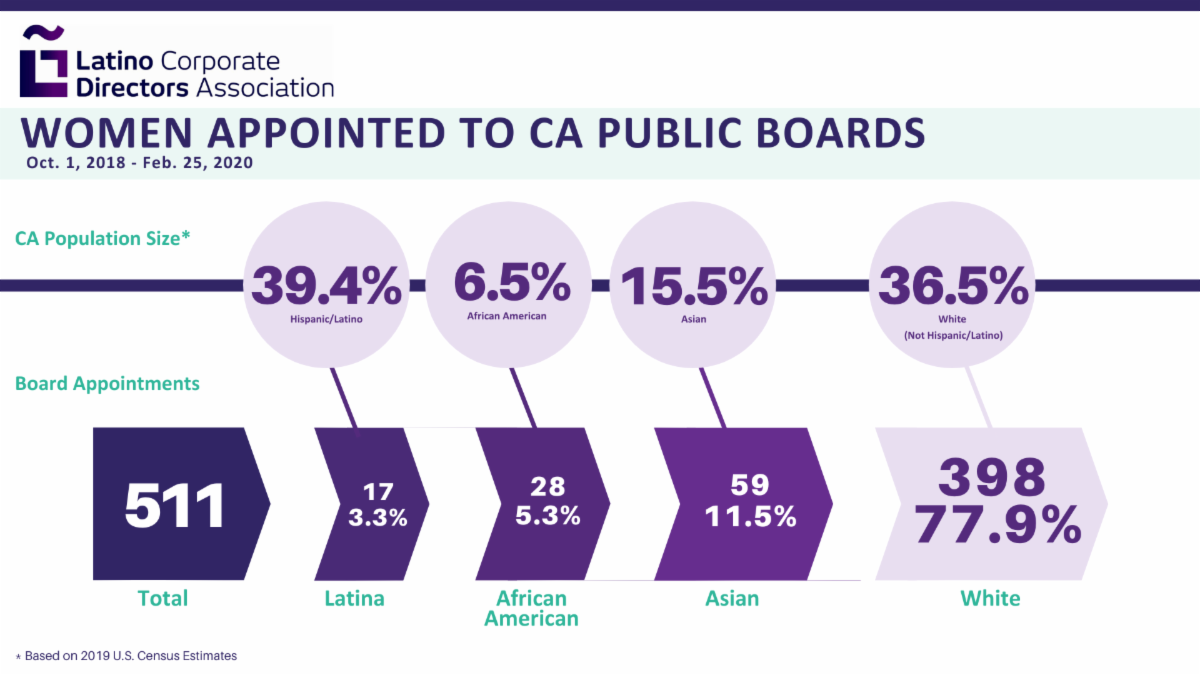
Despite California efforts to diversify boards, of the 511 seats filled by women on California public company boards since SB 826 was enacted, just 3.3% are Latina, compared to 77.9% white women.
In October 2018, California enacted SB 826, the first national law to diversify public boards in the state by mandating female participation on those boards. According to data from Equilar which has been supplemented by [Latino Corporate Directors Association] LCDA research, 511 women have been appointed to the boards of 415 companies since the law was enacted
Unfortunately, even though California is the most racially diverse state in the nation, nearly 78% of the women appointed to these boards are white women. Hispanics comprise more than 39% of Californias population which means that one in five people in California is Latina. However, just 17 women, or 3.3% of the women appointed to boards during this period are Latina. The table below shows representation by white, Latina, Asian, and African American women, compared to the size of the population by race in the state. Diversity is more than gender and once again, Latinas are being left behind.
# # #
|
|
Registration Opens Soon for the 2020 Virtual
Insurance Diversity Summit
|
|
The 2020 Virtual Insurance Diversity Summit is a one-of-a-kind, free, online event that includes: Matchmaking Roundtables, Resource Expo, and engaging webinars led by experts on the topics of race and diversity in the insurance industry, diversity in the boardroom, navigating the insurer procurement pathways, building resilience in business strategies, and much more!
Date: November 12 - 13, 2020
2020 is a pivotal year that will shape our future. The racial justice movement and COVID-19 laid bare the inequities that ravage our diverse business communities. Now more than ever, we need to come together to focus on "Uplifting Our Communities" and build each other up. California's insurance industry is the largest insurance market in the nation -- where insurance companies collect $310 billion annually in premiums -- and poised to advance supplier and board diversity.
Registration will be opening later this month - stay tuned!
|
|
UPCOMING CDI MEETINGS &
DIVERSITY TASK FORCE MEETINGS
|
|
 |
This new section of the newsletter will house all of the information regarding upcoming Commissioner TeleTownhalls and Insurance Diversity public meetings. |
Date and Time: September 8, 2020, 6:00 p.m. - 7:00 p.m. PDT
Event: TeleTownhall with Commissioner Lara and Zach Friend, Santa Cruz County Supervisor
Date and Time: September 11, 2020, 1:30 p.m. - 2:30 p.m. PDT
Event: TeleTownhall with Commissioner Lara, Orinda Fire Council and Assemblymember Bauer-Kahan
Date and Time: September 16, 2020, 10:00 a.m. - 12:00 p.m. PDT
Event: 3rd Quarterly Insurance Diversity Task Force Meeting
Meeting ID: 921 4414 0623
Meeting Password: 244580
Call In Number: 877-810-9415
Call In Access Code: 436691
Date and Time: September 17, 2020, 9:00 a.m. - 10:00 a.m. PDT
Event: Insurance Diversity Task Force Governing Board Diversity Advisory Group Meeting
Meeting ID: 925 3108 9984
Meeting Password: 511661
Call In Number: 877-810-9415
Call In Access Code: 436691
Date and Time: September 17, 2020, 1:00 p.m. - 2:00 p.m. PDT
Event: Insurance Diversity Task Force Supplier Diversity Advisory Group Meeting
Meeting ID: 946 5693 9214
Meeting Password: 067789
Call In Number: 877-810-9415
Call in Access Code: 436691
Date and Time: September 22, 2020, 1:00 - 2:00 p.m. PDT
Event: 2020 Virtual Insurance Diversity Summit Planning Meeting
Meeting ID: 937 2999 5344
Meeting Password: 991039
Call In Number: 877-810-9415
Call In Access Code: 436691
|
|
|
|
SEPTEMBER
This event is being held virtually.
This event is being held virtually.
|
|
OCTOBER
October 12 - 13
This event is being held virtually.
2020 NMSDC Conference and Business Opportunity Exchange - National Minority Supplier Development Council (NMSDC)
October 26 - 29
This event is being held virtually.
|
|
To submit a request to add your Supplier Diversity or Governing Board Diversity-related event, please contact us at: diversity@insurance.ca.gov.
|
|
The Insurance Diversity Initiative was established in 2011 to address diversity issues within California's $310 billion insurance industry. Specifically, these efforts are meant to increase procurement from California’s diverse suppliers, as well as to increase diversity amongst insurer governing boards. To accomplish these goals, the Department conducts outreach, creates partnerships, hosts events, and most importantly, administers surveys to collect and publicly disseminate information about the state of diversity in the insurance industry.
|
|
INSURANCE DIVERSITY INITIATIVE
Office of Insurance Commissioner Ricardo Lara
California Department of Insurance
(916) 492-3317
|
|
|
|
|
|
|