|
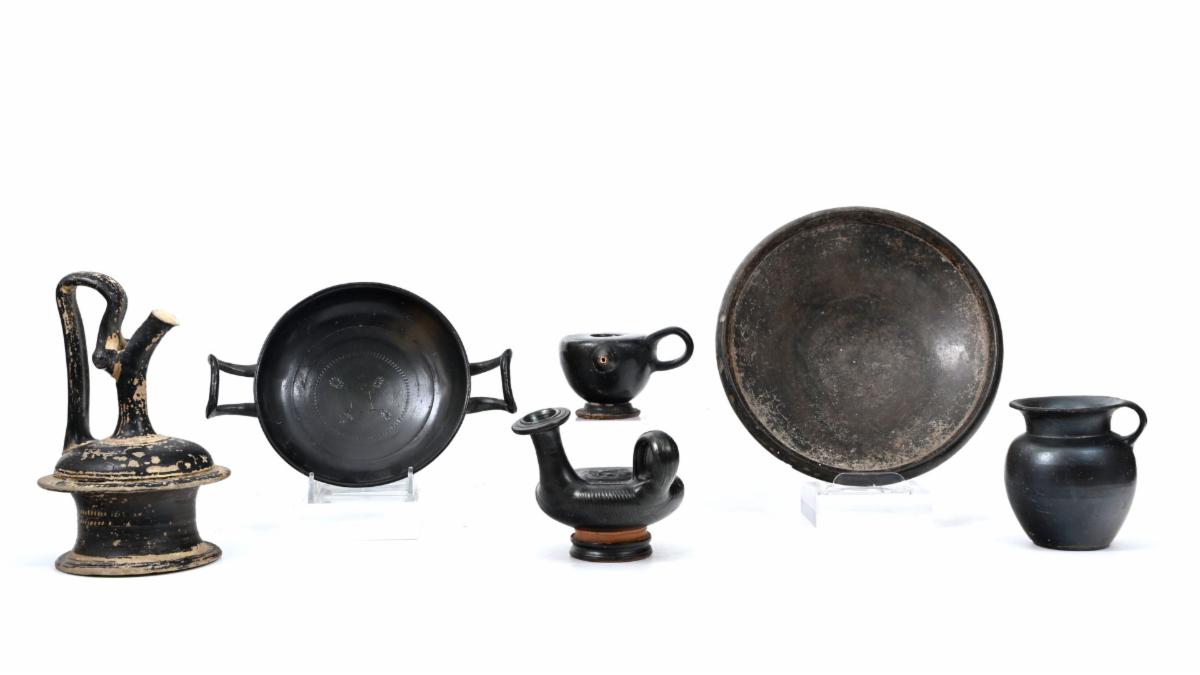
Twenty-four centuries ago, these six vessels were in daily use, pouring oil, holding wine, and feeding a child. Their mirror-black surface still catches the light, and it was never paint. It is a fine clay slip that turned black in the kiln, a method perfected in Athens and taken up by the potters of southern Italy in the 4th century BC. Here are three from the group.
The guttus, a small vessel for dispensing oil drop by drop, has a ribbed body, a ring handle, and a narrow spout. At the center of the top is a molded medallion of a Nubian figure. It comes from the William Frolich collection, New York.
The Campanian kylix, ca. 4th century BC, is a shallow two-handled wine cup with stamped decoration in the tondo. It measures 8¾ inches across the handles and has excellent root marks. It comes from the estate of Rosa and Aaron Esman of New York. Rosa Esman was a gallerist and print publisher, and her husband Aaron was a psychiatrist who wrote on creativity.
The baby feeder, Greek, ca. 350–325 BC, is a squat footed vessel with a short conical spout for controlled pouring. A very similar example is in the Metropolitan Museum of Art (acc. no. 91.1.1627).
Please also check out our recent acquisitions.
Best,
Howie and Dara
|