|
December 2025
Vol 14 Issue 2
From the Editor
Seasons's Greetings,
As another year ends, we at CRGC would like to thank you all for our successful SEER submission. The quality and timely data that you report helps us meet this crucial deliverable year after year.
This year was a bit challenging for some folks working in the National, State and regional registries. Hopefully everyone affected was able to land on their feet.
Here are some notable personnel changes at CRGC in 2025.
· Winny Roshala retired in September 2024, and Stephanie Phipps took over the role of Data Quality Control Director and Reporting Facility Compliance Officer in January.
· Amanda Hubbert took over the role of Data Collection Abstracting Supervisor in June, a position that Stephanie previously held.
· Mignon Dryden retired in July, and I took over her e-path and education duties.
Retirement is inevitable in the workplace. Here are the CRGC alums that moved on to other adventures in 2025.
Nai Robinson
Donald Fong
Mignon Dryden
Diane Overlook
Dee LeTendre
All in all, it was a busy year. There were some lows, but we close on a high. This winter whatever holiday you celebrate, be it Christmas, Hanukkah, Kwanzaa, Lohri, Boxing Day or even Festivus! May it bring you peace and joy!
Sincerely,
Nankee
In this edition:
· A thank you note from Judy Vang, our Senior Director of Operations.
· Melissa Lewis, Data Collection/QA Supervisor covers some common coding/abstracting errors.
· Cathy Lewis, Compliance Data Quality Specialist gives you a peek behind the compliance curtain.
· Scott Riddle, Business Analyst III, covers the completeness aspect of the CT report.
· And last, but not least Kyle Ziegler, Director Data Management, gives an in-depth analysis of our new database management system.
| | |
SEER Annual Data Submission
Judy Vang
Senior Director of Operations
The Cancer Registry of Greater California submitted its annual data to the National Cancer Institute’s Surveillance, Epidemiology and End Results (SEER) Program in early November. Our submission met most of the SEER and all the North American Association of Central Cancer Registries (NAACCR) high standards of quality and completeness requirement. The data submission included information for over 127,000 residents of the CRGC catchment area who were diagnosed, treated, or seen with cancer in 2023.
On behalf of the CRGC Team, we send our heartfelt thank you and appreciation to the cancer registrar community for your continued contributions to this vital effort. The data that cancer registrars collect, and curate is critical to the health of the nation.
| | |
Common Errors in Abstracts
Melissa Lewis, BS, ODS
Data Collection Supervisor | Quality Assurance
The Quality Assurance (QA) team is a part of the Data Collection Unit at the Cancer Registry of Greater California. This year, the QA team of five have processed over 35,000 Consolidation and Resolution of Patient Set Errors (RPSE) tasks for diagnosis years 2023-2024.
As fellow ODS, it’s understood how easy it is to make a mistake. That kind of thing that surprises you because you were confident you knew the answer. The good news- These errors are preventable with a bit more attentiveness and consistent use of the current coding manuals (i.e. STORE, VOLUME I, AJCC) and other resources.
Here are a few examples of what we’ve noticed and the reference:
Breast Laterality
An abstract is submitted by Hospital A documenting that the laterality of the primary is left, but the corresponding path report submitted by the same facility, documents the laterality as right.
Another issue that has been identified is abstracts submitted with laterality codes that do not correlate with any of the documented text.
Reference:
Volume I: Abstracting and Coding Procedures, Section V.2 Laterality, page 117
Coding Grade for Breast Carcinoma In-Situ (2018+)
We often see in-situ breast cases with the grade coded to 1, 2, or 3. The preferred grading system for in situ breast tumors is defined as Low(L) (Nuclear Grade 1), Intermediate (M) (Nuclear Grade 2, or High (H) (Nuclear Grade 3). Grades 1, 2, or 3 should not be used for in situ tumors.
Reference:
Grade Coding Manual, Version 3.2, Breast-Grade Table 12, Pages 110-111. *Notes 4-6 are extensive instructions for coding grade of Breast (In-situ & Invasive).
Histology Code for Serous Carcinoma NOS for Ovary, Fallopian Tube, and Peritoneum Sites
QA staff has noticed the Serous Carcinoma NOS (8441/3) histology code being used for High Grade Serous Carcinoma (8461/3) in Ovary, Fallopian Tube and Peritoneum sites. Code 8461/3 should be used if possible. Histology code 8441/3 should only be used if the tumor cannot be distinguished as low grade or high grade.
References:
Solid Tumor Rules - 2025 Update, Other Sites, Table 13 Ovary Histologies | Table 14 Peritoneum Histologies | Table 15 Fallopian Tube Histologies
SEER Inquiry 20240064
Oncology Data Specialists are some of the most detail-oriented people, but the intricacy of the work and constantly changing rules can be challenging at times. Try taking an extra moment to review your documentation for accuracy and make a habit of continuously referencing your manuals. This will not only increase familiarity with current rules, but it will help keep our statewide data quality reliable and valid.
Happy Abstracting!
| | |
2025 a year in retrospect……Compliance
Cathy Lewis, ODS-C
Compliance Quality Control Specialist II
2025 was a remarkably busy and successful year for our Compliance Team. The following accomplishments occurred this year:
· Developed a plan for facility assignments for the compliance team.
· Developed new policies, procedures, and forms for our Compliance team.
· Worked with the amazing Scott Riddle as he developed a new MS Access Database “Tracker” for all CRGC facilities.
· We learned to perform transmit functions.
Developing relationships with the hospital staff, vendors and abstractors at our facilities is essential. After our initial introductions by email, we request a new annual Reporting Facility Abstractor Information Form and update the SEER*DMS database with any new contact information and changes to the Expected Case Counts for each year.
Changes at the staffing, IT, and software level present challenges. We in the compliance team at CRGC work with the facilities to alleviate these challenges. If there is a discrepancy between the facility’s completeness case count and what we received, we have a process of requesting a Detail File report from the facility. This results in an Excel file which we can then analyze against cases we have received, and the facility can then determine if they have a missing file that needs to be transmitted.
If a facility is non-compliant, they are put on an Action Plan for that specific year. This plan is implemented with the cooperation of hospital staff to bring the facility into compliance with the California reporting requirements. The expected case count is reviewed against what we have received, the expected cases per month are determined and a goal date is set. We follow up with the facility at the beginning of the month to track progress. This is done till the facility transmits abstracts at their expected monthly rate. On the back end, our tracking database is updated daily, and we evaluate these numbers to gauge progress.
I am happy to report that we have met our compliance goal for the submission year 2023 and are well on our way to our 2024 goal.
| | |
The Completeness and Timeliness Report – Completeness Section Explained
Scott Riddle, B.S.
Business Analyst III
The California Cancer Registry (CCR) provides the Completeness and Timeliness Report (CT Report) to help gauge reporting progress. The Cancer Registry of Greater California (CRGC) provides these reports to the reporting community on a monthly basis. This article covers the Completeness section.
Completeness is measured using a count of cases based on the month and year of the Date First Contact (not the Date of Diagnosis!). The report reflects all new cases that were received by the reporting facility.
Color coding - The report uses color coding to help review and compare results. For the Completeness section, these are the associated colors and their meanings…
Gray - Expected Cases
| | |
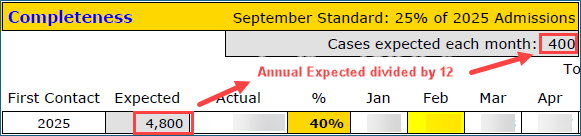
The Compliance Team members will review your previous year’s actual count after receiving and verifying a Completeness Form and adjust the facility’s expected count accordingly. The annual expected is calculated as a monthly expected for easier comparison to each month in both the Completeness and Timeliness sections. Please note that the count is an educated guess at what would be expected during that year.
Goldenrod – Percentage Completeness
| | |
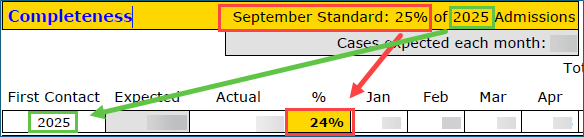
The CCR expects to receive 8.33% of your annual case load each month. The percentage standard is calculated and shown on the report’s Completeness banner. The facility’s current actual percentage rate, based on received cases, is shown on the row with the goldenrod-colored highlighted cell.
Yellow with Red Font – Possible Deficiency
| |
The CT Report has a calculation comparing the actual number of cases received against the expected. Often, this is an indication of a file that was generated but not sent – what we call a missed file. If you see one of these cells on your report, chances are that the CRGC Compliance Team will be asking about a reason for the deficiency and/or requesting that you provide an analysis file for further investigation.
In the next Chat Newsletter, we hope to have the 2nd article about the Timeliness section.
| |
A year of Learning a New DMS Means Facing New Challenges
Kyle L. Ziegler, BS, ODS
Director, Data Management
As you all may or may not be aware of, the California Cancer Registry migrated the statewide database to a new Database Management System (DMS) in the summer of 2024. This past year has been exciting and challenging at the same time. Like with any major change to an environment, fully understanding the new processes are key and imperative to harnessing the power and operability of the system.
The new DMS is called SEER*DMS, and it offers much more automation than we have ever seen in past DMSs. So much so that within weeks of migration our backlog of over 300,000 electronic pathology reports from previous years were resolved. Currently we are processing 2025 pathology reports within approximately 6 months of arrival in the DMS.
Many incoming records are processed automatically by the system and never need human intervention. These are incoming records (think your monthly transmission) that are uploaded into SEER*DMS and go through the entire workflow (matching (linking) to an existing patient set and possibly tumor, clear of all edits and is determined not to be a duplicate record, patient or tumor). If any of these automated tasks fail, then the record is sent for manual intervention by one of our staff. Keeping track of where records go and what happens to the records once you have performed a task has been challenging, although once it is understood, it makes total sense.
Currently, I believe between 65% and 80% of incoming records are processed automatically. Pathology reports are the one record type that has the most manual review tasks associated with it and work is currently underway to reduce that to a very minimal number needing review.
CRGC staff realized early in the deployment in SEER*DMS that all procedures and processes were affected and some procedures had to be thrown out completely and rewritten. This development resulted in efficiencies while in other circumstances resulted in what was once a straightforward task now being more complicated and requiring more steps.
Now that we have navigated two submission cycles to SEER, NPCR, and NAACCR, we have been working to resume normal external processes such as physician and hospital followback, both processes that have had the entire procedure rewritten, and edits and case consolidation of incoming records, which has changed and now requires a completely different set of tasks to complete these actions.
We have seen improvements in processes and in our 15 Data Quality Profile benchmarks in the 18 months since migration and we hope to continue this trend of improvements. I believe that all our partners, both internal and external, in time, will see benefit from this transition.
Overall, this migration has been a positive experience and a much needed one. This has been a great year of exploration, discovery, process improvement, and learning for CRGC. It will continue for the foreseeable future, but I can say with this migration, the CRGC has finally achieved a fully electronic workflow. Processes will continue to be refined and redeveloped to continue the move to a near fully automated system.
We are looking forward to what 2026 has in store for us!
| | |
If you have questions or concerns regarding any of the content of this CRGC communication, please contact me.
Nankee Singh, ODS
QC II, E-path & Education Coordinator
| | | | |