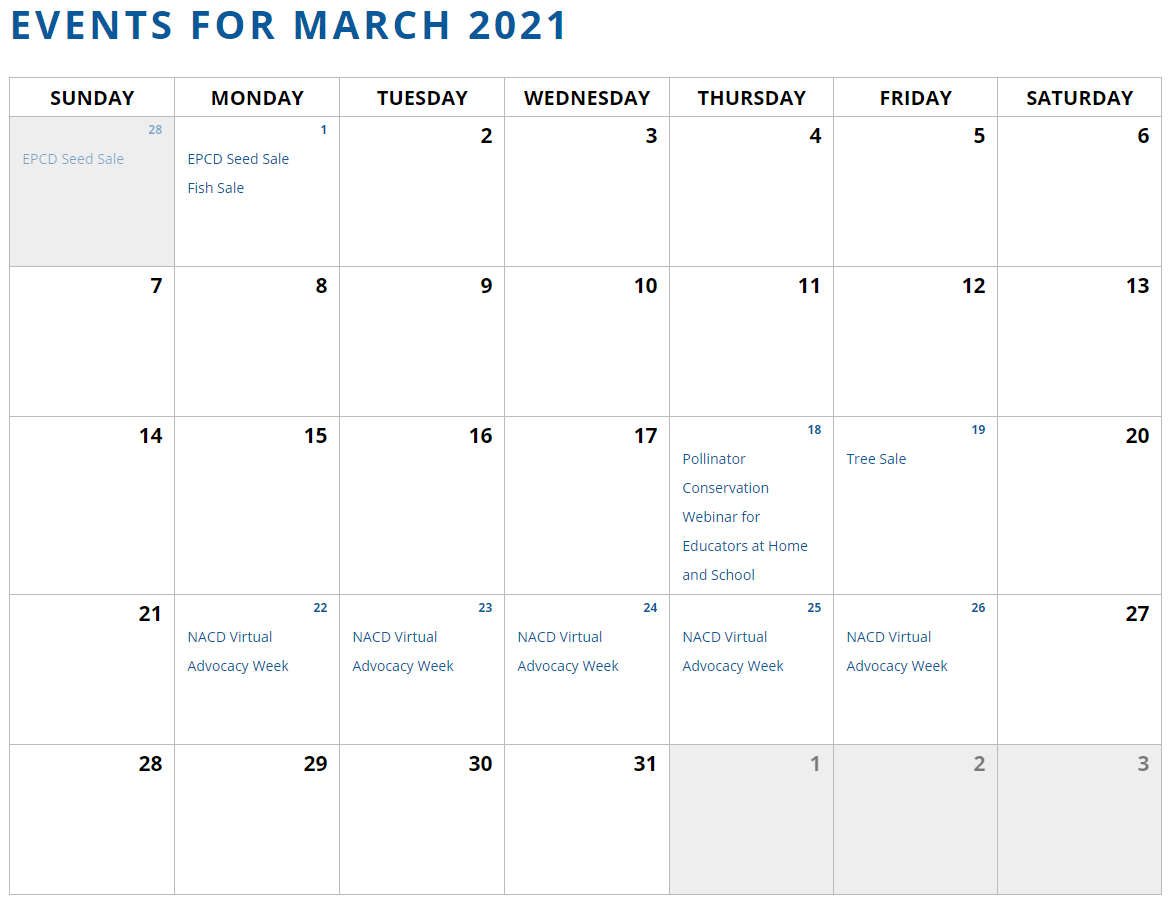
Last week, NACD hosted its 2021 Virtual Advocacy Week, and states ranging from New York to Washington State and Wyoming to Georgia conducted meetings with their elected representatives and agency officials.
Participants discussed the importance of local technical assistance, addressing climate change, increased staffing capacity at the Natural Resources Conservation Service (NRCS) and why additional federal investments in programs like the U.S. Department of Agriculture (USDA)’s Small Watershed Program and the U.S. Environmental Protection Agency (EPA)’s Section 319 Grant program are needed. Many states are continuing this engagement over the coming days and weeks. Information for future meetings can be found on NACD’s Advocacy Week webpage.
NACD is grateful for each state and district official’s participation to advocate on behalf of our nation’s conservation districts. Please contact NACD Director of Government Affairs Coleman Garrison at coleman-garrison@nacdnet.org with questions on scheduling future meetings or anything else related to federal advocacy.
|
NACD PRESENTS
IN WASHINGTON NRCS TRIBAL CONSERVATION ADVISORY COUNCIL
|
On March 24, several tribes within Washington State met with the Natural Resources Conservation Service (NRCS) as part of the Tribal Conservation Advisory Council (WATCAC). Comprised of all federally-recognized tribes in Washington and tribes that have lands in Washington State, WATCAC provides input to Washington’s State Conservationist Roylene Comes at Night on activities that affect tribes, their natural resources and tribal communities.
The WATCAC has assisted in developing and had final approval of the Tribal Program Strategy that directs NRCS on the foundation of the WA NRCS Tribal Program. A smaller group of tribal staff serves as the tribal local working group to assist NRCS in determining how to allocate the Tribal Environmental Quality Incentives Program (EQIP) funding pool, including identifying priority resource concerns and developing ranking questions that are relevant to tribal needs.
At this particular meeting, the robust agenda featured Roylene celebrating the work of the tribes and opportunities to partner with NRCS. Larry Davis, chair of NACD’s Tribal Outreach and Partnerships Resource Policy Group (RPG) and NACD Pacific Region Representative Ariel Rivers participated in the meeting. Together with Ike Martinez and Jacob Turner of the Spokane Tribe of Indians, NACD presented on the Technical Assistance (TA) Grants and opportunities for new tribal applicants. Davis also invited tribal partners to participate in future RPG meetings.
Through the TA Grant program, Martinez has conducted outreach related to high tunnels and other conservation practices related to forestry and rangelands, while also supporting the Tribe’s work on the farm bill and addressing contract needs through EQIP and other programs.
Additional partners also shared information about NRCS and USDA programs, including opportunities for beginning farmers and ranchers and new and upcoming opportunities through the farm bill.
Tribal consultation by federal agencies was also briefly addressed. “The NACD Tribal Resource Policy Group (RPG) has been hearing from BIA, NRCS and FSA on their consultation perspectives,” said Davis. “Tribal RPG members favor the initiation of consultation earlier in the process of agency rule-writing, a process that is important for tribal members to engage in.”
|
FRIENDS OF NACD DISTRICT GRANTS PROGRAM IMPACT:
BUTTE SWCD, IDAHO
|
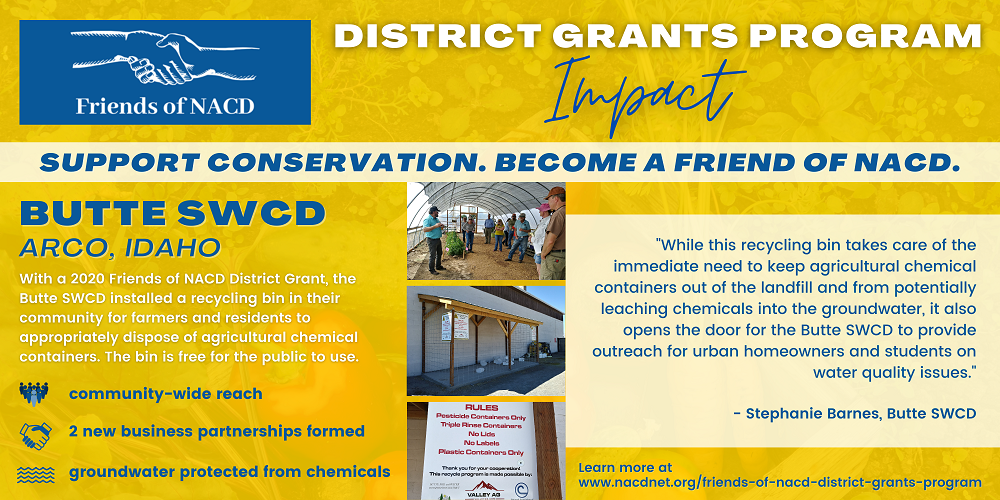
With a 2020 Friends of NACD District Grant, the Butte SWCD in Idaho installed a recycling bin in their community for farmers and residents to dispose of agricultural chemical containers. Free for public use, the bin keeps chemical containers out of landfills and their contents from leaching into groundwater.
Implementing this project has helped Butte SWCD form partnerships with two businesses: local chemical supplier and commercial applicator Valley Ag and the Agri-Plas, Inc. waste recycling company.
If you missed it earlier this month, learn more about the project in this blog post, and consider becoming a Friend of NACD to help other districts around the country launch innovative and impactful conservation projects in their own communities. |
TECHNICAL ASSISTANCE GRANTS GET CONSERVATION ON THE GROUND
IN NORTH CAROLINA
|
North Carolina’s conservation districts have seen a boost in technical assistance thanks to NACD technical assistance (TA) grants awarded to the North Carolina Division of Soil and Water Conservation. In 2018, the Division received its first round of funding, which it used to boost the technical capacity of the soil and water conservation districts (SWCDs) for Wilkes, Chatham, Martin, Robeson and Wayne SWCDs. The Division has since received 2019 and 2020 TA grants and has added the Columbus SWCD to its assistance list.
Natural resource concerns vary across the state, so each district’s portion of the TA funds was utilized differently. “It’s all about getting conservation on the ground, and it takes technical expertise to do that and keep the customer happy,” said Edward Davis, engineering technician and department head for Columbus SWCD.
In Wilkes County, where there was a major need for boosted forestry outreach and efforts, the Division used some of its grant funds to hire Daron Brown, a certified forester, for the conservation district. Brown helped with a lot of conservation activities, but the most common were the establishment of forest trails and landings to minimize the impacts of logging on soil erosion and water quality.
“We were able to put a lot of conservation on the ground due to the expertise that we would not have had if we didn’t have Daron on staff,” said Robert Baldwin, district director from Wilkes SWCD. “In the areas where we employed these practices, you can go back, and you can tell a significant difference compared to the ones where we did not.”
Martin SWCD brought on Rupert Hasty to help with Conservation Stewardship Program (CSP) enrollment, and he’s helped install practices to address cropland erosion, conservation cover and much more. At the Chatham SWCD, funds were used for Voluntary Agricultural Districts outreach efforts to help improve public awareness of agriculture, especially in rapidly developing areas.
|
USDA SEEKS INPUT
ON CLIMATE CRISIS
|
On January 27, President Biden issued an Executive Order titled “Tackling the Climate Crisis at Home and Abroad,” which directed the Secretary of Agriculture to solicit input once again from stakeholders on “how to encourage the voluntary adoption of climate-smart agricultural and forestry practices that decrease wildfire risk fueled by climate change and result in additional, measurable and verifiable carbon reductions and sequestration.”
On March 15, the U.S. Department of Agriculture (USDA) released a federal register notice to officially begin soliciting this feedback. The input requested is on “how to best use Department of Agriculture programs, funding and financing capacities, and other authorities, and how to encourage the voluntary adoption of climate-smart agricultural and forestry practices that decrease wildfire risk fueled by climate change and result in additional, measurable, and verifiable carbon reductions and sequestration and that source sustainable bioproducts and fuels."
With increased focus on the role agriculture can play in addressing climate change, it is vitally important that USDA receives input from the conservation district community on the ways that districts can help drive this effort. District staff are already involved in promoting climate-smart agriculture and forestry practices, and NACD strongly encourages your state association or individual district to provide comments by the April 15 deadline. Please contact NACD Director of Government Affairs Coleman Garrison at coleman-garrison@nacdnet.org if you have any questions.
|
|
NRCS Caribbean Area Recruiting for Four Positions with the ACES Program |
These positions help NRCS employees provide technical services in support of conservation. Click on the available positions below to learn more about them and apply:
|
FS and NRCS Seek JCLRP Proposals |
The U.S. Department of Agriculture (USDA)’s Forest Service (FS) and Natural Resources Conservation Service (NRCS) are requesting proposals for funding under the Joint Chief’s Landscape Conservation Initiative (JCLRP) beginning in fiscal year (FY) 2022.
The intent of the partnership is to achieve measurable outcomes through coordinated conservation activities on public and private lands. Selected projects will enhance collaboration among FS and NRCS, as well as many local, non-governmental, tribal and individual landowner stakeholders. JCLRP will align with shared stewardship by selecting projects that demonstrate a cross-boundary effort, work at the appropriate scale, and have mutually defined priorities that lead to desired outcomes
Proposals are due June 25, 2021. To learn more, click here.
|
2021 REPI Report to Congress Webinar |
Interested in learning more about the Readiness and Environmental Protection Integration Program (REPI)’s recent accomplishments?
Join the REPI office April 7 at 1:00 p.m. Eastern to hear more about REPI’s 2021 Report to Congress, which covers REPI’s actions and accomplishments through fiscal year 2020.
|
Apply Now:
NRCS Seeks
RCPP Applications
|
The Natural Resources Conservation Service (NRCS) is currently seeking innovative partner-led projects to deliver sustainable agricultural solutions.
NRCS will invest up to $75 million under the Regional Conservation Partnership Program (RCPP)’s Alternative Funding Arrangements to fund unique projects that take innovative and non-traditional approaches to conservation solutions at the local, regional and landscape scales. NRCS will be holding a webinar at 3:00 p.m. Eastern on April 1, 2021 for interested applicants.
|
NRCS Offers CSP Participants Renewal Options |
The Natural Resources Conservation Service (NRCS) is currently accepting applications for CSP contract renewals through March 31, 2021 for the approximately 11,000 CSP contracts that are currently set to expire December 31, 2021. The 2018 Farm Bill made several changes to the CSP program that could benefit producers in a new contract as long as the producer agrees to adopt additional conservation practices on their land above and beyond their current contract requirements. More information can be found here.
Additionally, as required in the 2018 Farm Bill, NRCS has been reviewing conservation practice standards and has published revised practice standards for 23 practices, including cover crops and stream crossings. It is important that conservation districts and state associations review these standards to ensure they continue to work for producers in your community. Comments are due by April 8 and more information can be found here.
|
Promote your conservation district or state association's tree sale, annual meeting, webinar, field day or more on NACD's Calendar of Events!
|
|