|
Background:
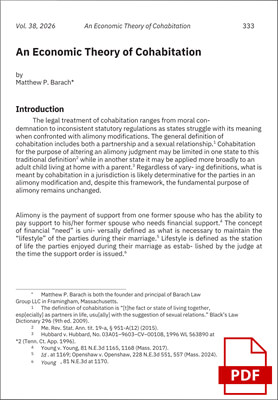
In my article “An Economic Theory of Cohabitation” I argue that the current legal framework governing cohabitation and alimony modifications is fundamentally flawed because it is rooted in outdated moral and religious judgments rather than economic reality. As a result, the only relevant inquiry should be whether a former spouse's cohabitation has produced an actual change in their financial need what I entitled: “the economic impact model”.
The article's central thesis is courts should only modify alimony when cohabitation produces a demonstrable change in the recipient's financial need or the payor's ability to pay. The mere fact of living with another person, whether a romantic partner, a roommate, or even a family member — should be nothing more than a starting point for the economic inquiry.
Drawing on Judge Richard Posner's economic theory of law, efficiency and economic clarity, not moral judgment — should drive the alimony modification law. A universal economic impact rule would reduce litigation costs, protect privacy, align with modern societal norms, and remain faithful to alimony's historic and fundamental purpose: addressing financial need.
The Core Legal Question: So, how does the Commonwealth view cohabitation and alimony?
Cohabitation is defined within M.G.L c. 208, Section 49:
“(d) General term alimony shall be suspended, reduced or terminated upon the cohabitation of the recipient spouse when the payor shows that the recipient spouse has maintained a common household, as defined in this subsection, with another person for a continuous period of at least 3 months.
(1) Persons are deemed to maintain a common household when they share a primary residence together with or without others. In determining whether the recipient is maintaining a common household, the court may consider any of the following factors:
(i) oral or written statements or representations made to third parties regarding the relationship of the persons;
(ii) the economic interdependence of the couple or economic dependence of 1 person on the other;
(iii) the persons engaging in conduct and collaborative roles in furtherance of their life together;
(iv) the benefit in the life of either or both of the persons from their relationship;
(v) the community reputation of the persons as a couple; or
(vi) other relevant and material factors.
In Frost-Stuart v. Stuart, 90 Mass. App. Ct. 366 (2016) the Appeals Court examined for the first time the issue of cohabitation under the new Alimony Reform Act.
After a 15-year marriage, the parties divorced in July 2010, which, importantly, fell before the effective date of the Massachusetts Alimony Reform Act of 2011. The agreement also expressly stated that Husband's “support obligation may be reviewed and adjusted upon a change in circumstances, including but not limited to … his loss or change of employment, [or] the Wife’s cohabitation with a dating partner.” In September, 2010, Former Wife began cohabiting with a new partner.
In March, 2013, Former Husband filed a complaint for modification, seeking termination of alimony on the basis of Former Wife’s cohabiting with a new dating partner for over three months, and Former Husband changing jobs to a position in which he no longer received an annual bonus.
The Probate and Family Court terminated the Former Husband’s alimony obligation and the Former Wife appealed to the Massachusetts Court of Appeals.
The Court of Appeals vacated the Probate and Family Court’s order terminating the former Husband’s alimony obligation, as the parties entered into their divorce judgment prior to the effective date of the Alimony Reform Act, March 1, 2012, meaning that the Act’s cohabitation provision did not apply.
The judgment instead was subject to the existing standard for modification of a “material change in circumstances”. The court emphasized that, under this standard, cohabitation alone is not sufficient grounds for modification, and it must be accompanied by a material change.
Important Takeaways
Initial Thoughts:
This case emphasizes, in part, the economic impact model that the existence cohabitation without an accompanying material change in circumstance is not sufficient grounds to terminate alimony payments albeit prior to the Alimony Reform Act. But the cautionary note is this case is prior to the effective date of the new alimony law. And case law on cohabitation is surprisingly relatively “thin.”
For Your Consideration:
It is important to remember that not all cohabitation situations are considered equivalent in the context of alimony modifications. The statute provides some flexibility to the Probate Court as they can “suspend” “reduce” or “terminate” alimony upon a cohabitation finding.
To Be Determined:
Is the “material change in circumstance” standard necessary along with cohabitation? Note the various options in the statute as a hint. As the court held: “although the mother's cohabitation may serve to reduce her household expenses or slightly increase her income, further fact finding is necessary to determine whether this is likely to eliminate her need for alimony.”
Practice Pointer:
Do not argue cohabitation alone but argue the economics of the material change of cohabitation: or what I called the “economic impact model!”
|