Rail Workers Weekly News Digest
Number 28 - July 14th, 2020
|
|
ARTICLE #1 - AMTRAK NEWS
U.S. House to Amtrak: We May Have Some Extra Money for You, But You Gotta Run Trains to Get it
|
|
The U.S. House drafted a bill this week that would provide significant funding for Amtrak, provided the railroad does not cut service. RT&S News
reported Tuesday
that some in Congress believe Amtrak is trying to use the low ridership resulting from the pandemic as an excuse to cut service frequency, particularly on long-distance trains. Amtrak has taken fire from Congress on this issue, and this bill is likely in response to that debate.
The draft Fiscal 2021 bill proposes that the regular Amtrak appropriation be increased, and that a minimum of an additional $26 billion in emergency grant funds be earmarked for both Amtrak and public transit. In order to receive the money, Amtrak must commit not to cut staff, routes, or train frequency.
Jim Mathews, president and CEO of the Rail Passengers Association, a lobbying group, said “Congress is really listening to Americans and recognizing the critical role passenger rail and public transit have always played in economic resilience. The House has already passed the authorizers’ ambitious policy framework for passenger rail in H.R. 2, the INVEST in America Act, and now House lawmakers are stepping up with a Fiscal 2021 money bill to make sure that Amtrak, commuter railroads and state agencies have the funds they need to keep America moving.”
Mathews added “Since May 28th, we’ve been saying that while we strongly support additional emergency funds for Amtrak, we’ve also insisted that any additional funds need to buy certainty for workers and passengers alike. Daily train service must be the very minimum service level. Title I includes important language protecting that service at 2018 levels in exchange for additional dollars.”
Section 502 of the bill spells out that receipt of the money would protect existing routes and daily service, along with employee protection against fur
loughs:
|
|
ARTICLE #2 - RAIL SAFETY NEWS
Canada's Rail Fatalities, Accidents Rose in 2019
|
|
(Editor's Note: The rail scene in Canada is dominated by just two railroads - Canadian National and an Canadian Pacific. It comes as no surprise that these are the first and the second Class One railroads in North America to have implemented so-called Precision Scheduled Railroading. And all 5 of those fatalities in 2019 - representing more than double the annual average - belong to CP and CN)
3 CP rail workers died in this Feb. 2918 wreck
In 2019, 1,246 rail accidents were reported to the
Transportation Safety Board of Canada
(TSB), up from 2018's total of 1,169 and a 17 percent increase from the previous 10-year average of 1,064, the agency reported yesterday.
The main-track accident rate last year was 3.3 accidents per million main-track train miles, up from 2.6 percent in 2018 and 42 percent above the 10-year average of 2.3, TSB officials said in a press release.
Rail fatalities rose to 72 last year from 57 reported in 2018, a figure about the same as the 10-year average of 73. Crossing accident-related fatalities rose to 28 last year from 19 the previous year, while trespasser fatalities rose to 38 from 34.
Five rail employees were fatally injured, which is higher than the 10-year average of two.
|
|
ARTICLE #3 - RAIL SAFETY NEWS
Alliance of Municipalities Including
Lac-Mégantic Call for Rail Safety Plan
|
|
An alliance of municipalities in the Montérégie and Eastern Townships wants to create a feasibility study examining ways to improve rail safety in their regions.
The Alliance du corridor ferroviaire Estrie-Montérégie (ACFEM) is seeking financial support for the study from the provincial transport ministry. The study would be conducted by officials in the city of Sherbrooke.
The alliance said Canadian Pacific could assign its experts to contribute to the study.
Lac-Mégantic Mayor Julie Morin has said that since the tragedy ravaged her town in 2013, municipalities crossed by rail lines have sought to increase security.
|
|
ARTICLE #4 - HIGH SPEED RAIL NEWS
For American High-Speed Rail,
2020 Could be a Turning Point
|
|
High-speed rail, long an afterthought in the United States, is making significant progress in the unlikeliest of times.
While the
economy
has sputtered this spring and
summer
during the Covid-19
pandemic
, high-speed rail projects have scored key wins.
XpressWest, a passenger rail project between Las Vegas and greater
Los Angeles
, a distance of about 170 miles, received the rights
two weeks ago
to build on the Interstate 15 median. Brightline, the Miami company that runs the project, plans to break ground later this year, with $5 billion of private funding, $4.2 billion of which will come in the form of tax-exempt bonds. Trains will reach speeds of 200 mph. It's expected to be completed in late 2023.
A Texas project that will offer 90-minute-or-less trips between Houston and Dallas received an important environmental review in May after a six-year wait. It also won a state court case this spring that gives it eminent domain rights, which will simplify the process of acquiring land between the two cities, which lie 240 miles apart.
"Now we're real," Texas Central CEO Carlos Aguilar told CNN Business. He expects service to begin in seven years.
The first US modern high-speed rail efforts emerged in 1965 in response to Japanese rail innovations. Legislation passed that year led to trains that traveled over 100mph between New York and Washington, DC. But high-speed rail soon stalled as the railroad industry collapsed in the 1970s.
|
|
ARTICLE #5 - CANADIAN RAIL NEWS
VIA Rail Lays Off 1,000 Employees
|
|
VIA Rail Canada Inc.
on July 8 announced it will temporarily lay off 1,000 unionized employees due to the impact of the COVID-19 pandemic.
VIA Rail does not anticipate ridership to be back to pre-COVID-19 levels in the foreseeable future, and therefore has had to adjust to the increasing financial impacts the crisis has had on the company, VIA Rail officials said in a press release.
"The current year has been filled with unprecedented challenges. First with the
[protest] blockades
in February and now with the ongoing pandemic, we have made every effort to protect our employees to the best of our abilities against the impacts of the service reductions," said VIA Rail President and Chief Executive Officer Cynthia Garneau.
The employees affected will receive a temporary written layoff notice, which respects the terms of the collective agreements. These temporary layoffs will take effect on July 24.
|
|
ARTICLE #6 - POSITIVE TRAIN CONTROL NEWS
Commuter Railroads Inch Toward Implementati
on
|
|
Commuter railroads continue to advance positive train control (PTC) implementation as the federal end-of-year deadline approaches.
As of March 31, 98 percent of the nearly 58,000 route miles subject to the federal mandate were either in revenue service demonstration (RSD) or in revenue service, according to the latest
PTC progress report
released last month by the
Federal Railroad Administration
(FRA).
About 63 percent of all commuter railroads' cumulative required route miles were PTC-governed as of March 31, a nearly 9 percent increase since Dec. 31.
Although most commuter railroads are on track to make it across the finish line in time, some have faced challenges with software bugs or delivery delays and limited qualified workforces, among other issues they are dealing with in the eleventh hour.
Four at-risk
Despite making the FRA's most recent at-risk list, Metra is on track with meeting the deadline for its $416 million implementation plan, says Chief Operating Officer Bruce Marcheschi.
|
|
ARTICLE #7 - TRUCKING NEWS
Podcast: Coalition Against Bigger Trucks
Law Enforcement Advisory Board
|
|
Some of the nation’s largest shippers and retailers right now are renewing their pursuit of major increases to the size and weight of trucks allowed on the nation’s highways. For example, as part of various coronavirus stimulus measures, the group Americans for Modern Transportation is seeking to mandate states to allow longer double trailer trucks. The National Grain and Feed Association and the National Grocers Association are seeking to raise the state and national limits on truck weights. In Congress, proponents of bigger trucks are pressing their case and pushing for amendments in whatever infrastructure bill is signed into law.
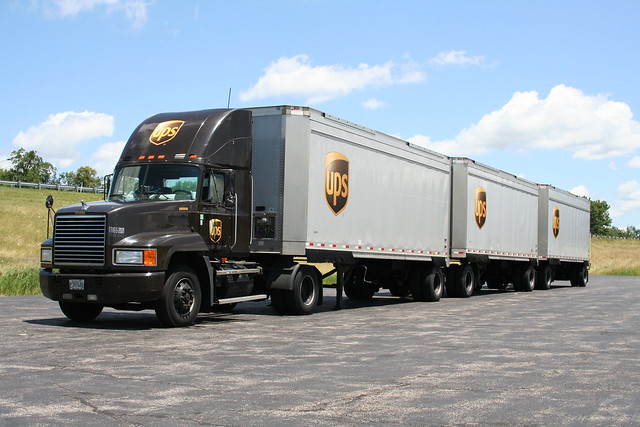
Current federal law provides for the operation of trucks hauling two trailers, each 28 feet in length. Federal law also limits the weight of any single trailer truck to no more than 80,000 pounds on interstate highways, with only limited exceptions. Although Congress has rejected previous attempts to raise size and weight limits, lawmakers are allowing a temporary reprieve from the weight limit as part of its response to the coronavirus crisis.
Railway Age Editor-in-Chief William C. Vantuono hosts Sheriff Donald B. Smith, who served as the 53rd Sheriff of Putnam County, New York, for 16 years, and Sgt. Andrew Matthews, a retired Connecticut State Police trooper and current Executive Director of the National Troopers Coalition. Both are part of the leadership of the
Coalition Against Bigger Trucks (CABT)
for which they serve as members of the law enforcement advisory board.
|
|
ARTICLE #8 - RAIL FREIGHT TRAFFIC NEWS
U.S. Freight-Rail Traffic Slipped 2.4% in Week 27
|
|
U.S. freight-rail traffic declined 2.4 percent to 437,989 carloads and intermodal units during the week ending July 4 compared with the same week a year ago, according to
Association of American Railroads
(AAR) data.
Carload volume decreased 12.7 percent to 192,767 units, while intermodal volume rose 7.7 percent to 245,222 containers and trailers during the week.
Two of 10 carload commodity groups posted increases: Farm products, excluding grain, and food were up 1,233 carloads to 15,148; and motor vehicles and parts were up 1,056 carloads to 12,152.
Commodity groups posting decreases included coal, down 10,949 carloads to 48,930; metallic ores and metals, down 6,872 carloads to 13,731; and nonmetallic minerals, down 5,000 carloads to 26,632.
Meanwhile, Canadian railroads logged 69,121 carloads, down 11 percent; and 61,227 intermodal units, down 8.2 percent during the week. Mexican railroads reported 18,739 carloads, down 15.4 percent, and 14,586 intermodal units, down 17 percent.
Individual Class Is reported the following carloads for the week versus a year ago: BNSF Railway Co., 74,364 carloads down from 91,710; CN, 52,431 down from 60,753; Canadian Pacific, 29,116, down from 32,008; CSX, 50,568, down from 57,779; Kansas City Southern, 12,190, down from 15,283; Norfolk Southern Railway, 46,709, down from 57,185; and Union Pacific Railroad, 77,580, down from 83,585.
|
|
|
|
|
|
|