WEL NEWSLETTER June 2025, Vol. 15, No. 3 REVISED | | Editor's Note: We have revised our June 2025 Newsletter due to an error. Please kindly ignore / delete the previous version sent earlier today. We apologize for this error and trust you will enjoy the corrected version below. | | |
Dear Kenneth,
The month of June is always buzzing. This June was no different. Laura Tamblyn-Watts visited our office and did her spectacular elder law power class for us, though I was stuck in Amsterdam having missed my connection flight. I was sad to miss Laura, but everyone learned so much and could not stop talking about how spectacular Laura was. I wonder what shoes she was wearing?
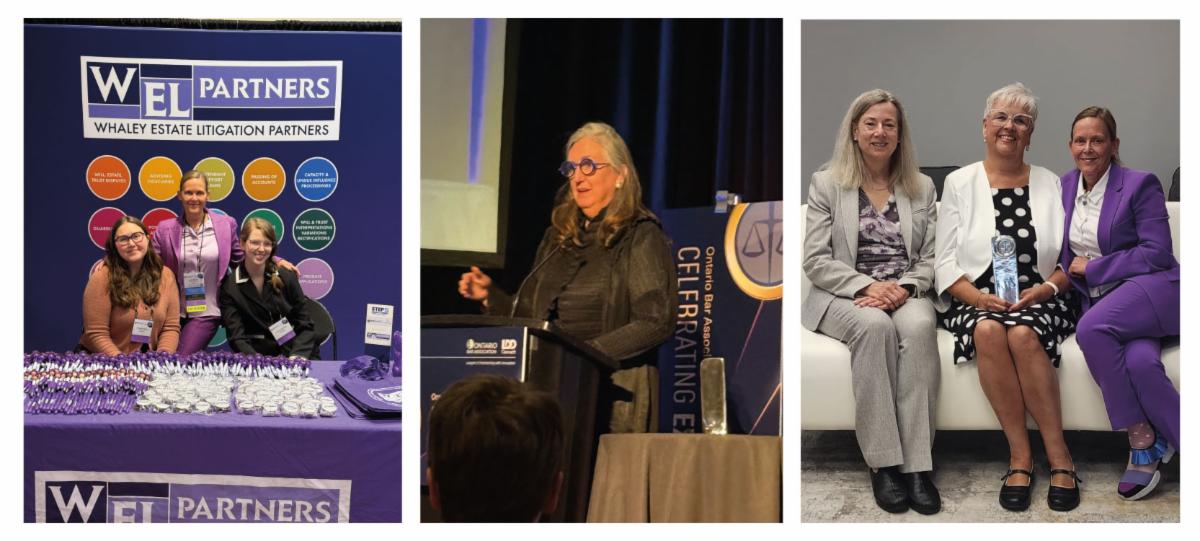
Our social agenda was flourishing this month: Our friends at RBC invited Bryan & I to an amazing lunch full of laughs and fun. Our team attended the OBA end-of-term dinner and celebrated with our colleagues and Clare Burns who was presented the OBA Award of Excellence in Trusts & Estates. I caught up with some high-school friends and shared a meal with Vikki and with Georgia! I am thankful to have such good friendships spanning a lifetime.
Then there was the 27th STEP National Conference which was sold out and I caught up with so many friends and colleagues from near and far. There was the board meeting and wonderful dinner, the learning, the reception, and surrounding all this the MNP Party, and the Solus Trust Party-now that was a busy, fun, whirlwind of a few days! This was followed by OBA Elder Law Day and celebrating the award of Excellence in Elder Law with Jane Meadus and all our wonderful friends from the elder law community. I was meant to go to the OBA Awards Gala but after a long week my team prevailed, and I had a great night’s sleep instead!
| | Sammi took me to a night with Victoria Elizabeth (V.E.) Schwab at the Opera House and I enjoyed learning about her new release, “Bury Our Bones in the Midnight Soil”, a story about toxic lesbian vampires. I received my signed, embossed copy and will put it on the summer reads list! | | |
Jaclyn, our summer and incoming articling student, Joanna Weiss, and Oliver O’Brien attended the Police College and chatted about elder abuse in a police education day. We are always delighted to be invited and to participate in this important initiative. I also participated in a Toronto Police Services Consultative Committee meeting planning for some elder prevention abuse community outreach. If you have any initiatives or ideas, you wish to share be sure to connect with me.
And to wrap up June our new associate, Emily Cara, starting next week, was called to the bar June 26th. Our articling student, Oliver O’Brien, was called to the bar also on June 27th and now starts his next journey as he ventures into his career era! Congratulations Oliver, we are very proud of you. Ollie’s parents came in from Plymouth, U.K. to celebrate with all of us.
| | |
Wishing everyone a HAPPY CANADA DAY!
Enjoy the Read,
Kim
| | 1. OBA CONFERENCE: ELDER LAW DAY | |
On June 19, 2025, WEL Partners’ Kimberly Whaley and Nima Hojjati had the honour of being a part of the Ontario Bar Associations Elder Law Day.
Kimberly, accompanied by Kelley Bryan (Office of the Public Guardian and Trustee), Jordan Korn (Goddard Gamage LLP), Graham Webb (The Advocacy Centre for the Elderly), and moderated by Kim Gale (Gale Law), touched on the topic of Loneliness, Vulnerability, and the Law. The session focused on identifying and preventing elder abuse when drafting Wills and POAs for vulnerable individuals, understanding predatory marriages, the current state of the law, including equitable considerations and access to justice.
Nima, a program chair of the event, also moderated a panel, with Brandon Chung (Henein Hutchison Robitaille LLP) and Det. Martin Franssen (Durham Regional Police Service) focused on the role of Criminal Law in protecting the Vulnerable with a focus on understanding the critical intersection of criminal law and elder law and how the legal system can address and prevent abuse, neglect, and financial crimes targeting vulnerable seniors.
For more details on the event, please visit the following link:
https://www.cbapd.org/details_en.aspx?id=ON_ON25ELD05V
Paper: Global Updates on Predatory Marriages
Chart: Cross-Provincial Revocation of Will Legislation
Chart: Cross Provincial Capacity to Marry Legislation Chart
| | 2. STEP CANADA’S 27TH NATIONAL CONFERENCE | |
On June 17, 2025, Kimberly Whaley presented at STEP Canada’s 27th National Conference. Moderated by William Dion-Bernard, and presenters, Dr. Adam Abba-Aji, and Kathy Shettel, the panel discussed the impact of mental health issues on estate planning and administration, both where a client has mental health issues and where the client has dependants, family members, or beneficiaries with such conditions.
STEP Conference Website
Presentation: Mental Health and How it Impacts Estate Administration & Litigation
Checklist: ANNOTATED CHECKLIST: Capacity Considerations in Planning & Litigation
| | 3. WEL PARTNERS’ JOANNA WEISS, OLIVER O’BRIEN, AND JACLYN HOLDSWORTH LEAD SESSION FOR ONTARIO POLICE COLLEGE COURSE | | |
On Friday, June 20th, 2025, Joanna Weiss, Oliver O’Brien, and Jaclyn Holdsworth had the privilege of attending at the Durham Region Police Service in Whitby, Ontario to lead a session for the Ontario Police College’s Elder Abuse Course. The session focused on the available civil and criminal remedies when an older person has been the victim of abuse, including financial abuse. WEL prepared and circulated resources for the course, including a paper on civil and criminal remedies. WEL Partners thanks the Ontario Police College for the opportunity to engage with their students on such important issues.
Elder Abuse Checklist: Civil and Criminal Remedies
| | 4. STEP JOURNAL: CROSSING THE THRESHOLD | | |
WEL Partners’ Gabriella Banhara and John Poyser TEP, joined forces in their article “Crossing the Threshold”. The article highlights how the law in Canada dealing with the capacity to make inter vivos gifts is contradictory and unsettled. The article highlights the influence of English cases like Ball v Mannin and Re Beaney, which establish that the understanding required for making such gifts varies with their significance. The article emphasizes the need for courts to clarify the capacity threshold for gifts, since courts continue to apply inconsistent standards, with some following Re Beaney's nuanced approach and others adopting a one-size-fits-all test.
See the following link for more details on the article: https://journal.step.org/step-journal-issue-3-2025/mental-capacity/crossing-threshold
| | 5. MARILYN PICCINI PUBLISHES UPDATED CHAPTER IN PRIVATE CLIENT: RECENT GLOBAL DEVELOPMENTS, LAW OVER BORDERS COMPARATIVE GUIDE 2025 | | Law Over Borders Comparative Guides are curated jurisdictional reviews, with each country’s chapter authored by an expert in their jurisdiction. Ms. Piccini authored the original chapter on Canada and has updated her chapter in a new, 2025 edition. The update to the guide cogently summarises legislative, caselaw, and practical changes in a post-pandemic era. The Global Legal Post has made a digital copy of Private Client Comparative Guide free to the public. | | 6. WEL PARTNERS’ LUNCH AND LEARN WITH LAURA TAMBLYN-WATTS | | |
This month, we had the pleasure of welcoming Laura, an accomplished advocate and expert in Elder Law, for a discussion on updates in the field. Laura is the author of numerous papers on aging issues and is a frequent media commentator.[1] Her #1 Bestselling new book Let’s Talk About Aging Parents was released in April 2024.
Laura is an absolute legend. She helped to co-found Canada’s second low-income seniors’ legal services centre, SeniorsFirst BC, located in Vancouver, and served as its first Legal Director. Laura was awarded the 2020–2021 Community Leadership in Justice Fellowship by the Law Foundation of Ontario. She was also awarded the Distinguished International Fellow Award from Stetson University Centre for Excellence in Elder Law and is a Canadian representative to the International Guardianship Network, and Fellow of the World Congress on Adult Guardianship.[2] Most recently, Laura was recognised by Queen’s University with their Alumni Global Citizenship Award.
Everyone here at WEL had questions for Laura. There was only so much content we could cover in an hour, but Laura reassured us: nobody has all the answers for managing the tough situations that arise in Elder Law. Rather, the important thing is to be able to recognise and address red flags.
We discussed legislative changes in the policy pipeline, ageism in Canada, recent research on dementia, trends in Power of Attorney documents, and legal problems that stem from misunderstood health problems. Laura has a wealth of insight aging and the law, and our team is grateful for her willingness to share her expertise.
[1] Laura Tamblyn Watts | Factor-Inwentash Faculty of Social Work
[2] Laura Tamblyn Watts | Canadian Investment Regulatory Organization
| | 7. EXECUTIVES FOR THE 2025-2026 OBA ELDER LAW SECTION | | WEL Partners’ Nima Hojjati and Oliver O’Brien will be joining the Ontario Bar Association’s Elder Law Section as Executive members for the 2025-2026 term. They are excited to plan Elder Law Day for 2026 and participate in other meaningful events for the upcoming term. | | Wel Partners’ enjoyed an afternoon in the pool on Wednesday at our annual pool party. We had an El Trompo taco truck this year which provided delicious tacos and churros and added to the fun! | | II. WEL SHOUT OUTS & CONGRATULATIONS | | OLIVER O’BRIEN’S CALL TO THE BAR | | On June 27, 2025, WEL Partners’ Oliver O’Brien was called to the Bar at Roy Thompson Hall. WEL Partners is proud of Oliver and all his accomplishments thus far in his young legal career. Congratulations Oliver, and to all the newly appointed lawyers on their calls to the Bar. | | ONTARIO BAR ASSOCIATION AWARDS GALA | | |
On June 19, 2025, the OBA held their annual Awards Gala, awarding some of Ontario's brightest legal stars and outstanding members of the profession have made exceptional contributions to the practice of law in Ontario and to the Ontario Bar Association. For the full list of the award winners, please click the below link. Congratulations to all!
https://www.cbapd.org/details_en.aspx?id=ON_ON25AWD01T
| | STEP CANADA: THE MICHAEL CADESKY VOLUNTEER OF THE YEAR AWARD | | |
WEL Partners congratulates Paul Taylor of Borden Ladner Gervais LLP on receiving STEP Canada’s Michael Cadesky Volunteer of the Year Award. The award is given to a Canadian member who best demonstrated magnanimous voluntary contribution for the past year. As a member of STEP for over 13 years, Paul has spent over a decade volunteering for STEP Ottawa and supporting the National Conference Program Committee, acting as Chair for the last 2 years, and in 2025 was elected to the role as National Treasurer. Congratulations again, Paul!
https://www.linkedin.com/posts/step-canada_step-stepcanada-stepcanconferences-activity-7341890884168302595-MBzp/
| | III. IN MEMORIAM: GERDA JOAN KAEGI | | |
The field of Elder Law said goodbye to a champion this month. Gerda Joan Kaegi passed away on June 5, 2025, at a time and place of her choosing and surrounded by family. Gerda was a Professor Emerita, a dedicated mother, and an incredibly generous human being. Gerda freely contributed her time, her money, and her sharp intellect to the betterment of others’ lives. Gerda was a leading spokesperson on issues affecting older adults, including the economic needs of older women and the rights of 2SLGBTQ+ older adults. Gerda was a frequent media commentator. Gerarda’s professional accomplishments and recognitions are lengthy, and her lifetime of advocacy will leave a legacy. Gerda’s obituary is available in the Toronto Star and in the Globe and Mail. Her surviving family will be holding a celebration of life in August. In lieu of flowers, Gerda’s family has asked people to consider making a donation to an organisation that reflects Gerda's spirit of passionate advocacy for education and social justice for all.
Read Gerda's Obituary on Legacy.com
| | SUNRISE ON THE REAPING, BY SUZANNE COLLINS | | |
By Samantha Whaley
I’ve been wanting to write a review of Sunrise on the Reaping (my favourite read of the year so far!) since its debut in March. With a story like this, however, it is a struggle to find the words to do it justice. In my first draft of this, I wasn’t able to say much more than essentially, “trust me, just read it,” which isn’t very inspiring. So, here is my attempt at doing justice to the latest addition to The Hunger Games series.
In September 2008, Suzanne Collins’ novel, The Hunger Games, was published, and a 9-year-old me began reading what would become one of the most popular dystopian novels of all time. A series about a fascist dictatorship, propaganda, creating common enemies, wealth disparities, and how one teenaged girl fanned the flames of a revolution that had been burning just below the surface for decades. My 9-year-old self could never have understood that what she was reading was in many ways already a reality of past, present, and, as has become blatantly apparent this year, the future. I will note that while I believe all young adult novels are for all readers, not restrictively young adult readers, The Hunger Games series is particularly important reading material for everyone. It is a story that contains critical lessons in rights, freedoms, and empathy, and though I was learning this all for the first time at 9-years-old, I found Sunrise on the Reaping to be just as poignant and thought-provoking at 26 years of age.
Sunrise on the Reaping is a prequel novel which follows Haymitch Abernathy during his year as a tribute in the 50th annual Hunger Games. Haymitch is a bootlegger, a friend, a boyfriend, a son, and a brother, who tries hard not to think about the odds he has of being reaped each year. When he is chosen to compete in the games, however, he realises a worse fear than dying in the games… the fear that should he misstep or rebel, the safety of his family and friends may be in jeopardy. The games are, after all, a performance. Show Panem how your people suffer for their disobedience. Show them gratitude for the lives of your people that remain. Show the country that you are contrite, that you are ashamed of your ancestors’ war. Show everyone that, at the core of humanity, everyone is simply predator or prey. Haymitch is in for the performance of his life. Alongside an oddsmaker, a childhood friend, and the most stuck-up girl in town, the tributes from district 12 will have to decide who they can trust, and, ultimately, how they want the world to see them in the arena. For those who have read the original trilogy, you can be rest assured there are many familiar characters in this novel, and more than a few ties to the original story which serve to make the whole series even more meaningful.
Sunrise on the Reaping is a story of hope, albeit in an unconventional sense. The narrative often feels much more like despair, exploring dark themes and a steep uphill battle. This quote from the novel speaks to the overarching hopeful sentiment:
“You were capable of imagining a different future. And maybe it won’t be realized today, maybe not in our lifetime. Maybe it will take generations. We’re all part of a continuum. Does that make it pointless?”
Often, progress is so imperceptibly slow that you might assume no progress is being made at all. Political progress is especially tiring, because injustice occurs within millions upon millions of micro-actions that are systemically encouraged and, often, mandated. As we have all seen in recent times, you can put so many tireless hours into climbing the mountain just to be met with an avalanche that deposits you right back where you started, or even farther behind. The hope is in the message that one person, no matter how young, and no matter where they’re from, can make the world see their determination and passion. Letting the world see how much you care is never a waste; it inspires others to do the same. It fans the flames. It ignites a revolution.
For more book reviews follow my bookstagram @iamsamreads
And if you do read Sunrise on the Reaping, please dm me for a chat I’d love to hear your thoughts!
https://www.indigo.ca/en-ca/sunrise-on-the-reaping-a-hunger-games-novel/9781546171461.html
| | (i) REPLACING ATTORNEY FOR PROPERTY WITH PUBLIC GUARDIAN AND TRUSTEE | | |
By Albert H. Oosterhoff
1. Introduction
It is not very common for the court to appoint a guardian of property for a person, especially if the person is already represented by an attorney for property. However, it will do so if it is necessary to protect the person’s property. The issue arose in Public Guardian and Trustee v Hara.[1]
2. Facts
The case concerns an application by the Public Guardian and Trustee (‘PGT’) for an order appointing the PGT as permanent guardian and trustee for property for Fumio Hara (‘Fumio’) and terminating the existing continuing power of property under which Fumio appointed his brothers Gerald and Katsushi Hara as his attorneys.
It is clear that Fumio is incapable of managing his property. He is 91 years old, suffers from dementia, and lives in a long-term care facility. A mini-mental examination rendered a very low score that indicated severe cognitive impairment.
The evidence provided in three affidavits of the PGT and in Gerald’s admissions showed that Gerald had misappropriated a lot of money from Fumio through cheques written on Fumio’s bank accounts, mostly in favour of Gerald and some in favour of Katsushi. The cheques did not indicate what they were for but expenses incurred with the use of Fumio’s credit card were clearly not incurred for his benefit. Gerald also mismanaged Fumio’s funds and emptied Fumio’s retirement fund. Gerald also failed to pay Fumio’s taxes, or his bills, including his fees at the long-term care facility. Fumio owned a condo in Burlington and for unexplained reasons Gerald took out a large mortgage on the condo. In 2024 Gerald agreed to sell the condo. The PGT paid Fumio’s unpaid accounts and was paid the balance of the net proceeds of the sale on the condo.
Gerald is willing to relinquish his role as attorney but would like a relative to take on the role of guardian. However, none has come forward to take on the role. Gerald argues that the PGT cannot be appointed guardian because of a term in the power of attorney that precluded the PGT from managing his affairs.
Katsushi consents to the relief sought by the PGT. He did not carry out his duties as attorney because he lived elsewhere and because of his own age and health issues. So he left the role of attorney to Gerald.
The PGT does not question that Fumio’s power of attorney was valid when he executed it.
3. Analysis and Judgment
Justice Kurz began his analysis by noting that, as an attorney, Gerald is a fiduciary and is not entitled to take any profits, benefits, or advantages from his position, except with the consent of the grantor.
His Honour then went on to consider the provisions of the Substitute Decisions Act, 1992[2] (‘SDA’) regarding the appointment of a guardian of property for a person. Section 22(1) empowers the court to appoint a guardian for a person who is incapable of managing property and it is necessary for decisions to be made on the person’s behalf. Subsection (2) permits the court to appoint a guardian for property even though there is a statutory guardian. But subsection (3) provides:
The court shall not appoint a guardian if it is satisfied that the need for decisions to be made will be met by an alternative course of action that,
(a) does not require the court to find the person to be incapable of managing property; and
(b) is less restrictive of the person’s decision-making rights than the appointment of a guardian.
His Honour then discussed the court’s reluctance to appoint a guardian in place of an attorney, because it interferes with the wishes of the grantor who appointed the attorney. He referred to Re Schaefers Estate, in which Fragomeni J stated:
[24] The jurisprudence establishes that two issues require consideration. First, there must be strong and compelling evidence of misconduct or neglect on the part of the attorney before a court should ignore the clear wishes of the donor [grantor]. With respect to this issue, the evidence has to establish that the donor was capable of granting proper power of attorney.
[25] The second issue relates to whether the court is of the opinion that the best interest [sic, interests?] of an incapable person are being served by the attorney.
Similarly, in Glen v Brennan,[3] Somers J stated:
9 The courts have generally taken the view that a written power of attorney executed by the donor at a time when he was apparently of sound mind … is simpler to deal with and gives the donee more flexibility in dealing on behalf of the donor. Also favouring a continuation of the appointment respects the wishes of the person who made the grant.
Justice Kurz concluded:
26 Based on the uncontested evidence before the court and Gerald’s own admissions, he has more than breached his fiduciary duties to his brother, Fumio. He has shredded them. He has treated Fumio’s property and money as if they were his own. He misappropriated hundreds of thousands of dollars of his brother’s money on what appears to be the brazen assumption that he was entitled to the money. He was not. He has also mismanaged Fumio’s money so that he missed many months of payments to the home at which he resides and is cared for and has failed to even file his tax returns. He has also caused expenses on the Condo to be expended unnecessarily after Fumio went into his care home.
27 I can think of no more clear case to remove an attorney.
His Honour took the view that although Fumio strongly preferred family members to manage his financial affairs rather than the government, the SDA permits the court to appoint the PGT as Fumio’s guardian of property. In any event, no family members came forward to take on the role of guardian. Thus, the PGT must be appointed as the guardian of last resort.
In light of Gerald’s egregious conduct, His Honour awarded substantial indemnity costs.
---
[1] 2025 ONSC 145.
[2] SO 1992, c 30.
[3] 2006 CarswellOnt 93.
| (ii) NATURE OF A TRUST BENEFICIARY’S INTEREST | | |
By Albert H. Oosterhoff
1. Introduction
The nature of a trust beneficiary’s interest has been much discussed for many years. The argument raises the question whether a beneficiary has a proprietary interest in the trust property or whether the beneficiary has only a personal right to require the trustee to use its rights in rem in accordance with the terms of the trust. A brief summary of the arguments is appropriate.[1]
There are in fact two views of the beneficiary’s right. Professor Maitland summarized them as follows:[2]
(1) cestui que trust has rights enforceable against any person who has undertaken the trust, against all who claim through or under him as volunteers (heirs, devisees, personal representatives, donees), against his creditors, and against those who acquire the thing with notice (actual or constructive) of the trust.
Or (2) cestui que trust has rights enforceable against everyone, except a bona fide purchaser who for value has obtained a legal right in the thing, without notice (actual or constructive) of the trust.
The first approach takes the view that the beneficiary does not have a direct ownership of the trust property. He only has a right against the trustee, who holds title to the property, to manage it for his benefit. But the beneficiary can also assert that right against anyone else who acquires the trust property from the trustee, unless the transferee is a bona fide purchaser of the legal interest, who gives value and has no notice of the trust. Maitland favoured this approach.
Professor Austin drew a distinction between rights in rem and rights in personam The former are proprietary rights which can be asserted against anyone, but the latter are merely personal rights. Austin claimed that a beneficiary has both rights.[3]
So which is to be preferred? It seems that most practitioners favour the second approach, whereas many academics insist that the first approach is the correct one. Their view is based on the fact that equity acts only and always in personam.
When we look at what beneficiaries can and cannot do, it is clear that beneficiaries cannot lay claim to trust property directly but must turn to the trustees to demand that they administer the trust in accordance with its terms. Similarly, beneficiaries do not have the right to make claims against third parties for injury to the trust property. Only the trustees can sue the third parties. Nor can beneficiaries normally direct the trustees what to do. Similarly, while a beneficiary can give away or sell her interest under a trust to another person, she does not thereby transfer the title, which the trustee retains. Indeed, it is incorrect to say that she transfers her interest; rather, she assigns her personal right.
It cannot be denied that the beneficiary does seem to enjoy proprietary rights. Thus, for example, if the trustee sells trust property in breach of trust and the purchaser knows of the breach, the beneficiaries can recover the property. And the same is true if the trustee gives away trust property. However, it can be argued that the beneficiary is still only seeking to have the trust performed. Similarly, while it is often thought that when beneficiaries terminate a trust under the rule in Saunders v Vautier[4] they are exercising a property right, but arguably they are exercising their right against the trustee to convey the property to them. Similar arguments can be made in respect of proceeds of trust property that the trustee has misappropriated.
The recent case, Hipkins v McDonald,[5] was concerned mostly with the right of co-owners to partition or sale of property held in common but the issue of the nature of a trust beneficiary also arose because the interest of some co-owners was held in trust. So the case is interesting for a number of reasons. Full disclosure: the court quoted and relied on views expressed in Oosterhoff on Trusts about the nature of a trust beneficiary’s interest.
2. Facts
A mother, Donna McDonald, (the ‘Testator’) was a lessee of cottage property (the ‘Property’) located in a provincial park. She died in 2018 and was survived by her three children, Carla Hipkins, Brian McDonald, and Roxane Serhan. The Testator’s Will named the three children her executors and trustees and directed them to pay her debts. Next, she directed her trustees to divide the residue of her estate equally among her three children. But she went on to say, ‘IT IS MY WISH AND DESIRE that the cabin that I own be transferred to my children who survive me as joint tenants with right of survivorship’. It was understood and agreed that the ‘cabin’ was the Property.
Ms Serhan died in 2019 before the Estate was fully administered. Under her will, her children (the ‘Serhan Grandchildren’) inherited the residue of their mother’s estate, which included her interest in the Property. Because of this fact and also because the Provincial Government allowed the names of only two people on the land lease, Ms Hipkins, Mr McDonald, and the Serhan Grandchildren, with the assistance of legal counsel, entered into a written agreement (the ‘Contract’) in 2019 to deal with the ownership of the property. Ms Hipkins received independent legal advice before she signed the Contract. The Contract provided that title would be held as tenants in common with Ms Hipkins holding one-third share and Mr McDonald holding a two-thirds share, which he would hold in trust as to a one-third share for the Serhan Grandchildren. In fact, the three children had agreed to the terms of their shared ownership before Ms Serhan died, and Ms Hipkins and Mr McDonald agreed that the Serhan Grandchildren were substituted for their mother.
Ms Hipkins and Mr McDonald then entered into the lease of the Property with the Government in accordance with the terms of the Contract; however, the parties’ shared ownership did not work out and factions developed, with Ms Hipkins on one side and Mr McDonald with the Sirhan Grandchildren on the other. The disagreement was mostly about the use that each branch of the family would be able to have of the Property.
Mr McDonald and the Serhan Grandchildren brought an action or an order entitling them to purchase Ms Hipkins’ one-third interest in the Property for fair market value. Ms Hipkins counterclaimed for a similar order to purchase Mr McDonald’s one-half interest (she was of opinion that the Serhan Grandchildren had no interest in the Property).
After the close of pleadings, both parties brought applications for summary judgment. The Parties agreed that their shared ownership could not continue, that the property should stay in the family and not be sold to a stranger, and that its value was $430,000.
The Chambers Judge held first that the testator’s ‘wish and desire’ regarding a joint tenancy for the Property did not impose an obligation on the executors to transfer it in that way because it was not a mandatory direction but was couched in predatory language. She also dismissed Ms Hipkins’s argument that the parties entered into the Contract under the common mistake that the Serhan Grandchildren had an interest in the Property. She went on to hold (1) that a joint tenancy could not be created in the circumstances because the four unities were not present; (2) that if there was a common mistake, Ms Hipkins shared in it and could therefore not rely on the mistake to avoid the Contract; and (3) the doctrine of estoppel by convention applied to prevent Ms Hipkins from resiling from the Contract, since Mr McDonald and the Serhan Grandchildren relied on to their detriment. Finally, the Chambers Judge concluded that a sale was appropriate and held that Mr McDonald should be allowed to purchase Ms Hipkins’ one-third interest. Hence, she made an order allowing Mr McDonald to pay one-third of the agreed value of the Property to Ms Hipkins. Ms Hipkins appealed the decision.
3. Analysis and Judgment
Chief Justice Robert W Leurer wrote the reasons for the Court of Appeal. The court agreed with the Chambers Judge’s reasons and dismissed the appeal.
The court held that the Chambers Judge did not err when she held that on a proper interpretation of the Will, the executors were not required to transfer the Property to the Testator’s three children. The Court referred to modern cases which hold that wills (just like contracts) must be interpreted in the context of their factual matrix, that is, in the context of the surrounding circumstances when the will is made. The interpretation thus involves a question of mixed fact and law. And therefore the modern standard of review of a judge’s interpretation of a will is palpable and overriding error.[6] The court reviewed the Chambers Judge’s reasons and held that she had not erred in her interpretation of the will. This meant also that the Contract was enforceable.
The court held further that the Chambers Judge did not err in holding that Mr McDonald was entitled to purchase Ms Hipkins interest in the Property. She applied the Imperial statutes on partition that were received in the Northwest Territories and Saskatchewan and remain the law in the Province. The statutes empower a court to partition or sell land held by co-tenants. The Chambers Judge concluded that a majority vote for making a decision is a reasonable manner of proceeding and found that Mr McDonald and the Serhan Grandchildren had not acted with malice or intimidation. She concluded that partitioning the property was unworkable and that a sale to Mr McDonald was appropriate since he holds the majority interest in the Property, undertook to purchase Ms Hipkins’ interest, paid more than his proportionate share of expenses, and was the first to seek relief. Accordingly, she held that there was no good reason to refuse his application for an order for sale to him.
The Court of Appeal held that since the Chambers Judge’s decision was discretionary, the standard of review is palpable and overriding error in the assessment of the facts.[7] The court found no basis for interfering with the decision of the Chambers Judge.
However, it addressed Ms Hipkins’ argument that the Chambers Judge erred in basing her decision on anything other than Mr McDonald’s interest was equivalent to her own, that is, a one-third interest, in some detail. She relied on a British Columbia case, Pallott v Douglas.[8] Ms Douglas held a lease to recreational property. She entered into a trust agreement for sharing use of the property with her brother, Mr Pallott. When the parties had a falling out, Mr Pallott brought an application for an order for partition or sale. The court denied the application, holding that under the British Columbia Partition of Property Act[9] only persons who have an immediate right to possession have standing to apply for partition or sale. Mr Pallott, as a beneficiary under a trust did not, since his interest was personal in nature only or, as the court in that case put it, Mr Pallott’s ‘entitlement to use the trust property is not immediate, but is rather subject to the limitations imposed by the Trust, namely, an allocation of time by Ms Douglas as trustee’.[10]
The Saskatchewan Court of Appeal considered the argument on this point in Pallott. That case referred to Oosterhoff on Trusts, accepted its position that a trust beneficiary has only a personal right against the trustee to have the terms of the trust carried out, and therefore concluded that the trust beneficiary lacked standing to seek partition or sale. While the Saskatchewan Court of Appeal appears to accept this premise and discussed it, the court distinguished the BC case. Chief Justice Leurer stated in paragraph 88:
Ultimately, I see no need to decide if the Serhan Grandchildren could, in their own name, seek an order for partition and sale. Pallot may be authority for the proposition that trust beneficiaries, such as the Serhan Grandchildren, may lack standing in their own right to seek to enforce rights that may only be maintained by the legal owner. However, I read nothing in that decision that would lead to the conclusion that a trustee – such as Mr McDonald – who holds the legal interest cannot seek partition and sale on behalf of the person or persons who hold a beneficial interest – such as the Serhan Grandchildren. (emphasis supplied)
Consequently, the Chief Justice agreed that the Serhan Grandchildren might have lacked standing to seek partition or sale, but said in paragraph 90:
However, I do not accept that their interest in the Property should have been ignored be the judge [as claimed by Ms Hipkins] when she considered who should ultimately be entitled to purchase it, given that the Serhan Grandchildren supported Mr McDonald in his request to acquire Ms Hipkins’ share of the Property. In these circumstances the facts were exactly as the judge found them to be, namely, that the competition in this case was between a party who held a one-third interest in the Property, on the one hand, and a party who held a two-thirds interest in the Property (with one-third being held in trust), on the other hand.
The court then addressed the Chambers Judge’s consideration of Ms Hipkins’ historical use of the Property and her sentimental attachment to it. It found that the Chambers Judge took the view that these factors ‘did not weigh in her favour against the claims of Mr McDonald and the Serhan Grandchildren’. The court held that this assessment of the facts by the Chambers Judge was within the permissible scope of her discretion. The court went on to hold that the Chambers Judge did not commit a reversable error in considering the fact that Mr McDonald had offered to pay Ms Hipkins for her share, that Mr McDonald had paid more than his proportionate share of the expenses, and other factors. Finally, the court concluded that the Chambers Judge’s decision to prefer Mr McDonald as purchaser was appropriate, since, all things being equal, ‘the law should favour a result that least disrupts the current ownership of the Property itself and respects the wishes of the majority over those of the minority interest holder’ (paragraph 114).
---
[1] For greater detail, see Oosterhoff on Trusts, 10th ed by Albert H Oosterhoff, Robert Chambers, and Mitchell McInnes (Toronto: Thomson Reuters, 2024), §1.13.
[2] FW Maitland, Equity: A Course of Lectures, rev ed by John Brunyate (Cambridge: Cambridge University Press, 1936), p 115.
[3] John Austin, Lectures on Jurisprudence, 4th ed by Robert Campbell (London: John Murray, 1873(, vol 1, at 388.
[4] (1841) 4 Beav 115, 49 ER 282 (Rolls Ct), affirmed (1841), 1 Cr & Ph 240, 41 ER 482 (Ch Div).
[5] 2025 SKCA 34.
[6] Citing Zindler v The Salvation Army, 2015 MBCA 33; Hicklin Estate v Hicklin, 2019 ABCA 136; Ross v Canada Trust Company, 2021 ONCA 161.
[7] Citing Kot v Kot, 2021 SKCA 4.
[8] 2007 BCCA 254.
[9] RSBC 1996, c 347.
[10] Pallott v Douglas, supra, para 35.
| | (iii) CASE UPDATE: HOCKNEY v. KNEELAND – DAMAGES ORDERED AGAINST ESTATE TRUSTEE FOR BREACH OF TRUST AND DISTRESS CAUSED TO BENEFICIARIES | | |
By Oliver O'Brien
Earlier this year, we wrote on the decision in Hockney v. Kneeland,[1] where Justice Myers of the Ontario Superior Court compelled an Estate Trustee to pass their accounts following excessive delay in the administration of an Estate.
The Estate Trustee ultimately did not provide an accounting or respond to the litigation. Accordingly, the court has issued a decision finding her in breach of trust and her fiduciary duties and that she caused emotional distress to the beneficiaries.[2]
Background
Hockney concerned the Estate of Mary Jane Hockney (the “Deceased”) who died in 2014. The Deceased made a Last Will and Testament appointing Mary Jane Kneeland (“Ms. Kneeland”) as her Estate Trustee. Ms. Kneeland prepared the Deceased’s Will and is licensed by the Law Society to practice law in Ontario.[3]
The assets of the Deceased consisted of approximately $255,000. For more than a decade, Ms. Kneeland held Estate funds in trust for the beneficiaries and refused to account. Between 2014 and 2022, Ms. Kneeland sent various sporadic reporting letters and emails to the beneficiaries, advising of purported delays in the administration of the Estate with the promise of distributions. In 2017, Ms. Kneeland provided the beneficiaries with cheques of $15,000 each, which totalled $105,000. This left $146,571.89 remaining in the Estate.[4]
The beneficiaries of the Estate raised concerns about the lack of communication and delay in the administration of the estate. The Law Society of Ontario cautioned Ms. Kneeland about her communication, delay, and practice management, but no further action was taken. Notwithstanding, in a written undertaking in February 2022, Ms. Kneeland committed to complete the estate administration by no later than June 30, 2023. This did not occur, and she was not heard from since October 2022.[5]
Application
In September 2024, the beneficiaries commenced an application to require Ms. Kneeland to account. Extensive efforts were made to serve Ms. Kneeland including eight unsuccessful attempts. The court was however satisfied that she was duly served.[6]
Justice Myers of the Ontario Superior Court was incensed at the prolonged delay and lack of accountability from Ms. Kneeland. His Honour noted how Ms. Kneeland had evaded service and has not attended the proceedings, despite being duly notified. Accordingly, the court ordered Ms. Kneeland to commence an application to pass her accounts as Estate Trustee by no later than April 30, 2025, and emphasized that she should expect strict enforcement of the order.[7]
Default Judgment
In a subsequent Order dated April 7, 2025, Justice Myers converted the application into an action and set the deadline for Ms. Keenland to provide a Statement of Defence by May 16, 2025. Ms. Kneeland did not provide a Defence and was accordingly noted in default.[8]
In addition to the amount sought in their Statement of Claim, the beneficiaries sought damages in the amount of $8,000 each for distress caused by Ms. Kneeland’s conduct. Each testified to the emotional toll the decade-long litigation had on them, including:
-
Emma Hockney, who suffered the distress of Ms. Kneeland’s ongoing failure to meet her obligations. Emma wished to use her inheritance to purchase a property which could not occur;[9]
-
Jack Hockney, who enrolled in a university program with the expectation of receiving his inheritance. Given no monies was received he was required to withdraw from the program and argued that had he continued and obtained a qualification he would be in a different financial position;[10] and
-
Will Hockney, who likewise was required to drop out of university given no inheritance was received, thereby putting him in a worse financial position that he would have been but for Ms. Kneeland’s excessive delay.[11]
Notably, His Honour found that he would have been “inclined to award punitive damages in at least the amount sought for distress due to the egregious and intentional wrongdoing of Ms. Kneeland”.[12] The court granted default judgment against Ms. Kneeland in the amount of $146,571.89 plus $56,000 for aggravated damages and prejudgment interest.[13]
Concluding Comments
Once again, Hockney v. Kneeland demonstrates the strict fiduciary duties and obligations that an Estate Trustee are held to in Ontario. Justice Myers summarised the case and the breaches by Ms. Kneeland as follows:
This case is an egregious example of breaches of duty and is made worse by the fact that the defendant is a lawyer who has been allowed to repeatedly ignore her duties to people who thought they could rely on her professionalism.
The defendant’s failure to carry out her duties and failure to pay to the plaintiffs the money due to them amounts to a breach of trust and breach of fiduciary duties at minimum. It is also a tortious conversion (or civil theft) of the funds. It also amounts to an unjust enrichment for which there is no juridical justification offered.[14] [emphasis added]
---
[1] Hockney v. Kneeland, 2025 ONSC 1309.
[2] Hockney v. Kneeland, 2025 ONSC 3592 (“Hockney”).
[3] Hockney v. Kneeland, 2025 ONSC 1309 at paras 1 – 3.
[4] Hockney v. Kneeland, 2025 ONSC 1309 at paras 12, and 21.
[5] Hockney v. Kneeland, 2025 ONSC 1309 at paras 13, 19 and 20.
[6] Hockney v. Kneeland, 2025 ONSC 1309 at paras 24 and 25.
[7] Hockney v. Kneeland, 2025 ONSC 1309 at para 35.
[8] Hockney at para 1.
[9] Hockney at paras 14 and 15.
[10] Hockney at paras 20 and 21.
[11] Hockney at paras 18 and 19.
[12] Hockney at para 12.
[13] Hockney at para 30.
[14] Hockney at paras 5 and 6.
| | (iv) BOLOTENKO v. WRIGHT ESTATE CASE REVIEW: ONTARIO’S BILL 245 DID NOT MAKE RETROACTIVE CHANGES TO THE SLRA | | |
By Jaclyn Holdsworth
Bolotenko v Wright Estate[1] was heard by Justice Leibovich on February 20, 2025, in the Superior Court of Justice. J Leibovich clarified what courts had previously only assumed: Bill 245 did not retroactively repeal Sections 15(a) and 16 of Ontario’s Succession Law Reform Act (SLRA).
Bill 245
Schedule 9 of the Accelerating Access to Justice Act, 2021 (Bill 245) revoked sections 15(a) and 16 of the SLRA.[2] The SLRA used to read:
(15) A will or part of a will is revoked only by, (a) marriage, subject to section 16…
…
(16) A will is revoked by the marriage of the testator except where, (a) there is a declaration in the will that it is made in contemplation of the marriage…
The Facts of the Case
The Estate Trustee brought a motion for directions asking whether Bill 245 applies retroactively. The series of events leading to this motion are as follows:
- On March 8, 1999, the Deceased executed his last will and testament. He did not state in his will that he made it in contemplation of marriage.
-
On February 13, 2003, the Deceased got married.
-
On January 1, 2022, the Government of Ontario passed Bill 245, repealing sections 15(a) and 16 of the Succession Law Reform Act.
-
On April 27, 2022, the Deceased passed away.
Applying the Law
J Leibovich notes that in Tran v. Canada (Public Safety and Emergency Preparedness), the Supreme Court of Canada said there is a presumption against the retroactive application of new legislation.[3] The presumption can be rebutted by an express provision in a statute, or by necessary implication.[4]
J Leibovich also pulled on non-binding decisions. In Estate of Harold Franklin Campbell (Re), the Ontario Superior Court of Justice assumed that the repeal was not retroactive.[5] In Vance (Re), a Saskatchewan court dealt with a similar issue as Bolotenko. In Vance (Re), a legislative amendment repealed the provision in Saskatchewan’s The Wills Act that formerly stated marriage revokes a will. Nothing in the amending legislation indicated that its effects were retroactive.[6] The Saskatchewan court held that applying the amendments retroactively would revive wills even in circumstances where testators had relied on the statutorily-imposed revocation.[7]
Leibovich’s Endorsement
Any marriage that happened before January 1, 2022, still acts to revoke wills made prior to that marriage.[8] Sections 15(a) and 16 of the SLRA were operational when the Deceased got married on February 13, 2003. the Deceased’s marriage did revoke his will.[9]
---
[1] Bolotenko v Wright Estate, 2025 ONSC 1154 (CanLII),
[2] Accelerating Access to Justice Act, 2021, S.O. 2021, c. 4 - Bill 245, https://www.ontario.ca/laws/statute/s21004
[3] Bolotenko v Wright Estate, 2025 ONSC 1154 (CanLII), at 4
[4] Ibid at 5
[5] Ibid at 9
[6] Ibid at 7
[7] Ibid at 8
[8] Ibid at 6
[9] Ibid at 10
| | (v) WHEN DOES AMENDING AN ALREADY FILED APPLICATION CONTRAVENE THE INTERESTS OF JUSTICE? | | |
By Gabriella Banhara
Richard v. Richard[1], 2025 QCCS 1676, concerned an Applicant’s amendment of an already existing and filed application. The Deceased, Rolland Richard (the “Deceased”) passed away on September 11, 2020, and was survived by his children, Luc Richard (“Richard” or the “Applicant”), Daniel Richard (“Daniel”) and Michel Richard (“Michel”) (collectively the “Defendants”).
Daniel was assigned as the liquidator of the Deceased’s Estate (the “Estate”). The Applicant commenced an application alleging that Daniel was not adequately fulfilling his tasks as the liquidator of the Estate, on the basis that he was abusing his power and causing delays. The Applicant requested that the court replace Daniel with an expert liquidator.
On November 13, 2024, the Applicant filed an amended application requesting the court to order the Defendants to collectively pay an additional $94,661 to the Estate (the “Amended Application”).
The Applicant cited Article 206 of Quebec’s Code of Civil Procedure, which allows a party to amend or withdraw a pleading without court approval before judgment, as long as it aligns with the principles of justice and does not result in undue delay.[2]
Issues
The Defendants opposed the Applicant’s amendments stating that they were not in the interests of justice on the following grounds:
i. Aimed to revive rights which were barred by the limitation period;
ii. Aimed to include a new cause of action different to that found in the original Application;[3]
Analysis
The Limitation Period
The Defendants argued that the information in the Amended Application was discovered in August of 2021. Since the initial application was filed in November of 2024, the Defendants claimed that the statute of limitations had expired, as more than three years had passed since the claim’s discovery. On this basis, the Defendants asserted that permitting such amendments would be contrary to the interests of justice.
The Court stated that the plaintiffs did not prove with certainty that the claim had been discovered in August of 2021.
The Court further noted that the Court of Appeal has consistently interpreted Article 206 liberally, often permitting amendments prior to judgements. The Court stated:
[ 50 ] In this case and at this stage of the proceedings, it would not be rational and effective to refuse the amendments, because that would force the applicant to introduce a new appeal, which would be contrary to the interests of the heirs and liquidators of the estate, and of the good administration and the rigorous and orderly use of the judicial system.[4]
The Court additionally asserted that when assessing whether an Amended Application is time barred, careful consideration must be given to not “venture into [the] merits” of the newly added order, request or evidence.[5] The court stated that such analysis should be saved for trial.
New Cause of Action
The Defendants asserted that the Amended Applicant attempted to introduce a new cause of action that was not connected to the initial application’s cause of action.
The court stated that the Applicant’s amendments arose from the same factual basis already existing in the initial proceeding regarding the liquidation of the Deceased’s Estate. [6] The court went on to state that the amendments would have been refused if the “new allegations were clear and obvious and appears on the face of the file”.[7] The Court stated the following:
[ 55 ] In Khader v. SNC-Lavalin Inc. , the Court of Appeal taught that an amendment violates the rule prohibiting entirely new claims, unrelated to the initial claim, when by the amendment, the party reinvents its theory of the case repeatedly or even at the last minute, because the opposing party has the right to know where it stands, that is, to know in good time what it is accused of, so as to be able to adequately defend itself, in fact as well as in law.[8]
The Court asserted that although the Amended Application arrives at new conclusions, they originate from the same “common factual framework”[9].
For these reasons, the Court permitted the Amended Application to proceed, concluding that the amendments to the initial application did not contravene the interest of justice.
--
[1] Richard v. Richard, 2025 QCCS 1676
[2] Code civil du Québec, RLRQ c CCQ-1991at Article 206
[3] Ibid at para 27.
[4] Ibid at para 50.
[5] Ibid at para 45.
[6] Ibid at para 40.
[7] Ibid at para 44.
[8] Ibid at para 55.
[9] Ibid at para 66.
|
| |
Ontario Police College Elder Abuse Course
Ontario Provincial Police, Orillia, ON
September 10 - 19, 2025
Speaking: Joanna Weiss and Oliver O’Brien
Canadian Lawyer Webinar – Capacity Seminar
September 10, 2025
Speaking: Kimberly Whaley, Bryan Gilmartin, Suzana Popovic-Montag, Ian Hull and a panel of international medical experts
University of Toronto: Medical Experts Course
The Role of the Medical Expert in Estate Litigation
September 11-12, 2025
Canadian Lawyer Webinar: AI in an Estate Practice
October 16, 2025
Kimberly Whaley, Bryan Gilmartin, WEL Partners
Ian Hull, Suzana Popovic-Montag, Hull & Hull LLP
Colloquium Legal Education Conference: Sudbury 2025
October 16 to 17, 2025
Speaking: Bryan Gilmartin
https://www.colloquiumsudbury.com/
LSO Estate Summit
October 22-23, 2025
Thunder Bay Law Association
October 30-31, 2025
Chair: Suzana Popovic- Montag - Hull & Hull LLP
Panelists: Jordan Atin, Kim Whaley, Ian Hull LSM - Hull & Hull LLP
https://tbla.ca/tbla-fall-conference/
| | VII. IN CASE YOU MISSED IT - RECENT BLOG POSTS | | WEL NEWSLETTER June 2025, Vol. 15, No. 3 - REVISED | | | | |