New England
Prison Education Collaborative
Bi-Monthly Newsletter
| | August 27, 2025 | Issue No. 6 | | |
1. Year 1 Accelerator Grant Awardees
2. Graduation Spotlight: August Edition
3. NEPEC Goes to the 4th Undergraduate Symposium at Maine State Prison
4. NEPEC Goes to the 79th Correctional Education Association International Conference
5. New England State Updates
- Connecticut
- Massachusetts
6. NEPEC Quarterly Workshop Series
7. Upcoming Events and Opportunities
8. Staying Connected
| | Year 1 Accelerator Grant Awardees | | |
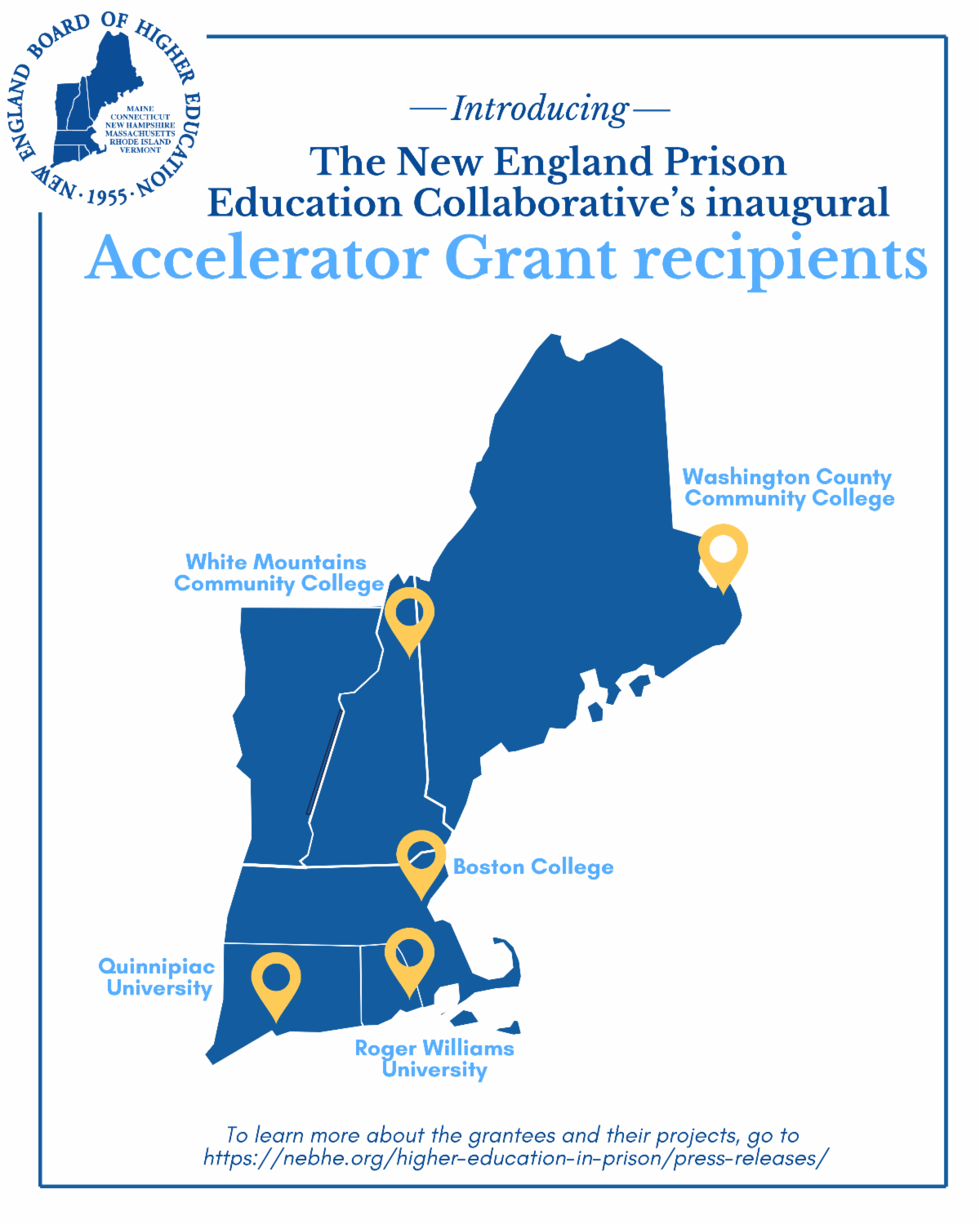
The New England Prison Education Collaborative (NEPEC), with support from Ascendium Education Group, is excited to announce the awarding of five subgrants of $100,000 each to five New England institutions for projects that will expand access to higher education in prison programming and support reentry after incarceration.
The Request for Proposals (RFP) was released on April 30, 2025, and was open to postsecondary institutions in all six New England states. NEPEC received applications from institutions in five of the six states— Connecticut, Maine, Massachusetts, New Hampshire, and Rhode Island. The proposals that were selected for funding detailed actionable plans to expand existing higher education prison programming or implement new initiatives in New England correctional facilities.
“Ascendium is deeply committed to expanding access to quality postsecondary education for incarcerated learners. NEPEC’s Accelerator Grants play a vital role in equipping New England institutions with the resources and support they need to advance this transformative work —not only inside correctional facilities, but also along the full continuum from incarceration to graduation and beyond into meaningful employment.” – Molly Lasagna, Senior Strategy Officer for Incarcerated Learner Initiatives, Ascendium Education Group, in the August 19, 2025 press release.
| |
Awardees
-
Boston College (Massachusetts) – to expand a Pell-eligible baccalaureate program to the Massachusetts Correctional Institution at Framingham (MCI-Framingham).
-
Quinnipiac University (Connecticut) — to transform a privately funded prison education program to a degree-granting, Pell-eligible pathway with reentry supports.
-
Roger Williams University (Rhode Island) — to expand their Pivot the Hustle program in order to deliver a holistic, trauma-informed, and credit-bearing reentry education experience to incarcerated learners in three RI correctional facilities.
-
Washington County Community College (Maine) — to convert its workforce-aligned computer technology certificates into a fully Pell-eligible associate degree.
-
White Mountains Community College (New Hampshire) — to launch a statewide prison education initiative, which will expand their degree offerings to two additional correctional facilities and build out a 2+2 pathway.
| | Graduation Spotlight: August Edition | | |
May 28, 2025 — White Mountains Community College, Berlin, NH
White Mountains Community College (WMCC) held their inaugural graduation ceremony on May 28,2025, for the Second Chance Pell Program at the Northern New Hampshire Correctional Facility (NNHCF) in Berlin. Fourteen students earned degrees in Business Administration and Liberal Arts.
Several members of the Corrections Education and Vocational Planning Group (CEVPG), the strategic planning group in New Hampshire, were instrumental in this milestone achievement including Nick Duffy, Director of Rehabilitative Services at the NHDOC; Laurie Foster, Deputy Director of Rehabilitative Services; Laura Hardwick, Director of Education at the NHDOC; Dr. Mark Rubinstein, Chancellor of the Community College System of New Hampshire; and Leah Maciejewski, Vice President of Academic Affairs at WMCC. Senator David Watters, whose legislation established the CEVPG, was also there to share in this impressive, coalition-driven accomplishment. The group remarked on the celebratory and joyful atmosphere, and how it was felt among graduates and non-graduates alike.
NEPEC Director Sarah Kuczynski was honored to be able to attend this event alongside Ascendium’s Molly Lasagna and the American Institutes for Research’s Ellen Cushing. A celebratory lunch followed the ceremony with additional members of the WMCC prison education program team and University of New Hampshire stakeholders.
June 20, 2025 — Massasoit Community College, Brockton, MA
At a graduation ceremony held at the Old Colony Correctional Center on June 20, 2025, Massasoit Community College awarded associate degrees in Liberal Arts Studies to its inaugural graduating cohort of eight students, who were enrolled in its Correctional Education and Returning Citizens (CERC) program. The momentous nature of the graduation was underscored by the students’ academic excellence with seven members being inducted into Phi Theta Kappa – the College’s honor society.
Massasoit is one of two formal prison education programs run by community colleges in Massachusetts and the first prison education program in Massachusetts to be approved by the U.S. Department of Education to award Pell grants to incarcerated students. Massasoit’s CERC Program enrolls 37 students across three county and state correctional facilities.
“Education has the power to change the lives of justice-involved students for the better. We are incredibly proud of these students’ academic achievements that will help prepare them to lead lives, build careers, and support their families post-incarceration.” – Bill Mitchell, President, Massasoit Community College.
“One of the pillars of successful reentry is education. Through these partnerships, the individuals under our care are given a vital education that strengthens pathways to success. We congratulate Massasoit Community College for investing in the DOC and in the future of our incarcerated individuals.” – Shawn Jenkins, Commissioner, Massachusetts Department of Correction.
June 27, 2025 — Connecticut State Community College, CT (multiple locations statewide)
In June 2025, Connecticut State Community College (CT State) held five graduation ceremonies with students enrolled in the Second Chance Pell programs at correctional facilities around the state. The Asnuntuck and Quinebaug Valley campuses graduated 43 incarcerated students in certificate and degree programs. These programs enroll approximately 300-350 students each semester, totaling over 2,000 since the programs’ inception in the fall of 2016. The events celebrate students’ accomplishments and commitment to their studies as they each prepare for reentry to the community.
CT State’s Asnuntuck, Middlesex, Quinebaug Valley, and Three Rivers campuses—formerly independent community colleges—were among the first cohort of institutions nationwide to offer a Second Chance Pell program. CT State’s Housatonic campus—also formerly an independent community college—joined the third cohort and began offering its program in 2022.
“Graduation marks a new beginning for our graduates. Each student is forging a new path and challenging themselves as they earn a college education and prepare for reentry. Students’ accomplishments demonstrate their commitment to themselves and the value that education holds for them. The knowledge and skills they learn are theirs to build upon and create a new life for themselves and their families. The ripple effect is long lasting as to the opportunities their accomplishments create. Congratulations to all our graduates!” – Teresa Foley, Interim Associate Dean of Non-traditional Transition Programs, Connecticut State Community College.
| | NEPEC Goes to the 4th Undergraduate Symposium at Maine State Prison | | |
|
On Wednesday, July 16, 2025, NEPEC Director, Sarah Kuczynski, traveled to Warren, Maine to attend the 4th Maine State Prison Undergraduate Symposium. The event highlights the academic work and efforts of currently incarcerated learners inside Maine State Prison through their educational partnership with the University of Maine at Augusta (UMA). The event featured nine of UMA's currently incarcerated students presenting academic, creative, and personal work on four student-moderated panels. The day also included a keynote address and concluded with an opportunity for attendees to mingle.
Sarah relished the opportunity to hear from a dynamic and talented group of students as part of the formal programming. In addition to admiring exciting visual art projects and engaging papers about subjects like the myth of meritocracy, Sarah enjoyed having the ability to connect with students, faculty, and facility staff individually during breaks in the programming.
“It is one thing to know that folks like Dan McGloin [Director of UMA’s Prison Education Partnership and Adjunct Professor] are doing amazing work, but it is a different thing entirely to have the opportunity to be in the facility and able to engage directly in the vibrant academic communities being created there.” – Sarah Kuczynski, NEPEC Director, New England Board of Higher Education.
“Student-centered events like this are vital in any higher education setting and it should be no different when that setting happens to be a prison. The hard work and rich intellect of these students deserves to be recognized, and our community needs to hear their voices.” – Dan McGloin, Director of the Prison Education Partnership and Adjunct Professor, University of Maine at Augusta.
| |
NEPEC Goes to the 79th
Correctional Education Association International Conference
| | |
|
From August 12 to 13, 2025, NEPEC Director, Sarah Kuczynski, joined professionals from across the country working to advance educational programming for incarcerated learners at the 79th Correctional Education Association (CEA) International Conference and Training Event. This year’s theme, “Paving the Bridge to Success,” highlighted the unique role education can play in one’s reentry journey. The event’s location in Pittsburgh, PA—known as the “City of Bridges”—further underscored this theme.
The conference included engaging sessions, workshops, and panels, spanning a wide range of topics, including adult education, youth learners, higher education, career and technical education, technology in corrections, special populations, college and career readiness, transition and reentry, and professional development.
Sarah attended sessions on the role of tutors in correctional education, innovative programs that engage Corrections Education Navigators as bridges between corrections education and the broader college community, and a session on ways to navigate disciplinary policies that can impact educational access. Sarah also participated in a workshop facilitated by Ess Pokornowski (Ithaka S+R), Jenna Dreier (Jobs for the Future), and Stacy Holliday (Jobs for the Future).
The workshop, “Research in Practice: Activating New Resources for Advancing Educational Technology in Corrections,” invited participants to explore two new resources—JFF's Transformative Edtech Solutions for Prison Learning Programs and Ithaka S+R's Technology Implementation for Higher Education in Prison—developed to aid student-centered decision-making as it pertains to education technology.
Sarah found the conference to be insightful and informative, and left Pittsburgh with a renewed sense of our shared purpose and collective impact.
| | New England State Updates | | |
|
Connecticut
On July 10, 2025, Connecticut's Criminal Justice Policy Advisory Commission (CJPAC) met for the second time this year to discuss various pertinent updates. CJPAC, which is chaired by the Undersecretary for the Criminal Justice Policy and Planning Division (CJPPD) within the Office of Policy and Management (OPM) was established by Public Act 06-193 to prevent prison overcrowding and implement a comprehensive reentry strategy that maximizes community supervision and, among other things, invests the savings from population reductions in employment opportunities. CJPAC is tasked with deliberating, advising, and voting on matters concerning the incarcerated population and broader criminal legal system in Connecticut.
During the meeting, Undersecretary Daniel Karpowitz provided an overview of the Needs Assessment of Higher Education in Connecticut Correctional Facilities Report, which was submitted to the CT Legislature in March 2025 pursuant to Public Act 24-81. The report, which is the only one of its kind in the country, provides recommendations that were grouped into five categories: (1) student capacity and agency goals, (2) systematic opportunities at the Department of Corrections (DOC), (3) officers are mission-critical, (4) executive interagency leadership and private sector collaboration, and (5) higher education systems change. In addition to the report overview, Undersecretary Karpowitz provided an important legislative update on the expansion of OPM CJPPD’s duties.
The NEPEC Team connected with Karpowitz to get his insights on the above. He shares his thoughts below:
"In the most recent legislative session of the Connecticut General Assembly, responsibility to develop and implement policies for the statewide delivery of postsecondary education in prisons was assigned to the Criminal Justice Policy and Planning Division within the Office of Policy and Management (OPM). OPM is the Governor's staff agency and provides the analysis to formulate public policy for all executive branch agencies as well as cities and towns. In particular, OPM's Criminal Justice Division has been central to the state's nation-leading efforts to reduce the costly over-reliance on incarceration. The number of people in prison in the state has been cut in half while the rate of violent crime has dropped below any seen in over half a century.
Vested with this new statutory authority, the Division seeks to implement the recommendations from its first-of-a-kind higher education needs assessment report, published in March 2025 pursuant to Public Act 24-81. Notably, the report's statutory elements, as outlined in Public Act 24-81, were designed in large part by Connecticut citizens who were themselves alumni of college in prison. Key goals articulated in the report include: to expand scale, quality and intensity of higher educational partnerships; to establish high-speed broadband and transform the entire information architecture accessible in every prison facility; to rigorously measure and grow the benefits of such programs for post-release employment and income; and to acknowledge and invest in the role of officers in the success of all such efforts."
Massachusetts
In July, NEPEC submitted written testimony to the Committee on Public Safety and Homeland Security within the Massachusetts Legislature related to H.2706/S.1654: An Act relative to postsecondary education in correctional facilities, which seeks to require a comprehensive assessment for improving the delivery of postsecondary education programs in correctional facilities. H.2706 was introduced to the legislature by Representative Priscila Sousa, who sits on NEPEC’s Regional Advisory Council. A parallel piece of legislation was introduced by Senator Brendan P. Crighton.
If passed, this legislation could address the data gap that hinders the ability to reliably report on important metrics, such as enrollment data, unmet student demand, completion rates, and credit transfer. This, in turn, would better equip the Commonwealth to advance evidence-based policy, improve existing programming, and identify inequities in access to and success within degree pathways in carceral facilities statewide.
Representative Sousa is not alone in her efforts to expand access to higher education in prison. In fact, Senator Jamie Eldridge secured a $150,000 earmark in the Mass Fair Share Supplemental budget for this exact purpose, with the Emerson Prison Initiative, Boston College Prison Education Program, and Boston University Metropolitan College Prison Education Program each getting $50,000. Additionally, Representative Christine Barber secured $100,000 in the budget for Brave Behind Bars, Inc., to support the Tufts University Prison Initiative of Tisch College women’s education program.
NEPEC looks forward to continuing to consult with legislators who are interested in research and insights that might support them in advocating for increased access to and success within higher education in prison programs.
| | NEPEC Quarterly Workshop Series | | |
|
As part of our virtual quarterly workshop series, NEPEC will convene several regional experts to discuss different approaches to reentry on Wednesday, September 24, 2025, from 3 to 4:15 PM EDT. The event, “Approaches to Reentry: Programs and Pathways in New England,” will highlight current reentry practices across the region and feature insights from experts and practitioners who are actively engaged in the field. Beginning with an overview of reentry, the session will feature three experts who will explore a range of strategies employed through their programs, including pre-release career and educational advising, educational voucher initiatives, community-building efforts, and practices to improve credit mobility.
Workshop Panelists:
-
James Monteiro, Executive Director and Founder, Reentry Campus Program (RI)
-
Patrick Flynn, Student Services Coordinator, Re-entry Specialist Prison Education Partnership, University of Maine at Augusta (ME)
-
Bryan O'Connor, Corrections Education Director, Community College of Vermont (VT)
A portion of the session will be reserved for open discussion, offering stakeholders and attendees a chance to ask questions, raise concerns, and receive focused technical assistance. We encourage all attendees to come prepared to engage and collaborate.
We hope to see you there!
RSVP here: https://events.teams.microsoft.com/event/d9d24622-5520-4e62-a7fb-922384134dd1@b380b9ab-1b37-4852-8ea8-0b3d58a47bed.
| | Upcoming Events and Opportunities | | |
NEPEC on the Road
Correctional Leaders Association Northeast Region Meeting* (invitation only)
September 8-11, 2025 | Bretton Woods, NH
*If you will be in attendance, come hear us speak on September 10, 10-10:50 AM.
Boston College Prison Education Program Graduation (invitation only)
September 18, 2025 | Shirley, MA
Building College and Community Partnerships for Reentry with Ithaka S+R (invitation only)
September 25-26, 2025 | New York, NY
Unlocking Pathways Kickoff Event with Western Mass CORE (invitation only)
September 30, 2025 | Virtual
Ascendium HEP Coalition Learning Community Kickoff Symposium (invitation only)
November 5-7, 2025 | Albany, NY
| | |
Thank you for your continued support and partnership as we work to make higher education accessible to all learners who are incarcerated in New England. We look forward to keeping you informed and engaged in our shared mission.
Best regards,
The NEPEC Team
| |
ABOUT NEPEC:
The New England Prison Education Collaborative (NEPEC) is a regional initiative led by the New England Board of Higher Education (NEBHE). In February 2024, NEBHE was awarded five years of grant funding from Ascendium Education Group to establish the Collaborative to build upon the recommendations of the 2023 New England Commission on the Future of Higher Education in Prison, a nine-month regional convening of leaders from across multiple sectors aimed at preparing the region for the reinstatement of federal Pell Grants for all currently incarcerated learners.
Through this initiative, NEBHE seeks to accelerate, support, and collaborate to help create a future where every incarcerated person in New England has access to high-quality, workforce-aligned, equitable postsecondary opportunities with a diverse range of educational pathways.
| |
Sign up for our newsletter to
make sure you don’t miss a thing!
Follow us on LinkedIn
Email us: nepec@nebhe.org
| | | | |