Wednesday, May 13, 2026

ASSOCIATION NEWS

New on Seen & Herd: Environmental Update - What Dairy Producers Need to Know Right Now

WUD's Director of Environmental Services and Regulatory Affairs, Paul Sousa, joined the latest episode of Seen & Herd to walk through the key environmental issues discussed at the recent Board of Directors meeting, and there's a lot on the horizon.

On the regulatory front, CARB has officially begun laying the groundwork for dairy-specific methane regulations, with implementation expected around 2030.


Stakeholder comments are due May 29th, and WUD is actively submitting detailed input on behalf of members. On the water quality side, the CV Salts program is moving forward for dairies in the Modesto Groundwater Sub-basin, offering a 35-year extension on nitrate limits, with other regions expected to follow.


There's also good news: the Dairy Plus program is expected to open in June, offering funding for infrastructure like vermin filtration systems and advanced manure separation technology. It's the final round of this program, and Paul's message is clear. Don't wait for the application window to start preparing. Identify what your operation needs, research the technology, and start talking to vendors now.


For the full update, including a breakdown of AB 411 carcass composting progress, research funding opportunities, and Tricolored Blackbird compensation, tune in to the latest episode of Seen & Herd, or reach out to Paul directly with your questions.


STATE NEWS

HEADS UP: Drone Surveillance Targeting California Dairies

California dairy operators need to be on alert. An extreme animal activist organization is conducting coordinated drone surveillance of dairy and calf ranch operations across the state, capturing footage and pushing it directly to sympathetic media outlets to generate damaging headlines.


Recent incidents across California make clear this threat is escalating. You don't have to be guilty of anything for your operation to end up in a story. The goal is association, not accuracy.


This isn't the first time we've flagged this, but members need to be prepared now more than ever.


Know What You Can and Can't Do

Licensed drone operators cannot be ordered out of airspace they're legally permitted to fly. You don't own the 400 feet above your property. But you're not without options.


When you spot a drone:

  • Call law enforcement immediately and cite concerns for employee and livestock safety.
  • Record the drone on your phone, especially if it's hovering over people, animals, or structures.
  • If you can locate the operator, record them, their vehicle, and their plates, especially if they're on your property or operating out of line-of-sight.
  • Do not confront the operator or attempt to disable the drone.


Ask responding officers to verify:

  • Valid FAA pilot certification
  • Drone registration number visible on the airframe
  • Remote ID signal broadcasting (check with the free DroneTag app)
  • Line-of-sight operation and compliance with no-fly zones (FAA's B4UFLY app)


Violations carry steep fines and license loss. Every report to law enforcement and the FAA matters because volume drives response.


Know Who's Coming Onto Your Property Too

Drone surveillance is only part of the threat. These same organizations have used undercover operatives to gain employment at farms and document operations from the inside. This resource from CDQAP covers what to watch for and how to protect your operation during the hiring process.


Report It

Members can submit Suspicious Activity Reports (SARs) directly through WUD's website, here.


ICYMI - California Water Plan 2028: A Farmer’s Perspective on the State’s Latest Water Promise

By Anja Raudabaugh, CEO of Western United Dairies


Governor Gavin Newsom launched the California Water Plan 2028 in February 2026, calling it the most ambitious water strategy in state history. Mandated by Senate Bill 72 (2025), the Legislature developed a plan that sets a new statewide target: developing an additional 9 million acre-feet of reliable water supply by 2040 through expanded storage, floodwater capture, conservation, reuse, and efficiency improvements. It promises to better address climate-driven whiplash (drought-to-flood swings) while balancing agricultural, urban, and environmental needs.


From the California Dairyman’s Perspective

For farmers and dairymen across the Central Valley, this announcement is met with understandable caution. When I asked for feedback on what to bring to the stakeholder group, it wasn't surprising that comments expressed doubt and skepticism over the plan. Over the last four decades, the state has made repeated high-profile commitments to expand reliable water supplies through major storage projects, Delta conveyance fixes, CALFED agreements, and multiple voter-approved water bonds totaling billions of dollars. Too many of those promises have been delayed, watered down, or outright broken, leaving agriculture to shoulder the consequences of chronic supply shortfalls. Over those forty years, only one project has moved forward, Sites Reservoir, and it still faces many hurdles. 


Regulatory blocking and relentless litigation by environmental advocacy groups continue to stand in the way of real progress on the infrastructure California desperately needs. Organizations such as the Center for Biological Diversity, Sierra Club, Friends of the River,


Natural Resources Defense Council (NRDC), and Restore the Delta have been among the most active in using lawsuits under CEQA, the Endangered Species Act, and other statutes to delay or derail new reservoirs, Delta tunnels, and other forward-looking storage projects. These groups remain anti-society for all of California. 


Despite this challenging track record, Western United Dairies sees the 2028 Water Plan process as an important opportunity for agriculture to push for measurable, science-based results that actually deliver new supply, not just more studies or environmental set-asides.


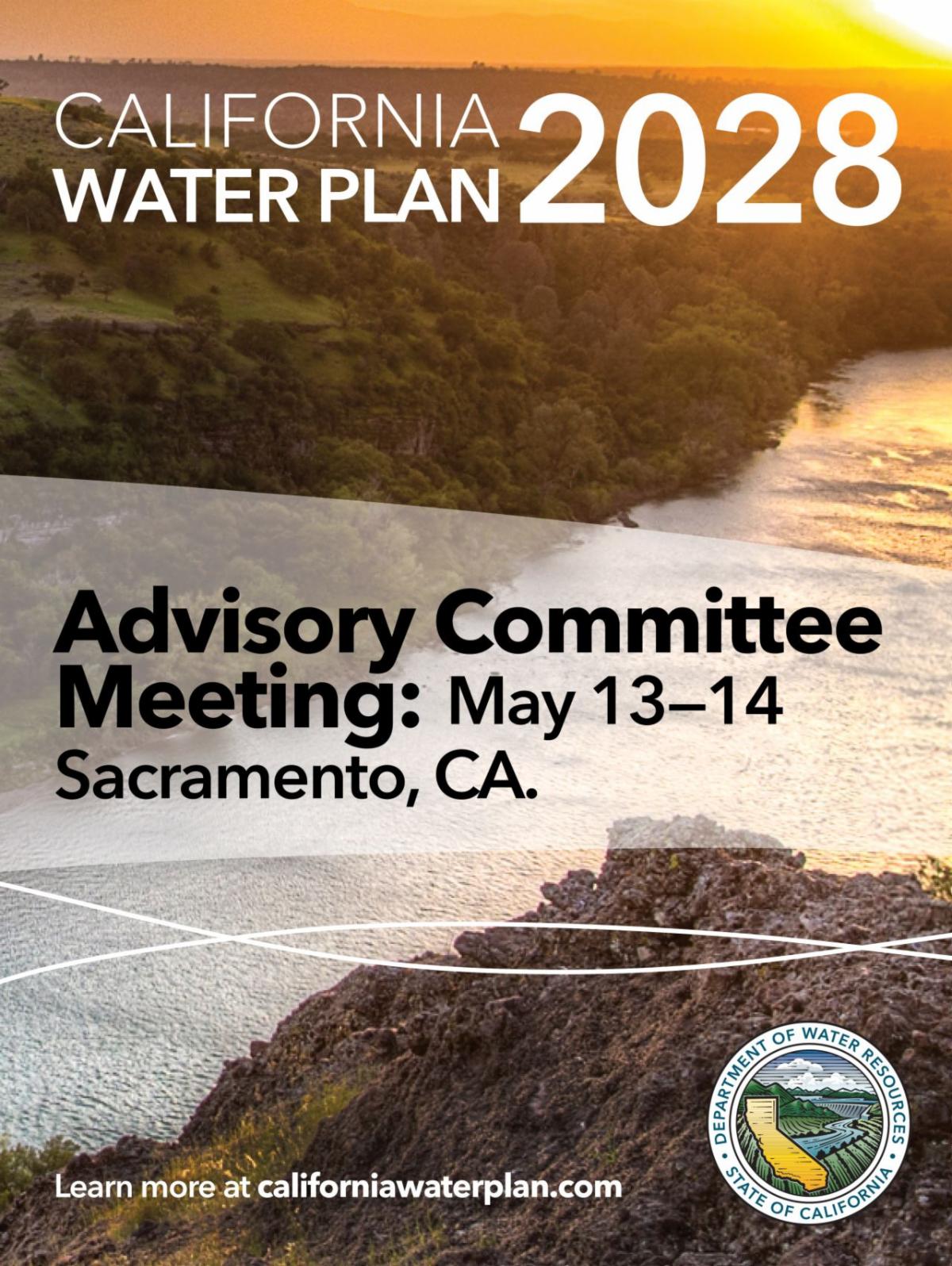
Next Week’s Advisory Committee Meeting The newly appointed Advisory Committee holds its first meeting next week: Date: May 13–14, 2026 (DoubleTree by Hilton, Sacramento)


May 13: 1:00 p.m. – 5:00 p.m.

May 14: 8:30 a.m. – 12:30 p.m.


All sessions are open to the public and will be livestreamed on the California Water Plan website and YouTube.


Western United Dairies CEO Anja Raudabaugh serves on the committee, ensuring dairy industry voices are represented as priorities, and the work plan for the 2028 and 2033 updates is shaped.


WUD will provide members with a full debrief and action items following the meeting. If you have specific concerns about water reliability, groundwater rules, or storage projects that impact your dairy or beef operation, please reach out to us so we can carry your input forward.


For more details on the plan, visit californiawaterplan.com. Stay engaged! California agriculture’s future depends on turning these promises into actual water on the farm.


MARKET UPDATE

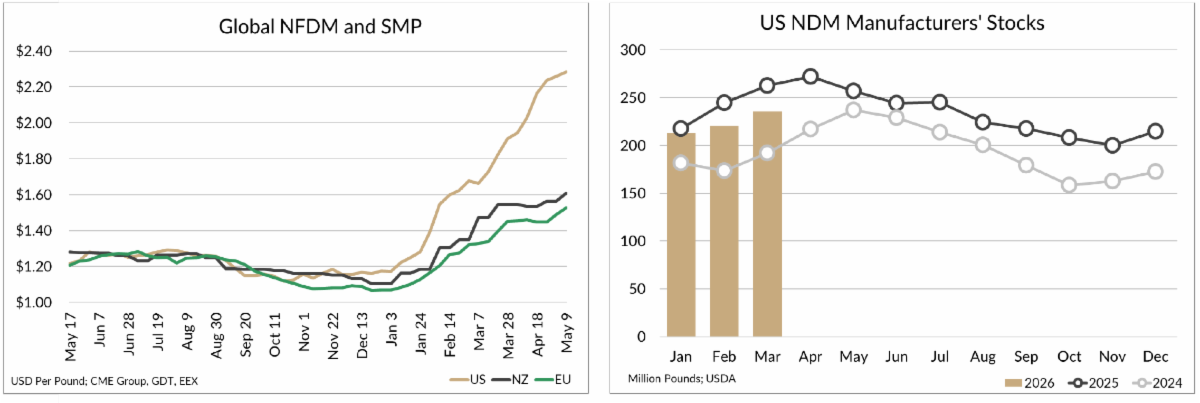
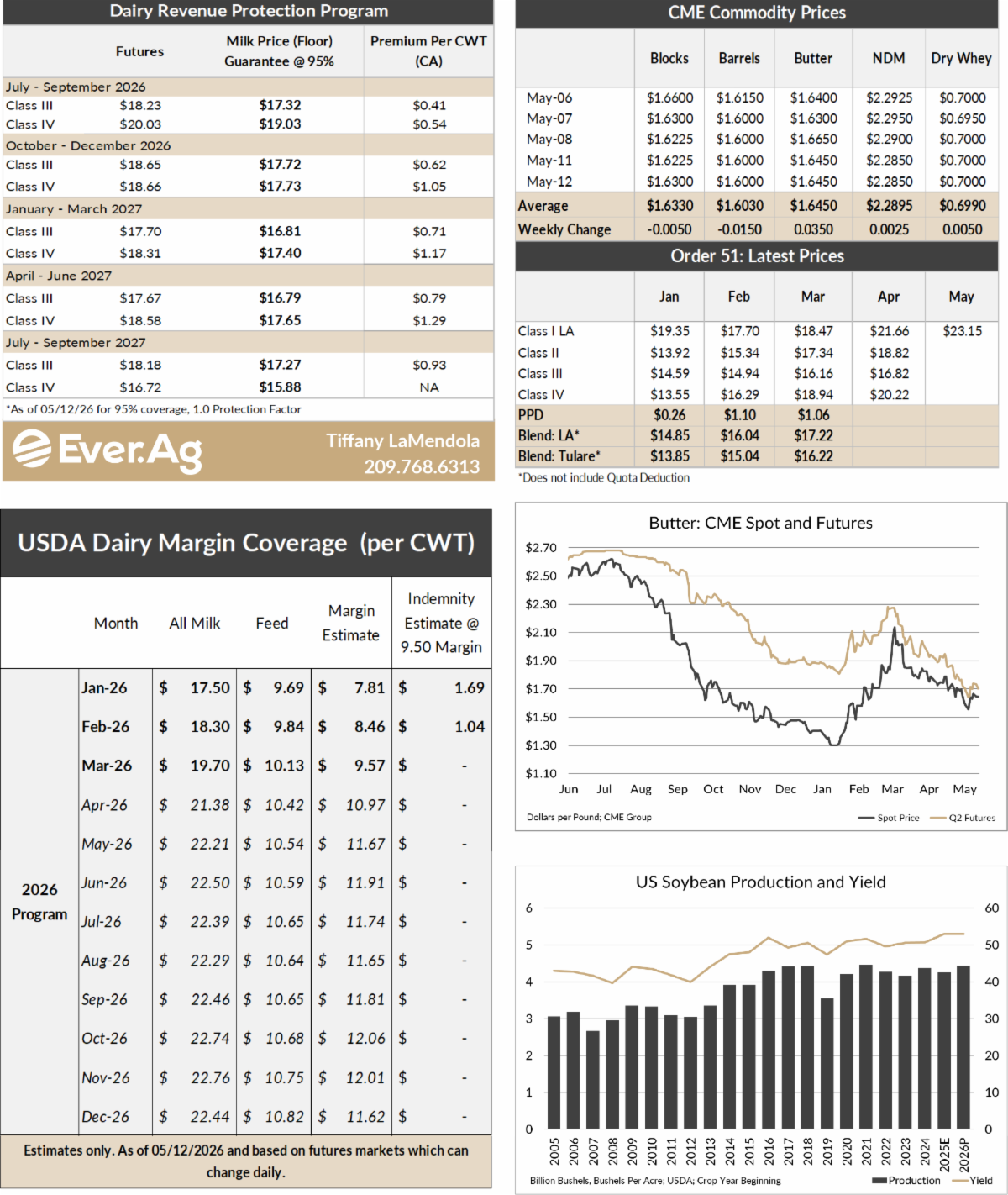
The CME nonfat dry milk market hit another new all-time high of $2.2950 per pound before backing off slightly. More product is making its way to Chicago and buyers are still eager, but, eventually, buyers will get caught up and prices will fall. When that happens is still uncertain.

  • According to USDA’s March Dairy Products report, US nonfat dry milk and skim milk powder production leapt higher year-over-year. But stocks were below prior-year levels. Butter and cheese output increased versus 2025.


  • Demand for US butter is strong, at home and abroad, but record fat levels coming off farms are keeping a lid on spot prices. After falling to the $1.50s last week, the spot price returned to the $1.60s. Trading slowed down a bit last week, with 38 lots exchanged compared to 92 the week before.


  • Cheese remains largely comfortable and rangebound in the $1.60s. Reports indicate that with new production capacity online, there’s enough product to fill demand, which remains healthy.
  • Milk powder prices at this week’s Global Dairy Trade Pulse event were mixed, with whole milk powder up 1.2% to $1.70 per pound and skim milk powder down 1.0% to $1.63 per pound. Butter slipped 1.3% to $2.54 per pound.
  • USDA’s May World Agricultural Supply and Demand Estimates report was neutral for corn, with production, yield and ending stock estimates coming in close to expectations. Soybeans tilted bullish, as estimates were mostly below predictions.
  • Corn and soybean farmers are deep into planting season now and crops are going into the ground at an above-average pace. Weather and war news continue to drive futures markets up and down over the past few days.


THANK YOU TO OUR CURRENT SPONSORS


Facebook  Instagram  LinkedIn  Web