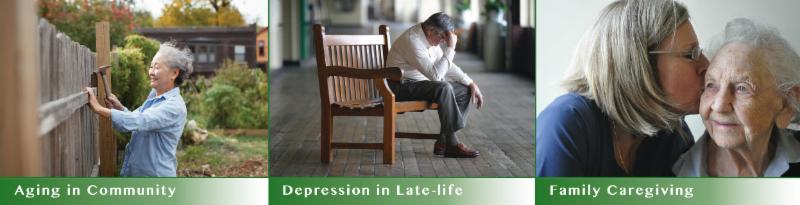
In June 2018, $1.4 million in funding was approved for Phase 2, Cohort 2 of the
Initiative
to improve the quality of life of older adults suffering from depression.
Through projects that engage community partners, the overall aim of the
Initiative
is to produce innovative approaches that can be replicated in similar sites in California, and beyond. Archstone Foundation began its work in depression in late-life by exploring, through key informant interviews, how the Foundation might implement the most effective strategy to address depression in community dwelling older people.
Following key informant interviews, experts Jürgen Unützer, MD, MPH, MA, at the University of Washington’s (UW) AIMS Center (Advancing Integrated Mental Health Solutions), and Ladson Hinton, MD, at the University of California, Davis (UC Davis), were funded to work with Archstone Foundation staff to define the scope of the problem the Foundation would seek to address; conduct an environmental scan and literature review on evidence-based depression programs; and recommend strategies for possible funding and evaluation. Subsequently, Archstone Foundation engaged Drs. Unützer and Hinton to facilitate its
Depression in Late-Life Initiative
.
Depression is common among older adults, and it comes at a high cost to patients and their families. Major depression affects 2 to 5% of community dwelling older adults, up to 10% of older adults in primary care clinics, and up to 30% of older adults with chronic medical illnesses. Late-life depression impairs quality of life and the ability to function. It is associated with increased health care costs, family stress, and increased risk of suicide. Depression is the most important, and arguably the most treatable, risk factor for completed suicide.
Archstone Foundation launched its
Depression in Late-Life Initiative
in June 2014, by awarding a four-year grant to the UW, and the UC Davis, to support the Care Partners: Bridging Families, Clinics, and Communities to Advance Late-Life Depression Care project. Care Partners is pilot-testing an innovative approach to strengthen the involvement of family, friends, and community-based organizations (CBOs) in providing enhanced collaborative care for depressed older adults.
Collaborative care is a proven, evidence-based patient-centered approach that treats mental health conditions, like depression, in primary care, or in the community, where older adults already have secure, established relationships. Effective collaborative care teams use established principles of chronic illness care, and draw upon shared knowledge, principles, and care plans as they work toward patient goals. Collaborative care teams provide proven treatments, such as antidepressant medications and evidence-based, brief counseling strategies, such as problem solving treatment in primary care (i.e., IMPACT collaborative care) or in patients homes’ (i.e., PEARLS collaborative care). These models take a population-based approach ensuring that those who need help do not fall through the cracks.
Based on the improvement in clinical outcomes demonstrated in Phase 1, Archstone Foundation’s Board of Directors approved Care Partners, Phase 2 in July 2017.
Projects funded in Phase 2, Cohort 1 include:
1. El Sol Neighborhood Educational Center;
2. Family Health Centers of San Diego; and
3. Sonoma County Human Services Department, Adult & Aging Division.
Phase 2, Cohort 2 projects approved in June 2018 include:
1. Depression and Bipolar Support Alliance;
2. Kaiser Foundation Hospitals;
3. Neighborhood Healthcare; and
4. University of California, Davis.
For more information about Care Partners, please click the link below: